
Bonsai watering
How to Water a Bonsai
Water a bonsai when the tree, pot, weather, and soil show that the root zone is ready for another full cycle. The useful beginner question is how much water the foliage is using, how large the container reservoir is, and whether the soil can take water while still returning oxygen to the roots.
Use the calendar as a check-in rhythm, then make the decision from evidence. Read the top dressing and soil particles, water every side of the pot with a gentle rose until drainage begins, and record what changed so the next decision is based on your bench rather than a generic schedule.
Updated July 3, 2026. Written by EntGrove Editorial.
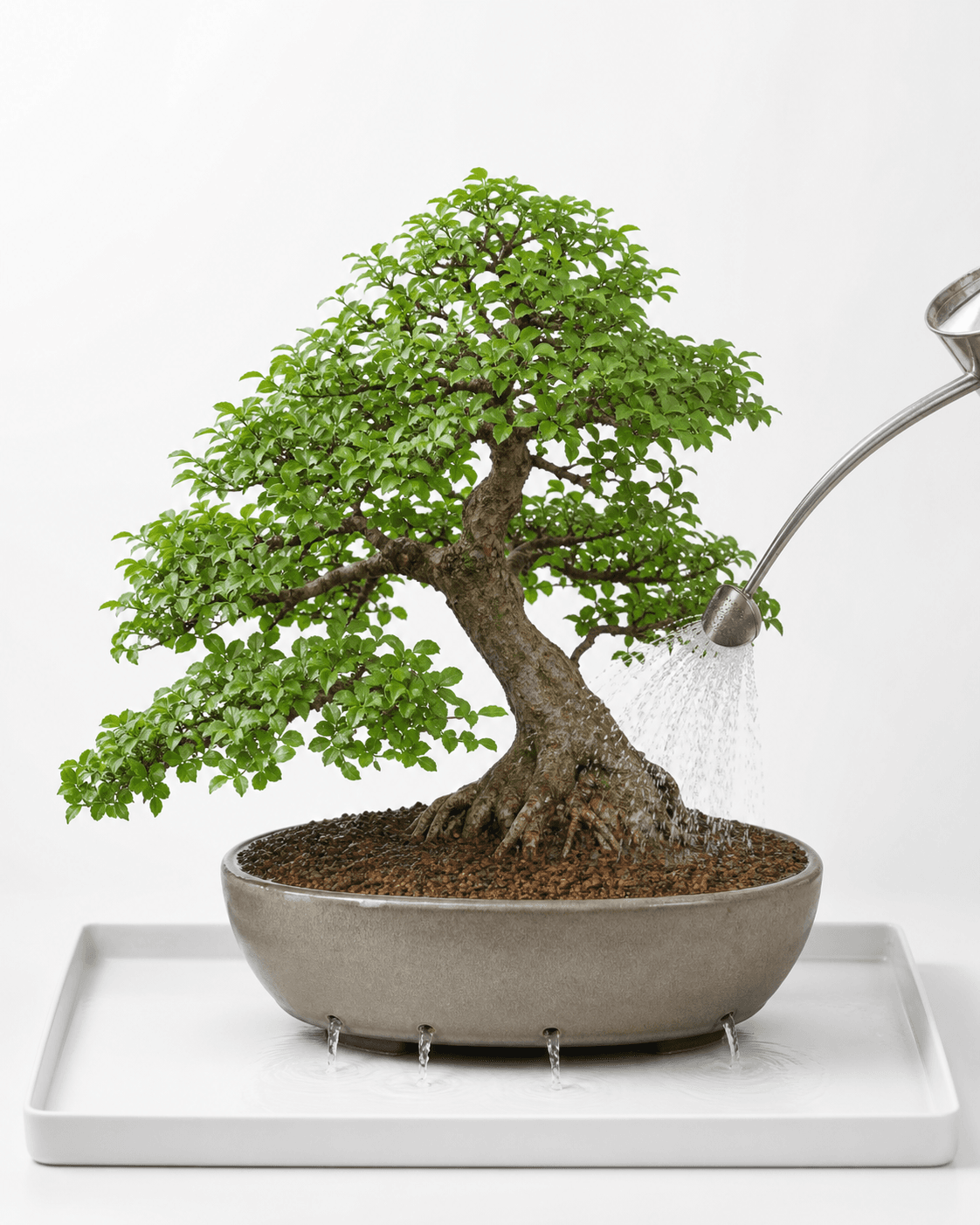
Decision sequence
How to water a bonsai by observation
- Step 1
Read the tree first
Estimate how much foliage is transpiring, whether the tree is in active growth or recovery, and whether the species usually runs wet, moderate, or dry.
- Step 2
Read the reservoir
Compare the foliage mass with pot size, soil type, root density, and container depth. A large canopy in a small shallow pot dries faster than a reduced tree in a large container.
- Step 3
Check the soil evidence
Look for dry top dressing, lighter akadama, shrinking moss, dry edges, or a chopstick that comes out nearly dry. In protected winter storage, wait until both moss and most particles show real drying.
- Step 4
Apply water in moving passes
Use a fine rose or soft stream, water every side of the pot, pause briefly, then return until water starts to leave the drainage holes without eroding the surface.
- Step 5
Let oxygen return
After watering, let the soil move back toward its normal dry-back point before the next cycle. Roots need water and air, so constant saturation is a cultural warning sign.
- Step 6
Record the cycle
Note weather, wind, shade, recent work, fertilizer, soil response, and any wilt, scorch, dull color, or slow drainage before adjusting tomorrow's watering.
Guide
Read the signals before acting.
Core rule
A watering schedule is a reminder to inspect the tree.
Mirai watering method starts with three variables: foliar mass, container reservoir, and current environment. A tree with a large canopy in a small pot can need water far more often than a recently reduced tree in a large training box, even when both sit on the same bench. Bonsai Mirai Library
The final decision still includes soil evidence. Sun, wind, temperature, humidity, species, and growth stage set the expectation, then soil color, top dressing, moss behavior, and drainage confirm whether the root zone is ready. Bonsai Mirai Library
Morning and evening rounds are useful because they create a habit of looking. The act of watering should remain conditional. If the root zone is still wet, more water reduces oxygen. If the pot is drying quickly, waiting for the next preferred hour can damage fine roots.
- A shallow bonsai pot has less reservoir than a deep training container.
- A broadleaf canopy usually transpires faster than a conifer canopy with waxier foliage.
- Wind can create water stress even when the air temperature is moderate.
- Freshly reduced trees use less water because they have less foliage pulling from the roots.
- Organic nursery cores can stay wet while the aggregate around them looks ready.
Root health
Good watering manages water and oxygen as one system.
Roots respire. Chronic overwatering harms bonsai by filling pore space with water for too long, creating an oxygen-poor root environment where fine roots decline and root-rot organisms gain an advantage. Bonsai Mirai Library
Drying also has a cost. Once root-zone water is insufficient, guard cells lose turgor, stomata close, transpirational cooling stops, and photosynthesis slows. Spring growth is especially water-demanding because new soft tissue lacks a mature cuticle and is expanding quickly. Bonsai Mirai Library
The practical target is a repeated cycle: water thoroughly, let the soil return toward the species-appropriate dry-back point, then water again. A single imperfect decision can often be corrected on the next cycle, but a habit of keeping soil constantly wet or repeatedly missing dry-down will compound.
Observation
Read foliage, reservoir, weather, and soil before the hose comes on.
Foliage mass is the engine. Mirai estimates that roughly 85 percent of absorbed water is used for evaporative cooling through transpiration, with the remainder supporting metabolic processes and new tissue. A leafy maple in wind, a stone planting with little soil, and a recently repotted tree can all have different needs within the same hour. Bonsai Mirai Library
Reservoir size is the constraint. Deeper containers move water more aggressively through the column, while shallow pots can retain water longer than intuition suggests. Oversized containers around weak roots are risky because the tree cannot draw down the extra wet soil fast enough. Bonsai Mirai Library
Use several cues rather than one trick. Dark akadama or visibly moist particles signal hydration. Beige akadama, flattened moss, curling moss edges, a light-colored sphagnum dressing, and a dry chopstick all suggest the upper soil is moving toward the next watering. If cues conflict, inspect more of the pot before acting.
- Check sun and shade sides of the pot, especially on wide or asymmetric plantings.
- Look for water running around the root ball, which points to compaction or hydrophobic surface material.
- Treat a pot that stays wet in warm weather as a root-health warning, especially after repotting or heavy pruning.
- Use pot weight as a secondary cue because human perception of heavy and light drifts over time.
Technique
Water thoroughly, gently, and from more than one angle.
Use a fine rose nozzle or soft watering wand. A gentle stream protects the top dressing, keeps particles stable, and lets water enter the soil instead of blasting channels through it. Bonsai Mirai Library
Keep the wand moving and water all sides of the container. Return in multiple passes until water begins to leave the drainage holes, which confirms that the full root mass has been saturated without wasting long runoff. Bonsai Mirai Library
A dry or compacted surface may shed the first pass. Pause, let capillary action pull moisture into the particles, then water again. If water continues to sheet off, pools on the surface, or bypasses the root ball along the pot wall, the tree may need surface restoration or repotting rather than a new schedule.
Season
The same tree changes its water demand through the year.
Spring can be the highest-demand season because new growth is soft, expanding, and short on protective cuticle. Warm spring spells can raise demand suddenly, and withholding water from a flushing tree can stop cooling and photosynthesis. Bonsai Mirai Library
Summer is climate-dependent. In low-humidity inland heat, water demand can exceed spring because cooling load is high. In humid hot climates, trees can slow into summer dormancy, and watering frequency may need to drop even while the weather feels intense. Bonsai Mirai Library
Fall is often underestimated. Mirai fall guidance describes a shift toward vascular productivity and root loading, so some trees consume water faster even as air temperatures fall. Winter watering depends on storage: outdoor dormant trees need protection from wind desiccation, while greenhouse trees may keep enough vascular activity to require thorough periodic watering. Bonsai Mirai Library
- Water at midday when the tree needs cooling water. The need matters more than the clock.
- Move heat-sensitive trees toward shade when temperatures push into the mid-90s F range.
- Reduce watering after heavy foliage reduction until the tree rebuilds transpiring mass.
- Check protected winter trees individually; identical shelves can dry at different speeds.
Species
Species changes the dry-back point, not the observation method.
Conifers generally tolerate drier, more oxygen-rich root conditions than deciduous broadleaf trees. Pines in particular are easy to overwater when they are treated like thirsty maples, while deciduous trees often use water quickly because thin leaves and thinner cuticles lose water faster. Bonsai Mirai Library
Junipers and pines are forgiving beginner subjects partly because they tolerate drought and watering mistakes better than many fine-rooted broadleaf trees. Azaleas, maples, wisteria, and water-loving deciduous conifers need closer attention to dry-down because hard drying can damage fine roots or soft growth.
Broadleaf evergreens from drier Mediterranean-style habitats can need a crispier top dressing before re-watering, while wet-root species still need oxygen in a bonsai pot. Native swamp or riparian habitat does not grant permission for stagnant container soil. Bonsai Mirai Library
Foliage
Treat foliar misting as a special tool, not the main watering method.
Routine bonsai watering is root-zone work. Mirai spring watering guidance generally avoids wetting foliage because persistent surface moisture can slow gas exchange, promote fungal spore germination, and spread pathogens in humid regions. Bonsai Mirai Library
Misting has a recovery use. After severe root work, heavy bending, a trunk split, or other situations where water transport is impaired, a brief surface film can reduce transpiration long enough for cells to rehydrate. In arid climates it can be more useful than in humid ones. Bonsai Mirai Library
Use misting with intent, then return to root-zone decisions. Misting the leaves of a tree in dry soil does not hydrate the root ball, and heavy repeated misting can push the soil into the wet, oxygen-poor state the roots are trying to escape.
Water quality
Water quality matters after basic watering is under control.
Mirai beginner guidance treats tap water as adequate for most bonsai while a grower is still learning basic watering. Water-quality intervention belongs after symptoms appear: stunted growth, unexplained yellowing, purpling needles, heavy mineral crust, or repeated chlorosis in species sensitive to alkaline water. Bonsai Mirai Library
A near-neutral pH range around 6.5 to 7.0 keeps the broadest range of nutrients available. High pH can make iron unavailable and create chlorosis that looks like a nutrition problem. Reverse osmosis, charcoal filtration, vinegar injection, or chlorine off-gassing can help in the right situation, but each adds management complexity. Bonsai Mirai Library
Deep overhead watering also flushes dissolved salts from the pot. Avoid routine submersion watering because it recycles accumulated minerals through the container instead of carrying them out the drainage holes. Bonsai Mirai Library
Troubleshooting
Most watering problems reveal themselves through drainage, color, and timing.
Start with the recent sequence. A tree that wilted before watering, revived after watering, and dries on a predictable rhythm is telling a different story from a tree that wilts in wet soil or stays dull for days after a full soak.
A container that refuses to dry in summer can indicate damaged roots, too much soil for the active root mass, or excessive foliage reduction. A container that dries minutes after watering may have a compacted core, hydrophobic top dressing, or water bypassing the root ball. Bonsai Mirai Library
Do not solve every symptom with more water. Inspect placement, wind, recent pruning, root work, fertilizer timing, soil breakdown, and whether the tree has enough foliage to pull water through the system.
- Crisp leaf edges: check heat, wind, dry roots, salt buildup, and sudden sun exposure.
- Yellowing in wet soil: check oxygen, old substrate, root rot, and water quality before adding fertilizer.
- Fast wilt after repotting: reduce sun and wind, protect roots, and avoid fertilizer until strong growth returns.
- Water pooling on the surface: inspect top dressing, moss, decomposed fines, and repot timing.
- Slow winter decline: check wind desiccation, frozen roots, and greenhouse watering frequency.
Failure modes
Underwatering can be immediate; overwatering usually compounds.
Mirai beginner guidance frames chronic overwatering as a weeks-to-months problem, while one missed watering on a dry tree can be fatal. That asymmetry is why beginners should check daily while learning, especially in heat, wind, spring flush, and small containers. Bonsai Mirai Library
The lesson is precision, not panic. A bonsai should not live waterlogged, and it should not be driven into repeated hard dry-down. The healthiest routine is a durable rhythm of full watering, real oxygen return, and the next watering before fine roots desiccate.
Fertilizer can worsen the wrong watering problem. Stressed trees often need water-oxygen correction first; fertilizer salts can compete with water uptake during heat or after root damage. Bonsai Mirai Library
Tracking
Watering records turn a vague habit into local evidence.
Record enough context that future you can reconstruct the decision: weather, wind, shade, pot size, soil type, recent work, fertilizer, pest treatment, rainfall, and how long the pot stayed wet or dry.
Photograph the tree, soil surface, and bench position when something changes. A later symptom often makes sense only after you can see whether the tree was moved, pruned, repotted, fertilized, shaded, or exposed to unusual heat.
EntGrove is built around that loop: observe, act, photograph, and compare. The useful record is a clear trail of what the tree experienced before it improved or declined.
Questions
Direct answers for the common mistakes.
Should I water my bonsai every day?
Check daily while learning, but water only when the tree and soil show need. In heat, wind, spring growth, or small pots, some trees need water more than once a day. In cool shade, after foliage reduction, or in a large container, the same tree may need less.
Is it better to water bonsai in the morning or evening?
Morning checks are useful because the tree enters daily heat with water available. The right time is still when the soil and tree need it. If a bonsai is drying at midday or in the afternoon, water then.
Can I water bonsai at midday?
Yes. If the tree needs water, midday watering is safer than withholding cooling water. Use a gentle stream, water the root zone, and consider shade or wind protection if heat is repeatedly pushing the tree beyond its normal range.
How do I know if bonsai soil is too compacted?
Warning signs include water pooling on the surface, water running down the pot edge, slow drainage, a moss or fine-root layer that repels water, or a pot that dries again almost immediately because water bypassed the root ball.
Can misting replace watering?
No. Misting can briefly reduce transpiration in recovery or help in very dry climates, but it does not hydrate the root ball. Bonsai watering starts with the root zone.
Is tap water safe for bonsai?
Usually, yes. Learn correct watering first. Investigate water quality if you see heavy mineral deposits, repeated chlorosis, stunted growth, or species-specific sensitivity to alkaline water.
Why is my bonsai wilting even though the soil is wet?
Wet soil with wilting foliage points toward impaired roots, low oxygen, heat stress, recent root work, disease, or a tree that cannot move water fast enough. Let the soil regain oxygen, reduce stress, and inspect the root and drainage history.
Should I bottom-water a bonsai by soaking the pot?
Routine bottom-watering is a poor default because it recycles salts and minerals instead of flushing them out. Use overhead watering through the soil column, reserving soaking for narrow rescue situations where the root ball has become temporarily hydrophobic.
Sources and next reading