
Repotting guide
When to Repot a Bonsai
Repot a bonsai when the root system has a clear reason for disturbance and the season gives the tree enough stored energy to rebuild roots. The strongest reasons are failed percolation, broken-down substrate, a needed change of planting angle or container, or a staged transition from nursery or field soil into bonsai soil.
For many temperate bonsai, the safest major root-work window is spring as buds swell and before full foliar demand arrives. The work succeeds when roots stay hydrated, clean cuts replace torn tissue, the tree is tied immovably into the pot, soil fills every void, and aftercare protects the reduced root system from wind, hard sun, freezing, and heavy fertilizer.
Updated June 21, 2026. Written by EntGrove Editorial.
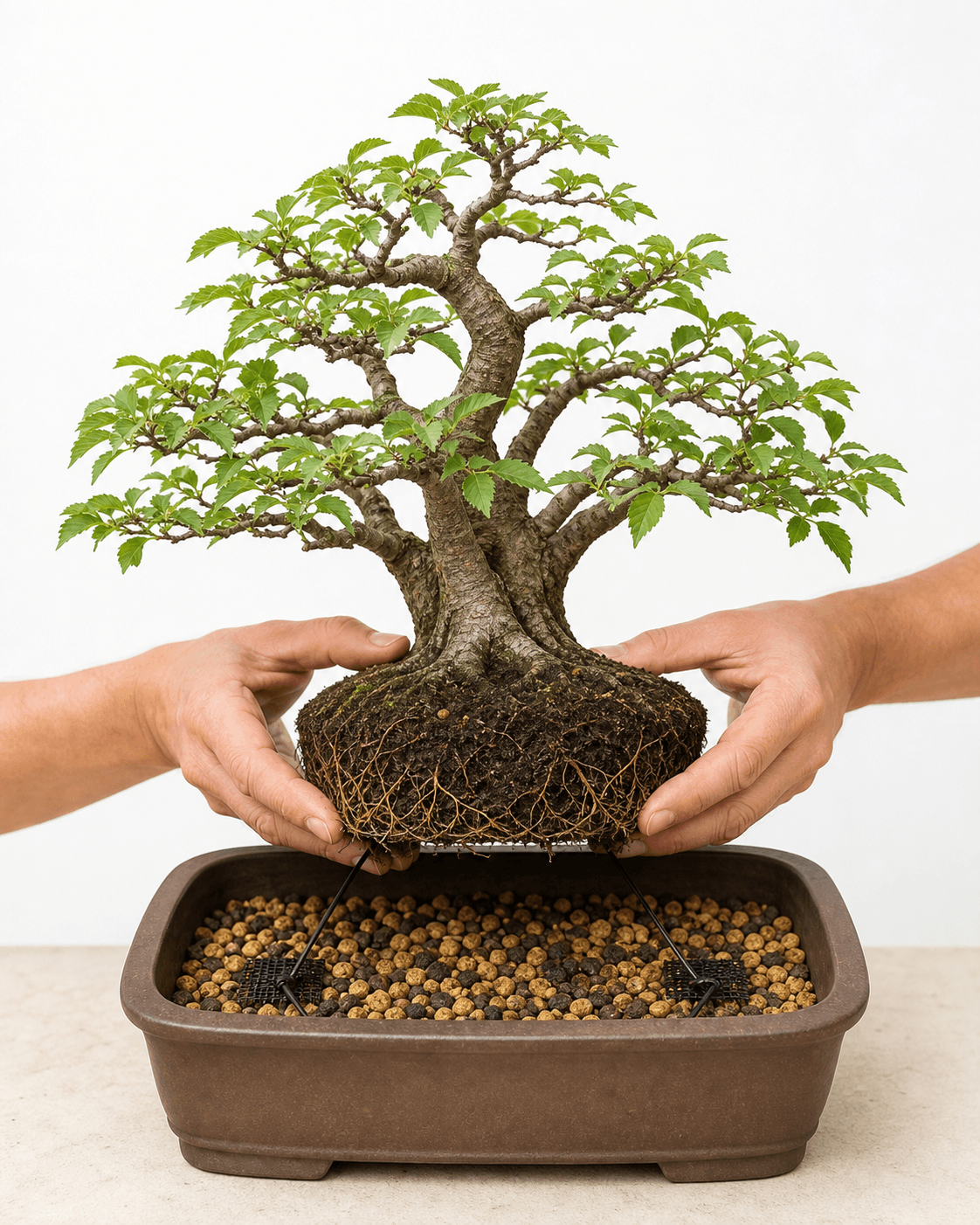
Decision sequence
How to repot a bonsai with less root stress
- Step 1
Confirm the reason
Look for failed percolation, compacted or decomposed soil, dense circling roots, a needed angle change, or a staged nursery-soil transition. A calendar interval alone is weak evidence.
- Step 2
Match season, species, and strength
For many temperate trees, work at spring bud swell and keep freezing out of aftercare. Delay major work on weak, newly collected, recently styled, or poorly hydrated trees.
- Step 3
Prepare the container first
Install fresh drainage screens, set tie-down wires, add a single-particle aeration layer, place the interior soil layer, and build a center mound sized to the root pad.
- Step 4
Free and read the root ball
Scrape the container wall before lifting, expose the true nebari, remove the bottom and side mats first, and preserve enough live roots and microbiotic continuity to keep the tree moving water.
- Step 5
Make clean root decisions
Cut torn, circling, or dominant coarse roots back to useful junctions. Avoid blind tearing, avoid full bare-rooting on conifers, and stage native-soil removal across future repots.
- Step 6
Set the angle and lock the tree
Shape the bottom of the root mass to the chosen planting angle, settle the tree onto the center mound, then tension tie-downs until trunk movement is gone.
- Step 7
Fill every void without crushing soil
Bulk-fill first, then chopstick steeply around the pot so soil contacts fine roots and hidden pockets. Keep fresh soil on top as the chopstick feeds particles downward.
- Step 8
Water and protect recovery
Flush the pot thoroughly, let the next watering wait until oxygen has returned, keep the tree out of freezing wind and harsh sun, and resume fertilizer only after strong growth appears.
Guide
Read the signals before acting.
Purpose
Repotting resets the water, oxygen, root, and design system.
Mirai repotting method reduces the decision to three primary reasons: water no longer moves through the root mass, the substrate has decomposed enough to lose water-oxygen balance, or the design needs a new container, angle, or root arrangement. Those reasons can overlap, especially when nursery soil, field soil, or years of fertilizer residue have built a stale core under the trunk. Bonsai Mirai Library
The operation is also a design event. Exposing the nebari can change the front. Reducing the bottom of the root mass can change planting angle. A pot with less depth can make the tree look older, but it also leaves less soil volume to buffer watering mistakes. Root work should answer a precise horticultural and visual problem before the tree leaves the pot.
The best repot often looks conservative. It preserves a functioning root zone, removes roots that no longer serve the next cycle, creates fresh soil-to-root contact, and gives the tree several months of stable recovery before the next demanding technique.
- Repot for water movement, soil structure, root architecture, planting angle, or container transition.
- Refresh surface percolation first when intact particles remain below the crust.
- Staged repots are normal when old native, nursery, field, or mountain soil remains inside the core.
- A design repot still has to respect root health, species timing, and aftercare capacity.
Timing
Spring bud swell is the broad window, then species narrows it.
For many temperate bonsai, the strongest major root-work window is spring as buds swell and before active growth fully opens. Stored fall energy is moving, the tree can compartmentalize clean root cuts, and new roots can begin as temperatures rise. The same operation becomes riskier after leaves or candles are already demanding water. Bonsai Mirai Library
The broad rule still needs species judgment. Pines, junipers, spruce, fir, hemlock, larch, redwood, cypress, azalea, broadleaf evergreen, tropical, and succulent material all differ in stored energy, root texture, microbial dependence, flower timing, heat tolerance, and aftercare needs. Fall repotting is possible in narrow specialist cases, but Mirai treats spring as the default because fall root reduction lowers winter hardiness. Bonsai Mirai Library
Timing also includes the weather after the work. A well-timed spring repot still fails when the pot freezes, dries in wind, or sits in hard sun before roots can move water. If aftercare cannot exclude freezing or dehydration, wait or reduce the ambition of the operation.
- Deciduous broadleaf: usually bud swell before leaves expand, with bleeding species handled cautiously.
- Conifers: keep part of the root mass intact and separate hard styling from hard root work.
- Tropicals: choose reliable warmth, light, and active growth over cold calendar spring.
- Azaleas: shallow fine roots, kanuma, flowering, and heat change the usual broadleaf schedule.
Diagnosis
The root ball should earn the risk.
Root problems often show as whole-tree patterns: uniform yellowing, reduced vigor across the canopy, random branch flagging, slow water use, or water that pools, sheets off, or follows channels around the root mass. Localized blotches or one-sided decline may point elsewhere, so diagnose pests, exposure, and watering before blaming the pot. Bonsai Mirai Library
Failed percolation starts with surface diagnosis. The spring fundamentals and percolation files both begin by opening the surface: remove moss buildup, fine surface roots, organic residue, and decomposed fertilizer until intact aggregate particles are visible. If the soil below is friable and water begins entering the center again, the tree may only need a surface refresh until the correct repot window. Bonsai Mirai Library
When the center stays sour, black, compacted, or inaccessible, plan a real repot. If the tree is weak or the season is wrong, temporary interventions such as lowering the surface, raising the water column with a reversible tape rim, and controlling rain can buy time while roots rebuild enough strength for a safer root operation.
- Water runs off the surface or down channels without soaking the center.
- The top layer has become a mat of moss, fertilizer residue, fines, and feeder roots.
- The bottom and walls are lined with dense roots adapted to the old container edge.
- Soil smells sour or anaerobic, or old organic pockets stay black and saturated.
- Growth weakens across the tree after light, water, pests, and placement have been checked.
Preparation
Prepare the pot before roots are exposed.
Pot preparation is part of the root work. Mark the front, install fresh screens, set anchor wires, and choose the soil layers before the tree comes out. Mirai uses a one-particle-thick coarse layer at the bottom for oxygen diffusion, then the interior particle size that will cultivate fine roots. The coarse layer raises oxygen at the pot floor and belongs one particle thick. Bonsai Mirai Library
Particle size and mix should match the species and stage. A 1:1:1 akadama, pumice, and lava blend is a reliable conifer default. More water-retentive deciduous and broadleaf work often leans toward akadama. Pines that need more oxygen may exclude the finest particles, while azaleas use kanuma-based media and tropical or succulent material needs warmth-specific decisions. Bonsai Mirai Library
Build a center mound exactly under where the trunk will sit. A flat root pad needs a low mound. A pocketed or angled root pad needs a taller cone so soil is pushed into voids when the tree settles. That center is nearly impossible to fill from the side later.
- Use fresh screen patches with enough overlap that soil cannot escape through the drain holes.
- Set tie-down wires so they take the shortest path to firm anchor points.
- Use a one-particle aeration layer, then the species-appropriate interior soil.
- Keep the tree as low as root health and design allow so the shallow pot keeps useful soil volume.
Root work
Expose, reduce, and preserve roots with intent.
Free the root ball from the container wall by scraping along the inside edge, then lift only when the resistance is released. On nursery stock, expose the true nebari from the top before reducing depth because adventitious roots and organic matter often bury the real trunk flare. Set the planting angle by shaping the bottom plane of the root mass so the tree seats flat at the chosen angle. Bonsai Mirai Library
Root pruning should create clean, useful endpoints. Cut torn, black, circling, or dominant coarse roots back to a branch point where finer lateral roots can take over. Mirai compares this to branch pruning: clean cuts redirect growth, while ripped root tissue tends to rot. Root shears can be dedicated to this gritty work so foliage scissors stay sharp. Bonsai Mirai Library
Preserve continuity. Conifers should keep an untouched sector of roots and old soil. Deciduous conifers such as larch, bald cypress, pond cypress, and dawn redwood also deserve microbial continuity. Rootbound nursery stock and collected trees should move from native or nursery soil into aggregate over two or three repots when the core cannot be safely replaced in one pass.
- Remove bottom and side mats first because those roots belonged to the previous container edge.
- Preserve useful structural roots that support nebari, design, or recovery.
- Hydrate exposed fine roots if they begin drying during the operation.
- Stop cleaning when useful friable soil and live roots are still doing work.
Anchoring
A newly repotted tree must be immovable in the pot.
Root tips form in stable soil. A wobbling trunk keeps the soil moving, and moving soil prevents new roots from forming. Mirai stabilization and pot-preparation files therefore treat tie-downs as a horticultural requirement. Bonsai Mirai Library
Settle the tree onto the mound by sliding and rotating it into place, then lock the position. Bamboo stakes can press over firm root points when the root mass cannot be wired directly. Galvanized steel wire is preferred for larger trees because it holds tension, while heavy aluminum can suit small trees when steel is impractical.
Tie-down direction should oppose the way the tree wants to fall. Pull slack out first, then twist enough to consume remaining slack without torquing the trunk off-axis. A planted tree that moves under light hand pressure needs more anchoring before soil finishing starts.
- Use the pot front and tree front together before final tensioning.
- Keep tie-down force short, direct, and anchored against solid roots, bamboo, or pot holes.
- Check stability by gently testing the trunk, then stop if the whole pot begins moving instead.
- Add external bench tie-downs later for tall, asymmetric, cascade, or wind-exposed containers.
Finish
Chopsticking and top dressing decide whether fine roots can use the new soil.
Bulk-fill the largest voids first. Detailed chopsticking then drives soil into fine spaces, especially under the root pad and behind structural roots. The chopstick should enter at a steep angle, move downward with minimal sideways prying, and feed fresh soil into empty pockets without crushing particles or lifting roots. Bonsai Mirai Library
The finished surface should sit about 1/8 to 1/4 inch below the rim so water can pool and enter the root mass instead of washing off. Contour the surface from the trunk toward the rim, then apply a thin sphagnum and green-moss top dressing that still lets soil show through. Applied this way, top dressing stabilizes the upper soil and helps roots occupy the surface layer without blocking oxygen. Bonsai Mirai Library
Top dressing is also a diagnostic. On fresh repots, gray moss that lightens evenly shows drying and root activity, while areas that stay wet may reveal zones roots have not yet colonized. Use it as a moisture gauge and keep the layer thin.
- Keep fresh soil on top while chopsticking so particles feed downward.
- Use a smaller chopstick around fine nebari and brittle roots.
- Avoid lateral prying that crushes akadama or breaks roots.
- Apply top dressing thinly enough that oxygen and water still move through the surface.
Aftercare
The first six weeks are part of the repot.
Water thoroughly at the end of the repot to settle soil, rehydrate particles, and flush dust. Mirai repotting files then emphasize the next dry-down: roots need oxygen after the first saturation. Constant wetness after root reduction suppresses new root formation and can shrink the active root system. Bonsai Mirai Library
Protect the tree from freezing, drying wind, and harsh direct sun while roots rebuild. Where bottom heat is used, roughly 70 to 80 F root-zone warmth can accelerate recovery, but the tree still needs staged acclimation from heat bed to greenhouse bench, sheltered outdoor spot, and full bench before tender growth opens. Bonsai Mirai Library
Hold fertilizer until strong growth appears, commonly at least 4 to 6 weeks. New root tips need callus, oxygen, and water balance before salts become useful. When feeding resumes, start light or moderate and extend the interval while recovery builds. Bonsai Mirai Library
- Avoid freezing the pot immediately after root work.
- Use morning sun or bright shade with wind protection while water use restarts.
- Watch water demand: shorter intervals between waterings are a strong recovery sign.
- Delay pruning, wiring, decandling, or heavy styling until recovery growth has hardened.
Species filter
Tree category changes how far the root work can go.
Pines store significant reserves in coarse roots and depend heavily on mycorrhizal partnerships, so root work should be conservative and never full bare-root. Junipers carry fine, fleshy roots that dry quickly and rely on active foliage, so keep foliage mass and avoid exposed-root delays. Elongating conifers can tolerate major work when the opposite half of the tree has been allowed to build energy, but severe root and severe foliage work should be separated. Bonsai Mirai Library
Deciduous broadleaf trees often give more root-work margin, but their spring water movement can make timing narrow. Maples, elms, hornbeams, beeches, flowering shrubs, and fruiting trees each have different bleeding, dieback, flower, fruit, and heat concerns. Deciduous conifers are vigorous, but Mirai still preserves microbial continuity on bald cypress, pond cypress, and larch as a separate category from bare-rootable nursery shrubs.
Tropicals and succulents need warmth. Ficus, bougainvillea, dwarf jade, jade, schefflera, tropical Myrtaceae, and warm shrubs should be repotted when nights, light, and aftercare support active growth. Azaleas use shallow fine-root and kanuma logic, with post-bloom tradition now treated more cautiously in hot modern summers.
Troubleshooting
Most repotting failures come from timing, movement, trapped water, or missing contact.
A clean-looking repot can fail when the root pad is loose, the soil was never chopsticked into the center, old pockets stay sour, top dressing is applied as a suffocating mat, the tree freezes after work, or the grower keeps watering a reduced root system as if nothing changed.
Mirai diagnostic files repeatedly tie root-zone decline to the water-oxygen balance under the trunk. If the tree dulls evenly, stops using water, shows random branch flagging, or stays wet for too long, inspect percolation, stability, old soil pockets, root aphids, and aftercare before adding fertilizer or repeating root disturbance. Bonsai Mirai Library
- Water pools on the surface: open the surface layer and check whether the center is receiving water.
- Tree wobbles: re-secure it immediately because moving soil prevents new root tips.
- Pot stays wet: reduce shade or rain exposure, improve airflow, and wait for real drying before watering again.
- New growth wilts in wind: move to calmer morning-sun protection while roots resume uptake.
- Weak growth after heavy root work: skip styling, skip heavy fertilizer, and let the tree rebuild.
Tracking
A repotting record should make the next repot easier.
Photograph the tree before extraction, the exposed nebari, the bottom mat, old soil pockets, root reductions, the selected angle, tie-downs, chopsticked surface, and first watering. Record soil mix, particle size, root-reduction severity, weather, aftercare placement, fertilizer restart, and the first date new water demand increases.
Those notes become local evidence. They show whether a species on your bench really needed a shorter interval, whether old nursery soil is still staged for future removal, whether a certain pot dries too slowly, and whether the next operation should be styling, surface remediation, or another full repot.
Questions
Direct answers for the common mistakes.
When is the best time to repot a bonsai?
For many temperate bonsai, the best major root-work window is spring as buds swell and before active growth fully opens. Species, climate, tree strength, and aftercare can narrow that window, especially for pines, junipers, azaleas, tropicals, succulents, and collected trees.
How often should I repot a bonsai?
Use root condition over a fixed interval. Young vigorous trees may need work every 2 to 3 years, while mature conifers or trees with a recently cleaned core may go much longer. Check percolation, root density, soil breakdown, and growth response before scheduling the work.
Should I bare-root a bonsai?
Avoid full bare-rooting on conifers, deciduous conifers, old collected material, and most nursery-stock transitions. Keep a functioning portion of roots and microbiotic soil intact, then replace old soil in stages as new aggregate-grown roots colonize the pot.
Can I repot a bonsai in summer?
Avoid summer repotting for most temperate bonsai unless there is a true emergency and aftercare is controlled. Heat, active foliage demand, and root loss create a severe water deficit. Many tropicals are different because they need warmth, but they still need strength and protection.
How much root can I remove?
The safe amount depends on species, vigor, foliage mass, root distribution, and how much old soil must remain. Mirai examples range from conservative conifer work to heavier deciduous nursery-stock reductions, but the principle is constant: keep enough live roots and foliage to power recovery.
What soil should I use when repotting?
Match the mix to species and stage. A 1:1:1 akadama, pumice, and lava mix is a reliable conifer default. Deciduous refinement often leans more akadama. Azaleas use kanuma-based mixes. Tropical and succulent material needs warmth, drainage, and water retention matched to the plant.
What should I do after repotting a bonsai?
Water thoroughly, let oxygen return before the next watering, keep the tree immobile in the pot, protect it from freezing, wind, and harsh sun, and delay fertilizer until strong growth appears. Watch water use because increasing demand is a strong recovery signal.
When can I fertilize after repotting?
Wait until the tree shows strong new growth, commonly at least 4 to 6 weeks after root work. Start with a light or moderate application and longer interval, because new root tips need water and oxygen balance before fertilizer salts are useful.
Why is my bonsai loose after repotting?
The tree was loose or the root mass shifted during finishing. Re-secure it promptly. Movement in the pot prevents new fine roots from forming, so stability is a health requirement.
What if water will not enter the root ball but it is the wrong season?
Start with surface remediation: remove compacted moss, fine roots, and organic residue until intact particles show, then wash fines out and water deeply. If the center still stays dry or sour, protect the tree and plan a staged repot in the right window.
Sources and next reading