
Design guide
Bonsai Design Basics
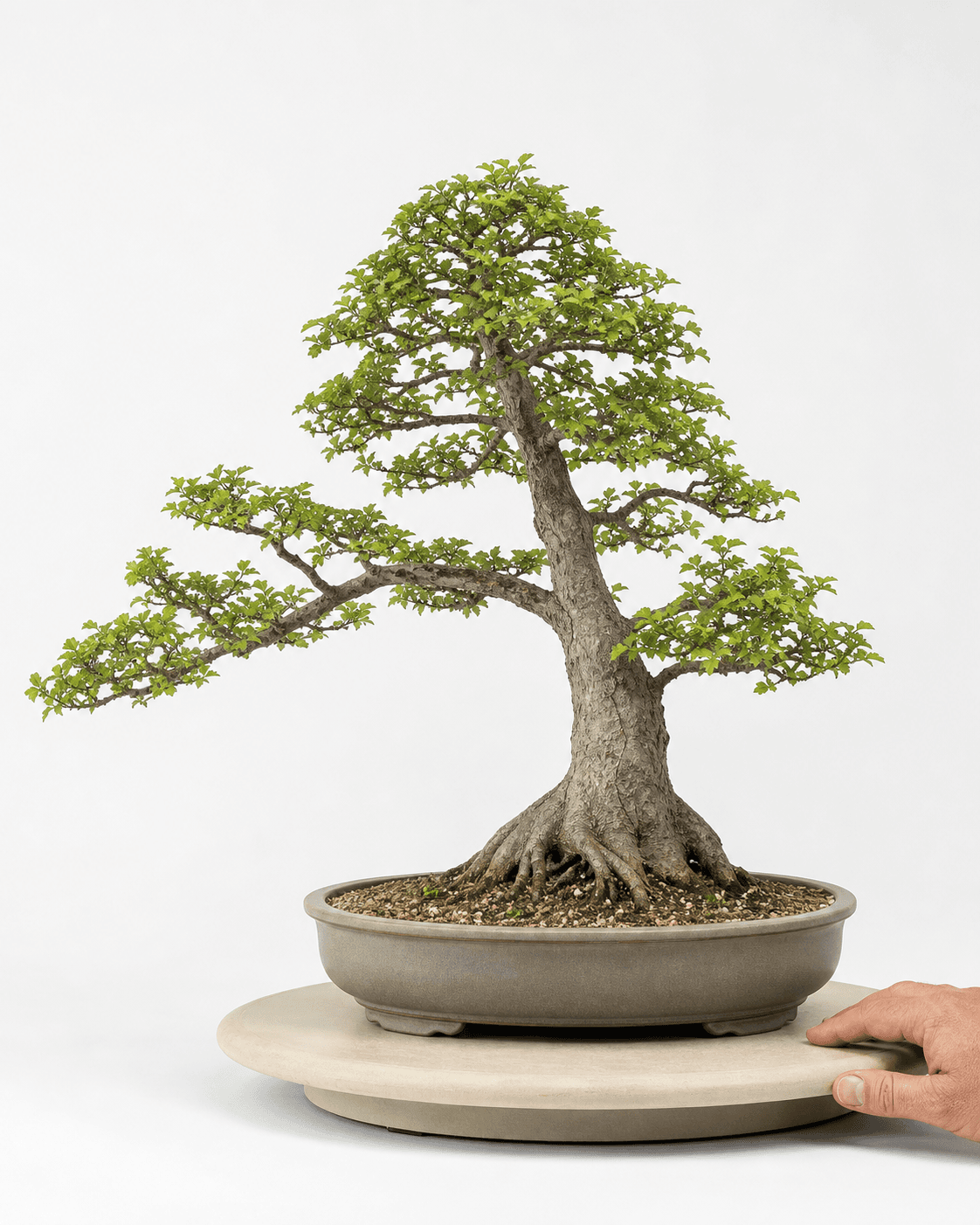
Bonsai design begins by reading the tree before styling it: base, trunk line, special features, defining branch, apex, health, species, and the environment the material suggests. Those choices decide whether the finished image should feel quiet, tense, dynamic, rugged, delicate, old, powerful, or restrained.
The practical sequence is stable base first, then trunk line, then defining branch, then apex, then branch hierarchy, negative space, and technique. Good design also knows when to pause, because a weak tree needs water, oxygen, light, roots, and foliage before it needs a stronger silhouette.
Updated June 20, 2026. Written by EntGrove Editorial.
Decision sequence
How to read a bonsai design before styling
- Step 1
Expose and judge the base
Brush or chopstick away enough surface soil to find the structural root flare while keeping the tree in its container. Choose the view where roots and trunk flare give visual stability across foreground, middle ground, and background.
- Step 2
Trace the trunk line
Read movement from the base toward the future apex. Favor varied angle changes, front-to-back plane shifts, and features that tell the tree story, then avoid locking the design to a repeated S-curve, zigzag, or flat side view.
- Step 3
Choose the defining branch
Identify the branch or outer foliage mass that creates the longest asymmetric flow. It may be the lowest branch, a high branch, a cascade line, or a subtle mass, but it must set the direction of the composition.
- Step 4
Resolve apex, space, and health
Place the apex in relation to the trunk and defining branch, then decide which spaces should open. Pause major cuts if the tree lacks enough roots, foliage, buds, or aftercare capacity to recover from the design.
Guide
Read the signals before acting.
Definition
Design is the reason every technique has a job.
A bonsai can be alive, wired, potted, and still feel unresolved. Design gives the work a reason: why this front, why this branch, why this void, why this pot, why this amount of foliage. The base anchors the image, the trunk line gives movement, the defining branch sets the longest flow, and the apex resolves or challenges that flow. Bonsai Mirai Library
Asymmetry is the basic language. Young trees tend toward efficient pyramids because that shape maximizes light capture. Older trees carry uneven growth, broken tops, missing limbs, deadwood, scars, shade pressure, wind, snow, drought, and competition. Bonsai design compresses that lived history into choices about mass, direction, proportion, and absence.
This makes design practical rather than decorative. Pruning, wiring, grafting, repotting, pot selection, and even fertilizer choices become better when each one serves a clear design stage. A branch kept for thickening should be judged differently from a finished branch. A sacrifice leader should look out of place until it has done its job.
Health
A weak tree is a care project before it is a design project.
Every major design intervention assumes a healthy tree. If water and oxygen are wrong in the root zone, if the tree is newly collected, if foliage mass is low, if the pot stays wet because roots are weak, or if recent root work has not recovered, the best design decision is delay. Bonsai Mirai Library
Health changes the design brief. A juniper stores much of its working strength in active foliage, so severe foliage reduction can put roots and live veins at risk. Pines depend heavily on root strength and stored energy, so styling after a major repot can spend reserves the tree needs for root recovery. Elongating species such as spruce, fir, hemlock, cedar, larch, redwood, and cypress rely on vascular strength and timing. Broadleaf trees may back-bud more freely, but bleeding, brittleness, flowering cycles, and water mobility still set limits.
Use the same standard for old collected material and young nursery stock. Valuable old bark, deadwood, or trunk movement does not make a weak tree ready. Cheap nursery material also deserves a health read, because a design lesson learned on a collapsing root system teaches the wrong lesson.
- Defer major styling when roots were heavily worked recently.
- Defer heavy juniper reduction until foliage mass and hardened new growth can support recovery.
- Defer pine styling after a first-stage repot until the roots have rebuilt strength.
- Defer broadleaf styling when sap bleeding, leaf-out, heat stress, or weak buds signal low reserves.
Front
Choose the front from base, trunk line, and special features together.
Front selection rests on three criteria: the strongest base, the best trunk line, and the special features that make the tree worth studying. The best front captures a good version of all three. A view with only the widest root spread may hide the trunk. A view with only a dramatic trunk may leave the tree visually unstable. A view with only deadwood may force every live branch into an awkward role. Bonsai Mirai Library
A good base is dimensional. Roots and flare should give foreground, side, and background presence so the trunk feels planted into the pot. On nursery stock, the real base is often buried. Expose it gradually while the tree stays in the container, and cut only roots you can see. Tearing roots or digging blind creates wounds that have nothing to do with design.
The trunk line is the backbone. Look for varied angle changes, different distances between those changes, and movement through depth rather than movement trapped on a flat plane. Repeated S-curves, corkscrews, perfectly alternating bends, and long lines parallel to the pot rim read as artificial unless the design has a very specific reason for them.
Special features should support the whole read. Deadwood, mature bark, scars, wounds, hollow trunks, flowering habits, fruit, unusual roots, or grafted foliage can justify a front, but each feature still has to work with the base and line. A favorite feature that breaks the composition should become future history rather than the whole design.
Flow
Trunk direction, defining branch, and apex decide the design feel.
Mirai design method treats three elements as the core read: trunk line, defining branch, and apex. Trunk direction comes from the visual weight of the trunk relative to the center of the base. The defining branch is the farthest branch or foliage mass that creates the longest asymmetric line. Apex direction comes from the high point and offset of the crown. Bonsai Mirai LibraryBonsai Mirai / Asymmetry
When trunk, defining branch, and apex all agree, the design feels harmonious. That can suit elegant, curving, delicate, or feature-rich material because the tree already carries enough interest. When defining branch and apex counter the trunk, the design gains tension. That can help humble material because the composition supplies interest the trunk lacks. When apex and defining branch disagree with each other, the design becomes dynamic. Cascades and semi-cascades often need this because the apex can pull visual mass back toward the base.
The base sets the limit. A wide, strong base can anchor a more dramatic asymmetric reach. A narrow or uncertain base may need a countering apex, a changed planting angle, a quieter silhouette, a wider pot, or years of root work before the design can honestly carry more movement.
- Harmonious: trunk, defining branch, and apex move in the same direction.
- Tension: defining branch and apex move against the trunk.
- Dynamic: apex and defining branch disagree, adding another directional change.
- Counterbalance: a smaller opposite branch can hold the viewer inside the composition.
Space
Removing a branch means designing the space it leaves.
Negative space is where design quality often becomes visible. Open space can reveal trunk movement, show depth between pads, separate foreground from background, reset the eye, expose deadwood, and let age feel believable. Crowded foliage can make an expensive tree read as one green mass. Bonsai Mirai Library
Judge the void before the cut. Ask what the viewer will see through it, whether remaining branches still have hierarchy, whether the branch blocks light to useful interior buds, and whether the tree can recover from the foliage loss. On refined trees, structural removal and fine cleanup should usually be separate operations so the large decision stays clear.
Depth is different from outline. Branches originating forward should usually stay visually forward, branches originating behind should usually stay behind, and multi-trunk compositions need one trunk shifted behind the other rather than aligned in one flat plane. A bonsai viewed from the front still has to occupy space.
Ecology
Species and habitat keep design from becoming generic.
Natural representation begins with traditional fundamentals, then adds species, age, habitat, and the forces acting on the tree. Snow load, coastal wind, dry ridges, dense forest competition, fire, browsing, rot, floodplain growth, flowering cycles, and fruit load all change what an honest bonsai image can be. Bonsai Mirai LibraryBonsai Mirai / Asymmetry
Broadleaf deciduous trees often design through root flare, trunk taper, branch hierarchy, twigging, seasonal silhouette, flowers, fruit, and autumn or winter display. Their canopies can be rounded and billowy rather than conifer-pad replicas. The better deciduous design uses alternation, depth, and ramification without forcing every branch into a flat green shelf.
Junipers design through live vein, deadwood, foliage strength, and the natural orientation of scale or needle foliage. A juniper with sparse foliage often reads better when each branch makes one coherent pad rather than many weak fragments. Pine designs depend on flush pattern, needle length, root strength, old bark, candle behavior, and how much foliage must stay to rebuild buds. Elongating species need live interior buds or shoots before reduction, because many will not replace a bare hole on old wood.
Habitat works as a design filter. A mountain hemlock can carry snow-shaped triangular masses and rounded deadwood. A Ponderosa pine may need scale large enough for long needles, old bark, and open western branch language. A flowering quince can be strongest when flower display, thorny twigging, and aged shrub character remain visible.
Pacing
Development grows options; refinement edits them.
Development builds trunk size, root strength, primary branches, wound closure, interior buds, and future design options. Refinement organizes secondary and tertiary branching, pad density, silhouette, leaf or needle scale, flowering display, and seasonal detail. A tree can also be mixed: one branch refined, one branch developing, and one branch kept only for recovery or graft support. Bonsai Mirai Library
Growth itself is evidence of surplus energy. When a developing tree has no interior buds or secondary structure, the design job may be to extend, feed, and create photosynthetic surface before pruning. When a refined tree already has dense ramification, the design job may be to pinch, prune, thin, and direct energy so strong areas stop getting stronger while weak areas stay useful.
The wrong stage produces the wrong technique. Pinching a developing tree can prevent the growth that would have made the design possible. Styling a refined tree with a drastic first-styling mindset can trigger coarse rebound growth, dieback, or years of lost detail. Records should name each branch job so future work can judge it by purpose.
Execution
Wire, prune, graft, and pot only after the read is clear.
Wire should follow strategy. Structural wiring works only where it is anchored to a point of immobility, and the cleanest wire in the world still fails if the branch has no design role. Mirai structural wiring guidance uses firm contact, consistent 55 to 60 degree application, appropriate gauge, and branch-shoulder anchoring so the bend happens where the design needs it. Bonsai Mirai Library
Pruning should answer a specific branch question: clean, manage growth, or improve structure. Cleaning creates light and air. Growth management shifts strength from tips to interiors, from apex to lower branches, and from coarse extension to usable ramification. Structural pruning improves line, taper, branch spacing, and negative space.
Grafting belongs where design cannot get living tissue by ordinary growth. Use it for missing branches, root correction, foliage conversion, cultivar preservation, or nebari repair when the material warrants the scar and aftercare. Pot choice also serves design and health together: shallow, deep, rectangle, oval, slab, masculine, feminine, rough, quiet, or refined should match root demand, species character, and visual weight.
Troubleshooting
Most failed designs come from unclear intent, weak trees, or copied shapes.
A design can fail even when each technique is technically correct. The common pattern is working from an image in memory instead of the material in front of you. Another pattern is preserving a favorite branch after it stops serving base, trunk, depth, or health.
The safer diagnostic is explicit: name the design intent, name the branch job, name the health cost, and name the next season requirement. If any answer is vague, postpone the cut, grow the branch longer, improve roots, or make a smaller move. Bonsai Mirai Library
- Flat front: branches, trunks, or pads all sit in the same plane.
- Generic conifer pads: deciduous, tropical, or flowering material loses its species character.
- Oversized apex: the top visually shrinks the trunk and weakens old-tree scale.
- Crowded green mass: positive foliage overwhelms negative space and depth.
- Copied style: the tree is forced into cascade, informal upright, or literati before the base and line support it.
- Stacked stress: design work is combined with recent repotting, weak roots, heat, drought, or pest pressure.
Tracking
Photograph the design read, not just the finished styling.
A useful record starts before the work. Photograph the base from several angles, the trunk line, branch origins, interior buds, foliage density, deadwood, scars, root condition if known, and the proposed front. Then photograph the design after structural cuts, after wiring, after potting angle changes, and after recovery.
Write down the reason for each major decision. Which branch is defining the flow. Which branch is counterbalance. Which branch is sacrifice. Which branch is weak and being left alone. Which part of the tree is in development. Which part is in refinement. Those notes make the next session less subjective and help EntGrove turn a styling day into a repeatable evidence loop.
Questions
Direct answers for the common mistakes.
What is the first step in bonsai design?
Start by reading the base, trunk line, special features, health, species, and likely front. Branch styling should follow that read, because wire and pruning cannot fix a design that starts from the wrong front or an unhealthy tree.
What is a defining branch in bonsai?
The defining branch is the branch or outer foliage mass that sets the longest asymmetric flow of the composition. It can be low, high, horizontal, cascading, forward, subtle, or even part of a larger foliage mass.
Why is asymmetry important in bonsai?
Asymmetry helps a bonsai read as older because mature trees accumulate uneven growth, lost branches, scars, deadwood, wind exposure, shade pressure, and other environmental effects over time.
Should the apex lean with or against the trunk?
Both can work. An apex that agrees with the trunk and defining branch feels harmonious. An apex that counters the trunk can create tension. An apex that disagrees with the defining branch can create dynamic balance when the base can support it.
How do I know which branches to remove?
Remove a branch only after judging its design role, the space it leaves, the light it blocks, the hierarchy it affects, and the recovery cost to the tree. If the branch is powering recovery, thickening, or graft support, it may need to stay for now.
When should bonsai design work wait?
Wait when roots were recently disturbed, the tree is weak, the pot stays wet from poor uptake, juniper foliage is thin, pine roots are still recovering, leaves are actively expanding on sensitive broadleaf trees, or aftercare is not ready.
Is bonsai design different for deciduous trees and conifers?
Yes. Deciduous trees often design through branch hierarchy, twigging, seasonal silhouette, flowers, fruit, and leafless structure. Conifers often depend more on foliage strength, needle or scale behavior, live veins, root strength, and species-specific bud response.
Can I design a bonsai from nursery stock?
Yes, but first expose the buried root flare, inspect graft unions, find the best trunk movement, and decide whether the material has enough usable structure. Many nursery trees need root correction and growth before final styling.
How does negative space improve a bonsai?
Negative space reveals trunk movement, separates foreground from background, creates depth, shows age, and prevents foliage from becoming one undifferentiated mass. The space left by a removed branch has to be designed as carefully as the branch itself.
Sources and next reading