
Wiring guide
How to Wire a Bonsai
Wire a bonsai when a healthy branch needs direction, position, or pad structure that pruning alone cannot create. Good wiring starts with a design decision, then uses the lightest wire that holds, a stable anchor, a consistent 55 to 60 degree coil angle, and a removal plan before the bark swells around the wire.
Structural wiring sets trunks and primary branches. Secondary and tertiary wiring organizes finer branchlets and foliage pads. Raffia, guy wires, and trunk stabilization are specialist support tools for high-load work, and each belongs only when the branch, species, and aftercare justify the added stress.
Updated July 3, 2026. Written by EntGrove Editorial.
Decision sequence
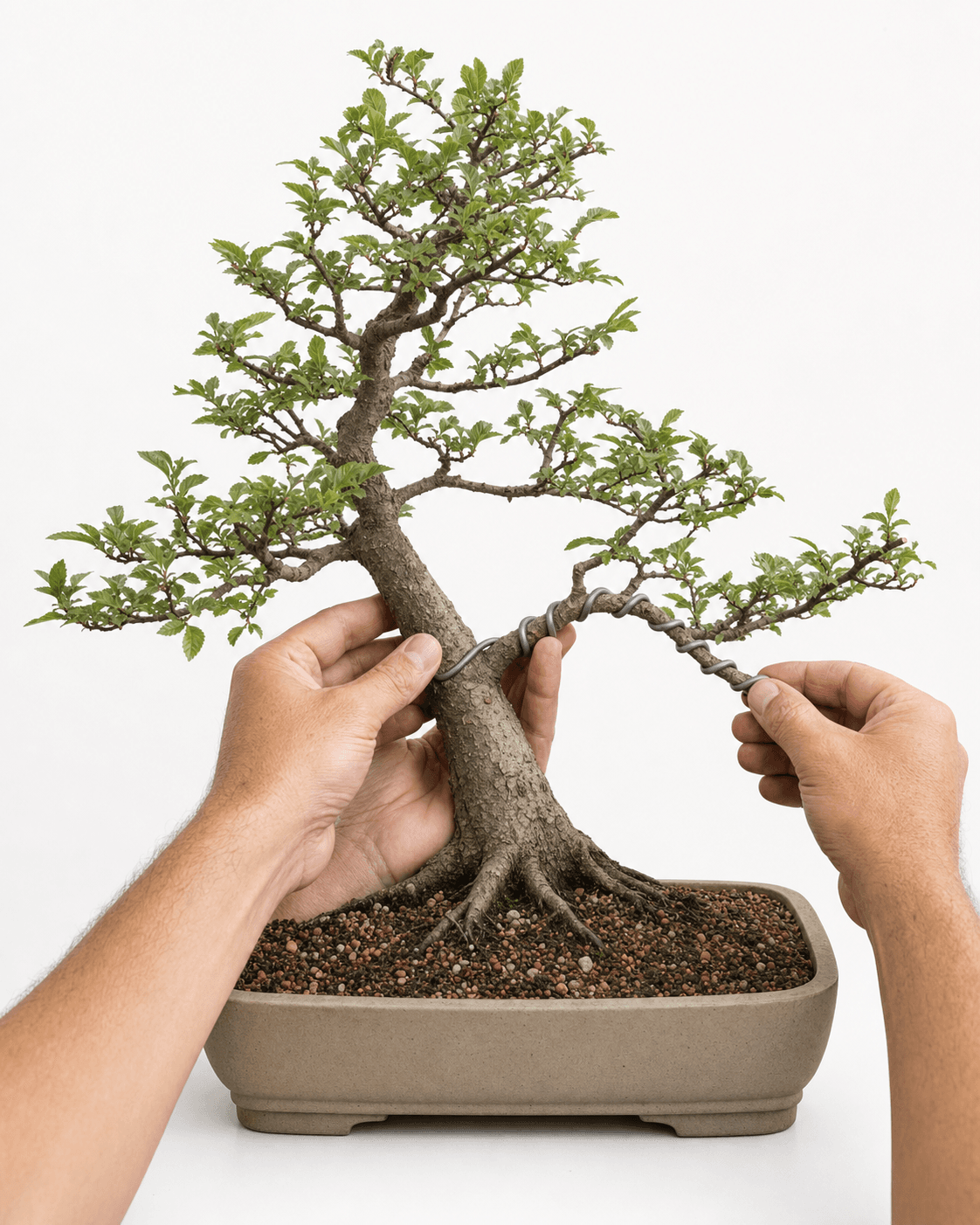
How to wire a bonsai branch with a clean anchor and removal plan
- Step 1
Name the design job
Decide whether the wire is setting trunk movement, primary branch direction, secondary ramification, a foliage pad, or a temporary show adjustment. Skip branches with no clear role.
- Step 2
Check vigor and stability
Wire only healthy, hydrated material with enough roots and foliage to recover. Stabilize a loose tree before high-leverage work and delay major bends after severe repotting, drought, or heavy reduction.
- Step 3
Select material and gauge
Use aluminum where softer bark or learning margin matters. Use copper where holding strength and smaller visual bulk matter. Size the wire by thickness, rigidity, and branch length, then cut a piece roughly 20 percent longer than the branch.
- Step 4
Create an anchor
Anchor trunk wire at the crown or soil line. Anchor a primary branch at the shoulder. Pair secondary branches only when they are close, similarly sized, and supported by structural wire or a stable parent branch.
- Step 5
Apply the coil cleanly
Keep the wire in contact with the branch, hold a 55 to 60 degree angle, maintain even spacing, and avoid gaps. Use the support hand to keep the branch still while the application hand lays the wire.
- Step 6
Bend with supported force
Move the branch in the direction that tightens the wire spiral, support the outside of the bend with your hand, and distribute movement across a longer section rather than forcing one point.
- Step 7
Set tips and foliage
For detail wiring, prune and clean first, then wire from interior to exterior. Stop when the tip or foliage mass is controlled, and orient the final tip so it can regain light.
- Step 8
Inspect and remove on time
Record the wiring date and check often during active thickening. Cut wire off in short pieces before it bites, then rewire later if the branch springs back.
Guide
Read the signals before acting.
Purpose
Wire only after the branch has a job.
Mirai structural wiring method begins with intent. Every wire should solve a design problem: trunk movement, primary branch direction, secondary branch distribution, pad geometry, apex position, or temporary refinement before a show. A clean wire with no design purpose still spends tree energy and adds scar risk. Bonsai Mirai Library
Pruning shortens or removes growth. Wiring repositions useful growth so it can become part of the final branch structure. That distinction matters on young nursery stock, collected conifers, broadleaf deciduous trees, and refined show trees because each stage needs a different amount of mechanical intervention.
The best beginner standard is simple: know the branch role before the wire goes on, know where the wire is anchored, know which way the branch will move, and know when the wire must come off. Without those answers, the work is practice material rather than tree work.
- Wire trunk and primary branches during structural work.
- Wire secondary and tertiary branchlets only after pruning and cleaning create usable pairs.
- Use guy wires when a branch needs directional pull with less bark coverage.
- Use show wire only after prior development lets the tree hold most of its shape.
Timing
A branch should be vigorous, hydrated, and worth the stress.
Vigorous growth is the strongest readiness signal. In the deciduous wiring corpus, malleability comes from stored resources and active water movement. Dryness and weakness increase brittleness, so withholding water to make branches bendable is poor practice. Bonsai Mirai Library
Wire after the tree has enough root function and foliage mass to support recovery. A freshly repotted conifer, a drought-stressed maple, a juniper with thin foliage, or an unstable tree in the pot should rebuild first. Heavy styling and hard root work are both major operations, and stacking them narrows the margin for recovery.
Season depends on species and goal. Leafless deciduous work gives visibility, but late-dormancy cuts and bends still need freeze protection afterward. Conifers often wire during structural styling windows when foliage has hardened and roots are stable. Exhibition wiring is a short-term refinement job, with Mirai show-wiring guidance using 10 to 21 days before a growing-season display and two to three months in dormancy.
- Wire healthy, hydrated trees with stable roots.
- Delay major wiring after severe root work, collection, drought, pest damage, or major foliage reduction.
- Use leafless visibility on deciduous trees without ignoring freeze and bark risks.
- Use show wire only on trees already refined enough to need minimal mechanics.
Material
Choose wire by bark, holding power, and leverage.
The Mirai corpus treats aluminum and copper as tools with different friction, holding power, and work-hardening behavior. Aluminum is smoother and often safer for thin-barked deciduous material, while copper can hold conifers and show-ready branches with less visual bulk once it work-hardens. Bonsai Mirai Library
Gauge is a mechanical decision. Thicker branches, longer branches, and more rigid wood all demand heavier wire because they create more leverage against the spiral. A wire that only holds the branch at the intended endpoint may fail when the bend needs adjustment, so size it for the branch range you may realistically use.
Beginners should practice on dead branches with a small kit before wiring valuable trees. The beginner structural wiring corpus names 18, 16, 14, 12, 10, and 6 gauge copper as a useful starter range for practice and many structural applications. Aluminum sizes differ by supplier, so test holding power on equivalent dead material instead of copying a gauge chart blindly.
- Use smoother aluminum for many broadleaf and thin-bark applications.
- Use copper when smaller gauge and stronger holding power are worth the skill requirement.
- Cut the wire roughly 20 percent longer than the branch so the tail becomes a control handle.
- Pad or protect special bark by adjusting technique, wire choice, or guy-wire strategy rather than relying on raffia as a bark shield.
Structural wire
Angle, spacing, contact, and anchor make the wire function.
Across the structural and detail-wiring corpus, the same three application rules repeat: every coil sits at a consistent 55 to 60 degree angle, adjacent turns keep even spacing, and the wire stays in continuous contact with the branch. Gaps reduce holding power because the branch moves before the wire begins to resist. Bonsai Mirai Library
Structural wire needs a point of immobility. Trunk wire anchors at the crown where trunk becomes roots. Primary branch wire anchors at the shoulder or branch collar, which exists around the full circumference of the branch. A loose spiral on the branch alone cannot control a bend because it has nothing stable to pull against.
Apply with two hands. The support hand holds the branch and wire in contact while the application hand uses the wire tail as a lever. Mirai describes the motion as straight-line planes rather than looping around the branch. This keeps angle, spacing, and contact consistent even when the branch curves.
- Hold 55 to 60 degrees through the anchor, branch, and final turn.
- Keep spacing consistent rather than tightening near junctions.
- Avoid visible gaps between wire and bark.
- Stand to the side for structural work so the wire tail gives leverage and the branch remains visible.
Bending
The wire should enter the shoulder from the side that serves the bend.
Branch direction begins at the shoulder. To lower a primary branch, route the wire across the top of the shoulder. To raise it, route the wire across the bottom. To move it laterally, enter from the side opposite the intended movement. This shoulder contact turns the branch collar into the stable point that resists springback. Bonsai Mirai Library
Bend in the rotational direction that tightens the spiral. Bending against the spiral opens the coil, creates gaps, and sacrifices holding power. Support the outside of the bend with your hand, move gradually, and distribute the change across a longer section of tissue instead of forcing one hinge point.
Read failure signals as the branch moves. Bark separation on the outside of a bend, gray elm bark splitting to green phloem, crushed needles, branch rolling under the wire, and seesaw movement in a paired-wire setup all mean the mechanics are failing. Stop, reduce the ambition, add support, or change technique before the branch tears.
- Lower from the top of the shoulder.
- Raise from the bottom of the shoulder.
- Move laterally from the side opposite the desired movement.
- For acute crotches where shoulder contact is impossible, use the obtuse side, rotate to absorb slack, or switch to a guy wire.
Detail wire
Fine wiring starts with pruning preparation, then uses less wire.
Detail wiring is separate from structural wiring. Before applying secondary or tertiary wire, clean the branch: remove downward growth, vertical growth, crotch growth, and the first 1/8 to 1/4 inch of congested fine ramification where the wire must enter. The preparation determines whether the pad can be wired cleanly. Bonsai Mirai Library
Pair branches by similar gauge and close proximity along the parent branch. Avoid pairing directly opposite branches. Structural wire should extend at least one and a half turns past a junction when it is used as the backbone for finer wire. In tandem wiring, one half of the wire follows the structural-wire rotation and the other half spins opposite so the two halves tighten against the branch.
Stop when the tip or foliage mass is controlled. Running wire deep into fine foliage breaks growth and adds no useful control. On pines, seat the final turn near the needle mass without crushing needles. On elongating conifers, wire from underneath and avoid trapping needles that will turn brown under pressure.
- Wire from bottom to top and interior to exterior to avoid disturbing finished work.
- Keep no more than three wires in one location whenever possible.
- Use the thicker branch to choose gauge when two paired branches differ.
- Finish with a small wire pad under the branch so the tip can be angled upward and later removed cleanly.
Species
Species changes how much wire belongs on the tree.
Deciduous trees often need an initial structural wiring round, then clip-and-grow, selective rewiring, and guy wires carry much of the refinement. Wiring every deciduous branch like a conifer can erase natural broadleaf character. The deciduous corpus favors preserving species movement, using subtle secondary movement, and avoiding unnecessary wire beyond the section that needs shape change. Bonsai Mirai Library
Conifers tend to need recurring wire because foliage pads, needle orientation, and branch angles remain central to refinement. Pines demand careful needle protection and final wire placement at the base of the needle mass. Junipers need foliage orientation, live-vein awareness, and staged work. Elongating conifers such as spruce, fir, hemlock, redwood, and bald cypress often require a heavier gauge than branch thickness suggests because tip-heavy foliage droops under rain and wind. Bonsai Mirai Library
Brittleness is species-specific. Some branches stretch and show tearing before failure; others snap suddenly. A thicker wire can reduce bend travel on brittle material. On bark-sensitive trees such as beech, Stewartia, ginkgo, linden, and refined maples, the cleanest choice may be softer wire, padding, a guy wire, or a smaller staged movement.
- Broadleaf deciduous: use wiring to set structure, then refine with growth management and selective rewiring.
- Pines: protect needles, avoid crushing bark, and match wiring to pine flush pattern and root strength.
- Junipers: preserve active foliage, live veins, and enough recovery time after heavy bending.
- Elongating conifers: support tip-heavy foliage and expect phototropic lift after flat pad placement.
Support tools
Raffia, guy wires, and tie-downs solve different load problems.
Raffia is primarily a compression tool. It distributes bending force across a wider area of living tissue during severe bends. The Mirai raffia corpus uses wet raffia for elasticity and compression, soaked for roughly two to four minutes until the center of the strand turns clear, applied as a flat belt with about 30 percent overlap, and bent while still wet. Bonsai Mirai Library
Use raffia where the branch diameter and bend severity justify it, especially heavy juniper bending with live-vein and deadwood considerations. Avoid treating raffia as routine bark armor. On pines and heavy-barked species it can damage or adhere to valuable bark and hide the visual failure cues needed to stop a bend. Limber pine is a special case where Mirai notes dry tissue and dry raffia when raffia is used at all.
Guy wires are better when the branch needs one directional pull, when bark coverage should stay minimal, or when an acute crotch prevents useful coil entry. Tree stabilization is a separate prerequisite: a wobbly trunk in the pot prevents new roots from forming and should be secured with non-stretch tie-downs before high-leverage styling. Bonsai Mirai Library
- Use raffia for severe compression-managed bends, not ordinary fine wiring.
- Keep raffia flat, tight, evenly overlapped, and anchored to a branch crotch, trunk, or deadwood point.
- Use guy wires for single-direction pulls or when coiled wire would scar too much bark.
- Stabilize loose trees before styling because leverage through a moving root ball undermines recovery.
Removal
Wire removal is part of the operation.
Wire scars form when branch expansion catches up to the coil. The risk is highest during active growth, on vigorous young material, and on fast-thickening species or branches. Elongating alpine conifers can also swell in fall as sugars and starches accumulate for winter hardiness, so fall wire needs close inspection on spruce, hemlock, fir, and larch. Bonsai Mirai Library
Cut wire off in short pieces, especially from fine twigs, pines, brittle branches, and bark-sensitive species. Unwinding can tear buds, crush foliage, reopen a bend, or track through existing scar tissue. If a branch springs back after clean removal, record the result and rewire in a future window with better gauge, angle, or timing.
Old scars change the next wiring path. Mirai guidance allows following the same rotation direction when needed, but the new wire should stay outside the scar line. Re-entering the same groove perpetuates damage and makes the scar harder to grow out.
- Inspect fast-growing branches often during active thickening.
- Remove wire before it bites, even if the branch has not fully set.
- Cut wire into short sections instead of unwinding from delicate growth.
- Run future wire outside old scars and adjust rotation or placement to avoid retracking damage.
Troubleshooting
Most wiring failures are visible before the branch breaks.
The common beginner failures are predictable: wiring without a design job, wire with no anchor, coils too steep or too loose, gaps under the wire, mismatched branch pairs, unsupported bending, too many wires stacked in one place, and delayed removal. Each one creates either poor control, bark damage, or a branch that looks mechanical after the wire comes off.
Use the warning signs. If the wire curves while the branch stays straight, the support hand is not holding the branch. If one paired branch teeters while the other moves, the pair lacks a stable anchor. If bark lifts on the outside of a bend, the tissue is near failure. If pine needles, spruce needles, or hemlock foliage are crushed under wire, the damage will brown and weaken the tip. Bonsai Mirai Library
A cracked branch is handled by severity and species. The deciduous wiring corpus notes that a branch cracked less than roughly half its thickness, with the compression face intact, can sometimes be pasted and left in position. A deeper split, weak branch, or conifer live-vein injury needs a more conservative response, less movement, support, and recovery rather than another bend.
- Wire slips or gaps open: the angle, contact, or bend direction is wrong.
- Branch returns immediately: gauge, anchor, or work-hardening was insufficient.
- Bark starts splitting: stop increasing severity and reassess support.
- Foliage browns under wire: needles or leaves were crushed, trapped, or shaded by the application.
- Tree moves in the pot: stop styling and stabilize the root system.
Tracking
A wiring record should explain both the bend and the aftercare.
Photograph the branch before wiring, after wiring, after bending, and when the wire comes off. Record wire material, approximate gauge, date, species, branch purpose, health condition, root stability, and any support tools such as raffia, guy wires, or tie-downs.
The removal note is the most valuable data. Did the branch hold. Did it spring back. Did it scar. Did the tip weaken. Did a species thicken faster than expected. These local observations turn wiring from a one-time styling task into a repeatable care calendar.
EntGrove records should connect the technique to the next operation. A wired branch may need a light season, more growth to set the bend, a future guy wire, or a later pruning pass. The record should name that next job while the reason is still visible.
Questions
Direct answers for the common mistakes.
What wire should a beginner use for bonsai?
Use aluminum for most early practice because it is smoother, easier to adjust, and less abrasive on many thin-barked trees. Practice angle, spacing, contact, and bending on dead branches before using copper or wiring valuable live material.
What angle should bonsai wire be applied at?
Use a consistent 55 to 60 degree angle, with even spacing and no gaps between wire and branch. The same standard applies to structural, secondary, and tertiary wiring.
How do I anchor bonsai wire?
Anchor trunk wire at the crown or soil line and primary branch wire at the shoulder where the branch meets the trunk. Fine branch pairs need a stable parent branch, similar branch sizes, and enough structural wire beyond the junction to hold the pair.
Is copper or aluminum better for bonsai wiring?
Copper gives stronger holding power with less visual bulk once it work-hardens, which is useful on many conifers and show trees. Aluminum is smoother and often better for learning, deciduous work, and bark-sensitive branches.
When should I remove bonsai wire?
Remove wire before it cuts into the bark. Check often during active growth, on vigorous young trees, and on elongating conifers in fall when branch swelling can accelerate.
Can every bonsai branch be wired?
Some branches should be left alone, pruned, guy-wired, grown stronger, or moved in stages. Weak, unstable, brittle, recently repotted, drought-stressed, or poorly attached branches have less margin for wiring.
Should I unwind bonsai wire or cut it off?
Cut wire off in short pieces, especially on fine twigs, pines, and bark-sensitive species. Unwinding can damage buds, tear bark, crush foliage, or undo the bend.
When should I use raffia on bonsai branches?
Use raffia only for bends that need compression support, usually severe bends on larger branches or junipers. It should be soaked, applied as a flat overlapped belt, anchored firmly, and bent while wet. Ordinary branch placement usually does not need raffia.
Why did my branch crack while wiring?
Cracks usually come from concentrated force, weak or dry tissue, insufficient support from the off hand, wrong bend direction, under-gauged wire, or species brittleness. Stop increasing the bend, support the branch, and record the failure signal before trying similar material again.
How long does bonsai wire take to set a branch?
It depends on species, vigor, age, branch thickness, season, and the severity of the bend. Fast-growing young branches may scar before they fully set, while old conifer branches can need repeated wiring or guy-wire support across multiple seasons.
Sources and next reading