
Species guide
Kaempferi Azalea Bonsai Care
Rhododendron kaempferi
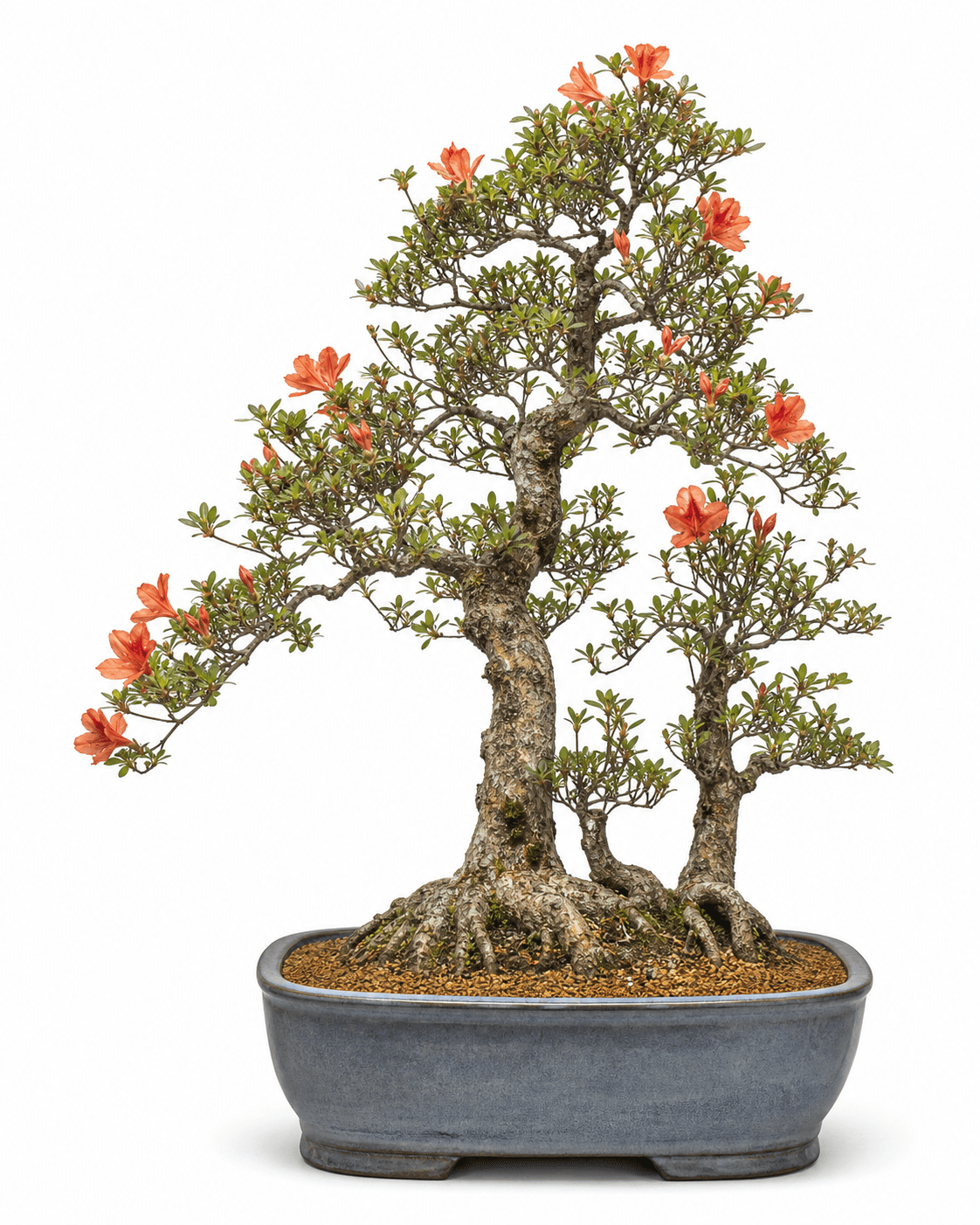
Kaempferi azalea, Rhododendron kaempferi, is an outdoor flowering azalea bonsai candidate for growers who can keep fine roots cool, acidic, evenly moist, and oxygenated. The practical care answer is filtered outdoor light, spring-first root work, kanuma-heavy soil, prompt flower cleanup, and post-bloom pruning before the next bud cycle is set.
Treat torch azalea as part of the Japanese evergreen azalea continuum. Separate it from Satsuki and Kurume when bloom timing, cultivar history, and pruning tolerance matter. Kaempferi usually reads as a tougher upright shrub with late spring to early summer flowers and a broader landscape-azalea character.
Bonsai Mirai has deep azalea method coverage and direct Kurume comparison. The local corpus does not include a dedicated Kaempferi transcript, so this guide applies the Mirai azalea method transparently, then grounds Rhododendron kaempferi taxonomy, hardiness, habitat, flower timing, pests, and propagation in Kew, NC State, Missouri, Oregon State, Clemson, and UC IPM sources.
Updated June 19, 2026. Written by EntGrove Editorial. Last verified June 19, 2026.
Care fingerprint
Read the species through its shared care pattern.
Acidic substrate, careful post-bloom pruning, shallow fine roots, and flower-bud timing matter more than generic broadleaf pruning. Use this as the starting point before local conditions and tree strength refine the calendar.
Note: Lower-priority page; useful as Kurume lineage and parentage context.
Read the foliage first
Broadleaf stress usually shows in leaf color, leaf size, wilt, scorch, or delayed hardening before it becomes a branch problem.
Match work to dormancy
Deciduous, evergreen, tropical, succulent, and flowering broadleaf trees recover on different calendars.
Protect fine roots
Root work should preserve enough active fine roots for the tree to rehydrate quickly after the operation.
Care cadence
The calendar starts with the tree's seasonal state.
Placement
Timing: Keep outdoors year-round with wind protection, dappled light, and winter shelter for the container when hard freezes arrive.
Watch for: Hot afternoon sun on a shallow pot, drying wind, dense shade that reduces bloom, and warm indoor overwintering.
NC State ExtensionUniversity of Missouri ExtensionBonsai Mirai LibraryWatering
Timing: Check the surface and root zone often in active growth; water thoroughly when kanuma begins to shift color but before the fine roots dry hard.
Watch for: Dry edges, sour lower soil, compacted dust, hard water, and a center root sheen that stops accepting water.
Bonsai Mirai LibraryUC IPM nursery azaleaFeeding
Timing: Feed during active growth after roots are functioning; ease off during full bloom and resume after spent flowers and ovaries are removed.
Watch for: Feeding a weak-rooted tree, pushing flowers on young material, or using high-nitrogen routines that create coarse shoots without balanced roots.
Bonsai Mirai LibraryFlower care
Timing: As flowers fade in late spring or early summer, remove petals and the green seed-forming ovary so the tree does not spend reserves on capsules.
Watch for: Hidden spent flowers inside the canopy, seed pods, wet petals, and flower load on weak branches.
Bonsai Mirai LibraryNC State ExtensionUC IPM petal blightPruning
Timing: Make the main refinement and shoot-selection pass shortly after flowering, before the next flower buds are set.
Watch for: Late pruning, repeated harsh cutback, three or more shoots from one junction, and a weakening apex.
Bonsai Mirai LibraryRepotting
Timing: Favor February through April before shoots elongate, with more severe root work earlier and lighter maintenance only on strong trees.
Watch for: Matted surface roots, broken-down kanuma, anaerobic pockets, poor percolation, and disturbance directly under the trunk.
Bonsai Mirai LibraryWiring
Timing: Wire selected young or secondary branches only when the tree is hydrated, strong, and not recovering from repotting or heavy flower load.
Watch for: Brittle older wood, soft bark, wire bite during swelling growth, and bends that remove the foliage a branch needs to stay alive.
Bonsai Mirai LibraryPests and disease
Timing: Inspect during warm weather, bloom, humid spells, and after root stress.
Watch for: Lace bugs, mites, aphids, scale, thrips, whitefly, root rot, petal blight, powdery mildew, rust, leaf spot, and chlorosis from high pH.
NC State ExtensionUC IPMUC IPM petal blightUC IPM nursery azaleaSpecies guide
Apply the species profile before copying another tree's calendar.
Profile
Kaempferi is a Japanese evergreen azalea with fine roots, upright growth, and a late spring flower cycle.
Rhododendron kaempferi is the accepted species name in Kew, and NC State lists torch azalea and Kaempferi azalea as common names. It belongs to Ericaceae, the same acid-loving family that gives azalea bonsai their narrow root and water-quality requirements. Kew POWONC State Extension
The horticultural profile is clear enough for bonsai use: a woody, evergreen to semi-evergreen shrub from Japan, naturally dense, multi-stemmed, and rounded. NC State gives landscape dimensions of 4-10 ft tall and 5-6 ft wide over roughly 10 years, which points toward small to medium bonsai with restrained old-tree imagery. NC State Extension
The care target is an outdoor azalea with acidic, moist, well-drained roots, partial or dappled shade, late spring to early summer flowers, and a repot cycle that protects fine surface roots. In bonsai terms, root health decides whether the flower display, branch density, and design work remain sustainable. Bonsai Mirai LibraryNC State ExtensionUniversity of Missouri Extension
The source record needs a plain caveat. Mirai gives deep technique coverage for Satsuki azalea plus a Kurume comparison, while Kaempferi-specific facts come from botanical and extension sources. Transfer the azalea method, then adjust it to the tree in front of you. Bonsai Mirai LibraryKew POWONC State ExtensionOregon State Landscape Plants
Wild pattern
Design from its mountain-shrub habit.
NC State describes Rhododendron kaempferi as growing in the mountainous regions and grassy hills of Japan. That is the most useful starting point for bonsai: bright but moderated exposure, acidic organic soils, constant moisture, and enough drainage that fine roots breathe after rain. NC State Extension
The wild and landscape habit is an upright, multi-stemmed shrub with a dense rounded canopy. Better bonsai designs let the base, branch density, flower mass, and asymmetric voids carry the image through broadleaf structure. NC State ExtensionBonsai Mirai / Asymmetry
For care, the wild pattern pushes the grower away from deep drought, alkaline water, full hot afternoon sun, and compact organic nursery cores. For styling, it favors mounded flowering forms, clumps, informal uprights, and careful negative space over dramatic deadwood, heavy one-pass branch removal, or strict conifer pad geometry. Bonsai Mirai LibraryUniversity of Missouri ExtensionNC State Extension
Strength
Read the apex, root sheen, and post-flower response before choosing technique.
The Mirai azalea corpus treats azalea bonsai as horticulture-first material. When water, fertilizer, pest pressure, repotting, and substrate are correct, azaleas can back-bud readily and rebuild fine ramification. When any of those basics slip, design options collapse quickly. Bonsai Mirai Library
Azaleas are basally dominant. Lower branches and basal shoots often hold more strength than the apex, so balance work frequently means reducing density low in the tree while protecting or rebuilding the top. Apex weakness is a serious signal because it often traces to root disturbance, stale kanuma, or too much pruning at the top. Bonsai Mirai Library
Separate development from refinement. A young Kaempferi needs roots, trunk base, and branch placement more than a full flower show. A refined tree can carry more flowers, but it still needs spent flowers removed and junctions thinned so old twigging stays productive. Bonsai Mirai Library
Use foliage draw as evidence. Mirai warns that cutting back to weak interior shoots with little active foliage can fail to keep water moving through the branch, while flower-bearing tips often show enough strength to support a controlled cutback. On Kaempferi, that means pruning to living, useful shoots rather than to empty interior wood. Bonsai Mirai Library
Flowers
Use the post-bloom window for flower cleanup, shoot selection, and energy balance.
NC State places Kaempferi flowers in late spring to early summer, with 2-3 funnel-shaped flowers at a terminal raceme. That timing makes post-bloom cleanup the key annual handoff from display to care. NC State Extension
Mirai distinguishes flowers from seed. The flower itself is less costly than the seed-forming ovary that remains after petals fade, so remove petals and the green ovary before the tree spends stored energy on capsules. Sweep the canopy more than once because spent flowers hide inside dense foliage. Bonsai Mirai Library
After bloom, thin shoot clusters back toward two useful laterals, remove basal water sprouts unless they have a planned role, and cut long shoots back to productive foliage. Mirai notes that non-Satsuki rhododendrons need the same kind of work while bloom is current or just finishing; once the vegetative flush has run, the strongest reinvigoration window has passed. Bonsai Mirai Library
Keep major operations separated across seasons. Heavy post-flower cutback, repotting, and major branch removal each draw on stored energy, so combine them only in exceptional early material resets. Most established Kaempferi bonsai should get one main intervention, then a recovery period with strong but controlled growth. Bonsai Mirai Library
Roots
Repot for oxygen and root renewal, then leave the trunk core alone.
Mirai gives February through April as the standard azalea repot window, ideally before new shoots elongate. More severe root work belongs earlier in that window so the tree can recover before heat and flower demand rise. The older post-flowering repot tradition is now a higher-risk choice in warmer summers. Bonsai Mirai Library
Azalea roots behave like a fine surface mat. Work the perimeter and surface layer, remove compacted moss, fertilizer crust, and broken-down kanuma, and avoid aggressive disturbance directly beneath the trunk. Mirai repeatedly ties damage to that central root sheen to apex decline. Bonsai Mirai Library
Use the 2-4 year interval as a starting range, then let the tree decide. Warm climates, heavy feeding, and dense surface roots shorten the interval; cool climates and slower growth can stretch it. Slow percolation, black sour soil, yellowing, random dieback, or apex weakness should move root inspection up the calendar. Bonsai Mirai LibraryUC IPM nursery azalea
Substrate
Kanuma works because it matches fine azalea roots and keeps the pot cool.
Mirai favors kanuma for azaleas because its soft, porous particles let fine roots penetrate while holding moisture. Acidity matters, and the larger value is a particle that supports water, oxygen, and the delicate root texture at the same time. Bonsai Mirai Library
A practical mix is mostly sifted kanuma with 5-20 percent same-sized pumice when you need more structure and future separability. If kanuma is unavailable, an akadama and pumice blend can work, but avoid leaving a peat-grown core surrounded by kanuma because the two zones dry and breathe differently. Bonsai Mirai Library
Remove dust, water thoroughly after potting, and chopstick gently because crushed kanuma can become a drainage problem. Newly repotted azaleas may need more frequent surface top-ups than other species because the top layer dries before the center has fully stabilized. Bonsai Mirai Library
Pot choice matters more than it seems. Mirai prefers relatively deeper azalea pots and at least one to two fingers of substrate between woody roots and the pot wall because hot pot edges cook fine roots. For styling, choose quiet unglazed or subdued glazed containers that make flowers and bark read clearly. Bonsai Mirai LibraryBonsai Mirai / Asymmetry
Climate
Landscape hardiness is useful, but the bonsai pot narrows the margin.
NC State lists USDA Zones 5a-7b for Rhododendron kaempferi in landscape use. That is stronger cold tolerance than many refined flowering bonsai suggest, but a shallow pot still exposes fine roots to faster freeze, thaw, wind, and dehydration. NC State ExtensionBonsai Mirai Library
In hot or dry regions, use morning sun, dappled light, and shade after the early day. NC State warns that more sun can increase flowering but makes water demand harder and can burn the plant. Missouri Extension gives the broader azalea rule: filtered sunlight or morning sun with afternoon shade is the safer default. NC State ExtensionUniversity of Missouri Extension
In cold regions, protect from hard wind and deep freezes while keeping the tree dormant and bright. Mirai describes azaleas as needing real winter chill close to freezing, so warm indoor overwintering is the wrong direction. In mild maritime regions, winter wet and stale soil can be more dangerous than low temperature, so shelter should protect roots without trapping them in constant saturation. Bonsai Mirai LibraryUC IPM nursery azaleaUniversity of Missouri Extension
In alkaline-water regions, plan for rainwater, filtered water, or regular pH monitoring before buying expensive material. A Kaempferi can survive a wide garden range in the ground, but a bonsai pot gives the roots less buffering capacity and makes water chemistry visible sooner. Bonsai Mirai LibraryUniversity of Missouri Extension
Health
Most pest problems get worse when roots, shade, or airflow are already wrong.
NC State lists a long pest range for Rhododendron kaempferi: aphids, borers, lace bugs, leafhoppers, mealybugs, mites, nematodes, scale, thrips, and whitefly. In bonsai, the dense canopy can hide early damage, so part the foliage and inspect leaf undersides. NC State ExtensionUC IPM
Disease pressure also follows the root and flower environment. NC State lists canker, crown rot, root rot, leaf spot, rust, and powdery mildew; UC IPM ties azalea root rot to overwatering, poor drainage, and weakened plants. Wet flowers can invite petal blight, especially when spent blooms remain in the canopy. NC State ExtensionUC IPM nursery azaleaUC IPM petal blight
Chlorosis deserves a pH and root check before a fertilizer response. Missouri Extension gives pH 5.0-5.5 as the target for azaleas and rhododendrons, and NC State warns that poor drainage rots roots. Yellow leaves can come from alkaline water, compacted roots, root disease, magnesium or iron availability, or genuine nutrient shortage, so diagnose the root zone first. University of Missouri ExtensionNC State ExtensionUC IPM nursery azalea
Well-fed azaleas can be pest magnets. Mirai calls out spider mites and scale on vigorous azaleas, while UC IPM adds lace bugs, aphids, thrips, whiteflies, mites, leaf gall, scorch, water deficit, and excess water to the practical inspection list. Bonsai Mirai LibraryUC IPM
Wiring
Wire selectively, then remove before soft bark marks.
The Mirai azalea guidance is conservative: use aluminum wire, support bends with the off hand, and wire structural or secondary branches only when the tree is strong. Routine wiring of every fine tip is inefficient on an azalea because pruning and shoot selection do more of the refinement work. Bonsai Mirai Library
Older azalea wood is brittle, and bark can mark quickly during active swelling. Fall can be a useful wiring window after bark has hardened, but only on trees with reliable roots and no recent heavy cutback. Bend in small steps, keep enough foliage beyond the bend to pull water, and check wire frequently once new growth starts. Bonsai Mirai Library
Avoid stacking wiring with root work, heavy flower load, or heat stress. A recently repotted Kaempferi should rebuild roots first; a tree that just finished a heavy bloom should have flowers removed, balance restored, and hydration stabilized before branch movement. Bonsai Mirai Library
Propagation
Cuttings are the practical route; grafting is a specialized design repair.
NC State lists stem cuttings as the recommended propagation strategy for Rhododendron kaempferi. For bonsai, cuttings also preserve a named cultivar or flower form better than seed, which can vary widely. NC State Extension
Mirai gives Satsuki azalea two cutting windows that can guide related evergreen azaleas: early spring hardwood or semi-hardwood before bud push, and semi-hardwood after the first flush hardens, with flowers removed to conserve energy. Treat Kaempferi cuttings with the same humidity, cleanliness, and cultivar-label discipline. Bonsai Mirai Library
Approach grafting can solve a missing branch, though Mirai warns that azalea grafted branches can remain weaker because they do not always tie into the primary vascular system as strongly as natural branches. Air-layering is possible on many broadleaf shrubs, while a rooted cutting or young nursery plant is usually a cleaner bonsai start. Bonsai Mirai Library
Sourcing
Buy for roots, cultivar clarity, and usable low structure before flower color.
Garden-center Kaempferi and Kaempferi-hybrid azaleas can be useful bonsai material, especially when they have low branching and a compact base. The risk is usually below the surface: peat-heavy nursery cores, girdling roots, hard-water buildup, or a graft union that will never make a believable nebari. NC State ExtensionBonsai Mirai Library
Specialist pre-bonsai is worth more when the grower can name the cultivar, show the root base, and explain the last repot. Flower color alone is a weak buying filter. Look for short internodes, healthy leaf color, flexible secondary branches, no dead apex, clean drainage after watering, and a tag that distinguishes species Kaempferi from a broad Kaempferi-hybrid label. Bonsai Mirai LibraryOregon State Landscape Plants
Collected landscape azaleas can make strong trunks, but the first operation should reset roots and structure while the plant still has vigor. Mirai gives field-lifted azaleas more tolerance for full root correction at collection than established bonsai, then becomes much more conservative once the tree is living in a pot. Bonsai Mirai Library
Troubleshooting
Translate symptoms through roots, light, water, and timing before reaching for a product.
Kaempferi symptoms often look vague above ground. Yellowing, weak flowers, stalled buds, and twig dieback can each come from several causes, so begin with the root environment, water quality, and recent work history before treating pests or feeding harder. Bonsai Mirai LibraryUC IPM nursery azaleaNC State Extension
Design
Let flower mass, trunk base, and negative space define the tree.
A Kaempferi azalea reads best when the design accepts shrub logic. The trunk may be multi-stemmed, the branches may be dense, and the flowers can dominate a short season. Let that structure guide the design away from strict pine pad geometry and toward a believable flowering broadleaf. NC State ExtensionBonsai Mirai / Asymmetry
Mirai azalea design emphasizes branch length, asymmetry, depth, and voids more than large one-pass structural relocation. Major branch removal on established azaleas can trigger dieback along the live line, so stage changes over years or make them during early material reset. Bonsai Mirai LibraryBonsai Mirai / Asymmetry
Deadwood should be rare and believable. Mirai treats deadwood as a weak azalea strategy because the wood degrades and often signals loss of live tissue. Kaempferi should usually lean on flower, bark, surface roots, live branch line, and aged twigging as the primary read. Bonsai Mirai Library
Forms
Kaempferi is both a species and a breeding parent, so labels need care.
NC State lists cultivar or variety names associated with Rhododendron kaempferi, including Amoenum, Damio, Johanna, and Obtusum. Treat these as label clues, then verify flower size, vigor, hardiness, and growth habit on the actual plant. NC State Extension
Oregon State explains that Kaempheri Hybrids were developed in Holland after World War I and were derived in part from Rhododendron kaempferi. The same page places Kaempheri beside Kurume and Satsuki in the broader evergreen Japanese azalea complex. Oregon State Landscape Plants
University of Missouri Extension adds a practical warning: some Gable hybrids are called Kaempferi hybrids because R. kaempferi was a parent, yet hardiness cannot be generalized across every hybrid. In bonsai, cultivar name should guide caution while direct observation remains the final evidence. A landscape-hardy hybrid still needs container root protection. University of Missouri Extension
History
Its bonsai value is tied to evergreen azalea breeding history.
Missouri Botanical Garden notes that R. kaempferi was introduced to the United States by Charles S. Sargent of the Arnold Arboretum from seed collected in Japan in 1892. That history helps explain why the plant shows up in Western azalea breeding records as well as in Japanese garden plantings. Missouri Botanical Garden
The species also sits behind many named evergreen azalea groups. Oregon State describes Kaempheri Hybrids as a post-World War I Dutch group derived partly from R. kaempferi, and Missouri Extension ties R. kaempferi parentage to Gable and Glenn Dale hybrid discussions. Oregon State Landscape PlantsUniversity of Missouri Extension
As bonsai material, Kaempferi is less documented than Satsuki and Kurume in public teaching, but it remains useful for understanding the azalea continuum: shrub habit, acid roots, post-bloom work, cultivar variation, and the need to keep horticulture ahead of flowers. Bonsai Mirai LibraryOregon State Landscape Plants
Species questions
Answer the beginner questions before styling.
Is Kaempferi azalea a good beginner bonsai?
It can be a good beginner flowering bonsai for an attentive outdoor grower who can manage acidic soil, steady moisture, filtered light, and post-bloom pruning. It is a poor fit for low-light indoor culture or casual watering.
Can Kaempferi azalea bonsai live indoors?
Use indoor display only briefly, usually during bloom. Long-term health is better outdoors with seasonal light, airflow, winter dormancy, and protection for the container during hard freezes.
How often should I water Kaempferi azalea bonsai?
Water by root condition and substrate color. Keep the fine roots evenly moist, water thoroughly when the surface begins to dry, and make sure drainage stays open so oxygen returns.
What soil is best for Kaempferi azalea bonsai?
Use a lime-free acidic mix. Sifted kanuma is the standard azalea choice because it holds moisture, stays acidic, and supports fine roots; adding a small portion of same-sized pumice can improve structure.
When should I prune Kaempferi azalea bonsai?
Prune shortly after flowering. Remove spent flowers and ovaries first, then thin shoot clusters and shorten strong growth before the next flower buds are set.
When should I repot Kaempferi azalea bonsai?
Favor February through April before new shoots elongate. Repot about every 2-4 years as a baseline, sooner if kanuma breaks down, drainage slows, or apex weakness points back to roots.
When does Kaempferi azalea bloom?
NC State describes Rhododendron kaempferi flowers as late spring to early summer, usually 1.5-2 inches wide and held in small terminal clusters. In bonsai, remove spent petals and ovaries as bloom fades.
Is Kaempferi azalea the same as Kurume or Satsuki azalea?
They are different labels. Kaempferi is Rhododendron kaempferi, while Satsuki centers on R. indicum and Kurume is usually treated as a hybrid group. Care overlaps because all are azaleas, but bloom timing, vigor, flower size, and cultivar history differ.
What is torch azalea bonsai?
Torch azalea is a common name for Rhododendron kaempferi. In bonsai, use the same fine-root azalea method, then verify whether the plant is the species, a Kaempferi hybrid, a Kurume, or a Satsuki before copying cultivar-specific advice.
Why are my Kaempferi azalea leaves turning yellow?
Common causes include alkaline water, high soil pH, compacted roots, root rot, poor drainage, or pest stress. Check soil acidity, water quality, root smell, and leaf undersides before feeding harder.
Sources
Species advice needs source discipline.
Next decisions
Plan the operation before copying the calendar.
A good care note for Kaempferi azalea records the tree's stage, the work done, and the aftercare used. That record matters more than a month-name rule.
Related species
Compare nearby trees before transferring advice.
Satsuki azalea
Rhododendron indicum
Kurume azalea
Rhododendron x obtusum (Kurume hybrids)