
Species guide
Satsuki Azalea Bonsai Care
Rhododendron indicum
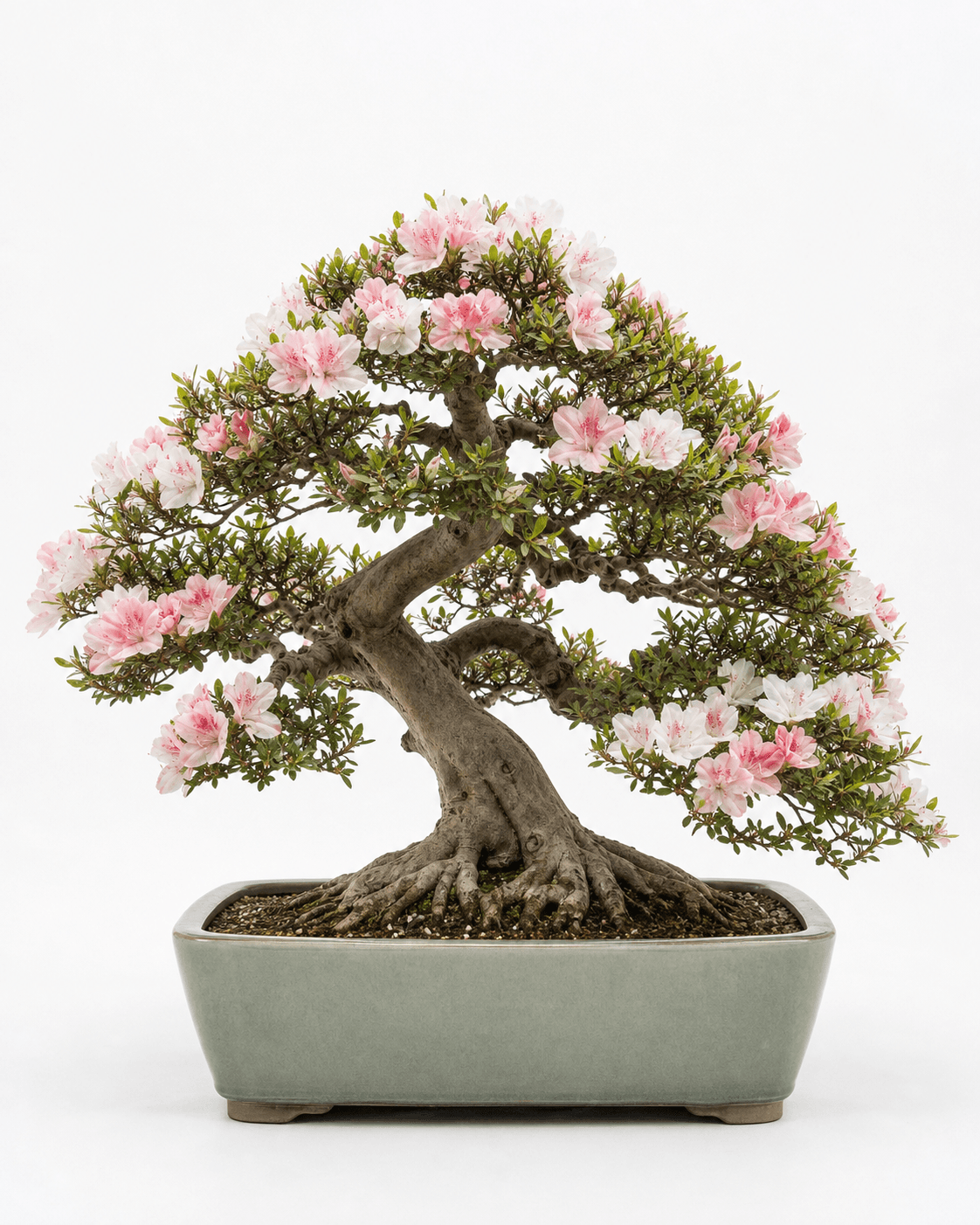
Satsuki azalea, Rhododendron indicum, is an outdoor flowering bonsai for growers who can manage acidic water, fine surface roots, flower cleanup, and winter root protection. The flowers are the public signal, but the long-term tree is built through root oxygen, post-bloom pruning, and staged design.
Treat Satsuki as Broadleaf > Azaleas, with a calendar that differs from generic deciduous broadleaf care. Main pruning follows the bloom, root work is strongest from late winter into early spring before shoots extend, and refined trees need enough healthy foliage to keep water moving through old branches.
The beginner mistake is stacking operations because the tree looks strong in flower. Let roots, pruning, wiring, and heavy flower display each have a recovery margin, especially on newer delicate hybrids and potted trees facing summer heat.
Updated July 5, 2026. Written by EntGrove Editorial. Last verified July 5, 2026.
Care fingerprint
Read the species through its shared care pattern.
Acidic substrate, careful post-bloom pruning, shallow fine roots, and flower-bud timing matter more than generic broadleaf pruning. Use this as the starting point before local conditions and tree strength refine the calendar.
Read the foliage first
Broadleaf stress usually shows in leaf color, leaf size, wilt, scorch, or delayed hardening before it becomes a branch problem.
Match work to dormancy
Deciduous, evergreen, tropical, succulent, and flowering broadleaf trees recover on different calendars.
Protect fine roots
Root work should preserve enough active fine roots for the tree to rehydrate quickly after the operation.
Care cadence
The calendar starts with the tree's seasonal state.
Placement
Timing: Grow outdoors year-round. Use spring and fall sun for bud strength, then filtered sun or shade cloth when hot sun threatens flowers, leaves, or the pot edge.
Watch for: Weak shade growth, faded flowers, lace bug pressure in exposed full sun, hot container walls, warm indoor display, and dry still air.
Bonsai MiraiClemson ExtensionNC State ExtensionWatering
Timing: Water from the soil and foliage evidence. Hydrate thoroughly when needed, but use lighter surface passes on newly repotted or shallow-rooted trees when the upper Kanuma begins to pale.
Watch for: Dry surface roots, ponding, sour black root zones, dry pockets under a wide trunk base, and hard water gradually pushing pH upward.
Bonsai Mirai LibraryBonsai MiraiFertilizer
Timing: Feed healthy active trees with moderate organic fertilizer. Pause during peak heat, avoid fertilizing sick root systems, and wait 4-6 weeks after repotting until strong growth confirms recovery.
Watch for: Fertilizer sitting undecomposed, mites on sugar-rich growth, salts on a dry root zone, and leaf growth pushed while flowers or roots are already draining reserves.
Bonsai Mirai LibraryFlower cleanup
Timing: As bloom finishes, remove spent flowers, stamens, and developing seed pods. On recently repotted trees, remove spent blossoms earlier so seed set does not tax recovery.
Watch for: Seed capsules, petal blight in wet flowers, show display left too long on a weak tree, and young material being judged only by flower count.
Bonsai Mirai LibraryUC IPM petal blightPruning
Timing: Use mid-spring for finer sustainable shoots when flower sacrifice is acceptable, or prune after flowering for tertiary ramification and next-year-bud protection.
Watch for: Three or four shoots from one junction, weak apex response, strong lower water sprouts, cuts back to tiny non-flowering interior tips, and late pruning that sacrifices the next bloom.
Bonsai Mirai LibraryRepotting
Timing: Repot from February through April before shoots elongate where climate allows. Earlier work suits heavier root reduction; historical post-flower June repotting has become riskier in hotter summers.
Watch for: Compacted surface Kanuma, matted roots, a peat core surrounded by fresh soil, exposed roots drying within minutes, and disturbance of the central shin below the trunk.
Bonsai Mirai LibraryBonsai MiraiWiring
Timing: Wire structural and major secondary branches only when the tree is strong and branches are flexible. Use aluminum, support each bend, and check often because the bark is thin.
Watch for: Brittle old wood, copper abrasion, fine-tip over-wiring, branch cracks, and wiring stacked onto repotting or flower exhaustion.
Bonsai Mirai LibraryBonsai MiraiWinter protection
Timing: Protect potted roots from hard freezes, cold wind, and rapid temperature swings. Recently pruned, recently repotted, small-pot, low-foliage, and weak Satsuki need the most insulation.
Watch for: Cold below about 28 F after work, frozen small pots, wet winter soil with poor oxygen, and delayed spring dieback during the first warm spell.
Bonsai Mirai LibraryMissouri Botanical GardenPests and disease
Timing: Inspect during bloom, wet weather, hot dry spells, and any period of poor drainage or weak indoor display.
Watch for: Petal blight, leaf and flower gall, Phytophthora root and crown rot, lace bugs, aphids, mites, scale, thrips, whiteflies, chlorosis, scorch, and water deficit or excess.
UC IPMUC IPM petal blightUC IPM nursery azaleaNC State ExtensionSpecies guide
Apply the species profile before copying another tree's calendar.
Spec
Satsuki azalea is an outdoor flowering broadleaf with fine roots and a strict timing calendar.
Rhododendron indicum is an accepted Kew species in Ericaceae, native to Japan. NC State describes it as a compact semi-evergreen shrub with a slow growth rate, high maintenance needs, partial shade preference, acidic well-drained moist soil, and showy mid-to-late spring flowers. Kew POWONC State Extension
As bonsai, Satsuki belongs in Broadleaf > Azaleas. The traits that matter most are surface-dominant fine roots, acidity, Kanuma structure, basal dominance, brittle older wood, and a flowering calendar that places major pruning soon after bloom or earlier when the tree is being built at the expense of flowers. Bonsai Mirai LibraryBonsai Mirai
The page uses Satsuki as the practical bonsai label while keeping Rhododendron indicum as the botanical anchor. Cultivar names matter for flower shape, vigor, and delicacy, but the basic care group stays the same until a grower can verify a more specific cultivar calendar. Kew POWOBonsai Mirai Library
For a beginner, the honest fit is attentive rather than easy. A healthy outdoor tree can be forgiving, but a potted Satsuki in stale soil, hard water, hot sun, or a dry room declines quickly because fine roots and flower-bearing branches have little margin for repeated stress. Bonsai Mirai LibraryBonsai Mirai
Native habit
The wild model is a Japanese temperate shrub built for outdoor culture.
Kew places Rhododendron indicum in western and central Honshu plus Kyushu, where it grows primarily in the temperate biome. NC State describes the plant as native to Japan and adapted to partial shade, acidic soil, good drainage, and consistent moisture. Kew POWONC State Extension
That origin explains the care. The bonsai pot must imitate a cool, moist, acidic, oxygenated root run with filtered light and moving air. The grower supplies that environment through Kanuma, careful watering, top dressing, hot-sun protection, and winter insulation around the container. Bonsai Mirai LibraryClemson ExtensionMissouri Botanical Garden
The wild habit also shapes design. Satsuki is shrub material with smooth muscular trunks, low branching, dense flower-bearing pads, and strong lower growth. A credible bonsai reads as an old flowering shrub compressed into a refined silhouette, with trunk line, defining branch, and apex organized around the material rather than an imported pine image. Bonsai Mirai LibraryBonsai Mirai / Asymmetry
Energy
Read the shin, surface roots, apex, and flower load before choosing work.
Mirai uses the term shin for the central root and trunk-base zone that keeps Satsuki water movement stable. Once Kanuma has consolidated under the trunk, disturbing that core can trigger apex decline, so repotting focuses on the surface mat, old fertilizer, moss, dust, and outer roots while preserving the central water path. Bonsai Mirai Library
Satsuki is basally dominant. Lower and side branches often hold more vigor than the apex, so a weak top is corrected by reducing density in the lower canopy, protecting the central root zone, and preserving enough foliage near the apex to keep water pulling through that tissue. Bonsai Mirai Library
Flower buds are a strength signal as well as a display. Mirai notes that cutting back to a tip carrying flower buds is safer than cutting to a tiny weak interior shoot, because the flower-bearing tip is already drawing water through the branch behind it. Bonsai Mirai Library
Development and refinement need different sacrifices. A developing Satsuki may skip or reduce a bloom season so primary and secondary structure can be built. A refined tree may keep more flowers, but seed pods, dense junctions, and exhausted spurs still need timely removal. Bonsai Mirai Library
Technique
Flowering is managed through cleanup, shoot selection, and timing discipline.
Satsuki bloom is late spring in most temperate calendars. Missouri Botanical Garden gives May to June for Rhododendron indicum, while NC State describes mid-to-late spring bloom with occasional fall repeat bloom in landscape culture. Missouri Botanical GardenNC State Extension
After flowers fade, remove spent flowers, stamens, and developing seed pods. Mirai treats seed set as a major drain on the bearing branch, and UC IPM petal-blight guidance supports keeping bloom sanitation and air movement high during wet flower periods. Bonsai Mirai LibraryUC IPM petal blight
Pruning immediately after flowering tends to produce finer tertiary response because much of the spring reserve has already been spent. Mid-spring pruning as new shoots begin pushing can build stronger secondary branching, but that choice sacrifices some bloom and belongs on trees being developed structurally. Bonsai Mirai Library
At each junction, reduce three or four shoots to two where strength allows. Crowded nodes create swelling and weak interior clutter, while clean two-shoot junctions keep light, water movement, and future ramification readable. Bonsai Mirai Library
Water sprouts from the trunk or base should usually be removed because they draw disproportionate energy. Keep one only when it solves a specific design or health problem, such as replacing a lost branch or re-empowering a weak apex. Bonsai Mirai Library
Roots
Repot for surface-root function while protecting the central core.
Mirai gives February through April as the standard Satsuki repotting window, ideally before new shoots elongate. Heavier root work belongs earlier in that window so the tree has more time to recover before heat and flowering pressure arrive. Bonsai Mirai Library
The older post-flowering June window still appears in tradition, but Mirai notes that hotter modern summers have made it much less reliable. A hot-climate grower should treat spring root work as the default and reserve post-flower root work for trees, regions, and aftercare setups that can protect recovery. Bonsai Mirai Library
Azalea roots concentrate in the surface layer because the plant behaves as a shrub. Repotting is therefore often surface surgery: remove compacted fertilizer, moss, Kanuma dust, and matted fine roots, then preserve the established shin under the trunk once it has become the central health zone. Bonsai Mirai Library
Do not let exposed roots dry. Mirai warns that azalea roots can die within minutes when exposed, so mist them during work, avoid tearing embedded old wires from the fibrous mat, and tie the tree with broad enough aluminum wire that the anchor does not slice through roots. Bonsai Mirai Library
After root work, water until runoff clears, keep the tree above freezing, out of wind and direct rain, and under roughly 65 F for severe repots where possible. Visible elongation of new shoots is the practical sign that recovery has begun. Bonsai Mirai Library
Substrate
Kanuma solves acidity and fine-root contact only when it stays open.
Kanuma is the classic Satsuki medium because its acidic pH near 5.5 suits ericaceous roots, the soft particle accepts fine hair roots, and the material holds water for a shallow surface-root system. Bonsai Mirai LibraryBonsai Mirai
Mirai commonly mixes about 20 percent pumice into Kanuma to improve structure, slow collapse under the tree weight, and make later repots cleaner. Healthy trees can use smaller shogun-grade Kanuma for surface area and water retention, while weak trees may need larger particles to restore oxygen. Bonsai Mirai Library
Work Kanuma gently. Aggressive chopsticking crushes friable particles into dust, and a peat core surrounded by fresh Kanuma creates two incompatible water and oxygen zones. Uniform soil through the pot is more important than a pretty surface layer. Bonsai Mirai Library
Pot depth is horticultural, not just aesthetic. Mirai favors relatively deep pots for many Satsuki because the extra volume acts as a heat sink and water reservoir even though roots remain shallow. Leave about two fingers of space between woody surface roots and the pot wall when possible to reduce edge heat damage. Bonsai Mirai Library
Top dressing should be thin enough to preserve the soil-color drying signal. Shredded sphagnum and moss can slow surface drying after repotting, but excessive top dressing hides when the surface roots are wet, dry, or failing to drain. Bonsai Mirai Library
Climate
Adjust Satsuki care by heat, water quality, and winter root exposure.
In mild humid regions, the challenge is often drainage and disease. UC IPM lists Phytophthora root and crown rot, leaf and flower gall, petal blight, and water excess among azalea problems, while Missouri warns that poor drainage leads to root rot. UC IPMMissouri Botanical Garden
In hot dry regions, protect the pot and flowers. Mirai recommends shade cloth once heat becomes stressful, and Clemson notes that filtered sun keeps flowers longer while full-sun azaleas are more susceptible to lace bugs. Bonsai MiraiClemson Extension
Hard or alkaline water slowly turns an acid-root problem into a nutrient problem. Mirai flowering-bonsai guidance ties alkaline water to iron lockout, and extension sources repeatedly specify acidic soil for Rhododendron indicum. Rainwater, pH-tested collected water, or a measured acidification program can be necessary in hard-water areas. Bonsai Mirai LibraryNC State ExtensionMissouri Botanical Garden
Winter protection should be root-focused. Missouri lists landscape hardiness around 0 F, but Mirai winter guidance treats fine roots, small pots, recent pruning, low foliage mass, and poor health as risk factors that can need protection near 28 F. Place pots on the ground or insulate them with breathable mulch rather than leaving them exposed on benches. Missouri Botanical GardenBonsai Mirai Library
Health
Most Satsuki pest pressure follows weak roots, wet flowers, or hot exposed foliage.
UC IPM lists common azalea invertebrates including aphids, black vine weevil, foliage miners, caterpillars, lace bugs, leafrollers, mealybugs, nematodes, spider mites, thrips, true bugs, and whiteflies. NC State adds borers, leafhoppers, scale, and other common landscape pests. UC IPMNC State Extension
Flower disease deserves its own monitoring. UC IPM lists azalea petal blight and Botrytis gray mold among plant diseases, and its petal-blight guidance emphasizes wet flower conditions, sanitation, and overhead-water avoidance during bloom. UC IPMUC IPM petal blight
Root and crown diseases usually begin as environment problems. NC State links Phytophthora root rot with leaf loss, reduced vigor, branch dieback, and wilting, and recommends drainage and overwatering correction as first cultural controls. In bonsai, that means inspecting percolation and root smell before reaching for fertilizer. NC State ExtensionUC IPM nursery azaleaBonsai Mirai Library
Mites and scale are common on dense or heavily fed material. Mirai notes that sugar-rich heavily fertilized azaleas attract spider mites and that scale can show as tiny white dots on bark, so cleaning, airflow, and restrained feeding are part of pest prevention. Bonsai Mirai LibraryUC IPM
Wiring
Use wire sparingly because Satsuki bark and old wood are fragile.
Mirai recommends wiring only structural and major secondary branches on Satsuki renovation. Fine-tip wiring across the whole canopy is inefficient and stressful because the species responds better to pruning, thinning, and length control than to constant fine-wire manipulation. Bonsai Mirai Library
Use aluminum rather than copper on Satsuki. The bark is thin and soft, and old wood is brittle, so the wire must hold with minimal torque. Support the branch with the off-hand and distribute each bend along a longer section of tissue. Bonsai Mirai Library
General wiring mechanics still apply: even coil angle near 55-60 degrees, continuous contact, equal spacing, and a solid anchor. On Satsuki, those mechanics are filtered through species fragility, recent flower load, and whether root work has already used the recovery budget. Bonsai Mirai Library
Propagation
Cuttings preserve the cultivar; grafting and seed have narrower roles.
Satsuki is usually propagated by cuttings when a grower wants to preserve a cultivar and flower pattern. Mirai public guidance names cuttings as the primary preservation route for desirable traits. Bonsai Mirai
Seed can produce variable plants and is better treated as breeding or root-stock work than as the normal path to a named Satsuki bonsai. If capsules are allowed to form on a bonsai, they cost energy that could have supported roots and branch strength. Bonsai Mirai LibraryNC State Extension
Layering and grafting can solve special design or cultivar problems, but they require active growth, reliable humidity, and careful aftercare. For most buyers, selecting healthy cutting-grown or well-established pre-bonsai is more practical than propagating a refined tree from scratch. Bonsai Mirai Library
Sourcing
Buy roots, cultivar vigor, trunk potential, and recovery margin before flower count.
A good Satsuki purchase has clean drainage, firm surface roots, healthy green growth, no sour smell, no loose trunk, no heavy pest load, and a trunk or low-branch structure worth developing after bloom fades. Flowers help identify the cultivar, but they can hide weak roots and poor branching. Bonsai Mirai LibraryBonsai Mirai
Retail gift plants and young nursery azaleas often arrive in organic nursery soil, plastic pots, or compacted root balls. Plan for stabilization first, then move toward Kanuma and bonsai structure in stages. Bonsai Mirai LibraryNC State Extension
Older named cultivars can be stronger than very specialized newer hybrids. Mirai notes that highly hybridized varieties can be more delicate and shorter lived, so a rare flower should be paired with a realistic assessment of vigor, climate, and grower skill. Bonsai MiraiBonsai Mirai Library
Collected or field-grown azalea material is a specialist purchase. Field-lifted azaleas can tolerate aggressive root reset when lifted at peak vigor, but once a Satsuki is established in a bonsai pot, major branch or root resets should be staged over years. Bonsai Mirai Library
Troubleshooting
Most Satsuki failures trace back to root oxygen, timing, or flower-load stress.
Symptom: wilt, leaf loss, or branch dieback while soil stays wet. Likely causes: compacted Kanuma, peat core, overwatering, root rot, or a disturbed shin. Fix: restore drainage at the right season, reduce environmental stress, skip fertilizer, and protect the tree until new growth proves recovery. Bonsai Mirai LibraryNC State ExtensionUC IPM nursery azalea
Symptom: yellowing or chlorotic leaves. Likely causes: alkaline water, high-pH substrate, root damage, poor drainage, pests, or nutrient lockout. Fix: test water and runoff, correct pH gradually, inspect roots and leaves, and avoid feeding over a water-oxygen problem. Bonsai Mirai LibraryNC State ExtensionMissouri Botanical Garden
Symptom: few flowers the next season. Likely causes: late pruning, too much shade, weak previous-year growth, root stress, or sacrificing bloom for structure. Fix: improve light and health, prune at the correct window, and record whether the tree is in development or flower display mode. Bonsai Mirai LibraryClemson Extension
Symptom: apex weakness while lower branches run. Likely causes: basal dominance, disturbed central root core, lower-canopy density, or cutting to weak interior tips. Fix: thin lower strength, protect the shin, preserve active apex foliage, and cut back to shoots that can keep water moving. Bonsai Mirai Library
Symptom: flowers turn spotted, mushy, or collapse in wet weather. Likely causes: petal blight or Botrytis conditions. Fix: remove infected petals, avoid overhead watering during bloom, improve ventilation, and clean fallen petals from the soil surface. UC IPMUC IPM petal blight
Symptom: stippled leaves, white dots on bark, or sticky residue. Likely causes: lace bugs, mites, scale, aphids, or other sucking insects. Fix: improve shade balance and airflow, inspect leaf undersides and bark, choose a rhododendron-safe treatment, and avoid blanket spraying during bloom. UC IPMNC State ExtensionBonsai Mirai Library
Design
Design Satsuki as an old flowering shrub with structure first and bloom second.
Mirai design fundamentals reduce every bonsai to base, trunk line, defining branch, and apex. On Satsuki, those elements should support a flowering shrub image: muscular base, smooth trunk, rounded crown, depth, and branch length that can carry flowers without turning into a loose hedge. Bonsai Mirai LibraryBonsai Mirai / Asymmetry
Satsuki design progresses through branch length, asymmetry, negative space, and thinning more than through moving major old branches. Established structural branch removal should be staged over 2-3 years, progressively reducing foliage so water lines can redirect without trunk or nebari dieback. Bonsai Mirai Library
Flowering-bonsai design asks whether the tree is built for a refined form that happens to flower or a flower display carried by simpler material. The best long-term Satsuki pageant is usually tree first: solid branch structure earns more convincing bloom than long branch extensions grown only for flower quantity. Bonsai Mirai Library
Deadwood and trunk flaws can be used carefully. Thin bark, weak compartmentalization, and water-line sensitivity mean that hollows, cuts, and scars should reinforce azalea age and story without inviting repeated dieback. Bonsai Mirai Library
Cultivars
Cultivar names explain flower behavior, vigor, and handling risk.
Satsuki has a deep cultivar vocabulary, and Mirai describes more than 300 hybrid varieties. The page keeps named cultivars together because the core care is shared, while flower size, petal shape, leaf size, vigor, and longevity affect refinement choices. Bonsai MiraiBonsai Mirai Library
Older strains such as Kaho or Osakazuki are often treated as stronger long-lived material, while highly hybridized spider-flower or fine-leaf forms such as Kinsai can be more delicate. Read the cultivar as a handling note, while root health remains the governing constraint. Bonsai MiraiBonsai Mirai Library
Named forms to track in records include Chinzan, Kinsai, Nikko, Hakurei, Shiraiyuki, Kaho, Osakazuki, Gyoten, Kozan, and Eikan. Record flower color and pattern, bloom timing, leaf size, heat response, and repot response so the cultivar behavior becomes local evidence. Bonsai Mirai LibraryBonsai Mirai
History
Satsuki is one of the classic Japanese flowering bonsai subjects.
Satsuki azalea sits beside Japanese maple and Japanese black pine as a recognizable Japanese bonsai subject because flowers, smooth bark, low trunk movement, and dense pads make it legible even to non-specialists. Bonsai MiraiBonsai Mirai / Asymmetry
Its exhibition history also creates temptation. Flowers can carry a mediocre structure for a few weeks, so serious Satsuki training repeatedly returns to the same question: does the tree still read well after the petals are gone? Bonsai Mirai Library
A notable mature Satsuki usually shows a stable root base, protected shin, rounded apex, old but living branch lines, well-spaced flower-bearing pads, restrained wire evidence, and enough ramification that bloom becomes a seasonal layer on top of bonsai structure. Bonsai Mirai LibraryBonsai Mirai / Asymmetry
FAQ
Satsuki azalea bonsai questions, answered directly.
The FAQ below covers the most common Satsuki decisions: indoor culture, watering, Kanuma, repot timing, post-bloom pruning, flower failure, yellow leaves, winter protection, and cultivar handling.
Species questions
Answer the beginner questions before styling.
Is Satsuki azalea a good beginner bonsai?
Yes for an attentive outdoor beginner who can manage water, acidity, filtered light, and winter protection. It is a poor first tree for a dry indoor room or for someone who wants to combine flowering display, hard pruning, wiring, and repotting in one season.
Can Satsuki azalea bonsai live indoors?
Long-term indoor culture is a bad fit. Satsuki needs outdoor light, air movement, seasonal rhythm, and cooler winter conditions. Indoor display should be brief, usually during bloom, then the tree should return outdoors.
How often should I water Satsuki azalea bonsai?
Check the root zone, surface Kanuma, foliage mass, and weather. Keep the fine surface roots evenly moist while preserving oxygen. Newly repotted trees often need shallower surface top-ups before the whole pot dries deeply.
What soil is best for Satsuki azalea bonsai?
Kanuma is the standard Satsuki medium because it is acidic, moisture-retentive, and friendly to fine roots. Mirai commonly adds about 20 percent pumice for structure and oxygen, with particle size adjusted to tree health and climate.
When should I repot Satsuki azalea bonsai?
Use late winter to early spring, roughly February through April, before shoots elongate where climate allows. Heavier root work belongs earlier. Post-flower repotting is historically known but riskier in hotter modern summers.
When should I prune Satsuki azalea bonsai?
For flower-preserving refinement, prune after flowering and remove spent flowers and seed pods. For structural development, mid-spring pruning can create stronger secondary growth, but it may sacrifice that year bloom.
Why did my Satsuki azalea not flower?
Common causes include late pruning, too much shade, weak previous-year growth, root stress, heat stress, or an intentional development year where flowers were sacrificed for structure. Check the prior season record before changing fertilizer.
Why are Satsuki azalea leaves turning yellow?
Start with water movement, root oxygen, and pH. Hard alkaline water, stale Kanuma, compacted nursery soil, root rot, pests, scorch, or nutrient lockout can all show as yellowing.
How cold can Satsuki azalea bonsai tolerate?
Landscape sources place Rhododendron indicum around USDA Zones 7-8, with Missouri noting about 0 F in the ground. A bonsai pot is more exposed, so protect roots and recently worked trees much earlier, especially around hard freezes and cold wind.
Are Kinsai, Kaho, Osakazuki, and other Satsuki cultivars cared for differently?
The core care is shared: outdoor culture, acidic Kanuma, fine-root protection, post-bloom cleanup, and careful pruning. Cultivar names affect flower style, vigor, heat tolerance, and how much risk the tree can tolerate during root or branch work.
Sources
Species advice needs source discipline.
Next decisions
Plan the operation before copying the calendar.
A good care note for Satsuki azalea records the tree's stage, the work done, and the aftercare used. That record matters more than a month-name rule.
Related species
Compare nearby trees before transferring advice.
Kurume azalea
Rhododendron x obtusum (Kurume hybrids)
Kaempferi azalea
Rhododendron kaempferi