
Species guide
Kurume Azalea Bonsai Care
Rhododendron x obtusum (Kurume hybrids)
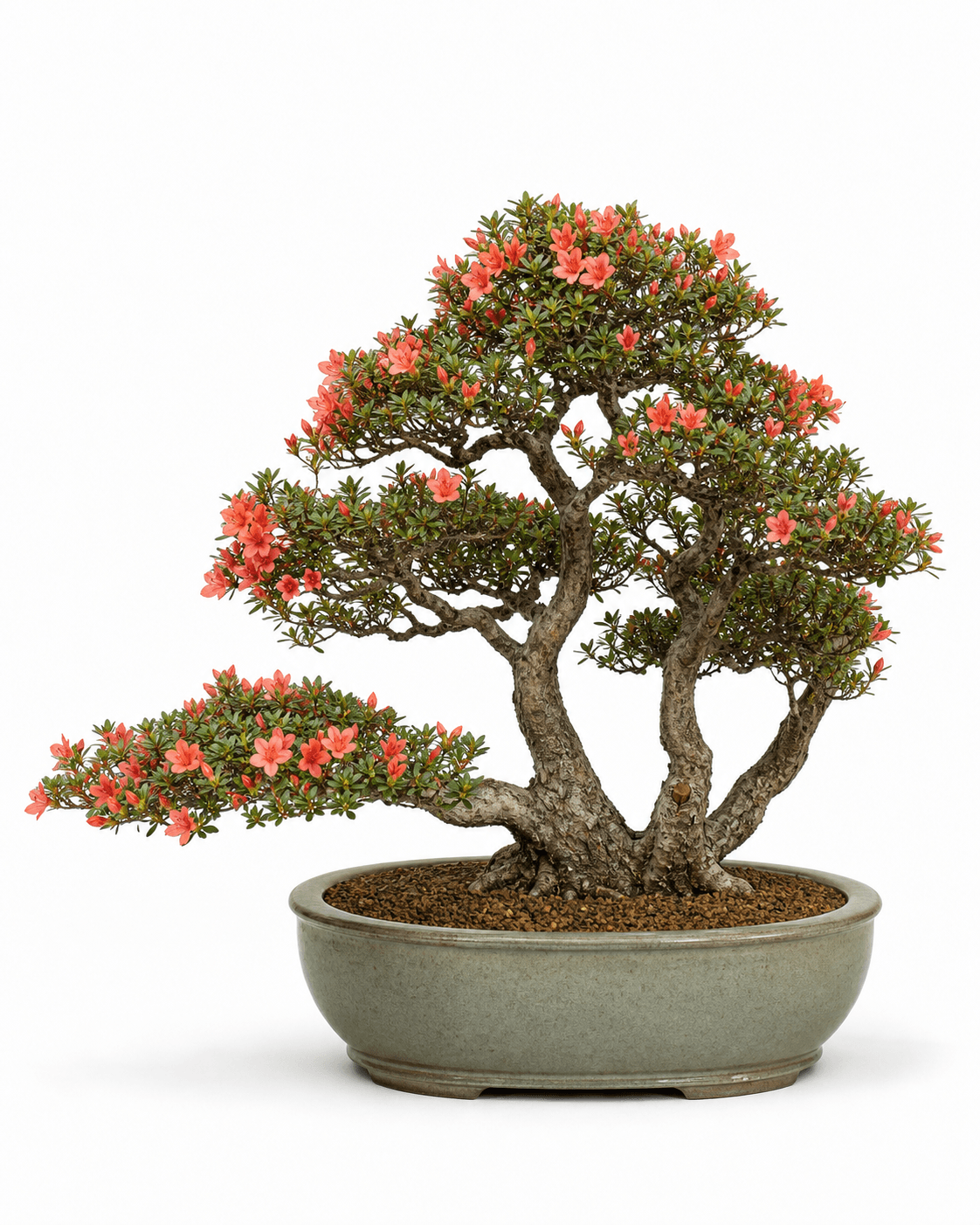
Kurume azalea is an outdoor flowering bonsai for growers who can protect fine roots, manage acidic water and soil, and prune immediately after the early spring bloom. The small leaves and flowers make it attractive for shohin and small bonsai, while the root system makes watering and repotting judgment the real skill.
Treat Kurume as Broadleaf > Azaleas in the EntGrove taxonomy. The local Mirai corpus has deep azalea method coverage and one Kurume-specific comparison, so this guide transfers Satsuki azalea technique carefully while calling out Kurume differences: earlier bloom, smaller foliage and flowers, lower tolerance for hard pruning, and more plausible natural deadwood.
Use indoor display only briefly during bloom. Long-term health comes from outdoor light, filtered heat, winter chill, moist oxygenated kanuma, prompt flower cleanup, spring root work, and patient staged design.
Updated June 14, 2026. Written by EntGrove Editorial. Last verified June 14, 2026.
Care fingerprint
Read the species through its shared care pattern.
Acidic substrate, careful post-bloom pruning, shallow fine roots, and flower-bud timing matter more than generic broadleaf pruning. Use this as the starting point before local conditions and tree strength refine the calendar.
Read the foliage first
Broadleaf stress usually shows in leaf color, leaf size, wilt, scorch, or delayed hardening before it becomes a branch problem.
Match work to dormancy
Deciduous, evergreen, tropical, succulent, and flowering broadleaf trees recover on different calendars.
Protect fine roots
Root work should preserve enough active fine roots for the tree to rehydrate quickly after the operation.
Care cadence
The calendar starts with the tree's seasonal state.
Watering
Timing: Check daily through bloom, warm wind, and the first year after repotting. Water when the surface begins to change color, then saturate the full root mass and let air return.
Watch for: Hard-dry kanuma, runoff through a crusted surface, stale wet lower roots, alkaline water, wilted flowers, and a center root core that stays dry.
Bonsai Mirai LibraryUniversity of Missouri ExtensionFlower cleanup
Timing: Remove petals and the green seed-bearing organ as bloom finishes. Sweep the canopy more than once because hidden ovaries are easy to miss.
Watch for: Seed pods, petals trapped in dense twigging, wet brown flowers, weak interior shoots, and flower load on young material that still needs growth.
Bonsai Mirai LibraryUC IPM petal blightPruning
Timing: Do main pruning immediately after the early bloom, before the post-flower flush spends stored energy and before the next flower buds are set.
Watch for: Threes and fours at one node, strong basal shoots, weak apex, late cuts that sacrifice flowers, and hard pruning repeated on a tree with weak roots.
Bonsai Mirai LibraryClemson ExtensionRepotting
Timing: Favor February through April, before new shoots elongate. Keep severe root work separate from severe pruning unless the plant is freshly lifted with field vigor.
Watch for: Compacted surface roots, black sour roots, peat cores, torn fine roots, dust-clogged kanuma, and disturbance under the trunk core.
Bonsai Mirai LibraryUC IPM nursery azaleaFertilizing
Timing: Feed established developing trees through active growth when roots work and temperatures are above roughly 50 F. Reduce bloom-year feeding if flower display is the goal.
Watch for: Pushing coarse shoots during exhibition preparation, fertilizing stale roots, chlorosis from pH drift, and pest attraction on lush summer growth.
Bonsai Mirai LibraryWiring
Timing: Wire younger flexible branches selectively, often in fall after bark has firmed. Use aluminum, support the bend, and check marks often.
Watch for: Thin bark, brittle older wood, wire bite during swelling, twisting the branch shoulder, and wiring fine tips instead of pruning them.
Bonsai Mirai LibrarySummer heat
Timing: Use filtered afternoon shade, pot shading, surface moss, and cooling water only when heat exceeds the root system capacity.
Watch for: Leaf scorch, faded blooms, hot pot walls, root mass close to the pot edge, lace bugs, and weak growth from keeping the tree in heavy shade all season.
Bonsai Mirai LibraryClemson ExtensionWinter protection
Timing: Keep dormant outdoors with root protection from hard freezes, dry wind, and freeze-thaw swings. Avoid warm winter storage that prevents rest.
Watch for: Foliage or trunk freeze injury below about 25 F, late-spring frost after soft growth opens, rodent damage, and pests surviving in warm shelter.
Bonsai Mirai LibraryOklahoma State ExtensionOregon State Landscape PlantsSpecies guide
Apply the species profile before copying another tree's calendar.
At a glance
Kurume is a compact Japanese evergreen azalea group with demanding fine roots.
Oklahoma State lists Kurume azalea as Rhododendron x obtusum in Ericaceae, with Japan as the origin, evergreen to semi-evergreen leaves, a compact shrub habit, and USDA Zone 6 landscape hardiness. Kew complicates the name by treating Rhododendron obtusum as a synonym under Rhododendron indicum, so the page uses Kurume hybrids as the practical horticultural identity. Oklahoma State ExtensionKew POWO
The bonsai value is scale. Oregon State describes R. kiusianum as a low, dense, twiggy shrub with small leaves and flowers about 2.5 cm across, and notes that some forms are used in bonsai. Mirai adds the bonsai comparison: Kurume has smaller leaves and flowers than Satsuki, flowers before leafing out, tolerates hard pruning less, and can carry natural deadwood more convincingly. Oregon State Landscape PlantsBonsai Mirai Library
The practical specification is narrow: outdoor culture, bright filtered light, pH-aware water, sifted kanuma or an equivalent fine-root substrate, 2-4 year root review, pruning immediately after bloom, and winter protection for the pot. Good sizes range from shohin to medium flowering shrub images, with clump, informal upright, and small literati forms all possible when the base and branch line support them. Bonsai Mirai LibraryClemson Extension
Wild habitat
Read Kurume through Japanese evergreen azalea ancestry and small mountain-shrub scale.
Kurume is a cultivated group rather than a single wild species page. The Azalea Society material places Kurume inside the broader Japanese evergreen azalea and Obtusum Group conversation, and Oregon State points to R. kiusianum from Kyushu Island at 4,000 to 5,000 ft as a relevant parent or close influence. Azalea Society of AmericaThe AzaleanOregon State Landscape Plants
For care, that ancestry points to a cool-rooted acid-loving shrub rather than a drought shrub. The plant wants moisture, oxygen, and partial shade when heat is strong. It also needs enough spring and fall light to build dense buds and compact internodes. Oklahoma State ExtensionClemson ExtensionBonsai Mirai Library
For design, the wild read is compact shrub, twig density, flower mass, low branching, and small-scale proportion. The tree should look like an aged flowering shrub in miniature rather than a pine with petals attached. Bonsai Mirai / AsymmetryOregon State Landscape Plants
Reading the tree
Start with roots, apex strength, flower load, and cultivar vigor.
A healthy Kurume reads first through the root environment. Mirai azalea method treats horticulture as the foundation: once water, fertilizer, repotting, and pests are correct, azaleas bud readily and can be designed. When roots decline, design options vanish quickly. Bonsai Mirai Library
Read apex strength carefully. Mirai ties weak azalea apexes to over-pruning the top, old inefficient branch tips, stale kanuma, and disturbance under the trunk core. A weak apex should guide you toward root correction, lower-branch reduction, and recovery, rather than more top pruning. Bonsai Mirai Library
Read flower load as a design choice. Flowers are the reason to grow Kurume, yet seed production drains stored energy. On young or recovering material, remove spent flowers and ovaries promptly and accept a smaller display if the tree needs growth. Bonsai Mirai Library
Read cultivar vigor before deciding how hard to work. Mirai warns that newer hybridized azaleas can be weaker than old robust varieties. The Azalea Society context reinforces that Kurume is a group, so a cultivar label is horticultural evidence rather than decoration. Bonsai Mirai LibraryThe Azalean
Pruning
Prune immediately after bloom, then let the next cycle build.
Kurume blooms earlier than Satsuki. Clemson places normal Kurume bloom from late March to mid-April, while Satsuki examples bloom May to June. That earlier flower window pulls the main pruning decision earlier on the calendar. Clemson Extension
Mirai post-flower method is direct: remove petals and the green seed-bearing organ at the base of each flower, then thin shoot clusters. Where three shoots emerge, reduce to two, favor laterals, and stagger lengths so the pad remains natural rather than hedge-flat. Bonsai Mirai Library
Use Kurume restraint where it differs from Satsuki. Mirai specifically notes lower tolerance for hard pruning, so reset structure slowly, especially on an established bonsai. Strong field-grown material can tolerate stronger first correction, but established potted trees deserve staged reductions. Bonsai Mirai Library
The refinement goal is young efficient branch tips. Mirai describes azalea branch tips aging out in roughly 2-3 years, so the best Kurume outlines are rebuilt in small cycles before tips become gray, stiff, and weak. Bonsai Mirai Library
Repotting
Repot in spring and protect the dense root sheen under the trunk.
Mirai azalea repotting now favors spring, usually February through April before new shoots elongate. Older post-flowering repotting traditions have become riskier as summer heat arrives sooner, especially for potted azaleas with fresh root cuts. Bonsai Mirai Library
The interval is condition-based. Mirai gives roughly every three years as a baseline, two years for heavily fed or fast-matting trees, and four years in cooler slower climates. Inspect drainage, surface compaction, root smell, and apex vigor rather than using a blind date. Bonsai Mirai Library
Root work should concentrate on the surface layer, where shrub roots live and where compacted fertilizer, moss, and broken-down kanuma block water and oxygen. Mirai warns against disturbing the dense core directly under the trunk once it has formed, because apex dieback can follow. Bonsai Mirai Library
Work fast and wet. Exposed azalea roots can dry within minutes, kanuma dust must be flushed out, and aggressive chopstick pressure crushes soft particles into drainage-blocking dust. Tie the tree with thick aluminum rather than a cutting wire that slices the fibrous root pad. Bonsai Mirai Library
After severe root work, keep the tree above freezing, out of wind and hard rain, below roughly 65 F air temperature, and in bright humidity until elongating new shoots prove recovery. Bonsai Mirai Library
Soil and pot
Kanuma works because it stays moist, soft, and acidic enough for fine roots.
Mirai explains kanuma as a mechanical match for azalea roots, beyond acidity alone. Its soft, microporous particles let very fine roots penetrate while holding moisture. Akadama can work as a substitute when water and fertilizer keep pH in the right range, while kanuma remains the specialist choice. Bonsai Mirai Library
Use clean particles. Buy fresh kanuma, sift dust aggressively, and flush a new planting until runoff clears. A small addition of same-sized pumice, often 5-20% depending on the local method, can keep percolation open and make future repots easier. Bonsai Mirai Library
Missouri Extension gives pH 5.0-5.5 as an azalea and rhododendron target, which is useful for water and fertilizer decisions. In bonsai, water quality can shift a small pot quickly, so alkaline tap water should trigger rainwater, filtration, or pH monitoring. University of Missouri ExtensionBonsai Mirai Library
Pot choice is horticultural first. Mirai favors slightly deeper azalea pots and enough soil between the woody root mass and pot wall to buffer heat. A shallow exhibition pot should wait until the root system is compact, vigorous, and predictable. Bonsai Mirai Library
For design, quiet glazed or muted unglazed containers can work, depending on flower color and bark age. The pot should support a flowering shrub image without turning the bloom into a bright decorative object disconnected from the trunk. Bonsai Mirai / Asymmetry
Climate
Use the landscape hardiness as a clue, then protect the bonsai root ball.
Oklahoma State lists Kurume azalea for USDA Zone 6, and Oregon State records R. kiusianum hardiness around -10 F. Those are landscape signals. A bonsai pot loses soil volume, ground insulation, and deep root access, so root protection should be more conservative. Oklahoma State ExtensionOregon State Landscape Plants
In cool maritime climates, give more sun in spring and fall, keep rain from turning old kanuma anaerobic, and protect from late frosts after soft growth appears. Mirai notes that spring frost after new growth emerges can harm tissue that winter-hardened foliage would have tolerated. Bonsai Mirai Library
In hot inland climates, use morning sun, filtered afternoon shade, pot shading, and attentive water. Mirai frames azalea summer stress as root-zone heat and oxygen stress; a tree can tolerate some dryness better than cooked roots. Bonsai Mirai LibraryClemson Extension
In hard-water regions, water chemistry becomes climate adaptation. Slightly acidic, low-impurity water is part of the care plan, especially where municipal water pushes pH upward and leaves mineral deposits. Bonsai Mirai LibraryUniversity of Missouri Extension
In winter, give chill and protection at the same time. Mirai notes that azaleas benefit from real winter rest near freezing, while roots and thin bark need protection from deep freeze, drying wind, and warm shelters that keep pests active. Bonsai Mirai Library
Pests and diseases
The common enemies are lace bugs, mites, scale, petal blight, chlorosis, and root rot.
Mirai lists spider mites, thrips, scale, aphids, and lace bugs as common azalea pests, especially on vigorous well-fed trees in hot humid climates. Clemson adds that azaleas in full sun are more susceptible to lace bugs than plants in partial shade. Bonsai Mirai LibraryClemson Extension
UC IPM petal-blight guidance matters during bloom. Wet blossoms, poor sanitation, and petals left in the canopy create a disease-prone display. Remove spent flowers, improve airflow, and avoid overhead watering during bloom when practical. UC IPM petal blight
UC IPM nursery guidance ties Phytophthora and Pythium root rot to overwatering, poor drainage, and weakened plants. Mirai describes the bonsai version as broken-down kanuma, anaerobic pockets, and root disturbance becoming apex weakness or branch dieback. UC IPM nursery azaleaBonsai Mirai Library
Chlorosis should trigger water, pH, and root checks before a fertilizer response. Oklahoma State notes Kurume can develop iron chlorosis and is sensitive to heat and drought, while Mirai adds magnesium and pH drift signals in azalea foliage. Oklahoma State ExtensionBonsai Mirai Library
Dormant pest control can include a properly diluted lime-sulfur program where legal and locally appropriate. Mirai cites a 30:1 water-to-lime-sulfur dormant spray for scale and overwintering insects, applied only after full dormancy. Bonsai Mirai Library
Wiring
Wire selectively with aluminum and let pruning do most refinement.
Mirai recommends aluminum wire for azaleas because the bark is thin and soft. Copper is too abrasive for the work most Kurume branches need. Use wire to set structural and major secondary lines, then return to pruning for fine twigging. Bonsai Mirai Library
Fall is often the safer wiring window because bark has hardened slightly while wood can still move. Support each bend with the off hand, reduce torque, and avoid asking brittle older wood to do what a young shoot should have done earlier. Bonsai Mirai Library
Wire marks can appear fast once active swelling starts. Check contact points through spring and fall, especially where flower cleanup or pruning has changed sap flow. Remove wire early and reapply later rather than allowing a scar to become part of the trunk story. Bonsai Mirai Library
Avoid wiring every fine tip. Mirai notes that routine wiring of fine azalea tips is unsustainable over time, while shoot selection and clip-and-grow build the 2-by-2 branch skeleton more cleanly. Bonsai Mirai Library
Propagation
Cuttings preserve cultivars; grafts and layers are specialized tools.
Cuttings are the practical way to preserve a Kurume cultivar. Mirai gives Satsuki two transferable azalea cutting windows: early spring hardwood or semi-hardwood before bud push, and semi-hardwood after the first flush hardens, with flowers removed to conserve energy. Bonsai Mirai Library
Seed can produce variation and may be useful for breeding or long-term experiments. Flower size, color, growth habit, and vigor should be expected to vary away from a named Kurume cultivar. The AzaleanBonsai Mirai Library
Approach grafting can solve a missing branch, although Mirai warns that azalea grafts can remain weaker because the attachment may stay more skin-to-skin than fully vascular. Air-layering is possible on many broadleaf shrubs, but for Kurume a rooted cutting or young nursery plant is usually cleaner. Bonsai Mirai Library
Propagation material should be labeled at the cultivar level. Kurume as a group already carries taxonomic ambiguity, so accurate nursery records support future care and collection bookkeeping. Azalea Society of America
Buying
Buy for root quality, low structure, cultivar clarity, and realistic flower scale.
Good Kurume material has a visible base, compact leaves, small flowers, healthy leaf color, flexible young shoots, multiple usable low branches, clean drainage, and an identifiable cultivar or group label. Oklahoma State ExtensionOregon State Landscape PlantsBonsai Mirai Library
Be cautious with peat-heavy nursery cores, weak spindly growth, persistent chlorosis, wilt after watering, dead apexes, poor drainage, graft unions that disrupt the base, and plants bought only for bloom color. Clemson ExtensionBonsai Mirai LibraryOklahoma State Extension
Landscape removals can produce aged trunks, but Mirai gives the strongest root and branch correction window at field lifting when vigor is high. Once the plant has lived in a bonsai pot for years, heavy single-pass correction becomes much riskier. Bonsai Mirai Library
Separate Kurume from Satsuki and Kaempferi in records. Care overlaps heavily, yet bloom timing, flower scale, pruning tolerance, and deadwood suitability differ enough that the label changes decisions. Bonsai Mirai LibraryClemson ExtensionAzalea Society of America
Troubleshooting
Diagnose Kurume by root oxygen, pH, heat, bloom timing, and recent work.
Kurume symptoms often look vague from the top. Start with the substrate, water source, drainage speed, flower and pruning calendar, and recent root work before treating every yellow leaf as a single missing nutrient. Bonsai Mirai LibraryOklahoma State ExtensionUC IPM nursery azalea
Design
Style Kurume as an aged flowering shrub with small-scale proportion.
Begin with base, trunk line, defining branch, and apex, then ask whether the plant wants compact shrub character, clump, informal upright, literati, or a low spreading image. Mirai design method starts with what the tree can express, and Kurume expresses flower mass, twig density, and small scale. Bonsai Mirai / AsymmetryBonsai Mirai Library
The defining branch should support the bloom display without letting flowers hide every design decision. Build negative space before the tree flowers, then evaluate whether the bloom improves the silhouette or covers weak branch structure. Bonsai Mirai / Asymmetry
Major changes should be staged. Mirai warns that azaleas weakly compartmentalize large cuts and can die back along live lines. Kurume has lower hard-pruning tolerance than Satsuki in the corpus, so large reductions need foliage draw, time, and wound care. Bonsai Mirai Library
Deadwood is possible with more credibility on Kurume than on Satsuki, according to Mirai, and it should stay subtle and natural. Soft azalea wood decays easily, so deadwood should read as age and weathering rather than carved juniper drama. Bonsai Mirai LibraryBonsai Mirai / Asymmetry
Cultivars
Kurume cultivar labels are care data, especially for bloom timing and work tolerance.
Clemson lists Coral Bells, Hinodegiri, Pink Pearl, and Snow as popular Kurume varieties, and notes that Coral Bells can bloom very early with dense small flowers. Treat those names as clues for timing, flower color, vigor, and display scale. Clemson Extension
The Azalea Society material describes Kurume as a named horticultural group with complex hybrid history. That history means two Kurume-labeled plants can differ in vigor, flower size, flower timing, and tolerance for heavy work. Azalea Society of AmericaThe Azalean
For bonsai, the cultivar question is practical: small flowers suit small trees, compact leaves help scale, strong root response expands styling options, and branch brittleness limits how much wiring can correct poor structure later. Bonsai Mirai LibraryOregon State Landscape Plants
Keep Satsuki, Kurume, Kaempferi, Gable, Glen Dale, and Encore labels separate in records until a plant is identified. The visual similarities are real, but pruning and bloom timing should follow the actual group and cultivar. Clemson ExtensionAzalea Society of America
History
Kurume bonsai sits inside Japanese evergreen azalea breeding and small-flower display culture.
The Azalea Society articles frame Kurume as a horticultural group that became prominent through Japanese evergreen azalea selection rather than as one clean wild species. That is why EntGrove treats the page as a group care guide. Azalea Society of AmericaThe Azalean
R. kiusianum provides a useful historical and scale reference. Oregon State describes it as a low dense Kyushu shrub with small flowers, many cultivars, and some bonsai use, which matches the small-tree appeal that made Kurume useful for bonsai. Oregon State Landscape Plants
In exhibition terms, Kurume has a different role from large-flowered Satsuki. It can carry the flowering-azalea image at smaller sizes, and its early spring bloom gives the grower a different calendar for preparation, pruning, and post-bloom recovery. Clemson ExtensionBonsai Mirai Library
Species questions
Answer the beginner questions before styling.
Is Kurume azalea a good beginner bonsai?
Yes for an attentive outdoor beginner who can water fine roots carefully, keep the soil acidic and oxygenated, and prune immediately after bloom. It is a poor fit for warm indoor shelves or casual hard pruning.
Can Kurume azalea bonsai live indoors?
Use indoor display only briefly during bloom. Long-term health depends on outdoor light, airflow, seasonal chill, and protected winter dormancy.
How often should I water Kurume azalea bonsai?
Water from pot condition. Keep kanuma evenly moist and slightly acidic, then make sure water exits cleanly so oxygen returns around the fine roots.
When does Kurume azalea bloom?
Kurume is an early spring azalea. Clemson places normal Kurume bloom from late March to mid-April, earlier than Satsuki bloom.
When should I prune Kurume azalea bonsai?
Do the main pruning as soon as flowering finishes. Remove spent petals and ovaries, thin shoot clusters to two, and avoid late cuts that sacrifice the next bloom.
When should I repot Kurume azalea bonsai?
Favor spring, usually February through April before shoots elongate. Established trees often fall into a 2-4 year rhythm, adjusted by drainage, kanuma breakdown, vigor, and climate.
What soil is best for Kurume azalea bonsai?
Sifted kanuma is the standard because it is soft, moist, and suitable for fine azalea roots. A small amount of same-sized pumice can improve long-term percolation.
Is Kurume azalea the same as Satsuki azalea?
They are separate azalea labels with overlapping care. Kurume usually flowers earlier, has smaller leaves and flowers, tolerates hard pruning less, and can carry natural deadwood more plausibly than Satsuki.
Why are my Kurume azalea leaves turning yellow?
Common causes include alkaline water, high pH, iron or magnesium availability, compacted kanuma, root rot, heat stress, lace bugs, or recent root disturbance. Check water, drainage, roots, and leaf undersides before feeding harder.
Sources
Species advice needs source discipline.
Next decisions
Plan the operation before copying the calendar.
A good care note for Kurume azalea records the tree's stage, the work done, and the aftercare used. That record matters more than a month-name rule.
Related species
Compare nearby trees before transferring advice.
Satsuki azalea
Rhododendron indicum
Kaempferi azalea
Rhododendron kaempferi