
Species guide
Shimpaku Juniper Bonsai Care
Juniperus chinensis var. sargentii
Shimpaku is an outdoor scale juniper for growers who can provide full sun, airflow, cold dormancy, and patient staged work. Its foliage stays green after root decline, so the safest beginner plan is strength first: sun, drainage, foliage mass, and one major operation at a time.
The name is a trade and bonsai label around the Sargent juniper complex. Kew accepts Juniperus chinensis var. sargentii, while nursery labels may say Shimpaku, Shinpaku, Juniperus sargentii, Chinese juniper, Itoigawa, Kishu, Toyama, or a grafted combination.
Mirai treats Shimpaku as a mounding juniper. It builds dense basal scale foliage before elongating, so refinement depends on waiting for spiking tips, cleaning bottoms and crotches, pruning back to strong interior ramification, and preserving every branch that still feeds a live vein.
Updated July 12, 2026. Written by EntGrove Editorial. Last verified July 12, 2026.
Care fingerprint
Read the species through its shared care pattern.
Maintain strong scale foliage, preserve interior light, and avoid overcleaning or pinching weak tips. Use this as the starting point before local conditions and tree strength refine the calendar.
Keep foliage strong
Junipers recover through active foliage, so styling choices should leave enough healthy tips to power the tree.
Protect live veins
Old junipers often depend on narrow live veins between roots and foliage; root work and carving should respect that path.
Do not stack major work
Heavy bending, major foliage reduction, carving, and repotting belong in a staged plan rather than the same weekend.
Care cadence
The calendar starts with the tree's seasonal state.
Placement
Timing: Grow outdoors year-round with sun, airflow, and winter dormancy. Short indoor display is possible after watering, followed by a return outside.
Watch for: Warm indoor storage, low light, stale air, pale weak tips, spider-mite pressure, or foliage that stays green while roots have already failed.
NC State ExtensionBonsai Mirai LibraryWatering
Timing: Water by root-zone evidence: full saturation, complete drainage, then oxygen return. Check more often during heat, wind, post-styling aftercare, or small-pot refinement.
Watch for: Hydrophobic old cores, water bypassing the center, constant wetness, dry deadwood pockets near live roots, and reduced water use after foliage reduction.
Bonsai Mirai LibraryNC State ExtensionFertilizer
Timing: Feed developing trees from active growth to build foliage mass. In refinement, feed lightly and strategically after the spring flush hardens so growth stays compact.
Watch for: Overfertilized beach-ball growth, weak trees being force-fed, recently repotted roots, and mite-prone tight cultivars pushed too lush in heat.
Bonsai Mirai LibraryCleaning and pruning
Timing: For refinement, begin after dense mounded foliage produces elongating spiking tips, often late July through September. Clean bottoms, crotches, weak interiors, then prune runners to strong ramified growth.
Watch for: Pinching, hedge shearing, cutting to bare wood, stripping strong tufts, losing interior light, and juvenile foliage from stress.
Bonsai Mirai LibraryWiring and structural work
Timing: Wire when the tree is vigorous and cambium has reattached after spring growth hardens. Heavy bends belong in active, recoverable windows, with raffia, rotation, and secure anchoring where needed.
Watch for: Cambium slipping, lateral bark cracks, deadwood used as a lever, weak graft unions, wire bite during thickening, and winter styling without protected aftercare.
Bonsai Mirai LibraryRepotting
Timing: Repot strong trees in a locally proven juniper window before the tree is exposed to heat stress. Keep a functioning root core, preserve foliage mass, and convert old soil in stages.
Watch for: Bare-rooting, washing the entire core, repotting after hard spring growth, stacking root work with heavy styling, or leaving a sour center untouched.
Bonsai Mirai LibraryPropagation and grafting
Timing: Root cuttings, air-layer suitable sections, or graft rooted whips only from vigorous, pest-clean material. Approach grafts need both host and scion watered until vascular union is secure.
Watch for: Weak hosts, mismatched graft diameter, grafts too close to future bends, premature scion severing, and cultivar labels without a provenance record.
Bonsai Mirai LibraryWinter protection
Timing: Keep dormant outside. Protect from freezing wind, frozen-dry roots, and repeated freeze-thaw in small pots; group trees, ground-set pots, or use an unheated structure as needed.
Watch for: Warm storage, dry winter soil, exposed refined foliage, wind below freezing, and greenhouse water demand that continues while roots are active.
Bonsai Mirai LibraryPests and disease
Timing: Inspect dense pads and branch crotches during heat, after pruning, before wiring, and in winter storage.
Watch for: Spider mites, scale, aphids, bagworms, webworms, borers, cedar-apple rust, twig blights, cankers, Phytophthora, root rot, scorch, and water stress.
NC State ExtensionUC IPM JuniperUC IPM Juniper Twig BlightsSpecies guide
Apply the species profile before copying another tree's calendar.
At a glance
Shimpaku is a mounding scale juniper for outdoor bonsai.
The botanical anchor for Shimpaku is Juniperus chinensis var. sargentii, a Cupressaceae subshrub or shrub native from the Russian Far East to North Korea and Japan. NC State treats the common nursery plant as Juniperus chinensis 'Shimpaku', a slow dwarf Chinese juniper with soft gray-green to dark green foliage, peeling bark, good drainage needs, full sun preference, and USDA Zones 4a to 9b. Kew POWONC State Extension
As bonsai, the practical spec is clearer than the label: outdoor evergreen conifer, full sun with heat moderation where needed, water by dry-down and oxygen return, mineral soil, conservative repotting every few years, no routine pinching, no bare-wood cutback, and winter root protection in containers. Bonsai Mirai LibraryNC State Extension
The best beginner sizes are shohin through medium bonsai when the trunk already has movement or the tree is a young cutting that can be grown patiently. Older grafted, collected, or heavily deadwooded material should be treated as intermediate because live veins, graft unions, and staged recovery decide the safe work. Bonsai Mirai LibraryBonsai Mirai / Asymmetry
Wild ecology
Its wild lesson is low mountain juniper, live vein, and durable deadwood.
Kew places Juniperus chinensis var. sargentii in the temperate biome across Japan, Korea, the Russian Far East, Sakhalin, the Kurils, Khabarovsk, Primorye, and Manchuria. That geography matters because the tree expects outdoor seasonal change rather than warm constant indoor conditions. Kew POWO
The care implication is strong light, drainage, and dormancy with protection from container extremes. Bonsai soil should imitate the function of rocky well-drained habitat, not the exact ground. The shallow pot needs water retention, oxygen movement, and enough root continuity to feed evergreen foliage through summer heat and winter wind. NC State ExtensionBonsai Mirai Library
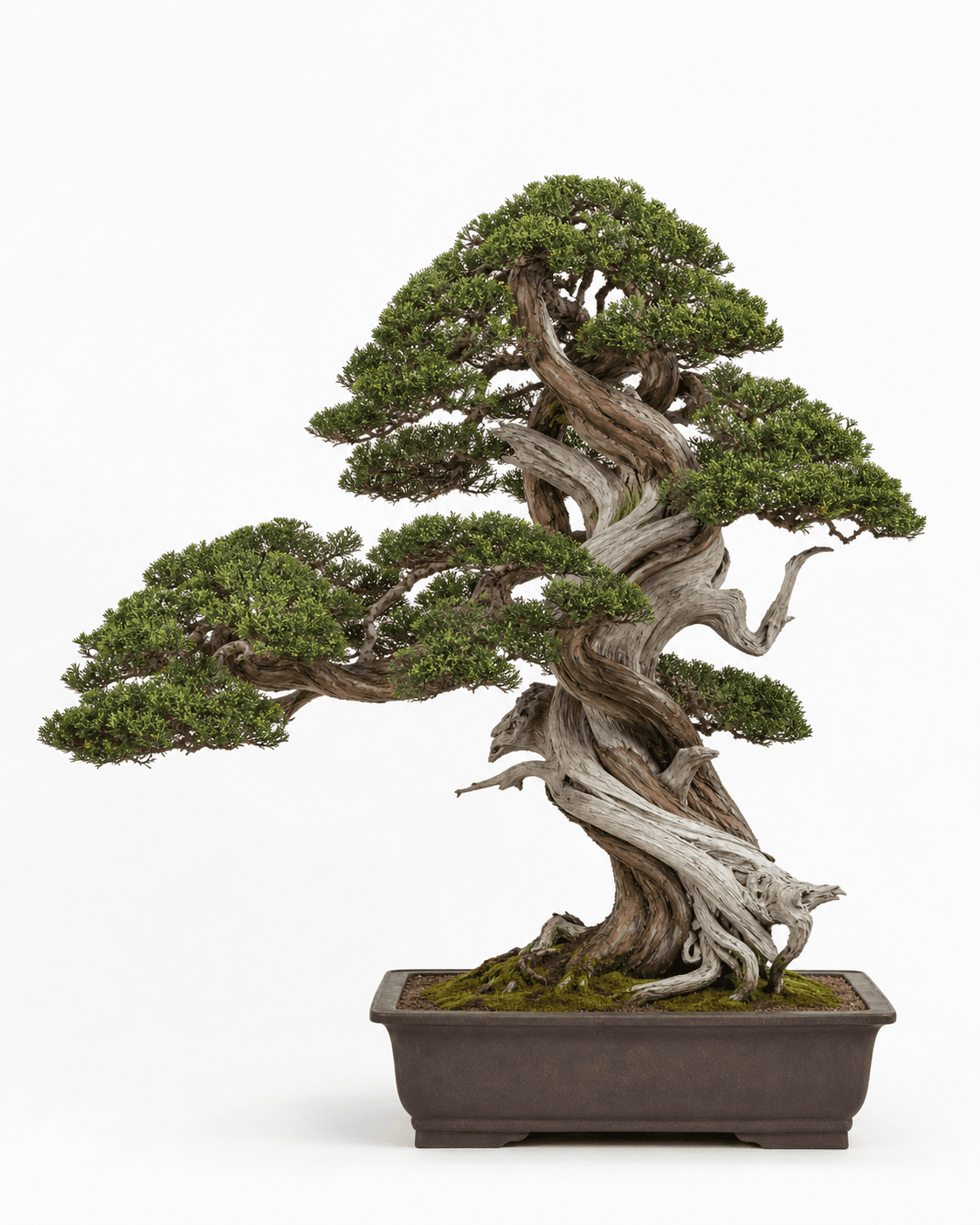
The design implication is even more important. Shimpaku bonsai should read through a living vein beside old wood, compact foliage that has survived exposure, and asymmetry produced by age and pressure. Deadwood, shari, and jin are most convincing when they explain how the tree lived. Bonsai Mirai LibraryBonsai Mirai / Asymmetry
Reading the tree
Mounding growth changes the timing of every cut.
Mirai separates Shimpaku from most native running junipers by growth habit. Shimpaku, Itoigawa, Kishu, and Toyama mound first: they build dense foliage at the base of a shoot, then later produce elongating tips. Running junipers elongate first, then backfill density. Bonsai Mirai LibraryBonsai Mirai juniper identification
That behavior explains the refinement cue. A dense mound without spiking tips should keep building. Once strong elongating tips appear beyond the foliage mass, the tree has enough surplus to clean weak interiors, remove bottom growth, decide crotches, and prune back to secondary or tertiary ramification. Bonsai Mirai Library
Foliage mass is the strength reservoir. More efficient foliage means more photosynthesis, stronger roots, faster grafting response, and better recovery after wiring or pruning. Weak, shaded, off-color interior shoots can become energy consumers after two or three years, while robust tufts at the edge are still the engine. Bonsai Mirai LibraryBonsai Tonight shimpaku vigor note
Cleaning and pruning
Clean bottoms, decide crotches, then prune only to live ramification.
The Shimpaku maintenance cycle has four parts: remove foliage hanging from the bottom line of the pad, address crotch growth selectively, remove spent weak interior pieces, and prune elongating tips back to strong interior ramification. The order matters because the bottom line reveals the pad before top growth is judged. Bonsai Mirai Library
Crotch growth needs a decision, not a reflex. Keep it when it is stronger, tighter, and better positioned than the parent piece it can replace. Remove it when the parent branch is healthy and the crotch shoot would steal flow from the intended ramification. Bonsai Mirai Library
Avoid pinching. Mirai is direct that pinching scale junipers creates stress and juvenile foliage. Use sharp scissor pruning back to a strong growing secondary or tertiary piece. Cutting past viable foliage or into bare wood rarely produces useful back budding. Bonsai Mirai Library
Juvenile prickly foliage is a diagnostic signal. Strong juvenile shoots at upper tips can mean vigor, while juvenile shoots in crotches, undersides, or after heavy work often signal stress and disrupted water flow. Restore culture and wait for mature scale growth before asking the tree for more refinement. Bonsai Mirai LibraryBonsai Mirai juniper identification
Repotting and roots
Repot from strength and keep the root-to-foliage system functioning.
Junipers regenerate roots from foliage-driven strength. A Shimpaku with weak foliage, no elongating tips, poor color, or recent heavy styling should not be repotted unless the roots are in urgent decline. First rebuild light, water, oxygen, and foliage mass. Bonsai Mirai Library
A good repot preserves root continuity while restoring percolation. Cut away dead roots and compacted outer mats, keep a functioning core under the trunk, tie the tree securely, and chopstick fresh particles into real root contact. Old nursery soil is usually converted across multiple repots. Bonsai Mirai Library
Timing is regional. General conifer repotting often falls near spring bud movement, while Mirai scale-juniper guidance separates true needle junipers from scale junipers and warns that repotting after spring growth has already pushed and partly hardened gives poor odds. Match the local window to tree strength, aftercare, and heat risk. Bonsai Mirai Library
After root work, keep the tree stable, protected from hard wind, and watered by reduced foliage demand. Heavy pruning or bending in the same recovery window is a common failure pattern because roots and foliage need each other to rebuild. Bonsai Mirai Library
Soil and pot
Use fine mineral particles for fine roots and compact foliage.
NC State gives the landscape rule: Shimpaku tolerates many soil pH and texture conditions when drainage is good, and root rot becomes a problem where drainage fails. Bonsai narrows that into a particle mix that holds enough water for evergreen foliage while opening oxygen after every watering. NC State ExtensionBonsai Mirai Library
For established refined Shimpaku, Mirai uses an akadama-forward juniper mix such as 2 parts akadama, 1 part lava, and 1 part pumice, with roughly 1/16 to 1/4 inch interior particles. Development, heat, rain, pot size, and old soil can push the mix coarser or more structural. Bonsai Mirai Library
Pot choice should support the tree stage before show proportion. Use deeper training containers during nursery-core conversion, graft establishment, or post-styling recovery. Refined Shimpaku often belongs in unglazed, quiet containers that strengthen the live-vein and deadwood story without competing with it. Bonsai Mirai LibraryBonsai Mirai / Asymmetry
A good potting record includes mix ratio, particle size, old soil retained, root reduction, tie-down path, top dressing, water behavior, aftercare location, and when the tree resumed active extension. Bonsai Mirai Library
Climate adaptation
Landscape hardiness does not remove container risk.
NC State's Zone 4a to 9b landscape range is useful for climate screening, but shallow bonsai containers lose thermal buffer. Protect roots as the root zone approaches hard freeze, and prioritize wind protection because frozen roots cannot replace water stripped from evergreen foliage. NC State ExtensionBonsai Mirai Library
Hot dry climates create the opposite problem. Junipers photosynthesize well in moderate summer warmth, then close down as heat climbs. Use morning sun, afternoon shade, pot shading, and precise watering during high-90s F heat rather than stripping foliage or watering constantly into stale soil. Bonsai Mirai Library
Humid regions need airflow and sanitation. Tight Shimpaku pads can hold wetness inside the canopy, and UC IPM lists twig blights, cankers, rusts, Phytophthora, and water-stress disorders across junipers. Dense foliage should be opened for light and air only when the tree is strong enough. UC IPM JuniperUC IPM Juniper Twig BlightsBonsai Mirai Library
Indoor wintering is a cultural mistake for temperate Shimpaku. Use an unheated cold frame, protected bench, ground-set grouping, or windbreak where needed, then keep water available during thaws and in any structure warm enough for root activity. Bonsai Mirai Library
Pests and diseases
Most pest pressure starts with dense pads, stress, or wet roots.
NC State lists tip and needle blight, root rot without good drainage, aphids, bagworms, webworms, and cedar-apple rust for Shimpaku. UC IPM adds common juniper problems including spider mites, scales, borers, bark beetles, twig blights, cankers, Phytophthora, rusts, scorch, nutrient disorders, and water stress. NC State ExtensionUC IPM Juniper
Spider mites deserve regular inspection on tight cultivars, especially Itoigawa. Mirai teaches the white-paper tap test: tap foliage over white paper, smear the moving specks, and read red streaks as mites, brown as aphids, and green as predatory mites. Hot, dry, dusty benches raise risk. Bonsai Mirai LibraryUC IPM Juniper
Twig blights and cankers usually worsen where wounds, wet foliage, soft overfertilized growth, and poor airflow overlap. UC IPM emphasizes sanitation, removing infected tips, disposing of debris, improving dryness and airflow, and avoiding excess fertilizer. UC IPM Juniper Twig BlightsUC IPM Juniper
Root rot is diagnosed by watering behavior and growth response before foliage color alone. A Shimpaku can remain green for weeks after roots have failed, so stale wet soil, sour odor, weak extension, juvenile stress foliage, and slow dry-down are earlier warnings than brown tips. Bonsai Mirai LibraryNC State Extension
Wiring
Shimpaku bends well when timing, support, and live veins line up.
Major juniper bending should wait until after the spring flush has hardened and the cambium has reattached to the xylem. Mirai uses a small bark scratch on an unwanted branch as a field test: bark that strips cleanly means cambium is still slipping, while bark that chips in small pieces means safer structural timing. Bonsai Mirai Library
Wire each section for the move it needs. Structural wire, raffia, guy wires, and branch rotation distribute force across living tissue. Crotches are weak points, deadwood can break, and the outer arc of a bend should be watched for small lateral cracks that mark the limit. Bonsai Mirai Library
Detail wiring on Shimpaku should preserve the foliage cloud. Mirai advises stopping wire short of the dense tuft, then letting future maintenance re-clean bottoms, crotches, and spent interiors instead of wiring every tip into a flat plane. Bonsai Mirai Library
Wire checks are frequent in active growth. Some mild conifer constriction can help a bend set, but deep bite on small refined branches can scar, interrupt flow, and damage the living vein that feeds a pad. Bonsai Mirai Library
Propagation
Cuttings, layers, and grafts preserve the cultivar story.
Mirai treats Itoigawa, Kishu, and Toyama as clonal selections propagated by cuttings, layering, and grafting. Seedlings may be useful junipers, but they do not preserve a named cultivar unless the parentage and selection are proven. Bonsai Mirai Library
Cuttings should come from pest-clean, vigorous, mature scale foliage and be recorded by cultivar. Air layers are plausible on Juniperus chinensis material because of adventitious sites along bark, but they still require strong foliage, steady moisture, and patient aftercare. Bonsai Mirai Library
Approach grafting uses a rooted scion whip shaved to match a host branch, then watered on both root systems until vascular fusion is secure. It is useful when foliage quality, branch position, root weakness, or design scale makes the existing foliage a real limitation. Bonsai Mirai Library
Grafting records matter. Note rootstock species, scion cultivar, graft date, union position, tape changes, severing date, and any native foliage retained as backup. A grafted native trunk with Kishu foliage and an own-root Kishu cutting can require the same foliage maintenance while telling very different provenance stories. Bonsai Mirai Library
Buying and sourcing
Buy vigor, drainage, and honest labels before buying a cultivar name.
A good Shimpaku candidate has active firm scale foliage, extending tips in season, usable low branches, a visible trunk line, no sour compact root core, no heavy mite history, and no fresh major work hidden by a clean surface dressing. Bonsai Mirai LibraryBonsai Tonight shimpaku vigor note
Nursery stock is useful when the roots can be converted gradually and the trunk offers future movement. Pre-bonsai cuttings are best for learning Shimpaku maintenance from the beginning. Collected or grafted material needs provenance, aftercare history, graft details, and proof that the root system is functioning. Bonsai Mirai Library
Inspect the delayed-decline risk that applies to junipers. Green foliage at purchase does not prove recent roots are healthy. Ask when it was repotted, when it was wired, how much foliage was removed, what soil remains under the trunk, and whether it spent time indoors. Bonsai Mirai Library
Cultivar tags deserve verification. Itoigawa, Kishu, Toyama, Tohoku, Hokkaido, San Jose, Foemina, Blaauw, and generic Chinese juniper labels can be mixed casually in trade. Buy from sellers who can explain whether the tree is own-root, grafted, cutting-grown, imported, or recently restyled. Bonsai Mirai LibraryNC State Extension
Troubleshooting
Read symptoms as root, foliage, and timing clues.
Symptom: prickly juvenile foliage after pruning or bending. Likely cause: stress response from pinching, heavy reduction, root disruption, or poor water flow. Fix: stop styling, improve light and water-oxygen balance, feed lightly only when active, and wait for mature scale growth. Bonsai Mirai LibraryBonsai Mirai juniper identification
Symptom: pale weak interior and strong outer shell. Likely cause: dense exterior shading and no interior cleaning. Fix: wait for vigor and spiking tips, then remove spent interiors, bottom growth, and selected crotches while preserving productive tufts. Bonsai Mirai Library
Symptom: browning tips and dead small shoots. Likely cause: twig blight, mite feeding, wire damage, dry wind, root dysfunction, or cuts made into weak foliage. Fix: inspect with magnification and a tap test, remove confirmed infected tips, improve airflow, and correct culture before more pruning. UC IPM Juniper Twig BlightsUC IPM JuniperBonsai Mirai Library
Symptom: soil stays wet, smells sour, or water runs around the root ball. Likely cause: decomposed particles, compact old organic core, poor tie-down, or hydrophobic dry pockets. Fix: surface-clean if intact particles remain, then plan staged repotting in the correct window. Bonsai Mirai LibraryNC State Extension
Symptom: branch dies after bending. Likely cause: cambium slip, unsupported crotch load, cracked live vein, weak graft union, or too little foliage left to feed the line. Fix: trace the live vein, seal nothing by habit, protect aftercare, and delay further work until strong extension returns. Bonsai Mirai Library
Design reading
Let live vein, deadwood, defining branch, and apex agree on the story.
Start design reading with the base and live vein. Clean enough dead bark to see the red living line, the deadwood margin, and the direction of sap flow before choosing a front. Juniper value comes from live vein and deadwood together. Bonsai Mirai LibraryBonsai Mirai / Asymmetry
Then read the trunk line, defining branch, and apex. Shimpaku can support harmonious, tension, or dynamic design depending on how those three elements agree or disagree. Cascade and semi-cascade designs often need the apex to pull visual mass back toward the base. Bonsai Mirai LibraryBonsai Mirai / Asymmetry
For refinement, pad structure should create positive and negative space without flattening every old branch back to youth. Mature mounding-juniper branches show subtle phototropic curvature and underside cleanliness; preserving that movement communicates age. Bonsai Mirai Library
Deadwood maintenance is ongoing. Mirai recommends regular re-addressing of deadwood, especially near the soil line, and live-vein cleaning after recovery to reduce borer habitat and clarify the composition. Deadwood should support the tree story rather than dominate by default. Bonsai Mirai Library
Cultivars and forms
Itoigawa, Kishu, and Toyama solve different scale and resilience problems.
Mirai treats Itoigawa, Kishu, and Toyama as regional clonal selections of Juniperus chinensis with tight mounding foliage. They share the same broad maintenance regimen, but foliage scale, color, disease pressure, and design proportion differ. Bonsai Mirai Library
Itoigawa is prized for very fine, bright foliage, yet Mirai repeatedly flags higher mite and disease sensitivity in some North American conditions. Kishu is slightly coarser but often more vigorous and more resistant to spider mites, rust, and Phomopsis. Toyama can suit larger trunks because the foliage reads larger and deeper green. Bonsai Mirai Library
Fudo, Tohoku, Hokkaido, San Jose, Foemina, Blaauw, and other Chinese-juniper labels should be evaluated by actual growth behavior. Observe whether the tree mounds before it runs, runs before it mounds, or reverts heavily to juvenile foliage after work, then choose timing from behavior rather than tag confidence. Bonsai Mirai LibraryNC State Extension
Grafted foliage should be acknowledged rather than hidden. A Sierra, California, Rocky Mountain, or other native trunk carrying Shimpaku foliage can be excellent bonsai material, but its rootstock, live vein, graft age, and scion cultivar all affect future work. Bonsai Mirai Library
History and notable trees
Shimpaku is central to modern juniper bonsai because it refined the foliage problem.
Shimpaku became prized in Japanese bonsai because compact scale foliage, flexible branches, live-vein contrast, and durable deadwood could create aged mountain images at bonsai scale. The trade name remains stronger than the botanical name in many nurseries because bonsai value has long been tied to foliage quality. Bonsai Mirai LibraryKew POWO
Modern grafting culture made Shimpaku even more influential. Mirai documents Kishu, Itoigawa, and Toyama scions used to refine older native juniper trunks, with strong cautions that grafting should solve a design or foliage-quality problem rather than erase good native character by habit. Bonsai Mirai Library
Exhibition-quality Shimpaku is judged through health, live-vein clarity, branch hierarchy, believable deadwood, compact mature scale foliage, clean pad bottoms, preserved interior ramification, and a pot that supports the age and movement of the tree. Bonsai Mirai LibraryBonsai Mirai / Asymmetry
FAQ
Shimpaku juniper bonsai questions, answered directly.
The FAQ below covers beginner fit, indoor culture, watering, pruning, repotting, juvenile foliage, cultivars, deadwood, and delayed decline after purchase.
Species questions
Answer the beginner questions before styling.
Is Shimpaku juniper a good beginner bonsai?
Yes for an outdoor beginner with sun, airflow, winter protection, and patience. Start with care and light cleaning before heavy wiring, carving, grafting, or root work.
Can Shimpaku bonsai live indoors?
Grow Shimpaku outdoors. It needs direct light, airflow, seasonal temperature change, and dormancy. A brief indoor display is possible after watering, followed by a return outside.
What is the scientific name for Shimpaku juniper?
Kew accepts Juniperus chinensis var. sargentii for the Sargent juniper complex. Bonsai trade labels may also say Shimpaku, Shinpaku, Juniperus sargentii, or Juniperus chinensis Shimpaku.
How often should I water Shimpaku bonsai?
Water when the upper particles begin drying and the tree still has oxygen in the root zone. Saturate thoroughly, let the pot drain, and adjust for heat, wind, pot size, foliage mass, and recent work.
Should I pinch Shimpaku foliage?
Use scissor pruning instead of pinching. Wait for elongating spiking tips, clean weak interiors and bottoms, then prune runners back to strong secondary or tertiary ramification.
When should I repot Shimpaku bonsai?
Repot only a strong tree in a locally proven juniper window, with aftercare ready. Preserve a functioning root core, keep enough foliage to feed recovery, and avoid pairing root work with heavy styling.
Why did my Shimpaku make prickly juvenile foliage?
Juvenile foliage usually follows stress: pinching, heavy pruning, bending, root disruption, overwatering, heat, or weak water flow. Improve culture and wait for stable mature scale growth before doing more work.
Which Shimpaku cultivar is best, Itoigawa or Kishu?
Itoigawa is valued for very fine foliage. Kishu is often tougher and more resistant to mite and disease pressure. Choose by climate, health, scale, provenance, and design rather than prestige alone.
Can I make jin and shari on Shimpaku?
Yes, when the tree is strong and the deadwood supports the design. First identify live veins, avoid cutting living flow by accident, and keep deadwood maintenance separate from root or heavy foliage stress.
Why did a newly bought Shimpaku die while staying green?
Junipers can hold green foliage after root failure. Recent repotting, indoor storage, compact wet soil, dry cores, mite pressure, or heavy styling before sale can all create a delayed-decline pattern.
Sources
Species advice needs source discipline.
Next decisions
Plan the operation before copying the calendar.
A good care note for Shimpaku records the tree's stage, the work done, and the aftercare used. That record matters more than a month-name rule.
Related species
Compare nearby trees before transferring advice.
Itoigawa shimpaku
Juniperus chinensis 'Itoigawa'
Kishu shimpaku
Juniperus chinensis 'Kishu'
Tohoku shimpaku
Juniperus chinensis 'Tohoku'
Hokkaido shimpaku
Juniperus chinensis 'Hokkaido'
Toyama shimpaku
Juniperus chinensis 'Toyama'