
Species guide
Toyama Shimpaku Bonsai Care
Juniperus chinensis 'Toyama'
Toyama shimpaku is a Juniperus chinensis cultivar or trade selection in the Japanese shimpaku group, valued for slightly longer, deeper-green foliage that can read better on larger trunks than very fine Itoigawa foliage. Treat it as a mounding scale juniper unless the actual plant proves otherwise.
Grow Toyama outdoors with full sun, airflow, open mineral soil, and real winter dormancy. Let the dense mounds build strength first, then prune only after spiking elongating tips show the tree has energy to respond.
Toyama is especially useful as a grafting foliage choice when a native juniper trunk needs compact foliage with enough scale to match a larger design. Verify clone provenance, graft status, root health, and pest history before paying a premium for the label.
Updated June 10, 2026. Written by EntGrove Editorial. Last verified June 10, 2026.
Care fingerprint
Read the species through its shared care pattern.
Maintain strong scale foliage, preserve interior light, and avoid overcleaning or pinching weak tips. Use this as the starting point before local conditions and tree strength refine the calendar.
Note: Named shimpaku cultivar or trade selection with slightly longer, deeper-green foliage than Itoigawa or Kishu in Mirai notes; useful on larger trunks where very fine foliage would read underscaled.
Keep foliage strong
Junipers recover through active foliage, so styling choices should leave enough healthy tips to power the tree.
Protect live veins
Old junipers often depend on narrow live veins between roots and foliage; root work and carving should respect that path.
Do not stack major work
Heavy bending, major foliage reduction, carving, and repotting belong in a staged plan rather than the same weekend.
Care cadence
The calendar starts with the tree's seasonal state.
Placement
Timing: Keep outdoors in sun, airflow, and winter dormancy. Give temporary afternoon protection after repotting, grafting, heavy styling, or sustained high-90s F heat.
Watch for: Indoor display care, warm dark winter storage, pale weak tips, small pots overheating, and green foliage masking root decline after collection or grafting.
Bonsai Mirai LibraryNC State ExtensionWatering
Timing: Check the upper 1/4 to 1/2 in of soil, then water through the full root mass until the pot drains freely. Recheck faster in wind, heat, and shallow pots.
Watch for: Hydrophobic old cores, water bypassing compact rootballs, stale wet akadama, dry wind, and large foliage masses on small root systems.
Bonsai Mirai LibraryFeeding
Timing: Feed healthy trees during active growth, heavier in development and lighter in refinement. Fall feeding supports stored strength for spring roots and summer foliage work.
Watch for: Feeding weak roots, high nitrogen during extreme heat, coarse response on refined pads, and fertilizer before 4 to 6 weeks of post-repot recovery growth.
Bonsai Mirai LibraryFoliage maintenance
Timing: Wait for the dense mounds to produce spiking elongating tips, often late July through September in temperate climates. Prune tips back to strong secondary or tertiary ramification.
Watch for: Cleaning before elongation proves strength, cutting to weak interior growth, constant pinching, bare crotches, and shade killing replacement shoots inside dense pads.
Bonsai Mirai LibraryBonsai Tonight shimpaku vigor noteRepotting
Timing: Repot during spring movement on a vigorous tree. Preserve old-core continuity, keep foliage active, tie the tree down firmly, and stage compact root conversion.
Watch for: Bare-rooting, reducing roots and foliage together, repotting after fresh grafting, unstable tie-downs, exposed fine roots drying, and heavy styling before recovery.
Bonsai Mirai LibraryWiring
Timing: Wire vigorous Toyama after growth hardens and cambium re-adheres. Set structure, then stop detail wire short of the tuft so the foliage cloud stays alive.
Watch for: Spring bark slipping, bends close to graft unions, wire hidden inside dense pads, branch tips wired into stiff fans, and old wire cutting into swelling shoots.
Bonsai Mirai LibraryGrafting
Timing: Approach graft after spring growth hardens and before peak summer heat. Use Toyama when the design needs compact shimpaku foliage with enough visual weight for a larger trunk.
Watch for: Weak hosts, fresh collections, no propagation history, grafts near future bends, scions thicker than the host can feed, and native foliage removed too early.
Bonsai Mirai LibraryPests and disease
Timing: Inspect dense pads, interior crotches, graft unions, and shaded branch junctions through warm weather and after winter protection.
Watch for: Spider mites, scale, aphids, bagworms, webworms, twig blights, cedar-apple rust, borers under old bark, and root rot from oxygen-poor soil.
Bonsai Mirai LibraryNC State ExtensionUC IPM JuniperUC IPM Juniper Twig BlightsWinter protection
Timing: Keep the tree dormant outdoors, then move pots off benches and insulate roots when temperatures fall below about 25 F or freeze-thaw wind is severe.
Watch for: Warm indoor storage, frozen dry roots, recently repotted trees left exposed, and winter work that removes too much foliage without controlled shelter.
Bonsai Mirai LibraryNC State ExtensionSpecies guide
Apply the species profile before copying another tree's calendar.
At a glance
Toyama is the larger-scale shimpaku foliage option for bigger trunks.
Toyama shimpaku should be handled as a named Juniperus chinensis cultivar or trade selection in the Japanese shimpaku group. Kew gives the accepted botanical anchor for Sargent juniper as Juniperus chinensis var. sargentii, and Mirai supplies the cultivar-specific bonsai method for Toyama as a mounding shimpaku selection. Kew POWOBonsai Mirai Library
Mirai distinguishes Toyama from Itoigawa and Kishu by foliage proportion: Toyama carries slightly longer, deeper-green foliage and can look more natural on larger-trunked material where very fine foliage appears underscaled. Bonsai Mirai Library
The care target is strong outdoor juniper culture: full sun, open roots, seasonal dormancy, staged work, clean pruning instead of pinching, and enough active foliage to power roots, graft unions, and live veins. Bonsai Mirai LibraryNC State Extension
Habitat
Read Toyama through parent shimpaku habitat and clonal bench selection.
Kew places Juniperus chinensis var. sargentii from the Russian Far East to North Korea and Japan, growing primarily as a temperate subshrub or shrub. That parent habitat points to sun, wind, winter dormancy, exposed mineral roots, and compact foliage formed by stress and time. Kew POWO
Mirai adds the bonsai layer. Toyama, Itoigawa, and Kishu were selected as regional outliers for repeatable mounding foliage, then maintained through cuttings, layering, and grafting so the foliage behavior stayed clonal. Bonsai Mirai Library
For care, copy the habitat signal: strong light, moving air, thorough watering followed by oxygen return, mineral soil, cold dormancy, and protection for fine roots when the pot freezes harder than the ground would. Bonsai Mirai LibraryNC State Extension
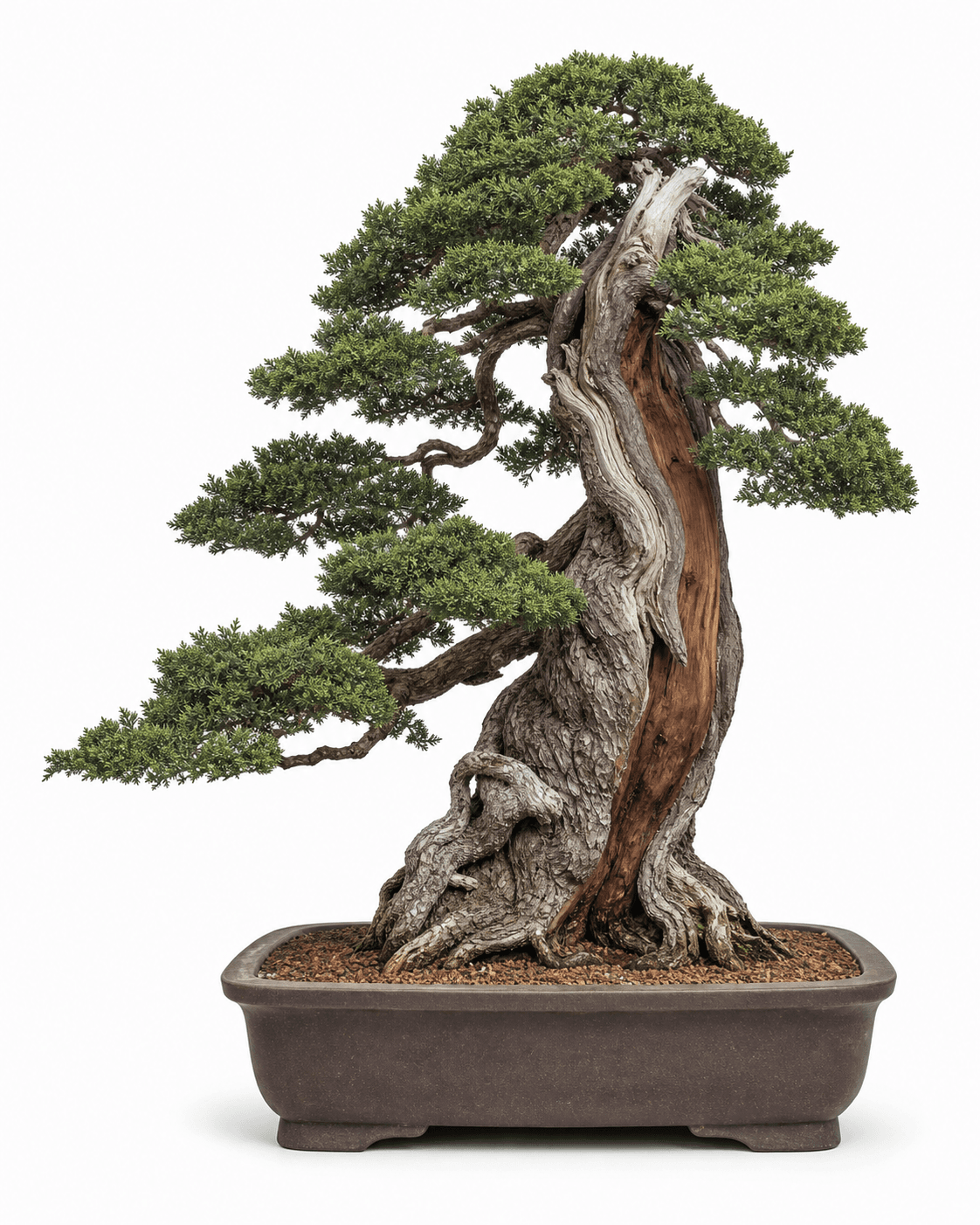
For design, let the tree read as exposed juniper: living red veins, deadwood shaped by weather, compact foliage mass, asymmetry, and visible space around the trunk. Toyama works best when its slightly larger foliage supports the trunk instead of hiding it. Bonsai Mirai / AsymmetryBonsai Mirai Library
Reading the tree
Judge readiness from spiking tips, roots, live veins, and graft confidence.
Mirai frames junipers as foliage-powered conifers. Toyama can recover from pruning, wiring, repotting, or grafting only when active foliage and oxygenated roots are already feeding the live veins. Bonsai Mirai Library
Mounding junipers build basal density before they elongate. On Toyama, spiking tips outside the dense mound are the practical signal that the tree has enough surplus strength for cleaning and cutback. Bonsai Mirai LibraryBonsai Tonight shimpaku vigor note
Weak interior foliage, browning crotches, dry compact roots, and juvenile stress growth all say to pause refinement. Improve sun, water penetration, airflow, and recovery before asking the tree to branch finer. Bonsai Mirai LibraryUC IPM Juniper
On grafted material, read the union before the canopy. Check whether the Toyama scion is thickening, whether stock foliage remains as a fallback, and whether future bends will strain the graft. Bonsai Mirai Library
Foliage work
Maintain Toyama with the mounding shimpaku cycle.
Mirai gives the Shimpaku maintenance cycle as four operations: remove competing crotch growth, remove foliage hanging below the pad line, remove spent weak interior foliage, and prune elongating tips back to strong secondary or tertiary ramification. Bonsai Mirai Library
Toyama shares this regimen with Kishu and Itoigawa. Wait for spiking tips before cleaning so the tree has enough stored energy to back bud, redirect strength, and refill interior spaces. Bonsai Mirai Library
Avoid constant tip pinching. Mirai links torn or partially removed juniper tips with juvenile stress foliage, while sharp scissor cuts back to strong ramification give a clearer recovery signal. Bonsai Mirai Library
Use Toyama foliage proportion deliberately. Because it is longer and deeper green than Itoigawa, leave enough pad depth to look natural on larger trunks while keeping light channels open through the interior. Bonsai Mirai Library
Hide cuts inside the canopy because juniper tips brown after pruning. Define bottom lines, open crotches, and shorten runners without turning mature pads into flat green shelves. Bonsai Mirai Library
Roots
Repot in spring movement and preserve conifer continuity.
Repot vigorous Toyama during spring movement, before heat and after the tree shows enough activity to rebuild roots. Tie the tree down firmly so new roots are not torn by trunk movement. Bonsai Mirai Library
Preserve part of the old core on conifers, especially grafted or collected junipers. Compact nursery or field soil should be converted across staged repots rather than removed all at once. Bonsai Mirai Library
Keep foliage on the tree after root work because juniper roots rebuild from photosynthate. Combining hard root reduction with hard foliage reduction weakens both sides of the recovery system. Bonsai Mirai Library
Aftercare should reduce water stress while keeping roots oxygenated: morning sun or bright shade, wind moderation, careful whole-rootball hydration, and no styling until new tips prove recovery. Bonsai Mirai Library
Soil and pot
Use mineral soil and a pot that matches Toyama foliage scale.
A standard Toyama mix can be 1:1:1 akadama:pumice:lava, screened around 1/16 to 1/4 in for fine roots. Use an akadama-heavier 2:1:1 akadama:lava:pumice mix when the tree has enough foliage mass to use more water and nutrient retention. Bonsai Mirai Library
Adjust by climate and stage. Coarser particles and more pumice help wet climates, recently collected trunks, weak roots, and low foliage mass. More akadama helps established refined trees hold water and nutrients evenly. Bonsai Mirai Library
Pot choice should support the visual weight of Toyama foliage. Unglazed clay, quiet earth colors, oval or rectangle forms, and moderate depth usually serve live-vein junipers better than glossy or delicate containers. Bonsai Mirai / AsymmetryBonsai Mirai Library
Larger grafted trunks need enough pot volume to protect roots and water evenly. A pot that is too shallow can make a strong Toyama canopy outrun the root system during summer wind. Bonsai Mirai Library
Climate
Adapt Toyama by protecting roots, airflow, and water-oxygen balance.
NC State lists Juniperus chinensis 'Shimpaku' for USDA Zones 4a to 9b, but bonsai root hardiness is lower than landscape hardiness because roots sit above ground in a small container. NC State Extension
In cold climates, keep Toyama dormant outdoors, then heel pots into mulch, place them on the ground, or use an unheated shelter when temperatures fall below about 25 F with drying wind. Bonsai Mirai LibraryNC State Extension
In hot dry climates, protect recently worked or small-potted trees from severe afternoon heat while keeping light high. Wind can dry dense pads faster than the rootball appears to indicate. Bonsai Mirai Library
In humid climates, thin gradually for airflow, watch twig blight and mites inside dense pads, and avoid organic soil cores that stay wet after the surface looks dry. Bonsai Mirai LibraryUC IPM Juniper Twig Blights
Pests
Dense Toyama pads need regular inspection.
NC State notes Shimpaku can be affected by tip and needle blight, root rot in poor drainage, aphids, bagworms, webworms, and cedar-apple rust. UC IPM lists mites, scales, borers, twig blights, rusts, cankers, Phytophthora, and other juniper problems. NC State ExtensionUC IPM JuniperUC IPM Juniper Twig Blights
Spider mites are easy to miss inside compact shimpaku foliage. Look for stippling, dusty interiors, weak color, and fine webbing, especially after hot dry weather or dense winter shelter. UC IPM Juniper
Twig blights often show as browning tips and interior dieback. Improve airflow, remove infected tips with clean tools, avoid wet foliage late in the day, and keep fertilizer moderate on stressed trees. UC IPM Juniper Twig Blights
Root rot and Phytophthora risk rise when compact old cores, organic nursery soil, or overwatered akadama exclude oxygen. Fix drainage and watering before chasing foliage symptoms. UC IPM JuniperBonsai Mirai Library
Cedar-apple rust and related rusts can matter where junipers grow near apples, crabapples, hawthorns, or pears. Site awareness and local extension guidance are better than routine chemical use. NC State ExtensionUC IPM Juniper
Wiring
Wire structure, then let the Toyama tuft stay alive.
Wire Toyama after growth hardens and cambium is less likely to slip. Set primary and secondary branches with enough support to hold movement, then check wire often because swelling can hide inside dense foliage. Bonsai Mirai Library
When wiring shimpaku tips, Mirai recommends stopping wire short of the dense foliage tuft. The tuft remains productive, and the next maintenance cycle can clean bottoms and crotches after elongation returns. Bonsai Mirai Library
Protect graft unions. Leave 1 to 2 in of healthy living tissue between a graft union and any future bend so movement does not tear a still-maturing vascular connection. Bonsai Mirai Library
Older live-vein junipers can be brittle or asymmetric. Use raffia, guy wires, staged bends, and strong aftercare when the bend matters more than quick completion. Bonsai Mirai LibraryBonsai Mirai / Asymmetry
Propagation
Preserve Toyama by clonal propagation, not seedlings.
Toyama is valuable because it is clonal. Mirai says Toyama, Itoigawa, and Kishu are propagated by cuttings, layering, and grafting, which preserves the foliage behavior that made each selection worth naming. Bonsai Mirai Library
Cuttings and air layers are practical for own-root Toyama stock when humidity, bottom heat, and aftercare are controlled. Seedlings from Juniperus chinensis will not preserve Toyama foliage traits. Bonsai Mirai LibraryKew POWO
Approach grafting is the practical high-end route when a native trunk needs Toyama foliage. Keep both root systems alive until the union proves itself, then separate donor roots gradually. Bonsai Mirai Library
Root grafting is a separate decision for bad bases or weak roots. Use known aggressive juniper rootstock only when the root problem is clearer than the risk of another grafting project. Bonsai Mirai Library
Sourcing
Buy documented Toyama identity, active growth, and honest graft history.
A good Toyama purchase has adult scale foliage, active elongating tips in season, useful interior growth, water that penetrates the full rootball, and a seller who can explain whether the tree is cutting-grown, layered, grafted, or simply Toyama-labeled nursery material. Bonsai Mirai LibraryBonsai Tonight shimpaku vigor note
Ask why Toyama was chosen. On a large native trunk, the answer should usually involve foliage proportion, deeper green visual weight, or better scale against deadwood and live veins. Bonsai Mirai LibraryBonsai Mirai / Asymmetry
A grafted Toyama should have stable unions, enough stock foliage retained during transition, and a record of when donor roots were severed. Fresh grafts are horticultural work in progress. Bonsai Mirai Library
Red flags include generic shimpaku at Toyama prices, no propagation history, weak scale mixed with juvenile stress needles, mite stippling inside dense pads, hidden compact nursery peat, recent severe pruning, and branch movement that strains graft unions. Bonsai Mirai LibraryUC IPM Juniper
Troubleshooting
Diagnose through foliage power, roots, timing, pests, and graft status.
Symptom: prickly juvenile foliage appears. Likely cause: stress from pinching, heavy bending, excessive pruning, root work, water imbalance, or recovery physiology. Fix: stop refinement, improve sun and water-oxygen balance, and wait for strong adult scale to return. Bonsai Mirai LibraryBonsai Mirai juniper identification
Symptom: no spiking tips appear by late summer. Likely cause: the tree is still building mounding mass, light is too weak, roots are congested, or the plant has not recovered from prior work. Fix: improve sun, water penetration, airflow, and feeding before pruning. Bonsai Mirai LibraryBonsai Tonight shimpaku vigor note
Symptom: interior pads brown while the outside stays green. Likely cause: interior shade, mites, weak spent shoots, twig blight, or stale wet roots. Fix: inspect closely, clean gradually, and improve airflow and drainage. Bonsai Mirai LibraryUC IPM JuniperUC IPM Juniper Twig Blights
Symptom: branch dies after repotting. Likely cause: root-to-live-vein disruption, fine roots drying, unstable tie-down, or foliage reduction during root recovery. Fix: shelter the tree, stabilize roots, and delay styling for a season. Bonsai Mirai Library
Symptom: a graft stays green but does not thicken. Likely cause: incomplete cambial union or stock foliage taking most sap. Fix: keep stock foliage as a fallback, maintain support, and reduce stock foliage only after clear union signs. Bonsai Mirai Library
Symptom: the tree does not match the Toyama label. Likely cause: mislabeled Chinese juniper, generic Shimpaku, Hokkaido, Tohoku, Kishu, Itoigawa, San Jose, or Foemina. Fix: document actual foliage and price the tree by observable quality. Bonsai Mirai LibraryBonsai Mirai juniper identification
Design
Use Toyama when larger foliage makes the old trunk more believable.
Mirai design work starts with base, trunk line, defining branch, apex, and ecological story. Toyama should serve those decisions by giving a larger live-vein juniper enough foliage scale to look coherent. Bonsai Mirai / AsymmetryBonsai Mirai Library
The first design question is proportion. If Itoigawa looks too delicate on a large trunk, Toyama may give the canopy enough depth and color to match strong deadwood, thick live veins, and heavy branch structure. Bonsai Mirai Library
Build a clear defining branch, then place secondary and tertiary branches so foliage supports the trunk without covering the live-vein path. Bottom-line cleaning creates pad separation, and restrained upper density preserves age. Bonsai Mirai LibraryBonsai Mirai / Asymmetry
Live-vein work should reveal the path of life through the design. Work from confirmed dead tissue toward living white phloem, then let uncertain boundaries clarify over two to three years. Bonsai Mirai Library
Deadwood should reinforce movement and age. Toyama foliage is most persuasive when trunk logic, live-vein contrast, and negative space already make the composition legible. Bonsai Mirai LibraryBonsai Mirai / Asymmetry
Cultivars
Separate Toyama from Itoigawa, Kishu, Hokkaido, Tohoku, San Jose, and Foemina.
Mirai names Toyama, Itoigawa, and Kishu as clonal Juniperus chinensis selections. They share mounding shimpaku behavior, but their foliage scale, vigor, resistance, and design proportion differ. Bonsai Mirai Library
Itoigawa is the fine emerald benchmark for delicate pads. Kishu is the durable compact benchmark, with stronger mite and disease resistance in Mirai notes. Toyama has longer, deeper-green foliage and can fit larger trunks. Bonsai Mirai Library
Tohoku and Hokkaido labels should be recorded and verified, but their direct source depth is thinner in the reviewed corpus. Treat them by observed habit and documented propagation history. Bonsai Mirai Library
San Jose, Foemina, Blaauw, procumbens, squamata, and eastern red cedar can carry different foliage texture, timing, disease pressure, and refinement behavior. Do not apply Toyama pricing or timing to those labels without verifying the plant. Bonsai Mirai juniper identificationBonsai Mirai Library
History
Toyama belongs to the shimpaku story of compact foliage for old juniper trunks.
The shimpaku bonsai tradition is tied to collected mountain junipers, live veins, deadwood, and compact foliage that can complete an ancient trunk without visually overpowering it. Bonsai Mirai LibraryBonsai Mirai / Asymmetry
Named cultivars matter because cuttings, layers, and grafts made desirable foliage repeatable. Toyama earned a place in that story because its deeper-green, slightly longer foliage solves a proportion problem on larger material. Bonsai Mirai Library
Grafting should answer a specific limitation: coarse native foliage, brittle branches, missing foliage near the trunk, or a proportion mismatch. Toyama is strongest when the design needs shimpaku refinement without undersized foliage. Bonsai Mirai Library
A strong Toyama bonsai should read old, restrained, and legible: clear live veins, weathered deadwood, interior light, and a canopy whose scale supports the trunk. Bonsai Mirai / AsymmetryBonsai Mirai Library
Species questions
Answer the beginner questions before styling.
Is Toyama shimpaku good for bonsai?
Yes. Toyama shimpaku is a strong bonsai foliage choice when grown outdoors with sun, airflow, mineral soil, winter dormancy, and staged work. It is especially useful on larger trunks where very fine foliage looks too small.
Can Toyama shimpaku live indoors?
Toyama needs outdoor sun, moving air, seasonal temperature change, and winter dormancy. Indoor display should be brief and followed by a return to outdoor growing conditions.
What is the difference between Toyama and Itoigawa shimpaku?
Mirai describes Toyama as having slightly longer, deeper-green foliage than Itoigawa. Itoigawa is better for very fine delicate pads, while Toyama can look more proportionate on larger trunks.
What is the difference between Toyama and Kishu shimpaku?
Kishu is the compact durable benchmark in Mirai notes, with stronger mite and disease resistance than Itoigawa. Toyama has longer, deeper-green foliage and is often chosen when foliage scale needs to match larger material.
Should Toyama shimpaku be pinched?
Avoid constant tip pinching. Wait for spiking elongating growth and prune back cleanly to strong secondary or tertiary ramification with sharp scissors.
When should Toyama shimpaku be pruned?
Routine refinement happens after the dense mounds produce elongating tips, often late July through September in temperate climates. Development trees may keep some runners longer to build strength and branch size.
What soil works for Toyama shimpaku?
Use open mineral soil such as 1:1:1 akadama:pumice:lava, or an akadama-heavier 2:1:1 juniper mix when an established foliage mass can use more water and nutrient retention.
When should Toyama shimpaku be repotted?
Repot during spring movement on a vigorous tree, preserving old-core continuity and active foliage. Inspect refined trees every 3 to 5 years, with longer recovery after major root conversion.
Why is my Toyama making prickly juvenile foliage?
Juvenile foliage on a scale juniper usually signals stress, overwork, or recovery physiology. Stabilize light, water, oxygen, roots, and aftercare before doing more pruning or wiring.
How do I verify a Toyama shimpaku label?
Ask for propagation history, compare the foliage scale with Itoigawa and Kishu, inspect for graft unions, and price the tree by observable quality when clone documentation is missing.
Sources
Species advice needs source discipline.
Next decisions
Plan the operation before copying the calendar.
A good care note for Toyama shimpaku records the tree's stage, the work done, and the aftercare used. That record matters more than a month-name rule.
Related species
Compare nearby trees before transferring advice.
Shimpaku
Juniperus chinensis var. sargentii
Itoigawa shimpaku
Juniperus chinensis 'Itoigawa'
Kishu shimpaku
Juniperus chinensis 'Kishu'
Tohoku shimpaku
Juniperus chinensis 'Tohoku'
Hokkaido shimpaku
Juniperus chinensis 'Hokkaido'