
Species guide
Kishu Shimpaku Bonsai Care
Juniperus chinensis 'Kishu'
Kishu shimpaku is a compact Juniperus chinensis selection used for refined outdoor juniper bonsai, especially where growers want strong mounding scale foliage with better durability than Itoigawa. Treat it as a named shimpaku cultivar under the Chinese juniper and Sargent juniper bonsai complex, then care for it as a foliage-powered mounding juniper.
The practical care pattern is simple and strict: full outdoor light, open mineral soil, active foliage before root work, no constant pinching, and refinement cleaning only after the dense mounds produce spiking elongating tips. Kishu can be tougher than Itoigawa, but weak roots, hidden graft unions, stale soil, and overcleaning still cause slow juniper decline.
Kishu is especially useful as grafting foliage on older North American juniper trunks because Mirai notes compact growth, high vigor, and stronger resistance to spider mites, rust, Phomopsis, and tip blight pressure than Itoigawa in many North American gardens.
Updated June 9, 2026. Written by EntGrove Editorial. Last verified June 9, 2026.
Care fingerprint
Read the species through its shared care pattern.
Maintain strong scale foliage, preserve interior light, and avoid overcleaning or pinching weak tips. Use this as the starting point before local conditions and tree strength refine the calendar.
Note: Compact durable shimpaku cultivar used own-root or as grafting foliage; separate from Itoigawa, Toyama, generic Shimpaku, San Jose, Foemina, and native juniper rootstocks before applying refinement or grafting assumptions.
Keep foliage strong
Junipers recover through active foliage, so styling choices should leave enough healthy tips to power the tree.
Protect live veins
Old junipers often depend on narrow live veins between roots and foliage; root work and carving should respect that path.
Do not stack major work
Heavy bending, major foliage reduction, carving, and repotting belong in a staged plan rather than the same weekend.
Care cadence
The calendar starts with the tree's seasonal state.
Placement
Timing: Keep outdoors with sun, airflow, and winter dormancy. Shift to afternoon protection after repotting, after graft work, after heavy styling, or during sustained high-90s F heat.
Watch for: Indoor display instructions, weak pale tips, warm dark winter storage, green foliage after root failure, and small pots heating faster than roots can hydrate.
Bonsai Mirai LibraryNC State ExtensionWatering
Timing: Check the upper 1/4 to 1/2 in of soil, then water through the full root mass in several gentle passes until drainage runs.
Watch for: Hydrophobic old cores, water bypassing the rootball, stale wet akadama, dry wind, and a dense foliage mass that suddenly increases demand.
Bonsai Mirai LibraryFeeding
Timing: Feed healthy trees during active growth, heavier in development and lighter in refinement. Fall feeding matters because next spring strength is built before dormancy.
Watch for: Fertilizer on weak roots, heavy nitrogen during extreme heat, coarse response on refined pads, and feeding before 4 to 6 weeks of post-repot recovery growth.
Bonsai Mirai LibraryFoliage maintenance
Timing: Wait until dense mounds produce visible spiking elongating tips, often late July through September in temperate climates, then clean and prune.
Watch for: Cleaning before elongation, stripping productive density, cutting to weak interior foliage, constant tip pinching, and hidden interiors losing replacement shoots.
Bonsai Mirai LibraryRepotting
Timing: Use spring movement and tree strength as the main cue. Preserve old-core continuity, keep foliage active, tie down firmly, and stage compact old soil over multiple repots.
Watch for: Bare-rooting, reducing roots and foliage together, repotting without foliar expansion, unstable tie-downs, and exposed fine roots drying during the operation.
Bonsai Mirai LibraryWiring
Timing: Wire vigorous trees after growth hardens and cambium re-adheres. Detail wiring can follow structural setting if foliage reduction stays limited.
Watch for: Spring bark slipping, winter heavy work without shelter, bends that strain graft unions, wire hidden inside dense pads, and tufts wired into stiff fans.
Bonsai Mirai LibraryGrafting
Timing: Approach graft after the spring flush hardens and before peak summer heat. Use vigorous Kishu whips on strong hosts with compatible branch diameter.
Watch for: Weak hosts, fresh collection, grafts placed too close to future bends, scions thicker than the host can feed, and native foliage removed before the graft proves itself.
Bonsai Mirai LibraryPests and disease
Timing: Inspect dense pads and branch crotches through warm weather and after winter protection. Kishu is more durable than Itoigawa in Mirai notes, while prevention still depends on airflow and vigor.
Watch for: Spider mites, scale, aphids, bagworms, webworms, twig blights, cedar-apple rust, borer shelter under old bark, and root rot from oxygen-poor soil.
Bonsai Mirai LibraryNC State ExtensionUC IPM JuniperUC IPM Juniper Twig BlightsWinter protection
Timing: Keep the tree dormant outdoors, then move pots off benches and insulate roots when temperatures fall below about 25 F or freeze-thaw wind is severe.
Watch for: Warm indoor storage, frozen dry roots, recently repotted trees left exposed, and winter work that removes foliage without controlled shelter.
Bonsai Mirai LibraryNC State ExtensionSpecies guide
Apply the species profile before copying another tree's calendar.
At a glance
Kishu is the durable fine-foliage shimpaku for serious outdoor juniper work.
Kishu shimpaku is a named Juniperus chinensis cultivar or trade selection in the Japanese shimpaku group. Kew gives the accepted botanical anchor for Sargent juniper as Juniperus chinensis var. sargentii, while Mirai treats Kishu, Itoigawa, and Toyama as clonal selections chosen for tight mounding foliage. Kew POWOBonsai Mirai Library
The practical identity is compact adult scale foliage with enough vigor and durability to support refinement or grafting. Mirai repeatedly distinguishes Kishu from Itoigawa by strength, mite resistance, and disease resistance, even though Itoigawa often gets more attention for maximum fineness. Bonsai Mirai Library
Grow it outdoors in direct light, open mineral soil, and a real dormant season. Kishu is a refinement and grafting tree by nature: excellent for compact pads, live-vein compositions, and old native trunks that need stronger fine foliage. Bonsai Mirai LibraryNC State Extension
Habitat
Read Kishu through parent shimpaku habitat and cultivar selection.
Kew places Juniperus chinensis var. sargentii from the Russian Far East to North Korea and Japan, growing primarily in a temperate biome. That parent context points toward sun, wind, winter dormancy, sharp drainage, and compact survival on exposed mineral sites. Kew POWO
Mirai adds the horticultural layer. Kishu, Itoigawa, and Toyama are selected regional outliers propagated by cuttings, layering, and grafting, so the important bonsai behavior is clonal and repeatable rather than seedling-variable. Bonsai Mirai Library
For care, that means oxygen-rich roots, steady but measured water, and protection of fine roots in hard cold. For design, it points toward live veins, weathered deadwood, asymmetric negative space, and compact foliage volume that looks wind-compressed rather than lush. Bonsai Mirai LibraryBonsai Mirai / Asymmetry
Kishu also has a bench habitat. Many high-end Kishu trees are grafted older trunks, so the foliage may be Kishu while the roots, live veins, and deadwood come from Rocky Mountain, California, Sierra, Utah, or other native junipers. Bonsai Mirai Library
Reading the tree
Judge readiness from foliage mass, spiking tips, roots, and graft union strength.
Mirai frames junipers as foliage-powered conifers. Kishu can be vigorous, yet the actual work limit still comes from active scale foliage, hydrated roots, and live veins that can recover after pruning or bending. Bonsai Mirai Library
A mounding juniper is ready for refinement when elongating shoots spike out of dense foliage. Without that cue, the tree is still building the photosynthetic density needed to respond. Bonsai Mirai Library
Visible vigor matters more than a green color check. Bonsai Tonight describes strong Shimpaku as showing slender extension beyond dense foliage, which gives a recovery margin for wiring, pruning, or cutback. Bonsai Tonight shimpaku vigor note
On a grafted Kishu, read the graft union before reading the branch. Fresh unions may stay green with a very thin cambial bond, so tape removal, branch movement, and native-foliage reduction need swelling, elongation, and stable callus as evidence. Bonsai Mirai Library
Foliage work
Clean Kishu like a mounding juniper, then prune to strong interior ramification.
Mirai gives the Shimpaku maintenance cycle as four moves: remove crotch growth where it is competing, remove foliage hanging below the pad line, remove spent weak interior foliage, and prune elongating tips back to strong secondary or tertiary ramification. Bonsai Mirai Library
Kishu shares that regimen with Itoigawa and Toyama. Its extra durability gives more margin, yet the cut still belongs inside viable foliage and back to a strong side shoot rather than into bare wood. Bonsai Mirai Library
Avoid constant tip pinching. Mirai warns that partial tip removal on Shimpaku-type junipers sends an ambiguous stress signal, while clean scissor pruning gives a clearer energy-redistribution signal. Bonsai Mirai Library
Keep useful crotch shoots when they are stronger, tighter, or better placed than the elongated branch above them. Blanket removal erases future replacement growth, while never cleaning crotches lets them steal strength from the intended branch. Bonsai Mirai Library
Hide cuts inside the canopy because juniper cut tips brown. Define the bottom line first, then adjust body and silhouette shoots so each pad stays separated without becoming a uniform green ball. Bonsai Mirai Library
Roots
Preserve conifer continuity and let foliage rebuild the roots.
Juniper roots are fine and fleshy compared with pine roots, and exposed tips dry quickly. Work efficiently, mist exposed roots if needed, and keep active foliage because foliage drives root recovery. Bonsai Mirai Library
Never bare-root a Kishu or a Kishu-grafted juniper. Mirai repeats the conifer continuity rule across repotting files, and old junipers can have root and live-vein relationships that make even soil removal a design-risk decision. Bonsai Mirai Library
Start each repot by naming the limitation: compact organic core, failed drainage, bad planting angle, dead root, circling structural root, or root mass trapped behind a pot lip. Solve that limitation rather than dismantling the whole rootball evenly. Bonsai Mirai Library
Tie-down quality is survival work. Moving root tips cannot establish fine new roots, so anchor the tree with downward pressure and stable root contact before aftercare begins. Bonsai Mirai Library
After a major conversion, shelter from wind, intense sun, heavy rain, and freezing. Let the tree grow out for a season or longer before returning to fine wiring or heavy foliage work. Bonsai Mirai Library
Soil and pot
Use fine mineral soil for compact roots and a quiet pot for old-wood character.
Mirai gives 1:1:1 akadama:pumice:lava as the beginner conifer default and 2:1:1 akadama:lava:pumice as a water and nutrition boost for many junipers. Shift coarser or lower in akadama in cool, wet, or high-rain climates. Bonsai Mirai Library
Particle size should match the root and foliage goal. Fine interior particles around 1/16 to 1/4 in encourage fine roots and compact foliage, while a coarser lower layer keeps oxygen moving. Bonsai Mirai Library
Avoid heavy houseplant or nursery organic soil in a shallow bonsai pot. Kishu can be resilient above ground while old wet soil quietly damages the root system. Bonsai Mirai Library
Pot pairing should make the tree feel older than its foliage. Unglazed rectangles, ovals, nanban-style containers, and rugged cascade pots work when depth, color, and weight support the live vein, trunk line, and deadwood. Bonsai Mirai / AsymmetryBonsai Mirai Library
Climate
Use Kishu durability for margin, then still adapt roots and aftercare to the bench.
Mirai notes that Shimpaku clones are unusually adaptable across wet, cold, hot, and humid conditions compared with many wild junipers. Kishu extends that advantage with better mite and disease resistance than Itoigawa in several Mirai grafting discussions. Bonsai Mirai Library
In humid or high-rain regions, preserve oxygen with open pads, clean interiors, coarser particles, and careful top dressing. More shade rarely solves a root-zone oxygen problem. Bonsai Mirai LibraryUC IPM Juniper Twig Blights
In dry inland regions, protect fresh repots and fresh grafts from afternoon heat and wind until new roots or unions can hydrate the foliage. Healthy established trees still need full morning light and complete rootball watering. Bonsai Mirai Library
In winter, keep dormancy. NC State gives broad landscape hardiness for Shimpaku, while Mirai advises moving junipers off benches and insulating roots around 25 F because bonsai roots lack ground buffering. NC State ExtensionBonsai Mirai Library
Pests and disease
Kishu is a stronger choice in pressure climates, and it still needs inspection.
Mirai repeatedly contrasts Kishu with Itoigawa by resistance: Kishu is described as more resistant to spider mites, rust, Phomopsis, and tip blight in North American conditions. Bonsai Mirai Library
Public sources keep the general risk list visible. NC State lists tip and needle blight, root rot without drainage, aphids, bagworms, webworms, and cedar-apple rust for Shimpaku. UC IPM adds spider mites, scale, borers, cankers, rusts, Phytophthora, and water-stress disorders across Juniperus. NC State ExtensionUC IPM Juniper
Spider mites still deserve regular checks. Inspect the underside of dense pads, dry hot bench positions, and recently stressed grafts with magnification before stippling becomes a design problem. UC IPM JuniperBonsai Mirai Library
Twig blights show as dieback in new growth and weak tips. UC IPM emphasizes sanitation, removal of infected tips, dry foliage, and avoiding excessive tender growth from overfertilization. UC IPM Juniper Twig Blights
Most prevention is cultural: sun, airflow, open pads, stable roots, no waterlogged soil, and a tree strong enough to compartmentalize small wounds. Bonsai Mirai LibraryUC IPM Juniper
Wiring
Wire the structure, protect the union, and leave the dense tuft alive.
Mirai places major juniper bending after the spring flush hardens and cambium has re-adhered to xylem. A small scratch test on sacrificial or unwanted growth can show whether bark strips easily or chips in small pieces. Bonsai Mirai Library
Kishu can be more rigid than flimsier native growth, which helps it hold careful wiring. Use structural wiring for trunk and primary branches first, then secondary and tertiary wiring to place pads. Bonsai Mirai Library
In refinement, wire only as far as the branch needs support and stop short of the dense foliage tuft. Directional pruning can express the last movement without turning every cloud into a wired cage. Bonsai Mirai Library
On grafted Kishu, keep bends at least 1 to 2 in away from young graft unions. Freshly unwrapped unions need immediate support, shade from harsh summer sun, and time before the branch is treated as self-supporting. Bonsai Mirai Library
Raffia, rotation, and compression are for serious bends and healthy trees. If the tree is recently repotted, weak, still slipping bark in spring, or carrying a young graft, delay the bend. Bonsai Mirai Library
Propagation
Cuttings preserve Kishu; grafting puts Kishu on old trunks.
Kishu is valuable because it is clonal. Mirai says Kishu, Itoigawa, and Toyama are propagated by cuttings, layering, and grafting, which preserves the foliage behavior that made the selection worth naming. Bonsai Mirai Library
Cuttings are the cleanest route for own-root Kishu. In the Mirai propagation primer, juniper cuttings are taken where green elongation transitions into caramel-brown hardened tissue, then rooted with spacing so dense foliage does not tangle and tear later. Bonsai Mirai Library
Air-layering works well enough in Juniperus chinensis selections to create grafting whips or separate usable branch sections. Root placement matters because full-circumference roots and one-sided roots serve different future graft uses. Bonsai Mirai Library
Approach grafting is the practical high-end use. Kishu is a favored scion where a native trunk needs compact, durable foliage and the host branch offers a straight, deadwood-free section with compatible diameter. Bonsai Mirai Library
Seed is inappropriate for named Kishu. Seedlings may be Juniperus chinensis, but they are genetically variable and should not be sold or planned as Kishu without verified clonal propagation. Bonsai Mirai LibraryKew POWO
Sourcing
Buy identity, vigor, roots, and graft honesty before buying the Kishu name.
Good own-root Kishu has compact adult scale, active tips, interior density, water that penetrates the whole rootball, and a seller who can explain propagation history. Bonsai Mirai LibraryBonsai Tonight shimpaku vigor note
Good grafted Kishu has visible, stable unions, enough native foliage left during transition, and a record of when donor roots were severed. Fresh grafts are in-progress horticulture rather than finished branch structure. Bonsai Mirai Library
Red flags include generic shimpaku labels at Kishu prices, no cultivar provenance, weak scale mixed with stress needles, mite stippling inside dense pads, hidden compact nursery peat, recent severe pruning, and branch movement that strains graft unions. Bonsai Mirai LibraryUC IPM Juniper
Kishu is a strong purchase in mite-prone or disease-prone regions because Mirai notes greater durability than Itoigawa. Itoigawa remains the finer visual choice when maximum delicacy matters and the grower can monitor pest pressure closely. Bonsai Mirai Library
Troubleshooting
Read the symptom through foliage power, roots, timing, and graft status.
Symptom: prickly juvenile foliage appears. Likely cause: stress from pinching, heavy bending, excessive pruning, root work, water imbalance, or recovery physiology. Fix: stop refinement, improve sun and water-oxygen balance, and wait for strong adult scale to return. Bonsai Mirai LibraryBonsai Mirai juniper identification
Symptom: interior pads brown while the outside stays green. Likely cause: shade inside dense foliage. Fix: clean bottoms, remove spent weak shoots, preserve useful interior growth, and increase airflow gradually. Bonsai Mirai Library
Symptom: branch dies after repotting. Likely cause: root-to-live-vein disruption, fine roots drying, unstable tie-down, or foliage reduction during root recovery. Fix: shelter the tree, stabilize roots, and delay styling for a season. Bonsai Mirai Library
Symptom: pale stippling and dry weak tips. Likely cause: spider mites, heat stress, or both. Fix: inspect with magnification, wash foliage if appropriate, correct water and heat exposure, then use targeted mite control after diagnosis. UC IPM Juniper
Symptom: graft stays green but does not thicken. Likely cause: incomplete cambial union or stock foliage still taking most sap. Fix: keep native foliage as a fallback, maintain compression or support, and reduce stock foliage gradually only after clear union signs. Bonsai Mirai Library
Symptom: Kishu pads stay dense with no spiking tips. Likely cause: the tree is still building mounding mass, or light and roots are limiting extension. Fix: improve sun, water penetration, airflow, and feeding before refinement pruning. Bonsai Mirai Library
Design
Use Kishu where compact strength, live veins, and old trunks need to agree.
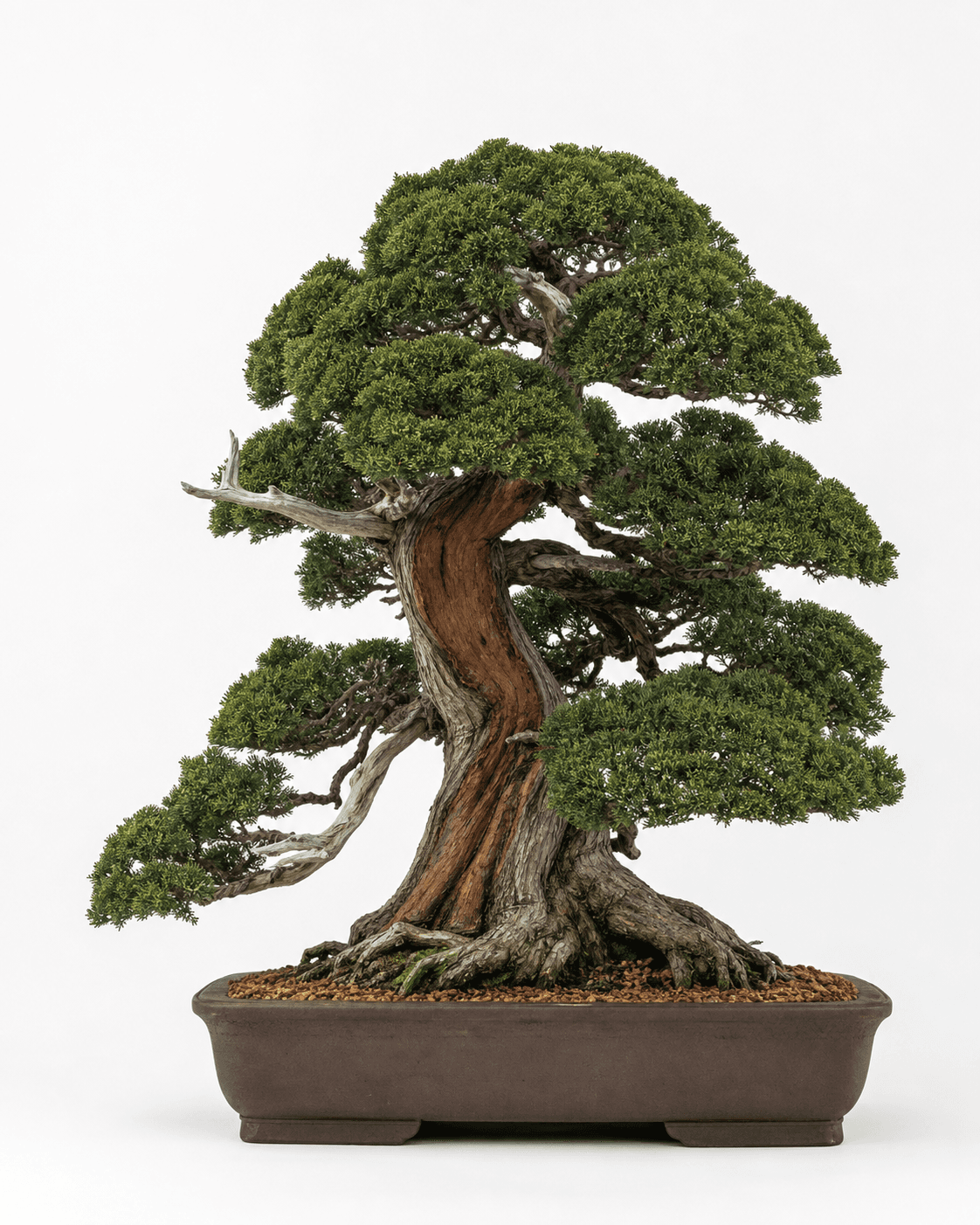
Mirai design work starts with base, trunk line, defining branch, apex, and ecological story. For Kishu, the story is durable compact foliage set against old bark, living red veins, and deadwood shaped by exposure. Bonsai Mirai / AsymmetryBonsai Mirai Library
The first design question is proportion. Kishu is a little coarser and stronger than Itoigawa, so it can fit medium and older trunks where maximum delicacy would feel too small. Bonsai Mirai Library
Build a clear defining branch, then let secondary and tertiary branches express lift within compact clouds. Clean lower lines create pad separation, while restrained upper density keeps the tree from becoming a green dome. Bonsai Mirai LibraryBonsai Mirai / Asymmetry
Live vein cleaning is part of design because it reveals the red living path against deadwood and informs front selection. Work from known dead tissue toward living white phloem, then let uncertain boundaries clarify over two to three years. Bonsai Mirai Library
Deadwood should reinforce age and direction. Kishu can support strong juniper contrast, but the best trees still keep foliage, vein logic, and negative space in balance. Bonsai Mirai LibraryBonsai Mirai / Asymmetry
Cultivars
Separate Kishu from Itoigawa, Toyama, San Jose, Foemina, and generic Shimpaku.
Mirai names Kishu, Itoigawa, and Toyama as clonal Juniperus chinensis selections. They share mounding shimpaku behavior, but differ in foliage scale, vigor, disease tolerance, and proportion. Bonsai Mirai Library
Kishu is the durable compact choice. Mirai calls it stronger than Itoigawa for many grafting projects, with better spider-mite, rust, Phomopsis, and tip-blight resistance. Bonsai Mirai Library
Itoigawa is the finer emerald foliage choice and can make exceptionally delicate pads. Toyama has longer, deeper-green foliage and can look proportionate on larger-trunked material. Bonsai Mirai Library
Tohoku and Hokkaido labels should be recorded, then verified against the actual foliage and growth habit. San Jose, Foemina, Blaauw, procumbens, squamata, and eastern red cedar can carry very different timing and refinement behavior. Bonsai Mirai LibraryBonsai Mirai juniper identification
A premium Kishu label should come with propagation history. Without that, evaluate the tree as a Chinese juniper or Shimpaku-type plant until the foliage behavior proves the claim. Bonsai Mirai Library
History
Kishu became important because it made refined juniper foliage more durable.
The shimpaku bonsai tradition is tied to collected mountain junipers, live veins, deadwood, and compact foliage that can complete an ancient trunk without overpowering it. Bonsai Mirai LibraryBonsai Mirai / Asymmetry
Kishu and Itoigawa matter because cuttings and grafts made refined foliage repeatable. Growers could pair reliable scale foliage with trunks whose native foliage was too coarse, too brittle, too sparse, or badly placed for the intended design. Bonsai Mirai Library
Mirai cautions that grafting should answer a specific limitation. Preserve native foliage when it reaches the desired quality; choose Kishu when durability, grafting success, or disease pressure makes it the better scion. Bonsai Mirai Library
A strong Kishu bonsai should look old, restrained, and legible: clear live veins, weathered deadwood, compact pads with interior light, and a canopy that supports the trunk rather than hiding it. Bonsai Mirai / AsymmetryBonsai Mirai Library
Species questions
Answer the beginner questions before styling.
Is Kishu shimpaku good for bonsai?
Yes. Kishu shimpaku is one of the best durable scale-foliage junipers for refined bonsai when it is grown outdoors with strong light, airflow, drainage, winter dormancy, and staged work.
Can Kishu shimpaku live indoors?
No. Kishu is a juniper and needs outdoor sun, moving air, seasonal temperature change, and winter dormancy. Indoor display should be brief.
What is the difference between Kishu and Itoigawa shimpaku?
Kishu is usually slightly coarser, more vigorous, and more resistant to mites and several juniper diseases. Itoigawa is valued for finer emerald foliage. Both are mounding Juniperus chinensis selections.
Should Kishu shimpaku be pinched?
Avoid constant tip pinching. Wait for spiking elongating growth, then use scissors to prune back to strong secondary or tertiary ramification while preserving productive foliage.
When should Kishu shimpaku be pruned?
Routine refinement is best when dense mounds begin producing elongating tips, often late July through September in temperate climates. Development pruning and recovery decisions can happen on different timing.
What soil works for Kishu shimpaku?
Use open mineral soil such as 1:1:1 akadama:pumice:lava, or an akadama-heavier 2:1:1 juniper mix when water and nutrient availability need support. Adjust coarser in wet climates.
When should Kishu shimpaku be repotted?
Repot during spring movement on a vigorous tree, preserving old-core continuity and active foliage. Inspect refined trees every 3 to 5 years, with longer recovery after major root conversion.
Why is my Kishu making prickly juvenile foliage?
Juvenile foliage on a scale juniper usually signals stress, overwork, or recovery physiology. Stabilize sun, water, oxygen, roots, and aftercare before doing more pruning or wiring.
Is Kishu better than Itoigawa for grafting?
Often yes in North American pressure climates. Mirai notes Kishu has stronger grafting performance and better mite, rust, Phomopsis, and tip-blight resistance than Itoigawa in many situations.
How cold hardy is Kishu shimpaku in a pot?
Landscape Shimpaku references can list broad hardiness such as USDA Zones 4a to 9b, but bonsai roots need protection during hard freezes. Move pots off benches and insulate roots around 25 F or in severe freeze-thaw wind.
Sources
Species advice needs source discipline.
Next decisions
Plan the operation before copying the calendar.
A good care note for Kishu shimpaku records the tree's stage, the work done, and the aftercare used. That record matters more than a month-name rule.
Related species
Compare nearby trees before transferring advice.
Shimpaku
Juniperus chinensis var. sargentii
Itoigawa shimpaku
Juniperus chinensis 'Itoigawa'
Tohoku shimpaku
Juniperus chinensis 'Tohoku'
Hokkaido shimpaku
Juniperus chinensis 'Hokkaido'
Toyama shimpaku
Juniperus chinensis 'Toyama'