
Species guide
Benjamin Fig Bonsai Care
Ficus benjamina
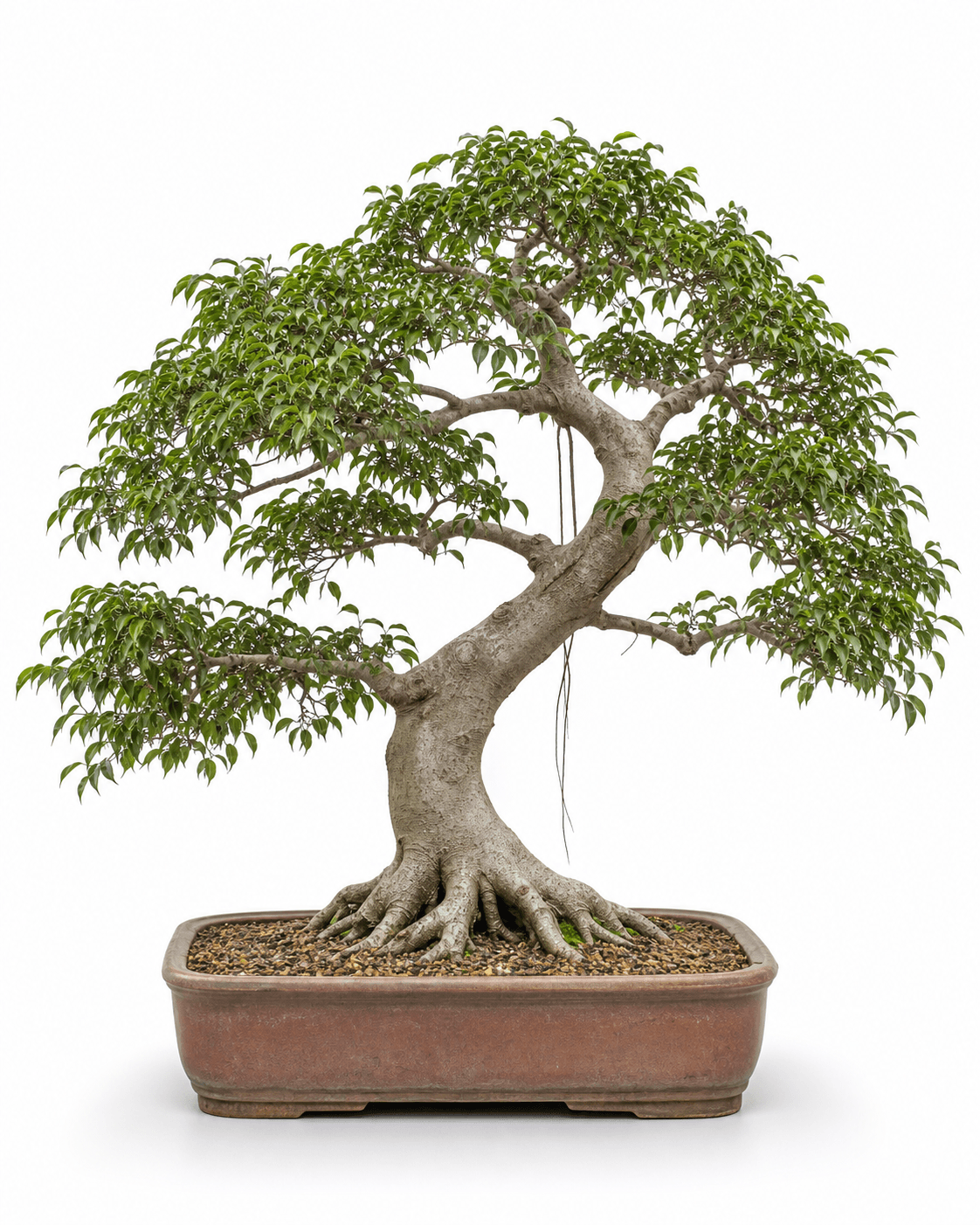
Benjamin fig bonsai, Ficus benjamina, is a warm-climate tropical fig that can live indoors only when light, heat, airflow, and root oxygen are deliberately managed. It is more reactive than Ficus microcarpa: it drops leaves after moves, has brittle branches, and especially in the Too Little cultivar should not be fully defoliated or cut back hard.
Treat it as Broadleaf > Tropical in the EntGrove taxonomy. Kew accepts Ficus benjamina L. in Moraceae and places it from the Indian subcontinent through southern China, Malesia, and northern Australia; NC State and UF/IFAS describe weeping fig as a common interior tree, bonsai subject, and frost-sensitive landscape plant for warm zones.
This profile has direct Mirai support for Too Little brittleness, tropical winter handling, ficus leaf work, and warm-night repotting, with broader tropical ficus method transferred where the local corpus is genus-level. The care answer is bright stable placement, water by soil condition and foliage mass, preserve enough leaves to keep roots breathing, and reserve heavy work for warm active growth.
Updated June 19, 2026. Written by EntGrove Editorial. Last verified June 19, 2026.
Care fingerprint
Read the species through its shared care pattern.
Treat indoor culture as a light-management problem first; prune and repot when the tree is actively growing and warm enough to recover. Use this as the starting point before local conditions and tree strength refine the calendar.
Note: Too Little is the compact bonsai-relevant cultivar label, but it needs conservative pruning because Benjamin fig is brittle compared with many ficus.
Read the foliage first
Broadleaf stress usually shows in leaf color, leaf size, wilt, scorch, or delayed hardening before it becomes a branch problem.
Match work to dormancy
Deciduous, evergreen, tropical, succulent, and flowering broadleaf trees recover on different calendars.
Protect fine roots
Root work should preserve enough active fine roots for the tree to rehydrate quickly after the operation.
Care cadence
The calendar starts with the tree's seasonal state.
Placement
Timing: Keep the tree warm, bright, and stable. Move outdoors after nights stay near 60 F / 16 C or warmer, then acclimate leaves gradually; begin active protection before nights approach 40 F / 5 C.
Watch for: Leaf drop after relocation, cold glass, air-conditioning drafts, heater blasts, low winter sun, and sudden full sun on leaves formed indoors.
Bonsai Mirai LibraryNC State ExtensionWatering
Timing: Water thoroughly when the upper particles begin to dry while the root ball still holds slight moisture. Reduce frequency in winter or after leaf loss.
Watch for: Water in saucers, compact nursery peat, stale odor, roots staying cold and wet, or dry shrinkage at the pot edge.
Bonsai Mirai LibraryNC State ExtensionFertilizer
Timing: Feed only during active growth. Development trees can take stronger feeding; refined trees and indoor winter trees need lighter inputs.
Watch for: Fertilizer applied to a leaf-dropping, cold, dim, or recently repotted tree before root oxygen and light have been corrected.
Bonsai Mirai LibraryPruning
Timing: Use repeated small warm-season cutbacks after shoots harden. Preserve growing tips and foliage where recovery strength is still being built.
Watch for: Severe cutback on Benjamin fig or Too Little ficus, hollow interiors from shearing, and removing all active foliage from a weak branch.
Bonsai Mirai LibraryLeaf work
Timing: Use selective leaf cutting, petiole-preserving leaf reduction, or stipule pinching on vigorous, warm, well-lit trees. Full defoliation is inappropriate for Benjamin fig in ordinary indoor culture.
Watch for: Bare branches that cannot transpire, overwatering after foliage reduction, and old weak shoots forced to rebuild from hidden buds.
Bonsai Mirai LibraryRepotting
Timing: Repot in warm active growth when nights are around 60 F / 16 C or warmer and at least 6-8 warm weeks remain for root recovery.
Watch for: Bare-rooting the entire tree, burying the crown, pairing root work with heavy top reduction, stacking repotting with partial defoliation outside truly tropical conditions, or repotting during leaf drop.
Bonsai Mirai LibraryWiring
Timing: Wire only flexible young-to-medium branches, then inspect often during active growth. Many Benjamin fig branches are safer shaped by clip-and-grow.
Watch for: Brittle cracking, latex appearing during a bend, wire bite in smooth bark, and fine twig wiring on fast-swelling shoots.
Bonsai Mirai LibraryPest checks
Timing: Inspect year-round indoors and after every warm-season move. Check leaf undersides, branch forks, and interior shaded growth.
Watch for: Scale, mealybugs, aphids, spider mites, thrips, ficus whitefly, sticky honeydew, sooty mold, and sudden thinning of the canopy.
NC State ExtensionUF/IFAS Miami-Dade ExtensionSpecies guide
Apply the species profile before copying another tree's calendar.
At a glance
Benjamin fig is a tropical ficus with a narrow margin indoors.
Benjamin fig is Ficus benjamina, a Moraceae fig with weeping branches, glossy evergreen leaves, milky sap, and small figs. Kew treats the name as accepted, and NC State lists weeping fig, Benjamin tree, small-leaved rubber plant, Java fig, and ficus tree among its common labels. Kew POWONC State Extension
For bonsai, the crucial distinction is behavior. Mirai calls out Ficus benjamina, especially the Too Little cultivar, as brittle and sensitive to full defoliation or severe cutback. That makes it a conservative-pruning ficus compared with Ficus microcarpa, Tigerbark ficus, or many willow-leaf ficus projects. Bonsai Mirai Library
The first-year goal is a stable bright growing environment. Put the tree in the brightest practical indoor position, avoid repeated moves, learn its drying rhythm, and delay styling until it has made a full flush of healthy new growth in your care. Bonsai Mirai LibraryNC State Extension
Wild habit
Its ecology explains the leaf drop and the design language.
Kew places Ficus benjamina across the Indian subcontinent, Indo-China, southern China, Malesia, northern Australia, and western Pacific islands, primarily in wet tropical forest. UF/IFAS describes it as a large evergreen tree in warm landscapes, with dense shade, drooping branchlets, smooth bark, and a wide crown. Kew POWOUF/IFAS Extension
That habitat points to constant warmth, high light filtered by tropical canopy conditions, and an active root system that never experiences a true temperate dormancy. Indoors, the plant reacts strongly when light, humidity, or temperature changes suddenly because the leaves were built for a different balance than the new room provides. Bonsai Mirai LibraryNC State Extension
For design, read Benjamin fig as a tropical canopy tree with pendulous branch ends and a broad crown rather than as a pine silhouette. Good bonsai forms usually emphasize a spreading banyan, clump, informal upright, small forest, or compact weeping canopy, with branch fans that divide outward instead of vertical conifer pads. Bonsai Mirai LibraryBonsai Mirai / Asymmetry
Reading the tree
Growth tells you whether the tree can handle work.
Mirai uses growth itself as the health signal: a tree makes new growth only when it has surplus energy beyond maintenance. On Benjamin fig, wait for firm new extension, good leaf color, and drying rhythm before pruning, wiring, or repotting. Bonsai Mirai Library
Development means building roots, trunk, branch placement, and enough leaf mass to make future choices possible. Refinement means short internodes, compact leaves, tertiary branching, and selective leaf work. A recently purchased indoor tree with leaf drop is in recovery, even if the trunk already looks old. Bonsai Mirai Library
Watch the distribution of vigor. Long shoots at the top, shaded inner leaves, and a hollow shell mean light and pruning are favoring the exterior. Open the canopy gradually, keep useful interior leaves, and let weak branches recover before shortening their tips. Bonsai Mirai Library
Pruning
Use conservative cutback and selective leaf work.
The central Benjamin fig rule is restraint. Mirai specifically warns that Ficus benjamina, especially Too Little, is brittle and will not tolerate full defoliation or severe cutback. Build structure by letting selected shoots extend, then shortening them to live leaves or visible buds while the tree is warm and actively growing. Bonsai Mirai Library
Preserve petioles when cutting leaves on ficus. Mirai notes that removing the blade while leaving the petiole helps the remaining tissue seal naturally. Use this as light energy balancing on strong areas; weak trees need foliage, better light, and better water movement before ramification work. Bonsai Mirai Library
Avoid hedge shearing. A sheared tropical canopy pushes growth to the outer shell and starves the interior. Work branch by branch: identify the line, choose the next fork, remove crossing or downward shoots, and keep leaves where they still feed a useful branch. Bonsai Mirai Library
If latex flows from a pruning cut, mist the wound with water to slow the flow. Clean sharp cuts heal faster on ficus than torn cuts, and wound closure depends on strong foliar mass after the work. Bonsai Mirai Library
Roots
Repot warm, preserve function, and leave foliage to pull water.
Mirai places tropical repotting and root work in the warm-night window, roughly when nights are consistently 60 F / 16 C or warmer. In temperate climates that often means late spring through midsummer, with enough warm weeks left for new roots to harden before protection season. Bonsai Mirai Library
Repot for evidence: decomposed soil, lost percolation, a packed root pad, sour smell, poor drainage, or a deliberate design move. A calendar inspection every 2-3 years is reasonable in warm vigorous culture, while cooler indoor culture may stretch longer if percolation remains good. Bonsai Mirai Library
Keep a meaningful portion of the root mass intact on a fully leafed Benjamin fig. Mirai general repotting guidance preserves part of the root system on trees carrying foliage so hydration continues. On a reactive ficus, this is especially important because leaf drop and root stress can amplify each other. Bonsai Mirai Library
After repotting, keep the tree warm, bright, and sheltered from harsh midday sun until new growth confirms recovery. Hold fertilizer for at least 4-6 weeks or until strong growth resumes, then restart gently. Bonsai Mirai Library
Soil and pot
Use a tropical broadleaf mix that can breathe indoors.
A Benjamin fig bonsai needs moisture without anaerobic roots. Mirai frames watering as a balance between water and oxygen in the root system, and the soil has to make that balance possible. Heavy houseplant potting soil stays wet too long in a shallow bonsai pot. Bonsai Mirai Library
A practical mix is akadama, pumice, and lava in roughly equal parts for a small tree in good light, adjusted by climate. Add more pumice or lava in cool rooms, wet climates, or dense indoor settings; add more akadama or a small amount of screened bark where heat, airflow, and fast drying are reliable. Bonsai Mirai Library
Pot choice should serve both horticulture and character. A slightly deeper oval or rectangle gives an indoor tropical more water reserve and root insulation than a very shallow tray. Glazed containers suit tropical evergreens well because color can carry the display while the foliage remains green year-round. Bonsai Mirai LibraryBonsai Mirai / Asymmetry
Keep the root crown visible and slightly proud of the soil surface. Burying tropical bark at the crown keeps the wettest zone against living tissue and increases rot risk, especially indoors where evaporation is slow. Bonsai Mirai Library
Climate
Treat cold as a root and growing-tip risk.
NC State lists Ficus benjamina for USDA Zones 10a-12b, and UF/IFAS gives landscape use in Zones 10B-11. Those zones describe ground-grown landscape potential, not the safety of a shallow bonsai pot exposed to cold wind or glass. NC State ExtensionUF/IFAS Extension
Mirai notes that ficus growth is strongest with nights above about 18 C and daytime warmth around 30-32 C, while metabolism drops sharply once nights fall near 12-13 C. It also frames 5 C as the point where containerized ficus need active protection, with true tropical species such as Benjamin fig kept more carefully than subtropical figs. Bonsai Mirai Library
In cold-winter regions, grow it as a protected tropical: outdoors for the warm season, indoors or greenhouse protected before cold nights, brightest winter placement available, reduced water as metabolism slows, and no heavy work while the tree is cold. Bonsai Mirai Library
In tropical or subtropical regions, the challenge shifts to heat, humidity, pests, and root speed. Growth can be fast enough that wire bites quickly, soil breaks down sooner, and pruning decisions need to be revisited more often. Bonsai Mirai LibraryUF/IFAS Miami-Dade Extension
Pests
Indoor weakness and warm-climate pests both matter.
NC State lists aphids, mealybugs, scale, spider mites, and thrips among common problems on Ficus benjamina. Indoors, these pests often rise when the tree is in dry air, low light, or a crowded canopy with too little inspection. NC State Extension
Ficus whitefly is a major warm-climate pest of ficus in Florida. UF/IFAS Miami-Dade describes it as damaging ficus hedges and trees, and bonsai growers in affected regions should inspect undersides of leaves, yellowing leaves, and sudden defoliation carefully. UF/IFAS Miami-Dade Extension
Root rot is the disease pattern most beginners create. It starts with compact soil, overwatering, a cold root zone, or too much water after leaf drop. Correct drainage, warmth, light, and watering rhythm before adding fertilizer. Bonsai Mirai Library
Sooty mold is a clue rather than the original problem: it often grows on honeydew from scale, mealybugs, aphids, or whitefly. Treat the insect, clean the leaves gently, and open the canopy so light and airflow return. NC State ExtensionUF/IFAS Miami-Dade Extension
Wiring
Wire less, check sooner, and stop when latex appears.
Benjamin fig has a brittle reputation in bonsai. Mirai singles out Ficus benjamina and Too Little as less tolerant of hard work than most ficus, so wiring should be conservative. Use clip-and-grow for fine twigs and wire only branches that can bend without cracking. Bonsai Mirai Library
For ficus branches that are worth wiring, Mirai favors aluminum close to the diameter of the branch because small wire scars quickly and fails to hold against fast tropical growth. Inspect weekly in warm weather when swelling is active. Bonsai Mirai Library
Latex appearing during a bend is a stop signal. It means internal tissue is reaching its limit, and continuing can create a fracture that wire cannot repair. Back off, stabilize the tree, and use staged pruning or guy-wires instead. Bonsai Mirai Library
Wire placement should support a broad tropical canopy. Lower branches can be heavier and more horizontal; upper branches should become finer, shorter, and more upward to outward, with pendulous tips kept intentional rather than accidental. Bonsai Mirai LibraryBonsai Mirai / Asymmetry
Propagation
Cuttings are the main route; air layers are possible but slower.
NC State lists stem cuttings as propagation for Ficus benjamina. Mirai general ficus guidance also favors cuttings because latex-bearing ficus root quickly when warmth, humidity, and oxygen are present. NC State ExtensionBonsai Mirai Library
Use warm active growth, clean cuts, and a medium that holds humidity without staying airless. Mirai suggests perlite for ficus cuttings because it supports humidity while reducing saturation risk. Bonsai Mirai Library
Air layering can rescue a better trunk line above poor roots or grafted material, and ficus trunk-fusion or grafting can work under high heat and humidity. For Benjamin fig, cuttings and layers are usually cleaner than aggressive graft projects because the branches are brittle and recovery should stay conservative. Bonsai Mirai Library
Seed propagation belongs mostly to horticulture and cultivar development. Bonsai growers usually start with nursery plants, cuttings, dwarf cultivars, or houseplant material selected for branch scale and compact leaves. NC State ExtensionUF/IFAS Extension
Buying
Buy for compact growth and visible health, not just a thick trunk.
Good Benjamin fig bonsai material has short internodes, leaves in scale with the intended design, flexible young shoots, a visible root flare, and no active leaf-drop spiral. Too Little is popular because the leaves are smaller, but its brittleness raises the technique bar. Bonsai Mirai LibraryNC State Extension
Inspect the roots and trunk base. Avoid trunks buried deeply in wet peat, plants sitting in decorative containers without drainage, or trees with soft black roots and sour soil smell. A dense but healthy nursery root system can be corrected; rotted roots make every styling decision premature. Bonsai Mirai Library
Check the canopy for pests before bringing the tree near other indoor plants. Sticky leaves, white cast skins, webbing, cottony clusters, or armored bumps on stems should be treated as a quarantine issue. NC State ExtensionUF/IFAS Miami-Dade Extension
Large houseplant Benjamins can become air-layer or cutting stock, but scale matters. Long straight trunks, coarse leaf size, and sparse interior buds mean years of rebuilding. A smaller compact cultivar with usable low branching is often the better bonsai purchase. Bonsai Mirai LibraryUF/IFAS Extension
Troubleshooting
Read symptoms through light, water, warmth, and recent moves.
Symptom: sudden leaf drop after purchase or relocation. Likely causes: light change, temperature swing, draft, lower humidity, or a root system unable to match the new room. Fix: choose one bright warm position, avoid more moves, adjust watering to reduced foliage, and wait for new growth. NC State ExtensionBonsai Mirai Library
Symptom: yellow leaves and wet soil. Likely causes: overwatering, compact soil, a cold root zone, or watering after leaf loss as if the full canopy remained. Fix: improve warmth and light, let oxygen return between waterings, and plan a warm-season repot if drainage has failed. Bonsai Mirai Library
Symptom: large leaves and long internodes. Likely causes: weak light, overfeeding in refinement, or too little root maturation. Fix: increase light, reduce feeding intensity after growth is strong, and prune only after usable extension hardens. Bonsai Mirai Library
Symptom: cracked branch while wiring. Likely causes: brittle wood, too much bend at once, or forcing older branches. Fix: stop the bend, mist latex if present, protect the wound, and switch to clip-and-grow or guy-wires. Bonsai Mirai Library
Symptom: sticky leaves or black film. Likely causes: scale, mealybugs, aphids, or whitefly producing honeydew that supports sooty mold. Fix: isolate the tree, identify the insect, clean leaves gently, and improve airflow and inspection frequency. NC State ExtensionUF/IFAS Miami-Dade Extension
Symptom: black translucent leaf patches after cold exposure. Likely cause: cold cell damage. Fix: move the tree warm, protect roots and growing tips, remove only clearly dead tissue later, and wait for warm active recovery. Bonsai Mirai Library
Design
Let the weeping habit become a controlled tropical canopy.
Start by finding the trunk line, the defining branch, and the apex. Benjamin fig often wants a soft, broad crown instead of a sharply tiered conifer image. The weeping habit can create grace when the branch architecture underneath is clear. Bonsai Mirai LibraryBonsai Mirai / Asymmetry
Build branch fans that divide outward: one to two to four to eight. Mirai uses this fan logic for tropical ficus because it distributes vigor and avoids a central spear that starves the surrounding structure. Bonsai Mirai Library
Banyan and clump designs suit the species when roots, aerial roots, or multiple trunks support the image. Mirai gives roughly 60 percent relative humidity as the minimum for intentional aerial-root induction, and those roots should descend clearly from branches or trunk lines instead of competing visually with every branch. Bonsai Mirai Library
The compact Too Little form can make credible small bonsai, but branch brittleness means the design should be grown and clipped into place. Save aggressive bends for species or cultivars that prove they can tolerate them. Bonsai Mirai LibraryNC State Extension
Forms
Too Little is the bonsai-relevant name to know.
NC State lists Too Little among Ficus benjamina cultivars and notes that it has smaller leaves and is popular as a bonsai. That makes it the main Benjamin fig form to look for when leaf scale matters. NC State Extension
Mirai adds the caution that Too Little is brittle and does not tolerate full defoliation or severe cutback. In practice, buy it for scale and prune it with patience rather than treating it like a hard-regenerating willow-leaf ficus. Bonsai Mirai Library
NC State lists additional houseplant cultivars such as Alii, Anastasia, Danielle, Exotica, Golden King, Pandora, Samantha, Variegata, and Wintergreen, while UF/IFAS calls out Exotica in its landscape fact sheet. Most are selected for ornamental foliage or habit, so verify internode length and leaf scale before treating a cultivar name as a bonsai advantage. NC State ExtensionUF/IFAS Extension
Braided and standard houseplant forms can be useful training material, but the first design decision is whether the existing trunk structure is worth keeping. Many become better cutting or air-layer projects than formal bonsai. Bonsai Mirai LibraryUF/IFAS Extension
History
Its bonsai role grew from houseplant culture and dwarf selections.
Ficus benjamina is one of the classic interior trees in the United States and other temperate markets. UF/IFAS describes its wide use as a landscape and ornamental tree in warm regions, while NC State highlights indoor container use and the bonsai popularity of Too Little. UF/IFAS ExtensionNC State Extension
In bonsai, Benjamin fig has a more modest reputation than Tigerbark, willow-leaf ficus, and old tropical banyan material. Its value is accessibility: growers can find it in houseplant trade, learn tropical water and light management, and develop small trees from compact material. Bonsai Mirai LibraryBonsai Mirai / Asymmetry
Exhibition-quality Benjamin fig depends on overcoming houseplant habits: sparse interiors, long straight shoots, wire scars, and leaf drop after moves. The strongest examples read as intentional tropical designs, not as clipped houseplants in small pots. Bonsai Mirai Library
Species questions
Answer the beginner questions before styling.
Is Benjamin fig a good indoor bonsai?
It can be grown indoors, but it needs very bright stable light, warmth, airflow, and careful watering. It is more reactive than Ficus microcarpa and commonly drops leaves after a move.
Is Ficus benjamina the same as weeping fig?
Yes. Weeping fig, Benjamin fig, Benjamin tree, Java fig, and small-leaved rubber plant are common labels for Ficus benjamina.
Why is my Benjamin fig bonsai dropping leaves?
Common causes include relocation, lower light, cold drafts, dry indoor air, overwatering, underwatering, pests, or root stress. Stabilize placement and watering before pruning or repotting.
How often should I water Benjamin fig bonsai?
Water when the upper soil particles begin to dry while the root ball still carries slight moisture. Water less after leaf drop, in winter, or in cool low-light rooms.
Can I fully defoliate Ficus benjamina?
Avoid full defoliation in ordinary bonsai culture. Mirai specifically cautions that Ficus benjamina, especially Too Little, is brittle and does not tolerate full defoliation or severe cutback.
When should I repot Benjamin fig bonsai?
Repot during warm active growth when nights are around 60 F / 16 C or warmer and enough warm weeks remain for recovery. Repot for root or soil evidence, not for a fixed date alone.
What soil is best for Benjamin fig bonsai?
Use a free-draining tropical broadleaf mix. Akadama, pumice, and lava in roughly equal parts is a good starting point, adjusted toward more oxygen in cool or wet conditions.
Can Benjamin fig bonsai go outside?
Yes, during warm weather after nights stay near 60 F / 16 C or warmer. Acclimate gradually to stronger outdoor light and bring it back into protection before cold nights.
Is Too Little ficus good for bonsai?
Yes, because it has smaller leaves and is widely used for bonsai. Work it conservatively because Mirai identifies Too Little as brittle and sensitive to full defoliation or severe cutback.
What pests attack Benjamin fig bonsai?
Watch for scale, mealybugs, aphids, spider mites, thrips, and ficus whitefly in affected regions. Sticky leaves, sooty mold, yellowing, and sudden thinning are inspection cues.
Sources
Species advice needs source discipline.
Next decisions
Plan the operation before copying the calendar.
A good care note for Benjamin fig records the tree's stage, the work done, and the aftercare used. That record matters more than a month-name rule.
Related species
Compare nearby trees before transferring advice.
Ficus retusa / Indian laurel
Ficus microcarpa
Tigerbark ficus
Ficus microcarpa 'Tigerbark'
Willow-leaf ficus
Ficus salicaria
Ginseng ficus
Ficus microcarpa 'Ginseng'
Mistletoe fig
Ficus deltoidea