
Species guide
Tigerbark Ficus Bonsai Care
Ficus microcarpa 'Tigerbark'
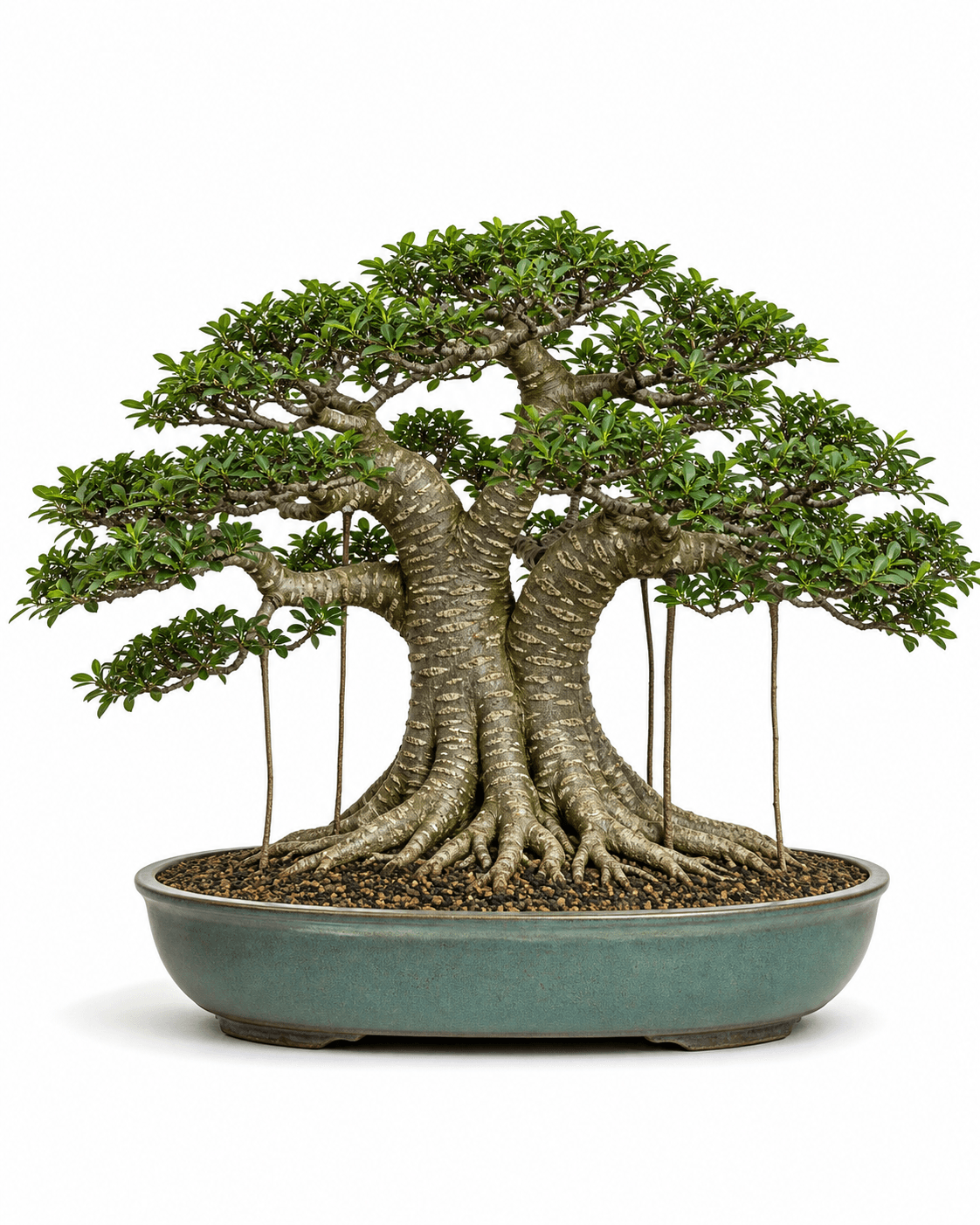
Tigerbark ficus is a small-leaf Ficus microcarpa trade form grown for patterned gray bark, strong back budding, reliable cuttings, and better indoor tolerance than most woody bonsai. It still needs tropical conditions: bright light, warm roots, oxygenated moisture, and active-growth timing for structural work.
Treat Tigerbark as Broadleaf > Tropical in the EntGrove taxonomy. Kew accepts Ficus microcarpa L.f. in Moraceae, native from tropical and subtropical Asia to the western Pacific, while Tigerbark, Golden Gate, Green Island, Ginseng, and Ficus retusa labels should be read as trade clues until the plant is identified.
The practical care answer is warm and specific: prune in repeated small rounds, use partial defoliation only on strong trees, check wire often, and reserve repotting or root work for a warm window when nights are consistently at or above 60 F / 16 C.
Updated June 19, 2026. Written by EntGrove Editorial. Last verified June 19, 2026.
Care fingerprint
Read the species through its shared care pattern.
Treat indoor culture as a light-management problem first; prune and repot when the tree is actively growing and warm enough to recover. Use this as the starting point before local conditions and tree strength refine the calendar.
Read the foliage first
Broadleaf stress usually shows in leaf color, leaf size, wilt, scorch, or delayed hardening before it becomes a branch problem.
Match work to dormancy
Deciduous, evergreen, tropical, succulent, and flowering broadleaf trees recover on different calendars.
Protect fine roots
Root work should preserve enough active fine roots for the tree to rehydrate quickly after the operation.
Care cadence
The calendar starts with the tree's seasonal state.
Placement
Timing: Keep indoors in cold climates, outside only after nights stay around 60 F / 16 C or warmer. In true warm climates, grow outdoors with sun, airflow, and humidity.
Watch for: Cold windowsills, air-conditioning drafts, heater blasts, dim rooms, and moving the tree from indoor shade straight into harsh outdoor sun.
Bonsai Mirai LibraryNC State ExtensionWatering
Timing: Check often during active growth and water thoroughly when the upper particles begin to dry while the interior still holds some moisture.
Watch for: A dense retail core, dry shrinkage from the pot edge, water left in a saucer, and winter watering that ignores the tree using less water.
Bonsai Mirai LibraryFertilizer
Timing: Feed during active warm growth. Development trees can be pushed harder; refined trees need enough food to recover without blowing coarse internodes.
Watch for: Feeding hard in a cold room, fertilizing a leaf-dropping tree before light and roots are fixed, and late cuts that reduce winter reserves.
Bonsai Mirai LibraryPruning
Timing: Use repeated cutback during warm active growth. Early to midsummer is the strongest window for major ficus back budding in temperate climates.
Watch for: Sheared outer shells, hollow interiors, many shoots from one cut site, and pruning into old wood without nearby active growth.
Bonsai Mirai LibraryDefoliation
Timing: Use partial defoliation on vigorous, mostly developed trees during the warm season. Full defoliation belongs only on very strong mature trees in heat and humidity.
Watch for: Development trees, weak indoor trees, recent repots, cool weather, and watering a leafless tree as though it still had a full canopy.
Bonsai Mirai LibraryRepotting
Timing: Repot or root-work when nighttime temperatures are consistently around 60 F / 16 C or warmer, leaving 6-8 warm weeks for new roots to harden.
Watch for: Pairing heavy root work with heavy defoliation, burying the root crown, bare-rooting without need, and weak recovery in cool late summer.
Bonsai Mirai LibraryWiring
Timing: Wire only branches large enough to hold shape, then inspect frequently during warm growth. Mirai recommends aluminum close to branch diameter for ficus.
Watch for: Fine twig wiring, fast wire bite in smooth bark, latex during a bend, and branches that need pruning or guying instead of force.
Bonsai Mirai LibraryAerial roots
Timing: Encourage aerial roots only when heat and humidity are high. Mirai gives roughly 60 percent relative humidity as a minimum for induction outside native tropical conditions.
Watch for: Dry indoor air, uneven sphagnum wraps that dry out, and aerial roots thickening out of scale because the main root system is underperforming.
Bonsai Mirai LibraryPest checks
Timing: Inspect year-round indoors, especially in winter and after new purchases. Check undersides, branch forks, the trunk base, and sticky surfaces.
Watch for: Scale, thrips, mites, mealybug, weakened leaves from low light, and black surface fungus in persistently humid warm canopies.
NC State ExtensionBonsai Mirai LibrarySpecies guide
Apply the species profile before copying another tree's calendar.
Spec
Tigerbark ficus is the patterned-bark Ficus microcarpa bonsai form.
Tigerbark ficus is managed as Ficus microcarpa, a Moraceae fig that Kew accepts as native from tropical and subtropical Asia to the western Pacific. The Tigerbark name points to the patterned bark and small-leaf bonsai selection, while retail labels may also say Ficus retusa, tiger bark fig, Chinese banyan, Golden Gate, Green Island, Ginseng, or Indian laurel. Kew POWOKew POWOBonsai Mirai LibraryBonsai Empire
The plant is a broadleaf evergreen tropical. NC State describes Ficus microcarpa as a warm, humid, full-sun tree with smooth gray bark, milky sap, dangling aerial roots, good drainage needs, and frequent use as an indoor tree and bonsai. NC State Extension
For bonsai, the useful traits are strong back budding, a forgiving live bark system, roots from cuttings, patterned lenticels, and the ability to become a banyan, clump, forest, fused-trunk, exposed-root, or root-over-rock tree. Its limits are equally clear: cold roots, dim rooms, compact soil, and neglected wire marks weaken the tree before styling skill can help. Bonsai Mirai Library
Native habit
Design Tigerbark from the banyan and strangler-fig habit.
Kew places Ficus microcarpa in the wet tropical biome, with a native range across tropical and subtropical Asia to the western Pacific. Denver Botanic Gardens lists it as a tree from tropical Asia, Australia, and Pacific islands, with sun or partial shade and evergreen foliage. Kew POWODenver Botanic Gardens
That ecology explains the bonsai. Ficus microcarpa can grow as a banyan-like canopy tree with aerial roots, multiple trunks, and roots gripping masonry, stone, or other trees. The convincing bonsai image is wide, low, warm, and humid in spirit, with roots and trunk mass carrying as much visual weight as the canopy. Bonsai Mirai LibraryNC State Extension
The care translation is direct: provide heat, light, moisture, and oxygen together. A wet tropical origin still requires air in the pot: the root zone should take water thoroughly and then breathe before the next cycle. Bonsai Mirai Library
Energy
Read leaf size, cuticle, extension, and temperature before choosing work.
Mirai frames tropical work around temperature and photosynthetic range. Ficus grows most strongly when nights are warm and days are bright, and its efficiency drops sharply once nights fall toward 12-13 C. That is why a tree can look green indoors while having too little energy for pruning, wiring, or root work. Bonsai Mirai Library
Leaf character is a diagnostic. Mirai notes that insufficient light makes tropical leaves enlarge as they try to catch more energy, while pale young ficus leaves lack the mature waxy cuticle that protects older dark leaves from heat and ultraviolet stress. Big soft leaves usually ask for better light and patience before refinement technique. Bonsai Mirai Library
Separate development from refinement. Development trees need runners, foliage mass, warmth, water, and fertilizer to thicken trunks and close wounds. Refinement trees need smaller repeated cuts, partial leaf work, and controlled feeding so the canopy becomes fine without draining the root system. Bonsai Mirai Library
Technique
Use cutback and partial defoliation as energy tools.
Ficus responds well to hard pruning when it is warm, bright, and vigorous. Mirai still warns against shearing the outside into a shell, because that pushes growth to the perimeter and leaves the interior dark and weak. Build branch structure through bifurcation: choose a living bud, prune to it, then repeat once the next flush has hardened. Bonsai Mirai Library
Stipule pinching is one ficus-specific refinement tool. Mirai describes removing the small triangular protective tip before the leaves open to encourage controlled back budding while keeping current leaves on the tree. That keeps photosynthesis working while nudging ramification inward. Bonsai Mirai Library
Defoliation needs restraint. Mirai says full defoliation is for mature ficus, at most once per year, and can leave a tree bare for 30-45 days before new growth hardens. Outside native tropical heat and humidity, partial defoliation is the safer default. Remove more from strong outer areas and leave inner leaves to pull energy inward. Bonsai Mirai Library
When cutting leaves, remove the blade and leave the petiole. Mirai notes that the petiole seals off the stem and helps reduce pathogen entry. After any major leaf reduction, water less because the tree has less foliage transpiring from the pot. Bonsai Mirai Library
Roots
Repot in the warm window and sequence roots away from heavy top work.
Mirai gives the tropical repotting threshold as consistently warm nights, around 60 F / 16 C or higher, with a practical temperate window from early summer into early August where enough warm weeks remain for roots to harden. That timing fits Tigerbark better than a cold early-spring routine borrowed from maples. Bonsai Mirai Library
Repot for reasons you can see: substrate decomposition, lost percolation, root congestion, transition out of dense retail soil, or a design move such as changing angle, exposing roots, or building a root-over-rock planting. A fixed calendar is less useful than water movement, root density, and vigor. Bonsai Mirai Library
Avoid stacking major stresses. Mirai advises staggering repotting and partial defoliation outside truly tropical conditions. If roots are cut hard, leave enough foliage to pull water and rebuild. If the canopy has just been heavily reduced, let new leaves mature before cutting roots. Bonsai Mirai Library
Root-over-rock Tigerbark needs patience. Mirai notes that disturbing root-over-rock ficus too soon resets root adhesion, so leave the planting alone for several years when roots are gripping stone and only repot when the root system or substrate demands it. Bonsai Mirai Library
Soil and pot
Build drainage, moisture, and oxygen around your light and watering habits.
NC State lists good drainage and moist soil for Ficus microcarpa, while Mirai explains the bonsai version: water and oxygen must both be available. A Tigerbark in compact peat can stay wet at the core while the surface looks dry, which makes both overwatering and underwatering easy. NC State ExtensionBonsai Mirai Library
For refinement, use a sifted granular mix that can produce fine roots. Mirai says akadama scales best for fine tertiary ramification in tropical broadleaf work, while tropical substrates can range from pine-bark organic mixes to inorganic pumice and lava blends depending on climate and watering. Bonsai Mirai Library
A practical indoor Tigerbark mix can lean mineral and open, then adjust with screened bark only if your room, pot, and watering dry too quickly. In constantly humid or automatic-watering conditions, reduce water-holding fines and keep the root crown high enough to avoid crown rot. Bonsai Mirai Library
Pot choice should support the tropical image. Mirai notes that glazed containers often suit tropicals because they lack the seasonal leaf drama of deciduous trees. Tigerbark can take a quiet green, cream, brown, or blue-gray glaze for refined banyan images, or a heavier shallow oval for root-over-rock and fused-trunk designs. Bonsai Mirai Library
Climate
Regional care is mostly a question of heat, light, humidity, and winter protection.
In tropical and subtropical climates, Tigerbark can grow outside for most or all of the year. That unlocks faster thickening, aerial roots, and more frequent work cycles. Mirai says tropicals in hot regions may tolerate two or three work sessions in a season, while cooler maritime climates often get only one or two useful windows. Bonsai Mirai Library
In temperate climates, move the tree outside only after warm nights settle, then acclimate gradually to sun. Bring it under protection before cold nights arrive. FNAI lists the landscape species in Zone 9b-11, while Mirai warns that a containerized tropical root ball has less thermal buffering than ground soil. Florida Natural Areas InventoryBonsai Mirai Library
Indoors, treat the setup as a grow environment. Strong window light may be enough for survival, while refinement usually improves with supplemental light, warm roots, airflow, and humidity that does not leave foliage wet all day. Mirai specifically mentions heating pads, humid air, and supplemental lighting for indoor winter ficus care in cold climates. Bonsai Mirai LibraryNC State Extension
Cold injury has a pattern. Mirai describes blackened translucent leaf patches after near-freeze exposure as cell rupture, and identifies freezing roots or growing tips as the danger line. If leaves are damaged but roots and tips remain alive, the recovery plan is warmth, light, and restraint. Bonsai Mirai Library
Pests
Most pest problems become worse when winter light and airflow are weak.
NC State lists greenhouse thrips, Cuban laurel thrips, and fern scale as insect problems for the Ginseng form of Ficus microcarpa. Indoor Tigerbark also commonly needs checks for scale, mealybug, spider mites, and sticky honeydew on leaves or nearby surfaces. NC State Extension
Use horticulture before sprays. Increase light, avoid cold wet roots, improve airflow, wash foliage when appropriate, and isolate new retail ficus until pests are ruled out. A weak indoor tree can carry pests for weeks before damage becomes obvious. Bonsai Mirai LibraryNC State Extension
Warm humid canopies can develop black surface fungus. Mirai treats routine canopy cleaning as normal tropical maintenance in humid climates. Clean carefully with water and a soft brush or cloth, then correct the airflow and leaf-wetness pattern that allowed it to spread. Bonsai Mirai Library
Root rot is the disease pattern to prevent first. It follows stale organic soil, standing water, cold roots, defoliated trees watered too heavily, or buried root crowns. The prevention is an oxygenated mix, correct watering, warm recovery, and matching foliage mass to root work. Bonsai Mirai Library
Wiring
Wire fewer branches, use enough aluminum, and stop when latex appears.
Mirai recommends aluminum wire close to the diameter of the ficus branch being shaped. Smaller wire can fail to hold fast-growing tropical wood and can cut in quickly. Fine twig wiring is usually a poor trade because Tigerbark twigs thicken and scar fast. Bonsai Mirai Library
Latex is a bend warning. Mirai says latex appearing during a bend signals that the branch has reached its structural limit. Stop the bend, support the branch, and use staged correction later if the line still needs movement. Bonsai Mirai Library
Use pruning, guy wires, clip-and-grow, and branch replacement wherever possible. Tigerbark back buds strongly when warm and bright, so a bad branch can often be replaced faster than it can be forced into a believable line. Bonsai Mirai Library
Propagation
Cuttings are the default, with grafting reserved for design gaps and fusion projects.
Mirai teaches ficus cuttings as the efficient propagation route: cuttings can be inserted into perlite without rooting hormone, where humidity stays high without keeping the tissue oversaturated. NC State also lists stem cutting for Ficus microcarpa. Bonsai Mirai LibraryNC State Extension
Air layering is possible, but Mirai prefers large cuttings for latex-bearing ficus because their regenerative speed makes cuttings simpler. Use air layers when the branch itself has unusual movement, bark, or root potential worth preserving. Bonsai Mirai Library
Grafting is common in tropical ficus work. Mirai describes branch grafting for missing branches, root grafting for nebari gaps, and trunk fusion when high heat and humidity let cambium knit quickly. Reserve those development tools for strong material; a weak indoor tree needs recovery first. Bonsai Mirai Library
Sourcing
Choose small leaves, useful bark, real taper, and a recoverable root system.
Good Tigerbark material has patterned lenticels, firm green leaves, short internodes, low usable branches, a base that can become convincing, and roots that can be improved without erasing the design. The bark markings are normal lenticels, which Mirai identifies as gas-exchange sites on tiger-striped ficus bark. Bonsai Mirai Library
Retail ficus often arrive in dense soil, with S-curves, braided trunks, or fused cuttings grown quickly under heat. Some can become good practice trees, but reject material with severe inverse taper, a rotten or buried root crown, active scale, weak pale leaves, no low buds, or a graft union that dominates the trunk. Bonsai Mirai LibraryNC State Extension
Ginseng ficus is related care-wise but different design-wise. NC State notes that Ginseng is a Ficus microcarpa cultivar used extensively in bonsai for bulbous roots and is sometimes grafted with smaller-leaved foliage. Tigerbark usually makes a more natural small-tree image when the trunk and roots are chosen well. NC State Extension
Specialist tropical bonsai growers, cuttings from known Tigerbark stock, and field-grown warm-climate trunks usually beat a mass-market pot when the goal is a long-term bonsai. Quarantine any new ficus indoors before it joins the bench. Bonsai Mirai Library
Troubleshooting
Diagnose Tigerbark by light, roots, temperature, foliage mass, and pests.
Symptom: gradual leaf drop indoors. Likely causes: low light, cold roots, a move from greenhouse to room, dry heater air, compact soil, or pests. Fix: increase light, stabilize warmth, inspect roots and leaves, then wait for new growth before styling. Bonsai Mirai LibraryNC State Extension
Symptom: leaves get larger and shoots stop extending. Likely causes: insufficient light or a tree held too cool for active growth. Fix: move closer to strong light, add supplemental lighting, warm the root zone, and postpone refinement until smaller vigorous leaves return. Bonsai Mirai Library
Symptom: yellowing, sour soil, or blackened roots. Likely causes: oxygen-starved substrate, standing water, cold wet roots, or watering a low-foliage tree too often. Fix: reduce watering to actual demand, improve warmth and airflow, and repot only in the warm window if the root system needs intervention. Bonsai Mirai Library
Symptom: wire marks or branch cracks. Likely causes: wire left through fast tropical swelling, wire too thin, or a bend pushed past the latex warning point. Fix: remove wire early, use larger aluminum on future structural branches, and replace impossible branches through pruning or grafting. Bonsai Mirai Library
Symptom: aerial roots will not form. Likely causes: humidity below the induction threshold, cool nights, dry sphagnum, or a tree that lacks enough energy. Fix: use a humid warm microclimate, wrap specific targets with moist sphagnum, guide roots down, and keep the canopy healthy. Bonsai Mirai Library
Design
Let the design read as a tropical fig.
Mirai defines banyan styling by proportion. A banyan ficus can be short and wide, with roots, secondary trunks, and a broad canopy doing the work of age. For Tigerbark, the patterned trunk should stay visible enough to justify the name, while the canopy becomes dense without becoming a clipped ball. Bonsai Mirai LibraryBonsai Mirai / Asymmetry
Aerial roots should read differently from trunks and branches. Mirai notes that they descend in straighter lines, so keep them vertical and let trunks carry movement. When every root and branch wiggles the same way, the banyan image becomes less believable. Bonsai Mirai Library
Branch design should fan and bifurcate, one to two to four to eight, so vigor is distributed across the canopy. Lower branches can be heavier and more ramified, while upper branches should become slimmer and finer. Avoid branch clusters at one point because they thicken slowly as a group and can create swelling. Bonsai Mirai Library
Tigerbark also works as root-over-rock because ficus roots can grip and thicken around stone. Commit to the rock early, protect the roots while they adhere, and delay repotting until the planting has enough attachment to survive disturbance. Bonsai Mirai Library
Forms
Tigerbark sits inside the larger Ficus microcarpa retail maze.
Ficus microcarpa forms overlap heavily in the bonsai trade. Labels can include Tigerbark, Tiger Bark, Golden Gate, Green Island, Green Gem, Chinese banyan, Indian laurel, Ginseng, and Ficus retusa. Kew keeps Ficus microcarpa and Ficus retusa as separate accepted species, so the retail label is a clue rather than proof. Kew POWOKew POWOBonsai Empire
Tigerbark is chosen for patterned bark, small leaves, and easy cutting propagation. Green Island, Green Gem, and Golden Gate are usually handled as compact microcarpa selections unless the plant proves otherwise. Ginseng is a swollen-root retail form, often grafted. Willow-leaf ficus has different foliage and stronger rot sensitivity, so its pruning and watering deserve separate care notes. Bonsai Mirai LibraryNC State Extension
If the tree is healthy, exact cultivar naming matters less than the response in front of you. Use Tigerbark-specific design goals for bark and root character, while borrowing the broader Ficus microcarpa care model for heat, light, water, pruning, and recovery timing. Bonsai Mirai LibraryKew POWO
History
Tigerbark belongs to the modern indoor bonsai era and the older banyan tradition.
Ficus microcarpa has a long cultural presence across warm Asian and Pacific landscapes, where banyan-like figs can become shade trees, street trees, temple trees, and root-over-structure trees. Kew notes environmental, social, animal-food, medicinal, invertebrate-food, fuel, and food uses. Kew POWO
Bonsai and penjing growers use that biology for banyan canopies, fused trunks, aerial-root curtains, and roots over rock or masonry. Mirai treats tropical design as ecology-led: the design should echo where the tree grows and how it competes for light. Bonsai Mirai LibraryBonsai Mirai / Asymmetry
Tigerbark became especially visible in Western beginner bonsai because cuttings are easy, leaves are small, bark is interesting early, and the tree survives indoor culture better than most temperate species. The best examples move beyond survival: they show deliberate root work, clean branch bifurcation, controlled scars, and a canopy shaped by light rather than a hedge shear. Bonsai Mirai LibraryNC State Extension
Species questions
Answer the beginner questions before styling.
Is Tigerbark ficus a good beginner bonsai?
Yes, it is one of the better beginner choices for indoor bonsai because it tolerates pruning, grows from cuttings, and can recover from mistakes. It still needs very bright light, warmth, good drainage, and pest checks.
Is Tigerbark ficus the same as Ficus microcarpa?
Treat it as a Ficus microcarpa form or cultivar for care. The Tigerbark name describes the patterned bark and bonsai selection, while Ficus microcarpa is the species-level care anchor.
Can Tigerbark ficus live indoors all year?
Yes, with strong enough light and warm stable conditions. It grows much better near a bright window or under a grow light than on a dim shelf.
How often should I water Tigerbark ficus?
Water when the upper particles begin to dry and the tree still has enough warmth and foliage to use water. In winter or after defoliation, water less because transpiration drops.
When should I repot Tigerbark ficus?
Repot during warm active growth when nights are around 60 F / 16 C or warmer. Roots, soil, drainage, or design set the need; the calendar is only a reminder to inspect.
Can I fully defoliate Tigerbark ficus?
Only if the tree is mature, vigorous, warm, bright, and humid enough to recover. Partial defoliation is safer for most temperate and indoor growers.
How do I get aerial roots on Tigerbark ficus?
Use heat and high humidity. Wrap targeted areas with moist sphagnum, keep the wrap alive, and guide roots down with a humid tube or straw once they emerge.
Why are Tigerbark ficus leaves getting big?
Large leaves usually point to weak light, excessive coarse growth, or a tree still in development. Improve light and root health before using leaf-reduction techniques.
Why is my Tigerbark ficus dropping leaves?
Common causes include a recent move, low light, cold roots, drafts, compact soil, overwatering, underwatering, or pests. Stabilize the environment before pruning or repotting.
Are the tiger stripes on the bark a disease?
No. On Tigerbark and similar ficus, the markings are lenticels and normal bark character. Still inspect for scale insects because scale can sit on bark and branch crotches.
Sources
Species advice needs source discipline.
Next decisions
Plan the operation before copying the calendar.
A good care note for Tigerbark ficus records the tree's stage, the work done, and the aftercare used. That record matters more than a month-name rule.
Related species
Compare nearby trees before transferring advice.
Ficus retusa / Indian laurel
Ficus microcarpa
Willow-leaf ficus
Ficus salicaria
Benjamin fig
Ficus benjamina
Ginseng ficus
Ficus microcarpa 'Ginseng'
Mistletoe fig
Ficus deltoidea