
Species guide
Willow-Leaf Ficus Bonsai Care
Ficus salicaria
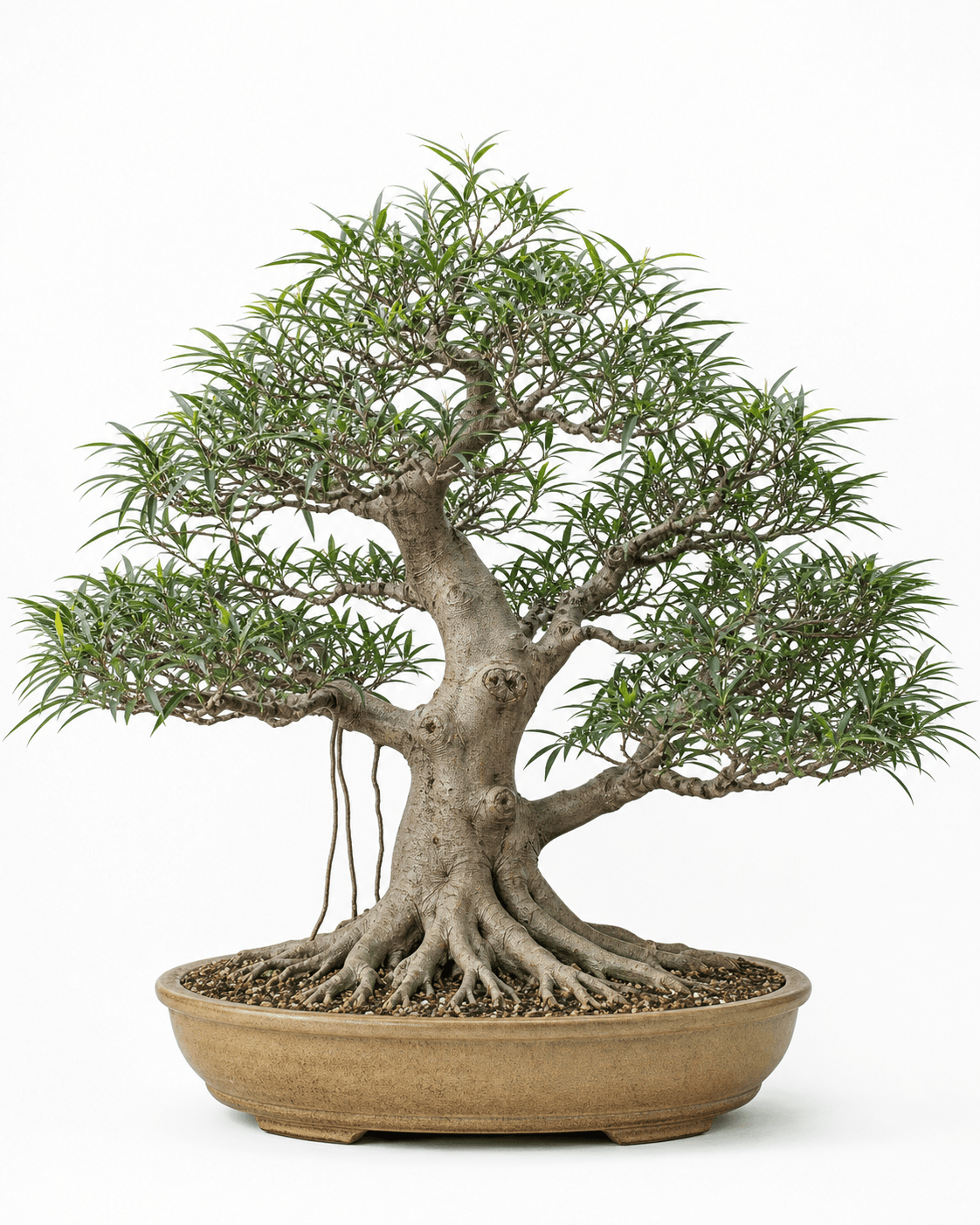
Willow-leaf ficus is a warm-climate fig bonsai grown for narrow leaves, rapid back budding, easy cuttings, and strong recovery from sharp pruning. Its weakness is root-zone saturation: wet roots, cool temperatures, and low foliage mass can shut the tree down or trigger branch dieback.
The name needs careful handling. EntGrove keeps the common bonsai page under willow-leaf ficus, while Kew accepts Ficus salicaria, Ficus neriifolia, and Ficus salicifolia as separate species. NC State covers the common bonsai plant as Ficus neriifolia, with Ficus nerifolia and Ficus salicifolia as previous labels, and Bonsai Mirai uses salicaria, salicifolia, and nerifolia in the bonsai trade sense.
For practical care, grow it warm and bright, water only after oxygen returns to the root zone, keep extra foliage on rot-prone trees, use partial defoliation with stipule pinching, and reserve repotting or root work for active growth when nights are consistently near 60 F / 16 C or warmer.
Updated June 19, 2026. Written by EntGrove Editorial. Last verified June 19, 2026.
Care fingerprint
Read the species through its shared care pattern.
Treat indoor culture as a light-management problem first; prune and repot when the tree is actively growing and warm enough to recover. Use this as the starting point before local conditions and tree strength refine the calendar.
Note: Bonsai trade uses willow-leaf ficus across several narrow-leaf fig labels. Verify the exact plant before applying native-range or hardiness claims.
Read the foliage first
Broadleaf stress usually shows in leaf color, leaf size, wilt, scorch, or delayed hardening before it becomes a branch problem.
Match work to dormancy
Deciduous, evergreen, tropical, succulent, and flowering broadleaf trees recover on different calendars.
Protect fine roots
Root work should preserve enough active fine roots for the tree to rehydrate quickly after the operation.
Care cadence
The calendar starts with the tree's seasonal state.
Placement
Timing: Keep warm and bright. Move outdoors only after nights are near 60 F / 16 C or warmer; protect before cold nights slow growth.
Watch for: Cold windowsills, air-conditioning drafts, dim rooms, weak elongated shoots, and sudden outdoor sun before leaves have hardened.
Bonsai Mirai LibraryNC State ExtensionWatering
Timing: Water thoroughly when the upper particles begin to dry and the tree has enough foliage and warmth to use water.
Watch for: Sour soil, yellowing leaves, black roots, branch dieback after wet weeks, or a leafless tree watered like a full canopy.
Bonsai Mirai LibraryPruning
Timing: Cut back during warm active growth. Development trees can take hard cutback when strong, then should be allowed to rebuild leaves before root work.
Watch for: Sheared outer shells, hollow interiors, branch clusters at one point, and large cuts without enough foliage to close.
Bonsai Mirai LibraryDefoliation
Timing: Prefer partial defoliation and stipule pinching. Use full defoliation only on a mature, vigorous tree in truly warm, humid recovery conditions.
Watch for: Random shoot clusters after full defoliation, weak interior buds, recent repotting, cool nights, or dry indoor air.
Bonsai Mirai LibraryRepotting
Timing: Repot in the warm window when nights are near 60 F / 16 C or warmer, with aftercare in protected bright conditions.
Watch for: Dense circling roots, decomposed organic soil, slow percolation, buried root crowns, and attempts to pair heavy pruning with major root reduction.
Bonsai Mirai LibraryWiring
Timing: Wire structural branches when warm and growing, using enough aluminum to hold the branch and removing it before swelling marks the bark.
Watch for: Latex at a bend, wire bite, cracked soft bark, and fine twig wiring that scars faster than it sets.
Bonsai Mirai LibraryFertilizer
Timing: Feed during active growth. Use stronger feeding for development and lighter feeding once refinement and leaf size matter.
Watch for: Coarse leaves from excess push, weak response from low light, and fertilizer left in cold wet soil while roots are inactive.
Bonsai Mirai LibraryAerial roots
Timing: Encourage aerial roots only during warm, vigorous growth with sustained humidity near 60 percent or higher.
Watch for: Dry wraps, cool nights, weak root systems, and aerial roots thickening out of scale because the main root system is underperforming.
Bonsai Mirai LibraryPests
Timing: Inspect year-round indoors and after summer outdoor exposure, especially branch crotches, leaf undersides, and shaded interiors.
Watch for: Scale, thrips, sticky honeydew, sooty mold, mites in dry rooms, and root rot after saturation.
NC State ExtensionBonsai Mirai LibrarySpecies guide
Apply the species profile before copying another tree's calendar.
At a glance
Willow-leaf ficus is generous in growth and strict about oxygen.
The care profile is tropical ficus first: heat, light, humidity, and foliar mass control recovery. A healthy willow-leaf ficus can root from large cuttings, bud from old tissue, and rebuild after hard pruning, but those strengths depend on active metabolism. Bonsai Mirai Library
The risk profile is root oxygen. Mirai flags willow-leaf ficus as more rot-sensitive than many other ficus when oversaturated. That single point should shape watering, soil, repotting, defoliation, and winter protection. Bonsai Mirai Library
Treat the scientific label as a field note. Kew separates Ficus salicaria, Ficus neriifolia, and Ficus salicifolia, while bonsai sources use several of those names for willow-leaf material. Care decisions should follow the verified plant, leaf form, root response, and growth behavior. Kew POWOKew POWOKew POWONC State Extension
Wild habitat
Read the wild fig before choosing the bonsai image.
Kew describes Ficus salicaria as a Guyana shrub in wet tropical habitat, Ficus neriifolia as a subtropical tree from the Himalaya to western Yunnan and northern Indo-China, and Ficus salicifolia as a dry-shrubland African and Arabian species. NC State describes the common willow-leaf fig bonsai as an evergreen subtropical tree from China and the Himalayas, growing in coniferous and broadleaf forests at 2,000-8,000 feet. Kew POWOKew POWOKew POWONC State Extension
The shared care implication is warmth, high light, seasonal humidity, and an airy root zone. This plant can handle abundant water only when roots are warm, oxygenated, and backed by active foliage. In cool indoor rooms, the same watering pattern becomes dangerous. Bonsai Mirai LibraryNC State Extension
The design implication is tropical broadleaf architecture: wide canopies, multiple trunks, aerial roots where humidity supports them, and branch fans rather than flat conifer pads. Narrow leaves let the tree read smaller than many figs, which makes it useful for forests, shohin, and exposed-root compositions. Bonsai Mirai LibraryBonsai Mirai / Asymmetry
Reading the tree
Stage, light, and roots decide how hard you can work.
In development, willow-leaf ficus should be allowed to run enough foliage to thicken trunks, heal wounds, and generate back buds. Mirai describes the species as storing reserves in thick live bark and living xylem tissue, which explains its unusual tolerance for hard cutback when it is strong. Bonsai Mirai Library
In refinement, the goal becomes controlled bifurcation. Let the branch extend enough to feed itself, then cut back to the nearest useful active leaf or bud. Stipule pinching gives the tree a signal to branch without stripping all photosynthetic surface. Bonsai Mirai Library
Oversized leaves, stalled shoots, and long internodes usually point to weak light, low temperature, or overlarge root energy for the current canopy. Root maturation, strong light, and tip control create small leaves more reliably than repeated stripping. Bonsai Mirai Library
Technique
Use partial leaf work and sharp cutback, then let the tree rebuild.
Willow-leaf ficus can back bud strongly, and Mirai notes that grafting is rarely needed on Ficus salicaria because hard cutback can trigger buds from trunks, roots, and branch junctions. That strength makes it excellent for rebuilding poor retail material or forest plantings. Bonsai Mirai Library
Full defoliation creates the common failure mode. Mirai warns that on willow-leaf ficus, full defoliation can produce chaotic shoot clusters because useful buds sit deep in the cambium. Partial defoliation plus stipule pinching gives cleaner ramification and keeps the tree moving water. Bonsai Mirai Library
When reducing a leaf, remove only what serves the design and the energy balance. Mature, dark leaves can be shortened or selectively removed, while inner leaves and end-tip leaves often deserve protection because they keep sap moving and help wounds close. On ficus leaf work, Mirai also favors leaving the petiole so the remaining tissue can seal cleanly. Bonsai Mirai Library
Avoid stacking hard cutback with a major repot in a temperate or indoor climate. A hard cutback asks the tree to spend stored reserves above ground; root work asks it to rebuild below ground. Sequence the work so one side recovers before the next demand. Bonsai Mirai Library
Roots
Repot only when warmth and foliage can support new roots.
Mirai sets the tropical repotting and root-work window around consistent nighttime temperatures near 60 F / 16 C or warmer. In temperate maritime climates that often means early summer into early August, while tropical climates may offer a longer active window. Bonsai Mirai Library
Willow-leaf ficus tolerates significant root work when strong. Mirai notes a unique ability to combine aggressive root pruning and top pruning with immediate full-sun recovery on developmental material. Treat that as a high-vigor, warm-climate technique rather than a default indoor maneuver. Bonsai Mirai Library
Leave some root mass intact on leafy trees, expose buried crowns, remove decomposed organic soil in a controlled way, and secure the tree firmly. Aim for a root system that can hydrate foliage while new fine roots colonize oxygenated particles. Bonsai Mirai Library
Soil and pot
Choose drainage, oxygen, and scale before decorative color.
A tropical ficus mix can vary by climate. Akadama supports fine ramified roots, pumice buffers water, and lava preserves air channels. In a wet greenhouse or cool room, increase structural particles so the pot does not stay sour after watering. Bonsai Mirai Library
Development material can stay in a larger container longer because foliar mass and root volume drive trunk growth. Refinement material earns a smaller, shallower, better-proportioned container after root quality and branch density already exist. Bonsai Mirai Library
Pot choice should match tropical character. Glazed containers, shallow ovals, forest slabs, root-over-rock plantings, and wider-than-tall proportions can all work when the root zone remains stable and the composition has enough humidity and light. Bonsai Mirai LibraryBonsai Mirai / Asymmetry
Climate
The same tree behaves differently in Florida, Portland, and a living room.
In humid tropical or subtropical regions, willow-leaf ficus can grow hard, back bud readily, and tolerate stronger operations because heat and humidity keep metabolism high. It may need frequent root inspection and prompt pruning because growth can outrun design quickly. Bonsai Mirai Library
In temperate regions, treat summer as the real work season. Move the tree outdoors after nights warm, acclimate it to sun, repot or style in the active window, and bring it back under protection before cold nights slow recovery. Bonsai Mirai LibraryNC State Extension
Indoors, engineer the missing tropics: strong light, warm roots, airflow, and humidity. Mirai notes that ficus metabolism drops sharply when nights fall to roughly 12-13 C, with strongest growth above 18 C nights and warm days near 30-32 C. Bonsai Mirai Library
Winter watering should fall with metabolism. A leafed-out tree under lights may still use water. A cool, low-light, recently pruned tree needs a much slower wet-dry cycle so roots can breathe. Protect the tree before roots or growing tips approach freezing conditions. Bonsai Mirai Library
Pests and disease
Watch pests, but prevent root rot first.
NC State lists fungus or root rot from overwatering for Ficus neriifolia, and also connects ficus with greenhouse thrips and scale. Indoor trees deserve regular underside, crotch, and bark checks because pests can build quietly in still air. NC State Extension
Scale and thrips weaken soft growth and leave sticky residue or distorted leaves. Remove light scale manually, improve airflow, and use appropriate horticultural soap or oil when needed. Quarantine new tropicals before placing them near a wintering bench. NC State Extension
Root rot is the cultural failure to prevent. Wet organic soil, cold roots, heavy watering after defoliation, and buried crowns all lower oxygen. Fix the water-oxygen balance before adding fertilizer or pruning for shape. Fresh cuts can bleed sticky latex, so keep skin sensitivity and clean tools in mind during pest or disease work. Bonsai Mirai LibraryNC State Extension
Wiring
Wire structural branches, then remove early.
Mirai recommends aluminum wire close to the diameter of the ficus branch being set. Small wire can scar quickly and fail to hold because tropical growth thickens fast. Bonsai Mirai Library
Fine twig wiring is often a poor trade on willow-leaf ficus. Mirai favors wiring branches of meaningful thickness and avoiding fine shoots that scar fast. Clip-and-grow, guy wires, branch replacement, and staged pruning usually give cleaner results with less bark damage. Bonsai Mirai Library
Latex is a stop sign during bending. When latex appears, the tissue has reached its limit. Stop, support the branch, and continue design through future growth rather than forcing one bend. Bonsai Mirai Library
Propagation
Cuttings are the obvious path, with grafting as a design tool.
Mirai describes Ficus salicaria as rooting from nearly any tissue: roots, trunks, or branches. The general ficus method is simple cuttings in perlite without rooting hormone, where humidity stays high without keeping the cutting oversaturated. Bonsai Mirai Library
NC State lists root cutting and stem cutting for Ficus neriifolia, which fits the bonsai evidence. Large cuttings are often more efficient than air layers on latex-bearing ficus because the genus regenerates quickly, but air layers can still rescue a good trunk line above poor roots when cuttings would lose the design. NC State ExtensionBonsai Mirai Library
Grafting remains useful for missing branches, root gaps, or fused-trunk projects. Use it on vigorous material with heat and humidity available. Weak indoor trees should be grown first, then engineered later. Seed is rarely the practical bonsai route because named trade identity and proven leaf scale matter more than genetic novelty. Bonsai Mirai Library
Sourcing
Buy the plant, roots, and label uncertainty together.
A good willow-leaf ficus has narrow healthy leaves, strong low buds, usable trunk movement, a stable base, and roots that can be improved without removing the design. Avoid trees with sour soil, active scale, pale sparse growth, rotten crowns, or severe inverse taper from fused nursery stock. Bonsai Mirai LibraryNC State Extension
Ask the seller what name they use and where the stock came from. Ficus salicaria, Ficus neriifolia, Ficus nerifolia, and Ficus salicifolia labels may appear on similar retail material, but the exact plant affects range claims and sometimes cold tolerance. Kew POWOKew POWOKew POWONC State Extension
Cuttings from a known bonsai parent are often better than anonymous retail plants because leaf size, internode length, rot response, and budding behavior are already proven. Quarantine every new ficus and watch watering for the first month. Bonsai Mirai Library
Troubleshooting
Most failures trace to light, roots, temperature, or timing.
Symptom: branch dieback after a wet period. Likely causes: oversaturation, cold roots, low foliage mass, compact soil, or root rot. Fix: warm the tree, increase light and airflow, reduce watering to actual demand, and repot only when warm enough for recovery. Bonsai Mirai LibraryNC State Extension
Symptom: chaotic clusters after defoliation. Likely cause: full defoliation on willow-leaf ficus forced random buds rather than controlled bifurcation. Fix: thin to useful shoots, rebuild leaf mass, then use stipule pinching and partial leaf work next cycle. Bonsai Mirai Library
Symptom: large leaves and stalled extension. Likely causes: weak light, cool nights, too much root energy for the current canopy, or a tree kept indoors away from summer vigor. Fix: improve light, warm the root zone, and postpone refinement until growth is strong. Bonsai Mirai Library
Symptom: wire marks. Likely causes: wire left through active swelling, wire too thin, or fine branches wired instead of grown and cut. Fix: remove wire earlier, use heavier aluminum for structural branches, and rely more on pruning. Bonsai Mirai Library
Symptom: no aerial roots. Likely causes: humidity below the induction threshold, cool nights, dry sphagnum, or low vigor. Fix: use a warm humid enclosure, wrap target zones with moist sphagnum, and keep the canopy growing. Bonsai Mirai Library
Design
Let the narrow leaves serve a tropical broadleaf design.
Willow-leaf ficus is one of the best ficus for forests because the leaf scale, back budding, and cutting reliability support many trunks. Mirai places the dominant trunk about one-third across a forest composition, then uses varied trunk sizes and gentle taper to create a unified canopy. Bonsai Mirai Library
For a single tree, read trunk line, defining branch, and apex first. Banyan, clump, exposed-root, root-over-rock, and informal upright all work when the branch architecture builds fans: one to two to four to eight, with lower branches heavier and upper branches finer. Bonsai Mirai LibraryBonsai Mirai / Asymmetry
Aerial roots should look like aerial roots: mostly vertical, direct, and distinct from moving trunks or branches. They need heat and humidity to form, and they should strengthen the design rather than distract from it. Bonsai Mirai Library
Avoid hedge shearing. A clipped outer shell shades the interior, loses inner buds, and leaves a hollow canopy. Open the structure, protect interior leaves that feed useful branches, and build the image through repeated small decisions. Bonsai Mirai Library
Forms
The willow-leaf name covers several trade labels.
NC State uses Ficus neriifolia for willow-leaf fig and lists Ficus gasparriniana, Ficus nerifolia, and Ficus salicifolia as previous names. It also notes that F. gasparriniana var. laceratifolia can appear as a separate label because of larger leaves and fruit. NC State Extension
Kew accepts Ficus salicaria, Ficus neriifolia, and Ficus salicifolia as separate names with different ranges. Bonsai retail language often uses those names less precisely, so a page that handles the trade group must be honest about that label ambiguity. Kew POWOKew POWOKew POWO
Compare with Tigerbark, Ginseng, and Benjamin fig before borrowing techniques. Tigerbark is usually a Ficus microcarpa form with patterned bark. Ginseng ficus is a swollen-root retail form. Benjamin fig is more brittle and reactive. Willow-leaf ficus has narrower leaves, stronger cutting potential, and stronger rot sensitivity. Bonsai Mirai LibraryNC State Extension
History
Its bonsai value comes from modern tropical practice.
Willow-leaf ficus became a favorite in tropical and indoor bonsai because it offers small visual scale, cutting reliability, rapid regrowth, and enough toughness for rebuilding poor material. It gives Western indoor growers a more workable tropical image than many large-leaf figs. Bonsai Mirai LibraryNC State Extension
Mirai uses willow-leaf ficus in both primer and forest contexts, which is a useful clue: the species is valuable as both single-tree material and multi-trunk composition material. The best work depends on restraint after the first hard rebuild. Bonsai Mirai Library
The taxonomy debate is part of the history. Ficus salicaria was first published in 2004 according to Kew, while Ficus neriifolia is an older accepted Asian name. Bonsai growers should keep the common name searchable while citing hardiness and range with care. Kew POWOKew POWO
Species questions
Answer the beginner questions before styling.
Is willow-leaf ficus a good indoor bonsai?
Yes, if it gets very bright light, warm roots, and careful watering. It is more forgiving than many indoor-labeled bonsai, but it is less forgiving of wet cool roots than Tigerbark ficus.
Is willow-leaf ficus Ficus salicaria or Ficus neriifolia?
Both names appear in bonsai contexts. Kew accepts them as separate species, while NC State covers the common willow-leaf fig bonsai as Ficus neriifolia and notes Ficus nerifolia and Ficus salicifolia as previous labels. EntGrove keeps this common page for the trade group and explains the ambiguity.
How often should I water willow-leaf ficus?
Water when the upper particles begin to dry and the tree has enough warmth and foliage to use water. After defoliation, in winter, or in low light, water less because transpiration drops.
Why is my willow-leaf ficus dropping branches?
Branch dieback often follows oversaturated roots, cold roots, compact soil, or heavy work done without enough foliage. Stabilize light, warmth, and watering before pruning more.
Can I fully defoliate willow-leaf ficus?
Use full defoliation rarely. Mirai favors partial defoliation plus stipule pinching because full defoliation can trigger chaotic shoot clusters on willow-leaf ficus. When cutting leaves, leave the petiole attached.
When should I repot willow-leaf ficus?
Repot during warm active growth when nights are near 60 F / 16 C or warmer. Root condition, soil breakdown, drainage, and design need should trigger the work.
What soil is best for willow-leaf ficus bonsai?
Use a free-draining tropical broadleaf mix with enough akadama for fine roots and enough pumice or lava for oxygen. Indoor and wet-climate trees need especially reliable drainage.
Does willow-leaf ficus need humidity?
Humidity improves vigor and helps aerial roots form, but it must come with airflow and oxygenated soil. Constant wet roots create rot risk.
Can willow-leaf ficus be grown from cuttings?
Yes. It is one of the easiest ficus to propagate from cuttings, including large trunk, root, or branch material when heat, humidity, and oxygenated media are available.
What styles suit willow-leaf ficus?
It suits forests, clumps, banyan designs, exposed-root work, root-over-rock, and informal uprights. The narrow leaves make it especially useful where smaller scale matters.
Sources
Species advice needs source discipline.
Next decisions
Plan the operation before copying the calendar.
A good care note for Willow-leaf ficus records the tree's stage, the work done, and the aftercare used. That record matters more than a month-name rule.
Related species
Compare nearby trees before transferring advice.
Ficus retusa / Indian laurel
Ficus microcarpa
Tigerbark ficus
Ficus microcarpa 'Tigerbark'
Benjamin fig
Ficus benjamina
Ginseng ficus
Ficus microcarpa 'Ginseng'
Mistletoe fig
Ficus deltoidea