
Species guide
Ginseng Ficus Bonsai Care
Ficus microcarpa 'Ginseng'
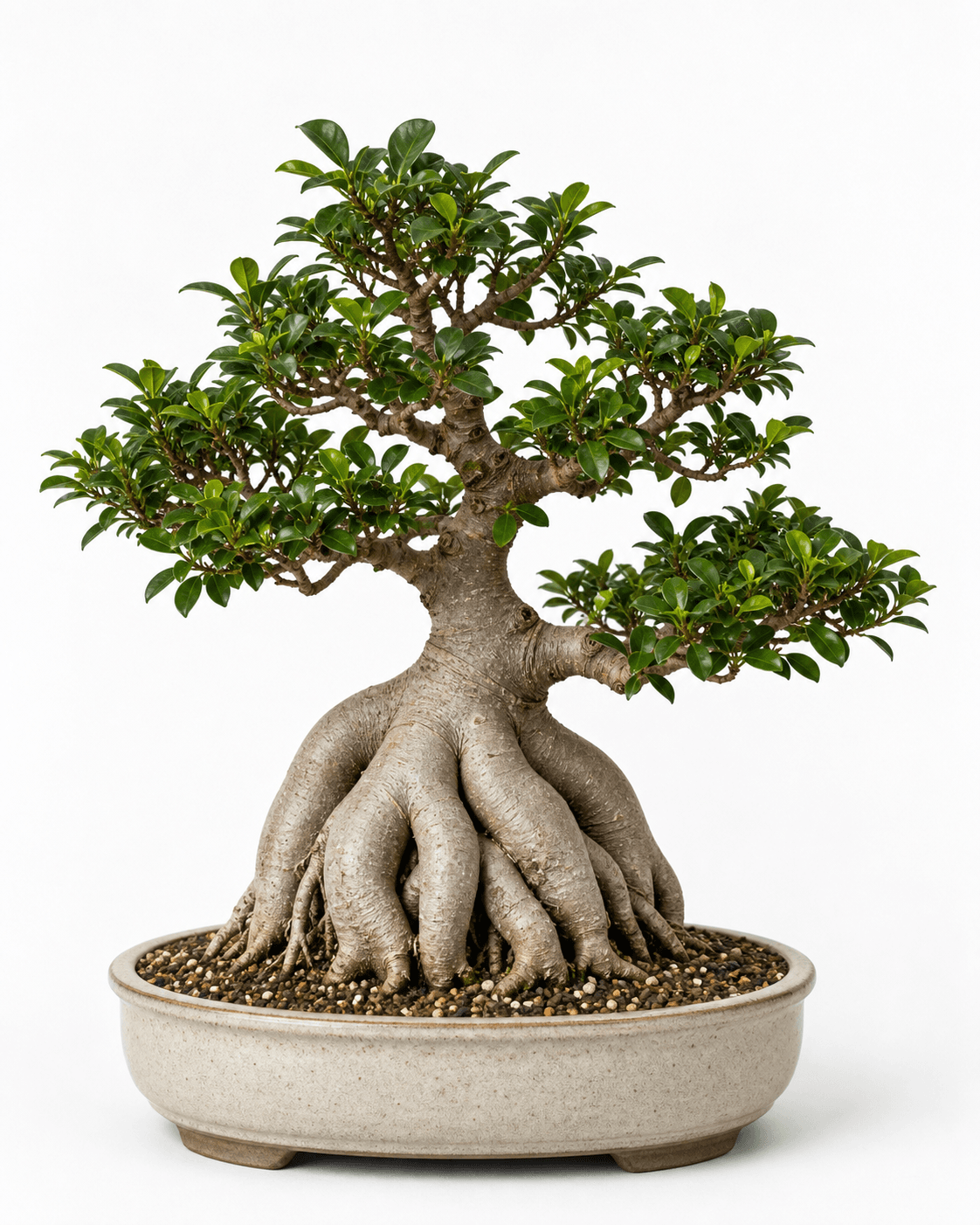
Ginseng ficus is the common retail form of Ficus microcarpa with swollen pot-bellied roots and, often, a grafted small-leaf canopy. It is durable enough for indoor beginners, but its bonsai future depends on honest material reading: grow the tree strong first, then decide whether to refine the existing root form, air-layer or cut above it, or use it as a training tree.
Treat it as Broadleaf > Tropical in the EntGrove taxonomy. Kew accepts Ficus microcarpa L.f. in Moraceae and places it across tropical and subtropical Asia to the western Pacific; NC State covers Ficus microcarpa Ginseng as a bonsai and indoor container tree with rapid growth, full-sun preference, moist well-drained soil, stem-cutting propagation, and glossy evergreen leaves.
The practical care answer is warmth, strong light, oxygenated watering, and active-growth timing. Repot only when nights are consistently near 60 F / 16 C or warmer, avoid pairing hard root work with hard canopy reduction, protect graft unions and smooth bark, and use cuttings or an air layer when the swollen-root retail form cannot become the tree you want.
Updated June 19, 2026. Written by EntGrove Editorial. Last verified June 19, 2026.
Care fingerprint
Read the species through its shared care pattern.
Treat indoor culture as a light-management problem first; prune and repot when the tree is actively growing and warm enough to recover. Use this as the starting point before local conditions and tree strength refine the calendar.
Read the foliage first
Broadleaf stress usually shows in leaf color, leaf size, wilt, scorch, or delayed hardening before it becomes a branch problem.
Match work to dormancy
Deciduous, evergreen, tropical, succulent, and flowering broadleaf trees recover on different calendars.
Protect fine roots
Root work should preserve enough active fine roots for the tree to rehydrate quickly after the operation.
Care cadence
The calendar starts with the tree's seasonal state.
Placement
Timing: Keep warm and bright year-round. Move outdoors only after nights stay near 60 F / 16 C or warmer, then acclimate gradually to stronger sun.
Watch for: Cold windowsills, air-conditioning drafts, heater blasts, weak winter light, and sudden outdoor sun on tender indoor leaves.
Bonsai Mirai LibraryNC State ExtensionWatering
Timing: Check often during active growth and water thoroughly when upper particles begin to dry while the interior still carries slight moisture.
Watch for: Dense retail peat around the swollen roots, water left in a saucer, dry shrinkage from the pot edge, and winter watering that ignores lower transpiration.
Bonsai Mirai LibraryFertilizer
Timing: Feed during active warm growth. Push development trees more strongly, then reduce intensity once leaf size, internodes, and graft swelling matter.
Watch for: Fertilizing a cold, dim, leaf-dropping tree before light and root oxygen are fixed, or feeding hard right after root pruning.
Bonsai Mirai LibraryPruning
Timing: Prune through repeated warm-season cutback after shoots harden. Keep enough leaves to power root function and wound closure.
Watch for: Hedge-sheared outer shells, hollow interiors, coarse grafted shoots, swelling around large cuts, and losing useful low branches by cutting every growing tip at once.
Bonsai Mirai LibraryDefoliation
Timing: Use partial defoliation only on strong, warm, bright trees. Full defoliation belongs to mature, vigorous ficus in high heat and humidity.
Watch for: Recent repotting, weak indoor trees, cool nights, dry rooms, and watering a reduced canopy as if it still had full leaf mass.
Bonsai Mirai LibraryRepotting
Timing: Repot when nights are consistently around 60 F / 16 C or warmer and at least 6-8 warm weeks remain for new roots to harden.
Watch for: Buried root crowns, grafted tops that need foliage left intact, sour organic cores, circling roots, and pairing heavy root work with hard top reduction outside truly tropical recovery weather.
Bonsai Mirai LibraryWiring
Timing: Wire only branches large enough to hold shape, then inspect frequently during warm growth. Use aluminum close to branch diameter for ficus.
Watch for: Wire bite in smooth bark, latex during bends, cracks near graft unions, and fine twig wiring that scars faster than it sets.
Bonsai Mirai LibraryPest checks
Timing: Inspect year-round indoors, especially after purchase and during winter. Look under leaves, at branch forks, and around the swollen root base.
Watch for: Scale, thrips, mites in dry rooms, sticky honeydew, sooty mold, and root rot symptoms after prolonged saturation.
NC State ExtensionBonsai Mirai LibrarySpecies guide
Apply the species profile before copying another tree's calendar.
At a glance
Ginseng ficus is a retail Ficus microcarpa form with inflated roots.
Ginseng ficus should be cared for as Ficus microcarpa, a Moraceae fig that Kew accepts as native from tropical and subtropical Asia to the western Pacific. NC State lists the plant as Ficus microcarpa Ginseng, also called Ficus Ginseng, Ginseng Ficus, and pot-bellied Ficus. Kew POWONC State Extension
The swollen lower structure is the defining feature. Many retail plants combine a fast-grown bulbous root or caudex-like base with a grafted canopy, so the tree can be visually durable before it is horticulturally refined. That form can stay charming as a houseplant bonsai, or it can become a starting point for graft, cutting, root, or air-layer experiments. NC State ExtensionBonsai Mirai Library
Its basic requirements are simple and strict: heat, very bright light, moist but well-drained soil, oxygen at the roots, and active-growth timing for serious work. The inflated roots store presence, but they do not excuse dim placement or stale wet soil. Bonsai Mirai LibraryNC State Extension
Wild habit
Read it as a tropical fig, then account for the nursery-made root form.
Kew places Ficus microcarpa in the wet tropical biome, with a range from tropical and subtropical Asia to the western Pacific. NC State describes the Ginseng form as a dense, irregular, multi-stemmed or multi-trunked woody plant used as an indoor tree and bonsai. Kew POWONC State Extension
In nature and warm landscapes, Ficus microcarpa can become a broad evergreen tree with smooth gray bark, adventitious roots, and a dense rounded crown. FNAI notes adventitious roots, milky sap, glossy leaves, small figs, and the ability to grow in cracks or very little soil in Florida. Florida Natural Areas InventoryKew POWO
For design, that points toward banyan, exposed-root, clump, and root-over-rock ideas. The Ginseng retail base changes the starting material: instead of pretending the swollen roots are an old trunk, make the root mass the subject, hide graft problems with growth, or restart the tree above the base if the proportions never settle. Bonsai Mirai LibraryBonsai Mirai / Asymmetry
Reading the tree
Judge light, graft quality, and active growth before touching tools.
Mirai frames tropical strength through light and temperature. Under weak light, tropical leaves enlarge and extension stalls. Under warmth, humidity, and strong light, ficus becomes vigorous enough to back bud, close wounds, root cuttings, and support grafting or fusion. Bonsai Mirai Library
On Ginseng ficus, read the graft union as carefully as the leaves. A clean union with similar bark, smooth taper, and low branching can be refined. A swollen abrupt union, mismatched foliage, or a canopy perched on a root bulb usually needs grow-out, branch replacement, or a clear plan that accepts the novelty form. Bonsai Mirai LibraryNC State Extension
Separate survival from development. A green indoor ficus may be alive while lacking enough energy for heavy pruning, defoliation, or root work. Wait for firm glossy leaves, active extension, and reliable water use before structural work. Bonsai Mirai Library
Make the design decision before the first serious repot. If the roots are the feature, expose and stabilize them. If the base is a training compromise, grow the canopy for cuttings, grafts, or an air layer rather than spending years correcting an image the material cannot support. Bonsai Mirai LibraryBonsai Mirai / Asymmetry
Technique
Prune for structure, then use leaf work sparingly.
Ficus can respond strongly to pruning, especially during warm active growth. Mirai cautions against shearing a ficus canopy into a dense outer shell because the interior loses light and ramification. Build branching by cutting back to useful active leaves or buds, then letting the next flush harden before repeating. Bonsai Mirai Library
The grafted top often needs branch selection more than leaf stripping. Remove crowded shoots from one junction, protect useful low branches, and avoid letting a single coarse grafted shoot dominate the whole canopy. If a large cut produces too many shoots, thin them before swelling becomes permanent. Bonsai Mirai Library
Stipule pinching can be useful once the tree is strong and branches are placed. Mirai describes removing the small protective tip before leaves open so back budding starts without sacrificing every working leaf, which matters for indoor trees with limited energy. Bonsai Mirai Library
Defoliation is a refinement tool for strong trees. Mirai says full defoliation should be limited to mature ficus, at most once per year, and that a leafless tree may take 30-45 days to rebuild and harden new leaves. For most indoor Ginseng ficus, partial defoliation and selective pruning are safer. Bonsai Mirai Library
After any leaf reduction, water less. Ficus with fewer leaves transpires less water, and Mirai links overwatering after defoliation with root-rot risk. Keep leaves on weak trees until light and roots improve. Bonsai Mirai Library
Roots
Repot in warmth and keep the root crown alive.
Mirai sets the tropical work window around nighttime temperatures consistently near 60 F / 16 C or warmer. In temperate climates, that often means early summer into early August, with enough warm weeks left for new roots to harden. Bonsai Mirai Library
Repot Ginseng ficus for root evidence: slow percolation, compacted retail soil, roots circling tightly, a buried crown, sour smell, or a design move that needs a new angle. Mirai emphasizes repotting for substrate breakdown, lost percolation, or design reason rather than a blind calendar. Bonsai Mirai Library
The swollen roots make potting depth important. Keep the crown and exposed root tissue from sitting constantly wet, and transition dense organic cores carefully into a granular mix. On a grafted tree, leave enough canopy to keep water moving while roots recover. Bonsai Mirai LibraryNC State Extension
Sequence work by recovery. Mirai warns against stacking major root work with heavy canopy reduction outside truly tropical conditions. If the root ball needs a hard correction, leave foliage. If the top was just cut hard or partially defoliated, wait until new leaves mature before disturbing roots. Bonsai Mirai Library
Soil and pot
Use drainage and proportion to make the root form intentional.
NC State lists loam, sand, shallow rocky texture, moist conditions, and good drainage for Ficus microcarpa Ginseng. In bonsai terms, use a granular tropical broadleaf mix that wets evenly and drains cleanly rather than heavy houseplant soil packed around the swollen base. NC State ExtensionBonsai Mirai Library
Akadama helps create fine ramified roots, while pumice and lava preserve structure and oxygen. In wet climates or low-light rooms, bias toward faster drainage. In hot bright conditions, keep enough water retention to prevent hard dry-down. Bonsai Mirai Library
Pot choice should solve scale. A shallow oval, glazed round, root-over-rock setting, or simple training pot can all work. The swollen roots should either feel deliberately exposed and stable or be grown over time into better surface roots, rather than half-buried in wet soil. Bonsai Mirai LibraryBonsai Mirai / Asymmetry
Climate
Ginseng ficus changes character by region.
In frost-free tropical and subtropical climates, Ficus microcarpa can live outdoors with strong growth, sun, humidity, and frequent response. FNAI lists USDA Zone 9b-11 for Ficus microcarpa, and that landscape range should still be treated conservatively in a shallow bonsai pot. Florida Natural Areas InventoryBonsai Mirai Library
In temperate climates, summer is the real development season. Move the tree outside after nights are warm, acclimate leaves to brighter light, perform repotting or structural work in the active window, then bring it back before cold nights slow the roots. Bonsai Mirai Library
Indoors, supply the missing tropics: a very bright window or grow light, warm roots, airflow, and humidity awareness. A tree kept green in a dim room can still lose fine branching and produce oversized leaves, so indoor care should be measured by active growth, not only leaf retention. Bonsai Mirai LibraryNC State Extension
Pests and disease
Prevent root rot and catch indoor pests early.
NC State flags potential problems including thrips and scale on the Ginseng ficus profile. Indoors, inspect leaf undersides, branch crotches, graft unions, and the base where pests can hide against gray bark. NC State Extension
Scale often looks like small bark-colored bumps, and sticky honeydew or sooty mold can appear below feeding sites. Remove light infestations manually, improve light and airflow, isolate new purchases, and use labeled horticultural oil or soap only when the tree is not heat-stressed. NC State ExtensionBonsai Mirai Library
Root rot is usually a culture problem: dense soil, cold roots, weak light, and watering that ignores reduced transpiration. Fix the water-oxygen balance before fertilizing or pruning for style. Bonsai Mirai Library
Wiring
Wire carefully around smooth bark and graft transitions.
Mirai recommends aluminum wire close to the diameter of the ficus branch being shaped. Fine wire bites quickly and may fail to hold in fast tropical growth. Use wire for branches worth setting, then remove early. Bonsai Mirai Library
Latex appearing during a bend is a structural warning. Stop the bend, support the branch, and build the design through future growth if the tissue resists. This matters near graft unions, where mismatched tissue and abrupt swelling already concentrate stress. Bonsai Mirai Library
For many Ginseng ficus, clip-and-grow is cleaner than wiring every twig. Let a shoot extend, cut to a useful direction, then repeat. Guy wires and pruning can solve coarse branches with less scarring than tight spirals on smooth bark. Bonsai Mirai Library
Propagation
Cuttings are easy, grafting is for design correction.
NC State lists stem cutting as the recommended propagation strategy for Ficus microcarpa Ginseng. Mirai likewise describes ficus cuttings as highly reliable when rooted in warm, humid, well-aerated conditions. NC State ExtensionBonsai Mirai Library
Cuttings can be a practical escape route from a poor swollen base. Mirai notes that ficus roots readily from cuttings without rooting hormone, and perlite keeps the balance of humidity and oxygen favorable. Grow the top strong first, then take warm-season cuttings with enough leaf reduction to keep transpiration in balance. Bonsai Mirai Library
Air-layering is slower than cuttings for latex-bearing ficus, but it can be the cleaner restart when the grafted top has useful trunk movement above a poor root bulb. Begin only after warm nights settle, keep the layer dark and stable, and treat the separated layer like collected material while new roots harden. Bonsai Mirai Library
Grafting is useful when the base is good and the canopy needs a missing branch, finer foliage, or better placement. Use vigorous material, clean cambium contact, secure mechanical support, and warm humid aftercare. Bonsai Mirai Library
Sourcing
Buy with the graft and root form in mind.
Ginseng ficus is widely sold in garden centers, houseplant shops, grocery displays, and beginner bonsai kits. Choose glossy healthy leaves, active buds, no scale, firm roots, and a graft union that can be hidden, improved through growth, or accepted as part of the design. NC State ExtensionBonsai Mirai Library
Red flags include a loose tree in the pot, sour soil, waterlogged moss glued over the surface, abrupt graft swelling, a canopy with no interior buds, soft black root areas, roots that wobble because the swollen base has rotted below the soil line, or a canopy that begins far above the root mass with no believable trunk transition. Bonsai Mirai Library
For serious bonsai, compare with Tigerbark, Green Island, Green Gem, willow-leaf ficus, and ungrafted Ficus microcarpa stock. Ginseng ficus is valuable when the exact root character serves the design; other ficus forms may start closer to a believable trunk and branch structure. Bonsai Mirai LibraryNC State Extension
Troubleshooting
Most problems trace to light, roots, grafts, or timing.
Symptom: leaf drop after purchase. Likely causes: a move from greenhouse to dim room, cold transport, low humidity, compact soil, or watering mismatch. Fix: stabilize warmth and light, check the root ball, avoid hard pruning, and water only when the soil has begun to dry. Bonsai Mirai Library
Symptom: soft or black swollen roots. Likely causes: buried crown, stale organic soil, standing water, or cold wet indoor culture. Fix: improve warmth and light, reduce watering to demand, and plan warm-window repotting if the decay is active. Bonsai Mirai LibraryNC State Extension
Symptom: large pale leaves and long internodes. Likely causes: weak light, low heat, or overfeeding relative to light. Fix: increase light, move outdoors in warm weather after acclimation, and postpone refinement until leaves mature darker and smaller. Bonsai Mirai Library
Symptom: swelling or cracking at the graft. Likely causes: mismatched scion and rootstock growth rates, wire stress, or coarse shoots left unchecked. Fix: inspect the union, keep useful foliage strong, avoid force near the graft, and prune coarse growth before swelling worsens. Bonsai Mirai Library
Symptom: pests returning indoors. Likely causes: scale or thrips hidden at purchase, low airflow, dry winter rooms, or nearby infested houseplants. Fix: isolate the tree, clean leaves and branch crotches, improve culture, and use labeled controls when needed. NC State ExtensionBonsai Mirai Library
Design
Make the swollen roots a deliberate design choice.
A convincing Ginseng ficus design starts by deciding whether the inflated roots are the feature or the problem. If they are the feature, expose them cleanly, choose a pot that gives them scale, and build a compact canopy that feels rooted in the base. Bonsai Mirai LibraryBonsai Mirai / Asymmetry
If the roots fight the image, use the plant as material. Grow the top hard, take cuttings, air-layer above the swollen section, graft branches where the trunk needs them, or build a banyan composition that absorbs the odd base into multiple trunks and aerial-root lines. Bonsai Mirai Library
Branch architecture should still follow tropical broadleaf logic. Build a fan that divides one to two to four to eight, keep lower branches heavier than upper branches, and avoid a clipped round canopy that shades its own interior. Bonsai Mirai Library
Aerial roots require heat and humidity. Mirai gives roughly 60 percent relative humidity as a practical induction threshold outside native tropical conditions. Without that microclimate, a healthy indoor tree can stay attractive while producing no aerial roots. Bonsai Mirai Library
Forms
Ginseng is one name inside the Ficus microcarpa retail maze.
NC State lists the plant as Ficus microcarpa Ginseng with Ficus Ginseng, Ginseng Ficus, and pot-bellied Ficus as common names. Kew accepts the underlying species, Ficus microcarpa, while bonsai and houseplant sellers often mix microcarpa, retusa, ginseng, tigerbark, Golden Gate, and Chinese banyan labels. NC State ExtensionKew POWOKew POWO
Tigerbark is usually selected for patterned bark and smaller leaves. Green Island and Green Gem are compact microcarpa selections. Willow-leaf ficus has narrower leaves and different watering sensitivity. Ginseng ficus is most recognizable by its swollen roots and frequent grafted top. Bonsai Mirai LibraryNC State Extension
Use labels as clues, then read the tree. Leaf shape, internode length, graft quality, root health, and growth response are more useful than a tag when deciding pruning, wiring, repotting, and styling. Bonsai Mirai Library
History
Its importance is access, not exhibition pedigree.
Ficus microcarpa has broad cultural and landscape use across warm regions. Kew notes environmental, social, animal-food, medicinal, invertebrate-food, fuel, and food uses, while NC State notes its frequent use as an indoor tree and bonsai. Kew POWONC State Extension
The Ginseng retail form became important because it made a woody tropical bonsai-looking plant cheap, durable, and available almost everywhere. It introduced many indoor growers to watering, pruning, pests, repotting, and the limits of mass-produced bonsai material. NC State ExtensionBonsai Mirai Library
High-level ficus bonsai usually come from better-rooted microcarpa selections, willow-leaf ficus, large cuttings, tropical field-grown trunks, or deliberately fused compositions. A Ginseng ficus can still teach excellent technique when the grower respects the material and improves it one growth cycle at a time. Bonsai Mirai LibraryBonsai Mirai / Asymmetry
Species questions
Answer the beginner questions before styling.
Is Ginseng ficus a good beginner bonsai?
Yes, it is durable enough for many indoor beginners if it gets bright light, warmth, good drainage, and careful watering. It is less ideal as refined bonsai material when the graft union or swollen roots look awkward.
Is Ginseng ficus the same as Ficus microcarpa?
Treat it as a Ficus microcarpa form for care. NC State lists Ficus microcarpa Ginseng, and Kew accepts Ficus microcarpa as the species-level botanical anchor.
Can Ginseng ficus live indoors all year?
Yes, with a bright window or grow light, stable warmth, and airflow. It grows far better outdoors during warm frost-free weather after gradual acclimation.
How often should I water Ginseng ficus?
Water when the upper soil particles begin to dry and the tree has enough warmth and foliage to use water. In winter, low light, or after pruning, water less often.
When should I repot Ginseng ficus?
Repot during warm active growth when nights are around 60 F / 16 C or warmer. Let root condition, drainage, soil breakdown, and design need trigger the work.
Are the swollen roots on Ginseng ficus natural?
They are a nursery-produced retail form of Ficus microcarpa. The roots are living tissue, but the exaggerated pot-bellied look is selected and trained for sale.
Can I cut off the Ginseng roots and restart the tree?
Often yes, if the top is vigorous and warm conditions are available. Grow the tree strong first, then use cuttings or an air layer to restart above a poor base.
Why is my Ginseng ficus dropping leaves?
Common causes are low light, recent relocation, cold roots, overwatering, dry indoor air, compact soil, or pests. Stabilize culture before pruning or repotting.
Can I defoliate Ginseng ficus?
Use partial defoliation only on a healthy, actively growing tree. Full defoliation is reserved for mature, vigorous ficus in warm humid recovery conditions.
What styles suit Ginseng ficus?
It suits exposed-root, informal upright, small banyan, clump, root-over-rock, and training-tree projects. The best style depends on whether the swollen roots support or weaken the image.
Sources
Species advice needs source discipline.
Next decisions
Plan the operation before copying the calendar.
A good care note for Ginseng ficus records the tree's stage, the work done, and the aftercare used. That record matters more than a month-name rule.
Related species
Compare nearby trees before transferring advice.
Ficus retusa / Indian laurel
Ficus microcarpa
Tigerbark ficus
Ficus microcarpa 'Tigerbark'
Willow-leaf ficus
Ficus salicaria
Benjamin fig
Ficus benjamina
Mistletoe fig
Ficus deltoidea