
Species guide
Bougainvillea Bonsai Care
Bougainvillea spectabilis, Bougainvillea glabra
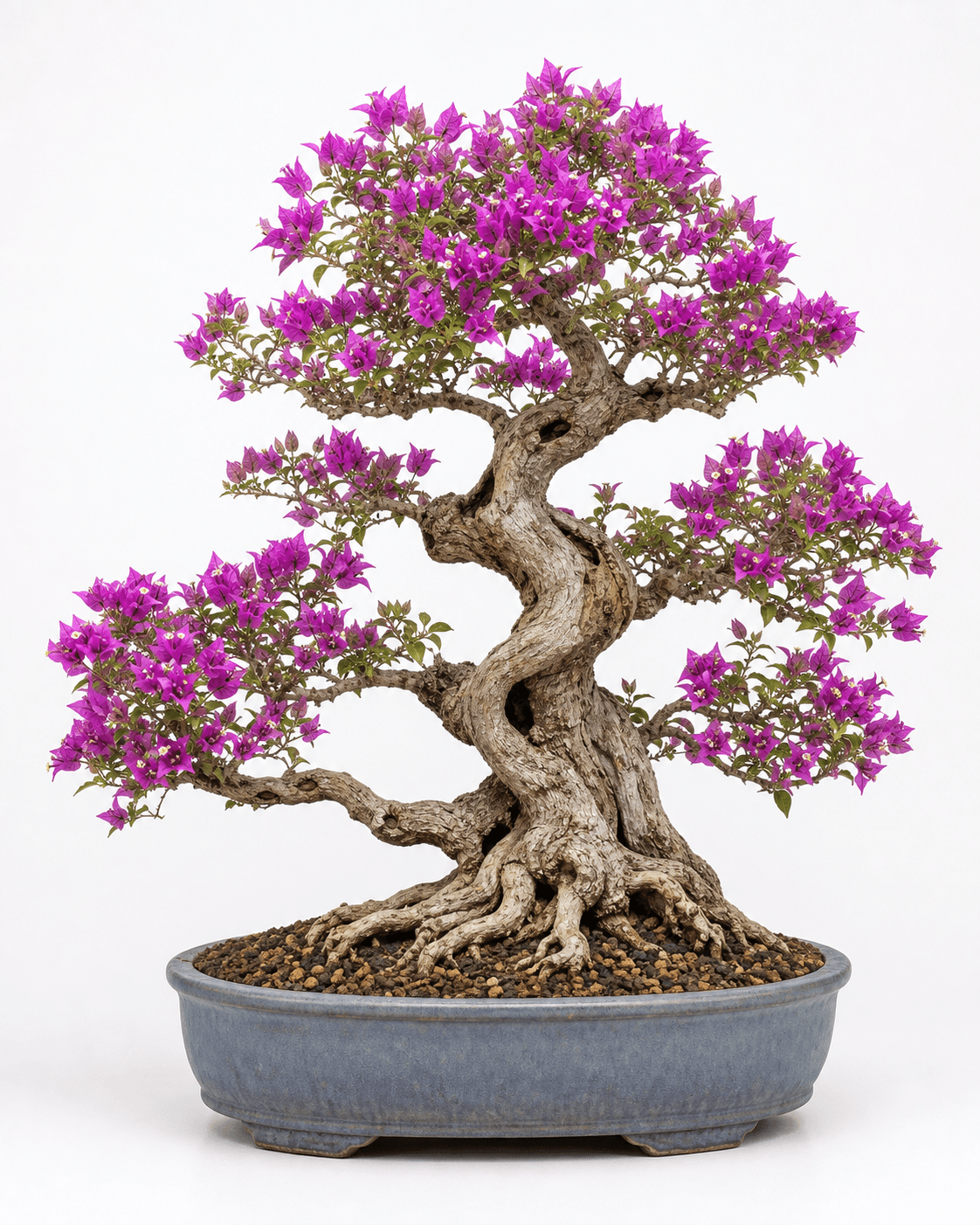
Bougainvillea bonsai needs strong sun, a root system that dries between thorough waterings, and protection before cold nights arrive. Its finest trees use the species as a vine: sharp directional changes, rounded flowering volumes, and old trunks built before the tree enters a shallow pot.
The papery display comes from colored bracts surrounding small flowers. Development depends on long thorn-bearing shoots, while refinement preserves shorter flowering shoots and removes excess suckers after the tree has enough trunk and primary structure.
Root and wound work deserve restraint. Bougainvillea has paper-fine roots, rot-prone interior wood, and branch junctions that can break after aggressive bending, so the safest program stages major operations and lets warmth, foliage, and oxygen fund recovery.
Updated July 12, 2026. Written by EntGrove Editorial. Last verified July 12, 2026.
Care fingerprint
Read the species through its shared care pattern.
Treat indoor culture as a light-management problem first; prune and repot when the tree is actively growing and warm enough to recover. Use this as the starting point before local conditions and tree strength refine the calendar.
Read the foliage first
Broadleaf stress usually shows in leaf color, leaf size, wilt, scorch, or delayed hardening before it becomes a branch problem.
Match work to dormancy
Deciduous, evergreen, tropical, succulent, and flowering broadleaf trees recover on different calendars.
Protect fine roots
Root work should preserve enough active fine roots for the tree to rehydrate quickly after the operation.
Care cadence
The calendar starts with the tree's seasonal state.
Placement
Timing: Use full sun outdoors during warm active growth; protect from frost and use a bright cool winter room around 50-59 F / 10-15 C where winters are cold.
Watch for: Low-light indoor growth, frost, cold wet benches, weak flowering, or long soft shoots produced in shade.
Bonsai Mirai LibraryNC State ExtensionIllinois ExtensionWatering
Timing: Water thoroughly when the soil becomes dry, then let the root mass move toward moderate dryness before watering again.
Watch for: Waterlogged organic cores, skipped watering in heat, root rot symptoms, or panic watering after bracts drop.
Bonsai Mirai LibraryUC IPMNC State ExtensionFlowering
Timing: Prioritize full sun, warmth, and cycles of extension followed by pruning; UC Master Gardeners note that Bougainvillea flowers on new wood and can bloom after a short dry interval.
Watch for: Excess nitrogen, too much shade, constant irrigation, pruning away all fresh growth before bracts form, or expecting winter flowers in a cold dim room.
UC Master Gardener bloom noteBonsai Mirai LibraryIllinois ExtensionFertilizer
Timing: Feed actively growing trees with balanced or slightly nitrogen-forward nutrition. Mirai gives about 10-5-5 as one working ratio, while UC Master Gardeners warn that excess nitrogen can reduce bloom.
Watch for: Soft rank shoots, few bracts, pale leaves from underfeeding, or pushing fertilizer while roots are cold or recently cut.
Bonsai Mirai LibraryUC Master Gardener bloom notePruning
Timing: Prune after flowering and after extensions have made enough new growth; severe landscape pruning belongs after the main bloom period, not during heat stress.
Watch for: Cutting away future bracts too early, leaving long thorny whips unchecked, or defoliating a weak tree to force a style.
Bonsai Mirai LibraryUniversity of Arizona ExtensionUC Master Gardener bloom noteWiring
Timing: Wire young flexible shoots, inspect often, and rely more on pruning for older structure because mature branches harden and can break.
Watch for: Brittle old wood, thorns during handling, bark marks, wire bite during warm growth, or trying to bend a branch that should be grown and cut back instead.
Bonsai Mirai LibraryNC State ExtensionUC ANR Plant SafelyRepotting
Timing: Use mid-to-late spring bud swell with bottom heat in temperate climates, or an early-summer window with at least six to eight warm recovery weeks. Let root condition drive frequency.
Watch for: Bare-rooting, tearing fine yellow roots, cold aftercare, slow drainage, or replacing a functioning root system for cosmetic reasons.
Bonsai Mirai LibraryPests and safety
Timing: Inspect active growth, bract clusters, and sheltered indoor-winter trees; handle with gloves because thorns are part of the plant architecture.
Watch for: Aphids, scale, mealybugs, whiteflies, root rot, fungal or bacterial leaf spot, contact dermatitis from sap, and punctures from thorns.
Bonsai Mirai LibraryNC State ExtensionUC IPMUC ANR Plant SafelySpecies guide
Apply the species profile before copying another tree's calendar.
Honest fit
Bougainvillea is easy to admire and only easy to grow when light and winter protection are solved.
Bougainvillea bonsai has a rare beginner appeal: it can make old-looking trunks, sharp movement, and intense bract color without needing tiny leaves to carry the whole image. Bonsai Mirai says it can back-bud from old wood after hard pruning, which gives growers more design recovery than many tropical flowering shrubs. Bonsai Mirai Library
The beginner trap is placement. Bonsai Mirai says Bougainvillea needs full sun and high temperatures for flowers, Illinois Extension says the plant needs at least six hours of direct sunlight to bloom indoors, and NC State defines full sun as six or more hours. A bright window that keeps a ficus alive may still be too weak for a reliable Bougainvillea display. Bonsai Mirai LibraryIllinois ExtensionNC State Extension
The second trap is aftercare. Bonsai Mirai warns that Bougainvillea roots are thin, yellow, and delicate; UC IPM warns against overwatering; and UC ANR notes thorn and sap hazards. That combination means a beginner can succeed, but only by treating the tree as a warm-climate bonsai with deliberate handling rather than a forgiving houseplant. Bonsai Mirai LibraryUC IPMUC ANR Plant Safely
Identity
Most care advice applies to the Bougainvillea complex, but names still matter.
Kew Plants of the World Online accepts Bougainvillea glabra and Bougainvillea spectabilis as separate species in Nyctaginaceae. Kew lists both with native ranges in Brazil, while NC State describes B. spectabilis as a woody evergreen vine or shrub from Brazil, Bolivia, Peru, and Argentina. Kew POWO: Bougainvillea glabraKew POWO: Bougainvillea spectabilisNC State Extension
Bonsai and nursery trade labels are looser than botanical references. NC State notes that B. spectabilis is larger and hairier than B. glabra, but otherwise similar, and many cultivated Bougainvillea are selected or hybridized for bract color and habit. For care, identify the plant as Bougainvillea first, then adapt to vigor, thorniness, leaf size, bract habit, and local winter storage. NC State ExtensionIllinois Extension
Papery bracts create the showy color around small tubular flowers, according to NC State and Illinois Extension. That distinction matters for pruning: if all fresh flowering shoots are shortened before bracts develop, the plant may be healthy and still fail to perform. NC State ExtensionIllinois Extension
Placement
Give it full sun and warmth, then make winter protection explicit.
Bonsai Mirai recommends full sun and high temperatures during the growing season, with a cool bright winter room near 50-59 F / 10-15 C in temperate climates. NC State lists full sun as six or more hours of direct sun and partial shade as two to six hours, but for flowers the full-sun end is the working assumption. Bonsai Mirai LibraryNC State Extension
NC State lists landscape hardiness in USDA Zones 9b-11b for Bougainvillea spectabilis, and UC IPM says plants in frost-prone areas should be moved indoors in winter. A shallow bonsai pot has less thermal buffer than an in-ground vine on a wall, so protection begins earlier. NC State ExtensionUC IPM
Indoor growing is possible only as a compromise around light and season. Illinois Extension says Bougainvillea need at least six hours of direct sunlight to bloom when grown indoors, advises winter rest after outdoor summer growth, and notes that some leaf drop can occur when plants move between outdoor and indoor conditions. Illinois Extension
In EntGrove taxonomy, Bougainvillea sits under Broadleaf > Tropical beside ficus, Fukien tea, Brazilian rain tree, sweet plum, serissa, and other warm-climate bonsai. Warmth, recovery capacity, and light determine its care calendar. Bonsai Mirai LibraryNC State Extension
Water and roots
Balance deep watering with a decisive return of root-zone oxygen.
Bonsai Mirai recommends watering thoroughly once the soil is dry, while UC IPM says to water infrequently but deeply and allow soil to dry out before watering again. NC State adds the broader horticultural picture: Bougainvillea is drought tolerant once established and susceptible to root rot in constantly wet soil. Bonsai Mirai LibraryUC IPMNC State Extension
A bonsai pot narrows the margin. The tree may tolerate dry periods better than many tropicals, but a small container in hot sun can dry hard enough to damage fine roots. The correct habit is observation: water the whole root mass, confirm drainage, then let the mix approach moderate dryness before the next watering. Bonsai Mirai LibraryUC IPM
Soil needs to support that dry-wet rhythm. Mirai gives 1/4 to 1/8 inch pumice or lava for vigorous development and a 1:1:1 akadama:pumice:lava mix for slower, finer refinement growth. UC IPM reinforces the need for reliable drainage. Bonsai Mirai LibraryUC IPM
Leaf or bract drop calls for diagnosis before watering. Illinois Extension notes that plants may drop leaves when moved indoors, and UC IPM says overwatering can cause root rot. Check light, temperature, drainage, soil moisture, and the recent move first. Illinois ExtensionUC IPM
Pruning and bloom
Prune for cycles: grow, flower, cut back, then rebuild strength.
Bonsai Mirai says to cut shoots after flowering, leaving two leaves on each, and to perform hard structural pruning in autumn. It also says Bougainvillea tolerates pruning well and can back-bud after hard cuts, which is why old trunk lines and compact flowering crowns are realistic bonsai goals. Bonsai Mirai Library
Flower timing argues for restraint. UC Master Gardeners note that Bougainvillea flowers on new wood, that too much nitrogen can reduce flowering, and that flowers can follow a period of dryness. Illinois Extension similarly connects bloom with direct light and seasonal rest. UC Master Gardener bloom noteIllinois Extension
Landscape pruning references help with the severity question. University of Arizona Extension recommends trimming Bougainvillea after its bloom period is over and before the hottest season; it specifically warns against severe pruning during hot summer months. In bonsai terms, do not combine hard top work, heat, and root stress just because the species is vigorous. University of Arizona Extension
A practical bonsai rhythm is to let strong shoots extend enough to feed the plant and set bracts, enjoy the display, then cut back to useful nodes while the tree still has warmth for recovery. Constantly pinching every tip can keep the silhouette neat and still remove the flowering engine. Bonsai Mirai LibraryUC Master Gardener bloom note
Wiring and design
Use wire on young growth, but let pruning build most of the structure.
Bonsai Mirai gives the clean wiring rule: wire young shoots and twigs, but be careful with older branches because they are stiff and break easily. That makes Bougainvillea a better clip-and-grow subject than a tree for dramatic bending after the branch has hardened. Bonsai Mirai Library
The plant architecture also affects handling. NC State describes woody stems armed with stout curved thorns, and UC ANR warns that Bougainvillea has thorns and irritating sap. Gloves and deliberate branch support are practical technique, not overcaution. NC State ExtensionUC ANR Plant Safely
Designs that fit the species usually use old bark, angular trunks, exposed dead or aged sections where the plant offers them, and a crown that can be cut back after bloom. Forcing compact pads like a juniper usually fights the plant; building a flowering canopy through repeated extension and pruning fits it better. Bonsai Mirai LibraryNC State Extension
Inspect wire often during warm growth. The sources do not give a universal wire-removal interval for Bougainvillea, and that is appropriate: growth speed, bark thickness, shoot age, and fertilizer all change the risk. Remove wire before it bites rather than waiting for a calendar date. Bonsai Mirai Library
Repotting
Repot warm, handle roots gently, and do less than the branch vigor tempts you to do.
The Mirai corpus describes Bougainvillea roots as paper-thin and steel-wool-fine. Preserve a functioning portion of the root mass, reduce the greatest container-fit problem first, and keep fine roots hydrated throughout the operation. Bonsai Mirai Library
Choose the window from warm active recovery weather, tree strength, and root evidence such as drainage decline, compacted soil, or a pot full of roots. A flowering tree in poor light or a cold winter room remains a weak repotting candidate during spring. Bonsai Mirai LibraryUC IPM
Use the EntGrove repotting guide for the general decision sequence, then narrow it to Bougainvillea rules: avoid tearing fine roots, avoid cold aftercare, keep the tree stable in the pot, and do not pair hard root reduction with severe top pruning unless the tree has heat and vigor to recover. Bonsai Mirai LibraryUniversity of Arizona Extension
After repotting, water to settle the mix, confirm drainage, protect from extreme heat and wind while roots reconnect, and delay aggressive fertilizer until the tree is moving again. Keep the root system alive, oxygenated, and warm enough to rebuild. Bonsai Mirai LibraryUC IPM
Failure modes
The three common failures are dim light, wet cold roots, and rough handling.
Failure one is treating Bougainvillea as a normal indoor plant. Bonsai Mirai says flowers require full sun and high temperatures, while Illinois Extension says indoor bloom needs at least six hours of direct sunlight. Without that light, the plant may survive but the bonsai promise disappears. Bonsai Mirai LibraryIllinois Extension
Failure two is keeping roots too wet, especially when temperatures are low. UC IPM recommends infrequent deep watering with drying between waterings, and NC State lists root rot as a problem in wet soil. Cold storage should be bright and protected, not stale and saturated. UC IPMNC State ExtensionBonsai Mirai Library
Failure three is rough styling. Bonsai Mirai warns that older branches are stiff and break easily and that roots are delicate; UC ANR adds thorn and sap hazards. Work slowly, support the branch, and choose pruning over wire when the bend is really a break waiting to happen. Bonsai Mirai LibraryUC ANR Plant Safely
Pest checks are still part of the rhythm. Bonsai Mirai lists aphids, scale, mealybugs, whiteflies, and caterpillars, while NC State lists aphids, leaf miner, bacterial and fungal leaf spot, root rot, scale, and mealybugs. Dense bracts and indoor winter shelter can hide problems until the plant is already weakened. Bonsai Mirai LibraryNC State Extension
Forms
Choose by growth habit and bract behavior before choosing by color.
NC State notes that many hybrids and cultivars are available, especially among B. glabra and B. spectabilis selections. Illinois Extension lists the familiar color range as red, purple, orange, yellow, white, and pink bracts. For bonsai, the best color is secondary to internode length, branch placement, trunk base, thorn density, and root health. NC State ExtensionIllinois Extension
Bonsai Mirai says the two species often used for bonsai are B. glabra and B. spectabilis. It also notes that older plants can develop gray-beige bark with age and can flower in terminal or axillary tufts in summer to autumn when conditions are right. Bonsai Mirai Library
The buying rule is simple: pick compact material with usable low branches, healthy fine roots, and evidence that it has grown hard in good light. A weak plant covered in bracts after greenhouse forcing may be less useful than a rough nursery plant with a better trunk and recoverable structure. Bonsai Mirai LibraryUC IPMNC State Extension
Development and refinement
Read the shoot type before deciding whether to run it or remove it.
Indeterminate shoots are long, vegetative, and commonly thorn-bearing. They build trunk and primary-branch girth. Determinate flowering shoots make shorter extensions and contribute compact twigging and bracts, yet they offer little value as sacrifice growth. Bonsai Mirai Library
During development, preserve and support selected suckers until they have built the needed structure. Bougainvillea confined to a bonsai pot adds girth slowly, so major trunk work belongs in the ground, an oversized training container, or a root-escape setup. Bonsai Mirai Library
During refinement, remove unwanted suckers and preserve the compact flowering framework. Use partial defoliation only after a flush has hardened and on a healthy tree whose structure is largely complete. Leaving small interior leaves redirects strength inward while preserving photosynthesis. Bonsai Mirai Library
Pests and diseases
Start with root oxygen, then identify the pest before treating.
NC State lists aphids, scale, mealybugs, whiteflies, mites, thrips, and leaf-chewing pests among Bougainvillea problems. UC IPM specifically tracks Bougainvillea looper. Inspect leaf undersides and shoot tips, then use the least disruptive control appropriate to the confirmed pest. NC State ExtensionUC IPM
Root and crown rot become likely when the substrate stays wet, the crown is buried, or cool indoor conditions suppress water use. Improve drainage and airflow, widen the watering interval, and protect remaining roots. A sour smell, soft crown, and declining uptake require immediate investigation. NC State ExtensionUC IPMBonsai Mirai Library
Curved thorns can puncture skin, and UC ANR flags irritating sap. Wear gloves and eye protection during dense branch work, place the pot away from walkways, and bag thorny clippings before disposal. NC State ExtensionUC ANR Plant Safely
Propagation
Cuttings preserve the cultivar and can start with surprisingly large wood.
Bougainvillea stores substantial reserves in vine wood and can root from large cuttings during warm active growth. Smaller cuttings are easier to manage, while large trunk cuttings can preserve aged bark and movement when they receive excellent drainage and stability. Bonsai Mirai Library
Reduce foliage to match the unrooted cutting, use a highly aerated medium such as perlite, provide bright filtered light, and maintain humidity around the foliage without saturating the base. Delay fertilizer until roots are established. Bonsai Mirai Library
Air layering can create a compact root system below useful trunk movement, though the exposed center can rot after separation. Seed creates genetic variation; cuttings and layers preserve bract color, leaf size, and growth habit. Bonsai Mirai LibraryNC State Extension
Buying and sourcing
Buy the trunk, root condition, and growth habit before the bract color.
B. glabra usually offers smoother leaves, shorter growth, and finer ramification than B. spectabilis. Verify the label when possible, then judge the actual plant: leaf size, internode length, thorn-bearing sucker habit, bract response, and the density of low usable branches. Bonsai Mirai LibraryNC State Extension
Landscape and nursery material can provide old trunks, yet collection needs permission, warm aftercare, and generous root stubs. Avoid flat cuts at the base, hollow trunks with active wet decay, and material whose only attraction is a temporary bract display. Bonsai Mirai Library
Inspect drainage, root smell, trunk stability, thorn injuries, graft unions, and the transition from nursery core to newer soil. A healthy rough plant with good movement often offers more long-term value than a weak plant forced into bloom for retail. NC State ExtensionUC IPMBonsai Mirai Library
Design and styling
Let the vine character determine the trunk line, defining branch, and crown.
Begin with the base and trunk direction, then choose a defining branch that creates the longest asymmetric point. Place the apex so its direction either harmonizes with that movement or returns visual mass toward the base in cascade and semi-cascade designs. Bonsai Mirai / AsymmetryBonsai Mirai Library
Sharp cut-built changes, contorted ascent, and rounded volumes suit Bougainvillea. Preserve negative space between masses so the old trunk remains visible when bracts fill the canopy. Uniform pads and a symmetrical dome obscure its vine ecology. Bonsai Mirai / AsymmetryBonsai Mirai Library
The species lacks durable rot-resistant heartwood, so large deadwood features are temporary and demanding. Build age through bark, sound hollowing, directional line, and repeated branching. Use a pot shape and planting angle that reinforce the chosen movement. Bonsai Mirai LibraryBonsai Mirai / Asymmetry
History and display
Mature Bougainvillea bonsai are judged by old vine character before flowers.
Bougainvillea moved from South American native ranges into warm-climate horticulture as a wall, pergola, and container plant. Its worldwide ornamental use created a large pool of landscape trunks and named color selections for bonsai growers. Kew POWO: Bougainvillea glabraKew POWO: Bougainvillea spectabilisNC State Extension
Exhibition-quality trees show convincing trunk age, clean directional structure, fine twigging appropriate to the leaf size, and an intentional relationship between bract mass and negative space. A full display cannot compensate for a weak base or unfinished primary branches. Bonsai Mirai / AsymmetryBonsai Mirai Library
Plan show timing around health. The post-bract period is an energy low, so recovery belongs ahead of styling ambitions. A healthy tree shown with fewer bracts and clear structure offers a stronger long-term path than one repeatedly weakened to force color. Bonsai Mirai Library
Species questions
Answer the beginner questions before styling.
Is Bougainvillea a good beginner bonsai?
It can be a good beginner bonsai in warm, bright conditions with careful watering. It is a poor first bonsai for low-light rooms, cold winter storage, or growers who tend to keep soil constantly wet.
Can Bougainvillea bonsai live indoors?
Only with very strong light and realistic expectations. Bougainvillea is best grown outdoors in warm full sun and brought into a bright cool protected place for winter where frost is a risk.
How much sun does Bougainvillea bonsai need?
Use full sun as the default. Horticultural sources define full sun as six or more hours of direct sun, and bonsai-specific guidance connects full sun and high temperatures with flowering.
How often should I water Bougainvillea bonsai?
Water thoroughly when the soil has dried, then let it approach moderate dryness again. Do not keep the root ball constantly wet, especially in cool weather.
Why is my Bougainvillea bonsai not flowering?
The most common reasons are not enough direct sun, too much nitrogen, constant watering, pruning off new flowering growth, or trying to bloom the plant in a cold dim winter location.
When should I prune Bougainvillea bonsai?
Prune after flowering and after enough new growth has extended to feed the tree. Avoid severe pruning during extreme heat or when the tree is weak.
When should I repot Bougainvillea bonsai?
Repot when drainage or root geometry requires it. Use mid-to-late spring bud swell with bottom heat in temperate regions, or early summer when at least six to eight warm recovery weeks remain, and preserve part of the paper-fine root mass.
Can I wire Bougainvillea bonsai branches?
Wire young flexible shoots, but avoid forcing older stiff branches because they break easily. Clip-and-grow is often safer for long-term structure.
Sources
Species advice needs source discipline.
Next decisions
Plan the operation before copying the calendar.
A good care note for Bougainvillea records the tree's stage, the work done, and the aftercare used. That record matters more than a month-name rule.
Related species
Compare nearby trees before transferring advice.
Ficus retusa / Indian laurel
Ficus microcarpa
Tigerbark ficus
Ficus microcarpa 'Tigerbark'
Willow-leaf ficus
Ficus salicaria
Benjamin fig
Ficus benjamina
Ginseng ficus
Ficus microcarpa 'Ginseng'