
Species guide
Cotoneaster Bonsai Care
Cotoneaster microphyllus, Cotoneaster horizontalis
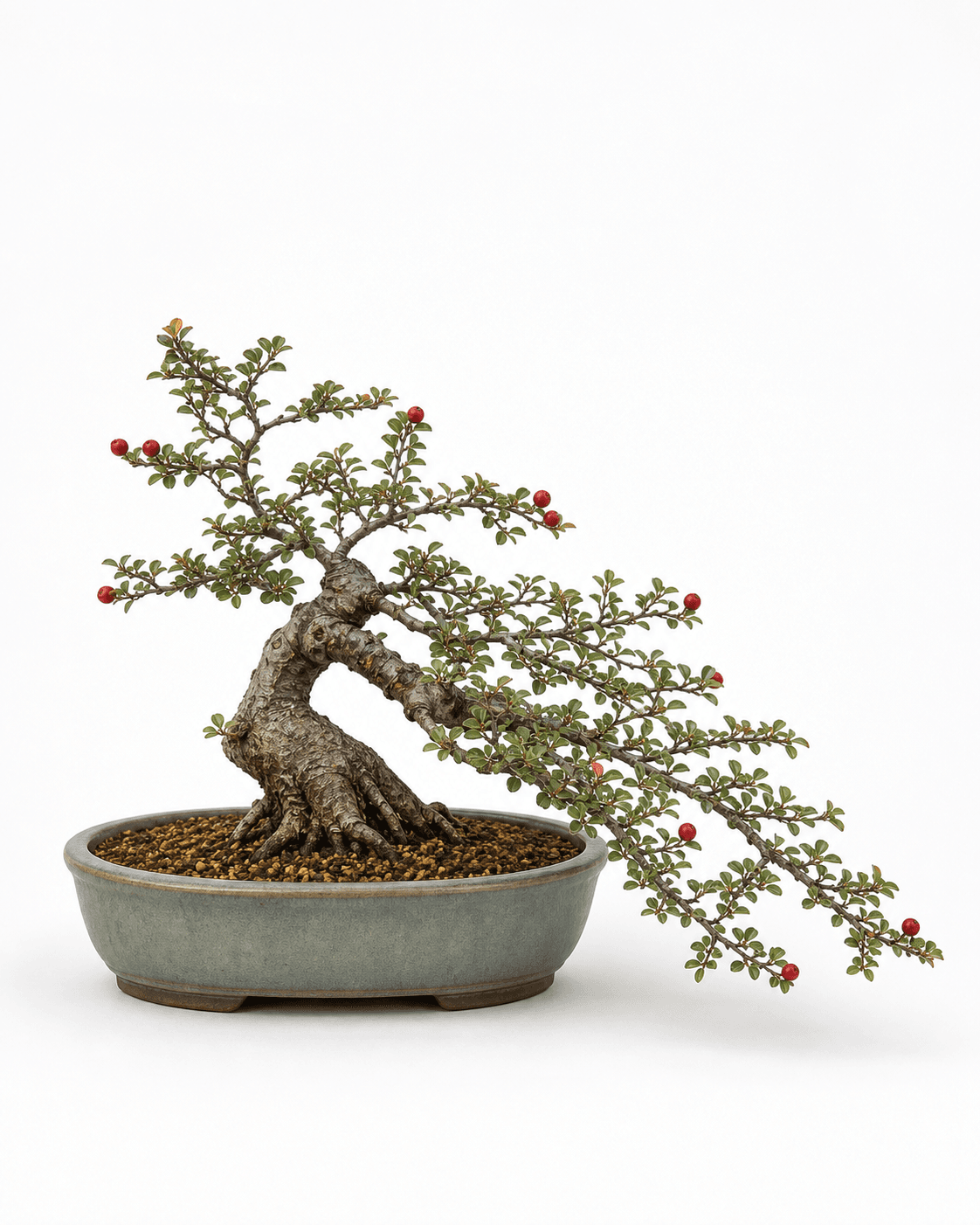
Cotoneaster is a compact outdoor bonsai shrub valued for small leaves, spring flowers, red berries, and strong tolerance of pruning. Grow it in real sun and air, protect the shallow pot from hard freezes, and treat flower and fruit as a refinement reward after branch strength is present.
EntGrove places Cotoneaster in Broadleaf > Evergreen because the bonsai method follows retained-foliage shrubs, but the genus includes deciduous, semi-evergreen, and evergreen forms. Identify the plant in front of you, then use the shared logic: preserve root oxygen, prune after growth hardens, and keep enough short wood for flowers and fruit.
Source depth is transferred rather than species-specific. Cotoneaster appears in local Mirai corpus topic tags, but no reviewed claim text gives a Cotoneaster-only technique. The method below applies Mirai broadleaf evergreen, fruiting bonsai, soil, watering, repotting, wiring, energy, propagation, and design principles conservatively, with Kew and extension sources grounding taxonomy, hardiness, disease, propagation, and regional invasive risk.
Updated July 13, 2026. Written by EntGrove Editorial. Last verified July 13, 2026.
Care fingerprint
Read the species through its shared care pattern.
Protect from hard freezes when species demands it, prune with active foliage in mind, and repot when roots can recover without dormancy cues. Use this as the starting point before local conditions and tree strength refine the calendar.
Read the foliage first
Broadleaf stress usually shows in leaf color, leaf size, wilt, scorch, or delayed hardening before it becomes a branch problem.
Match work to dormancy
Deciduous, evergreen, tropical, succulent, and flowering broadleaf trees recover on different calendars.
Protect fine roots
Root work should preserve enough active fine roots for the tree to rehydrate quickly after the operation.
Care cadence
The calendar starts with the tree's seasonal state.
Placement
Timing: Grow outdoors in sun and moving air. Add afternoon shade only when the pot dries too quickly or heat pushes foliage beyond efficient photosynthesis.
Watch for: Weak bloom in shade, hot dry roots, leaves flagging during heat, winter wind on evergreen forms, and spring dieback that follows unnoticed frozen roots.
NC State ExtensionRoyal Horticultural SocietyBonsai Mirai LibraryWatering
Timing: Water thoroughly when the top dressing and visible particles indicate the root zone is drying. In summer, fruiting shrubs in small pots can need frequent water; in cool seasons, slow down.
Watch for: Berries shriveling, fine twig dieback, sour soil, water bypassing a dense root pad, and repeated evening saturation that leaves roots short of oxygen.
Bonsai Mirai LibraryRoyal Horticultural SocietyFertilizer
Timing: Feed organic fertilizer during active growth. Use heavier feeding in development, moderate feeding while building secondary structure, and light feeding on refined trees after spring growth hardens.
Watch for: Overlong shoots, large leaves, reduced flower quality from coarse growth, salt pressure in 95 F plus heat, and fertilizer applied before roots show activity.
Bonsai Mirai LibraryPruning
Timing: Let the first flush extend and harden, then prune back to interior buds for ramification. In refinement, preserve selected short flower wood and thin after bloom when berries matter.
Watch for: Hedged outlines, removing every flower spur, pruning behind nodes with no viable buds, weak interior twigs, and late cuts that reduce next season display.
Bonsai Mirai LibraryRoyal Horticultural SocietyNC State ExtensionWiring
Timing: Wire after growth hardens and sugars are redistributed. Use aluminum or protected wire on smooth young shoots, and prefer guy wires or pruning on older stiff wood.
Watch for: Wire bite on swelling young shoots, brittle bends on old branches, rotating leaf undersides into harsh sun, and detailed wiring that bruises a tree still in development.
Bonsai Mirai LibraryRepotting
Timing: Repot in spring as buds swell and before the tree needs full foliar water support. Use the operation to restore water and oxygen balance, planting angle, and root-pad health.
Watch for: Water failing to penetrate, decomposed particles, a dense outer root shell, late-year repotting into winter wetness, and bare-rooting retained-foliage material.
Bonsai Mirai LibraryRoyal Horticultural SocietyFlowers and berries
Timing: Let selected short shoots flower, then decide whether the tree has enough strength to carry fruit. Remove fruit on weak, recently repotted, or still-developing trees.
Watch for: Over-cropping, birds spreading seed, branches left long only for bloom count, and display goals interrupting primary or secondary branch building.
Bonsai Mirai LibraryNC State ExtensionRoyal Horticultural SocietyPests and disease
Timing: Inspect around bloom, after warm wet weather, through dense summer foliage, and before winter storage. Sanitize tools when disease is suspected.
Watch for: Lace bugs, aphids, scale, mites, cotoneaster webworms, leaf spots, cankers, and fire blight symptoms such as dead blossoms, blackened hooked shoots, attached dead leaves, or wet-spring ooze.
Penn State ExtensionNC State ExtensionRoyal Horticultural SocietySpecies guide
Apply the species profile before copying another tree's calendar.
At a glance
Cotoneaster is a small-leaved outdoor shrub bonsai grown for flowers, berries, and twigging.
Cotoneaster belongs to Rosaceae, the rose family. For bonsai, the common working labels are Cotoneaster microphyllus, a littleleaf evergreen shrub native from northern Pakistan through the Himalaya region into China and northern Myanmar, and Cotoneaster horizontalis, the rockspray cotoneaster from central and southern China and Taiwan. Kew POWO: C. microphyllusKew POWO: C. horizontalisOregon State: C. microphyllusOregon State: C. horizontalis
The bonsai case is practical: tiny leaves, dense twigging, spring flowers, red berries, and a habit that can fit shohin, kifu, clump, cascade, root-over-rock, and low spreading designs. Its limits are also practical: shallow roots hate stale wetness, fruit costs energy, fire blight belongs on the watch list, and regional invasive guidance matters before propagation. Bonsai Mirai LibraryNC State ExtensionPenn State ExtensionRoyal Horticultural Society
Place it outside in sun to partial shade, use a granular mix, repot in spring when buds swell, and protect the container in hard freezes. Landscape hardiness near Zone 5 still requires container root protection. NC State ExtensionOregon State: C. horizontalisOregon State: C. microphyllusBonsai Mirai Library
Wild habitat
Low shrubs, rocky slopes, and open light explain both the care and the design.
Oregon State describes Cotoneaster microphyllus as an evergreen ground cover or shrub, 1 to 3 ft tall, with dense creeping stems, very small leaves, solitary white flowers, and rosy-red fruit. The same source describes Cotoneaster horizontalis as a low, spreading, often much wider shrub with fish-bone branching, small flowers, and red fruit from late summer into fall. Oregon State: C. microphyllusOregon State: C. horizontalis
Those source habitats point to open light, drainage, and air movement. In a pot, the grower supplies that ecology by giving sun for flowers and berries, managing heat through watering and occasional afternoon shade, and preventing winter wetness from sitting around cold roots. NC State ExtensionRoyal Horticultural SocietyBonsai Mirai Library
The design implication is strong. C. horizontalis already gives a layered rockspray line, while C. microphyllus gives tight evergreen leaf scale and low shrub density. Good Cotoneaster bonsai often preserve low branching memory as the design core. Oregon State: C. horizontalisBonsai Mirai / Asymmetry
Reading the tree
Read Cotoneaster by stage first: trunk building, branch scaffolding, or berry-ready refinement.
In development, sacrifice the display. Mirai fruiting-bonsai method treats flowers and fruit as something earned after structure is built, because fruiting draws energy and long display branches often weaken taper, movement, and ramification. Bonsai Mirai Library
In secondary development, let chosen shoots extend until they have enough length and thickness, then cut back to interior buds. Mirai broadleaf evergreen method is clear that ramification requires both bifurcation and progressively shorter internodes, so repeated clipping without energy management only makes a denser shrub. Bonsai Mirai Library
In refinement, let strong spring growth harden before cutting. Protect weak interior twigs, reduce overgrown shoots to viable interior buds, and preserve selected short flower wood when berries are part of the year plan. Bonsai Mirai LibraryRoyal Horticultural Society
Pruning
Prune for structure first, then preserve enough short wood for the berry display.
Cotoneaster responds well to clip-and-grow, but timing controls quality. Mirai broadleaf evergreen method lets spring growth harden and become energy positive before prune-back, then cuts to interior buds to create a finer second flush. Bonsai Mirai Library
Flower and fruit timing adds a second calendar. NC State records late-spring flowers and late-summer fruit on C. horizontalis, while RHS warns that pruning can reduce flowering and berry production when old flower-bearing wood is removed at the wrong time. NC State ExtensionRoyal Horticultural Society
The working compromise is simple: build the tree first, then let selected short shoots flower once the branch structure is good. If the tree is weak, newly repotted, or still thickening, remove fruit early and spend that energy on roots and ramification. Bonsai Mirai Library
Roots
Repot in spring and preserve the living core of the root system.
Mirai repotting method starts with purpose: restore the water and oxygen balance, correct a planting angle, or move the tree into a more appropriate container. For Cotoneaster, spring bud-swell is the default window because roots can recover before full summer transpiration arrives. Bonsai Mirai Library
Broadleaf evergreens should be handled with core preservation in mind. Mirai repeatedly warns against full bare-rooting retained-foliage material, and the soil corpus teaches working from the outside of the root mass while protecting the central shin under the trunk. Bonsai Mirai Library
Use water behavior as the trigger. If water stops penetrating, the soil has decomposed, or roots have packed the outer wall, repot. If a refined tree still drains evenly and grows predictably, the 3 to 4 year broadleaf evergreen rhythm remains a guide. Bonsai Mirai LibraryRoyal Horticultural Society
Soil and pot
Use a mineral mix that keeps small roots supplied with both water and oxygen.
Mirai soil method defines bonsai soil by water, oxygen, structure, and nutrient exchange. For broadleaf evergreen refinement, the corpus favors akadama-rich soil because root scaling in good akadama supports smaller leaves, shorter internodes, and finer ramification. Bonsai Mirai Library
A practical development mix can start around 1:1:1 akadama:pumice:lava, then shift richer in akadama when refinement is the goal and the grower can manage particle breakdown. In wet climates, keep enough pumice and lava to preserve oxygen and avoid a cold sour core. Bonsai Mirai Library
Pot choice should support the shrub character. Low ovals, shallow rectangles with enough root volume, soft unglazed clay, and quiet muted glazes all work. Very shallow show pots increase water and winter risk, so reserve them for refined, well-rooted trees. Bonsai Mirai / AsymmetryBonsai Mirai Library
Climate
Adapt Cotoneaster care to winter roots, summer heat, and regional seed risk.
Cold regions need root protection. Oregon State gives Zone 5 landscape hardiness for C. horizontalis and C. microphyllus, but Mirai broadleaf evergreen method warns that refined twigging and small containers lose cold tolerance quickly. Protect the pot from hard freezes and winter wind. Oregon State: C. horizontalisOregon State: C. microphyllusBonsai Mirai Library
Hot regions need root-zone observation. Mirai watering method asks the grower to read foliar mass, container volume, sun, wind, humidity, and temperature. Once heat pushes above efficient photosynthesis, a cooler position can be better than forcing full sun while the pot cooks. Bonsai Mirai LibraryRoyal Horticultural Society
Regional stewardship matters because fruiting shrubs can spread by birds. RHS flags several cotoneaster species as potentially invasive and recommends care near open countryside or sensitive habitats. Keep bonsai seed and prunings contained, and follow local restrictions. Royal Horticultural Society
Pests and diseases
Fire blight, canker, lace bugs, webworms, and mites are the serious watch points.
Penn State describes fire blight on cotoneaster as blossom death, blackened curled shoots, persistent dead leaves, cankers, and wet-spring ooze. During dry dormant weather, its guidance calls for cutting infected branches at least 4 in (10 cm) below the canker base and disinfecting tools frequently. Penn State Extension
Risk varies by plant and climate. Penn State includes C. horizontalis and C. microphyllus among relatively resistant cotoneasters, while Purdue notes that fire blight is more troublesome for C. horizontalis in the South. Resistant does not mean immune, so buy clean stock and keep succulent growth moderate. Penn State ExtensionPurdue Arboretum
NC State lists lace bugs, leaf spot, canker, fire blight, cotoneaster webworm, and mites, with mites more likely in hot dry conditions. RHS also lists aphids and scale. Identify the pest or disease first, open congested growth for inspection and air, then follow local extension guidance for the confirmed problem. NC State ExtensionRoyal Horticultural Society
Wiring
Wire young shoots after hardening, then let pruning do most of the refinement.
Mirai structural wiring fundamentals still apply: correct wire angle, even spacing, continuous contact, and bends distributed across a span so one brittle point never carries the load. On smooth young Cotoneaster shoots, check wire early because scars stay visible. Bonsai Mirai Library
Broadleaf evergreen timing points to post-hardening work. Wait for the spring flush to firm and for sugars to redistribute before wiring young shoots. Bonsai Mirai Library
Use wiring to set trunk and primary lines, then rely on cutback for fine twigging. Older Cotoneaster wood can be stiff, so guy wires, clip-and-grow, and branch replacement often make a cleaner tree than repeated heavy bends. Bonsai Mirai LibraryBonsai Mirai / Asymmetry
Propagation
Use cuttings, seed, and layers with local invasive rules in mind.
Cotoneaster can be propagated horticulturally from seed, cuttings, and layers, but a bonsai grower should decide whether propagation is responsible before starting. RHS invasive-risk guidance means seed and rooted cuttings should stay within legal, contained cultivation. Royal Horticultural Society
Mirai propagation method favors clean cuts, correct cutting maturity, reduced foliage, high oxygen, mist, and controlled media moisture. For small-leaved shrubs, choose compact pieces with short internodes and useful movement before rooting them. Bonsai Mirai Library
Air layers are useful when a branch already has scale and movement worth preserving. Mirai teaches even moss thickness around the wound to build radial roots, plus careful dry-down because constant saturation builds callus before roots. Bonsai Mirai Library
Buying
Buy for leaf scale, branch pattern, roots, health, and a responsible source.
Start by identifying the habit. C. horizontalis gives layered fish-bone branching and red fruit; C. microphyllus gives dense evergreen creeping growth and tiny leaves. A genus-only nursery tag is workable only after you inspect leaf size, foliage retention, and branch habit. Oregon State: C. horizontalisOregon State: C. microphyllusPurdue Arboretum
Good pre-bonsai has a trunk line that already suggests low shrub age, recoverable roots, short internodes, interior buds, and clean bark without cankers. Dense hedge stock can work when the inner structure has light and live buds after cleaning. Bonsai Mirai / AsymmetryBonsai Mirai LibraryPenn State Extension
Red flags include imported or wild-dug material with unclear legality, wet peat cores, blackened shoot tips, cankers, scale, mite stippling, an over-fruited weak plant, or a species restricted in your region. Penn State ExtensionRoyal Horticultural SocietyBonsai Mirai Library
Troubleshooting
Most failures trace back to light, root oxygen, winter roots, disease sanitation, or display pressure.
Long internodes with few flowers: increase sun, stop overfeeding during refinement, and prune after the flush hardens so the second flush is finer. Royal Horticultural SocietyBonsai Mirai Library
Leaves yellow while the soil stays wet: improve drainage, reduce watering frequency, inspect for decomposed soil, and suspend pruning or fertilizer until the root zone recovers. Bonsai Mirai Library
Spring growth starts then collapses: suspect winter root damage in the container. Protect the pot earlier next year and avoid demanding pruning until new roots rebuild. Bonsai Mirai Library
Shoot tips blacken or hook after bloom: treat fire blight as a serious possibility. During dry dormant weather, cut at least 4 in (10 cm) below the canker base, disinfect tools frequently, and follow local extension guidance. Penn State Extension
Flowers appear but fruit weakens the tree: remove fruit, rebuild roots and foliage, and delay berry display until primary and secondary branch structure are already stable. Bonsai Mirai Library
New seedlings appear around the bench or garden edge: remove them before they establish, keep berries out of wild disposal areas, and check whether your local authority restricts the species. Royal Horticultural Society
Design
Style Cotoneaster as a low flowering shrub with believable asymmetry and seasonal restraint.
Mirai design method starts with trunk line, defining branch, and apex. On Cotoneaster, those reads are usually compact and lateral, especially when the material shows rockspray or ground-cover ancestry. Bonsai Mirai / AsymmetryOregon State: C. horizontalis
Use the berries as accent. The strongest fruiting bonsai expression is a structured tree that can also carry flowers and fruit, so avoid long unramified branches kept only for bloom count. Bonsai Mirai Library
Suitable designs include clump, raft, low informal upright, root-over-rock, cascade, semi-cascade, and small spreading shrub forms. Deadwood is rarely the primary feature; branch rhythm, twig density, flower timing, and berry placement carry the design. Bonsai Mirai / AsymmetryOregon State: C. horizontalis
Forms
Treat the genus label as a starting point, then identify the actual growth habit.
C. horizontalis, often called rockspray cotoneaster, is the source to inspect when you want the distinctive fish-bone branch pattern and red autumn fruit. It may behave deciduous, semi-evergreen, or broadleaf evergreen depending on climate and source description. NC State ExtensionOregon State: C. horizontalisPurdue Arboretum
C. microphyllus, often called littleleaf cotoneaster, is useful where evergreen habit, dense creeping stems, and very small leaves are the priority. Its shrub scale makes it especially attractive for small bonsai. Kew POWO: C. microphyllusOregon State: C. microphyllus
Other Cotoneaster species and hybrids appear in gardens and trade. Publish care advice only after verifying the species, regional invasive status, winter leaf behavior, and disease susceptibility, because the genus is broader than the bonsai shorthand suggests. Royal Horticultural SocietyKew POWO: C. horizontalisKew POWO: C. microphyllus
History
Cotoneaster bonsai belongs to the small flowering-and-fruiting shrub tradition.
Cotoneaster has long been valued in gardens for groundcover habit, branching texture, flowers, and persistent fruit. In bonsai, those same traits make it a compact seasonal-display subject with less emphasis on ancient trunk mass. Oregon State: C. horizontalisOregon State: C. microphyllusRoyal Horticultural Society
The more refined the tree becomes, the more discipline it needs. Mirai fruiting-bonsai method treats fruiting display as a late-stage privilege because the best examples show credible tree form first, then seasonal color. Bonsai Mirai Library
For exhibition, the useful standard is restraint: a clean low structure, healthy small leaves, visible branch rhythm, and berries placed where they clarify the silhouette. Bonsai Mirai / AsymmetryBonsai Mirai Library
Species questions
Answer the beginner questions before styling.
Is cotoneaster a good beginner bonsai?
Yes for an outdoor grower. Cotoneaster has small leaves, flowers, berries, and strong pruning tolerance, but it needs sun, air, root oxygen, and winter container protection.
Can cotoneaster bonsai live indoors?
Treat cotoneaster as an outdoor shrub bonsai. A cool bright protected space can help during winter extremes, while warm low-light indoor culture weakens growth and flowering.
How much sun does cotoneaster bonsai need?
Use full sun for the strongest flowers and berries where the roots can keep up. Shift to partial shade during severe heat when the shallow pot dries too quickly.
How often should I water cotoneaster bonsai?
Use root-zone condition to set watering frequency. In summer a leafy, fruiting cotoneaster may need frequent thorough watering; in cool weather let oxygen return before watering again.
When should I repot cotoneaster bonsai?
Spring bud-swell is the default window. Repot when roots are dense, water percolation slows, or soil breaks down; broadleaf evergreen refinement often runs about 3 to 4 years between root work.
Should I prune cotoneaster before or after flowering?
Use development pruning when structure matters most, even if flowers are lost. On refined trees, preserve selected short flower wood, then thin and shape after bloom when berry display is part of the plan.
What does fire blight look like on cotoneaster bonsai?
Watch for dead blossoms, blackened shoots that curl like a hook, dead leaves that stay attached, sunken cankers, or cloudy ooze in wet spring weather. Isolate the tree and follow current local extension guidance for sanitation and pruning.
Is cotoneaster invasive?
Some Cotoneaster species are regionally invasive or potentially invasive. Check local guidance, contain berries and seedlings, and avoid distributing restricted species.
Why did my cotoneaster push spring growth and then die back?
A common cause is winter root damage in the pot. The canopy can start growing from stored energy, then collapse when surviving roots fail to supply the new leaves.
Should I let a young cotoneaster bonsai carry berries?
Usually no. Fruit is energy-expensive, so developing, weak, or recently repotted trees should put energy into roots and branches before seasonal display.
Sources
Species advice needs source discipline.
Next decisions
Plan the operation before copying the calendar.
A good care note for Cotoneaster records the tree's stage, the work done, and the aftercare used. That record matters more than a month-name rule.
Related species
Compare nearby trees before transferring advice.
English boxwood
Buxus sempervirens
Japanese boxwood
Buxus microphylla
Korean boxwood
Buxus sinica var. insularis
English holly
Ilex aquifolium
Japanese holly
Ilex crenata