
Species guide
English Holly Bonsai Care
Ilex aquifolium
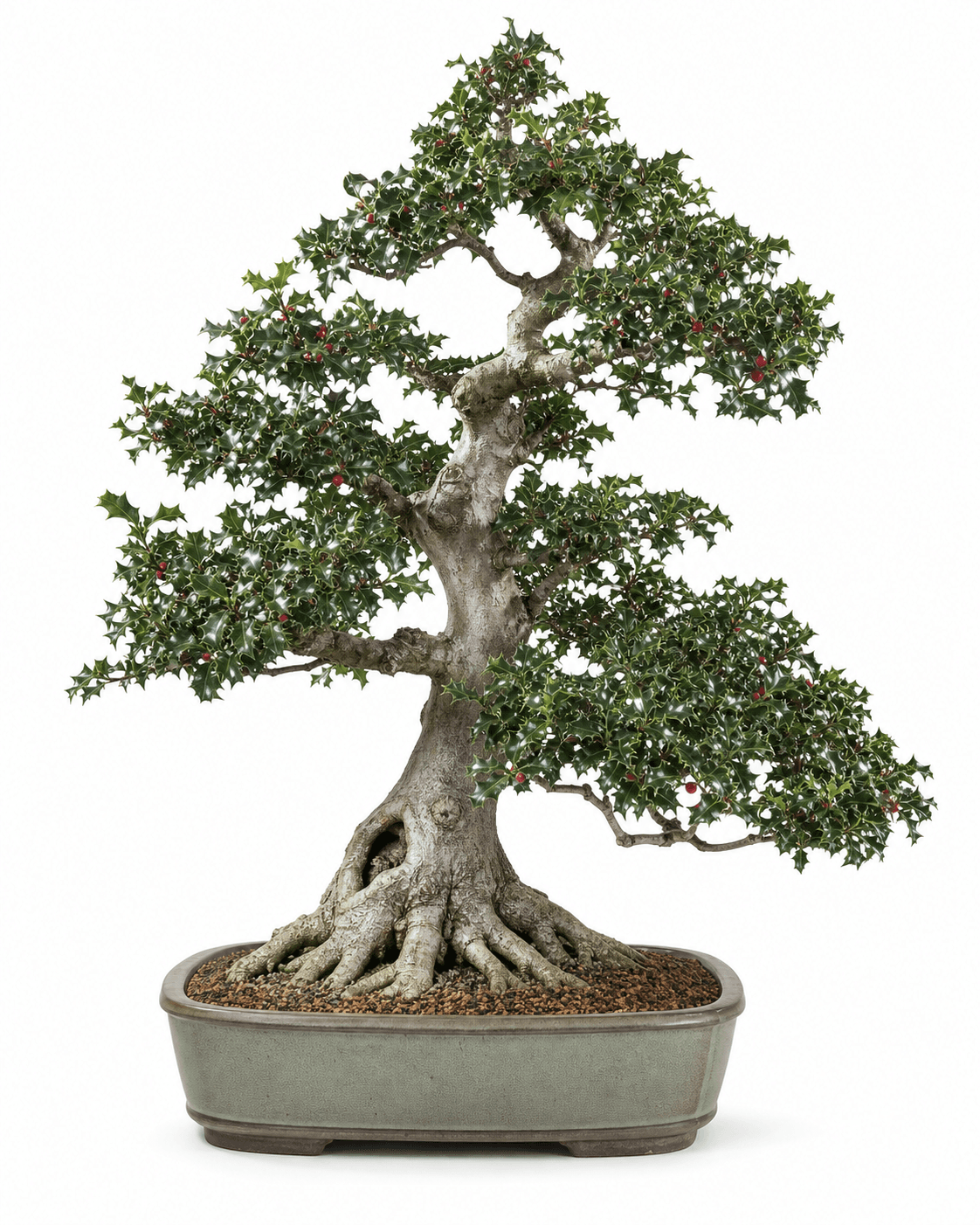
English holly bonsai should be grown outdoors as a temperate broadleaf evergreen with bright light, cool roots, steady moisture, and careful pruning after growth hardens. It can make a strong medium or large bonsai, but the leaves are spiny, the fruit is mildly toxic to people and pets, and seed spread is a serious concern in invasive regions.
The correct botanical name is Ilex aquifolium. Common labels include English holly, common holly, European holly, Christmas holly, wild holly, and feral holly, while Japanese holly, Japanese winterberry, yaupon holly, American holly, and generic Ilex labels need separate records.
The local Mirai corpus has broadleaf-evergreen holly guidance rather than a dedicated English-holly file. This page uses Mirai for bonsai timing and technique, then anchors English-holly-specific taxonomy, hardiness, toxicity, dioecious fruiting, pest risk, and invasive-region cautions to university and public-agency sources.
Updated June 11, 2026. Written by EntGrove Editorial. Last verified June 11, 2026.
Care fingerprint
Read the species through its shared care pattern.
Protect from hard freezes when species demands it, prune with active foliage in mind, and repot when roots can recover without dormancy cues. Use this as the starting point before local conditions and tree strength refine the calendar.
Note: Broadleaf evergreen holly with separate male and female plants; female fruiting requires a compatible male pollinizer. Invasive-region caution: English holly is a 2025 Washington Class C noxious weed and should not be allowed to spread seed near susceptible forest understories.
Read the foliage first
Broadleaf stress usually shows in leaf color, leaf size, wilt, scorch, or delayed hardening before it becomes a branch problem.
Match work to dormancy
Deciduous, evergreen, tropical, succulent, and flowering broadleaf trees recover on different calendars.
Protect fine roots
Root work should preserve enough active fine roots for the tree to rehydrate quickly after the operation.
Care cadence
The calendar starts with the tree's seasonal state.
Placement
Timing: Grow outdoors in full sun to part shade, with morning sun and afternoon protection in hot inland climates. Protect pots from cold dry wind during winter.
Watch for: Weak interior twigs in deep shade, scorched foliage in hot dry sun, hot-humid summer decline, and winter root injury that appears after spring growth begins.
NC State Extension: Ilex aquifoliumOregon State Landscape Plants: Ilex aquifoliumBonsai Mirai LibraryWatering
Timing: Water thoroughly when the upper mix begins to dry, then let oxygen return. Read both the surface and the old core if the tree came from landscape nursery stock.
Watch for: Water running around a dry core, yellow shoot tips, early leaf drop, wet soil smell, and roots that stay cold and saturated for days.
Bonsai Mirai LibraryClemson Extension: Holly diseases and insect pestsFeeding
Timing: Feed moderately in development after growth starts. In refinement, feed lightly after the first flush hardens and again in fall so spring growth stays shorter.
Watch for: Large leaves, coarse shoots, weak lower branches under a strong apex, salt buildup during heat, and feeding before post-repot growth proves recovery.
Bonsai Mirai LibraryPruning
Timing: For strength, prune before spring growth. For refinement, let the first flush harden, then prune back to interior buds and manage leaf size by reducing strong zones first.
Watch for: Hedge shearing that makes a green shell, pruning off all potential fruiting shoots, cutting weak interiors, and late pruning that pushes tender growth before cold.
Bonsai Mirai LibraryNC State Extension: Ilex aquifoliumFruiting
Timing: Keep a verified female plant and a compatible male nearby if berries are wanted. Remove fruit from weak, recently repotted, or developing trees.
Watch for: No berries without a male pollinizer, fruit exhausting weak trees, seed spread by birds, and mildly toxic berries where children or pets can reach them.
NC State Extension: Ilex aquifoliumOregon State Landscape Plants: Ilex aquifoliumWashington State Noxious Weed Control Board: Common hollyRepotting
Timing: Repot in spring around bud swell or visible active tips. Retain enough old core and foliage for recovery, especially on older landscape-collected material.
Watch for: Bare-rooting, heavy root work plus heavy top reduction, loose tie-downs, compacted organic nursery soil, and moving too fast into a shallow container.
Bonsai Mirai LibraryNC State Extension: Ilex aquifoliumWiring
Timing: Wire after growth hardens or during a calm structural window when branches are hydrated. Use aluminum for thin or easily marked branches, and check often.
Watch for: Wire hidden under spiny foliage, bark scuffing, brittle second bends, branch bases used as fulcrums, and wire bite during late-season thickening.
Bonsai Mirai LibraryPests and disease
Timing: Inspect during cool wet periods, spring mite peaks, leafminer season, and after drought or winter stress. Quarantine nursery stock before placing it near refined trees.
Watch for: Black root rot, Phytophthora root rot, tar spot, anthracnose, leaf blight, cankers, southern red mite, leafminers, scale, spittlebug damage, winter damage, and drought scorch.
NC State Extension: Ilex aquifoliumClemson Extension: Holly diseases and insect pestsRegional ethics
Timing: Before buying, check local invasive guidance. In western Washington, treat escaped English holly as a regulated weed issue and prevent seed movement.
Watch for: Female trees fruiting near forests, bird-dispersed seedlings, branches rooting in moist soil, cut stumps resprouting, and legal county control requirements.
Washington State Noxious Weed Control Board: Common hollyNC State Extension: Ilex aquifoliumSpecies guide
Apply the species profile before copying another tree's calendar.
At a glance
English holly is a spiny evergreen broadleaf with real bonsai limits.
English holly, Ilex aquifolium, is a broadleaf evergreen tree or shrub in Aquifoliaceae. NC State lists English, common, European, and Christmas holly as common names, while Washington uses common holly, English holly, wild holly, feral holly, and Christmas holly for the same species. NC State Extension: Ilex aquifoliumWashington State Noxious Weed Control Board: Common holly
The bonsai appeal is the winter image: dark glossy leaves, pale bark, small white flowers, and red or yellow fruit on female plants. The constraints are equally practical: slow growth, spines, leaf size, poor-drainage sensitivity, heat and humidity dislike, fruit toxicity, and invasive potential in parts of western North America. NC State Extension: Ilex aquifoliumOregon State Landscape Plants: Ilex aquifoliumWashington State Noxious Weed Control Board: Common holly
Mirai gives no dedicated English-holly file in the local corpus. It does identify evergreen holly inside the broadleaf-evergreen technique framework, so this page applies that method conservatively and lets English-holly public sources control species-specific facts. Bonsai Mirai LibraryNC State Extension: Ilex aquifolium
Habitat
Its wild signal is cool woodland edge, hedgerow, and understory.
NC State describes English holly as native to Europe, North Africa, and Western Asia, often in well-drained soils in scrub, hedges, and woodland as a dominant understory shrub. Oregon State gives a narrower landscape summary from the British Isles to southern and central Europe. NC State Extension: Ilex aquifoliumOregon State Landscape Plants: Ilex aquifolium
For care, translate that habitat into bright light without overheated roots, moisture without stagnant soil, and protection from cold dry wind. The species accepts full sun or partial shade, but bonsai containers make hot dry exposures and poor drainage much more severe. NC State Extension: Ilex aquifoliumOregon State Landscape Plants: Ilex aquifoliumBonsai Mirai Library
For design, use the plant as a woodland evergreen or old hedgerow tree. A credible English holly bonsai should have a strong base, layered branching, dark winter mass, and fruit used as a seasonal accent rather than a permanent energy drain. Bonsai Mirai / AsymmetryNC State Extension: Ilex aquifolium
In the Pacific Northwest, the same shade tolerance becomes an ecological problem. Washington lists common holly as a 2025 Class C noxious weed because it spreads through forest understories, displaces native species, and reproduces by bird-distributed seed as well as vegetative rooting. Washington State Noxious Weed Control Board: Common holly
Reading the tree
Read identity, sex, roots, and interior light before styling.
Start with identity. English holly is Ilex aquifolium. Japanese winterberry is Ilex serrata and deciduous, American winterberry is Ilex verticillata and deciduous, Japanese holly is usually Ilex crenata in landscape trade, and yaupon holly is Ilex vomitoria. NC State Extension: Ilex aquifoliumKew POWONC State Extension
Then determine sex when the tree flowers. English holly is dioecious, so female plants need a male pollinizer nearby to set fruit. A bonsai record should preserve whether the tree is male, female, or still unverified. NC State Extension: Ilex aquifoliumOregon State Landscape Plants: Ilex aquifolium
Read roots before branch ambition. Yellow shoot tips, early leaf drop, stalled growth, and wet soil can point to root rot or oxygen loss. A shiny canopy can hide a failing interior core, especially in old nursery stock. Clemson Extension: Holly diseases and insect pestsBonsai Mirai Library
Finally read the interior. Spines and dense outer growth make it easy to overlook weak buds, dead twigs, leafminer trails, scale, and old wire. Open small windows first, then decide which branches matter. NC State Extension: Ilex aquifoliumClemson Extension: Holly diseases and insect pestsBonsai Mirai Library
Pruning
Prune after hardening for refinement, and protect the fruiting plan.
Mirai broadleaf-evergreen method is built around the first flush. Let spring growth elongate and harden until the leaves and stems prove they are energy-positive, then prune strong shoots back to interior buds or short internodes. Bonsai Mirai Library
English holly can be pruned and shaped, but hedge shearing is a poor bonsai refinement habit. It creates a spiny green shell, shades the interior, and leaves fewer usable branch choices later. NC State Extension: Ilex aquifoliumBonsai Mirai Library
For medium or large leaves, use selective leaf reduction only on vigorous refinement trees. Mirai broadleaf-evergreen work supports partial leaf reduction with prune-back to stimulate a finer second flush, while full defoliation remains a special-case technique rather than routine care. Bonsai Mirai Library
Fruit changes the pruning plan. NC State notes that blossoms and fruit appear on new growth, and female plants need male pollen. If winter berries are the design goal, preserve enough new shoots and remove fruit from weak or root-worked trees. NC State Extension: Ilex aquifoliumOregon State Landscape Plants: Ilex aquifolium
Roots
Repot in spring, keep continuity, and fix old nursery cores slowly.
Repot English holly in the broadleaf-evergreen spring window, around bud swell or the first visible active tips. The goal is enough root activity to recover, with enough stored foliage left to power new roots. Bonsai Mirai Library
Avoid full bare-rooting. Mirai treats broadleaf evergreens as lower-water-mobility trees that need retained root and soil continuity. Work the surface, sides, bottom, and compacted pockets in stages instead of washing the whole root system clean. Bonsai Mirai Library
Old landscape stock often arrives with organic soil, circling roots, and a dense center under the trunk. Convert for function before aesthetics: remove enough old material to restore water entry and oxygen, then tie the tree firmly and backfill carefully around fine roots. Bonsai Mirai LibraryNC State Extension: Ilex aquifolium
Separate root work from major top reduction when possible. A female tree carrying fruit, or a tree with a stale nursery core, should spend a season rebuilding root function before heavy styling or a shallow show pot. Bonsai Mirai LibraryNC State Extension: Ilex aquifolium
Soil and pot
Build a moist, oxygenated root zone before chasing a small pot.
English holly prefers moist, well-drained soil and is intolerant of poor drainage. In bonsai, a water-retentive mineral mix is safer than stale organic nursery soil because it lets you supply moisture while keeping oxygen moving. NC State Extension: Ilex aquifoliumClemson Extension: Holly diseases and insect pests
A 2:1:1 akadama:pumice:lava mix is a practical broadleaf-evergreen starting point. Refined trees with consistent watering can shift toward higher akadama for finer roots; hot or wet climates may need more durable oxygen particles. Bonsai Mirai Library
Use a training pot deep enough to buffer water and temperature while roots recover. Shallow winter-fruit display pots should come after the tree has a dense root plate, even water use, and a canopy that can handle the smaller reservoir. Bonsai Mirai Library
Pot pairing should quiet the sharp foliage. Soft rectangles, muted ovals, and understated glazed containers often support the dark leaves and red fruit better than bright pots that compete with the winter image. Bonsai Mirai / Asymmetry
Climate
Zone 7 hardiness is a landscape number, and pots are stricter.
NC State lists English holly for USDA Zones 7a to 8b, and Oregon State lists Zone 7. In containers, protect roots from deep freezes, drying wind, and full winter sun that can dehydrate leaves while roots are cold. NC State Extension: Ilex aquifoliumOregon State Landscape Plants: Ilex aquifoliumBonsai Mirai Library
In hot dry areas, use afternoon protection and keep the pot cool. Oregon State specifically says English holly needs sun protection in hot, dry areas, and Mirai notes that container-grown broadleaf evergreens can need shade even when field plants tolerate more sun. Oregon State Landscape Plants: Ilex aquifoliumBonsai Mirai Library
In hot humid regions, be more cautious. NC State says English holly dislikes hot and humid summers and typically performs poorly in the southern United States, so root oxygen, air movement, and disease monitoring become central. NC State Extension: Ilex aquifoliumClemson Extension: Holly diseases and insect pests
In invasive regions, fruiting is a management decision. Female English holly bonsai should have fruit removed before birds disperse seed, or be avoided entirely where escaped holly is already damaging forest understories. Washington State Noxious Weed Control Board: Common hollyNC State Extension: Ilex aquifolium
Pests and diseases
Drainage, density, and quarantine prevent most serious losses.
Root disease is the biggest bonsai risk. Clemson lists black root rot and Phytophthora root rot on hollies, with symptoms including stunting, chlorosis, yellowing shoot tips, early leaf drop, twig dieback, wilted limbs, and decline during stress. Clemson Extension: Holly diseases and insect pests
Leaf and stem diseases include tar spot, anthracnose, leaf blight, and cankers. NC State also warns that excessively wet conditions can lead to root rot, anthracnose, tar spot, leaf blight, or cankers. NC State Extension: Ilex aquifoliumClemson Extension: Holly diseases and insect pests
Common pests include southern red mite, leafminers, scale, and occasional spittlebug damage. Inspect the undersides of leaves, old twig junctions, and dense interior zones before pests are visible from the bench front. Clemson Extension: Holly diseases and insect pests
Winter damage, drought damage, and spine spot can mimic disease. Diagnose exposure and mechanical leaf injury before reaching for pesticides, and avoid broad spraying during flower periods when bees are active. Clemson Extension: Holly diseases and insect pestsNC State Extension: Ilex aquifolium
Wiring
Wire for structure, then let pruning refine the spiny canopy.
Wire English holly when branches are hydrated and growth has hardened enough to tolerate handling. The goal is primary and secondary line, with pruning carrying most fine twig refinement. Bonsai Mirai Library
Use aluminum on thin, smooth, or brittle branches. The local corpus explicitly points to holly as a brittle deciduous example where aluminum is safer than copper, and that caution transfers well to English holly branch handling. Bonsai Mirai Library
Support every bend with the off hand and roll the branch through the bend rather than levering from one point. Spines make hidden pressure points easy to miss, so inspect for wire bite often. Bonsai Mirai Library
Pruning should finish what wire starts. English holly can be shaped as a hedge in landscapes, but bonsai branch architecture comes from directional pruning, interior light, and selective wire on branches that define the silhouette. NC State Extension: Ilex aquifoliumBonsai Mirai / Asymmetry
Propagation
Use cuttings and layers for named plants, and control seed.
NC State lists seed and stem cutting as recommended propagation strategies. For bonsai, cuttings are the better path for named cultivars because seedlings vary and may create invasive risk where fruit can escape. NC State Extension: Ilex aquifoliumWashington State Noxious Weed Control Board: Common holly
Broadleaf-evergreen air layers are viable after spring growth hardens and sugars are moving downward. Larger trunk layers may need more than one season, and the branch should keep enough foliage to feed root formation. Bonsai Mirai Library
Seed propagation belongs in controlled settings. Female English holly fruit is attractive to birds, and Washington notes seed spread by birds plus vegetative rooting where stems contact moist soil. Washington State Noxious Weed Control Board: Common hollyNC State Extension: Ilex aquifolium
Grafting is mainly a nursery or cultivar-preservation tool. For bonsai, grafting should answer a specific problem such as missing roots or preserving a desirable small-leaf clone. Bonsai Mirai LibraryNC State Extension: Ilex aquifolium
Buying
Buy healthy roots, clear identity, and a lawful ecological context.
Good English holly starter material has a visible base, compact internodes, useful lower branches, healthy glossy foliage, active interior buds, even water penetration, and no fresh severe pruning on weak roots. Bonsai Mirai LibraryNC State Extension: Ilex aquifolium
Record the tag exactly. English holly, common holly, European holly, Christmas holly, wild holly, and feral holly can all refer to Ilex aquifolium, while Japanese holly, yaupon holly, American holly, winterberry, and generic Ilex are different care records. NC State Extension: Ilex aquifoliumWashington State Noxious Weed Control Board: Common holly
Prefer male plants or non-fruiting management in invasive regions. If a female tree is selected for winter display, plan fruit removal before birds spread seed and confirm local rules before purchasing. Washington State Noxious Weed Control Board: Common holly
Red flags include wet sour soil, blackened roots, branch dieback, heavy leafminer damage, scale, mite bronzing, no interior buds, fresh collected material with little foliage, and nursery stock imported from a known disease lot. Clemson Extension: Holly diseases and insect pestsBonsai Mirai Library
Troubleshooting
Diagnose roots, exposure, fruit load, pests, and identity.
Symptom: yellowing shoot tips and early leaf drop. Likely cause: poor drainage, Phytophthora, black root rot, compacted old soil, or a waterlogged pot. Fix: restore drainage, isolate diseased stock, and avoid fertilizing until root function returns. Clemson Extension: Holly diseases and insect pestsBonsai Mirai Library
Symptom: no berries. Likely cause: male tree, no compatible male nearby, flower buds pruned away, weak spring growth, or a young plant not yet flowering. Fix: verify sex during bloom and keep a male pollinizer close if fruit is desired. NC State Extension: Ilex aquifoliumOregon State Landscape Plants: Ilex aquifolium
Symptom: bronzed, stippled, or dropping leaves. Likely cause: southern red mite, drought, winter damage, or hot container exposure. Fix: inspect leaf undersides, wash mites early, adjust shade, and protect winter roots. Clemson Extension: Holly diseases and insect pestsBonsai Mirai Library
Symptom: blotched leaves. Likely cause: tar spot, leafminer trails, or spine spot from leaf punctures. Fix: identify the pattern, improve airflow, remove badly affected leaves, and avoid unnecessary broad insecticide use. Clemson Extension: Holly diseases and insect pests
Symptom: vigorous outer shell and dead interior twigs. Likely cause: hedge clipping, shade inside the canopy, and dense spiny growth. Fix: thin carefully, prune to interior buds, and rebuild a branch structure instead of shearing. Bonsai Mirai LibraryNC State Extension: Ilex aquifolium
Symptom: the tree does not match English holly. Likely cause: Ilex crenata, Ilex opaca, Ilex verticillata, Ilex serrata, Ilex vomitoria, or a hybrid holly label. Fix: relabel only after leaves, fruit, habit, and source tag agree. NC State Extension: Ilex aquifoliumOregon State Landscape Plants: Ilex aquifolium
Design
Use the winter image without letting fruit become the whole design.
Start with base, trunk line, defining branch, and apex. English holly has strong visual signals already: dark evergreen leaves, spines, winter fruit, and a dense pyramidal habit. The design should edit those signals into a tree-shaped composition with branch architecture. Bonsai Mirai / AsymmetryNC State Extension: Ilex aquifolium
Let branches rise or spread from the trunk before dropping into foliage masses. The natural source image is woodland edge, hedgerow, and understory, so believable designs often read as tough small trees rather than alpine deadwood subjects. NC State Extension: Ilex aquifoliumBonsai Mirai / Asymmetry
Use fruit as punctuation. A female tree covered in berries can look spectacular in winter, but fruit draws energy and creates seed-risk decisions. Refined display should balance berry count, branch strength, and ecological responsibility. NC State Extension: Ilex aquifoliumWashington State Noxious Weed Control Board: Common hollyBonsai Mirai Library
Deadwood should be restrained. Broadleaf evergreen wounds can support age when they follow old tear lines or hollowed scars, but excessive carved deadwood can fight the smooth bark and glossy winter foliage. Bonsai Mirai / AsymmetryBonsai Mirai Library
Cultivars
Cultivar labels affect sex, leaf color, spines, and fruit.
NC State says English holly has more than 200 cultivars, often grouped as non-variegated or variegated. It lists examples such as Argentea Marginata, Dapper, Ferox Argentea, Marginata Bicolor, Scotch, Sparkler Monler, and Zelta's Elite. NC State Extension: Ilex aquifolium
Cultivar sex matters. NC State marks some cultivars as female, some as male, and Ferox Argentea as a sterile male. A female-only bonsai will not reliably fruit without a male source nearby. NC State Extension: Ilex aquifolium
Variegated leaves can be beautiful but often make the tree read more ornamental than ancient. For bonsai design, green-leaved material is usually easier to age convincingly, while variegated branches need stricter scale control. NC State Extension: Ilex aquifoliumBonsai Mirai / Asymmetry
Keep hybrids and lookalikes separate. Meserve hollies, American holly, Japanese holly, yaupon holly, and Ilex x altaclerensis can share trade language but bring different hardiness, leaf scale, and fruiting expectations. NC State Extension: Ilex aquifoliumOregon State Landscape Plants: Ilex aquifolium
History
English holly carries a strong winter-cultural image.
English holly is the classic European Christmas holly, used for winter decoration because glossy evergreen leaves and red fruit hold their color when deciduous trees are bare. NC State Extension: Ilex aquifoliumOregon State Landscape Plants: Ilex aquifolium
That cultural image can help bonsai presentation when used with restraint. A winter display can show the tree as a living seasonal object, but the bonsai still needs credible trunk age, branch hierarchy, and a healthy root system. Bonsai Mirai / AsymmetryBonsai Mirai Library
In North America, English holly also has a regional agricultural and ecological history. Washington notes more than 100 years of holly growing in the state while also listing escaped holly as a Class C noxious weed in 2025. Washington State Noxious Weed Control Board: Common holly
A strong English holly bonsai should be judged by identity, root health, leaf scale, interior ramification, clean pest history, winter-fruit management, and whether the grower prevents seed escape where the species is invasive. NC State Extension: Ilex aquifoliumWashington State Noxious Weed Control Board: Common hollyBonsai Mirai Library
Species questions
Answer the beginner questions before styling.
Is English holly good for bonsai?
Yes, English holly can work as an outdoor medium or large bonsai. It is best for growers who can manage spiny evergreen foliage, slow growth, root drainage, winter protection, and fruiting ethics.
Can English holly bonsai live indoors?
Use outdoor culture. English holly needs strong light, airflow, seasonal change, and winter dormancy. Indoor display should be brief and followed by a return to outdoor conditions.
How do I tell English holly from Japanese holly or winterberry?
English holly has spiny evergreen leaves and red berries. Japanese holly usually has smaller crenate evergreen leaves and black fruit, while winterberry hollies are deciduous. Check the tag, leaf margin, fruit color, and seasonal leaf retention before relabeling.
How cold hardy is English holly bonsai?
Use USDA Zone 7 as the landscape baseline. NC State lists Zones 7a to 8b and Oregon State lists Zone 7, but container roots need protection from freezes, wind, and winter sun.
Does English holly need a male and female plant for berries?
Yes. English holly is dioecious. Female plants need a compatible male pollinizer nearby to produce berries, and bonsai growers should remove fruit from weak trees or invasive-risk settings.
Are English holly berries poisonous?
NC State gives English holly low-severity poison characteristics and warns that berry ingestion can cause a minor toxic reaction. Keep berries away from children, pets, and horses.
When should English holly be repotted?
Repot in spring around bud swell or visible active tips. Keep root continuity, avoid full bare-rooting, and separate major root conversion from major top reduction when possible.
What soil works best for English holly bonsai?
Use a moist but well-drained mineral mix. A 2:1:1 akadama:pumice:lava mix is a practical starting point, with more akadama for refined trees and more oxygen particles for hot or wet conditions.
Should English holly bonsai be defoliated?
Use selective leaf reduction only on vigorous refinement trees after growth hardens. Full defoliation is a special-case broadleaf-evergreen technique and should stay out of routine English holly care.
Is English holly invasive?
It can be. Washington listed common holly as a Class C noxious weed in 2025 because escaped plants spread through forest understories. Check local rules and prevent seed movement from female bonsai.
Sources
Species advice needs source discipline.
Next decisions
Plan the operation before copying the calendar.
A good care note for English holly records the tree's stage, the work done, and the aftercare used. That record matters more than a month-name rule.
Related species
Compare nearby trees before transferring advice.
English boxwood
Buxus sempervirens
Japanese boxwood
Buxus microphylla
Korean boxwood
Buxus sinica var. insularis
Japanese holly
Ilex crenata
Yaupon holly
Ilex vomitoria