
Species guide
Japanese Holly Bonsai Care
Ilex crenata
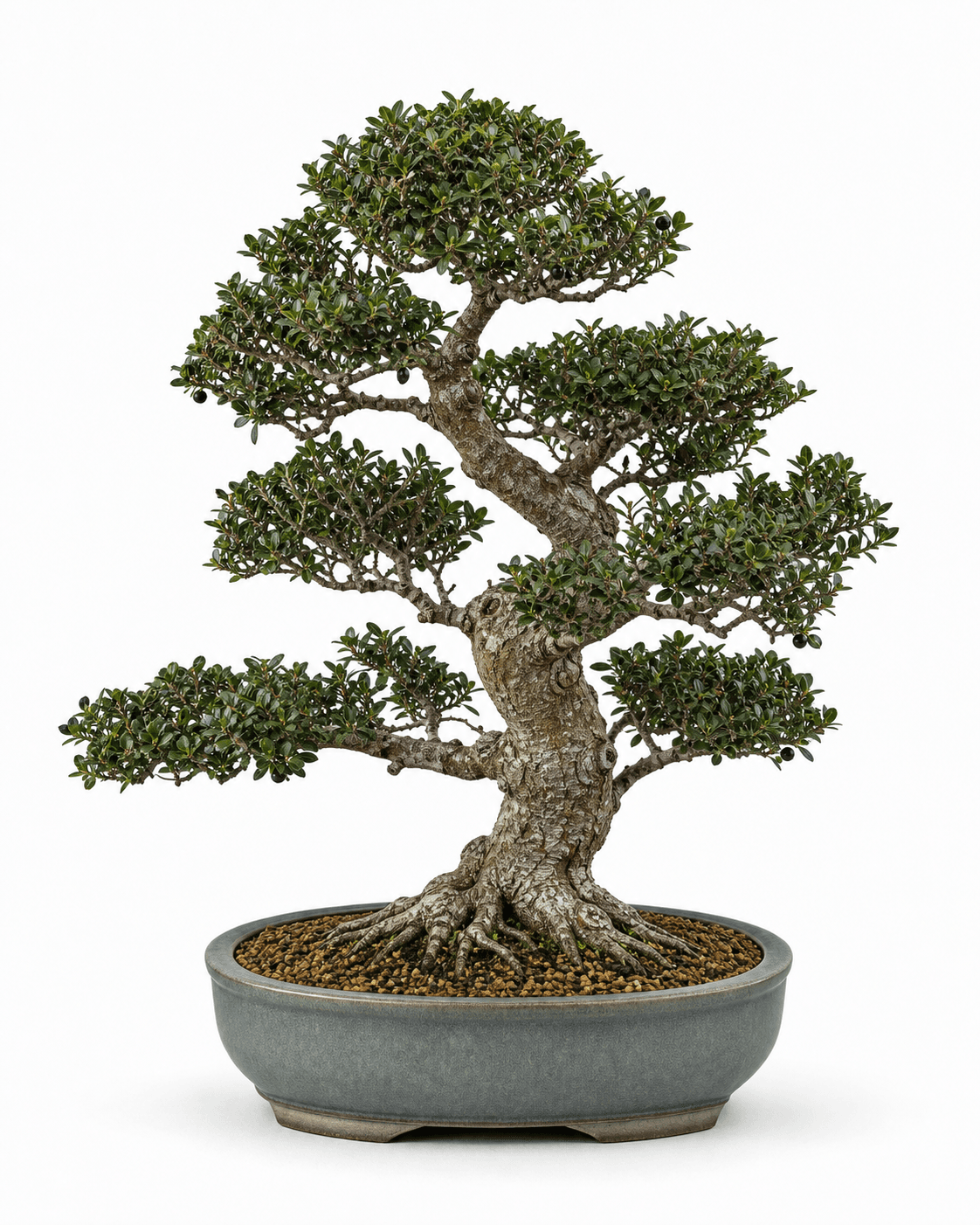
Japanese holly bonsai should be grown outdoors as a compact broadleaf evergreen with bright light, acidic well-drained soil, steady moisture, and protection from hot humid summers and cold dry wind. It is most useful for small to medium bonsai because the leaves are naturally small, glossy, alternate, and usually spineless.
The correct botanical name is Ilex crenata Thunb. Common labels include Japanese holly, box-leaved holly, box leaved holly, Helleri holly, Sky Pencil holly, Convexa Japanese holly, and Dwarf Pagoda Japanese holly, while Japanese winterberry is Ilex serrata and belongs to the deciduous fruit-display group.
The local Mirai corpus has broadleaf-evergreen holly method and a yaupon-holly primer, but no dedicated Ilex crenata file. This page uses Mirai for bonsai timing, pruning, root, watering, and design method, then anchors Japanese-holly identity, hardiness, black fruit, cultivar names, heat limits, and pest risk to Kew, NC State, Oregon State, Missouri Botanical Garden, RHS, and Clemson Extension.
Updated June 11, 2026. Written by EntGrove Editorial. Last verified June 11, 2026.
Care fingerprint
Read the species through its shared care pattern.
Protect from hard freezes when species demands it, prune with active foliage in mind, and repot when roots can recover without dormancy cues. Use this as the starting point before local conditions and tree strength refine the calendar.
Read the foliage first
Broadleaf stress usually shows in leaf color, leaf size, wilt, scorch, or delayed hardening before it becomes a branch problem.
Match work to dormancy
Deciduous, evergreen, tropical, succulent, and flowering broadleaf trees recover on different calendars.
Protect fine roots
Root work should preserve enough active fine roots for the tree to rehydrate quickly after the operation.
Care cadence
The calendar starts with the tree's seasonal state.
Placement
Timing: Grow outdoors in full sun to partial shade. In warm climates, use morning sun and afternoon shade; in cold climates, protect the pot from winter wind.
Watch for: Pale stretched shoots in deep shade, scorched tips in hot sun, weak growth during humid heat, and spring dieback after exposed winter roots were damaged.
NC State Extension: Ilex crenataMissouri Botanical Garden: Ilex crenataBonsai Mirai LibraryWatering
Timing: Water thoroughly when the upper soil begins to dry, then let oxygen return. Read the old nursery core as well as the new bonsai soil during conversion years.
Watch for: Wilted new tips, yellowing leaves, water bypassing a dry core, sour wet soil, and Helleri-type plants drying too far in their first container years.
NC State Extension: Ilex crenataClemson Extension: Holly diseases and insect pestsBonsai Mirai LibraryFeeding
Timing: Feed moderately in development after active growth begins. In refinement, feed lightly after the first flush hardens and again in fall.
Watch for: Coarse long shoots, loss of compact leaf scale, weak interior buds, and fertilizer pushed into a tree with root-rot symptoms.
Bonsai Mirai LibraryPruning
Timing: For refinement, let spring growth harden, then prune back to usable interior buds. In development, keep selected sacrifice growth until the trunk and primary branches earn their scale.
Watch for: Hedge shearing that makes a dense shell, pruning behind the last viable bud, repeated full defoliation, and removing fruiting shoots when a display crop is planned.
Bonsai Mirai LibraryNC State Extension: Ilex crenataFruiting
Timing: Keep a verified female plant and a compatible male nearby if black fruit is wanted. Remove fruit from weak, newly repotted, or early-development trees.
Watch for: No fruit on male cultivars, no nearby male, hidden fruit below foliage, seed spread from ripened fruit, and confusion with red-fruited winterberry or English holly.
NC State Extension: Ilex crenataMissouri Botanical Garden: Ilex crenataRepotting
Timing: Repot in spring at bud swell or early active tips. Work in stages when a dense nursery root ball, black root rot risk, or a shallow show container is involved.
Watch for: Full bare-rooting, major top reduction and major root reduction in the same session, compact organic soil left anaerobic, and loose tie-downs.
Bonsai Mirai LibraryClemson Extension: Holly diseases and insect pestsWiring
Timing: Wire hydrated branches after growth hardens or during a calm structural window. Favor clip-and-grow for brittle or very old branches.
Watch for: Wire hidden by dense leaves, smooth bark marking, branch shoulders snapping, crossing wire over blackened wounds, and wire left through a flush.
Bonsai Mirai LibraryPests and disease
Timing: Inspect in spring and fall for mites and scale, after wet periods for root disease, and after summer stress for chlorosis or decline.
Watch for: Black root rot, Phytophthora root rot, spider mites, nematodes, aphids, scale, holly leafminer, holly leaf blight, alkaline-soil yellowing, and drought injury.
NC State Extension: Ilex crenataClemson Extension: Holly diseases and insect pestsRHS: Ilex crenataSpecies guide
Apply the species profile before copying another tree's calendar.
At a glance
Japanese holly is a small-leaf evergreen broadleaf, not winterberry.
Japanese holly is Ilex crenata, an accepted species in Aquifoliaceae. Kew lists it as a shrub or tree native from eastern Nepal to temperate eastern Asia, and NC State describes it as an evergreen shrub or small tree from Japan and East Asia. Kew POWO: Ilex crenataNC State Extension: Ilex crenata
For bonsai, the useful traits are small glossy alternate leaves, compact branching, slow growth, black fruit on female plants, and tolerance for pruning. The main limits are heat and humidity stress, alkaline chlorosis, black root rot sensitivity, slow thickening, and cultivar identity. NC State Extension: Ilex crenataMissouri Botanical Garden: Ilex crenataClemson Extension: Holly diseases and insect pests
Name discipline matters. Older bonsai speech sometimes uses Japanese holly for umemodoki, the deciduous Japanese winterberry Ilex serrata. EntGrove uses Japanese holly for evergreen Ilex crenata and Japanese winterberry for Ilex serrata. Kew POWO: Ilex crenataKew POWOBonsai Mirai Library
Habitat
Its native signal is moist East Asian woodland, thicket, and mountain edge.
Kew gives a broad native distribution across eastern Nepal, East Asia, Japan, Korea, the Kuril Islands, Sakhalin, Taiwan, Tibet, and Vietnam. NC State describes Japanese holly in thickets, woods, wet places, lowlands, and mountains across Japan. Kew POWO: Ilex crenataNC State Extension: Ilex crenata
Translate that habitat into bright outdoor light, acidic and well-drained roots, and a cool protected container. The species can handle full sun or partial shade, but bonsai roots are more exposed than landscape roots, so hot pots and dry wind quickly change the risk profile. NC State Extension: Ilex crenataMissouri Botanical Garden: Ilex crenataBonsai Mirai Library
For design, Ilex crenata is a quiet evergreen shrub or small tree rather than a rugged mountain deadwood subject. Strong bonsai usually read as compact old broadleaf trees: clear base, compact trunk movement, layered twig structure, and a restrained dark-green winter mass. Bonsai Mirai / AsymmetryNC State Extension: Ilex crenata
Kew records introductions in several U.S. states and parts of Europe. Responsible bonsai culture means controlling fruit and checking local invasive guidance when female plants set seed. Kew POWO: Ilex crenataMissouri Botanical Garden: Ilex crenata
Reading the tree
Read cultivar, sex, roots, and heat history before pruning.
Start with cultivar identity because the trade is cultivar-heavy. NC State says the wild type is rarely seen and lists common selections including Compacta, Convexa, Helleri, Hetzii, Sky Pencil, Soft Touch, Stokes, and Twiggy. NC State Extension: Ilex crenata
Then determine sex. Japanese holly is dioecious, so fruiting requires a female plant and a male pollinizer. NC State marks Compacta, Hoogendorn, Latifolia, and Stokes as male, while Convexa, Helleri, Hetzii, and Sky Pencil are listed as female. NC State Extension: Ilex crenataMissouri Botanical Garden: Ilex crenata
Read root function before branch ambition. Yellowing foliage, stalled tips, wet soil odor, and sudden decline point toward the water-oxygen balance, alkaline soil, black root rot, Phytophthora, nematodes, or a compacted nursery core. NC State Extension: Ilex crenataClemson Extension: Holly diseases and insect pestsBonsai Mirai Library
Read heat history as well. NC State warns that Japanese holly may struggle in high heat and humidity, and Missouri Botanical Garden makes the same point for hot humid summers. A tree weakened by summer stress should be stabilized before refinement work. NC State Extension: Ilex crenataMissouri Botanical Garden: Ilex crenata
Pruning
Build compact ramification with harden-then-prune timing.
Mirai broadleaf-evergreen method waits for spring growth to elongate and harden before refinement pruning. On Japanese holly, that means pruning after the shoot has firmed and the interior buds are viable enough to respond. Bonsai Mirai Library
The small leaves mean leaf cutting is rarely the first tool. Use selective shoot pruning, interior thinning, and light-zone control before considering partial defoliation, and reserve full defoliation for proven vigorous refinement trees. Bonsai Mirai LibraryNC State Extension: Ilex crenata
Avoid treating a bonsai like a hedge. Repeated exterior shearing makes a dense green shell, shades interior buds, hides pests, and delays the branch selection work that creates believable broadleaf structure. Bonsai Mirai LibraryClemson Extension: Holly diseases and insect pests
Development and refinement should have different rules. In development, let selected leaders thicken the trunk and primary branches. In refinement, cut back strong zones first, protect weak interiors, and keep the apex from stealing the whole tree. Bonsai Mirai LibraryBonsai Mirai / Asymmetry
Repotting
Repot in spring and keep the root system connected.
Mirai places broadleaf-evergreen repotting in spring as buds swell or active growth begins. The goal is to restore water entry, oxygen, and root-to-soil contact while leaving enough foliage and root continuity for recovery. Bonsai Mirai Library
Japanese holly deserves conservative root work because Clemson highlights black root rot on Japanese holly, and NC State lists spider mites, nematodes, leaf blight, aphids, scales, and alkaline yellowing as real problems. Root stress and poor drainage turn small issues into collapse. Clemson Extension: Holly diseases and insect pestsNC State Extension: Ilex crenata
Convert nursery soil in stages. Slice and tease the perimeter, remove the densest downward and circling roots, preserve a working core, and tie the tree firmly so new roots are not torn by movement. Bonsai Mirai Library
After repotting, water thoroughly, keep the tree protected from wind and heat, delay heavy fertilizer until new growth proves root recovery, and avoid a hard top reduction in the same session. Bonsai Mirai LibraryNC State Extension: Ilex crenata
Soil and pot
Use acidic, oxygen-rich soil and pots that suit a quiet evergreen.
NC State recommends acidic, well-drained soil and warns that alkaline soils yellow the leaves. Missouri Botanical Garden says Japanese holly prefers light, moist, acidic soil with good drainage. Bonsai soil should support that preference without staying anaerobic. NC State Extension: Ilex crenataMissouri Botanical Garden: Ilex crenata
A 2:1:1 akadama:pumice:lava mix is a practical starting point. Use more akadama for refined trees where root ramification and moisture retention are priorities, and more pumice or lava where summers are wet, humid, or root disease has appeared. Bonsai Mirai LibraryClemson Extension: Holly diseases and insect pests
Pot choice should support the tree rather than advertise itself. Unglazed or quiet glazed rectangles, ovals, and shallow rounds work for compact tree images; deeper training containers are better while old nursery roots are being converted. Bonsai Mirai / AsymmetryBonsai Mirai Library
Sky Pencil and other upright forms often need more visual gravity than their narrow nursery shape suggests. Helleri, Convexa, Soft Touch, and Dwarf Pagoda material usually reads better in low, restrained containers after the base and branch structure have been clarified. NC State Extension: Ilex crenataOregon State Landscape Plants: Ilex crenataBonsai Mirai / Asymmetry
Climate
Zone 5 hardiness does not remove container winter risk.
NC State lists USDA Zones 5a to 8b, Missouri Botanical Garden lists Zones 5 to 8, and RHS gives H6. Those are landscape signals. In a bonsai pot, root temperature, wind, freeze-thaw cycling, and refinement level control the real safety margin. NC State Extension: Ilex crenataMissouri Botanical Garden: Ilex crenataRHS: Ilex crenataBonsai Mirai Library
In cold regions, store Japanese holly where roots stay cold but protected: an unheated cold frame, mulch bed, protected bench, or greenhouse just above the worst wind exposure. Refined twigging lowers cold tolerance. Bonsai Mirai LibraryNC State Extension: Ilex crenata
In hot humid regions, give afternoon shade, larger soil volume during development, clean airflow, and close root-disease monitoring. High heat and humidity are explicitly flagged by NC State and Missouri Botanical Garden. NC State Extension: Ilex crenataMissouri Botanical Garden: Ilex crenataClemson Extension: Holly diseases and insect pests
In mild maritime regions, watch the opposite problem: too much winter wet, too little summer heat, and slow recovery after heavy pruning. Adjust soil particle size and work timing to how fast the tree actually hardens growth. Bonsai Mirai LibraryRHS: Ilex crenata
Pests
Root disease, mites, scale, and chlorosis are the core checks.
Clemson Extension identifies black root rot as especially severe on Japanese, inkberry, and blue or Meserve hollies. It also covers Phytophthora root rot, leaf spot problems, scale, mites, leafminers, and winter or drought damage across hollies. Clemson Extension: Holly diseases and insect pests
NC State lists spider mites, nematodes, aphids, scales, holly leaf miners, and holly leaf blight for Ilex crenata, plus yellowing from alkaline soils. RHS also flags scale insects, holly leaf miner, aphids, holly leaf blight, Phytophthora root rot, and honey fungus. NC State Extension: Ilex crenataRHS: Ilex crenata
For bonsai, prevention is mostly cultural: acidic mineral soil, clean drainage, strong airflow, careful watering, quarantine for nursery stock, and prompt removal of dead interior twigs that shelter pests. Bonsai Mirai LibraryClemson Extension: Holly diseases and insect pests
Pesticide decisions should follow local extension labels and diagnosis. Small bonsai make hand inspection, leaf removal, water sprays for mites, and isolation more practical than broad preventive spraying. Clemson Extension: Holly diseases and insect pestsNC State Extension: Ilex crenata
Wiring
Wire early, protect smooth bark, and use pruning when wood resists.
Japanese holly has smooth bark and slow-growing wood. Wire young branches early when they still move, support the shoulder with the off hand, and distribute movement across a longer section rather than forcing one sharp bend. Bonsai Mirai LibraryNC State Extension: Ilex crenata
Use aluminum for fine or easily marked branches unless a specific branch needs copper holding strength. Dense foliage hides wire, so check frequently during active growth and remove before the branch swells around the coil. Bonsai Mirai Library
Clip-and-grow is often the better structural tool for old Helleri, Convexa, and hedge-derived stock. Prune to a bud facing the next direction, then wire the new shoot while it is still young enough to set. Bonsai Mirai LibraryNC State Extension: Ilex crenata
Avoid wiring over blackened, rotten, or freshly cut tissue. Root disease and branch dieback can travel quietly through dense evergreen material, so wire only branches with clear vigor and healthy leaves beyond the bend. Clemson Extension: Holly diseases and insect pestsBonsai Mirai Library
Propagation
Cuttings preserve cultivar identity better than seed.
NC State lists seed and stem cuttings as propagation strategies, and RHS recommends semi-ripe cuttings in late summer or early autumn or hardwood cuttings in January with bottom heat. NC State Extension: Ilex crenataRHS: Ilex crenata
For bonsai, cuttings are usually the cleanest path because most nursery Japanese hollies are cultivars. Seedlings may lose the compact habit, sex, leaf size, and fruit color that made the parent useful. NC State Extension: Ilex crenataMissouri Botanical Garden: Ilex crenata
Air layers can work when a branch has enough foliage and vigor to root, but broadleaf-evergreen layers should be timed after active growth is moving and should not be separated until the new root mass is real. Bonsai Mirai Library
Grafting is mainly a nursery or problem-solving technique. Use it only when preserving a cultivar, adding roots, or correcting a specific structural flaw is worth the added aftercare. Bonsai Mirai LibraryNC State Extension: Ilex crenata
Buying
Buy cultivar clarity, visible base, and clean roots.
Good starter material has a visible base, short internodes, compact leaves, interior buds, healthy glossy foliage, a root ball that accepts water, and a cultivar habit that fits the intended design. Bonsai Mirai LibraryNC State Extension: Ilex crenata
Record the tag exactly. Helleri is a low mounding female cultivar, Sky Pencil is a narrow female form, Convexa has convex leaves and black fruit, and Dwarf Pagoda is an Oregon-listed compact Japanese holly cultivar. NC State Extension: Ilex crenataOregon State Landscape Plants: Ilex crenata
Red flags include wet sour soil, blackened roots, yellow leaves in alkaline media, spider-mite stippling, scale, leafminer tracks, dead interior twigs, no lower branches, and a topiary shape with no trunk line. NC State Extension: Ilex crenataClemson Extension: Holly diseases and insect pests
Avoid paying bonsai prices for ordinary hedge stock until the trunk earns it. Japanese holly is useful, but slow thickening means the base, nebari, and primary structure matter more than a clipped dome. Bonsai Mirai / AsymmetryMissouri Botanical Garden: Ilex crenata
Troubleshooting
Most failures trace back to roots, heat, light, or identity.
Symptom: leaves yellow while the soil stays wet. Likely cause: low oxygen, black root rot, Phytophthora, compacted nursery soil, or alkaline conditions. Fix: isolate the tree, restore drainage, reduce watering frequency, and repot only in the proper spring window unless emergency rot removal is required. NC State Extension: Ilex crenataClemson Extension: Holly diseases and insect pestsBonsai Mirai Library
Symptom: brown or yellow foliage after a dry spell. Likely cause: drought stress, especially on Helleri-type plants or recently potted material. Fix: water thoroughly, add afternoon shade, and avoid heavy pruning until new growth proves recovery. Clemson Extension: Holly diseases and insect pestsNC State Extension: Ilex crenata
Symptom: no black fruit. Likely cause: male plant, no male pollinizer near a female plant, flower buds pruned away, weak spring growth, or a non-fruiting cultivar. Fix: verify cultivar and sex during flowering. NC State Extension: Ilex crenataMissouri Botanical Garden: Ilex crenata
Symptom: dense outer shell and dead interior. Likely cause: hedge clipping, weak light penetration, and no structural thinning. Fix: open windows gradually, keep weak interior leaves, and rebuild branches rather than clipping the outline again. Bonsai Mirai LibraryNC State Extension: Ilex crenata
Symptom: the tree has red fruit or drops leaves for winter display. Likely cause: it is probably Ilex serrata, Ilex verticillata, Ilex aquifolium, or another holly. Fix: relabel after checking leaf retention, leaf margin, fruit color, and tag history. Kew POWONC State ExtensionNC State Extension: Ilex aquifolium
Symptom: mite stippling, scale bumps, or leafminer trails. Likely cause: dense evergreen foliage hid pests until damage became visible. Fix: isolate, inspect leaf undersides, remove badly affected leaves, improve airflow, and follow extension guidance for treatment. NC State Extension: Ilex crenataClemson Extension: Holly diseases and insect pests
Design
Design from compact evergreen mass and small leaf scale.
Start with base, trunk line, defining branch, and apex. Japanese holly gives you small leaves and dense branching; it does not give instant old-tree structure. The design work is selecting fewer better lines from the hedge. Bonsai Mirai / AsymmetryBonsai Mirai Library
Helleri and similar mounding cultivars suit low compact broadleaf images. Sky Pencil suits narrow literati-adjacent or formal upright experiments only when the trunk has movement or taper beyond the nursery column. NC State Extension: Ilex crenataOregon State Landscape Plants: Ilex crenataBonsai Mirai / Asymmetry
Fruit should support the design rather than define it. Black fruit is subtle and often hidden below the foliage, so branch structure, negative space, and winter leaf mass carry the composition. NC State Extension: Ilex crenataMissouri Botanical Garden: Ilex crenataBonsai Mirai / Asymmetry
Deadwood should be minimal and credible. Old pruning wounds can become hollows, but broadleaf evergreen holly usually reads stronger through smooth bark, compact twigs, and restrained foliage than through carved drama. Bonsai Mirai LibraryBonsai Mirai / Asymmetry
Cultivars
Cultivar names change habit, sex, fruit, and bonsai use.
NC State lists many Ilex crenata cultivars and notes that almost all Japanese hollies in trade are cultivars. That makes the tag part of the care record, not just a shopping label. NC State Extension: Ilex crenata
Helleri is a small-leaf female cultivar with infrequent fruit and a mounding habit. It is often mislabeled by bonsai beginners as boxwood, but Japanese boxwood belongs to Buxus and has opposite leaves rather than alternate Ilex leaves. NC State Extension: Ilex crenataNC State Extension
Sky Pencil is a female narrow upright cultivar. Convexa is female, has convex leaves, and can bear pea-sized black fruit. Dwarf Pagoda is recognized by Oregon State as a Japanese holly cultivar and is worth treating as compact cultivar material. NC State Extension: Ilex crenataOregon State Landscape Plants: Ilex crenata
Keep Ilex crenata separate from Ilex serrata, Ilex verticillata, Ilex aquifolium, Ilex vomitoria, and generic Ilex labels. The visible clues are leaf retention, leaf margin, fruit color, fruit position, growth habit, and the exact nursery tag. NC State Extension: Ilex crenataKew POWONC State ExtensionNC State Extension: Ilex aquifolium
History
Japanese holly is a nursery workhorse with bonsai potential.
In landscape horticulture, Ilex crenata is valued as a boxwood-like evergreen for hedges, borders, foundations, and topiary. NC State explicitly notes that it can be severely pruned to manage size. NC State Extension: Ilex crenataMissouri Botanical Garden: Ilex crenata
That landscape history is useful for bonsai because old hedges and nursery plants can offer compact leaves and dense buds. The limitation is ordinary trunk character: many plants have clipped tops, buried bases, and little taper. Bonsai Mirai LibraryBonsai Mirai / Asymmetry
The bonsai record also has a naming trap. Mirai corpus mentions of Japanese holly tied to winter berry display likely refer to umemodoki, Ilex serrata, while evergreen Ilex crenata should be handled through broadleaf-evergreen method. Bonsai Mirai LibraryKew POWOKew POWO: Ilex crenata
A strong Japanese holly bonsai should be judged by verified identity, root health, acidic soil response, small leaf scale, interior ramification, clean pest history, and a design that rises above clipped nursery shrub language. NC State Extension: Ilex crenataClemson Extension: Holly diseases and insect pestsBonsai Mirai / Asymmetry
Species questions
Answer the beginner questions before styling.
Is Japanese holly good for bonsai?
Yes. Japanese holly can make strong small to medium outdoor bonsai because it has small evergreen leaves, dense branching, and good pruning tolerance. It is best for growers who can manage acidic soil, root oxygen, winter protection, and slow development.
Can Japanese holly bonsai live indoors?
Use outdoor culture. Japanese holly needs bright light, air movement, seasonal change, and cool dormancy. Indoor display should be brief and followed by a return to protected outdoor conditions.
How do I tell Japanese holly from Japanese winterberry?
Japanese holly is evergreen Ilex crenata with small alternate glossy leaves and black fruit. Japanese winterberry is deciduous Ilex serrata and is grown for red or colored winter berries on bare twigs.
How cold hardy is Japanese holly bonsai?
NC State lists Ilex crenata for USDA Zones 5a to 8b and Missouri Botanical Garden lists Zones 5 to 8. Bonsai pots need extra protection because roots freeze faster than landscape roots.
Does Japanese holly need male and female plants for fruit?
Yes. Japanese holly is dioecious. Female plants need a compatible male pollinizer nearby to produce the small black fruit.
What soil does Japanese holly bonsai need?
Use acidic, well-drained mineral soil that stays moist without going anaerobic. A 2:1:1 akadama:pumice:lava mix is a good starting point, adjusted toward more oxygen if root disease appears.
When should Japanese holly be repotted?
Repot in spring as buds swell or active tips begin. Inspect every 3 to 4 years, and move gradually when converting dense nursery soil into bonsai soil.
Should Japanese holly be defoliated?
Routine full defoliation is too aggressive. Use selective pruning and thinning after growth hardens. Partial leaf reduction belongs only on vigorous refinement trees with a clear purpose.
Why is my Japanese holly turning yellow?
Common causes are alkaline soil, poor drainage, black root rot, Phytophthora, compacted nursery soil, drought stress, or mite pressure. Check roots and soil first before adding fertilizer.
Are Helleri and Sky Pencil Japanese holly bonsai candidates?
They can be. Helleri is compact and mounding, while Sky Pencil is narrow and upright. Both need trunk character, a visible base, healthy roots, and branch structure before they deserve a shallow bonsai pot.
Sources
Species advice needs source discipline.
Next decisions
Plan the operation before copying the calendar.
A good care note for Japanese holly records the tree's stage, the work done, and the aftercare used. That record matters more than a month-name rule.
Related species
Compare nearby trees before transferring advice.
English boxwood
Buxus sempervirens
Japanese boxwood
Buxus microphylla
Korean boxwood
Buxus sinica var. insularis
English holly
Ilex aquifolium
Yaupon holly
Ilex vomitoria