
Species guide
English Boxwood Bonsai Care
Buxus sempervirens
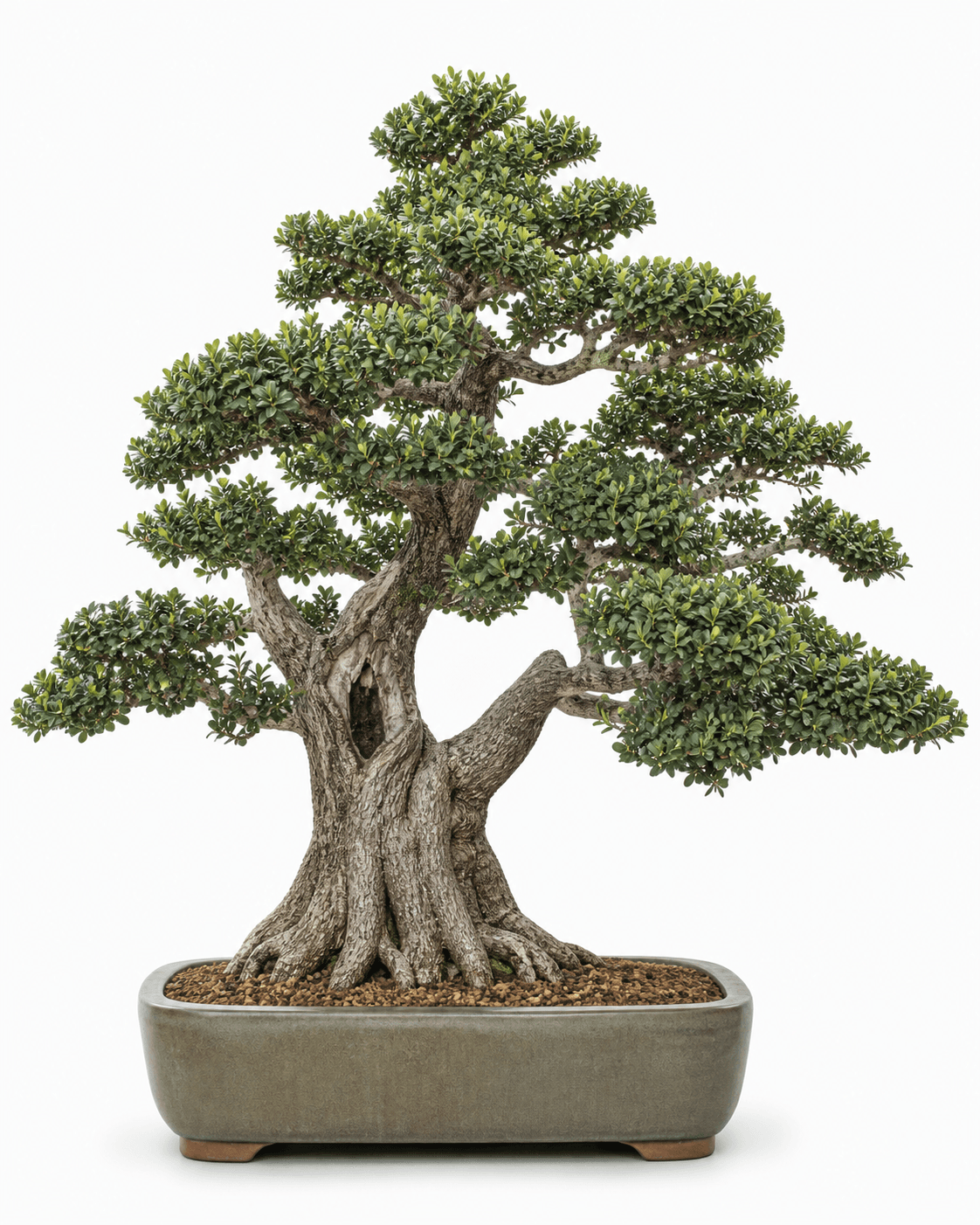
English boxwood bonsai should be grown as a slow outdoor broadleaf evergreen with moist, aerated roots, careful winter protection for the pot, and regular thinning so interior buds stay alive. It rewards patient clip-and-grow work more than fast trunk building.
Use Buxus sempervirens for the species page, then read the nursery label closely. American and common boxwood usually refer to broader B. sempervirens material, while many U.S. horticulture sources use English boxwood for the dwarf cultivar Buxus sempervirens Suffruticosa.
The main risks are stale wet soil, dense unthinned foliage, rough wiring on brittle wood, late-season cuts that push tender growth, and boxwood blight or leafminer arriving with nursery stock. The strongest bonsai candidates already have age, a believable base, healthy roots, and clean disease history.
Updated July 13, 2026. Written by EntGrove Editorial. Last verified July 13, 2026.
Care fingerprint
Read the species through its shared care pattern.
Protect from hard freezes when species demands it, prune with active foliage in mind, and repot when roots can recover without dormancy cues. Use this as the starting point before local conditions and tree strength refine the calendar.
Read the foliage first
Broadleaf stress usually shows in leaf color, leaf size, wilt, scorch, or delayed hardening before it becomes a branch problem.
Match work to dormancy
Deciduous, evergreen, tropical, succulent, and flowering broadleaf trees recover on different calendars.
Protect fine roots
Root work should preserve enough active fine roots for the tree to rehydrate quickly after the operation.
Care cadence
The calendar starts with the tree's seasonal state.
Placement
Timing: Grow outside in morning sun, filtered sun, or gentle full sun where the pot stays cool. Use a cold frame, unheated greenhouse, or sheltered bench before container roots face sustained hard freeze.
Watch for: Warm indoor decline, winter bronzing, wind dehydration, hot reflected exposure, frozen pots, and a dense outer shell shading the interior.
NC State Extension: SuffruticosaVirginia Cooperative ExtensionBonsai Mirai LibraryWatering
Timing: Water thoroughly when the surface and visible particles dry, then let oxygen return before watering again. Check old nursery cores and shaded pot corners separately.
Watch for: Slow drainage, sour soil, leaves yellowing while soil stays wet, summer wilting, and frequent light watering that never flushes the whole pot.
Bonsai Mirai LibraryClemson Extension boxwood pestsDevelopment pruning
Timing: For trunk and branch building, prune near spring push or after growth hardens, then let selected shoots extend. Keep enough foliage to rebuild roots and feed new buds.
Watch for: Weak trees, heavy root work in the same season, large branch cuts without shoulder development, and pruning one side much harder than the rest of the canopy.
Bonsai Mirai LibraryRefinement pruning and thinning
Timing: After the first flush hardens, prune to interior nodes, reduce clusters to two useful shoots, and thin for light and air. For Suffruticosa, use the species-specific extension window after the last frost and avoid late-summer or early-fall pruning.
Watch for: A solid green shell, lost interior buds, coarse growth from heavy spring feeding, and late-summer cuts that trigger tender growth before cold.
Bonsai Mirai LibraryNC State Extension: SuffruticosaVirginia Cooperative ExtensionFertilizer
Timing: Feed during active growth according to stage. Developing trees can receive moderate nutrition after growth hardens; refined English boxwood needs lighter inputs, with a pause during peak heat when salts compete with water uptake.
Watch for: Oversized leaves, long internodes, salt buildup in hot weather, starving a tree under repeated pruning, and feeding while root function is poor.
Bonsai Mirai LibraryWiring
Timing: Wire after growth hardens and when tissue is hydrated enough to bend. Use young flexible shoots, distribute load carefully, and remove wire before dense foliage hides bite.
Watch for: White scar tissue, bark scuffing, cracked old wood, inverted foliage, copper staining on pale bark, and branches better solved by pruning or replacement growth.
Bonsai Mirai LibraryRepotting
Timing: Inspect when water stops entering evenly, soil breaks down, or old nursery soil must be converted. Use spring green-up or bud-swell as the default, then protect from wind and hard sun.
Watch for: Compacted organic cores, overwatering after a larger pot, heavy styling in the repot year, loose tie-downs, and roots damaged twice within about two years.
Bonsai Mirai LibraryNC State ExtensionPests and disease
Timing: Quarantine new boxwood, inspect dense interiors through the growing season, check current movement rules in box tree moth regions, and use extension confirmation when boxwood blight is suspected.
Watch for: Leaf spots, black stem lesions, sudden defoliation, mite stippling, scale, leafminer blisters, psyllid cupping, Volutella canker, root rot, skeletonized leaves, webbing, caterpillars, and frass.
Clemson Extension boxwood pestsUSDA APHIS box tree mothBonsai Mirai LibrarySpecies guide
Apply the species profile before copying another tree's calendar.
At a glance
English boxwood is a slow evergreen for outdoor, disease-aware growers.
Record the plant as Buxus sempervirens when the tag says common boxwood, common box, American boxwood, European box, or broader English boxwood. Record Buxus sempervirens Suffruticosa when the plant is the classic dwarf English form. Kew POWOAmerican Boxwood SocietyNC State Extension: Suffruticosa
The useful bonsai facts are slow growth, evergreen foliage, strong latent buds, shallow roots, brittle older wood, and disease-sensitive dense canopies. It fits patient clip-and-grow growers who can provide outdoor light, airflow, and winter root protection. Bonsai Mirai LibraryNC State ExtensionClemson Extension boxwood pests
Use USDA Zones 5a to 8b as the landscape baseline for the species, with Zones 5 to 8 as Clemson guidance for common boxwood. Container bonsai should be protected earlier than in-ground shrubs because the pot loses heat and moisture buffering. NC State ExtensionClemson Extension boxwood guideBonsai Mirai Library
Wild habitat
Its native range points to tempered exposure, steady moisture, and evergreen energy storage.
Kew places Buxus sempervirens from Europe to northern Iran and northern Africa in the temperate biome. Public extension sources describe a slow evergreen shrub or small tree that prefers well-drained soil, moderate moisture, and protection from harsh exposure. Kew POWONC State ExtensionVirginia Cooperative Extension
In bonsai terms, retained foliage is part of the energy system. Mirai broadleaf evergreen method treats winter foliage as stored energy and photosynthetic capacity, so pruning, winter protection, and leaf retention all affect spring response. Bonsai Mirai Library
Design should follow that ecology. English boxwood looks convincing as an old hedgerow shrub, compact broadleaf evergreen, clump, or broad-crowned hardwood image with open branch rhythm. A dense topiary shell makes the trunk read smaller and weakens the interior. Bonsai Mirai / AsymmetryBonsai Mirai Library
Reading the tree
Choose the work from stage, vigor, and root function.
Start with water movement. Mirai boxwood guidance treats constantly wet substrate as a water-oxygen imbalance or root dysfunction. Fix drainage, surface dry-back, and root health before refinement pruning or wiring. Bonsai Mirai LibraryClemson Extension boxwood pests
Development work accepts coarser response. A tree that needs branch thickening can be pruned near spring push, fed more strongly after hardening, and allowed to extend before the next cut. Bonsai Mirai Library
Refinement work asks for restraint. Once a boxwood has scale and branch structure, heavy spring feeding or coarse pruning creates larger leaves and longer internodes. Let the first flush harden, then prune to useful interior buds. Bonsai Mirai Library
The dedicated Mirai boxwood sessions focus mainly on Kingsville and other Buxus microphylla material. This page transfers only claims framed for Buxus broadly or for broadleaf evergreens, while Buxus sempervirens identity, hardiness, pruning, disease, and cultivar details come from Kew and extension sources. Bonsai Mirai LibraryKew POWONC State Extension: SuffruticosaVirginia Cooperative Extension
Pruning
Thin for light, preserve interior buds, and reduce in stages.
Boxwood carries latent buds along old stems. Mirai uses that trait for hard cutback, branch replacement, and ramification, while favoring cutback to existing interior shoots whenever the tree offers them. Bonsai Mirai Library
The branch-selection workflow is interior first: clean enough dead and congested growth to see structure, make one confident cut, then let each opening expose the next decision. Preserve small interior buds on main lines because they are future cutback points. Bonsai Mirai Library
Extension guidance matches the bonsai problem. Clemson calls thinning the most important maintenance activity for English boxwood Suffruticosa, and Virginia Tech recommends thinning dense English boxwood every one to two years while avoiding late-summer pruning that can produce cold-tender shoots. Clemson Extension boxwood guideVirginia Cooperative ExtensionNC State Extension: Suffruticosa
For refined trees, prune back to interior nodes and build informal billowy pads with visible gaps. Repeated exterior shearing shades out the inside, weakens back-buds, and makes the tree read as hedge work. Bonsai Mirai LibraryBonsai Mirai / Asymmetry
Roots
Repot when roots lose function, then protect the recovery.
Mirai broadleaf evergreen method places routine root work in spring as buds swell or winter color gives way to active green. For Buxus, sustained warmth matters more than a brief early warm spell. Bonsai Mirai Library
Use a staged conversion for an old nursery core. Preserve functional interior roots while correcting the surface, sides, bottom, and compacted soil in planned steps. The aggressive first bare-root method in the dedicated primer is documented for field-grown Buxus microphylla, so it is not the default for English boxwood. Bonsai Mirai Library
Do not pair major first-time root reduction with heavy structural cutback unless the tree is already domesticated and vigorous. Newly converted hedge or nursery material should rebuild roots before another large styling operation. Bonsai Mirai Library
Tie the tree firmly. New roots need a stable root mass, and shallow bonsai containers reduce water pull while increasing oxygen demands. A deeper training container can be smarter than a show pot during conversion. Bonsai Mirai Library
Soil and pot
Use a mineral mix that keeps boxwood moist without suffocating the shin.
Mirai soil method defines the target as structural durability, water retention, nutrient retention, and oxygen in the same shallow container. For boxwood, that usually means akadama-heavy mineral soil with pumice or lava added when heat, watering style, or an old root core demands more air. Bonsai Mirai Library
The boxwood primer gives a useful pH target around 6.5 to 6.8 and flags alkaline irrigation as a chlorosis driver. NC State lists neutral 6.0 to 8.0 for common boxwood, while Virginia Tech gives 6.5 to 7.2 for landscape boxwoods. Bonsai Mirai LibraryNC State ExtensionVirginia Cooperative Extension
Pot choice should match stage. Old collected or hedge material can use deeper boxes or mica containers while it builds a thin root plate; refined Suffruticosa can move shallower only after water enters and drains evenly. Bonsai Mirai LibraryNC State Extension: Suffruticosa
Use quiet glazed or muted containers for refined trees. Mirai ceramic guidance supports color and glaze for boxwood because the evergreen foliage and small flowers provide limited seasonal display compared with flowering deciduous trees. Bonsai Mirai LibraryBonsai Mirai / Asymmetry
Climate
Adapt around heat, winter wind, root freezes, and disease pressure.
In hot regions, give morning sun, afternoon shade, and enough pot volume to buffer roots. Mirai notes that container-grown broadleaf evergreens can need peak-summer sun protection because small pots heat and dry faster than in-ground shrubs. Bonsai Mirai LibraryClemson Extension boxwood guide
In cold regions, the above-ground label can survive while the pot root system fails. Mirai broadleaf evergreen refinement notes that small containers lose heat quickly and root damage may show only after spring foliage demands water. Bonsai Mirai Library
Winter bronzing can be cosmetic when leaves remain attached and the plant regreens. Full winter sun and wind are more serious in a pot because frozen soil blocks water uptake while foliage still transpires. Bonsai Mirai LibraryVirginia Cooperative ExtensionNC State Extension: Suffruticosa
Regional sourcing matters. The Mirai boxwood primer and Clemson both flag European and American boxwood as more vulnerable to boxwood blight than many Asian-lineage selections. Quarantine and cultivar choice matter when blight is known locally. Bonsai Mirai LibraryClemson Extension boxwood guideClemson Extension boxwood pests
Pests and diseases
Treat boxwood as quarantine material before it joins the bench.
Clemson lists boxwood blight, boxwood dieback, decline, Volutella canker, Phytophthora root rot, boxwood moth, leafminer, psyllid, nematodes, mites, and scale among boxwood concerns. NC State flags leaf spot, blight, and leafminer on Suffruticosa. Clemson Extension boxwood pestsNC State Extension: Suffruticosa
Boxwood blight deserves the strictest response. Mirai treats it as a quarantine problem, and Clemson describes leaf spots, black stem lesions, defoliation, sticky spores, tool spread, sanitation, and confirmation needs. Bonsai Mirai LibraryClemson Extension boxwood pests
Dense foliage hides insects. Part the canopy to inspect for leafminer blisters, mite stippling, scale, psyllid cupping, and box tree moth feeding. Thin for light and airflow before disease pressure becomes the dominant design force. Clemson Extension boxwood pestsBonsai Mirai Library
Root rot is usually cultural first. Clemson ties Phytophthora root rot to high soil moisture, overwatering, heavy rain, warm wet soil, heavy clay, and poor drainage. In bonsai, restore oxygen and correct watering before styling. Clemson Extension boxwood pestsBonsai Mirai Library
Wiring
Wire with hydration, bark protection, and an exit plan.
Mirai structural wiring fundamentals apply: even spacing, firm contact, load distributed across the bend, and offhand support. Boxwood adds brittle wood and thin cambium, so the margin between useful movement and visible scarring is small. Bonsai Mirai Library
Work with the branch curve that already exists. Mirai warns that fighting an existing contour causes catastrophic failure, and tension cracking on the outside of a bend is the stop signal. Bonsai Mirai Library
Hydration matters. The branch-selection corpus notes boxwood bends best when sap flow makes tissue flexible, while dry tissue is brittle. The same condition makes bark delicate, so check wire early. Bonsai Mirai Library
Copper can provide useful leverage on durable boxwood bark, but metal choice does not prevent bite or crotch damage. Use pruning, guying, or replacement shoots when an older branch would need force that the crotch cannot safely absorb. Bonsai Mirai Library
Propagation
Cuttings, layers, and collected divisions carry the most value.
NC State lists stem cuttings as the propagation method for Buxus sempervirens Suffruticosa. Use healthy, correctly identified stock and keep the rooting medium airy and evenly moist. NC State Extension: Suffruticosa
Use the general propagation method for cuttings: take warm-season softwood or semi-hardwood material, cut cleanly, reduce foliage so transpiration matches limited roots, and keep an airy medium evenly moist. Bonsai Mirai Library
Air layering is feasible but less certain than it is on many deciduous broadleaf species. Set a layer after the spring flush hardens and foliage is photosynthesizing, then choose the layer point for base, trunk line, and future style before convenience. Bonsai Mirai LibraryBonsai Mirai / Asymmetry
Grafting rarely earns its complexity on boxwood because the genus back-buds readily. If a graft is used, Mirai recommends taking scions from the same tree because trade labels are unreliable. Bonsai Mirai Library
Buying
Buy for identity, root condition, interior buds, and disease history.
Ask whether the plant is broad Buxus sempervirens, Suffruticosa, a Japanese boxwood, a Korean-derived cultivar, or a hybrid. American Boxwood Society naming convention separates American boxwood as B. sempervirens and English boxwood as B. sempervirens Suffruticosa. American Boxwood SocietyNC State Extension: SuffruticosaKew POWOKew POWO
Old hedge and estate material can be excellent when it has base flare, low branches, healthy interior buds, and a shallow fibrous root mat. Avoid material with stale clay cores, black stem lesions, sudden defoliation history, or recent exposure to known boxwood blight. Bonsai Mirai LibraryClemson Extension boxwood pests
Suffruticosa is compact and slow, often 2 to 3 feet tall and 2 to 4 feet wide in landscape references. Broader common-box forms and cultivars such as Arborescens or Dee Runk can provide larger trunk material but need harder reduction. NC State Extension: SuffruticosaOregon State: B. sempervirens SuffruticosaClemson Extension boxwood guide
Inspect drainage before buying. Water should enter the root ball, drain cleanly, and leave no sour smell. A tree that sheds water around a dry core or stays wet for days needs conversion before refinement. Bonsai Mirai LibraryClemson Extension boxwood pests
In the United States, check the current USDA APHIS box tree moth quarantine map before moving boxwood across state lines. Inspect nursery material for skeletonized or missing leaf sections, silk webbing, green caterpillars with black stripes and white spots, and sawdust-like frass. USDA APHIS box tree moth
Troubleshooting
Read symptoms through roots, foliage density, season, and source history.
Leaves yellow at the margin: check water quality, pH, magnesium, calcium balance, and root oxygen. The Mirai boxwood primer ties alkaline irrigation and root-zone imbalance to boxwood chlorosis. Bonsai Mirai Library
Soil stays wet and growth stalls: reduce watering frequency, open the surface, inspect particle breakdown, and plan a repot when the tree can recover. A wet boxwood usually needs oxygen restored. Bonsai Mirai LibraryClemson Extension boxwood pests
Interior twigs die: thin the outer canopy, stop repeated shell shearing, and preserve living interior buds during the next cutback. Dense shade inside the canopy is a structural and health problem. Bonsai Mirai LibraryClemson Extension boxwood guideVirginia Cooperative Extension
New shoots burn after late pruning: avoid late summer and early fall cuts next year. Let new growth harden, and protect refined branch tips from winter wind. Bonsai Mirai LibraryVirginia Cooperative Extension
Leaves spot, stems blacken, or the tree defoliates rapidly: isolate the tree and compare symptoms with Clemson boxwood blight guidance. Use local extension testing before moving tools or plants near the rest of the bench. Clemson Extension boxwood pestsBonsai Mirai Library
Leaves are skeletonized or disappear behind silk webbing: inspect for box tree moth caterpillars and frass, isolate the plant, and report suspected damage through the current USDA APHIS or state plant-health channel. USDA APHIS box tree moth
Spring growth starts and then collapses: suspect winter root injury or post-repot water imbalance. Protect roots earlier, anchor the tree better, and adjust watering after foliage hardens. Bonsai Mirai Library
Design
Build an aged broadleaf evergreen, then let small foliage carry the scale.
Mirai design method reads base, trunk line, defining branch, and apex first. English boxwood often has old hedge character, dense shoots, and restrained movement, so design should emphasize age, asymmetry, branch hierarchy, and open space. Bonsai Mirai / AsymmetryBonsai Mirai Library
The boxwood primer favors a complex apex with several small sub-crowns, each set at slightly different heights. That crown reads more like an old broadleaf tree than a single rounded dome. Bonsai Mirai Library
Branch selection should be objective. Remove the branch with poor taper transition, weak bifurcation, long internodes, bad orientation, or a swelling risk, while keeping enough scaffolding to feed replacement growth. Bonsai Mirai Library
Deadwood can support old material when it looks naturally torn or weathered. Mirai guidance favors hand-tearing over smooth carving because fresh carved boxwood can look artificial and slowly rots back over time. Bonsai Mirai Library
Trunk cleaning is a refinement detail demonstrated in the Mirai corpus on Buxus microphylla. On English boxwood, test a small area first, use alcohol sparingly, and follow vertical bark lines only when the bark tolerates gentle brushing. Bonsai Mirai Library
Cultivars and forms
Suffruticosa gives fine scale; broader common-box forms give mass.
NC State describes Buxus sempervirens Suffruticosa as a true dwarf English boxwood that reaches 2 to 3 feet tall and 2 to 4 feet wide. Oregon State calls it dense, compact, and very slow, around 2.5 cm per year. NC State Extension: SuffruticosaOregon State: B. sempervirens Suffruticosa
Clemson separates the broader species from its cultivars: common boxwood can reach 15 feet or more, Arborescens can become tree boxwood, Dee Runk is tall and conical, Suffruticosa is the widely grown dwarf English form, and Variegata is slow and ornamental. Clemson Extension boxwood guide
Disease resistance should influence sourcing. Clemson says B. sempervirens is among the least resistant groups for boxwood blight, and the American Boxwood Society points to cultivar-level differences in susceptibility. Clemson Extension boxwood guideAmerican Boxwood Society
Separate English boxwood from Japanese boxwood, Korean-derived Wintergreen and Winter Gem labels, Harland boxwood, and Helleri Japanese holly. Opposite Buxus leaves, tag history, growth rate, and hardiness claims all help confirm identity. Kew POWOKew POWOKew POWOClemson Extension boxwood guide
History
English boxwood bonsai comes from garden longevity and patient reduction.
Buxus sempervirens is an old European and western Asian landscape plant, and American garden language later separated American, common, and English boxwood labels around the same species and its dwarf selections. Kew POWOAmerican Boxwood SocietyClemson Extension boxwood guide
As bonsai, its strength is inherited age: old hedges, formal-garden shrubs, estate material, and slow dwarf forms can already contain dense branching, pale bark, and small foliage that younger nursery plants need decades to build. Bonsai Mirai LibraryNC State Extension: Suffruticosa
The exhibition standard is quiet horticulture: clean bark, visible interior branch structure, no blight suspicion, a pot that supports moisture without heaviness, and a crown with asymmetry rather than uniform clipping. Bonsai Mirai / AsymmetryBonsai Mirai LibraryClemson Extension boxwood pests
Species questions
Answer the beginner questions before styling.
Is English boxwood a good beginner bonsai?
Yes for patient outdoor growers. It buds from old wood, tolerates pruning, and can make convincing aged bonsai, while slow growth, drainage, thinning, and disease monitoring require steady care.
Can English boxwood bonsai live indoors?
Use outdoor culture as the standard. Warm indoor rooms weaken English boxwood; use bright unheated shelter only when winter exposure would damage container roots or foliage.
Is English boxwood the same as Buxus sempervirens?
EntGrove uses English boxwood as the search-friendly page name for Buxus sempervirens, but many U.S. horticulture sources use English boxwood specifically for the dwarf cultivar Buxus sempervirens Suffruticosa.
How much sun does English boxwood bonsai need?
Morning sun or filtered sun is the safest default. Full sun can work in mild climates when the pot stays cool, while winter sun, wind, and hot reflected exposure can dehydrate foliage.
How often should I water English boxwood bonsai?
Water by root-zone condition. Water thoroughly as the surface and visible particles dry, then let the pot drain so roots regain oxygen.
When should I repot English boxwood bonsai?
Use spring green-up or bud-swell as the default. Let water penetration, root density, soil breakdown, and vigor decide the year rather than repotting on a fixed cycle.
When should I prune English boxwood bonsai?
For development, prune near spring push or after growth hardens. For refinement, prune after the first flush hardens, thin the canopy, and avoid late-summer cuts that force tender winter growth.
Why does English boxwood bonsai die back inside?
The usual cause is a dense outer shell that blocks light and air. Thin the canopy, preserve interior buds, and inspect for fungal disease, mites, leafminers, psyllids, and root problems.
What soil works for English boxwood bonsai?
Use a mineral mix that stays evenly moist while draining freely. Akadama-heavy mixes suit refined trees when watering is reliable; pumice or lava can add oxygen and heat buffering.
What diseases matter most on English boxwood bonsai?
Boxwood blight, Volutella canker, Phytophthora root rot, leaf spots, leafminer, mites, scale, psyllids, nematodes, box tree moth, and winter injury deserve regular checks.
Sources
Species advice needs source discipline.
Next decisions
Plan the operation before copying the calendar.
A good care note for English boxwood records the tree's stage, the work done, and the aftercare used. That record matters more than a month-name rule.
Related species
Compare nearby trees before transferring advice.
Japanese boxwood
Buxus microphylla
Korean boxwood
Buxus sinica var. insularis
English holly
Ilex aquifolium
Japanese holly
Ilex crenata
Yaupon holly
Ilex vomitoria