
Species guide
Yaupon Holly Bonsai Care
Ilex vomitoria
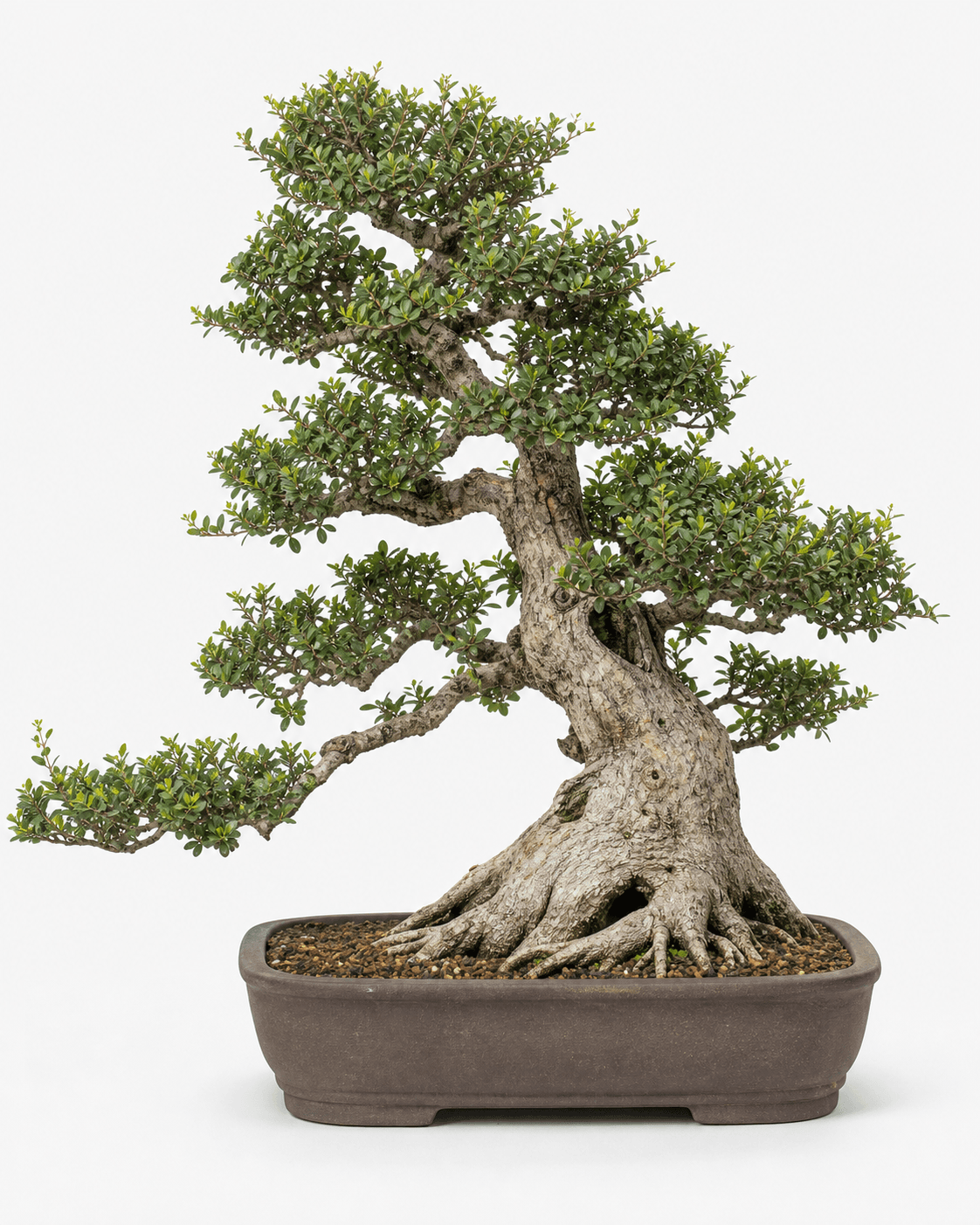
Yaupon holly bonsai should be grown outdoors as a warm-temperate broadleaf evergreen with full sun to part shade, steady water, strong drainage, and pruning after growth hardens. It is one of the better North American hollies for bonsai because mature landscape plants can develop heavy bases, small evergreen leaves, quick back-budding, and convincing coastal or old-hedge character.
The correct botanical name is Ilex vomitoria. Common labels include yaupon holly, yaupon, yaupon tea, cassina, and cassena, while dwarf yaupon, Nana, Schilling's Dwarf, and Stokes Dwarf describe cultivar or nursery forms that need tag-level records.
This page is unusually strong for an evergreen Ilex because the local Mirai corpus includes a dedicated Yaupon holly primer. Mirai provides the bonsai method; NC State, UF/IFAS, Clemson, and Kew-indexed taxonomy provide the hardiness, native range, cultivar, caffeine, fruiting, and pest context.
Updated June 11, 2026. Written by EntGrove Editorial. Last verified June 11, 2026.
Care fingerprint
Read the species through its shared care pattern.
Protect from hard freezes when species demands it, prune with active foliage in mind, and repot when roots can recover without dormancy cues. Use this as the starting point before local conditions and tree strength refine the calendar.
Note: Native southeastern North American broadleaf evergreen holly. Leaves contain caffeine, female plants need compatible male pollen for fruit, and dwarf cultivar identity affects fruiting, growth color, and bonsai use.
Read the foliage first
Broadleaf stress usually shows in leaf color, leaf size, wilt, scorch, or delayed hardening before it becomes a branch problem.
Match work to dormancy
Deciduous, evergreen, tropical, succulent, and flowering broadleaf trees recover on different calendars.
Protect fine roots
Root work should preserve enough active fine roots for the tree to rehydrate quickly after the operation.
Care cadence
The calendar starts with the tree's seasonal state.
Placement
Timing: Grow outdoors in full sun to part shade. In the South, give air movement and afternoon protection during severe heat; in colder areas, protect the pot when hard frost threatens.
Watch for: Long weak shoots in shade, scorched foliage in hot shallow pots, late-frost root injury, and inland dry-wind stress on recently collected material.
NC State Extension: Ilex vomitoriaUF/IFAS Extension: Ilex vomitoriaBonsai Mirai LibraryWatering
Timing: Water the soil thoroughly when the surface begins to dry, then let the pot breathe. Avoid routine trunk spraying on old hollows because wet wood accelerates decay.
Watch for: Water bypassing an old core, yellow foliage, sour soil smell, soft deadwood, and dry pockets under dense surface roots.
Bonsai Mirai LibraryClemson Extension: Holly diseases and insect pestsFeeding
Timing: Feed moderately during development after growth begins. In refinement, feed lightly after the first flush hardens and again in fall to build reserves without coarse spring extension.
Watch for: Oversized leaves, coarse hedge regrowth, salt stress in summer heat, and feeding a recently collected or root-stressed tree before it is actively growing.
Bonsai Mirai LibraryPruning
Timing: Use a thin-then-hedge-then-thin cycle. Thin interior growth for light and structure, hedge or prune the exterior to trigger back-budding, then return roughly a month later to restore airflow.
Watch for: Full defoliation, clipped green shells, retained root suckers, and removing all foliage from a branch that still needs to feed buds behind the cut.
Bonsai Mirai LibraryFruiting
Timing: Track sex and cultivar during flowering. Female plants need compatible male pollen for fruit; many dwarf selections are sold for foliage more than berry display.
Watch for: No fruit on male or sterile plants, flower buds clipped away, fruit exhausting weak trees, and confusion between red-fruited Yaupon and black-fruited Japanese holly.
NC State Extension: Ilex vomitoriaUF/IFAS Extension: Ilex vomitoriaNC State Extension: Ilex crenataRepotting
Timing: Repot in spring as growth starts. Convert old landscape or nursery cores in stages and keep enough foliage to power recovery.
Watch for: Bare-rooting old collected trunks, combining heavy root work with heavy top reduction, late frost after repotting, and loose tie-downs in shallow pots.
Bonsai Mirai LibraryWiring
Timing: Wire secondary and tertiary branches after growth hardens, when branches are hydrated and flexible. Build primary structure mostly by pruning and regrowth.
Watch for: Mature primary branches snapping, wire bite hidden under dense foliage, sharp one-point bends, and guy wires left for too long on slow-setting wood.
Bonsai Mirai LibraryPests and disease
Timing: Inspect dense foliage during warm humid weather and after drought or winter stress. Quarantine landscape stock before it joins refined trees.
Watch for: Scale, leafminers, mites, spittlebugs, twig dieback, black root rot, Phytophthora root rot, leaf spots, soft deadwood, and winter or drought damage.
Clemson Extension: Holly diseases and insect pestsNC State Extension: Ilex vomitoriaSourcing
Timing: Look first at old landscapes, hedges, and legal removals in the native or planted range. Collect only with permission and with enough root ball to support the evergreen canopy.
Watch for: Buried bases, brittle old primaries, huge wounds placed on the front, sprinkler-rotted trunks, protected wild sites, and ordinary dwarf shrubs priced like old collected trees.
Bonsai Mirai LibraryNC State Extension: Ilex vomitoriaSpecies guide
Apply the species profile before copying another tree's calendar.
At a glance
Yaupon holly is a native evergreen with real bonsai response.
Yaupon holly, Ilex vomitoria, is a broadleaf evergreen in Aquifoliaceae. NC State lists yaupon holly, yaupon, yaupon tea, cassina, cassena, Christmas berry, evergreen cassena, Indian black drink, and Appalachian tea as common names, which explains why nursery tags can vary widely. NC State Extension: Ilex vomitoria
The bonsai value is practical: small leaves, a native warm-temperate constitution, reliable budding, good pruning response, and access to old landscape trunks. Mirai identifies Nana and Schilling's Dwarf as the two dwarf forms most often used for bonsai. Bonsai Mirai LibraryNC State Extension: Ilex vomitoria
The main limits are brittle mature primary branches, slow healing on old cuts, deadwood that can rot in humid climates, and root balls that often arrive from decades of landscape soil. A strong Yaupon bonsai is built by staged root work, clip-and-grow structure, retained foliage, and careful wound placement. Bonsai Mirai LibraryClemson Extension: Holly diseases and insect pests
Habitat
Its habitat signal is coastal plain, woodland edge, and tough evergreen thicket.
NC State places Ilex vomitoria across the eastern and southern United States and Mexico. UF/IFAS describes it as a southern U.S. native that grows as a shrub or small tree and is widely planted in Florida landscapes. NC State Extension: Ilex vomitoriaUF/IFAS Extension: Ilex vomitoria
For care, translate that habitat into sun, air, and reliable water in a fast-draining pot. Landscape Yaupon tolerates drought after establishment, but a shallow bonsai container loses the deep-soil buffer that made the plant resilient in the ground. UF/IFAS Extension: Ilex vomitoriaBonsai Mirai Library
For design, coastal material often carries a lean from salt exposure, weather, and repeated bud loss on the exposed side. Mirai frames the image as wind-pushed rather than theatrical windswept: the tree still needs believable lower branches, a readable base, and compact evergreen mass. Bonsai Mirai LibraryBonsai Mirai / Asymmetry
In the Southeast, Yaupon is native rather than a weed problem, but bonsai sourcing still needs restraint. Use legal landscape removals, nursery stock, or propagated cultivars, and avoid digging wild plants from sensitive habitats or protected land. NC State Extension: Ilex vomitoriaBonsai Mirai Library
Reading the tree
Read cultivar, sex, roots, and old branch brittleness before styling.
Start with the label. Ilex vomitoria is Yaupon holly. Ilex crenata is Japanese holly and often has black fruit, Ilex aquifolium is English holly with spiny leaves, Ilex verticillata and Ilex serrata are deciduous winterberries, and generic Ilex tags need more inspection. NC State Extension: Ilex vomitoriaNC State Extension: Ilex crenataNC State Extension: Ilex aquifoliumNC State Extension
Then record cultivar and sex. NC State lists many forms, including Dwarf, Nana, Pendula, Pride of Houston, Stokes Dwarf, Will Fleming, and yellow-fruited types. Mirai separates Nana and Schilling's Dwarf by new growth color: Nana opens lime green, while Schilling's Dwarf opens red. NC State Extension: Ilex vomitoriaBonsai Mirai Library
Read the roots before judging the branches. Old Yaupon hedge stock can have a strong base and dense surface roots, but the center may hold compacted soil that sheds water around the sides. The first bonsai season is often about restoring water entry and oxygen. Bonsai Mirai Library
Read old primaries with suspicion. Mirai describes mature primary branches as brittle enough to snap under force, so an unusable line is usually pruned back and rebuilt rather than bent into submission. Bonsai Mirai Library
Pruning
Use clip-and-grow, directional pruning, and retained foliage.
Yaupon responds well to clip-and-grow. Cut back to an alternate leaf or bud pointing in the direction you want the next branch to move, then let the new shoot harden before the next reduction. Bonsai Mirai Library
Mirai warns against full defoliation on Yaupon. Leave foliage on every stem so the tree keeps enough photosynthetic engine to push predictable buds and recover from pruning. Bonsai Mirai Library
The mature-tree maintenance loop is specific: thin interior clutter, hedge or prune the exterior of pads to drive back-budding, then thin again after dense new growth returns. Mirai notes that this follow-up can be needed in roughly 30 days during active growth. Bonsai Mirai Library
Remove root suckers and low interior shoots that steal energy from the apex unless they are part of a planned clump or replacement branch. Keep the lower primary branches longer than upper branches so branch taper reads as age rather than a clipped dome. Bonsai Mirai Library
Roots
Repot in spring and convert old landscape cores slowly.
Repot Yaupon in spring as active growth begins. The broadleaf-evergreen rule is continuity: do enough work to restore water and oxygen, while preserving roots, soil, and foliage needed for recovery. Bonsai Mirai Library
Avoid full bare-rooting on old collected or nursery material. Work compacted soil from the edges, bottom, surface, and obvious dead pockets, then tie the tree securely so new roots are not torn by movement. Bonsai Mirai Library
If a landscape tree was collected with a large root ball, keep the first bonsai container functional and forgiving. A shallow show pot can come later, after the tree proves it can hydrate, push new growth, and dry at a predictable pace. Bonsai Mirai Library
Protect repotted trees from hard frost. Mirai notes that Yaupon can survive freezes in the ground, but exposed bonsai roots are more vulnerable because the container has little thermal mass. Bonsai Mirai LibraryNC State Extension: Ilex vomitoria
Soil and pot
Choose oxygen, moisture control, and a pot that fits the tree stage.
A 1:1:1 akadama:pumice:lava mix is a practical development starting point because it balances water retention, oxygen, and long-term structure. Refined trees with stable watering can move toward a more akadama-heavy broadleaf-evergreen mix. Bonsai Mirai Library
Do not copy harsh native stress into the bonsai pot. Mirai uses native substrate as a design and character clue, then still expects the container to provide a controlled water and oxygen environment. Bonsai Mirai Library
Yaupon can tolerate shallow and small containers when watering is attentive. Use deeper or larger training containers for collected trunks, weak trees, recent root work, and hot climates where shallow pots dry too quickly. Bonsai Mirai Library
Pot choice should match the image. Dwarf foliage and clipped pads suit quiet rectangles or ovals; old coastal trunks can handle rougher unglazed containers, but the pot should never compete with hollows, scar tissue, or a heavy base. Bonsai Mirai / AsymmetryBonsai Mirai Library
Climate
Warm regions are easiest, but pots change the hardiness math.
NC State lists Yaupon holly for USDA Zones 7a to 9b. Mirai describes bonsai performance through Zone 10, which fits the tree's southern and coastal use, but inland dry wind and exposed winter benches still demand protection. NC State Extension: Ilex vomitoriaBonsai Mirai Library
In humid coastal and Gulf climates, prioritize airflow, trunk-dry watering, and deadwood sanitation. Soft wet hollows should be cleaned back to firm wood and then allowed to dry before any carving or refinement. Bonsai Mirai LibraryClemson Extension: Holly diseases and insect pests
In hot inland climates, use larger soil volume, afternoon shade, and careful fertilizer timing during extreme heat. In cool maritime climates, watch recovery speed after pruning and defoliation-related work because heat drives the second flush. Bonsai Mirai LibraryUF/IFAS Extension: Ilex vomitoria
In colder Zone 7 gardens, overwinter the pot out of hard wind and repeated freeze-thaw. A plant hardy in the ground can still lose roots in a shallow bonsai container. NC State Extension: Ilex vomitoriaBonsai Mirai Library
Pests
Dense evergreen foliage hides pest and root problems.
Clemson groups hollies with recurring risks from black root rot, Phytophthora root rot, leaf spots, leaf blight, cankers, leafminers, scale, mites, aphids, and spittlebugs. In bonsai, dense pads can hide the first signs until damage is already visible. Clemson Extension: Holly diseases and insect pests
Black root rot and Phytophthora are usually water-oxygen problems before they become pest-control problems. If leaves yellow while the soil stays wet, isolate the tree, check drainage, and suspend styling until roots recover. Clemson Extension: Holly diseases and insect pestsBonsai Mirai Library
Scale and leafminers often arrive on nursery or hedge material. Quarantine new trees, inspect the undersides and midribs of leaves, open the canopy for airflow, and use extension guidance for treatment choices. Clemson Extension: Holly diseases and insect pestsNC State Extension: Ilex vomitoria
Old hollows need the same attention as living foliage. A trunk that stays wet is prone to rot, and impermeable hardeners can trap moisture. Mirai favors removing soft wood, drying the area, and using lime sulfur sparingly when color control is needed. Bonsai Mirai Library
Wiring
Wire young wood, prune old wood, and remove wire early.
Reserve wiring mostly for secondary and tertiary branches. Mirai describes old primary Yaupon branches as brittle, so major structure is usually created by cutting back to usable buds and growing replacement lines. Bonsai Mirai Library
When wiring, pre-bend the wire with the leading thumb so the wire supplies the curve rather than using the branch as leverage. The cambium is thin and marks easily. Bonsai Mirai Library
Distribute movement over many coils and avoid a single sharp bend. If a branch has an old wound, place wire so the bend does not tear the secondary branch away at the weak point. Bonsai Mirai Library
Check wire frequently. Mirai warns that wire scars on Yaupon can remain visible for years, and guy wires are often inefficient because slow-growing holly may need too long to set the bend. Bonsai Mirai Library
Propagation
Use cuttings for cultivars, seed for species, and layers for problem branches.
Yaupon can be grown from seed, but seedling sex, fruit color, leaf size, and habit are unknown until the plant matures. Seed is useful for rootstock or local-native projects, not for preserving a named dwarf cultivar. NC State Extension: Ilex vomitoriaUF/IFAS Extension: Ilex vomitoria
Use cuttings to preserve Nana, Schilling's Dwarf, Stokes Dwarf, Pendula, Will Fleming, or other named forms. Keep cultivar records because sex, growth habit, berry color, and bonsai scale all affect long-term use. NC State Extension: Ilex vomitoriaBonsai Mirai Library
Air layering can be useful when an old hedge branch has the right movement but no usable root base. Time layers during active growth and separate only after the new root mass can carry the evergreen foliage. Bonsai Mirai Library
Grafting is rarely the first choice for Yaupon bonsai. Consider it only for cultivar preservation, root correction, or a deliberate fruiting or foliage change that justifies the aftercare. Bonsai Mirai Library
Buying
Old hedge material can be excellent when the base earns the work.
Mirai rates old residential and commercial landscape plants as the best Yaupon sourcing route because decades-old shrubs can have thick bases that ordinary nursery plants lack. Always secure permission and check local rules before collecting. Bonsai Mirai Library
For nursery stock, buy the trunk and cultivar. Dwarf forms like Nana and Schilling's Dwarf offer small leaves and compact growth; upright or weeping forms may be useful only if their habit supports the intended design. Bonsai Mirai LibraryNC State Extension: Ilex vomitoria
Red flags include a buried base, sprinkler-rotted hollow, reverse taper from hedge cuts, brittle old branches with no interior buds, compacted sour soil, leafminer trails, scale, and a topiary silhouette with no trunk line. Bonsai Mirai LibraryClemson Extension: Holly diseases and insect pests
The species is native through much of the Southeast, so bonsai culture can support local material rather than importing similar evergreen hollies. In non-native regions, keep seed-bearing plants contained and follow local guidance for any Ilex that can escape. NC State Extension: Ilex vomitoriaUF/IFAS Extension: Ilex vomitoria
Troubleshooting
Most Yaupon failures trace to roots, old wood, wet hollows, or wrong identity.
Symptom: yellowing foliage while soil stays wet. Likely cause: low oxygen, black root rot, Phytophthora, or compacted nursery soil. Fix: isolate, restore drainage, stop fertilizing, and postpone styling until active growth returns. Clemson Extension: Holly diseases and insect pestsBonsai Mirai Library
Symptom: a primary branch snapped during styling. Likely cause: mature Yaupon wood was bent instead of rebuilt. Fix: seal or clean the break, keep foliage elsewhere, and grow a replacement branch from a suitable bud. Bonsai Mirai Library
Symptom: no red berries. Likely cause: male plant, sterile or non-fruiting cultivar, no compatible male nearby, clipped flower wood, or a weak tree. Fix: verify sex and cultivar during flowering before changing care. NC State Extension: Ilex vomitoriaUF/IFAS Extension: Ilex vomitoria
Symptom: black fruit on a small evergreen holly. Likely cause: Japanese holly or another Ilex label, not typical Yaupon. Fix: check leaf shape, fruit color, tag history, and cultivar records. NC State Extension: Ilex crenataNC State Extension: Ilex vomitoria
Symptom: soft hollow wood or sour smell after rain. Likely cause: retained moisture in old deadwood. Fix: remove mushy wood, let the hollow dry, improve watering technique, and avoid impermeable hardeners. Bonsai Mirai Library
Symptom: dense outer shell and weak interior. Likely cause: repeated hedge clipping without thinning. Fix: open windows, keep live interior leaves, prune to directional buds, and rebuild pads in cycles. Bonsai Mirai Library
Design
Design from base, coastal age, and compact evergreen mass.
Begin with base, trunk line, defining branch, and apex. Old Yaupon material often has a strong trunk but awkward hedge scars; the design should turn useful hollows and scars into character while hiding or reducing the wounds that distract. Bonsai Mirai / AsymmetryBonsai Mirai Library
Coastal-lean designs should still feel botanically credible. Mirai explains that salt fog and exposed-site pruning can shape a wind-pushed image, but Yaupon pads remain broadleaf pads with alternate leaves, not conifer foliage clouds. Bonsai Mirai Library
Use clip-and-grow to create taper in primary and secondary structure. Immediate silhouette is less important than branch taper, interior buds, and a canopy that can be refined without returning to a clipped shrub. Bonsai Mirai LibraryBonsai Mirai / Asymmetry
Deadwood belongs on Yaupon when the material already has old hollows or removal scars. Keep it restrained, dry, and structurally backed by live tissue; broadleaf evergreen age reads as much through bark, scars, trunk mass, and compact leaves as through carved features. Bonsai Mirai LibraryBonsai Mirai / Asymmetry
Cultivars
Cultivar identity affects foliage scale, fruiting, and silhouette.
Mirai names Ilex vomitoria Nana and Schilling's Dwarf as the two Yaupon forms most used for bonsai. The practical difference in the corpus is new growth color: Nana opens lime green, while Schilling's Dwarf opens red. Bonsai Mirai Library
NC State lists Dwarf, Nana, Pendula, Pride of Houston, Stokes Dwarf, Will Fleming, yellow-berried Yellow Berry, and other forms. Some records describe dwarf selections with limited or absent fruit, so do not assume berries until the individual plant proves sex and fruiting behavior. NC State Extension: Ilex vomitoria
Schilling's Dwarf and Stokes Dwarf are especially common landscape labels for compact male or low-fruiting foliage plants. They can be excellent bonsai stock, but a fruit display usually requires a verified female plant and compatible male pollen. NC State Extension: Ilex vomitoriaUF/IFAS Extension: Ilex vomitoria
Keep Yaupon separate from American holly, dahoon, inkberry, English holly, Japanese holly, Japanese winterberry, and American winterberry. The clues are leaf margin, leaf size, fruit color, deciduous versus evergreen behavior, native range, and the exact nursery or collection record. NC State Extension: Ilex vomitoriaNC State Extension: Ilex aquifoliumNC State Extension: Ilex crenataNC State Extension
History
Yaupon carries native-plant, tea, and landscape-history signals.
NC State notes that Yaupon leaves contain caffeine and that the species has been used for tea. The specific epithet vomitoria is tied to historical ceremonial drink use, so bonsai copy should avoid casual medicinal claims and simply record the plant accurately. NC State Extension: Ilex vomitoria
In American landscapes, Yaupon is a durable hedge, screen, and small evergreen tree. That history matters for bonsai because old landscape removals can provide aged bases, compact ramification, and wounds that already tell a site story. UF/IFAS Extension: Ilex vomitoriaBonsai Mirai Library
As a native southern species, it also broadens bonsai beyond imported Japanese and Chinese standards. A strong Yaupon bonsai can look regional: coastal, humid, scrubby, old, and clearly grown from its own ecology. NC State Extension: Ilex vomitoriaBonsai Mirai / Asymmetry
Exhibition quality will come from trunk age, clean wound decisions, foliage density, and branch taper. Fruit can be a seasonal accent, but structure and horticultural health should carry the tree. Bonsai Mirai LibraryBonsai Mirai / Asymmetry
Species questions
Answer the beginner questions before styling.
Is Yaupon holly good for bonsai?
Yes. Yaupon holly is one of the stronger North American evergreen broadleaf bonsai candidates because it has small leaves, good back-budding, pruning tolerance, and access to old landscape trunks. It works best outdoors in warm-temperate climates.
Can Yaupon holly bonsai live indoors?
Use outdoor culture. Yaupon needs sun, airflow, seasonal change, and a cool winter period. Indoor display should be brief and followed by a return to protected outdoor conditions.
When should Yaupon holly be repotted?
Repot in spring as active growth begins. Inspect every 3 to 4 years, and convert old nursery or landscape soil gradually rather than bare-rooting an old evergreen root ball.
Should Yaupon holly be defoliated?
No routine full defoliation. Mirai specifically cautions to leave foliage on every stem so Yaupon retains enough energy to push predictable buds. Use thinning, directional pruning, and selective leaf cleanup instead.
What soil does Yaupon holly bonsai need?
Use fast-draining mineral soil that still holds moisture. A 1:1:1 akadama:pumice:lava mix is a practical development starting point; more akadama can be used in refined trees when watering and climate support it.
Why is my Yaupon holly not producing berries?
Common reasons are a male plant, sterile or low-fruiting cultivar, no compatible male pollinizer near a female plant, flower wood pruned away, or a weak tree. Verify cultivar and sex during flowering before changing fertilizer or pruning.
Are Nana and Schillings Dwarf good Yaupon bonsai cultivars?
Yes. Mirai identifies Nana and Schillings Dwarf as the two Yaupon forms most used for bonsai. Nana opens lime-green new growth, while Schillings Dwarf opens red new growth. Both need a good base and healthy roots to be worth bonsai training.
Can I wire old Yaupon holly branches?
Be conservative. Mature primary branches are brittle and can snap under force. Wire young secondary and tertiary branches, and build old structure mostly by pruning back to buds and growing replacement lines.
Is Yaupon holly poisonous or caffeinated?
NC State notes that Yaupon leaves contain caffeine and that berries are toxic only if eaten in large quantities. Do not market a bonsai as an edible tea plant unless it is grown and handled specifically for that purpose.
How do I tell Yaupon holly from Japanese holly?
Yaupon holly is Ilex vomitoria and commonly carries red or yellow fruit on female plants. Japanese holly is Ilex crenata and typically has small black fruit. Confirm with leaf shape, fruit color, cultivar tag, and source history.
Sources
Species advice needs source discipline.
Next decisions
Plan the operation before copying the calendar.
A good care note for Yaupon holly records the tree's stage, the work done, and the aftercare used. That record matters more than a month-name rule.
Related species
Compare nearby trees before transferring advice.
English boxwood
Buxus sempervirens
Japanese boxwood
Buxus microphylla
Korean boxwood
Buxus sinica var. insularis
English holly
Ilex aquifolium
Japanese holly
Ilex crenata