
Species guide
Fukien Tea Bonsai Care
Ehretia microphylla
Fukien tea bonsai, Ehretia microphylla, can live indoors only when the grower supplies bright light, warm stable air, careful watering, humidity support, and a quiet recovery rhythm. Most failures come from weak indoor light, cold drafts, stale wet roots, dry heated rooms, or repeated moves.
The local Mirai corpus has no dedicated Fukien tea file, so this guide transfers tropical broadleaf, watering, soil, repotting, propagation, energy, and design method from Mirai, then grounds identity and range in Kew. Where species-specific evidence is thin, the page says so.
Treat Fukien tea as a warm, frost-free tropical broadleaf with a narrow comfort window. It suits an observant grower who can read moisture and stability each day; ficus, dwarf jade, and Chinese elm give beginners more margin.
Updated July 5, 2026. Written by EntGrove Editorial. Last verified July 5, 2026.
Care fingerprint
Read the species through its shared care pattern.
Treat indoor culture as a light-management problem first; prune and repot when the tree is actively growing and warm enough to recover. Use this as the starting point before local conditions and tree strength refine the calendar.
Read the foliage first
Broadleaf stress usually shows in leaf color, leaf size, wilt, scorch, or delayed hardening before it becomes a branch problem.
Match work to dormancy
Deciduous, evergreen, tropical, succulent, and flowering broadleaf trees recover on different calendars.
Protect fine roots
Root work should preserve enough active fine roots for the tree to rehydrate quickly after the operation.
Care cadence
The calendar starts with the tree's seasonal state.
Placement
Timing: Grow outside in frost-free tropical weather. In temperate regions, move outdoors only after nights stay above 60 F and transition gradually.
Watch for: Leaf drop after sudden moves, cold glass, heater blasts, low indoor light, and no airflow around dense foliage.
Bonsai Mirai LibraryKew POWOLight
Timing: Use the strongest safe light available. Indoors, place close to a bright window or under a proper grow light with air movement.
Watch for: Larger leaves, long internodes, fewer flowers, stalled extension, and foliage dropping after weeks in a dim room.
Bonsai Mirai LibraryWatering
Timing: Check daily while learning the tree. Water thoroughly when the upper root zone begins to dry, then let oxygen return before the next watering.
Watch for: A damp surface over a dry core, sour wet soil, water standing against the pot, sudden wilt, yellowing, or fine roots that never get air.
Bonsai Mirai LibraryRepotting
Timing: Repot only when warm, healthy growth and root evidence justify it. Use the 60 F night threshold as a minimum for tropical root work.
Watch for: Compacted import soil, lost percolation, root congestion, a loose trunk, and the temptation to repot while the tree is already dropping leaves.
Bonsai Mirai LibraryPruning
Timing: Let growth extend and harden, then prune back to useful interior buds. Keep recovery capacity ahead of cosmetic shaping.
Watch for: Cutting a weak tree, removing too much leaf mass, branch dieback after large cuts, and treating every new shoot as a problem.
Bonsai Mirai LibraryFertilizer
Timing: Feed during active warm growth after the tree is moving water well. Use lighter organic feeding in refinement and pause after repotting until strong new growth returns.
Watch for: Fertilizer on a dry or sour root zone, salt stress after root work, coarse growth from heavy feeding, and feeding during dim winter decline.
Bonsai Mirai LibraryWinter protection
Timing: Before cool nights arrive, move the tree into a bright warm setup. Reduce water demand expectations as metabolism slows.
Watch for: Cold roots, wet soil that no longer dries, weak grow lights, spider mites, scale, and leaf drop from a late move.
Bonsai Mirai LibraryPests
Timing: Inspect weekly during indoor protection and after any stress event. Warm still rooms make small pests build quickly.
Watch for: Spider mites, scale, mealybugs, whiteflies, sticky residue, stippled leaves, blackened tips, and yellowing tied to root stress.
Bonsai Mirai LibrarySpecies guide
Apply the species profile before copying another tree's calendar.
At a glance
Fukien tea is a small-leaf tropical broadleaf with a narrow indoor margin.
Ehretia microphylla is the current Kew-accepted name for the tree sold as Fukien tea, Fujian tea, Carmona retusa, and Carmona microphylla. It sits in Boraginaceae and belongs in the EntGrove Broadleaf > Tropical group because the useful bonsai calendar is warm-growth driven rather than dormancy driven. Kew POWO
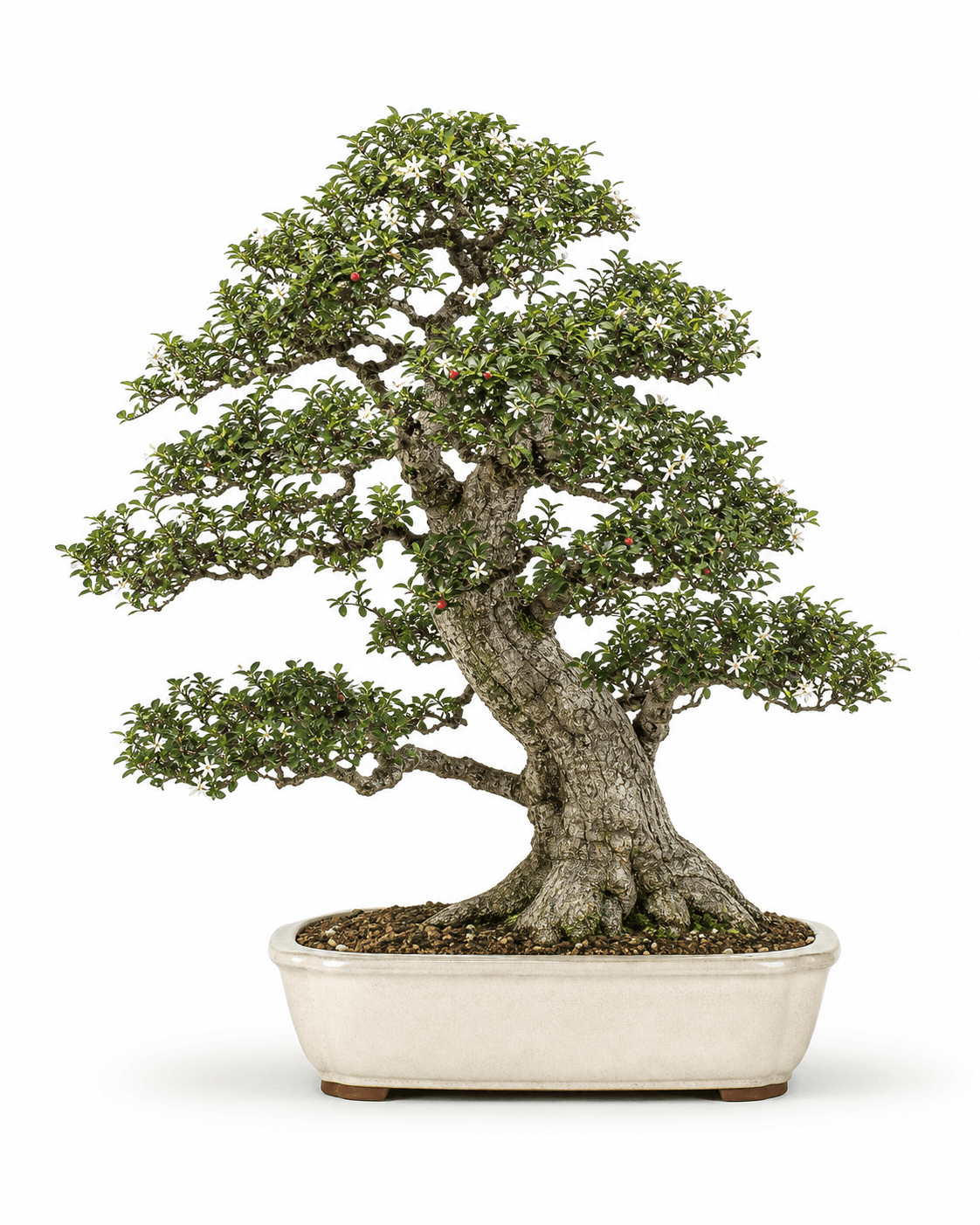
For bonsai, the plant is attractive because small leaves, white flowers, red fruit, roughening bark, and dense twigging can make a young tree read older than its trunk age. That appeal comes with a daily care burden: stable warmth, high light, even moisture, root oxygen, humidity, and pest inspection decide success. Kew POWOUseful Tropical PlantsBonsai Mirai Library
Because the local Mirai corpus has no dedicated Fukien tea file, this page avoids false precision. The bonsai technique here comes from Mirai tropical broadleaf, watering, soil, repotting, propagation, fertilizer, energy, and design method; the public plant identity comes from Kew and supporting tropical-plant references. Bonsai Mirai LibraryKew POWO
Wild habitat
Its wild logic is warm, bright, tropical to subtropical shrubland.
Kew places Ehretia microphylla from India to Nansei-shoto and the Solomon Islands and describes it as a shrub or tree that grows primarily in the wet tropical biome. Useful Tropical Plants summarizes a broader practical habitat frame of open, dry, sunny habitats, thickets, shrub vegetation, teak forest, sandy soils, and scrub forest at low to moderate elevations. Kew POWOUseful Tropical Plants
That mixed habitat frame explains the care balance. Fukien tea wants warmth and light, yet a bonsai pot strips away the deep-ground buffer that would protect roots during heat, rain, or dry wind. The grower has to provide moisture without suffocation and brightness without a hard transition from indoor shade to summer sun. Bonsai Mirai LibraryUseful Tropical Plants
It also explains the design. Fukien tea should read as a small aged broadleaf shrub or tree: fissured bark, small leaves, rounded flowering twigs, and a compact canopy. Flat conifer pads and dramatic deadwood usually fight the species character. Bonsai Mirai / Asymmetry
Reading the tree
Read stability before styling because leaf drop is the main warning light.
Mirai method starts with health. A tree only has surplus energy for bonsai work after it is growing beyond maintenance. On Fukien tea, the useful signs are firm glossy leaves, new extension, drying rhythm that speeds up after watering, and no ongoing leaf drop after a move. Bonsai Mirai Library
Weak light shows up as larger leaves, longer spacing, stalled shoots, fewer flowers, and decline after pruning. Root stress shows up as yellowing, limp foliage in wet soil, sour smell, or a pot that stays wet far longer than expected. Those signs call for stabilization, not styling. Bonsai Mirai Library
Separate development from refinement. A young or recovering Fukien tea needs leaf mass, root maturation, and moderate extension. A refined tree can take lighter tip pruning, selective leaf reduction, and tighter fertilizer, yet only while warm light and water movement support recovery. Bonsai Mirai Library
Technique
Prune for compact broadleaf growth and keep flowers secondary to health.
Use pruning as the main refinement tool. Let shoots extend until the new growth is firm enough to have returned energy, then cut back to useful interior buds or pairs that preserve branch direction. Repeated tiny cuts on a weak tree create stress without solving the light or root problem. Bonsai Mirai Library
Avoid routine full defoliation. Mirai tropical guidance treats root maturation, light, and tip control as the main engines of smaller leaves and ramification. Partial leaf reduction can help strong refined tropical broadleaf material, but stripping a stressed indoor Fukien tea removes the solar panels it needs for recovery. Bonsai Mirai Library
Flowers and fruit should be read as evidence of strength, not as the care goal. If a small tree is weak, remove some flowers or fruit so the canopy can rebuild leaves and roots. A healthy flowering tree can keep some display, provided water and fertilizer match the energy cost. Bonsai Mirai LibraryUseful Tropical Plants
Do major cuts sparingly. Small broadleaf material often looks better when direction changes are built by pruning back to side shoots over time rather than forcing old brittle branch wood into one dramatic bend. Bonsai Mirai LibraryBonsai Mirai / Asymmetry
Roots
Repot only when the tree is warm, growing, and root work has a clear reason.
Mirai tropical guidance gives three real reasons to repot: substrate decomposition, lost percolation, or a deliberate design change. Fukien tea is often sold in dense retail soil, so the goal is planned correction when the tree is strong rather than emergency bare-rooting during leaf drop. Bonsai Mirai Library
Use warm active growth as the gate. For tropical species, Mirai places repotting and pruning work after nighttime temperatures consistently exceed 60 F. Indoors, the equivalent is a warm bright setup where new growth is already moving and the aftercare environment is ready before roots are cut. Bonsai Mirai Library
Never bare-root a leafed tropical broadleaf. Leave a portion of the root mass intact so the foliage keeps a water supply, reduce old dense soil in stages, tie the tree firmly, and chopstick fresh aggregate around the remaining fine roots without crushing them. Bonsai Mirai Library
After repotting, use bright shade or gentle morning light, steady warmth, careful watering, and no fertilizer until strong new growth confirms root recovery. A newly worked tree that is still drying slowly is asking for oxygen and time. Bonsai Mirai Library
Soil and pot
Use soil that holds moisture without stealing oxygen.
The watering target is a root zone that can be saturated thoroughly and then breathe. Mirai beginner soil guidance uses akadama, pumice, and lava as the basic container toolkit: akadama holds nutrients, pumice holds available moisture, and lava keeps oxygen moving. Bonsai Mirai Library
For Fukien tea, start with a moisture-retentive but open aggregate mix and adjust to your room. A dry heated apartment may need more water-holding particle behavior, while a cool low-light winter shelf needs faster oxygen return and less organic material. Bonsai Mirai Library
Avoid deep burial of the root crown. Mirai tropical repotting warns that burying a tropical crown too deeply can keep the bark-soil transition wet and invite rot. Show the base, keep the crown high, and build the soil surface so water enters without pooling against the trunk. Bonsai Mirai Library
A quiet glazed oval or soft rectangle usually suits Fukien tea better than a heavy conifer container. The pot should support small leaves, flowers, fruit, and old-bark texture while leaving enough reservoir for a tropical broadleaf that can dry quickly in active growth. Bonsai Mirai / AsymmetryBonsai Mirai Library
Climate
Grow it as an outdoor tropical where possible and as a managed indoor tree where necessary.
In frost-free tropical and warm subtropical climates, Fukien tea can live outdoors year-round with bright light, rain-aware drainage, and pest inspection. Even there, small pots need more precise watering than plants growing in the ground. Kew POWOBonsai Mirai Library
In temperate climates, the tree needs a deliberate indoor winter setup. Mirai tropical guidance says indoor culture works only when light spectrum, humidity, air circulation, and water quality are managed. A windowsill can keep a tree alive only when it is bright, warm, and stable enough for continued function. Bonsai Mirai Library
Move the tree outside gradually after nights stay above 60 F, first into protected bright shade or morning sun. Bring it back under protection before autumn nights become cold enough to stall roots. Each move is a stress event, so make transitions few and controlled. Bonsai Mirai Library
Winter watering should slow with metabolism. Mirai tropical winter guidance recommends sharply reducing watering when tropicals slow down, letting the substrate approach dryness before watering again. For Fukien tea, that means fewer waterings while still avoiding a bone-dry root ball. Bonsai Mirai Library
Pests and diseases
Indoor stress turns small pests and root problems into major decline.
Most Fukien tea pest trouble follows weak indoor culture: dim light, still air, dry heat, and a tree already shedding leaves. Check the undersides of leaves, twig crotches, flower clusters, and sticky surfaces for spider mites, scale, mealybugs, and whiteflies. Bonsai Mirai Library
Root rot risk comes from the water and oxygen imbalance that Mirai watering guidance names as the core container problem. A pot that stays wet because the room is cool, the soil is fine, or the foliage is declining should be managed for oxygen first. Bonsai Mirai Library
Yellow leaves are a diagnostic pattern, not a treatment plan. Review recent moves, cold exposure, water penetration, drainage, light, and pests before adding fertilizer. Fertilizer salts on weak roots can make water uptake harder. Bonsai Mirai Library
Use chemical treatment only after identifying the pest and checking the local label. On a reactive indoor tropical, repeated sprays stacked onto weak roots, low light, and dry air can become one more stressor. Bonsai Mirai Library
Wiring
Wire young flexible shoots lightly and let pruning do most of the styling.
Mirai structural wiring method still applies: wire should sit at a consistent 55 to 60 degree angle, stay in contact without choking the branch, and support a specific structural goal. Practice on expendable material before wiring a valued small tropical. Bonsai Mirai Library
Fukien tea is usually better shaped by pruning, selective guy wires, and staged growth than by forcing older branch wood. The species is grown for small twiggy broadleaf character, and heavy visible wire can scar or break the very detail that makes the tree appealing. Bonsai Mirai LibraryBonsai Mirai / Asymmetry
Wire only a healthy tree in active growth or stable warm protection. Avoid wiring immediately after repotting, during leaf drop, after pest treatment, or when winter light is too weak for quick recovery. Bonsai Mirai Library
Check wire often. Tropical shoots can swell quickly once warmth and light return, and small dark bark can hide early bite. Remove by cutting the wire away rather than unwinding if the shoot is brittle. Bonsai Mirai Library
Propagation
Cuttings are the practical route; air layers are for specific design saves.
Mirai propagation guidance places softwood and general cuttings after nights stay above 60 F, ideally warmer, because warm soil drives root initiation. That warm-window logic transfers cleanly to Fukien tea. Bonsai Mirai Library
Use healthy non-flowering shoots, reduce foliage so transpiration does not outrun the future roots, and root in perlite or another airy medium that holds humidity without saturation. Do not fertilize cuttings during root initiation. Bonsai Mirai Library
Seed is possible because the plant fruits, but cuttings preserve useful small-leaf and bark traits more predictably for bonsai. Allow rooted cuttings to harden, then move into a modest pot rather than an oversized wet container. Bonsai Mirai LibraryUseful Tropical Plants
Air layering can rescue a poor base or a good upper trunk, but it should be reserved for strong warm trees. Mirai layering guidance requires stable darkness, moist rather than waterlogged sphagnum, and no repeated opening to inspect progress. Bonsai Mirai Library
Buying
Buy stability, roots, and label clarity before flowers.
Most beginner Fukien tea bonsai arrive as imported or mass-produced indoor retail trees. Inspect the root surface, drainage, foliage firmness, active shoot tips, branch dieback, pests, and evidence of recent stress before caring about flowers or a decorative pot. Bonsai Mirai Library
Reject trees with glued rock, sour wet soil, widespread yellowing, dry brittle tips, sticky foliage, webbing, or a pot that has no drainage path. If the trunk wobbles in the pot, roots or tie-downs are already compromised. Bonsai Mirai Library
Verify the name. Kew accepts Ehretia microphylla and lists Carmona retusa and Carmona microphylla as synonyms, while the retail bench may also say Fukien tea, Fujian tea, Philippine tea, or Carmona. Separate it from Serissa, sweet plum, Neea, Premna, and boxwood labels before applying advice. Kew POWO
Specialist tropical bonsai growers and acclimated pre-bonsai stock offer better odds than gift-shop trees. A plain nursery plant with active roots and branch options is often a stronger starting point than a finished-looking tree already declining indoors. Bonsai Mirai Library
Troubleshooting
Work backward through the last change before doing more bonsai work.
Fukien tea decline usually follows a recent change in placement, light, water, roots, temperature, pest pressure, or pruning. Stabilize the environment first. A tree in active leaf drop rarely benefits from simultaneous repotting, fertilizing, pruning, and spraying. Bonsai Mirai Library
Design
Design it as a small aged flowering broadleaf, not as a miniature conifer.
Mirai design method starts with base, trunk line, defining branch, and apex. On Fukien tea, the most convincing images usually use rough bark, small leaves, flowers, fruit, and compact rounded masses to suggest age at small scale. Bonsai Mirai / AsymmetryBonsai Mirai Library
Choose a front that shows the best base and trunk movement, then preserve a defining branch that gives the canopy asymmetric direction. Round the apex gently rather than building a sharp conifer peak. Bonsai Mirai / Asymmetry
Clip-and-grow suits the species because branch direction can be built through repeated side-shoot selection. Use wire for young scaffolding only when it solves a real structural problem. Bonsai Mirai LibraryBonsai Mirai / Asymmetry
Deadwood is usually a flaw-management detail on Fukien tea. The species value is living bark, flowers, fruit, and small twigging, so large carved features should stay rare and material-driven. Bonsai Mirai / Asymmetry
Cultivars and forms
Most labels are name variants, so judge the plant in front of you.
The important label issue is taxonomy rather than cultivar culture. Kew accepts Ehretia microphylla and lists Carmona retusa, Carmona microphylla, and several older names as synonyms. Most retail Fukien tea tags describe that same practical bonsai group. Kew POWO
Select for traits you can see: naturally small leaves, short internodes, firm active growth, clean root flare, usable lower branches, and bark texture. A flowering display on the sales bench is less useful than a tree that holds leaves for several weeks in your conditions. Bonsai Mirai Library
Common-name confusion is real. Serissa, sweet plum, Premna, Neea, Bahama berry, and small boxwoods can all sit near Fukien tea in retail indoor-bonsai displays. Confirm leaf texture, flower form, fruit, bark, and the botanical label before borrowing a care calendar. Kew POWO
History
Fukien tea is important as penjing and indoor retail material, with limited documented technique.
The common English name points to Fujian, the southeastern Chinese province historically romanized as Fukien. Useful Tropical Plants notes ornamental, hedge, and bonsai use, while Kew anchors the plant across a wide Asian and Pacific native range. Kew POWOUseful Tropical Plants
In western bonsai, Fukien tea became one of the best-known indoor gift trees because it can look complete while small: dark leaves, white flowers, fruit, and aged bark. That market history also explains why many poor specimens arrive in compacted soil and weak indoor positions. Useful Tropical Plants
There is no strong public canon of named Fukien tea bonsai comparable to Japanese black pine, Japanese maple, or shimpaku. The exhibition standard is therefore practical and visual: healthy tropical culture, credible broadleaf structure, small leaf scale, compact flowering growth, and evidence that the tree has adapted to container life. Bonsai Mirai / AsymmetryBonsai Mirai Library
Source depth
This page is conservative because direct species technique is thin.
The local Bonsai Mirai distilled corpus contains no dedicated Fukien tea file. That makes this page different from the Japanese maple, Chinese elm, pine, juniper, ficus, and many other profiles with species-specific Mirai coverage. Bonsai Mirai Library
The care recommendations here transfer only the tropical and broadleaf principles that fit the plant: warm active-growth timing, water and oxygen balance, conservative root work on leafed trees, light-driven indoor limits, organic fertilizer restraint, cuttings during warm nights, and design from species character. Bonsai Mirai LibraryBonsai Mirai / Asymmetry
Use the page as a careful operating model, then let the tree in front of you decide the pace. Fukien tea rewards small observations: how fast the pot dries, whether new shoots harden, whether flowers hold, and how the canopy responds after each move. Bonsai Mirai Library
Species questions
Answer the beginner questions before styling.
Is Fukien tea a good beginner bonsai?
Fukien tea is common in beginner retail displays, yet it asks for close daily observation. It needs bright light, stable warmth, careful watering, humidity support, and pest checks. Ficus, dwarf jade, and Chinese elm are usually safer first indoor choices.
Can Fukien tea bonsai live indoors?
Yes, with a managed indoor setup: the brightest practical light, steady warmth, air movement, humidity support, and watering by soil condition. Indoors is protection, while warm outdoor growth is stronger when nights stay above 60 F.
How often should I water a Fukien tea bonsai?
Check daily while learning the tree. Water thoroughly when the upper soil begins to dry, then let oxygen return. The interval changes with leaf mass, pot size, soil, heat, airflow, and indoor light.
Why is my Fukien tea dropping leaves?
The usual causes are a recent move, cold draft, weak light, dry heated air, underwatering, stale wet soil, root stress, or pests. Stabilize placement and water movement before pruning, fertilizing, or repotting.
When should I repot Fukien tea bonsai?
Repot only when the tree is healthy, warm, and growing, with root or soil evidence such as lost drainage, compacted import soil, or root congestion. Use nights consistently above 60 F as the active-work threshold.
What soil is best for Fukien tea bonsai?
Use a sifted aggregate bonsai mix that holds moisture while keeping oxygen available. Adjust the water-holding fraction to your room and avoid dense organic soil that stays wet in low winter light.
Should I wire a Fukien tea bonsai?
Wire only healthy young flexible shoots when a structural goal requires it. Most shaping should come from pruning, side-shoot selection, and staged movement because older branch wood can crack and small bark can scar.
Why are Fukien tea leaves turning yellow?
Yellowing often points to root stress, overwatering, poor oxygen, weak light, hard-water or nutrient issues, pests, or cold exposure. Check water movement and root-zone smell before adding fertilizer.
Does Fukien tea need humidity?
It benefits from humidity and airflow together. Dry heated rooms increase stress and pest pressure, while stagnant wet air can worsen disease. Use room humidity, open spacing, and gentle air movement.
Can I grow Fukien tea from cuttings?
Yes. Take healthy softwood or semi-soft cuttings during warm active growth after nights stay above 60 F, reduce foliage, root in an airy medium such as perlite, and keep the medium humid without saturation.
Sources
Species advice needs source discipline.
Next decisions
Plan the operation before copying the calendar.
A good care note for Fukien tea records the tree's stage, the work done, and the aftercare used. That record matters more than a month-name rule.
Related species
Compare nearby trees before transferring advice.
Ficus retusa / Indian laurel
Ficus microcarpa
Tigerbark ficus
Ficus microcarpa 'Tigerbark'
Willow-leaf ficus
Ficus salicaria
Benjamin fig
Ficus benjamina
Ginseng ficus
Ficus microcarpa 'Ginseng'