
Species guide
Jack Pine Bonsai Care
Pinus banksiana
Jack pine is a cold-climate, outdoor, two-needle North American pine from boreal forests, sandy barrens, and fire-renewed stands. For bonsai, treat confirmed Pinus banksiana as Pine > Short-Needle Single-Flush: build needle mass first, pinch only strong refined candles, prune after the spring flush hardens, and avoid routine Japanese black pine decandling.
This guide is transparent about source depth. The local Mirai corpus lacks a dedicated Jack pine file, but it names Jack pine inside the short-needle single-flush method; taxonomy, ecology, hardiness, morphology, pests, and conservation context are grounded in Kew, Flora of North America, USDA Forest Service Silvics and FEIS, NC State Extension, and University of Minnesota Extension.
Updated June 8, 2026. Written by EntGrove Editorial. Last verified June 8, 2026.
Care fingerprint
Read the species through its shared care pattern.
Use candle timing and bud selection carefully; compact needles do not mean the tree tolerates repeated aggressive work. Use this as the starting point before local conditions and tree strength refine the calendar.
Identify flush behavior
Single-flush, multiflush, white pine, and compact pine groups have different pruning windows and different risk levels.
Avoid default decandling
Japanese black pine methods do not transfer safely to every pine, especially slow, weak, collected, or five-needle trees.
Use needles as strength data
Needle length, color, age, and density help show where vigor is strong, weak, or becoming shaded.
Care cadence
The calendar starts with the tree's seasonal state.
Placement
Timing: Grow outdoors in full sun with strong airflow and a real winter. Use afternoon root cooling in hot climates because NC State notes Jack pine does best with cool summers and poor heat tolerance.
Watch for: Interior shade dieback, warm winter storage, hot night stress, sudden summer yellowing, and nursery labels that hide a different two-needle pine.
NC State ExtensionUSDA Forest Service SilvicsWatering
Timing: Water until the whole root system is wet, then let air return before the next cycle. Dry sandy ecology becomes a preference for oxygen while the pot still needs complete hydration.
Watch for: Hydrophobic old soil, sour wet pockets, root cores that stay saturated, dry windy days, and shallow containers that heat faster than landscape roots.
Bonsai Mirai LibraryUSDA Forest Service SilvicsDevelopment feeding
Timing: Feed strongly while building roots, branch length, and interior buds. Short-needle single-flush pinching requires an energy-positive tree with enough needle mass to respond.
Watch for: Pinching a weak tree, starving a tree after root work, or trying to create fine ramification before branch length and buds exist.
Bonsai Mirai LibraryRefinement feeding
Timing: Once structure and length are in place, moderate spring excess and support recovery after pinching or post-flush pruning.
Watch for: Overfeeding a refined crown into coarse candles, or withholding nutrition after work that needs a strong bud response.
Bonsai Mirai LibrarySpring candle pinching
Timing: Pinch only strong refined candles as the candle extends and needle clusters begin to separate. Leave weak, young, recently repotted, and still-developing branches alone.
Watch for: Tearing off the whole candle, pinching after needles have separated, and treating all growth tips when the tree is still in development.
Bonsai Mirai LibraryPost-flush pruning
Timing: After new needles darken, sharpen, and attach firmly, shorten overlong shoots and reduce multi-bud junctions back to two shoots where refinement exists.
Watch for: Cutting behind the current year needles, pruning a weak branch, leaving three to five shoots at one junction, and pruning after stems have hardened too far.
Bonsai Mirai LibraryRepotting
Timing: Repot in spring as buds begin to move. Keep collected or old nursery root work staged and preserve enough native core to maintain mycorrhizal continuity.
Watch for: Bare-rooting, unstable tie-downs, removing too many coarse roots at once, and selecting a shallow show pot before the root geometry allows it.
Bonsai Mirai LibraryUSDA Forest Service FEISPests and disease
Timing: Inspect during warm growth, after drought, after heavy work, and whenever needle color changes outside normal older-needle shed.
Watch for: Jack pine budworm, redheaded pine sawfly, bark beetles, root borers, needle miners, scale, rust fungi, pine gall rust, needle cast, root rot, heart rot, and Armillaria.
USDA Forest Service FEISUniversity of Minnesota ExtensionNC State ExtensionSpecies guide
Apply the species profile before copying another tree's calendar.
At a glance
Confirm Pinus banksiana, then use short-needle single-flush timing.
Kew accepts Pinus banksiana Lamb. as a Pinaceae species native from Subarctic America into north-central and northeastern United States. Flora of North America lists Jack pine and pin gris and describes paired, short, twisted needles with often serotinous cones. Kew POWOFlora of North America
For bonsai method, EntGrove places Jack pine in Pine > Short-Needle Single-Flush Pines. Mirai lacks a dedicated Jack pine file, but pinching-to-design and post-harden pine pruning place Jack pine inside the same timing family as Scots, mugo, lodgepole, and shore pine. Bonsai Mirai Library
The working baseline is full sun, outdoor dormancy, complete watering followed by oxygen return, mineral pine soil, staged root work, and branch-stage reading. The highest practical risk is applying annual Japanese black pine decandling to a tree that should be managed as single-flush. Bonsai Mirai LibraryNC State Extension
Wild habitat
Jack pine is a boreal fire pine of sandy, exposed, nutrient-lean sites.
USDA Silvics describes Jack pine as a northern forest pine that grows farther north than any other American pine and is the most widely distributed pine species in Canada. It often colonizes exposed mineral soil after fire. USDA Forest Service Silvics
FNA gives the habitat as fire-successional boreal forests, tundra transition, dry flats, hills, and sandy soils. University of Minnesota Extension adds well-drained sandy soils, glacial eskers, sand dunes, rocky soils, and moderately acidic sites. Flora of North AmericaUniversity of Minnesota Extension
Those wild conditions translate into bright light, cool roots, lean oxygen-rich soil, and careful water management. A potted Jack pine can dry fast in wind and still decline if the old core stays wet and anaerobic. Bonsai Mirai LibraryUSDA Forest Service Silvics
Design can borrow from the ecology when the material supports it: crooked boreal trunks, open crowns, fire-scar deadwood, sparse sandy-barrens character, and dense young forest images all belong to the species story. Bonsai Mirai / AsymmetryUSDA Forest Service Silvics
Energy
Read needle mass, branch stage, and root recovery before every technique.
Mirai short-needle single-flush method separates development from refinement. Development grows length, vascular strength, and interior buds; refinement starts only after a branch has reached design length and has enough buds to divide strength safely. Bonsai Mirai Library
Vigor is visible through shoot length and needle count together. A long shoot with few needles lacks the same budding capacity as a strong needled shoot, so cutback decisions should read both length and photosynthetic mass. Bonsai Mirai Library
Healthy pines commonly carry several years of needles. Mirai post-harden pruning uses third-year needle drop as a sign that a pine is energy positive and ready for more refined cleaning, selection, or wiring. Bonsai Mirai Library
For collected or wild-origin Jack pine, roots decide timing. USDA FEIS describes a seedling taproot, deep roots on well-drained soils, and abundant lateral roots mostly in the upper soil; bonsai conversion should respect that structure in stages. USDA Forest Service FEISBonsai Mirai Library
Pine technique
Pinch only in refinement, then prune after the flush hardens.
Mirai pinching guidance names Jack pine among short-needle single-flush pines that can respond to candle pinching. The operation belongs on strong refined candles that are extending beyond the intended silhouette. Bonsai Mirai Library
The timing is narrow. Pinch while the candle has extended and needle clusters are visible but still attached to the candle. Once the new needles separate and the candle becomes a shoot, pulling can rip the entire tip away. Bonsai Mirai Library
Post-flush pruning begins after new needles darken, sharpen, and attach firmly to the stem. Prune shoots that exceed the current season outline, and leave needle pairs at the cut site so buds have living axils. Bonsai Mirai Library
Reduce three-, four-, and five-shoot junctions back to two shoots by strength first, acute crotch second, and lateral orientation third. This keeps swelling out of the branch and preserves taper. Bonsai Mirai Library
Keep Jack pine in the single-flush workflow. Use spring pinching and post-flush pruning after the tree earns refinement work, rather than annual Japanese black pine decandling. Bonsai Mirai Library
Roots
Stage coarse roots and old soil instead of forcing a show pot early.
USDA FEIS describes Jack pine seedlings as developing a taproot and mature trees on deep well-drained soils as having deep roots plus abundant lateral roots near the upper soil. Collected or old nursery material may therefore have a root geometry that needs staged reduction. USDA Forest Service FEIS
Mirai yamadori repotting method starts root reduction at the greatest limitation and stops as soon as the root mass fits a proportionally suitable container. For Jack pine, that usually means solving long coarse roots over multiple repots. Bonsai Mirai Library
Keep the tree stable. Tie-downs and braces matter because rotation shears fine roots. A newly potted pine should not move when the trunk is touched. Bonsai Mirai Library
Leave some native or old core in the first conversion when needed. Mirai repotting guidance says existing microbial populations can colonize fresh granular soil when old substrate remains in contact with the root mass. Bonsai Mirai Library
Soil and pot
Use mineral pine soil and a pot that cools the roots.
Mirai pine soil guidance uses one part akadama, one part pumice, and one part lava as the baseline conifer mix. Pumice holds water, lava preserves oxygen, and akadama holds nutrients. Bonsai Mirai Library
For Jack pine, keep oxygen high and fines controlled. Larger training containers can use sifted particles that remove the smallest fraction, especially when old field soil remains inside the rootball. Bonsai Mirai Library
Pot choice should match the material. A rugged boreal trunk can take an unglazed oval, rectangle, or slab-like container. A young forest or sandy-barrens image can use a lower quiet container once the roots are ready. Bonsai Mirai / Asymmetry
Avoid very shallow pots too early. NC State lists full sun and cool-summer preference, while bonsai roots sit above ground; extra root volume can buffer heat while the tree develops. NC State ExtensionBonsai Mirai Library
Climate
Cold is expected, heat is the harder container problem.
NC State lists Jack pine across USDA Zones 2a to 7b and describes tremendous cold tolerance. In a bonsai pot, winter protection still matters because shallow roots experience colder and drier conditions than landscape roots. NC State Extension
Heat adaptation is more limited. NC State says Jack pine does best in cool summers and cannot tolerate heat well; in warm regions, use afternoon root protection, airflow, and careful watering instead of indoor shelter. NC State Extension
USDA Silvics describes wide genetic variation across the range. A tree from Great Lakes sand barrens, northern Canada, or western hybrid zones may behave differently in spring timing, heat response, and cone behavior. USDA Forest Service SilvicsFlora of North America
Plan work by tree signals rather than fixed dates. Bud movement, candle extension, needle attachment, third-year needle shed, and root recovery tell you more than a calendar imported from another region. Bonsai Mirai Library
Pests and disease
Watch budworms, sawflies, bark beetles, rusts, needle cast, and root disease.
USDA FEIS lists many insect groups on Jack pine, including root borers, root feeders, shoot and stem borers, leaf feeders, needle miners, sucking insects, redheaded pine sawfly, and Jack pine budworm. USDA Forest Service FEIS
University of Minnesota Extension recommends vigor management to help control budworms and bark beetles, including avoiding suppressed low-vigor stands and removing slash after cutting. In bonsai terms, avoid leaving stressed woody debris and damaged tissue around weak trees. University of Minnesota Extension
Disease pressure includes rust fungi, pine gall rust, needle cast, root rot, heart rot, and Armillaria. NC State also lists needle cast, root rot, and rust as potential problems. USDA Forest Service FEISNC State ExtensionUniversity of Minnesota Extension
Prevention in bonsai is mostly horticultural: full sun, clean airflow, dry foliage by night where possible, oxygenated soil, prompt diagnosis of abnormal browning, and no heavy work on a tree that is already declining. Bonsai Mirai LibraryNC State Extension
Wiring
Wire after strength is visible and before swelling damages bark.
Wire Jack pine when the tree is strong enough to heal and the needles can tolerate handling. Mirai short-needle pine timing often pushes heavier wiring and cleaning toward early fall as third-year needles drop. Bonsai Mirai Library
Keep force distributed. Use proper anchoring, avoid crushing needle bundles, and use guy wires when a branch needs directional pull without a tight spiral of wire. Bonsai Mirai Library
Check often during vascular thickening. Jack pine bark can become rugged with age, but young bark and refined branches still mark when wire is left too long. Flora of North AmericaBonsai Mirai Library
Design wiring should follow existing branch hierarchy. A branch emerging from the front, side, or back of the trunk should be routed in a believable direction, with smaller shoulder branches masking structural drops where needed. Bonsai Mirai / Asymmetry
Propagation
Seed is the credible route; collect and buy legally sourced material.
USDA FEIS says open-grown Jack pine can begin seed production at 5 to 10 years and that serotinous cones can store large seed reserves. Seed is therefore the main propagation route. USDA Forest Service FEIS
Serotinous cones open after heat. FEIS reports that resin bonds usually melt at temperatures above 140 degrees F, though hot dry weather can open some cones without fire. USDA Forest Service FEIS
Cuttings and air layers are poor default strategies for pines. Grafting may be possible in pine culture, but it should be treated as advanced and recorded carefully because rootstock behavior can affect vigor and timing. Bonsai Mirai Library
For bonsai, seedlings and young nursery trees are often more adaptable than old collected trees. USDA Silvics notes broad genetic variation, so seed provenance should be recorded with the plant. USDA Forest Service SilvicsBonsai Mirai Library
Sourcing
Buy for identity, roots, buds, and climate fit before rugged character.
Good Jack pine material has a credible Pinus banksiana label, paired short needles, healthy multi-year foliage, visible buds near future branch sites, a trunk line worth developing, and roots that can be staged into bonsai soil. Flora of North AmericaBonsai Mirai Library
Label confusion is common. Scrub pine, regional pine, young lodgepole, Virginia pine, Scots pine, red pine, and generic two-needle pine labels should be verified by range, fascicles, cones, bark, and nursery records. Flora of North AmericaUSDA Forest Service Silvics
FNA says Jack pine is sympatric with Pinus contorta in western Alberta and northeastern British Columbia and forms hybrid swarms there. Material from overlap regions needs careful provenance notes before applying either page too literally. Flora of North America
Avoid material with dry brown interiors, weak terminal growth, severe needle cast, sour compacted nursery soil, recent heavy pruning, pest galleries, major root loss, or a climate origin that will struggle on your bench. NC State ExtensionBonsai Mirai Library
Troubleshooting
Diagnose by recent work, root oxygen, heat stress, and pine-pest symptoms.
Symptom: branch tip dies after candle work. Likely cause: pinching too late, cutting behind usable current-year needles, or treating a weak branch. Fix: leave needle pairs at cut sites and reserve pinching for strong refined zones. Bonsai Mirai Library
Symptom: long coarse needles. Likely cause: development growth, recovery, excessive spring strength, or inadequate ramification. Fix: grow structure first, then refine through correct pinching and post-flush pruning. Bonsai Mirai Library
Symptom: yellowing or weak growth in summer heat. Likely cause: hot root zone, poor heat tolerance, or water stress. Fix: cool the pot, improve airflow, water completely, and avoid moving the tree indoors. NC State ExtensionBonsai Mirai Library
Symptom: weak roots after repotting. Likely cause: unstable tie-down, too much root reduction, sour old core, or too much wet empty soil. Fix: stabilize the tree, protect from extremes, and wait for strong candles before more work. Bonsai Mirai Library
Symptom: thinning canopy with discolored needles. Likely cause: needle cast, rust, root rot, Armillaria, budworm, sawfly, beetle pressure, or compounded stress. Fix: isolate, photograph symptoms, improve horticulture, and seek local extension diagnosis. USDA Forest Service FEISUniversity of Minnesota ExtensionNC State Extension
Design
Let boreal exposure, fire ecology, and natural irregularity guide the image.
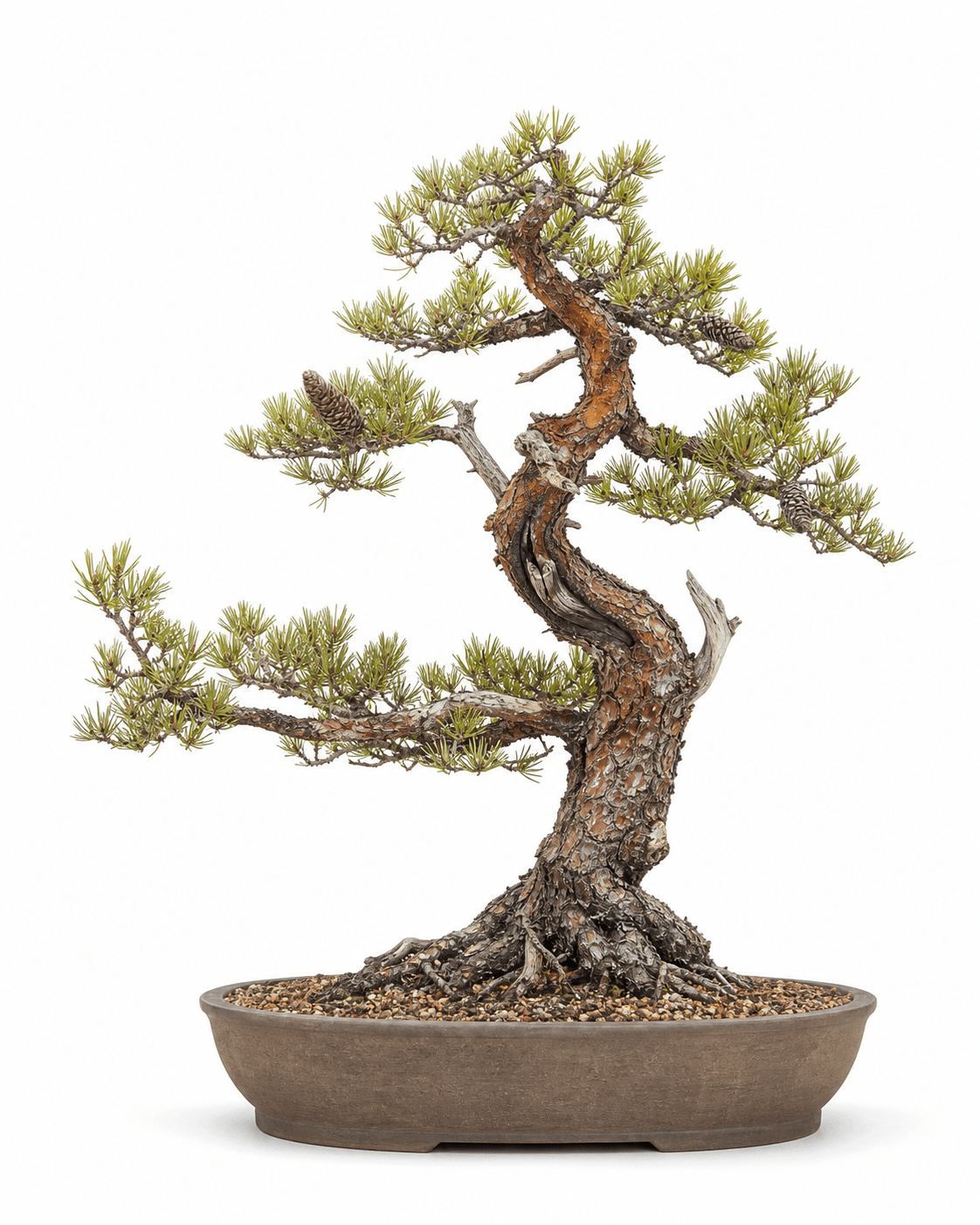
Jack pine often looks most convincing when its design accepts ruggedness. FNA describes straight to crooked trunks, irregular rounded or flattened crowns, scaly orange- to red-brown bark, and poorly self-pruning branches. Flora of North America
Bonsai design should begin with trunk line, defining branch, and apex. Choose the front that shows movement, base, deadwood, and branch hierarchy, then build a crown that supports the species character rather than a generic pine triangle. Bonsai Mirai / Asymmetry
Fire and serotiny can inform deadwood, but keep it pine-specific. Pine deadwood should feel fibrous, bark-associated, and weathered, with restraint compared with juniper deadwood. USDA Forest Service FEISBonsai Mirai Library
Forest and group plantings are credible from seedlings because Jack pine naturally forms even-aged stands after disturbance. Use varied heights and open spaces to avoid making the planting read as a nursery row. USDA Forest Service SilvicsBonsai Mirai / Asymmetry
A literati or sparse sandy-barrens image can work when the trunk already has irregular line and small foliage. Let the branch count stay low, but keep enough needle mass to support the pine. Bonsai Mirai / AsymmetryBonsai Mirai Library
Forms
Species identity and provenance matter more than named forms.
Kew lists Pinus banksiana as the accepted species and includes synonyms such as Pinus divaricata, Pinus hudsonica, Pinus rupestris, and Pinus sylvestris var. divaricata. Keep old names as aliases, not separate care calendars. Kew POWO
FNA reports no lower taxa for Pinus banksiana, while also noting hybrid swarms with Pinus contorta in western Alberta and northeastern British Columbia. That makes provenance more important than cultivar name for bonsai. Flora of North America
Landscape forms may appear in specialty conifer trade, but the bonsai decision should start with roots, buds, needle health, trunk line, and climate fit. A named dwarf without roots or interior buds is a poor bonsai candidate. Bonsai Mirai / Asymmetry
Record regional labels carefully. Scrub pine can point to different trees in different regions, and Hudson Bay pine or Banksian pine should still resolve back to Pinus banksiana before this guide is applied. USDA Forest Service SilvicsFlora of North America
History
Jack pine is a fire-adapted boreal pine with a distinct wildlife story.
Kew records Pinus banksiana Lamb. as first published in 1803. USDA Silvics describes the species as commercially important in northern forests and as the most widely distributed pine in Canada. Kew POWOUSDA Forest Service Silvics
The fire story is central. USDA FEIS calls Jack pine the boreal conifer best adapted to fire, with populations persisting through delayed seed release from serotinous cones, early reproductive maturity, fast growth in full sun, and mineral seedbed preference. USDA Forest Service FEIS
NC State notes that Jack pine provides nesting habitat for the endangered Kirtland warbler, and USDA FEIS says the species is managed to provide that habitat. Young, dense Jack pine stands are therefore more than timber ecology. NC State ExtensionUSDA Forest Service FEIS
The public Jack pine bonsai canon is much smaller than the canon around Japanese black pine or Scots pine. A strong exhibition tree should make the species readable through short paired needles, irregular boreal line, fire or sand-barrens character, and disciplined single-flush timing. Bonsai Mirai / AsymmetryFlora of North America
Species questions
Answer the beginner questions before styling.
Can Jack pine be grown as bonsai?
Yes. Jack pine can be grown as outdoor bonsai when it receives full sun, cool roots, mineral soil, staged root work, and short-needle single-flush pine timing.
Can Jack pine bonsai live indoors?
Keep Jack pine outdoors. It needs sun, airflow, seasonal temperature change, and winter dormancy, with only brief indoor display.
Should I decandle Jack pine?
Avoid routine Japanese black pine decandling. Use spring pinching only on strong refined candles, then post-flush pruning after needles harden.
When should Jack pine be pinched?
Pinch strong refined candles in spring when they have extended and needle clusters are beginning to separate. Leave weak, developing, recently repotted, and heat-stressed branches alone.
What soil works for Jack pine bonsai?
Use a fast mineral pine mix such as akadama, pumice, and lava. Adjust particle size and water retention for climate, pot depth, and old soil still inside the rootball.
How cold hardy is Jack pine bonsai?
NC State lists Jack pine for USDA Zones 2a to 7b, but bonsai roots need protection from repeated freeze-thaw, drying wind, and severe cold in shallow pots.
Why is my Jack pine yellowing in summer?
Common causes include hot roots, missed watering, compacted wet soil, needle disease, root rot, or pest pressure. Improve root-zone conditions and get local diagnosis for abnormal disease symptoms.
Is Jack pine the same as lodgepole pine?
They are separate species: Jack pine is Pinus banksiana and lodgepole pine is Pinus contorta. FNA notes hybrid swarms where their ranges overlap in western Canada, so provenance can matter.
What pests matter most for Jack pine bonsai?
Watch Jack pine budworm, redheaded pine sawfly, bark beetles, root borers, needle miners, scale, rust fungi, pine gall rust, needle cast, root rot, heart rot, and Armillaria.
What styles suit Jack pine bonsai?
Informal upright, slanting, literati, rugged boreal pine, sandy-barrens images, fire-scar deadwood, forest plantings, and small to medium two-needle pine designs suit Jack pine best.
Sources
Species advice needs source discipline.
Next decisions
Plan the operation before copying the calendar.
A good care note for Jack pine records the tree's stage, the work done, and the aftercare used. That record matters more than a month-name rule.
Related species
Compare nearby trees before transferring advice.
Scots pine
Pinus sylvestris
Mugo pine
Pinus mugo
Lodgepole / shore pine
Pinus contorta
Foxtail pine
Pinus balfouriana