
Species guide
Foxtail Pine Bonsai Care
Pinus balfouriana
Foxtail pine is an outdoor, cold-climate, five-needle California endemic. EntGrove keeps confirmed Pinus balfouriana in Pine > Short-Needle Single-Flush because its needles are short and persistent, but the Mirai corpus flags foxtail as an unsettled pine, so the safest care is conservative: preserve needle mass, keep roots oxygenated, and avoid routine decandling.
This guide uses direct Mirai mentions from five-needle post-flush, bristlecone, and slab-planting files, then grounds the species facts in Kew, Flora of North America, USDA Forest Service FEIS, USDA high-elevation white-pine materials, RHS, FWS, and the Gymnosperm Database. The practical focus is identity, northern versus southern provenance, old-needle retention, white pine blister rust, and legal sourcing from nursery or documented material.
Updated June 8, 2026. Written by EntGrove Editorial. Last verified June 8, 2026.
Care fingerprint
Read the species through its shared care pattern.
Use candle timing and bud selection carefully; compact needles do not mean the tree tolerates repeated aggressive work. Use this as the starting point before local conditions and tree strength refine the calendar.
Note: California endemic five-needle pine with short, persistent foliage; keep the short-needle single-flush placement caveated because the Mirai corpus treats foxtail technique as unsettled.
Identify flush behavior
Single-flush, multiflush, white pine, and compact pine groups have different pruning windows and different risk levels.
Avoid default decandling
Japanese black pine methods do not transfer safely to every pine, especially slow, weak, collected, or five-needle trees.
Use needles as strength data
Needle length, color, age, and density help show where vigor is strong, weak, or becoming shaded.
Care cadence
The calendar starts with the tree's seasonal state.
Placement
Timing: Grow outdoors year-round in full sun and moving air. Give the tree winter dormancy while shielding the pot from severe freeze-thaw and from summer root heat.
Watch for: Indoor wintering, warm dormancy, dense shade, black pots on paving, stagnant humid benches, and sudden lowland heat after high-elevation sourcing.
USDA Forest Service FEISRHSWatering
Timing: Soak the whole root mass, then wait for the mix to regain air. Water by the actual rootball, especially when native soil, pumice, or old nursery media dry at different speeds.
Watch for: Wet native cores, dry outer mix around a wet center, algae, sour organic pockets, and watering less just because the wild tree grows on harsh ridges.
Bonsai Mirai LibraryUSDA Forest Service High Elevation White PinesDevelopment feeding
Timing: Feed modestly to strongly only after roots are functioning. Development work should build needle mass, roots, and interior buds before refinement begins.
Watch for: Heavy fertilizer on weak collected roots, starvation after recovery starts, and spring nitrogen that lengthens needles on a tree already in refinement.
Bonsai Mirai LibraryNeedle retention
Timing: Preserve attached older needles unless they release naturally or the tree is strong enough for a deliberate cleanup. Wild foxtail can hold needles for decades.
Watch for: Stripping older needles for neatness, confusing retained old needles with poor hygiene, and removing the foliage bank before roots can replace it.
Flora of North AmericaBonsai Mirai LibrarySpring pinching
Timing: Use spring candle pinching only on strong refined material with proven response. If the tree is weak, newly collected, recently repotted, or still building structure, let candles extend.
Watch for: Treating foxtail like routine Scots pine, pinching every candle, or using a category label as permission to reduce a rare slow tree.
Bonsai Mirai LibraryPost-flush pruning
Timing: For strong refined shoots, shorten after hardening and keep living needle clusters behind every cut. For uncertain trees, defer to light cleanup and strength building.
Watch for: Cutting behind all current-year needles, removing the strongest shoots from a weak crown, or expecting reliable buds after the post-sheath window has passed.
Bonsai Mirai LibraryRepotting
Timing: Repot around spring bud movement when freeze protection is available. Keep the rootball anchored, preserve functioning roots, and convert old soil gradually.
Watch for: Bare-rooting, stacking repotting with a first styling, loose tie-downs, freezing fresh root cuts, and final-pot urgency on collected material.
Bonsai Mirai LibraryWiring
Timing: Wire only strong trees after growth hardens or in an early-fall structural window. Protect old bark, branch crotches, needles, and root anchorage.
Watch for: Needle breakage, wire bite on slow-healing bark, dramatic bends after root work, and branch placement that erases high-elevation character.
Bonsai Mirai LibraryBonsai Mirai / AsymmetryPests and disease
Timing: Inspect at purchase, after collection, in wet springs, during beetle season, and whenever one branch flags. Treat rust and root decline as serious issues.
Watch for: White pine blister rust, branch-tip dieback, cankers, pitch tubes, boring dust, needle cast, sawfly larvae, conifer aphid, pine shoot moth, honey fungus, wet-root decline, and heat stress.
USDA Forest Service FEISRHSThe Gymnosperm DatabaseSpecies guide
Apply the species profile before copying another tree's calendar.
At a glance
Foxtail pine is a rare California five-needle pine with short foliage and cautious technique.
Kew accepts Pinus balfouriana Balf. and gives the native range as California, specifically the Klamath Mountains and southern Sierra Nevada. FNA treats foxtail pine as endemic and of conservation concern. Kew POWOFlora of North America
The bonsai care headline is outdoor full sun, cold dormancy, high root oxygen, slow technique, and careful sourcing. Foxtail has short needles, but Mirai also names it among pines whose refinement behavior remains unsettled, so strong-tree evidence matters more than calendar confidence. Bonsai Mirai LibraryRHS
The page sits in Pine > Short-Needle Single-Flush because that is the current EntGrove taxonomy and because the foliage is short enough to support that care conversation. The working rule is conservative short-needle timing with five-needle restraint. Bonsai Mirai LibraryFlora of North America
Wild habitat
The wild model is open California high country, poor soils, wind, snow, and old needles.
FNA records foxtail pine in timberline and alpine meadows from 1500 to 3500 m. USDA FEIS describes two disjunct subspecies: northern foxtail in the Klamath region and southern foxtail in the high Sierra Nevada. Flora of North AmericaUSDA Forest Service FEIS
The northern trees often occupy ridge crests, mountain tops, steep south and west slopes, and serpentine or other harsh substrates. The southern trees occupy cold winter, warm dry summer Sierra sites, often on well-drained decomposed granite. USDA Forest Service High Elevation White PinesUSDA Forest Service
That ecology becomes care. A bonsai pot should drain, breathe, and stay cool at the root zone, while still receiving complete waterings. The wild tree survives harsh sites because roots, needles, and climate are in balance. Bonsai Mirai LibraryUSDA Forest Service High Elevation White Pines
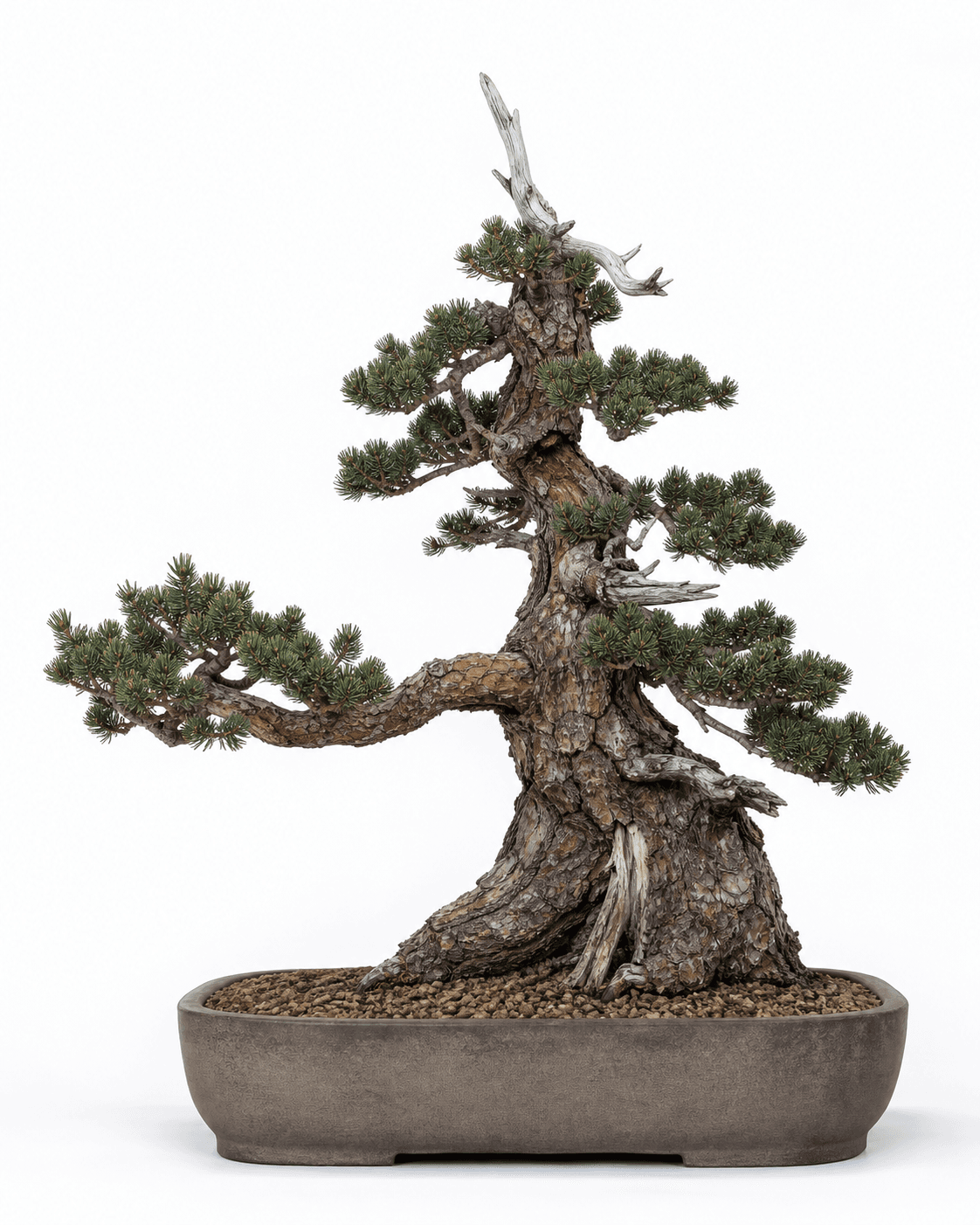
Design should begin with where the tree lives. USDA serpentine-community notes describe flattened crowns, thick branches, odd wind and snow angles, and tightly bunched bottlebrush foliage. Those details are stronger than generic pine-pad styling. USDA Forest ServiceBonsai Mirai / Asymmetry
Reading the tree
Read needle years, root recovery, provenance, and response before choosing technique.
Foxtail foliage can look static for a long time. FNA gives needle persistence of 10 to 30 years, while USDA high-elevation white-pine tables also list 10 to 30 years. Old needles are a strength bank, not clutter by default. Flora of North AmericaUSDA Forest Service High Elevation White Pines
Mirai slab-planting material notes that collected bristlecone, foxtail, and limber pines can carry decades of needles in habitat, then settle to fewer retained years after domestic roots can replenish photosynthate reliably. Bonsai Mirai Library
Development means root recovery, stable water use, strong candles, enough interior buds, and enough foliage to build vascular tissue through fall. Refinement begins only after the tree can tolerate reduction without losing the next season. Bonsai Mirai Library
Provenance is part of reading. Northern foxtail and southern foxtail differ by site, crown habit, substrate, and climate. A lowland nursery seedling, a grafted form, and a legally collected high-elevation tree should not receive identical work intensity. USDA Forest Service FEISThe Gymnosperm Database
Pine technique
Use short-needle methods only after the tree proves strength.
Mirai short-needle pine method supports spring pinching only when a single-flush tree already has strength and refinement structure. Freshly collected or recovering pines should build interior ramification and visible back budding first. Bonsai Mirai Library
Foxtail demands an extra caveat. Mirai five-needle post-flush material names foxtail among pines that do not fit cleanly into the standard long-needle single-flush refinement framework. That means each technique should start as a test on strong areas, not a whole-tree habit. Bonsai Mirai Library
If spring pinching is used, reserve it for strong refined candles that exceed the intended silhouette. Leave weak, interior, recently repotted, or development candles to extend and feed the branch. Bonsai Mirai Library
Post-flush pruning is safer than aggressive spring work for many foxtails. Shorten hardened shoots only where retained needle clusters can support new buds, and keep enough foliage around the branch to build fall vascular strength. Bonsai Mirai Library
Avoid routine Japanese black pine decandling. The reviewed corpus gives no annual foxtail decandling cycle, and old-needle, slow-response, high-elevation material can lose years of strength after one unnecessary reduction. Bonsai Mirai Library
Roots
Root work should be staged, anchored, and oxygen-focused.
Repot established foxtail around spring bud movement when aftercare can protect fresh roots from hard freeze, drying wind, and prolonged saturation. The reason should be functional: blocked percolation, soil collapse, root density, angle correction, or container transition. Bonsai Mirai Library
Collected and old nursery material should keep a functioning core while the outer soil is improved in stages. Pines depend on retained roots, microbial continuity, and firm anchoring after work. Bonsai Mirai Library
Tie-downs are part of aftercare. A moving pine tears new roots and delays recovery, so use wire, braces, bamboo, or container geometry to keep the root mass immobile. Bonsai Mirai Library
Match container size to the active root system. A dramatic collected trunk in an oversized wet box can have large soil volumes with few roots, which keeps oxygen low around the living core. Bonsai Mirai Library
Soil and pot
Use mineral oxygen and quiet containers that suit exposed high-country pine.
A useful starting mix is equal akadama, pumice, and lava with fine particles controlled. In wet climates, increase drainage and air space. In hot dry climates, protect the pot and tune particle size before simply withholding water. Bonsai Mirai Library
USDA high-elevation materials place southern foxtail on well-drained decomposed granite and northern foxtail on gabbro, granodiorite, limestone, schist, and serpentine-influenced sites. Container soil should echo drainage and mineral structure, not exact geology. USDA Forest Service High Elevation White Pines
Use unglazed stoneware, rugged ovals, rectangles with softened corners, slabs, crescent forms, and quiet gray or warm-brown clay. The container should support old bark, bottlebrush foliage, wind, rock, and snow history. Bonsai Mirai / Asymmetry
Small pots can help needle scale only after the root system and interior buds are established. During development, a slightly larger container may be the better tool because it builds strength. Bonsai Mirai Library
Climate
Cold dormancy and cool roots matter more than forcing lowland speed.
RHS rates Pinus balfouriana H7 and recommends full sun in well-drained neutral to acidic soil. The Gymnosperm Database cites USDA Zone 5 cold hardiness, while the native range is California high country rather than humid lowland woodland. RHSThe Gymnosperm DatabaseKew POWO
In cold continental regions, keep the tree dormant and protect the pot from repeated freeze-thaw, drying wind, and rootball dehydration. A cold frame should preserve winter rather than create warm storage. Bonsai Mirai Library
In maritime regions, winter aftercare often means water control. Keep the tree cold, bright, and ventilated while preventing recent root work from staying saturated for weeks. Bonsai Mirai Library
In hot lowland regions, root heat and weak winter dormancy are the main limits. Use morning sun, pot shade, airflow, and careful species selection rather than pushing a high-elevation pine through warm nights. USDA Forest Service High Elevation White PinesBonsai Mirai Library
Pests and disease
Watch rust, insects, root oxygen, and climate stress.
USDA FEIS notes white pine blister rust in northern foxtail populations and says infection can kill cone-bearing branch tips. The Gymnosperm Database also discusses blister rust as an introduced disease affecting this and other white pines. USDA Forest Service FEISThe Gymnosperm Database
RHS lists possible adelgids, conifer aphid, sawfly larvae, pine shoot moth, honey fungus, and needle cast diseases. In bonsai, inspect more often after purchase, root work, heat, wet springs, and unexplained branch flagging. RHS
Look for orange rust signs, swollen cankers, tip dieback, pitch tubes, boring dust, abnormal needle cast, mite-like stippling, sour soil, and one-sided decline. Quarantine suspect five-needle pine material until the problem is identified. USDA Forest Service FEISRHS
The common cultivated failure is cultural: wet old cores, low oxygen, warm roots, overwork, or drought followed by saturation. Correct horticulture before repeating broad pesticide or fungicide treatments. Bonsai Mirai Library
Wiring
Wire for wind, snow, and bottlebrush foliage rather than polished pine pads.
USDA serpentine-community notes describe branches growing at odd angles from lifelong exposure to wind and heavy snow. That is a design clue. Foxtail styling can keep asymmetry and branch irregularity without making the tree look neglected. USDA Forest ServiceBonsai Mirai / Asymmetry
Wire only when roots and branches are strong enough. Support branch shoulders, distribute bends, protect old bark, and avoid twisting tight bends into one small section of slow-healing wood. Bonsai Mirai Library
Needles cluster densely around shoot tips, so wiring can crush the foliage that funds recovery. Work slowly, lift shoots rather than combing them flat, and check wire before swelling marks old bark. Flora of North AmericaBonsai Mirai Library
Major bends belong in a staged plan. Separate heavy wiring from repotting, major foliage reduction, and first styling on collected material. Bonsai Mirai Library
Propagation
Seed and grafting are the realistic routes; collection requires documentation.
FNA records two-year cones, winged seeds, and no lower taxa in its treatment. USDA high-elevation materials list wind as primary seed dispersal and seed maturity commonly taking 20 to 50 years in high-elevation white pines. Flora of North AmericaUSDA Forest Service High Elevation White Pines
RHS lists seed, semi-ripe cuttings, hardwood cuttings, and grafting as propagation routes. For bonsai, seed and grafted specialty material are more realistic than relying on cuttings from old wood. RHS
Grafted plants need inspection. Check graft union, rootstock vigor, reverse taper, needle mismatch, and whether the upper tree can develop a believable old-pine base. Bonsai Mirai Library
Collected material should have clear legal provenance and visible recovery history. A rare high-elevation trunk with weak roots is a conservation and horticulture risk. Kew POWO general informationFlora of North AmericaBonsai Mirai Library
Sourcing
Buy identity, roots, and provenance before age or drama.
Start with the scientific name. Foxtail pine is Pinus balfouriana. FWS also records foxtailed pine, and FNA discusses historic subsp. austrina labels, but bristlecone, whitebark, limber, and western white pine should stay separate until verified. U.S. Fish and Wildlife ServiceFlora of North America
Good nursery material has active buds, retained needles, a stable rootball, mineral soil or a manageable nursery core, and enough trunk movement or bark to justify the slow work. Avoid a rare label attached to weak roots. Bonsai Mirai Library
For grafted forms, inspect the union from all sides. A graft may be fine for a garden tree but visually difficult for bonsai if it creates swelling, bark mismatch, or a base that cannot be hidden. Bonsai Mirai Library
Avoid material with rust symptoms, recent heavy collection, no new root evidence, severe bark beetle signs, compact sour soil, few viable buds, or vague high-elevation pine labels. USDA Forest Service FEISRHS
Troubleshooting
Solve foxtail pine problems by symptom, cause, then fix.
Symptom: long candles with weak interiors. Likely cause: development growth without branch selection or enough light inside. Fix: build health first, then shorten only strong hardened shoots while preserving needle clusters and interior buds. Bonsai Mirai Library
Symptom: yellowing and slow branch decline after styling. Likely cause: excessive needle removal, root weakness, or unchanged watering after foliage reduction. Fix: stop refinement, protect roots, water by demand, and rebuild foliage. Bonsai Mirai Library
Symptom: one branch flags with canker or orange rust signs. Likely cause: possible white pine blister rust or related branch disease. Fix: quarantine, photograph symptoms, remove from other five-needle pines, and seek local plant-health diagnosis. USDA Forest Service FEISThe Gymnosperm Database
Symptom: blackening roots, sour smell, or stalled candles. Likely cause: wet old soil, low oxygen, or oversized recovery container. Fix: improve drainage and airflow, avoid fertilizer until roots resume, and plan staged repotting at the next safe window. Bonsai Mirai Library
Symptom: sudden needle cast or widespread discoloration. Likely cause: normal old-needle shed, needle disease, drought, heat, or root damage. Fix: compare needle age and branch pattern before treating, then correct culture and confirm disease locally. Flora of North AmericaRHS
Design
A credible foxtail design shows old California high-country exposure.
Foxtail pine earns its common name from dense bottlebrush-like needle clusters near branch ends. A design should let that texture remain readable instead of forcing every shoot into a flat, generic pad. USDA Forest Service FEISUSDA Forest Service
Use trunk line, defining branch, and apex to explain the place: ridge wind, snow load, rockfall, lightning, sparse soil, and long exposure. The best branch often carries the whole environmental story. Bonsai Mirai / AsymmetryUSDA Forest Service FEIS
Deadwood should remain pine-specific: fibrous, weathered, and restrained. USDA FEIS notes long-persisting woody debris in arid high-elevation communities, while Mirai pine deadwood method avoids juniper-style sharpening. USDA Forest Service FEISBonsai Mirai Library
Scale matters. Medium and large designs let five-needle clusters, thick old bark, broad bases, and sparse crowns read naturally. Shohin is possible only with compact nursery material and careful expectations. RHSBonsai Mirai / Asymmetry
Forms
Separate accepted species, historic subspecies labels, and garden forms.
Kew accepts Pinus balfouriana as the species and treats subsp. austrina and var. austrina as synonyms. FNA reports no lower taxa in its treatment while discussing the genetic and morphological distinction of southern plants. Kew POWOFlora of North America
USDA FEIS and USDA high-elevation materials still use northern foxtail and southern foxtail as practical ecology labels. Keep those labels because they help with climate, substrate, and growth-habit expectations. USDA Forest Service FEISUSDA Forest Service High Elevation White Pines
The Gymnosperm Database notes Spingarn Form as a cultivar or form in the broader horticultural record. Specialty nursery names should be treated as material notes until the plant proves roots, buds, and bonsai structure. The Gymnosperm Database
Foxtail, Great Basin bristlecone, Rocky Mountain bristlecone, whitebark, and limber pine overlap in five-needle high-elevation language. Use cones, range, needle resin details, bark, provenance, and scientific-name records to separate them. Flora of North AmericaUSDA Forest Service High Elevation White Pines
History
Foxtail pine is a paleoendemic high-elevation tree with an ancient-tree aura.
USDA serpentine-community materials describe the two foxtail subspecies as paleoendemics: formerly broader lineages now confined to separated California mountain regions. The Klamath and Sierra populations are more than 300 miles apart. USDA Forest Service
USDA FEIS records foxtail as very long-lived, with an oldest recorded southern foxtail around 3400 years as of the 2004 review. It grows faster and decays sooner than Great Basin bristlecone on wetter sites, but still belongs in the ancient high-elevation pine conversation. USDA Forest Service FEIS
The Gymnosperm Database says the tree was named for John Balfour, a patron of plant collector John Jeffrey, and places foxtail within an ancient Balfourianae section with fossil relatives from western North America. The Gymnosperm Database
Public bonsai documentation is much thinner than for Japanese black pine, Japanese white pine, or Scots pine. A strong foxtail bonsai should therefore be transparent about source depth, conservative in technique, and visually faithful to exposed California high country. Bonsai Mirai LibraryBonsai Mirai / Asymmetry
Species questions
Answer the beginner questions before styling.
Can foxtail pine be grown as bonsai?
Yes. Foxtail pine can be grown as an advanced outdoor bonsai when it has full sun, cold dormancy, high-oxygen mineral soil, protected roots, legal sourcing, and conservative pine timing.
Can foxtail pine bonsai live indoors?
Keep foxtail pine outdoors. It needs sun, airflow, seasonal change, and cold dormancy, with only brief indoor display.
Is foxtail pine a short-needle single-flush pine?
EntGrove places Pinus balfouriana in Pine > Short-Needle Single-Flush for navigation, but Mirai flags foxtail technique as unsettled. Use short-needle methods cautiously and only on strong refined material.
Should I decandle foxtail pine?
Avoid routine decandling. The reviewed Mirai corpus gives no annual foxtail decandling cycle, so needle preservation and conservative post-hardened work are safer.
When should foxtail pine be pinched?
Pinch only strong refined candles in spring after the tree has proven reliable response. Leave weak, developing, newly collected, or recently repotted areas alone.
Why does foxtail pine keep so many old needles?
Old-needle retention is normal. FNA and USDA high-elevation materials record foxtail needles persisting 10 to 30 years, and Mirai notes old collected foxtail can shed back after domestic roots recover.
What soil works for foxtail pine bonsai?
Use a high-oxygen mineral pine mix such as equal akadama, pumice, and lava, with fine particles controlled and water retention adjusted for climate and pot depth.
How cold hardy is foxtail pine bonsai?
RHS rates Pinus balfouriana H7, and the Gymnosperm Database cites USDA Zone 5 hardiness. Potted roots still need protection from severe freeze-thaw and winter drying.
What pests and diseases matter most?
Watch white pine blister rust, adelgids, conifer aphid, sawfly larvae, pine shoot moth, honey fungus, needle cast, beetle signs, root decline, and heat or wet-soil stress.
Is collecting foxtail pine ethical?
Use nursery-grown, grafted, or legally documented material only. Foxtail pine is endemic and of conservation concern, so undocumented collection is a serious sourcing red flag.
Sources
Species advice needs source discipline.
Next decisions
Plan the operation before copying the calendar.
A good care note for Foxtail pine records the tree's stage, the work done, and the aftercare used. That record matters more than a month-name rule.
Related species
Compare nearby trees before transferring advice.
Scots pine
Pinus sylvestris
Mugo pine
Pinus mugo
Lodgepole / shore pine
Pinus contorta
Jack pine
Pinus banksiana