
Species guide
Japanese Red Pine Bonsai Care
Pinus densiflora
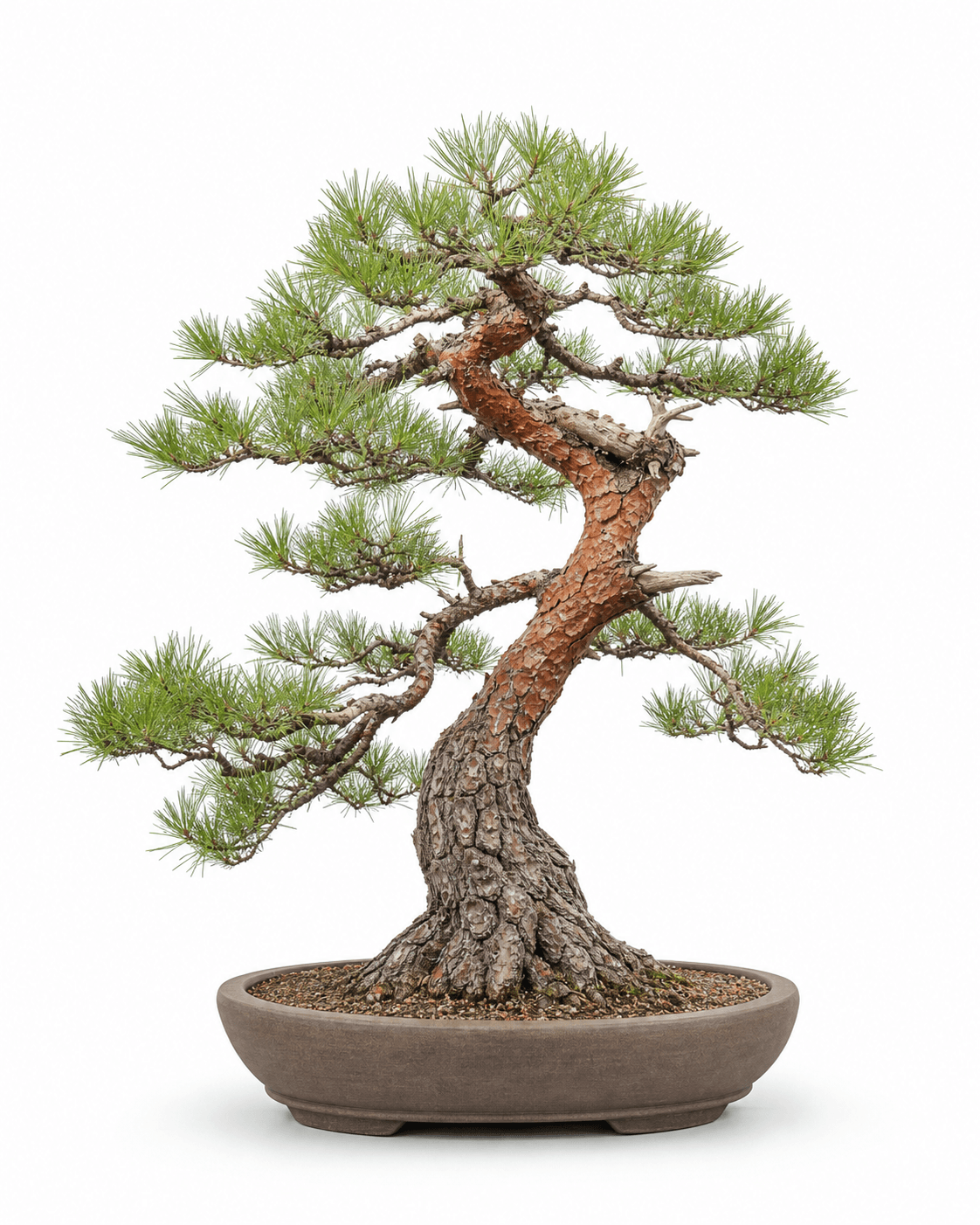
Japanese red pine is an outdoor, cold-dormant, two-needle pine with orange-red bark, softer needles, and a looser branch character than Japanese black pine. Treat confirmed Pinus densiflora as Pine > Multiflush: decandling can create a second flush on strong refinement-stage trees, while development trees should keep enough candles and needles to build structure.
The core care difference from black pine is restraint. Mirai red-pine guidance keeps more needle pairs on Pinus densiflora, avoids brittle-wood bends, and styles the tree around its softer akamatsu line rather than forcing it into a dense black-pine silhouette.
Updated June 7, 2026. Written by EntGrove Editorial. Last verified June 7, 2026.
Care fingerprint
Read the species through its shared care pattern.
Time decandling by species, climate, and strength; a weak multiflush pine should still be treated conservatively. Use this as the starting point before local conditions and tree strength refine the calendar.
Identify flush behavior
Single-flush, multiflush, white pine, and compact pine groups have different pruning windows and different risk levels.
Avoid default decandling
Japanese black pine methods do not transfer safely to every pine, especially slow, weak, collected, or five-needle trees.
Use needles as strength data
Needle length, color, age, and density help show where vigor is strong, weak, or becoming shaded.
Care cadence
The calendar starts with the tree's seasonal state.
Placement
Timing: Grow outdoors year-round in full sun and moving air, with container root protection in severe freezes and light afternoon moderation in hot inland summers.
Watch for: Indoor culture, weak light, warm winter storage, hot black benches, stagnant humid corners, and cold dry wind on a recently worked tree.
RHSMissouri Botanical GardenBonsai Mirai LibraryWatering
Timing: Water the whole root mass, then let oxygen return before the next watering. A root-bound or nursery-soil core may need slower soaking so water reaches the center.
Watch for: Dry pockets, sour wet cores, weak candles after a hot week, runoff around old soil, and using drought as a needle-shortening technique.
Missouri Botanical GardenUF/IFAS ExtensionBonsai Mirai LibraryDevelopment feeding
Timing: Feed strongly while building trunk, roots, sacrificial growth, and primary branches. Development zones can carry longer candles while refinement zones are kept tighter.
Watch for: Trying to refine before the branch structure exists, cutting every candle on a tree that still needs trunk or branch extension, and starving a weak lower branch.
Bonsai Mirai LibraryRefinement feeding
Timing: For a tree scheduled for early-summer decandling, Mirai multi-flush guidance feeds strongly in spring and stops the final fertilizer roughly four weeks before the cut.
Watch for: Residual nitrogen that makes the second flush coarse, no spring feeding before a planned decandling, and treating a weak tree as refinement material.
Bonsai Mirai LibraryDecandling
Timing: Use the early-summer multi-flush window only on strong refinement areas. Cut candles uniformly in the chosen area and leave a few millimeters of green tissue at the base.
Watch for: Recently repotted roots, weak or bare-base candles, partial decandling that fails to reset energy, and copying a calendar without enough season for the second flush to harden.
Bonsai Mirai LibraryNeedle plucking
Timing: Use needle distribution to balance strength. Mirai red-pine guidance leaves roughly 12 to 15 needle pairs per shoot on Pinus densiflora, more than black pine, because the needles are thinner.
Watch for: Dropping below the 10 to 12 pair safety floor, removing every older needle, stripping only undersides, and cutting needles in the season before or after repotting.
Bonsai Mirai LibraryFall shoot selection
Timing: After the second flush hardens, reduce crowded junctions to two useful shoots, or leave extra shoots only on weak branches that need more needle mass.
Watch for: Three or more shoots swelling a junction, flush cuts made with heavy shears, over-plucked lower branches, and late work followed by unprotected hard freezes.
Bonsai Mirai LibraryRepotting
Timing: Repot in spring as candles begin to move and warm root recovery is available. Stage old nursery soil instead of bare-rooting the whole pine at once.
Watch for: Loose tie-downs, old organic cores, major top reduction in the same season, needle pruning around the repot year, and wet cold aftercare.
Bonsai Mirai LibraryRHSWiring
Timing: Wire only when the tree is strong and branches can be checked often. Red pine wood is brittle in the Mirai corpus, so use smaller bends, better anchoring, and staged movement.
Watch for: Large single-session bends, twisting older branches, wire bite during active growth, damaged new candles, and forcing red pine into tight black-pine pad geometry.
Bonsai Mirai LibraryPests and disease
Timing: Inspect during spring candle growth, humid needle-cast weather, drought stress, and after heat or root stress. Keep weak trees out of refinement cycles until symptoms are understood.
Watch for: Adelgids, aphids, pine sawfly, pine shoot moth, occasional scale, mites, needle cast, rust, canker, pine wilt nematode risk, and resinous shoot damage.
RHSUF/IFAS ExtensionBMC ProceedingsSpecies guide
Apply the species profile before copying another tree's calendar.
At a glance
Japanese red pine is the softer multi-flush pine.
Kew accepts Pinus densiflora Siebold & Zucc. and gives the native range as the southern Russian Far East to Korea and central to southern Japan. RHS lists Japanese red pine as a correct name in Pinaceae, with evergreen foliage and Japan plus Korea as its plant range. Kew POWORHS
For bonsai, the category is Pine > Multiflush. Mirai dedicated red-pine guidance groups Pinus densiflora with Pinus thunbergii for early-summer decandling, but it keeps more needles on red pine and treats the wood as more brittle. Bonsai Mirai Library
The practical care spec is outdoor full sun, thorough watering followed by root oxygen, well-drained mineral soil, spring repotting, strong candles before decandling, fall shoot selection after the second flush hardens, and design that preserves the loose red-bark character. Bonsai Mirai LibraryMissouri Botanical GardenRHS
Wild habitat
Its wild story is temperate light, poor ground, red bark, and open branching.
Kew places the species in a temperate biome, and Missouri Botanical Garden describes Japanese red pine on rocky slopes, hillsides, and lakeshores in Japan, Korea, northeastern China, and far southeastern Russia. Kew POWOMissouri Botanical Garden
Missouri Botanical Garden describes the habit as irregular but graceful, often multi-trunked at the base, with broad-rounded shape, horizontal branches, and a flattened mature crown. NC State also emphasizes widespread arched branches, plumes of green needles, and orange to orangish-red peeling bark. Missouri Botanical GardenNC State Extension
Care follows the habitat by favoring sun, drainage, and air. Well-drained soil appears across RHS, Missouri Botanical Garden, Purdue, and UF/IFAS, so a bonsai pot should support full hydration without a stagnant center. RHSMissouri Botanical GardenPurdue Arboretum ExplorerUF/IFAS Extension
Design follows the same ecology. Use the crooked trunk, orange-red upper bark, horizontal reach, and softer crown as source material for an open old-pine image rather than a dense, heavily tiered black-pine shape. Bonsai Mirai / AsymmetryNC State ExtensionMissouri Botanical Garden
Reading the tree
Read candle strength, needle mass, old needles, and branch brittleness before choosing work.
Mirai red-pine guidance gives the same readiness signal as other multi-flush pines: current-year candles must show that the root system has recovered. Strong elongating candles and a relatively even needle distribution allow the tree to re-enter refinement. Bonsai Mirai Library
Needle mass is the energy map. Mirai teaches that apical dominance in pines is functionally tied to needle quantity, because needles drive transpiration, photosynthesis, and root-fed resource movement. Bonsai Mirai Library
Older needles remain valuable. Mirai multi-flush guidance warns against removing all second-year needles and uses third-year needle tissue as potential back-budding support on bare branches. Bonsai Mirai Library
The species-specific warning is wood quality. Mirai describes Pinus densiflora as brittle compared with black pine, so branch placement starts with bend safety, branch selection, and staged movement rather than force. Bonsai Mirai Library
Technique
Decandle only strong refinement zones, then use needle count to balance red pine.
Decandling red pine belongs in early summer after the second-flush window opens. Mirai says the operation resets the energy system in refinement areas, and needle distribution becomes the lever for balancing vigor. Bonsai Mirai Library
Uniformity matters. Mirai red-pine guidance cuts every candle in the chosen refinement area, including strong, medium, weak, and unemerged buds, because selective candle-length pruning does not reliably balance multi-flush pine strength. Bonsai Mirai Library
The cut is precise. Leave only a few millimeters of green candle at the base so adventitious buds are preserved, while avoiding a long stub that pushes new shoots outward. Bonsai Mirai Library
The red-pine needle target is higher than black pine. Mirai gives roughly 12 to 15 needle pairs per shoot on Pinus densiflora, compared with roughly 10 to 12 on Pinus thunbergii, because red-pine needles are thinner and produce less surface area per pair. Bonsai Mirai Library
Keep laterally placed needles when choosing bud positions. Remove needles from the top and bottom of a shoot first, then retain alternating lateral pairs so future buds emerge in positions that can become usable branches. Bonsai Mirai Library
Development branches get different treatment. If a branch needs extension, leave its candle intact during decandling, remove all but two candles at a fork, then make the length cut in August so buds form near the cut site. Bonsai Mirai Library
Roots
Repot red pine as a root-energy decision, then leave the needles alone while it recovers.
Repot in spring as candles begin to move and the tree can rebuild fine roots. Mirai black-pine and multi-flush pine method uses candle movement and root recovery as the timing signal, not a fixed date. Bonsai Mirai Library
The root system needs both water and oxygen. Public plant sources repeatedly call for well-drained soil, and Mirai pine method ties recovery to a functioning root system supplied by adequate needle mass. RHSMissouri Botanical GardenBonsai Mirai Library
Stage old soil conversion. Nursery material may have a dense organic center or field soil that does not rewet evenly. Remove the limiting portion first, keep enough working roots, and tie the tree firmly so new roots are not torn. Bonsai Mirai LibraryUF/IFAS Extension
Avoid needle pruning in the season immediately before or after repotting. Mirai warns that severed water columns between roots and needle tips have not healed, which raises dieback risk. Bonsai Mirai Library
Soil and pot
Use a sharp pine soil and a pot that supports the softer akamatsu image.
Start with a mineral pine mix such as akadama, pumice, and lava in roughly equal parts. Adjust sharper with more pumice or lava in cool wet gardens, and hold a little more akadama where hot summers and frequent watering dry the pot too fast. Bonsai Mirai Library
Particle choice should solve the actual root problem. Refinement trees need even moisture and air through a smaller root mass; development trees may need a larger container, coarser particles, and stronger feeding while trunk and branch structure are built. Bonsai Mirai Library
Purdue and UF/IFAS both mention slightly acidic, well-drained soil, while RHS says any well-drained soil in full sun. In bonsai terms, that means drainage, root oxygen, and water quality come before a rigid recipe. Purdue Arboretum ExplorerUF/IFAS ExtensionRHS
Pot selection should leave room for the tree character. Unglazed rectangles, ovals, and soft-cornered containers can support informal upright, slanting, and multi-trunk forms; Tanyosho-style umbrella crowns often read better with a wider, quieter pot. Bonsai Mirai / Asymmetry
Climate
Cold hardiness does not remove container risk.
Landscape hardiness looks broad: Missouri Botanical Garden lists Zones 3 to 7, Purdue lists USDA Zone 3, UF/IFAS lists 3A through 7B for Aurea, and RHS gives H7. A bonsai pot exposes roots to colder, faster swings than the ground. Missouri Botanical GardenPurdue Arboretum ExplorerUF/IFAS ExtensionRHS
In cold regions, protect the container after fall shoot selection or heavy needle work because foliage reduction lowers winter sugar storage. Mirai black-pine and multi-flush pine guidance ties fall foliage mass directly to cold resilience. Bonsai Mirai Library
In hot regions, keep the foliage bright but protect roots from excessive bench heat. Missouri Botanical Garden allows some light afternoon shade in hot summer climates, which fits bonsai practice when root-zone temperature is the limiting factor. Missouri Botanical GardenBonsai Mirai Library
In wet coastal regions, stretch the watering interval only after checking the pot center. The species accepts well-drained moisture, but a compacted old core can stay wet while the surface appears ready. RHSUF/IFAS ExtensionBonsai Mirai Library
Pests and disease
Pest pressure often follows weak roots, stress, and dense needles.
RHS lists adelgids, aphids, pine sawfly, pine shoot moth, honey fungus, and needle cast diseases for Pinus densiflora. UF/IFAS adds occasional scale, bark beetles, pine needle miner, pine needle scale, pine tortoise scale, spittle bug, spruce mites, Zimmerman pine moth, pine weevils, pine wilt nematode, needle blight, rusts, canker, and needle cast. RHSUF/IFAS Extension
Pine wilt deserves separate mention because Japanese red pine is a documented host in Asia. A BMC Proceedings study describes severe damage to Japanese pine forests from pine wilt disease and the pine wood nematode, Bursaphelenchus xylophilus. BMC Proceedings
For bonsai, diagnosis starts with culture. Check whether the tree was overworked, underlit, waterlogged, drought-stressed, or recently repotted before assuming every yellow needle is a pathogen. Bonsai Mirai LibraryUF/IFAS Extension
Prevention is ordinary but strict: full sun, open air, clean benches, removal of shed needles, no decandling of weak trees, and local extension diagnosis before fungicide or insecticide use. RHSUF/IFAS ExtensionBonsai Mirai Library
Wiring
Wire for movement with brittle wood in mind.
Mirai describes Pinus densiflora wood as exceptionally brittle compared with black pine. That means red pine wiring starts with branch selection, anchoring, and modest staged bends rather than heroic single-session movement. Bonsai Mirai Library
Detail wiring is most useful after decandling when the tree is open and reduced, or after the second flush hardens and shoot selection clarifies which branches stay. Avoid wiring during spring candle elongation, because damaged candles can produce poor juvenile growth. Bonsai Mirai Library
Use wire to support the natural character: rising shoots, soft droop, open negative space, and horizontal branch reach. A red pine that is wired into rigid layered pads loses the quality that separates it from black pine. Bonsai Mirai LibraryBonsai Mirai / Asymmetry
Check wire often during warm growth. The bark is part of the appeal, and NC State plus Missouri Botanical Garden both emphasize orange-red or flaky bark that should be protected from avoidable scars. NC State ExtensionMissouri Botanical Garden
Propagation
Seed is the default, while cultivars and forms usually need grafting.
RHS and UF/IFAS both list seed propagation for Pinus densiflora. Seedlings are useful for trunk development, exposed-root experiments, and long training timelines because they start with a clean root system. RHSUF/IFAS Extension
Named forms are often nursery selections. NC State lists Aurea, Burkes Red Pine, Glitzer, Jane Kluis, Oculus Draconis, Pendula, Umbra, and Umbraculifera; UF/IFAS names Alboterminata, Oculis-draconis, and Umbraculifera. NC State ExtensionUF/IFAS Extension
Grafted material should be inspected carefully. Mirai multi-flush guidance says foliage determines metabolic behavior, but a graft union can still affect design, taper, nebari, and long-term compatibility. Bonsai Mirai Library
Air-layering is a poor default for pines. Mirai multi-flush guidance says pine air layers rarely succeed because pines callus slowly and can shed the layered section before roots form; ground-layering in a field is more reliable but slow. Bonsai Mirai Library
Buying and sourcing
Buy for roots, bark, branch safety, and accurate identity.
Confirm the label. Japanese red pine can be confused with Japanese black pine, Scots pine, American red pine, and umbrella-pine labels that may point to other genera or to Italian stone pine. Use Pinus densiflora when buying serious material. Kew POWORHSPurdue Arboretum Explorer
Nursery stock should be evaluated from the base upward: root flare, graft union if present, trunk movement, bark quality, branch positions, candle strength, and whether the old soil can be converted safely. Bonsai Mirai LibraryUF/IFAS Extension
Good pre-bonsai has many interior needles, healthy buds, flexible young shoots where future branches are needed, and enough sacrifice growth to keep development moving. A finished-looking top on poor roots is a weak purchase. Bonsai Mirai Library
Red flags include a high graft, reverse taper from whorls, brittle primary branches that require big bends, sparse bare interior shoots, compacted nursery soil, resinous pest damage, and recent heavy styling before sale. Bonsai Mirai LibraryUF/IFAS Extension
Troubleshooting
Read symptoms through roots, light, needles, and timing before adding technique.
Symptom: long weak needles and sparse interior buds. Likely cause: weak light, too much spring nitrogen on a refined tree, or not enough interior needle mass. Fix: increase outdoor light, adjust feeding, and use needle distribution only after strength returns. RHSBonsai Mirai Library
Symptom: no second flush after decandling. Likely cause: weak roots, bare-base candles, too little needle tissue, late timing, or partial work that failed to reset the tree. Fix: stop refinement, rebuild roots and foliage, then wait for strong candles. Bonsai Mirai Library
Symptom: lower branch keeps weakening. Likely cause: shade, low needle mass, or competition from a stronger branch above it. Fix: reduce the competitor, extend the weak branch, or redesign so the weak area is no longer carrying the tree. Bonsai Mirai Library
Symptom: branch cracks during styling. Likely cause: brittle red-pine wood, poor anchoring, or too large a bend. Fix: stop the bend, stabilize the branch if viable, and plan future movement through younger shoots or design selection. Bonsai Mirai Library
Symptom: yellowing and needle drop after wet weather. Likely cause: normal older needle shed, needle cast, stale roots, or waterlogged soil. Fix: check which needle age is dropping, clean debris, improve drainage and airflow, and seek local diagnosis if current needles are affected. RHSUF/IFAS Extension
Symptom: resin, shoot collapse, or holes in bark. Likely cause: shoot moth, bark beetles, borers, or stress-related secondary pests. Fix: isolate the tree, inspect shoots and bark, remove infested material where appropriate, and stabilize culture before more pruning. UF/IFAS Extension
Symptom: rapid wilt or broad browning in a region with pine wilt. Likely cause: pine wood nematode or another serious vascular problem. Fix: get local extension or plant-health diagnosis quickly and avoid moving suspect material. BMC ProceedingsUF/IFAS Extension
Design
Style red pine from softness, red bark, and open branch rhythm.
Mirai red-pine guidance says Pinus densiflora carries a softer, more pendulous aesthetic than Pinus thunbergii. The shoots often rise vertically at first, then relax into a looser line. Bonsai Mirai Library
Public plant sources reinforce that design vocabulary. NC State calls the tree picturesque, with arched branches and orange-red bark, while Missouri Botanical Garden describes crooked or leaning trunks, horizontal branching, and a flattened mature crown. NC State ExtensionMissouri Botanical Garden
The defining branch should make the softness legible. A low horizontal branch, a lifted open crown, or a multi-trunk base can all work when the trunk line and apex read as one old pine rather than separate styled parts. Bonsai Mirai / Asymmetry
Deadwood should stay restrained. Red pine design usually gains more from bark, line, and open negative space than from bright carved features. If old deadwood exists, keep it subordinate to the living trunk. Bonsai Mirai / AsymmetryBonsai Mirai Library
Forms
Tanyosho, Dragon-eye, Aurea, and weeping forms change design before they change the care class.
NC State lists several cultivar names relevant to bonsai and garden material: Aurea, Burkes Red Pine, Glitzer, Jane Kluis, Oculus Draconis, Pendula, Umbra, and Umbraculifera. NC State Extension
UF/IFAS notes Aurea Japanese red pine with yellowish foliage, reddish-orange peeling bark, and uses including bonsai and specimen planting. It also identifies Umbraculifera, often sold as Tanyosho pine, as a multi-trunked compact form. UF/IFAS Extension
Purdue lists Pinus densiflora Umbraculifera as a related dwarf Japanese red pine and describes the straight species as spreading, branched, evergreen, and notable for bark. Those clues matter when evaluating whether a compact tree is a form, cultivar, or trained nursery shape. Purdue Arboretum Explorer
Care still starts from the foliage group. A variegated, golden, umbrella, or weeping Pinus densiflora remains a red pine for multi-flush physiology, while cultivar vigor and graft status adjust how hard the tree can be worked. Bonsai Mirai LibraryNC State Extension
History
Akamatsu carries Japanese garden, architectural, and bonsai history.
Kew records Pinus densiflora as first published in Flora Japonica in 1842 and lists Japanese red pine plus aka-matsu among common-name records. The Japanese name akamatsu points directly to the red-bark identity growers value. Kew POWO
Missouri Botanical Garden notes the species as a picturesque specimen and explicitly says it is also used for bonsai. NC State tags the plant for bonsai and describes the crooked, twisted, sometimes leaning or multi-trunked form that makes older material valuable. Missouri Botanical GardenNC State Extension
Japanese red pine is culturally close to Japanese black pine, but the bonsai reading should remain distinct. Black pine often presents a stronger, denser coastal image; red pine reads more graceful, open, and bark-led. Bonsai Mirai LibraryBonsai Mirai / Asymmetry
For exhibition-quality work, the page should become more visual once founder photography exists: bark closeups, needle-count diagrams, decandling cuts, fall shoot selection, and Tanyosho versus straight-species forms all deserve original images. Bonsai Mirai Library
Species questions
Answer the beginner questions before styling.
Can Japanese red pine be grown as bonsai?
Yes. Japanese red pine is a classic outdoor bonsai pine when it receives full sun, seasonal dormancy, mineral soil, complete watering, and species-aware multi-flush timing.
Can Japanese red pine bonsai live indoors?
No. Keep Japanese red pine outdoors. Indoor display should be brief because the tree needs full sun, airflow, and winter dormancy.
Is Japanese red pine a multi-flush pine?
Yes. Mirai red-pine guidance treats Pinus densiflora as a multi-flush pine with Japanese black pine, meaning strong refinement-stage trees can be decandled to create a second flush.
How is Japanese red pine different from Japanese black pine?
Red pine has thinner needles, softer growth, more brittle wood, and a looser visual character. Mirai leaves more needle pairs on red pine and styles it with less force than black pine.
When should Japanese red pine be decandled?
Use the early-summer multi-flush window only after strong current candles prove the roots have recovered. The exact timing depends on climate, tree size, and the season left for second-flush hardening.
How many needles should be left on Japanese red pine?
Mirai red-pine guidance leaves roughly 12 to 15 needle pairs per shoot on Pinus densiflora, more than the roughly 10 to 12 pairs often used on Japanese black pine.
What soil works for Japanese red pine bonsai?
Use a well-drained mineral pine mix such as akadama, pumice, and lava, adjusted to climate. The rootball should wet fully and then regain oxygen.
How cold hardy is Japanese red pine bonsai?
Landscape sources list broad cold hardiness, including USDA Zones 3 to 7 or RHS H7. Bonsai roots are less insulated than landscape roots and need protection in severe freezes.
What is Tanyosho pine?
Tanyosho usually refers to Pinus densiflora Umbraculifera, an umbrella-headed, often multi-trunked Japanese red pine form. Treat it as red pine while adjusting design to its compact habit.
What pests and diseases affect Japanese red pine bonsai?
Watch adelgids, aphids, sawfly, shoot moth, scale, mites, bark beetles, needle cast, rust, canker, honey fungus, and pine wilt risk where present. Stabilize culture before advanced techniques.
Sources
Species advice needs source discipline.
Next decisions
Plan the operation before copying the calendar.
A good care note for Japanese red pine / akamatsu records the tree's stage, the work done, and the aftercare used. That record matters more than a month-name rule.
Related species