
Species guide
Japanese White Pine Bonsai Care
Pinus parviflora
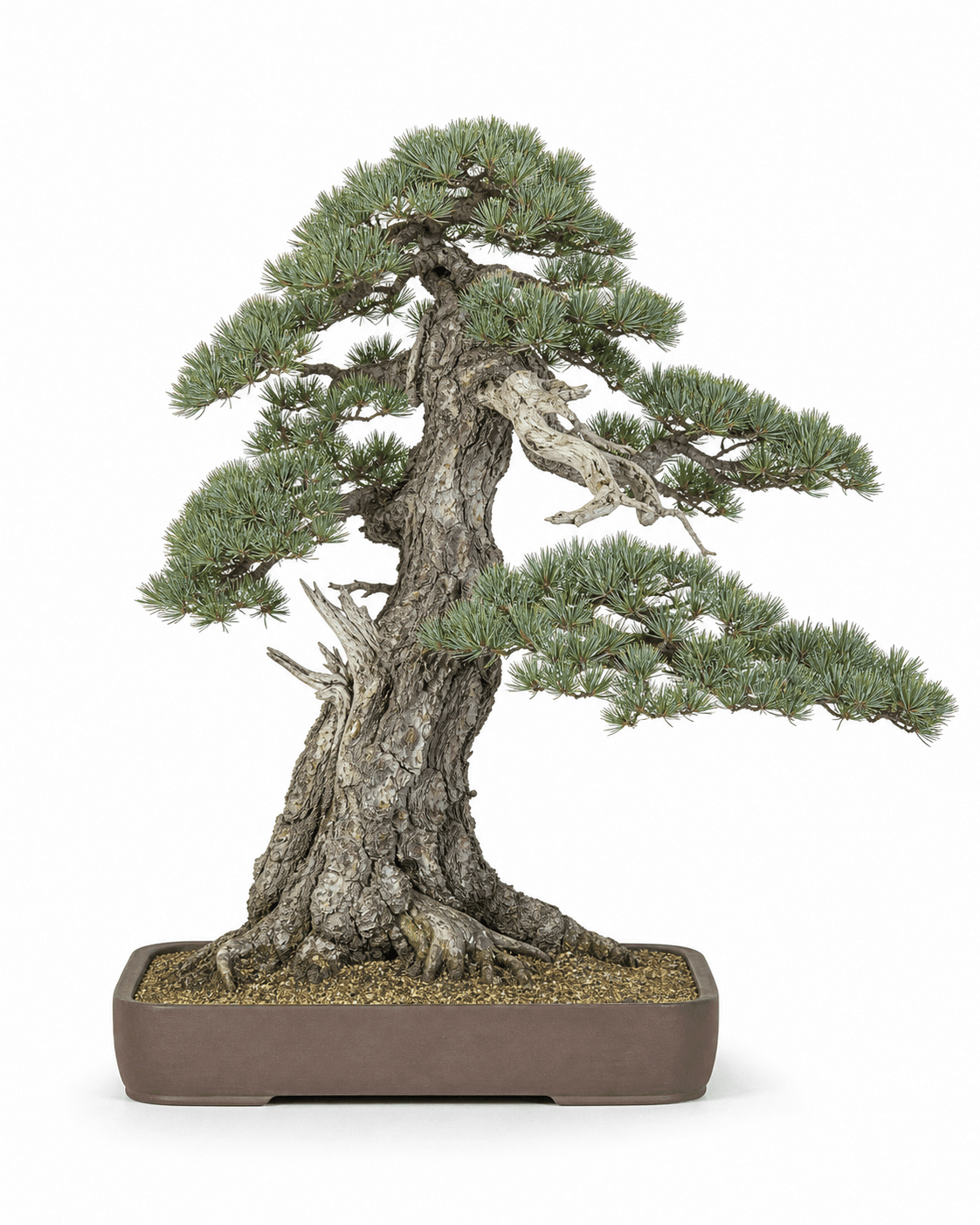
Japanese white pine, Pinus parviflora, is an outdoor five-needle pine for growers who can provide full sun, cold dormancy, and a root system that dries back fast enough for oxygen. The species rewards patience: the safest work is staged around sheath-drop pruning, conservative roots, and long recovery margins.
EntGrove currently files Japanese white pine under Pine > Outlier Pine as a safety warning against black-pine calendars, while the Mirai corpus treats standard Pinus parviflora technique as five-needle long-needle single-flush work. Avoid spring candle pinching and black-pine decandling unless a cultivar-specific source and tree response support a different plan.
A good beginner result depends on environment more than enthusiasm. Keep the tree outdoors, preserve enough needles to drive roots and back buds, water completely followed by oxygen return, and separate repotting, wiring, pruning, and heavy styling into different recovery windows.
Updated July 12, 2026. Written by EntGrove Editorial. Last verified July 12, 2026.
Care fingerprint
Read the species through its shared care pattern.
Protect older needles, avoid aggressive decandling assumptions, and adjust work to slow recovery, rare outlier decandling, and species-specific bud behavior. Use this as the starting point before local conditions and tree strength refine the calendar.
Identify flush behavior
Single-flush, multiflush, white pine, and compact pine groups have different pruning windows and different risk levels.
Avoid default decandling
Japanese black pine methods do not transfer safely to every pine, especially slow, weak, collected, or five-needle trees.
Use needles as strength data
Needle length, color, age, and density help show where vigor is strong, weak, or becoming shaded.
Care cadence
The calendar starts with the tree's seasonal state.
Placement and dormancy
Timing: Grow outdoors year-round in full sun and moving air. Use brief indoor display only after watering, then return the tree outside.
Watch for: Warm indoor winter rooms, no true cold rest, weak interior buds, leggy needles, drying wind on frozen pots, and hot benches that outpace root water movement.
Bonsai MiraiEisei-enNC State ExtensionLight and heat
Timing: Use full sun for compact needles and strong buds, then moderate afternoon heat when temperatures or reflected surfaces exceed the tree root system.
Watch for: Leggy needles, weak interior buds, foliage that cannot keep up with water demand, and sustained heat above about 100 F without shade or root protection.
Bonsai MiraiEisei-enNC State ExtensionWatering
Timing: Saturate the whole root ball during each watering, then let the pot dry enough for oxygen to return before the next watering.
Watch for: Permanent moisture, fine particles, compacted soil, dry pockets, high-pH or hard-water yellowing, and yellow needles tied to root oxygen rather than fertilizer shortage.
Bonsai MiraiEisei-enBonsai Mirai LibraryDevelopment feeding
Timing: Feed development trees from spring through fall after growth is active, preserving long shoots and needle mass to build roots, vascular tissue, and interior buds.
Watch for: Underfed trunk-building trees, early cutback before interior buds become branches, and choosing short needles before the tree has enough structure.
Bonsai Mirai LibraryEisei-enRefinement feeding
Timing: On refined trees, withhold spring fertilizer during candle elongation, resume after sheath drop or hardening, and adjust for heat above about 95 F.
Watch for: Long internodes from spring feeding, weak refined trees that need rebuilding, and fertilizer timing copied from Japanese black pine decandling programs.
Bonsai Mirai LibraryBonsai MiraiEisei-enSheath-drop pruning
Timing: Let spring candles elongate fully. Prune standard five-needle white pine after papery sheaths drop and needles harden, often in early summer, while leaving current-year needles on retained shoots.
Watch for: Spring pinching, total candle removal, cutting behind all new needles, pruning weak branches like strong branches, and expecting a second flush.
Bonsai Mirai LibraryBonsai MiraiEisei-enRepotting
Timing: Repot in spring before or as buds move, adjusted for local aftercare. Preserve functioning roots, mycorrhizal continuity, and some old core while moving toward open soil.
Watch for: Bare-rooting, washing roots, repeated exploratory slip-potting, loose tie-downs, cold wet aftercare, and wiring or pruning immediately after root work.
Bonsai MiraiEisei-enBonsai Mirai LibraryWiring and structural work
Timing: Wire from sheath drop onward for light work, with fall as the prime window for heavier structure once vascular resources are moving rootward.
Watch for: Brittle older branches, hidden graft-union swelling, damaged back buds, wire left into swelling growth, and bends attempted on trees with weak roots.
Bonsai Mirai LibraryBonsai MiraiEisei-enWinter protection
Timing: Keep the tree dormant outdoors, then protect container roots during hard freezes, drying wind, and freeze-thaw cycles.
Watch for: Warm-winter climates with insufficient dormancy, fall-pruned trees entering severe cold with low foliage mass, and frozen small pots exposed above ground.
Bonsai MiraiNC State ExtensionBonsai Mirai LibraryPests and root problems
Timing: Inspect opening candles in spring, older needles after hardening, roots at repotting, and foliage color whenever water or pH changes.
Watch for: Woolly adelgid, aphids, borers, caterpillars, mealybugs, weevils, tip blight, needle cast, rust, root rot, and hard-water chlorosis.
Bonsai MiraiEisei-enNC State ExtensionSpecies guide
Apply the species profile before copying another tree's calendar.
At a glance
Japanese white pine is a cold-dormant five-needle pine built through restraint.
Pinus parviflora is an evergreen pine in Pinaceae. Kew accepts the name, lists the native range as South Korea, the southern Kuril Islands, and Japan, and treats it as a temperate tree. Kew POWO
The practical spec is narrow: outdoor sun, cold winter rest, open mineral soil, complete watering followed by oxygen return, careful heat moderation, and slow work. NC State lists slow growth, good drainage, full sun, Zones 4a-7b, five-needle foliage, and cultivars that include Kokonoe, a bonsai favorite. NC State ExtensionOregon State Landscape Plants
The bonsai method is five-needle single-flush pine work. Let spring candles harden, prune after sheath drop when the tree has useful energy, preserve enough new needles for buds and roots, and keep black-pine decandling out of the standard plan. Bonsai Mirai LibraryBonsai MiraiEisei-en
The current EntGrove route places Japanese white pine in the Outlier Pine hub because beginner searches often compare it with black pine and pinyon-style exceptions. The technique language on this page names the more precise physiology: standard Pinus parviflora behaves as a long-needle single-flush five-needle pine. Bonsai Mirai Library
Native habit
Its wild image is temperate mountain softness, gray bark, and restrained strength.
Kew gives a temperate East Asian native range, and NC State describes a tree that becomes broad, spreading, picturesque, and flat-topped with age. Oregon State notes a generally conical to broad-conical evergreen habit with five-needle foliage and a strong bonsai reputation. Kew POWONC State ExtensionOregon State Landscape Plants
Translate that habitat into care by respecting low water mobility. A container tree cannot draw from a mountain root system, so the grower must provide full hydration, fast oxygen return, cool roots where summers are harsh, and true winter cold. Bonsai MiraiBonsai Mirai Library
Translate it into design by making the species look like a white pine rather than a miniature black pine. The Mirai design corpus describes white-pine branch language as softer, more rounded, and more open, with smooth arcs and billowy five-needle tufts rather than hard paired-needle density. Bonsai Mirai LibraryBonsai Mirai / Asymmetry
Energy
Read branch stage before pruning: development, pushback, refinement, or recovery.
Five-needle pine work is branch-specific. A single tree can carry development branches that need elongation, secondary branches that need pushback, tertiary refined branches that can be shortened, and weak branches that should simply gather foliage. Bonsai Mirai Library
Back budding is built through needle mass, fall vascular thickening, and root strength. Cutting every long shoot because the tree looks untidy can spend the very foliage that would have created future interior buds. Bonsai Mirai Library
Refinement begins when interior buds have become real transpiring shoots. Mirai gives a practical threshold for long-needle single-flush pines: build the new bud into a branch roughly half the parent diameter before cutting back to it. Bonsai Mirai Library
Recovery has its own reading. A recently repotted, water-stressed, pest-hit, or warm-winter-weakened white pine should rebuild roots and needles before styling. Mirai specifically cautions that water-oxygen decline is solved through culture, not by stacking repotting, pruning, pinching, or wiring. Bonsai Mirai LibraryBonsai Mirai
Technique
Sheath drop is the central white-pine pruning signal.
The spring candle should fully elongate. When the papery sheath at the base of each five-needle cluster dries and drops, the needle cluster has hardened, elongation has stopped, and refined white-pine pruning becomes useful. Bonsai Mirai LibraryBonsai Mirai
For standard long-needle Pinus parviflora, avoid pinching elongating spring candles. Mirai files explain the consequence clearly: the remaining needles on a pinched long-needle single-flush pine can elongate excessively and become visually unusable. Bonsai Mirai Library
When shortening a current-year shoot, leave at least one cluster of new needles. Buds form from the retained needle cluster; cutting behind all current-year needles leaves a dead tip rather than a new bud site. Bonsai Mirai LibraryEisei-en
Strength balancing is achieved by reductive pruning of stronger shoots, selective retention of weaker shoots, and conservative cleanup. Needle plucking is limited to old or bottom-facing needles that block light and air, never used as a black-pine-style energy-balancing habit. Bonsai Mirai Library
Dwarf cultivars can be exceptions. Mirai separates Zuisho and Kokonoe from standard long-needle behavior because their genetic dwarfism can allow pinching without the same needle-length penalty. Confirm cultivar identity and vigor before applying that exception. Bonsai Mirai LibraryNC State Extension
Roots
Repot to improve oxygen while preserving the pine root system.
Mirai public guidance repots white pine in spring before buds move, often January or February in many Northern Hemisphere settings. Eisei-en gives the same principle through a later signal: spring as buds begin to swell, commonly March. Bonsai MiraiEisei-en
The date is secondary to roots and aftercare. A white pine with weak buds, poor drainage, low needle mass, or limited post-work protection should wait. A healthy tree with stable weather and a clear root problem can be moved toward better soil. Bonsai Mirai LibraryBonsai Mirai
Conservative root continuity matters. Leave functioning old core under the trunk where needed, preserve mycorrhizal contact, avoid washing roots, and secure the tree firmly so new roots are not torn by trunk movement. Bonsai Mirai LibraryEisei-en
After root work, skip refinement stress until recovery is visible. A recently repotted white pine needs foliage to drive water movement and roots, so pruning, wiring, and styling should be scheduled after the tree proves it has reconnected. Bonsai Mirai LibraryBonsai Mirai
Soil and pot
The soil target is oxygen first, then water retention tuned to climate.
Mirai's white-pine baseline is equal parts akadama, pumice, and lava, sifted to retain roughly 1/8 to 1/4 inch particles. The removed fine fraction matters because small particles hold water and reduce oxygen in a species with low water mobility. Bonsai MiraiBonsai Mirai Library
Eisei-en gives a similar 1:1:1 akadama, lava, and pumice mix and about 3/16 inch, or 4 mm, particles for medium and large trees, with smaller particles for shohin. The shared principle is free drainage with enough moisture to hydrate the full root mass. Eisei-en
Pot choice should support the image without compromising roots. White pine often reads well in understated unglazed containers, soft rectangles, ovals, semi-cascade pots, or rugged quiet clay that reinforces age. Depth should protect roots enough for the local winter and summer, especially on own-root trees. Bonsai Mirai LibraryBonsai Mirai / Asymmetry
Grafted trees add another potting consideration. A low, swollen, or visually jarring graft union can dominate the base, while a higher discreet union can be hidden in composition. Choose front, soil line, and container depth after inspecting the graft from every side. Bonsai Mirai Library
Climate
Japanese white pine wants cold dormancy and moderated heat.
NC State notes that the heat and humidity of the deep South are poor matches for healthy landscape culture, while Mirai warns that warm-winter climates exhaust white pine over several years by denying adequate dormancy. NC State ExtensionBonsai MiraiBonsai Mirai Library
In hot climates, keep the foliage bright but protect the root system and afternoon exposure when water mobility becomes the limit. Mirai's public care guide gives a practical threshold: above 100 F, use about 30 percent shade cloth for extreme heat. Bonsai MiraiEisei-en
In cold climates, keep dormancy but protect the container. NC State and Oregon State describe cold-hardy landscape trees, yet a bonsai pot exposes fine roots to freeze, wind, and thaw cycles. Set pots on the ground, mulch, or use an unheated shelter when deep cold threatens. NC State ExtensionOregon State Landscape PlantsBonsai Mirai Library
In mild coastal climates, watch dormancy quality rather than winter calendar labels. The Mirai corpus includes cases where Japanese white pine struggles in mild Mediterranean coastal conditions because the tree needs meaningful winter cold to thrive. Bonsai Mirai Library
Pests
Most visible trouble starts at candles, needles, roots, or water chemistry.
Mirai singles out woolly adelgid on freshly opening candles and buds. Inspect in early to mid-spring before needles emerge, because damage at this point compromises the year's entire growth push. Bonsai Mirai
Eisei-en lists common pine pests and diseases: aphids, borers, caterpillars, mealybugs, weevils, tip blight, needle cast, and rust. Treat the diagnosis locally, then reduce stress by improving sun, airflow, and watering discipline. Eisei-en
Broad yellowing often points below the foliage. Mirai flags high-pH or hard water, dissolved minerals, overwatering, and root-system problems as common drivers of poor color. Check drainage and water quality before increasing fertilizer. Bonsai MiraiBonsai Mirai Library
NC State says the species has relatively few landscape problems when planted in cooler temperatures with good drainage, and it also notes wind damage susceptibility. In bonsai terms, protect recovering branches and newly wired trees from drying wind. NC State Extension
Wiring
Wire after needles harden, and protect every future bud.
Mirai's public care guide gives a broad white-pine wiring window from early autumn to early spring, or just after candle pruning in early to mid-summer. It also gives a firm sequencing rule: wire should wait after repotting. Bonsai Mirai
The Mirai corpus refines the timing: refined five-needle pines can be wired from sheath drop onward because needles are firmly attached, while severe first styling is best held for fall. Fall work aligns with vascular accumulation and slower transpiration. Bonsai Mirai Library
Older white pine and some cultivars can be brittle. Miyajima coverage in the corpus warns that mature bark and resin-dense cores create sudden failure during bends, with less warning than on straight Pinus parviflora, limber, or Ponderosa pine. Bonsai Mirai Library
Preserve back buds when applying wire. Future refinement comes from those buds, and unnecessary bud loss can delay maturation for years. Work under the branch, support bends, and check wire as growth resumes. Bonsai Mirai Library
Propagation
Seed produces the species; grafting preserves the valued forms.
Mirai's public white-pine guide says white pine is propagated mostly from seed. Seed-grown material gives natural roots and avoids graft-union issues, though it takes many years to develop bark, trunk, and branch density. Bonsai Mirai
Grafting is common for desirable needle types and named cultivars. Mirai notes that selected white-pine foliage can be grafted onto Japanese black pine rootstock for field production, and the Miyajima corpus treats that cultivar as almost always grafted on black pine. Bonsai MiraiBonsai Mirai Library
A grafted white pine should still be pruned by the scion's foliage behavior. Black-pine roots can add vigor, trunk bark, and production convenience, while the Pinus parviflora top remains a five-needle single-flush pine. Bonsai Mirai LibraryEisei-en
Cuttings and air layers are specialist work rather than the ordinary path for this species. For most growers, seed, grafted nursery material, or established pre-bonsai are the practical sources. Bonsai MiraiBonsai Mirai Library
Sourcing
Buy roots, buds, graft quality, and climate fit before rarity.
Good beginner material has active buds, healthy blue-green to green five-needle clusters, drainage that wets evenly, a stable tie-down, and enough foliage to recover from future root correction. A weak imported tree in stale wet soil needs horticulture before styling. Bonsai MiraiBonsai Mirai Library
Inspect the graft. Miyajima and many named forms are commonly grafted on black pine; quality improves when the union is discreet, proportional, and compatible with the intended front. A thin scion on a bulky rootstock can remain visually distracting for the life of the tree. Bonsai Mirai Library
Own-root trees deserve extra watering caution. Eisei-en notes that Japanese white pine on its own original roots prefers the drier side and is susceptible to root rot when overwatered. Eisei-en
Match the purchase to your climate. A cold-winter, bright, airy garden can support the species; warm humid summers and warm winters make the margin smaller. In unsuitable climates, Japanese black pine or another pine group may be the more responsible choice. NC State ExtensionBonsai MiraiBonsai Mirai Library
Troubleshooting
Diagnose white pine by needles, roots, water, season, and last work.
Symptom: new needles are long and coarse. Likely cause: spring fertilizer on a refined tree, pinching during elongation, weak light, or development-stage vigor. Fix: improve sun, withhold refinement fertilizer until hardening, and prune after sheath drop where strength allows. Bonsai Mirai LibraryBonsai Mirai
Symptom: broad yellowing across the canopy. Likely cause: hard water, high pH, stale wet soil, root rot, or poor oxygen. Fix: check drainage, water source, and roots before feeding harder. Bonsai MiraiBonsai Mirai Library
Symptom: branch tip dies after pruning. Likely cause: cutting behind all current-year needle clusters or cutting a weak branch too hard. Fix: leave new needles on retained shoots and let weak branches elongate until they have their own strength. Bonsai Mirai LibraryEisei-en
Symptom: few or no interior buds. Likely cause: insufficient needle mass, shade, poor roots, or pruning before the tree had enough vascular growth. Fix: grow strongly, feed in development, open light pathways, and wait until buds become real shoots before cutting back. Bonsai Mirai Library
Symptom: decline after several mild winters. Likely cause: inadequate dormancy and stored-reserve depletion. Fix: provide a colder outdoor winter site or choose a pine adapted to the local climate. Bonsai MiraiBonsai Mirai Library
Symptom: a grafted tree has a swollen base and weak scion. Likely cause: old graft mismatch, poor vigor above the union, or styling that overtaxed the scion. Fix: inspect the union, preserve scion foliage, delay heavy bending, and buy better grafts in the future. Bonsai Mirai Library
Symptom: sticky sap after large summer cuts or jin work. Likely cause: pitch flow from fresh pine tissue in heat. Fix: reserve heavy deadwood and structural reductions for fall where possible, seal live wounds, and manage sap flow cleanly. Bonsai Mirai Library
Design
Design for quiet age, soft arcs, and open five-needle foliage.
Japanese white pine design starts with the base, trunk line, defining branch, and apex, then asks whether the species image reads as old mountain pine. The strongest trees feel calm, directional, and sparse enough for air and negative space to matter. Bonsai Mirai LibraryBonsai Mirai / Asymmetry
The Mirai pine-design corpus separates pine archetypes: black pine reads rigid and powerful, red pine reads freer and informal, and white pine reads smooth, curved, and softly compressed. Let those differences shape branch angle and tip movement. Bonsai Mirai Library
Semi-cascade and cascade forms suit many grafted white pines when the trunk or defining branch already drops. Mirai cascade guidance keeps one clearly longest tip so the style has direction instead of becoming an even skirt of foliage. Bonsai Mirai Library
Deadwood should read as pine. Mirai pine deadwood guidance favors rugged, craggy, weathered features rather than sharpened juniper-like jin. Freshly stripped pine sapwood can bleed resin, so timing and restraint matter. Bonsai Mirai LibraryBonsai Mirai / Asymmetry
Mature white pines often force sacrifices. Shaded interior pieces that are no longer energy-positive should give way to branches that can receive light, carry needles, and keep the design alive for the next decade. Bonsai Mirai Library
Forms
Cultivar names change pinching, graft expectations, and scale.
NC State lists Aoba Jo, Aoi, Azuma, Brevifolia, Gimborn's Pyramid, Glauca, and Kokonoe, and notes Kokonoe as a popular bonsai choice. Oregon State also lists compact, variegated, and dwarf selections such as Bergman, Fukai, Ogon janome, Pygmy Yatsubusa, and Tani Mano Uki. NC State ExtensionOregon State Landscape Plants
Kokonoe and Zuisho deserve special technique notes. Mirai treats these dwarf Pinus parviflora cultivars as short-needle single-flush forms where pinching can be appropriate, because genetic dwarfing limits needle elongation. Bonsai Mirai LibraryNC State Extension
Miyajima deserves special structural caution. The local corpus describes it as typically grafted on Japanese black pine rootstock, with brittle older branches and internal resin-dense wood that can tear earlier than standard Pinus parviflora. Bonsai Mirai Library
The accepted infraspecific names also matter for labels. Kew lists Pinus parviflora var. parviflora and Pinus parviflora var. pentaphylla as accepted infraspecifics, with older homotypic synonyms in the record. Kew POWO
History
The Yamaki Pine shows the species at a centuries-long time scale.
The National Bonsai Foundation documents the Yamaki white pine as a Japanese white pine in training since 1625 and part of the 1976 Japanese Bicentennial gift to the United States. National Bonsai Foundation
NBF also records the later family visit that revealed the tree had survived the 1945 bombing of Hiroshima with the Yamaki family. That history made the tree widely known as the Peace Tree. National Bonsai Foundation
As a care lesson, the Yamaki Pine is a reminder that white-pine bonsai is continuity work. The best specimens show health, preserved buds, staged pruning, stable roots, and design restraint over decades rather than one dramatic styling event. National Bonsai FoundationBonsai Mirai LibraryBonsai Mirai / Asymmetry
Exhibition white pines are judged through proportion, health, subtle branch movement, short needles, old bark, clean graft handling where present, quiet pot pairing, and a canopy that lets each pad breathe. Bonsai Mirai LibraryBonsai Mirai / Asymmetry
FAQ
Japanese white pine bonsai questions, answered directly.
The FAQ below covers beginner fit, indoor culture, watering, decandling, sheath-drop pruning, repotting, grafted trees, yellowing, and cultivar exceptions.
Species questions
Answer the beginner questions before styling.
Is Japanese white pine a good beginner bonsai?
It can be a good first pine for an outdoor grower with full sun, winter dormancy, careful watering, and patience. It is a poor match for indoor shelves, wet nursery soil, and heavy first-year styling.
Can Japanese white pine bonsai live indoors?
Keep Japanese white pine outdoors. It needs direct light, airflow, and cold winter dormancy. A short indoor display is possible after watering, followed by a return outside.
How often should I water Japanese white pine bonsai?
Water by soil condition rather than a fixed daily habit. Saturate the whole container, then wait until the root zone has dried enough for oxygen to return.
Should I decandle Japanese white pine like Japanese black pine?
Avoid black-pine decandling on standard Japanese white pine. It is a five-needle single-flush pine, so refinement is handled through sheath-drop pruning, retained new needles, and staged fall work.
When should I prune Japanese white pine candles?
Use the sheath-drop signal. Once the papery sheaths dry and fall from the five-needle clusters, the current growth has hardened and can be shortened where the branch is strong enough.
When should I repot Japanese white pine bonsai?
Repot in spring before or as buds move, adjusted for local aftercare and tree strength. Preserve functioning roots, avoid washing the whole root system, and separate root work from heavy styling.
Why is my Japanese white pine turning yellow?
Seasonal old-needle yellowing can be normal. Broad yellowing points to hard water, high pH, stale wet soil, poor oxygen, root rot, pests, or disease more often than simple hunger.
Is a grafted Japanese white pine cared for differently?
Read both parts of the tree. Black-pine rootstock can change vigor and base character, while the Pinus parviflora scion still follows five-needle single-flush pruning rules.
Can Zuisho or Kokonoe white pine be pinched?
Sometimes. Mirai treats dwarf cultivars such as Zuisho and Kokonoe as short-needle single-flush exceptions where pinching can work because needle length is genetically limited. Confirm cultivar identity and vigor first.
What is the best soil for Japanese white pine bonsai?
Use an open, high-oxygen pine mix. A common baseline is equal parts akadama, pumice, and lava, sifted to remove fine particles and adjusted for local heat, wind, and container size.
Sources
Species advice needs source discipline.
Next decisions
Plan the operation before copying the calendar.
A good care note for Japanese white pine / goyo-matsu records the tree's stage, the work done, and the aftercare used. That record matters more than a month-name rule.
Related species
Compare nearby trees before transferring advice.
Bristlecone pine
Pinus longaeva, Pinus aristata
Whitebark pine
Pinus albicaulis
Pinyon pine
Pinus edulis, Pinus monophylla, Pinus cembroides
Italian stone pine
Pinus pinea
Aleppo pine
Pinus halepensis