
Species guide
Virginia Pine Bonsai Care
Pinus virginiana
Virginia pine is an outdoor, eastern North American two-needle pine from dry uplands, old fields, barrens, and lower mountains. Treat confirmed Pinus virginiana as Pine > Multiflush, but use a lighter cycle than Japanese black pine: decandle only strong refinement-stage trees, rest the tree between decandling years, and skip decandling in any repot year.
This guide is grounded in direct Mirai Virginia pine and multiflush-pine claims, then checked against Kew, Flora of North America, USDA Forest Service Silvics and FEIS, and NC State Extension. The practical focus is label clarity, multiple flushes, full sun, high-oxygen roots, cone persistence, tip moth and sawfly pressure, and design that preserves the species rough old-field character.
Updated June 8, 2026. Written by EntGrove Editorial. Last verified June 8, 2026.
Care fingerprint
Read the species through its shared care pattern.
Time decandling by species, climate, and strength; a weak multiflush pine should still be treated conservatively. Use this as the starting point before local conditions and tree strength refine the calendar.
Note: Mirai and NC State both support multiflush handling, but the decandling cycle must rest between work years and should never be stacked with repotting.
Identify flush behavior
Single-flush, multiflush, white pine, and compact pine groups have different pruning windows and different risk levels.
Avoid default decandling
Japanese black pine methods do not transfer safely to every pine, especially slow, weak, collected, or five-needle trees.
Use needles as strength data
Needle length, color, age, and density help show where vigor is strong, weak, or becoming shaded.
Care cadence
The calendar starts with the tree's seasonal state.
Placement
Timing: Grow outdoors in full sun with strong airflow and real winter dormancy. Use pot shade in extreme heat while keeping foliage in bright light.
Watch for: Indoor wintering, shaded benches, black pots on hot paving, stale humid corners, and weak interior buds after dense nursery shearing.
NC State ExtensionUSDA Forest Service SilvicsWatering
Timing: Soak the whole root mass, then wait for the mix to regain air. Water by rootball behavior because old field soil and fresh aggregate can dry at different speeds.
Watch for: Hydrophobic old cores, sour wet organic soil, sudden dry pockets, shallow hot pots, and reduced water use after decandling.
Bonsai Mirai LibraryUSDA Forest Service SilvicsDevelopment feeding
Timing: Feed strongly while building roots, trunk, branch length, and interior buds. Multi-flush work depends on stored root strength and enough needles to rebuild.
Watch for: Starving young material, cutting back before buds exist, or reducing sheared nursery material before the root system has recovered.
Bonsai Mirai LibraryUSDA Forest Service SilvicsRefinement feeding
Timing: In a planned decandling year, pull spring nitrogen back before early-summer cutting. Resume support only after the second flush hardens and the tree has a recovery plan.
Watch for: Continuous heavy spring feed before decandling, long coarse second flush, and weak lower branches starved by unchecked apical growth.
Bonsai Mirai LibraryDecandling
Timing: Use early-summer decandling only on strong refinement-stage trees with vigorous current candles and even needle distribution. Rest the tree between decandling years.
Watch for: Decandling weak shoots, decandling every year, decandling after repotting, cutting after the daylight window has closed, and expecting Japanese black pine tolerance.
Bonsai Mirai LibraryDevelopmental length selection
Timing: If branches were not decandled, use the late-summer developmental window to shorten excess length after the foliar-to-vascular transition begins.
Watch for: Cutting second-flush growth too soon, leaving three or more shoots at junctions through fall, and reducing branches that still need length.
Bonsai Mirai LibraryFall selection and needle work
Timing: After growth hardens, select shoots, reduce crowded junctions to two useful shoots, and balance needle density only on strong refinement material.
Watch for: Over-plucking a tree that needs to rest, removing the foliage bank after pests, or cleaning old needles before the tree is energy positive.
Bonsai Mirai LibraryRepotting
Timing: Repot in spring as buds begin to move. Stage root conversion, anchor the rootball firmly, and leave foliage intact for recovery.
Watch for: Bare-rooting, loose tie-downs, heavy root reduction, oversized wet boxes, and any plan that combines major root work with decandling.
Bonsai Mirai LibraryUSDA Forest Service SilvicsPests and disease
Timing: Inspect in spring and summer, after shearing or pruning, after drought, and whenever candles flag or needles yellow outside normal seasonal change.
Watch for: Nantucket pine tip moth, Virginia pine sawfly, redheaded pine sawfly, southern pine beetle, Ips beetles, pales weevil, pitch canker, heart rot, and wind damage.
USDA Forest Service SilvicsUSDA Forest Service FEISNC State ExtensionSpecies guide
Apply the species profile before copying another tree's calendar.
At a glance
Virginia pine is a true multiflush pine with a rest-year rule.
Kew accepts Pinus virginiana Mill. and gives the native range as eastern United States. Flora of North America describes an endemic two-needle pine of dry uplands, sandy or shaly barrens, old fields, and lower mountains. Kew POWOFlora of North America
For bonsai method, EntGrove places Virginia pine in Pine > Multiflush. Mirai multiflush developmental pruning names Virginia pine among confirmed multiflush pines, and NC State Christmas tree guidance says Virginia pine produces multiple flushes during the growing season. Bonsai Mirai LibraryNC State Extension Christmas Tree Species
The important difference from Japanese black pine is tolerance. Mirai Pitch pine design notes that Virginia pine can be decandled, but annual decandling is too much for many trees and decandling in a repot year often kills the tree. Bonsai Mirai Library
Wild habitat
The wild model is sun, disturbance, dry ground, and irregular old-field structure.
USDA Silvics places Virginia pine through the Piedmont and lower mountains from central Pennsylvania to Mississippi, Alabama, and northern Georgia, with coastal plain outliers as far north as New Jersey and Long Island. USDA Forest Service Silvics
FNA gives the habitat as dry uplands, sterile sandy or shaly barrens, old fields, and lower mountains from 0 to 900 m. USDA adds abandoned farmland, cutover land, burned areas, and disturbed sites where seedlings receive direct light. Flora of North AmericaUSDA Forest Service Silvics
The care implication is full sun, oxygen-rich roots, and careful water management. Wild drought tolerance becomes a preference for air in the root zone, while a bonsai pot still needs complete watering when the rootball is dry. Bonsai Mirai LibraryUSDA Forest Service Silvics
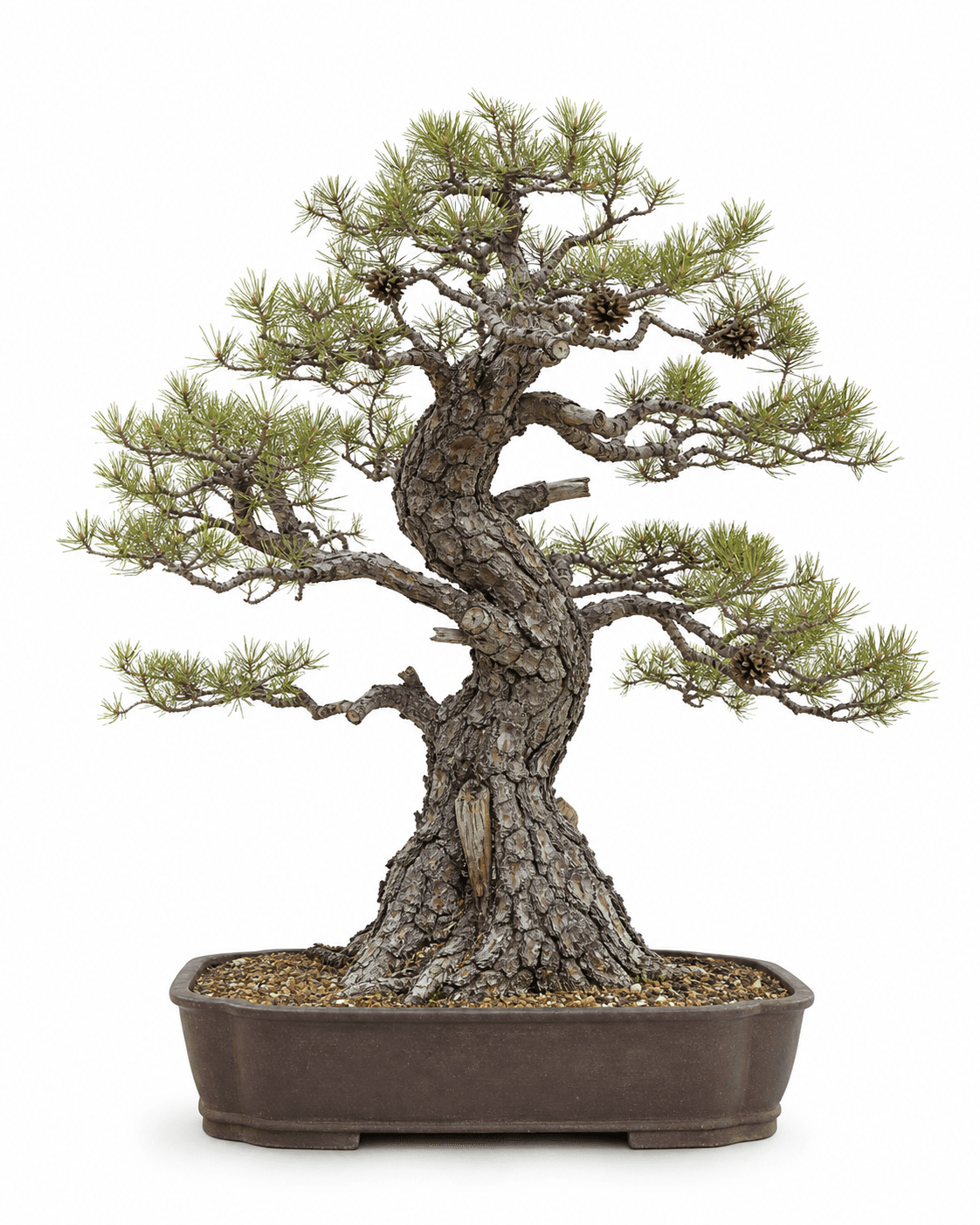
The design implication is roughness. FNA describes straight or contorted trunks, irregular rounded or flattened crowns, and spreading branches; that supports old-field pine, scrub pine, and rugged informal designs better than flawless formal pads. Flora of North AmericaBonsai Mirai / Asymmetry
Reading the tree
Read root strength, candle vigor, needle density, and recent work before cutting.
Mirai multiflush guidance treats strong current-season candle extension as the main green light for decandling. Weak candles mean the tree should rebuild roots and needle mass instead. Bonsai Mirai Library
Energy distribution moves quickly in multiflush pines. Mirai spring energy work says strong areas get stronger and weak areas get weaker rapidly, so refinement relies on needle-density balancing after strength is secured. Bonsai Mirai Library
The root system is the bank. Mirai pine overview says pines store strength in coarse roots and rely on mycorrhizal associations; USDA Silvics records many mycorrhizal genera associated with Virginia pine roots. Bonsai Mirai LibraryUSDA Forest Service Silvics
Recent work changes the calendar. After root work, pest defoliation, or drought, preserve foliage and postpone decandling until vigorous full-length candles and even needle density return. Bonsai Mirai LibraryUSDA Forest Service FEIS
Pine technique
Use multiflush technique, then give Virginia pine recovery time.
Mirai developmental pruning lists Virginia pine with Japanese black pine, Japanese red pine, Pitch pine, loblolly, longleaf, and sand pine as confirmed multiflush pines. The trait means a strong tree can replace removed spring candles in the same season. Bonsai Mirai Library
The decandling window belongs in early summer while enough daylight remains for a second flush to elongate and harden. Mirai post-harden pine pruning says the multiflush decandling window closes by late June in a temperate Northern Hemisphere frame. Bonsai Mirai Library
Virginia pine receives the caution that defines this page. Decandle only if roots, candles, and needle density prove strength, then let the next season rebuild before another full cycle. Bonsai Mirai Library
Needle plucking balances water movement in multiflush pines. Reduce stronger branches toward the needle density of weaker significant branches, and leave weak zones with enough foliage to rebuild. Bonsai Mirai Library
For developmental branches that were not decandled, use late-summer length selection rather than forcing a second flush. Mirai places that work in a short window around early to mid-August in Northern Hemisphere timing. Bonsai Mirai Library
Roots
Root work and decandling should live in separate seasons.
Repot Virginia pine in spring as buds begin moving. The goal is function first: restore percolation, replace collapsed soil, correct root geometry, or move from nursery soil into a container that matches the active root system. Bonsai Mirai Library
USDA Silvics says Virginia pine is shallow-rooted enough for windthrow risk in older stands after excessive thinning, while also forming mycorrhizal associations across several fungal genera. In a pot, that argues for staged root reduction and firm anchoring. USDA Forest Service Silvics
Mirai multiflush pruning is direct about the work stack: after heavy root work or repotting, skip decandling and preserve full needle mass so photosynthesis can rebuild roots. Bonsai Mirai Library
Tie-downs are part of horticulture. A moving pine tears new roots, delays microbial recovery, and makes any later foliar work less safe. Bonsai Mirai Library
Soil and pot
Use oxygen-rich mineral soil and avoid stale old-field cores.
Mirai pine soil method starts with one part akadama, one part pumice, and one part lava. Pumice holds water, lava preserves oxygen, and akadama holds nutrients for roots and microbial life. Bonsai Mirai Library
USDA Silvics says Virginia pine grows best on clay, loam, or sandy loam and tolerates soil acidity from pH 4.6 to 7.9, while doing poorly on wet or impeded drainage. A bonsai mix should translate that into drainage plus controlled moisture. USDA Forest Service Silvics
In humid eastern climates, sift fines and avoid organic pockets that stay wet overnight. In hot dry regions, keep oxygen high but protect the pot from heat so the rootball does not cycle from saturated to baked. Bonsai Mirai LibraryUSDA Forest Service Silvics
Unglazed ovals, rectangles, slabs, and subdued warm clay suit rough old-field or flat-topped pine images. Very shallow show pots should wait until roots are fine, radial, and stable enough to support them. Bonsai Mirai / Asymmetry
Climate
Adapt the calendar to humid summers, dry uplands, and cold potted roots.
USDA Silvics describes a mostly humid range with 35 to 55 in of annual precipitation, summer averages around 70 to 75 F, winter temperatures around 25 to 40 F, and 160 to more than 225 frost-free days by region. USDA Forest Service Silvics
In cold zones, protect the pot while preserving dormancy. NC State lists Zones 4a to 8b, but bonsai roots are exposed to colder air and faster freeze-thaw than landscape roots. NC State Extension
In humid eastern summers, schedule decandling only when the tree is strong, then keep full sun and airflow high. Humidity and wet foliage raise pest and disease pressure after wounds. Bonsai Mirai LibraryNC State Extension
In hot southern or inland sites, shade the container and maintain even water access while keeping the foliage bright. USDA notes low-moisture tolerance, but dry survival is slower growth rather than refinement strength. USDA Forest Service Silvics
Pests and disease
Tip moths, sawflies, beetles, pitch canker, and heart rot shape the risk profile.
NC State Christmas tree guidance says Virginia pine is subject to rust canker and that tip moths are the main problem in that production context. Young bonsai material from sheared stock should be inspected closely for old tip injury. NC State Extension Christmas Tree Species
USDA Silvics lists seedbugs, coneworms, cone borers, Virginia pine sawfly, and Nantucket pine tip moth among reproductive and conelet pests. It also records seed and cone insect pressure reducing viable seed yield. USDA Forest Service Silvics
USDA FEIS lists principal diseases as heart rot and pitch canker, with southern pine beetle, Ips beetles, Virginia pine sawfly, redheaded pine sawfly, and pales weevil as principal insect pests. USDA Forest Service FEIS
NC State Extension adds wind damage susceptibility and broad pest and disease pressure. In bonsai, stabilize horticulture before treatment decisions: sun, water, oxygen, tie-down, sanitation, and local diagnosis first. NC State ExtensionBonsai Mirai Library
Wiring
Wire for irregular pine structure, then check fast-growing refined zones often.
Virginia pine naturally builds spreading, ascending, or descending branches with irregular crowns. Wiring should preserve that rough architecture instead of making every branch parallel and level. Flora of North AmericaBonsai Mirai / Asymmetry
Do structural wiring before choosing advanced multiflush interventions. Mirai developmental pruning says design and branch placement need to be established before decandling or length-selection decisions can be made well. Bonsai Mirai Library
Wire strong pines in windows when the tree has hardened growth and enough foliage to recover. Avoid heavy bends after repotting, after pest loss, or during a season already used for decandling. Bonsai Mirai Library
Check wire frequently on vigorous refined branches. Multi-flush energy can thicken selected junctions quickly, and crowded three-shoot junctions should be reduced before they build inverse taper. Bonsai Mirai Library
Propagation
Seed, cuttings, grafting, and nursery stock all exist, with seed giving the cleanest bonsai start.
USDA Silvics says Virginia pine produces cones early in open-grown trees, sometimes around age 5, and heavy cone crops recur at intervals of 3 or more years. Seed dispersal begins in October and is mostly complete within 3 months. USDA Forest Service Silvics
Seedlings are useful for bonsai because roots, trunk movement, and low branches can be trained early. They also avoid the weak interiors common in old sheared Christmas tree stock. Bonsai Mirai / AsymmetryNC State Extension Christmas Tree Species
USDA Silvics records that cuttings from 7- and 8-year-old Virginia pine rooted best in one cited trial when taken in December and treated with indolebutyric acid, while mature-tree cuttings failed. USDA Forest Service Silvics
The same source reports about 65 percent success for dormant scions grafted onto dormant rootstock, with side-veneer grafting common. For bonsai, a graft union should be treated as a design and bending constraint. USDA Forest Service SilvicsBonsai Mirai Library
Sourcing
Buy the label, roots, interior buds, and recovery history before bark alone.
Good Virginia pine material has a confirmed Pinus virginiana label, paired twisted needles, persistent small cones, strong current candles, living interior buds, and a rootball that can be moved into mineral soil in stages. Flora of North AmericaBonsai Mirai Library
Christmas tree and native-plant nursery material can be useful because the species is grown commercially and tolerates poor sites. Look past sheared outlines and inspect whether inner buds and branch structure still exist. NC State Extension Christmas Tree SpeciesUSDA Forest Service Silvics
Label confusion is common. Scrub pine, spruce pine, Jersey pine, shortleaf pine, Pitch pine, loblolly pine, Table Mountain pine, and generic two-needle pine labels should be verified by scientific name, range, fascicles, cones, bark, and source records. NC State ExtensionFlora of North America
Avoid weak or freshly dug trees, sour compacted soil, severe tip moth injury, sawfly defoliation, pitch canker symptoms, wind-broken trunks without a design plan, and sellers who promise annual black-pine decandling. USDA Forest Service FEISBonsai Mirai Library
Troubleshooting
Start diagnosis with the last work done, then check roots, tips, insects, and disease.
Symptom: no second flush after decandling. Likely cause: weak root system, uneven needle density, late timing, or a tree that needed a rest year. Fix: preserve foliage, feed for recovery, and skip the next decandling cycle. Bonsai Mirai Library
Symptom: decline after repotting and candle removal. Likely cause: stacked root and foliar reduction. Fix: separate repotting and decandling by at least a recovery season and rebuild with full needle mass. Bonsai Mirai Library
Symptom: resinous dead tips or crooked damaged new growth. Likely cause: tip moth, pitch canker, pruning stress, or drought. Fix: isolate the pattern, improve culture, and seek local extension diagnosis before broad cutting. NC State Extension Christmas Tree SpeciesUSDA Forest Service FEIS
Symptom: foliage disappears in clusters. Likely cause: sawfly larvae or other defoliators. Fix: inspect undersides and branch tips, remove pests early, and postpone decandling until foliage returns. USDA Forest Service SilvicsUSDA Forest Service FEIS
Symptom: old needles turn yellow-green in late fall. Likely cause: seasonal color tendency described by NC State Christmas tree guidance. Fix: compare with normal old-needle age before treating as disease. NC State Extension Christmas Tree SpeciesFlora of North America
Symptom: wobble after root work. Likely cause: weak tie-down or a root mass with too little contact. Fix: brace the tree, reduce wind exposure, and avoid pruning until roots anchor. Bonsai Mirai Library
Design
Let the tree read as scrub, old-field, and resilient eastern pine.
FNA describes Virginia pine crowns as irregularly rounded or flattened, with straight or contorted trunks and gray-brown plated bark. That gives the design a rougher voice than polished Japanese black pine. Flora of North America
Begin with trunk line, defining branch, and apex. Mirai design fundamentals use those three elements to set the whole composition, and Virginia pine often benefits from tension or rugged asymmetry. Bonsai Mirai / Asymmetry
Persistent cones and stout sheared branch ends can be assets or distractions. Keep cones only when the design needs them and the tree has enough strength; remove heavy cone loads from weak refined branches. Flora of North AmericaBonsai Mirai Library
Deadwood should stay pine-specific: broken branch stubs, weathered scars, subtle fire or old-field damage, and bark-associated tears. Avoid bright juniper-style carving that fights the species bark. Bonsai Mirai Library
Forests can be credible because USDA Silvics says Virginia pine often grows in pure stands as a pioneer on old fields, burned areas, and other disturbed sites. Use uneven spacing and varied heights so the planting reads as succession rather than nursery rows. USDA Forest Service SilvicsBonsai Mirai / Asymmetry
Forms
Wates Golden is the named form to know, but observed response matters more.
Kew accepts Pinus virginiana and lists Pinus inops, Pinus ruthenica, and Pinus turbinata as synonyms. Keep those as old labels rather than separate care calendars. Kew POWO
NC State lists Wates Golden as a cultivar with yellow needles and winter interest. The form can matter visually, but the bonsai choice still depends on roots, buds, branch line, and vigor. NC State Extension
Kew general information lists scrub pine as an English common name and Least Concern conservation status. The common name is useful for search, but it can also overlap with other regional scrub pines. Kew POWO general information
Record provenance and observed flush behavior. Virginia pine is multiflush in the reviewed Mirai and NC State sources, but a weak tree, a cold site, or a recently repotted tree should still be rested. Bonsai Mirai LibraryNC State Extension Christmas Tree Species
History
Virginia pine moved from forest weed reputation to useful pulpwood, Christmas tree, and bonsai material.
Kew records Pinus virginiana as first published by Miller in 1768. USDA Silvics notes the tree was once dismissed as a forest weed and called scrub pine, then became important for reforesting abandoned and cutover land. Kew POWOUSDA Forest Service Silvics
USDA Silvics describes commercial use in the southeast for pulpwood and lumber, with reforestation value on abandoned agricultural lands and mined sites. FEIS also records Christmas tree planting and reforestation uses. USDA Forest Service SilvicsUSDA Forest Service FEIS
NC State Christmas tree guidance calls Virginia pine the most popular choose-and-cut Christmas tree species for eastern North Carolina growers, largely because it grows fast and produces multiple flushes that can be sheared. NC State Extension Christmas Tree Species
The public bonsai record is smaller than the record for Japanese black pine or Scots pine. A strong Virginia pine bonsai should therefore teach the species clearly: eastern old-field ecology, multiflush capacity, rest-year restraint, and rough native pine design. Bonsai Mirai LibraryBonsai Mirai / Asymmetry
Species questions
Answer the beginner questions before styling.
Can Virginia pine be grown as bonsai?
Yes. Virginia pine can be grown as outdoor bonsai when it receives full sun, winter dormancy, mineral soil, staged root work, and multiflush timing paced by tree strength.
Can Virginia pine bonsai live indoors?
Keep Virginia pine outdoors. It needs sun, airflow, seasonal temperature change, and winter dormancy, with only brief indoor display.
Is Virginia pine a multiflush pine?
Yes. Mirai names Virginia pine among confirmed multiflush pines, and NC State says the species produces multiple flushes during the growing season.
Should I decandle Virginia pine every year?
Avoid annual decandling. Mirai says Virginia pine can be decandled, but alternating decandling and rest years is safer, and decandling in a repot year is dangerous.
When should Virginia pine be decandled?
Use the early-summer multiflush window only on strong refinement-stage trees with vigorous candles and even needle density. Skip weak, recently repotted, or pest-stressed trees.
What soil works for Virginia pine bonsai?
Use a high-oxygen mineral pine mix such as equal akadama, pumice, and lava. Adjust particle size, fines, and water retention for climate and old soil inside the rootball.
How cold hardy is Virginia pine bonsai?
NC State lists Virginia pine for USDA Zones 4a to 8b. Potted roots still need protection from repeated freeze-thaw, winter wind, and sudden warm storage.
Why are my Virginia pine needles yellowing in fall?
Some late-fall yellow-green color can be seasonal. Check needle age, branch pattern, roots, and pest signs before assuming disease.
What pests matter most for Virginia pine bonsai?
Watch tip moths, Virginia pine sawfly, redheaded pine sawfly, southern pine beetle, Ips beetles, pales weevil, pitch canker, heart rot, and wind damage.
What styles suit Virginia pine bonsai?
Informal upright, slanting, literati, old-field pine, rough flat-topped pine, rugged forest, and medium two-needle pine designs suit Virginia pine best.
Sources
Species advice needs source discipline.
Next decisions
Plan the operation before copying the calendar.
A good care note for Virginia pine records the tree's stage, the work done, and the aftercare used. That record matters more than a month-name rule.
Related species
Compare nearby trees before transferring advice.
Japanese black pine / kuromatsu
Pinus thunbergii
Japanese red pine / akamatsu
Pinus densiflora
Pitch pine
Pinus rigida