
Species guide
Pitch Pine Bonsai Care
Pinus rigida
Pitch pine is an outdoor, fire-adapted eastern North American pine with unusually strong trunk and branch back-budding for the genus. Treat it as a multi-flush pine only after confirming strong candle extension, root health, and enough ramification to support the second flush.
This profile is grounded in two dedicated Bonsai Mirai Pitch pine files plus Mirai pine fundamentals, with public sources from Kew, RHS, NC State, Flora of North America, USDA Silvics, USDA FEIS, Purdue, and Cornell for taxonomy, range, fire ecology, hardiness, morphology, cultivars, and landscape tolerances.
Updated June 6, 2026. Written by EntGrove Editorial. Last verified June 6, 2026.
Care fingerprint
Read the species through its shared care pattern.
Time decandling by species, climate, and strength; a weak multiflush pine should still be treated conservatively. Use this as the starting point before local conditions and tree strength refine the calendar.
Identify flush behavior
Single-flush, multiflush, white pine, and compact pine groups have different pruning windows and different risk levels.
Avoid default decandling
Japanese black pine methods do not transfer safely to every pine, especially slow, weak, collected, or five-needle trees.
Use needles as strength data
Needle length, color, age, and density help show where vigor is strong, weak, or becoming shaded.
Care cadence
The calendar starts with the tree's seasonal state.
Placement
Timing: Grow outdoors year-round in full sun with moving air. Use pot protection in severe cold and root-zone cooling during hot reflected-surface weather.
Watch for: Indoor culture, weak light, warm winter storage, stagnant humid corners, salt spray on newly worked foliage, and hot benches that dry only the outer soil.
NC State ExtensionRHSCornell Woody Plants DatabaseWatering
Timing: Water the whole root mass, then let the mineral mix breathe. Root-bound or rock-planted Pitch pine may need slower soaking so dense root zones actually rehydrate.
Watch for: Dry pockets, stale wet cores, water running around a root-bound mass, fertilizer burn after dry stress, and decandling decisions made before water uptake recovers.
Bonsai Mirai LibraryUSDA Forest Service SilvicsDevelopment feeding
Timing: Feed well while building trunk, branches, and back buds. Pitch pine can create large adventitious clusters, but those buds still need root strength and needles to become useful shoots.
Watch for: Styling away the foliage battery, weak candles, epicormic clusters left to swell where no branch is wanted, and treating bark age as proof of maturity.
Bonsai Mirai LibraryRefinement feeding
Timing: Pull back fertilizer roughly one month before decandling on strong refined trees, then let the second flush mature before fall cleanup and shoot selection.
Watch for: Heavy spring feeding on a refined crown, no fertilizer recovery after second flush, youthful coarse response, and weak lower branches being outpaced by upper growth.
Bonsai Mirai LibraryDecandling
Timing: Use the early-summer multi-flush window around the summer solstice in the Northern Hemisphere, adjusting earlier for larger trees and later for smaller refined trees.
Watch for: Weak current candles, recently repotted roots, fewer than half the target shoots cut, late decandling after daylight is insufficient, and expecting Japanese black pine cut-site behavior.
Bonsai Mirai LibrarySecond flush
Timing: After decandling, allow the second flush to extend and harden without mid-elongation pinching. Pitch pine often pushes from adventitious sites behind the cut.
Watch for: Juvenile wavy fascicles mistaken for damage, pinching the new flush, no bud swelling after 3 to 4 weeks, and second-flush growth that stays weak because too few shoots were decandled.
Bonsai Mirai LibraryShoot selection and needle plucking
Timing: Use fall after the second flush hardens, or early spring before bud push if fall work was missed. Balance density against the weakest useful region rather than counting needles mechanically.
Watch for: Over-plucking weak lower branches, keeping three or more shoots at one junction, wiring every natural shoot, and reducing so hard that next year has no recovery mass.
Bonsai Mirai LibraryRepotting
Timing: Repot in spring as buds move. Keep the tree stable, stage old soil or rock roots, and separate major root work from major decandling unless the tree is unusually strong.
Watch for: Bare-rooting, loose tie-downs, stale central roots in rock plantings, root mats with no soil between layers, and decandling a tree that just lost significant roots.
Bonsai Mirai LibraryCornell Woody Plants DatabasePests and disease
Timing: Inspect during humid needle-cast weather, sawfly season, drought stress, after fire-scar or deadwood work, and whenever pitch tubes or branch flags appear.
Watch for: Sawfly larvae, adelgids, conifer aphids, pine shoot moth, loopers, southern pine beetle, needle casts, honey fungus, root rots, and cone or pollen drain on weak trees.
RHSUSDA Forest Service SilvicsUSDA Forest Service FEISSpecies guide
Apply the species profile before copying another tree's calendar.
At a glance
Pitch pine is the rugged eastern pine with multi-flush technique and old-wood buds.
Kew accepts Pinus rigida Mill. in Pinaceae and gives the native range as southeastern Canada to the eastern United States. Flora of North America lists Pitch pine from Ontario and Quebec through much of the eastern United States, with habitat from upland or lowland sterile soils to dry and boggy sites. Kew POWOFlora of North America
For bonsai, the critical classification is multi-flush. Mirai dedicated Pitch pine files describe Pinus rigida as capable of producing a second flush that matures within one growing season, with adventitious response often behind the decandling cut rather than only at the cut site. Bonsai Mirai Library
The practical spec is full outdoor sun, mineral soil, thorough watering, true winter rest, careful decandling only on strong trees, needle and shoot density balanced after the second flush hardens, and design that keeps its irregular fire-pine character. Bonsai Mirai LibraryRHSNC State Extension
Wild habitat
Its wild image is poor soil, fire, barrens, ridges, swamps, and stubborn recovery.
USDA Silvics describes Pitch pine from central Maine and southeastern Ontario south through Virginia, southern Ohio, eastern Tennessee, northern Georgia, and western South Carolina, with spotty distribution because it often occupies poorer soils. USDA Forest Service Silvics
The site range is broader than a simple dry pine story. USDA Silvics lists sandy outwash plains, marine and alluvial sands and gravels, shallow ridges, plateaus, south or west slopes, swamps, and sites ranging from excessively drained to poorly drained. USDA Forest Service Silvics
Fire defines the species. USDA FEIS records bole and crown sprouting from epicormic buds protected by bark, basal sprouting from root-crown buds, and regeneration from nonserotinous or fire-opened serotinous cones. USDA Forest Service FEIS
Translate that into care by avoiding extremes in a container. Wild tolerance for drought, poor soil, salt, and occasional wetness becomes full sun, root oxygen, stable moisture, and enough growth to fuel recovery after pruning or decandling. NC State ExtensionRHSBonsai Mirai Library
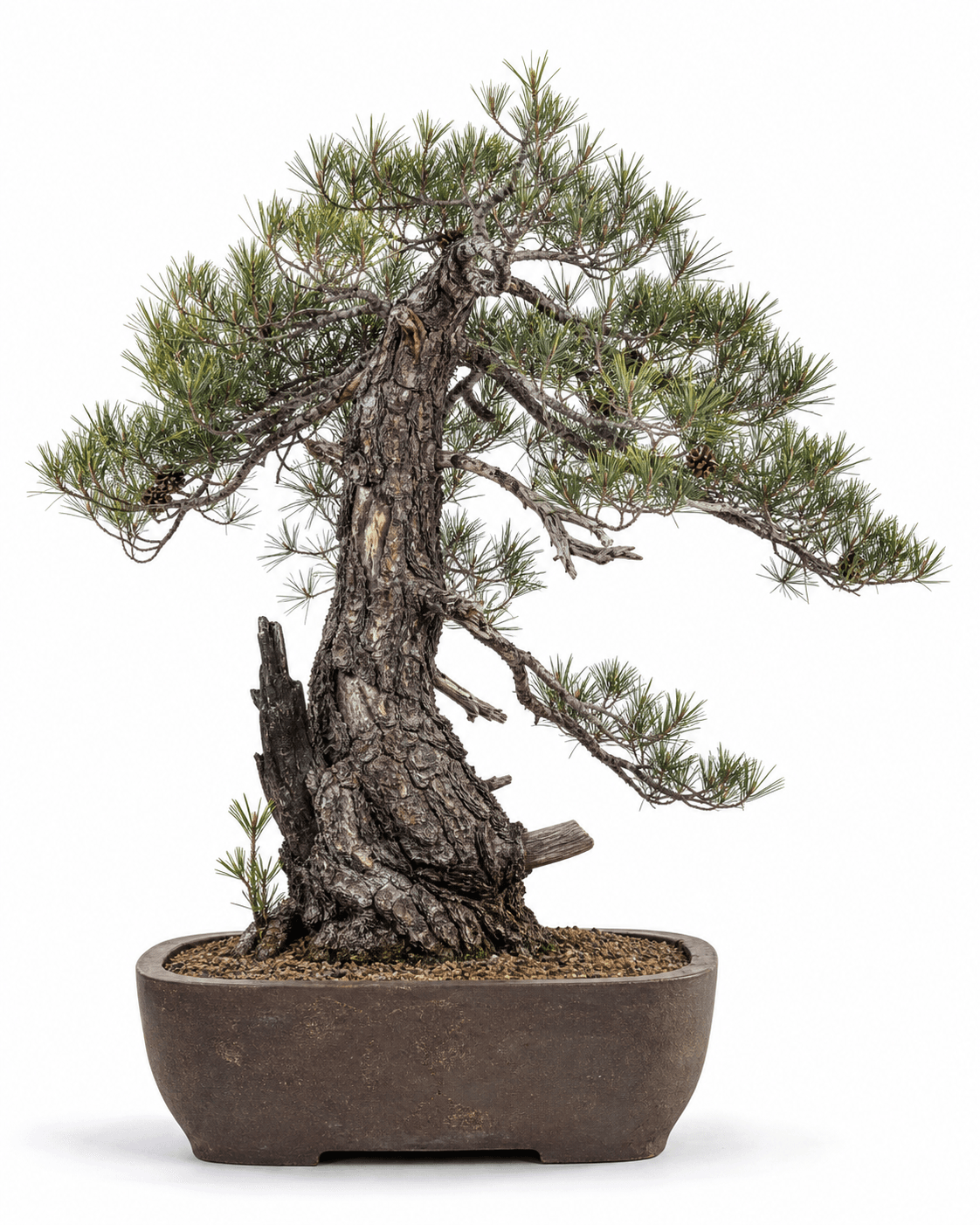
Translate it into design through crooked trunks, thick bark, fire scars, basal sprouts, old branch replacement, uneven canopies, and pine barrens character. A Pitch pine bonsai should read as a survival pine with no tidy nursery-screen symmetry. USDA Forest Service FEISUSDA Forest Service SilvicsBonsai Mirai / Asymmetry
Reading the tree
Read candle strength, adventitious buds, root history, and whether the tree is ready for a second flush.
Mirai identifies visible dormant buds at the base of still-elongating candles as a signal of multi-flush capacity. Pitch pine also back-buds from trunk, primary branch bases, and between bark plates as part of its fire-recovery strategy. Bonsai Mirai Library
Strong current candles are the permission signal for decandling. Weak candles, recent root work, poor water uptake, or sparse lower branches should shift the plan toward strength building. Bonsai Mirai Library
Epicormic clusters can be useful or excessive. Mirai notes that Pitch pine may form clusters with dozens of buds from irregular cell division, and styling should remove those clusters unless a branch is wanted at that exact site. Bonsai Mirai Library
Bark can mislead age reading. Pitch pine develops thick fissured bark relatively young because of fire adaptation, so evaluate actual branch maturity, root stability, and ramification instead of assuming bark plates mean old collected age. Bonsai Mirai LibraryNC State Extension
Technique
Decandle Pitch pine as a strong multi-flush pine, then respect its irregular second flush.
Mirai Pitch pine guidance treats Pinus rigida as multi-flush because it can complete a second flush in the same growing season. The operation belongs on strong, established trees with enough ramification to absorb the response. Bonsai Mirai Library
The early-summer window is governed by daylight. The summer solstice is the practical Northern Hemisphere reference point, with larger trees usually cut earlier for needle development and smaller refined trees cut later for shorter growth. Bonsai Mirai Library
Cut enough of the tree to force the response. Mirai multi-flush guidance says at least 50 percent of the target area should be decandled, with 65 percent or more more reliable. Small partial cuts can leave the cut zones weak. Bonsai Mirai Library
Expect the Pitch pine response to differ from Japanese black pine. The second flush often emerges from adventitious sites behind the cut, and early juvenile wavy fascicles can mature to true needles at the tips. Bonsai Mirai Library
Do not pinch the second flush while it elongates. Let the new growth harden, then use fall or pre-bud-push spring shoot selection and needle plucking to balance density against the weakest useful branch. Bonsai Mirai Library
Cone production can indicate strength rather than stress. On a refined tree, cone and pollen production may modestly reduce needle length, but remove reproductive load when roots, weak branches, or recovery need the energy more. Bonsai Mirai LibraryUSDA Forest Service Silvics
Roots
Repot for oxygen and stability, especially on root-bound or rock-planted material.
Pines depend on coarse roots, stored starch, and mycorrhizal activity, so root work is a major energy decision. Repot Pitch pine in spring as buds move so the tree has the growing season to rebuild fine roots. Bonsai Mirai Library
USDA Silvics reports deep roots on well-drained sandy sites and shallower but still active roots on heavier or wet soils, with mycorrhizae present even on some submerged roots. That explains the species range, but a bonsai pot still needs aerated structure. USDA Forest Service Silvics
Use staged root-core conversion. Remove the root or old-soil problem that limits container fit first, preserve enough functioning roots, and place granular soil where new fine roots should form. Bonsai Mirai Library
Rock plantings are handled in place. Mirai Pitch pine rock-planting guidance keeps the stone and tree together, reduces roots around the container and stone edge, and refreshes soil without trying to separate mature roots from the rock. Bonsai Mirai Library
After repotting, avoid stacking decandling or heavy styling unless the tree had unusual strength and retained enough foliage. Let candles prove recovery before asking for a second flush. Bonsai Mirai Library
Soil and pot
Use mineral soil with enough fine fraction to support multi-flush response.
The baseline Mirai pine soil is 1:1:1 akadama:pumice:lava. For Pitch pine and other multi-flush pines, the dedicated rock-planting file keeps the 1/16 in fines rather than removing them because the fine fraction supports budding and second-flush strength. Bonsai Mirai Library
RHS says Pitch pine grows in any well-drained soil, while NC State lists sand, acid pH, good drainage, moist to occasionally dry conditions, and resistance to dry and poor soils. RHSNC State Extension
Cornell is more specific for landscape culture: full sun, excellent drainage, sandy soil preference, acid pH, salt tolerance, and difficult bare-root transplanting. Those details support careful root handling in bonsai conversion. Cornell Woody Plants Database
Pot choice should reinforce the tree image. Unglazed rectangles, rugged ovals, slabs, and stone plantings suit the fire-pine character, while very formal containers can fight the free branch rhythm. Bonsai Mirai / AsymmetryBonsai Mirai Library
Climate
Adapt the calendar to cold northern sites, humid barrens, coastal salt, and hot southern edges.
USDA Silvics describes a humid range with 37 to 56 in of annual precipitation, 112 to 190 frost-free days, winter lows to -40 F in the north, and summer highs above 100 F in much of the range. USDA Forest Service Silvics
Cold-climate growers should keep the tree dormant outdoors while protecting the pot. The species can tolerate severe landscape cold, but a shallow container exposes roots to faster freeze and thaw cycles. NC State ExtensionPurdue Arboretum ExplorerCornell Woody Plants Database
Humid coastal and barrens growers should watch fungal pressure, sawfly pressure, salt exposure after storms, and water continuity in sandy mixes. Good airflow is part of disease prevention. RHSUSDA Forest Service Silvics
Hot inland growers should protect the pot from reflected heat while maintaining full sun on the foliage. Drought tolerance in the ground does not justify letting a bonsai root mass separate into dry pockets. NC State ExtensionUSDA Forest Service FEISBonsai Mirai Library
Pests and disease
Watch sawflies, moths, needle diseases, beetles, and root rot after stress.
RHS lists adelgids, conifer aphid, sawfly larvae, pine shoot moth, honey fungus, and needle cast diseases as Pitch pine risks. In bonsai, the same issues become more urgent after drought, root work, or heavy pruning. RHS
USDA Silvics records loopers causing extensive damage to Pitch pine in Massachusetts, including major Cape Cod defoliation in 1954. Defoliators can remove the foliage battery that decandling and recovery depend on. USDA Forest Service Silvics
FEIS notes southern pine beetle context within Pitch pine ecosystems, and its broader review ties fire, drought, and insects together. Pitch tubes, boring dust, branch flags, and sudden crown thinning need local diagnosis rather than cosmetic pruning. USDA Forest Service FEIS
Root rots matter when old soil stays wet. USDA Silvics links windfall risk in older plantations to root rots, while bonsai culture adds loose tie-downs, stale cores, and overwatered compact organic soil as practical triggers. USDA Forest Service SilvicsBonsai Mirai Library
Wiring
Wire less than you think and protect the natural branch line.
Mirai Pitch pine redesign guidance warns against wiring every shoot on free-form pines such as Pitch, red, or Monterey pine. Wire is visually rigid, and unnecessary wire can strip away the natural character even before bending begins. Bonsai Mirai Library
When two adjacent branches both carry natural character, wire one independently rather than pairing both with a crossing anchor. The goal is to preserve at least one line that looks untouched. Bonsai Mirai Library
Heavy bark changes wire management. Mirai notes that heavy-gauge wire may not bite quickly until needle mass and sugar load are high, but when swelling starts, it can hide under bark plates and should be checked closely. Bonsai Mirai Library
For thick trunks or branches that cannot bend cleanly, wedge cuts may be safer than brute-force bending. Spring before growth is the best wedge-cut window in Mirai pine guidance, with early fall as a second choice. Bonsai Mirai Library
Propagation
Seed is normal, sprouts are ecological, and bonsai cuttings are minor.
RHS and NC State list propagation by seed. USDA Silvics says fresh nursery seed needs no stratification in the cited nursery practice, while cone opening and seed release vary by inherited cone behavior and fire history. RHSNC State ExtensionUSDA Forest Service Silvics
Seedlings give the cleanest bonsai start because roots can be trained early and the grower can build movement before the trunk becomes coarse. They also avoid ecological damage to pine barrens and rocky native stands. USDA Forest Service FEISBonsai Mirai Library
The species sprouts from basal, bole, and crown buds after fire or injury in nature. That ecological trait explains bonsai back-budding potential. Old collected material still needs root strength before hard cuts. USDA Forest Service FEISBonsai Mirai Library
Grafting is possible within pine practice, but Pitch pine bonsai value usually comes from its own bark, old-wood buds, and irregular branches. Treat unusual grafts or hybrids as separate material with observed behavior recorded. USDA Forest Service FEISBonsai Mirai Library
Sourcing
Buy confirmed identity, roots, recovery history, and branch character.
A good Pitch pine candidate has a confirmed Pinus rigida label, three-needle fascicles, live interior buds or shoots, strong candles, stable roots, usable irregular branch lines, and no urgent need for repotting and decandling in the same year. NC State ExtensionRHSBonsai Mirai Library
Nursery and native-plant sources can be useful because Pitch pine tolerates poor soils, salt, full sun, and drought. Cornell lists bare-root transplanting as difficult, so container or balled-and-burlapped history matters. Cornell Woody Plants DatabasePurdue Arboretum Explorer
Collected material requires explicit permission and long aftercare. Pine barrens, rocky ridges, and coastal habitats can be ecologically sensitive, and fire-shaped old material often has complex roots that should be staged slowly. USDA Forest Service FEISUSDA Forest Service SilvicsBonsai Mirai Library
Avoid weak candles, severe sawfly or needle-cast damage, stale wet organic soil, trunk rot, fresh root disturbance, unverified red pine or Virginia pine labels, and sellers who promise annual black-pine-style decandling without observing the tree first. RHSBonsai Mirai Library
Troubleshooting
Start with root oxygen, strength, timing, and whether the response is normal Pitch pine behavior.
Symptom: second flush comes from behind the decandling cut. Likely cause: normal Pitch pine adventitious response. Fix: let it harden, then select shoots by direction, density, and future branch value. Bonsai Mirai Library
Symptom: no second flush after decandling. Likely cause: weak candles, late timing, too little of the tree cut, poor roots, or insufficient daylight after the operation. Fix: rebuild strength and skip the next decandling cycle. Bonsai Mirai Library
Symptom: large bud clusters swell between bark plates. Likely cause: fire-adapted epicormic response after pruning, damage, or high vigor. Fix: keep only clusters that become useful branches and remove the rest before they create bulges. Bonsai Mirai Library
Symptom: foliage disappears quickly in summer. Likely cause: sawfly larvae or looper defoliation. Fix: inspect daily during outbreaks, remove larvae promptly, and avoid decandling until the tree rebuilds foliage. RHSUSDA Forest Service SilvicsBonsai Mirai Library
Symptom: yellowing from needle base to tip after fertilizing. Likely cause: fertilizer burn and root damage. Fix: remove fertilizer, flush the substrate heavily once, then stabilize water and shade the pot from heat while roots recover. Bonsai Mirai Library
Symptom: decline after repotting. Likely cause: old core left wet, tie-down movement, root mats without soil between layers, or decandling too soon after root loss. Fix: stabilize, water by root response, and wait for strong candles. Bonsai Mirai Library
Symptom: pitch tubes, boring dust, or sudden branch flags. Likely cause: beetles or wound-associated pests on a stressed pine. Fix: isolate, diagnose locally, reduce stress, and avoid fresh wounds during peak pressure. USDA Forest Service FEISRHS
Design
Design for free-form pine character and avoid rigid black-pine geometry.
Mirai places Pitch pine in the informal aesthetic register of red pine rather than the rigid upright register of black pine. Irregular branch placement, asymmetry, and minimal uniformity suit the species better than equal pads. Bonsai Mirai LibraryBonsai Mirai / Asymmetry
Old Pitch pine often carries compact lower branches, upper branches that arc and dome outward, leaning trunks, and apex movement that commits in the rising direction. Those traits support slanting, literati, and rugged informal upright designs. Bonsai Mirai Library
Fire ecology gives the design vocabulary: basal sprouts, trunk buds, blackened or broken sections, persistent cones, thick bark, and branches that replaced damaged crowns. Use those features with restraint rather than turning every wound into decorative deadwood. USDA Forest Service FEISUSDA Forest Service SilvicsBonsai Mirai Library
Pine deadwood should echo the live trunk. Mirai pine-deadwood guidance favors bark, taper, nebari, broken cylindrical stubs, and low contrast over bleached juniper-style stripping. Bonsai Mirai Library
Rock plantings can be especially credible because the wild tree occupies ridges, sandy plains, and shallow rocky sites. Mature rock plantings should gradually read as roots and stone supporting an arid outcrop, with the container serving the root system quietly. USDA Forest Service SilvicsBonsai Mirai Library
Cultivars
Compact selections exist, but source behavior matters more than the name.
Kew accepts Pinus rigida and lists synonyms including Pinus taeda var. rigida and Pinus rigida f. globosa. FNA lists no lower taxa in its treatment. Kew POWOFlora of North America
NC State lists Little Giant, Sand Beach, and Sherman Eddy. Cornell describes Sand Beach as low-growing and prostrate, and Sherman Eddy, also known as Little Giant, as a slow-growing dwarf rounded form. NC State ExtensionCornell Woody Plants Database
Dwarf and prostrate forms can help with scale, but they may bring graft, root, and vigor questions. Inspect root base, candle strength, interior buds, and branch line before paying for a cultivar label. Cornell Woody Plants DatabaseBonsai Mirai Library
Hybrid labels need caution. FEIS reports natural hybridization with shortleaf, pond, and loblolly pine where ranges overlap. Record observed flush behavior before applying this Pitch pine calendar to uncertain material. USDA Forest Service FEIS
History
Pitch pine is a fire-barrens species whose bonsai value comes from recovery.
Kew records Pinus rigida as first published by Miller in 1768. USDA Silvics explains the species name as a reference to rigid or stiff cone scales and sharply pointed needles. Kew POWOUSDA Forest Service Silvics
USDA Silvics also records the practical historical value: resinous wood used for rough construction, ship building, mine props, fencing, railroad ties, pulpwood, crating, fuel, and naval stores. USDA Forest Service Silvics
FEIS gives the ecological history that matters most to bonsai: fire, epicormic buds, basal sprouts, serotinous cones, dwarf pine plains, and postfire seedling recovery across northeastern pine barrens. USDA Forest Service FEIS
In bonsai, Pitch pine is valuable because it demonstrates a North American multi-flush pine that keeps native ruggedness while allowing decandling and adventitious back-budding when the tree has enough strength. Bonsai Mirai LibraryBonsai Mirai / Asymmetry
Species questions
Answer the beginner questions before styling.
Can Pitch pine be grown as bonsai?
Yes. Pitch pine can be grown as outdoor bonsai when it receives full sun, winter dormancy, mineral soil, complete watering, and technique paced by root strength and candle vigor.
Can Pitch pine bonsai live indoors?
No. Pitch pine is an outdoor pine that needs full sun, airflow, and seasonal dormancy. Indoor display should be brief.
Is Pitch pine a multi-flush pine?
Yes. The dedicated Mirai Pitch pine files treat Pinus rigida as multi-flush because it can produce a second flush that matures in one growing season.
Should Pitch pine be decandled?
Decandle only strong, established Pitch pine with vigorous current candles and enough ramification. Skip decandling after major root work, on weak candles, or when the early-summer daylight window has passed.
When should Pitch pine be decandled?
Use the early-summer multi-flush window around the summer solstice in the Northern Hemisphere. Larger trees are usually cut earlier; smaller refined trees can be cut later for shorter second-flush growth.
Why does Pitch pine bud from the trunk?
Pitch pine is fire-adapted. Dormant buds protected by bark can produce epicormic sprouts along the trunk and branches after fire, pruning, damage, or strong growth.
What soil works for Pitch pine bonsai?
Use a mineral pine mix, often 1:1:1 akadama:pumice:lava. For multi-flush Pitch pine, Mirai guidance keeps the 1/16 in fines to help support budding and second-flush strength.
How cold hardy is Pitch pine bonsai?
NC State lists landscape hardiness at USDA Zones 4a to 7b, Purdue lists Zone 4, Cornell lists Zone 3a, and RHS rates it H7. Bonsai pots still need root protection in severe freezes.
Which Pitch pine cultivars are useful for bonsai?
Little Giant, Sherman Eddy, and Sand Beach are the main compact or prostrate names in the sources reviewed. Roots, graft status, buds, and candle strength matter more than the cultivar name.
How is Pitch pine different from Japanese black pine?
Both can be managed as multi-flush pines, but Pitch pine often produces second-flush growth from adventitious sites behind the cut and carries a freer, more irregular design character.
Sources
Species advice needs source discipline.
Next decisions
Plan the operation before copying the calendar.
A good care note for Pitch pine records the tree's stage, the work done, and the aftercare used. That record matters more than a month-name rule.
Related species
Compare nearby trees before transferring advice.
Japanese black pine / kuromatsu
Pinus thunbergii
Japanese red pine / akamatsu
Pinus densiflora
Virginia pine
Pinus virginiana