
Species guide
California Juniper Bonsai Care
Juniperus californica
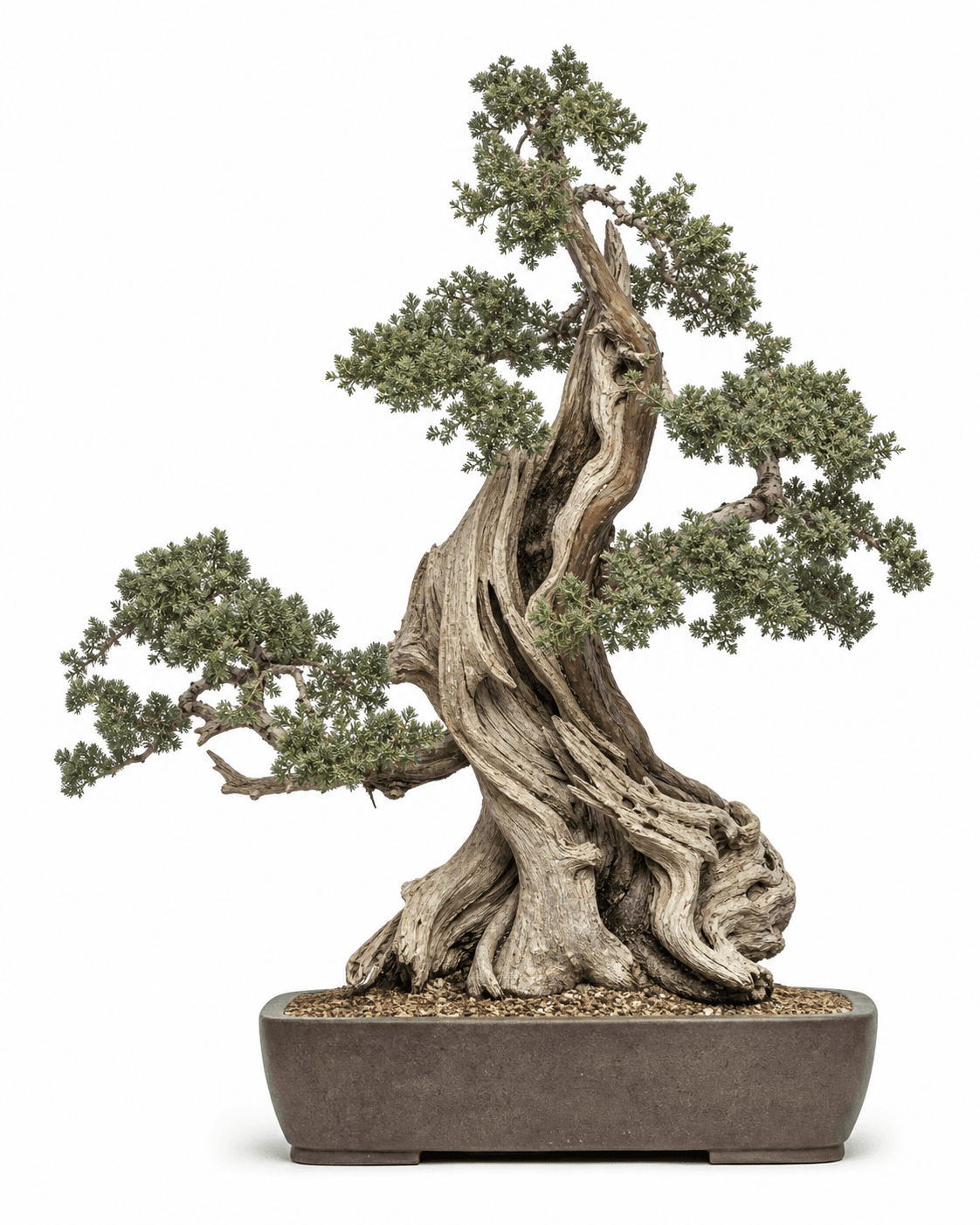
California juniper is an outdoor, arid-region North American juniper with powerful deadwood, compact scale foliage, fine roots, and a slower recovery rhythm than many nursery junipers. Give confirmed Juniperus californica full sun, careful water-oxygen balance, staged root work, and long recovery windows before major styling.
This guide is grounded in dedicated Mirai California juniper files, desert-juniper method, running-juniper pruning, juniper species physiology, and public references from Kew, Flora of North America, USDA FEIS, Oregon State, NPS, CT Agricultural Experiment Station, and UC IPM. The practical focus is collected-material recovery, live-vein preservation, foliage strength, soil, heat and cold limits, pest diagnosis, grafting decisions, and design that respects the species dry-slope character.
Updated June 8, 2026. Written by EntGrove Editorial. Last verified June 8, 2026.
Care fingerprint
Read the species through its shared care pattern.
Protect old collected root systems, preserve live veins, and avoid combining major styling with aggressive root work. Use this as the starting point before local conditions and tree strength refine the calendar.
Note: Dry-country North American juniper with dedicated Mirai California juniper coverage; verify against Sierra, western, Utah, Rocky Mountain, and eastern red cedar labels before applying care.
Keep foliage strong
Junipers recover through active foliage, so styling choices should leave enough healthy tips to power the tree.
Protect live veins
Old junipers often depend on narrow live veins between roots and foliage; root work and carving should respect that path.
Do not stack major work
Heavy bending, major foliage reduction, carving, and repotting belong in a staged plan rather than the same weekend.
Care cadence
The calendar starts with the tree's seasonal state.
Placement
Timing: Grow outdoors in full sun with strong airflow. In extreme heat, shade the pot or afternoon bench surface while keeping foliage bright.
Watch for: Indoor storage, deep shade, cold wet exposure below the mid-20s F, black pots on heat-reflective paving, and freshly repotted trees in intense afternoon sun.
Oregon State Landscape PlantsBonsai Mirai LibraryWatering
Timing: Water thoroughly when the upper substrate begins to dry, then let oxygen return. Use the whole rootball, not the native habitat, as the watering gauge.
Watch for: Hydrophobic collected cores, surface compaction, dead roots after over-drying, sudden fall root rot after summer drought stress, and foliage that keeps color after roots have failed.
Bonsai Mirai LibraryDevelopment feeding
Timing: Feed moderately when the tree is healthy and extending. Let running tips build foliage mass before asking for tighter interior growth.
Watch for: Heavy organic fertilizer clogging the surface, force-feeding a weak tree, and feeding immediately after severe root or graft work.
Bonsai Mirai LibraryPruning
Timing: For refinement, prune after the first flush hardens in late spring to early summer. For recovery or structural development, let the tree run until strength is clear.
Watch for: Pinching tips, cutting to bare stems, reducing weak interior foliage, removing too much in spring, and chasing compactness before roots recover.
Bonsai Mirai LibraryRepotting
Timing: Repot in spring once the tree is active enough to restore roots, or follow local expert timing for old collected junipers. Preserve foliage and old root ecology.
Watch for: Bare-rooting, changing the whole root system at once, combining repotting with grafting, loose tie-downs, and aftercare that lets the rootball dry hard.
Bonsai Mirai LibraryWiring
Timing: Wire once live veins have hardened enough to bend without tearing. Use wire large enough to control the branch, and support each shoulder while bending.
Watch for: Thin wire that cannot set the bend, unsupported branch bases, twisting foliage away from light, live-vein tearing, and wire left on during rapid swelling.
Bonsai Mirai LibraryGrafting
Timing: Approach-graft in early spring as buds wake when native foliage is too coarse, branch response is poor, or a small-scale design needs Itoigawa or Kishu foliage.
Watch for: Grafting weak hosts, grafting the same spring as a repot, placing grafts on curves, poor cambium contact, and starving grafts under dominant native foliage.
Bonsai Mirai LibraryWinter protection
Timing: Give modest dormancy, then protect the root zone when nights fall around 25-28 F or when cold wet weather follows pruning or repotting.
Watch for: Frozen fine roots, greenhouse warmth without light, cold saturated soil, and moving a tree from a cool maritime climate into summer heat without transition time.
Bonsai Mirai LibraryPests and disease
Timing: Inspect after drought, repotting, styling, grafting, dense foliage, and warm dry weather. Diagnose before spraying because root and culture failures often look like disease.
Watch for: Tip blight, cedar-apple or cedar-hawthorn rust where alternate hosts are nearby, spider mites, bagworms, juniper webworm, bark beetles, borers, root rot, and juniper mistletoe on wild or landscape material.
Connecticut Agricultural Experiment StationUC IPM Bark BeetlesUSDA Forest Service FEISSpecies guide
Apply the species profile before copying another tree's calendar.
At a glance
California juniper is a dry-country running juniper with foliage-powered roots.
Kew accepts Juniperus californica Carriere and places it in Cupressaceae. FNA describes a multistemmed shrub or small tree with a rounded crown, gray exfoliating bark, scale-like leaves, and one-year seed cones. Kew POWOFlora of North America
In bonsai, the working rule is simple and demanding: strength is in the foliage. Mirai juniper method says foliage mass produces the sugars that rebuild roots and live veins, so heavy reduction on weak material turns a desert survivor into a delayed-decline project. Bonsai Mirai Library
California juniper belongs in EntGrove taxonomy under Juniper > North American Junipers. It is usually a collected or regionally grown advanced subject, valued for live veins, bulky deadwood, dry-slope character, and the patience it teaches. Bonsai Mirai LibraryFlora of North America
Wild habitat
The habitat is dry, rocky, exposed, and slower than the bonsai bench.
FNA gives the habitat as dry rocky slopes and flats from about 750 to 1600 m. USDA FEIS places the species from Shasta County south to Baja California, with desert-slope populations from the Colorado Desert edge and Joshua Tree region toward Kern County, plus isolated Nevada and Arizona sites. Flora of North AmericaUSDA Forest Service FEIS
USDA FEIS describes pinyon-juniper woodland, desert chaparral, Joshua tree woodland, coastal sage scrub edges, alluvial fans, shallow coarse soils, and steep slopes. It also records mild moist sunny winters, hot dry summers, and a long growing season where water limits growth. USDA Forest Service FEIS
The care implication is controlled abundance. Mirai specifically warns that a native habitat shows what the tree survives against competition, while cultivation can give California juniper more reliable water, oxygen, nutrition, and root temperature control. Bonsai Mirai Library
The design implication is dry-slope asymmetry. Irregular multistemmed growth, stiff branchlets, rounded crowns, pinyon-juniper associates, and fire-sensitive old survivors all point toward rugged live-vein designs rather than soft garden silhouettes. Flora of North AmericaUSDA Forest Service FEISBonsai Mirai / Asymmetry
Reading the tree
Read foliage, live veins, old roots, and recovery history before touching structure.
California juniper can stay visually green while roots lag behind. Mirai files on John Naka material note that a severely unhealthy collected California juniper can spend roughly eighteen months producing little or no new foliage while recovering from collection stress or prior decline. Bonsai Mirai Library
A strong tree extends tips, keeps interior shoots alive, and shows firm scale foliage rather than ropey weak growth. Healthy back budding appears as mature growth on useful top and lateral positions, while juvenile crotch shoots often signal stress or over-pinching. Bonsai Mirai Library
Live veins are the map. Before bending, carving, grafting, or reducing, trace each branch to the vein that feeds it, then preserve enough foliage on that vein to keep water movement and root response active. Bonsai Mirai Library
Collected history matters. A tree that was flat-cut, buried deep in recovery media, allowed to dry hard, or styled before roots recovered should be stabilized and repotted for truth before being redesigned for appearance. Bonsai Mirai Library
Foliage work
Prune running tips after strength appears, and never pinch California juniper.
Mirai treats California juniper with running-juniper logic. Let tips extend to build energy, then prune with scissors back to strong side growth or useful interior shoots. Fingertip pinching removes the primary photosynthetic engine and weakens the root system. Bonsai Mirai Library
Spring heavy reduction creates coarse, long-internode growth on running junipers. For refinement, Mirai prefers pruning after the first flush hardens, usually late spring to early summer, so the response is calmer and finer. Bonsai Mirai Library
Cut only to living lateral growth that can take over. Bare wood and weak spent interior foliage are poor targets, and a hard cut into them can trigger juvenile growth, branch loss, or root decline. Bonsai Mirai Library
Open dense exterior masses before the interior is abandoned. A clean underside improves pad definition, but the top surface should stay organic, uneven, and alive rather than shaved into flat topiary. Bonsai Mirai Library
Roots
Repot to restore percolation, then keep every useful bit of foliage.
Juniper roots are fine and low in storage. Mirai juniper overview describes roots as efficient uptake tissue, while the foliage mass supplies the sugars that rebuild roots after work. Bonsai Mirai Library
Repot when water no longer moves through the root mass, when soil collapses, when buried collection depth hides roots and deadwood, or when the design must move into a container that fits the active root system. Bonsai Mirai Library
Keep conifer root ecology intact. Mirai running-juniper pruning includes the hard warning to avoid bare-rooting conifers because mycorrhizal and microbial relationships support water and nutrient uptake. Bonsai Mirai Library
After repotting, protect from heat and wind, keep the tree stable, and do not balance root reduction by removing foliage. On junipers, foliage regenerates roots, so the canopy is part of the recovery system. Bonsai Mirai Library
Soil and pot
Use more water-holding capacity than a desert story would suggest.
Mirai gives California juniper a 2:1:1 akadama:lava:pumice target with fine-to-medium particles from about 1/16 in to 1/4 in. The akadama fraction supports fine adventitious roots and on-demand nutrient exchange. Bonsai Mirai Library
If the tree stays too wet in a cool, rainy, or humid climate, shift toward 1:1:1 and increase the minimum particle size. The practical target is a rootball that hydrates fully and returns to oxygen before roots die. Bonsai Mirai Library
Pot choice should honor the trunk. Massive collected deadwood usually needs a stable, quiet, unglazed container with enough depth for root temperature and water buffering. Save small shallow pots for refinement after recovery is already proven. Bonsai Mirai LibraryBonsai Mirai / Asymmetry
Cascade or semi-cascade material must be anchored so visual mass and physical mass agree. A moving rootball tears new roots and can erase months of recovery in one windy week. Bonsai Mirai Library
Climate
Heat is useful, cold wet roots are the larger container risk.
Oregon State lists full sun, drought resistance, and USDA Zone 8 for landscape California juniper. The NPS Joshua Tree page records it as a native shrub or tree in that park from 50 to 1500 m. Oregon State Landscape PlantsNational Park Service: Joshua Tree
Mirai says established junipers can handle heat near and above 100 F, but small containers, fresh repots, and black bench surfaces change the risk. Shade the pot and protect roots before shading healthy foliage. Bonsai Mirai Library
Winter protection starts earlier than with alpine junipers. For California juniper bonsai, Mirai uses the 25-28 F range as a practical root-zone warning, especially when cold arrives with wet soil or recent work. Bonsai Mirai Library
Regional moves should be seasonal. A tree moving from a cool maritime climate to a warmer Mediterranean or inland climate should transition from fall through early spring so foliage and cuticle behavior adapt before summer. Bonsai Mirai Library
Pests and diseases
Most California juniper problems begin as stress, then become pest or pathogen problems.
USDA FEIS records juniper mistletoe as an important pathogen in pinyon-juniper woodlands and notes another Phoradendron mistletoe affecting California juniper in lower Sierra San Pedro Martir sites. USDA Forest Service FEIS
General Juniperus problems include Phomopsis and Kabatina tip blights, rusts, winter injury, aphids, bagworms, juniper webworm, redcedar bark beetle, and spruce spider mite. The CT Agricultural Experiment Station emphasizes that drought, excess moisture, shade, and other stressors increase disease susceptibility. Connecticut Agricultural Experiment Station
UC IPM lists cedar and cypress bark beetles on junipers and notes that bark beetles often attack drought-stressed, injured, diseased, weakened, or recently cut material. On bonsai, treat boring dust, flagging tips, and exit holes as urgent diagnostic signs. UC IPM Bark Beetles
For California juniper specifically, Mirai frames many humid-climate disease problems as water-oxygen mismatches. Roots that die after over-drying can become pathogen entry points once fall rain or heavy watering returns. Bonsai Mirai Library
Wiring
Use enough wire, support every shoulder, and protect coarse foliage.
California juniper is a coarse desert juniper compared with fine Japanese refinement cultivars. Mirai Utah juniper method, explicitly transferred to California juniper, calls for heavier functional wire, often 10-12 gauge into fine branching on small desert-juniper work. Bonsai Mirai Library
The wire must control position. Stacking weak wire creates extra pressure points without holding the bend, while loose wire on fine branches lets the branch move and damages vascular connections. Bonsai Mirai Library
Support the shoulder with your thumb while bending, and handle foliage from below rather than spreading or pulling it apart. If a live vein starts to tear, move the fulcrum along the branch and seal fresh damage promptly. Bonsai Mirai Library
Wire for light. Branch orientation matters as much as branch location, so rotate foliage laterally and slightly upward where possible instead of flattening every tip into a static plane. Bonsai Mirai Library
Propagation and grafting
Seed and cuttings are slow; approach grafting is the practical bonsai propagation skill.
FNA and Oregon State describe dioecious plants with seed cones, usually one or two seeds. USDA FEIS says birds and mammals disperse viable scarified seeds after eating the fleshy cones. Flora of North AmericaOregon State Landscape PlantsUSDA Forest Service FEIS
Seed propagation is possible but slow and variable. For bonsai, the more important propagation decision is whether the native foliage can support the intended scale or whether a refined cultivar should be grafted. Bonsai Mirai Library
Mirai California juniper grafting strategy uses approach grafts in early spring as buds wake. Do not graft a weak tree, and do not graft in the same spring as a repot because root recovery consumes the energy the graft needs. Bonsai Mirai Library
Grafting is justified when native foliage repeatedly weakens on styled branches, when coarse male foliage fights the scale of the design, or when Itoigawa, Kishu, or another refined foliage type will preserve the trunk and live veins better. Bonsai Mirai Library
Buying and sourcing
Buy roots and recovery history before you buy deadwood.
Good California juniper material has legal provenance, a confirmed Juniperus californica identity, active scale foliage, clear live veins, stable root anchoring, visible recovery history, and deadwood that belongs to the trunk rather than to carving alone. Bonsai Mirai LibraryFlora of North America
Collected trees need a slower buying standard. Ask when the tree was collected, how many growing seasons it has been stable, whether it has pushed new foliage since collection, how root work was staged, and whether the original field soil still hides under the trunk. Bonsai Mirai Library
Avoid freshly collected trees, flat-cut root systems, weak ropey foliage, large dead root pockets, severe borer signs, termite-soft deadwood, loose trunks, and trees styled hard before recovery. A green canopy can lag behind root failure. Bonsai Mirai LibraryUC IPM Bark Beetles
Nursery or landscape California juniper is rarer than procumbens, Chinese juniper, or Rocky Mountain cultivars. Verify the label against FNA traits, range, cones, foliage, and the source record before applying this page. Flora of North AmericaOregon State Landscape Plants
Troubleshooting
Start with water movement, then read foliage, live veins, pests, and timing.
Symptom: strong tips were pinched and the tree weakened. Likely cause: removal of the foliage engine. Fix: stop pinching, let runners extend, keep water and oxygen balanced, and delay refinement until mature growth returns. Bonsai Mirai Library
Symptom: branches fade weeks or months after styling. Likely cause: live-vein damage, weak root recovery, or too much foliage reduction. Fix: preserve remaining foliage, stabilize the rootball, improve sun and airflow, and stop major work. Bonsai Mirai Library
Symptom: water runs around the rootball but the core stays dry. Likely cause: hydrophobic collected soil or compacted root sheen. Fix: soak carefully, plan staged repotting, and restore percolation without bare-rooting. Bonsai Mirai Library
Symptom: root rot appears after fall rain. Likely cause: roots died from over-drying or poor oxygen earlier, then pathogens entered dead tissue. Fix: correct the water-oxygen cycle and remove only confirmed dead tissue at the right root-work window. Bonsai Mirai Library
Symptom: brown tips, ash-gray tissue, or scattered twig death. Likely cause: tip blight, winter injury, mites, bark beetles, or stress. Fix: inspect with magnification, prune dry infected tissue when appropriate, and seek local extension diagnosis before broad treatment. Connecticut Agricultural Experiment StationUC IPM Bark Beetles
Symptom: grafts fail. Likely cause: weak host, dominant native foliage, poor cambium contact, curved graft surfaces, or grafting after repotting. Fix: rebuild vigor and place the next spring graft on a straight, vigorous, planned branch section. Bonsai Mirai Library
Design
Let deadwood and live vein define the design, then make foliage support them.
Mirai calls bulky, masculine deadwood the California juniper signature. Old material should show depth, grain, fissures, weathering, and a clear relationship between living red vein and aged dead tissue. Bonsai Mirai Library
Begin with trunk line, defining branch, and apex. The defining branch sets the tree length and movement; the apex should answer the trunk rather than pull the eye away from the deadwood story. Bonsai Mirai / AsymmetryBonsai Mirai Library
Do not expose every deadwood feature. Mirai running-juniper pruning favors integrating foliage around protruding deadwood so deadwood remains part of the composition instead of becoming the whole subject. Bonsai Mirai Library
Foliage should make mass, depth, and movement. Preserve a small rear sprig where it creates depth past deadwood, use uneven top surfaces, and avoid symmetrical equality between the defining branch and apex. Bonsai Mirai Library
Historic trees deserve extra restraint. Mirai California juniper legacy material emphasizes reading prior structural decisions before reversing them because lineage can carry design value that a cleaner pattern would erase. Bonsai Mirai Library
Forms and labels
Keep the species name clear, then record foliage behavior by tree.
Kew accepts Juniperus californica and lists Sabina californica, Juniperus cedrosiana, Juniperus cerrosianus, Juniperus pyriformis, and Juniperus californica f. lutheyana as synonyms or forms. Kew POWO
FNA says no lower taxa are recognized in its treatment, while noting leaf-oil races without correlated morphological traits. For bonsai, that means care should follow observed foliage, roots, and provenance rather than an unverified race label. Flora of North America
Mirai notes a practical foliage distinction inside California juniper: male foliage can be coarser, leggier, and longer-internoded than female foliage. That affects whether native foliage can be refined at the planned scale. Bonsai Mirai Library
California white cedar and desert white cedar are common names for a Juniperus species. Separate this species from Sierra juniper, western juniper, Utah juniper, Rocky Mountain juniper, eastern red cedar, Chinese juniper, and procumbens before following the page. Oregon State Landscape PlantsFlora of North America
History
California juniper is part of the American collected-juniper canon.
California juniper has a strong American bonsai history because old collected trunks can carry the deadwood, live veins, and desert survival language that defined many early western bonsai masterpieces. Bonsai Mirai LibraryBonsai Mirai / Asymmetry
Mirai includes John Naka California juniper material and legacy restyling work in the corpus. The lesson from that material is patience: recovery, potting, structure, and restyling happen over years, not within one season. Bonsai Mirai Library
USDA FEIS records Indigenous uses of the wood and berry-like cones, along with fencepost, fuelwood, Christmas tree, watershed, wildlife, and pinyon-juniper woodland roles. Those facts give design context beyond bonsai display. USDA Forest Service FEIS
The exhibition standard is honest age. A strong California juniper bonsai should show slow dry-country growth, live-vein continuity, protected old roots, and deadwood that reads as weathered survival rather than surface decoration. Bonsai Mirai Library
Species questions
Answer the beginner questions before styling.
Can California juniper be grown as bonsai?
Yes. California juniper is a major North American juniper bonsai subject, especially from legally collected or long-established material with strong live veins and deadwood.
Can California juniper bonsai live indoors?
Keep California juniper outdoors. It needs full sun, airflow, heat, and seasonal change, with only brief indoor display.
How often should I water California juniper bonsai?
Water when the upper substrate begins to dry, then hydrate the whole root mass. Do not keep it bone dry because cultivated California juniper grows best with balanced water and oxygen.
What soil works for California juniper bonsai?
Mirai recommends 2:1:1 akadama:lava:pumice with 1/16 in to 1/4 in particles as a California juniper target, adjusted toward more oxygen in cool wet climates.
When should California juniper be pruned?
Let runners extend first. For refinement, prune after the first flush hardens in late spring to early summer. Avoid pinching active tips.
When should California juniper be repotted?
Repot when drainage, root density, old soil, or planting angle requires it, usually in a spring active-growth window with strong aftercare. Never bare-root the whole tree.
How cold hardy is California juniper bonsai?
Oregon State lists landscape hardiness to USDA Zone 8. In a bonsai pot, protect roots around 25-28 F, especially in cold wet weather.
Should California juniper be grafted with Itoigawa or Kishu foliage?
Only when the native foliage cannot support the design scale or repeatedly weakens on styled branches. Graft strong hosts in early spring and skip grafting in repot years.
Why is my California juniper turning brown after styling?
Common causes include excessive foliage removal, live-vein damage, weak roots, over-drying followed by root rot, mites, tip blight, or bark beetle damage. Stabilize first, then diagnose locally.
What styles suit California juniper bonsai?
Rugged collected-juniper styles suit it best: informal upright, slanting, literati, semi-cascade, live-vein and deadwood compositions, and medium to large dry-country designs.
Sources
Species advice needs source discipline.
Next decisions
Plan the operation before copying the calendar.
A good care note for California juniper records the tree's stage, the work done, and the aftercare used. That record matters more than a month-name rule.
Related species
Compare nearby trees before transferring advice.
Sierra juniper / Western juniper
Juniperus grandis
Western juniper
Juniperus occidentalis
Rocky Mountain juniper
Juniperus scopulorum
Utah juniper
Juniperus osteosperma
One-seed juniper
Juniperus monosperma