
Species guide
Rocky Mountain Juniper Bonsai Care
Juniperus scopulorum
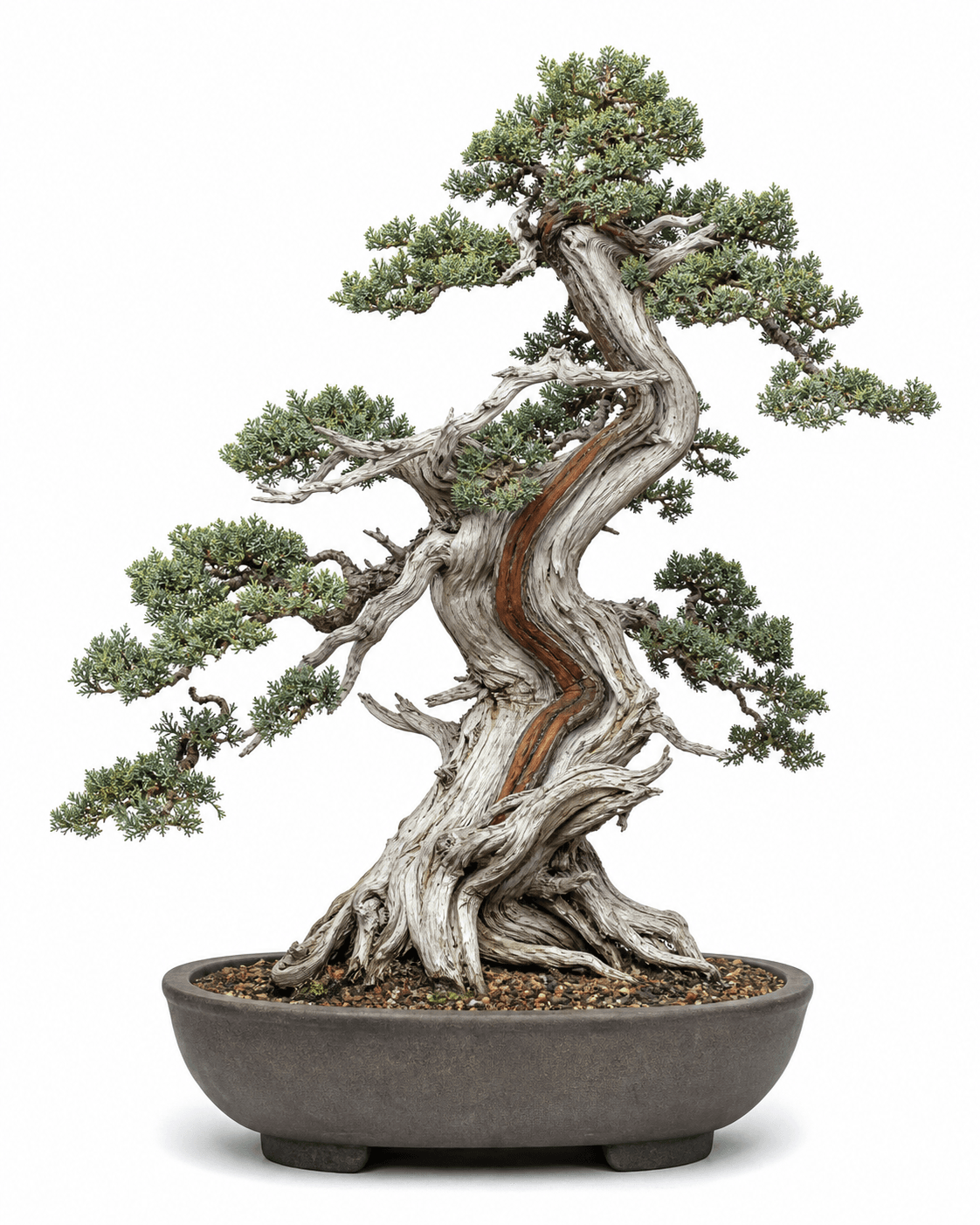
Rocky Mountain juniper is an outdoor, cold-hardy North American running juniper with fine scale foliage, fragile fine roots, and deadwood that often weathers from the outside inward around solid heartwood. Give confirmed Juniperus scopulorum full sun, thorough watering followed by oxygen return, staged root work, and pruning that preserves active tips until the tree is strong enough to refine.
This guide is grounded in dedicated Mirai Rocky Mountain juniper pruning, styling, realization, and second-repotting files, then checked against public references from Kew, Flora of North America, USDA Forest Service, Oregon State, Utah State, The Gymnosperm Database, and UC IPM. The practical focus is collected-material recovery, no-pinching foliage work, live-vein safety, sandblasted deadwood, cold continental adaptation, hybrid label confusion, and pest diagnosis.
Updated June 9, 2026. Written by EntGrove Editorial. Last verified June 9, 2026.
Care fingerprint
Read the species through its shared care pattern.
Protect old collected root systems, preserve live veins, and avoid combining major styling with aggressive root work. Use this as the starting point before local conditions and tree strength refine the calendar.
Note: Cold-hardy running North American juniper with dedicated Mirai Rocky Mountain juniper pruning, styling, and second-repotting coverage; verify against eastern red cedar, Utah juniper, western juniper, Sierra juniper, one-seed juniper, and hybrid-zone redcedar labels before applying care.
Keep foliage strong
Junipers recover through active foliage, so styling choices should leave enough healthy tips to power the tree.
Protect live veins
Old junipers often depend on narrow live veins between roots and foliage; root work and carving should respect that path.
Do not stack major work
Heavy bending, major foliage reduction, carving, and repotting belong in a staged plan rather than the same weekend.
Care cadence
The calendar starts with the tree's seasonal state.
Placement
Timing: Grow outdoors in full sun with strong airflow. Protect the pot from severe freezes after heavy pruning, repotting, or live-vein work, even though the species is very cold hardy in the ground.
Watch for: Indoor storage, deep shade, hot black containers, winter windburn on exposed benches, and recently repotted trees moved straight into intense heat.
Oregon State Landscape PlantsUtah State University ExtensionBonsai Mirai LibraryWatering
Timing: Water thoroughly when the upper 1/4 in to 1/2 in of substrate dries. After major foliage reduction, reduce frequency because transpiration demand falls until foliage regrows.
Watch for: Hydrophobic old field cores, wet outer soil around a dry center, stale akadama, root aphids in weak anaerobic roots, and watering by habitat story rather than pot response.
Bonsai Mirai LibraryDevelopment feeding
Timing: Feed moderately to strongly only after active growth proves the roots are working. Let running tips build foliar mass before asking for interior density.
Watch for: Fertilizing immediately after severe root work, force-feeding a weak tree, and heavy nitrogen on refined foliage that needs shorter internodes.
Bonsai Mirai LibraryPruning
Timing: For refinement, late winter before bud break is useful, and mid-June can work on vigorous ramified trees after growth starts hardening. Avoid active spring flush pruning.
Watch for: Pinching active tips, cutting to bare stems, pruning weak old interior foliage, removing too much in spring, and treating running juniper like Shimpaku.
Bonsai Mirai LibraryRepotting
Timing: Repot as winter color recedes and green pigment returns, before long days and heat. Build a bushy canopy first because foliage powers new roots.
Watch for: Bare-rooting, slip-potting a waterlogged tree into more soil, combining a second repot with heavy styling, unsupported fragile roots, and loose tie-downs.
Bonsai Mirai LibraryWiring
Timing: Wire and bend only when vascular tissue is firm, the tree is rooted, and the design angle is known. Heavy bends need structural spines, raffia, and closed-system anchors.
Watch for: Sharp cracks from live tissue, guy wires anchored to the box, wrong wrap direction against natural twist, too many wires at one junction, and wire bite during active swelling.
Bonsai Mirai LibraryLive-vein and deadwood work
Timing: Clean live veins from mid-summer through winter after cambium re-adheres, or late winter before sap loosens the bark. Preserve aged deadwood surfaces unless work clearly improves the tree.
Watch for: Grinding into white live tissue, spring bark stripping, metal brushes on aged deadwood, moss at the soil line, and carving generic juniper texture onto species-specific wood.
Bonsai Mirai LibraryGrafting
Timing: Graft only vigorous, well-rooted material with abundant foliage. Prefer native foliage when proportion and quality support the design; graft only to solve a clear refinement problem.
Watch for: Grafting weak collected trees, grafts on curved host sections, severing scion roots too soon, sudden removal of stock foliage, and final designs locked before graft results are known.
Bonsai Mirai LibraryPests and disease
Timing: Inspect after wet foliage periods, drought stress, root work, summer heat, and dense canopy buildup. Stabilize water, oxygen, sun, and airflow before escalating treatments.
Watch for: Spider mites, juniper twig blights, Phomopsis, Kabatina, Cercospora blight, cedar-apple rust, stem rust galls, bark beetles, borers, scale, root aphids, Phytophthora, and mistletoe on collected material.
USDA Forest Service FEISUC IPM JuniperUC IPM Juniper Twig BlightsSpecies guide
Apply the species profile before copying another tree's calendar.
At a glance
Rocky Mountain juniper is a cold-country running juniper with fine foliage and demanding roots.
Kew accepts Juniperus scopulorum Sarg. and gives the native range as western Canada to northern Mexico. FNA places it in Cupressaceae and describes a dioecious tree with scale foliage, blue-black glaucous cones, and rocky-site habitat. Kew POWO general informationFlora of North America
For bonsai, the important category is Juniper > North American Juniper. Mirai dedicated Rocky Mountain juniper files describe it as an elongating or running juniper first, so active tips are a strength engine before they become a refinement problem. Bonsai Mirai Library
The practical care spec is outdoor full sun, complete watering with oxygen return, moderate feeding when strong, no pinching, careful late-winter or post-harden pruning, staged root conversion, and live-vein work that respects the exact route of conductive tissue. Bonsai Mirai LibraryOregon State Landscape Plants
Wild habitat
The habitat is rocky, dry to subhumid, cold, exposed, and often transitional.
FNA gives the habitat as rocky soils, slopes, and eroded hillsides, with elevation generally 1200-2700 m and lower coastal outliers. USDA FEIS gives a broader near-sea-level to 9000 ft range depending on region. Flora of North AmericaUSDA Forest Service FEIS
USDA Silvics describes a broad distribution from central British Columbia and southern Alberta through the Rocky Mountains, Great Basin, northern Great Plains, Utah mountains, Arizona Plateau, and New Mexico. It often occupies transition zones rather than uniform forest. USDA Forest Service Silvics
Climate is dry and subhumid in much of the range, but the species also appears in semiarid, subalpine, and maritime conditions. USDA FEIS reports tolerance from about minus 35 F to 110 F, while noting better performance where average minimums are above roughly minus 10 F to minus 5 F. USDA Forest Service FEIS
The care implication is disciplined abundance. Wild trees survive drought, wind, shallow soil, and cold, but bonsai culture should supply reliable water, oxygen, sun, root temperature control, and recovery time without forcing the tree into constant stress. Bonsai Mirai LibraryUSDA Forest Service FEIS
The design implication is exposed-mountain age. Rocky slopes, eroded hillsides, pinyon-juniper woodland, ponderosa transition, and cold wind support asymmetrical crowns, sparse foliage, narrow live veins, and fine sandblasted deadwood. USDA Forest Service SilvicsBonsai Mirai / Asymmetry
Reading the tree
Read running tips, interior growth, old needle drop, live veins, and root oxygen first.
Mirai says Rocky Mountain juniper is elongating first and mounding second. The tree extends runners to accumulate energy, then the grower prunes those tips to redistribute strength into secondary and tertiary shoots. Bonsai Mirai Library
Old third-year needle shed is a readiness signal. In the direct Rocky Mountain juniper realization file, that shed indicates vascular tissue has re-solidified enough for heavier structural decisions. Bonsai Mirai Library
Root-zone symptoms matter more than calendar confidence. The second-repotting file flags abnormal green needle shedding, random branch dieback, or broad non-winter color change as water and oxygen imbalance signs that may require root intervention. Bonsai Mirai Library
Live veins decide what can be bent, carved, removed, or grafted. Trace each branch to its conductive tissue before styling, and stop cleaning when bright white living tissue appears. Bonsai Mirai Library
Foliage work
Never pinch Rocky Mountain juniper. Prune runners to strong lateral growth.
The dedicated Mirai pruning file is blunt: fingertip pinching removes the active growing tip and weakens Rocky Mountain juniper. Tip growth is the photosynthetic engine that powers roots and live veins. Bonsai Mirai Library
For refinement, cleanly cut an extended runner back to a strong fresh interior shoot or lateral branch. That removes auxin dominance from the tip and redirects energy into secondary shoots that can become ramification. Bonsai Mirai Library
Timing changes the response. Late winter before bud break can prune stored energy before the spring flush, while pruning during active spring extension wastes the tree investment and can trigger coarse growth. Bonsai Mirai Library
Mid-June work belongs only on vigorous, ramified material as new growth begins to harden. Applying that timing to a developing or weak collected tree can cause serious decline. Bonsai Mirai Library
Pad building starts with the defining branch. Set the longest asymmetric point first, clean the underside for separation, shorten interior body branches enough to keep depth, and leave the top surface organic rather than shaved flat. Bonsai Mirai LibraryBonsai Mirai / Asymmetry
Roots
Build foliage before root work, then remove the greatest limitation first.
Mirai repeats the core juniper rule across the dedicated files: foliage mass regenerates roots. Do not reduce the canopy to balance root reduction the way some growers might on deciduous material. Bonsai Mirai Library
The second-repotting file describes a staged collected-tree sequence. First build an outer ring of refined roots, then on a later repot remove the remaining native or field-soil core while preserving that new root ring as the anchor. Bonsai Mirai Library
Repot when winter color recedes and green pigment returns to the interior of the foliage, before significant new growth, heat, or long days. That signal shows resources moving back into photosynthetic tissue. Bonsai Mirai Library
Never bare-root a conifer. Mirai ties retained root ecology to water and nutrient uptake, and the dedicated file warns that the fragile juniper root mass must stay supported until the repot is complete. Bonsai Mirai Library
Slip-potting a struggling juniper into a larger container can worsen oxygen problems because more soil holds more water. Correct the water and oxygen imbalance rather than burying it. Bonsai Mirai Library
Soil and pot
Use fine mineral particles, enough akadama for roots, and enough oxygen for survival.
Mirai gives Rocky Mountain juniper and general juniper mixes a 1/16 in to 1/4 in root-zone particle range, with a thin 1/4 in to 1/2 in aeration layer at the bottom of larger pots. Bonsai Mirai Library
Use 1:1:1 akadama:pumice:lava when the tree stays wet, the climate is cool and rainy, or the tree is early in collected recovery. Move toward 2:1:1 when a strong refined tree needs more water and nutrient retention. Bonsai Mirai Library
USDA FEIS says Rocky Mountain juniper often grows on calcareous or somewhat alkaline soils, derived from basalt, limestone, sandstone, lavas, and shale, and even where no developed soil exists. Bonsai soil should translate that as structure and oxygen, not as crushed landscape soil. USDA Forest Service FEISBonsai Mirai Library
Pot choice should support the old mountain image and root recovery stage. Development boxes and deeper training containers are appropriate for recently collected trees; refined old trees can move into quiet unglazed ovals, rectangles, or slabs after root density is reliable. Bonsai Mirai / AsymmetryBonsai Mirai Library
Climate
Cold hardiness is real, but a shallow bonsai pot changes the risk.
Landscape hardiness is broad. Oregon State lists USDA Zone 3, Utah State gives Zones 3-7, and The Gymnosperm Database gives Zone 3 with a cold hardiness limit between roughly minus 39.9 C and minus 34.4 C. Oregon State Landscape PlantsUtah State University ExtensionThe Gymnosperm Database
Container roots are less protected than wild roots in rock and soil. Mirai general juniper guidance moves trees off benches and insulates the root zone below about 25 F, especially after pruning, repotting, or reduced foliage mass. Bonsai Mirai Library
Hot dry gardens should protect the pot more than the foliage. The realization file notes that heat damage to roots may show four to six weeks after exposure, and container shading can prevent root cooking. Bonsai Mirai Library
Humid and cool wet gardens should use sharper soil, larger minimum particles, and careful airflow because retained moisture can create the same oxygen imbalance that drives root decline and tip disease. Bonsai Mirai LibraryUC IPM Juniper
Pests and disease
Most disease pressure follows wet foliage, stale roots, dense growth, or stress.
USDA FEIS lists cedar foliage rusts, stem-gall rusts, juniper mistletoes, Phomopsis blight, Cercospora blight, Kabatina tip blight, roundheaded borers, bark beetles, cedar twig beetles, flatheaded borers, gall midges, spider mites, and juniper berry mites. USDA Forest Service FEIS
UC IPM summarizes common juniper problems including bark beetles, flatheaded borers, scales, spider mites, twig blights, Phytophthora root and crown rot, rusts, cankers, wood decay, scorch, nutrient disorders, and water deficit or excess. UC IPM Juniper
UC IPM twig-blight guidance says Phomopsis and Kabatina infect wet foliage through wounds, producing brown, red, or yellow wilted shoots. Bonsai prevention is clean cuts, dry foliage at night, airflow, restrained fertilizer, and prompt removal of confirmed infected shoots. UC IPM Juniper Twig Blights
Mirai root-aphid guidance from the second-repotting file treats root aphids as a symptom of weak, anaerobic roots rather than the primary cause. Correct the old soil and water-oxygen balance while treating the pest. Bonsai Mirai Library
Wiring
Heavy bends work only when live veins are traced and forces are closed.
The professional Rocky Mountain juniper file says severe bends need wire spines embedded parallel to the branch and tied with raffia. Wrapped wire alone cannot protect a large branch through a major bend. Bonsai Mirai Library
When one side of a branch is deadwood and the other is live vein, Mirai removes or fractures compressive deadwood so the live vein is placed in tension rather than crushed. Junipers tolerate stretch better than compression. Bonsai Mirai Library
Anchor guy wires to the tree's own structure, not to the grow box. A closed system keeps bending force out of fragile roots and reduces the risk of tearing new root growth. Bonsai Mirai Library
Match wrap direction to natural rotational grain. Support the shoulder with an opposing hand, listen for dull bark or deadwood pops versus sharp live-tissue cracks, and unwind tensioned guy wires slowly rather than cutting them. Bonsai Mirai Library
Propagation
Seed and cuttings are possible, while bonsai character usually comes from legal collected or nursery material.
USDA Silvics says seed germination is slow, often after a 14 to 16 month after-ripening period, with low percentages and delays beyond two years possible because of embryo and seedcoat factors. USDA Forest Service Silvics
USDA Silvics also describes vegetative propagation: Rocky Mountain juniper lacks natural sprouting or layering, and cuttings can root when treated with indolebutyric acid and intermittent mist. USDA Forest Service Silvics
For bonsai, seedlings and cuttings offer clean roots but slow character. Collected material carries age and deadwood, while nursery cultivars offer reliable containers, blue foliage forms, and more predictable aftercare. Oregon State Landscape PlantsBonsai Mirai Library
Grafting is a design tool, not a rescue. Mirai grafting strategy requires a vigorous host, abundant foliage, established roots, and a clear reason to replace or supplement native foliage. Bonsai Mirai Library
Sourcing
Buy identity, roots, legal provenance, and recoverable foliage before dramatic deadwood.
Confirm the label as Juniperus scopulorum. FNA and The Gymnosperm Database both warn about close similarity or hybridization with eastern redcedar and other junipers, and USDA FEIS adds hybrid reports with alligator, creeping, one-seed, Utah juniper, and eastern redcedar. Flora of North AmericaThe Gymnosperm DatabaseUSDA Forest Service FEIS
Nursery stock can be useful when roots are healthy, the trunk has movement, and cultivar foliage fits the design. Oregon State lists landscape forms including Blue Creeper, Gray Gleam, Medora, Pathfinder, Tabletop, Tolleson weeping forms, and Wichita Blue. Oregon State Landscape Plants
Collected material should come only from legal, documented sources with aftercare history. Mirai files repeatedly show that collected junipers may need three to five years after a major repot to regain full vigor. Bonsai Mirai Library
Red flags include weak or freshly collected trees, hydrophobic native cores, recently cleaned live veins without strong new growth, heavy carving before root recovery, root aphid signs, mite stippling, twig blight, and a seller who cannot separate Rocky Mountain from Utah, Sierra, western, or eastern red cedar labels. Bonsai Mirai LibraryUC IPM Juniper
Troubleshooting
Read symptoms through foliage mass, root oxygen, timing, and live-vein continuity.
Symptom: juvenile needle foliage after work. Likely cause: over-pruning, pinching, root stress, or overstimulated coarse growth. Fix: stop pinching, rebuild running foliage, and prune only to strong fresh lateral growth. Bonsai Mirai Library
Symptom: random branch dieback or green needle shedding as winter ends. Likely cause: water and oxygen imbalance around old roots. Fix: inspect drainage, surface compaction, old core wetness, and consider staged repotting during the proper signal window. Bonsai Mirai Library
Symptom: cottony white masses on roots. Likely cause: root aphids exploiting a weak root system. Fix: correct anaerobic soil, then treat with appropriate local controls such as beneficial nematode timing rather than relying on contact sprays alone. Bonsai Mirai Library
Symptom: brown, red, or yellow wilted tips after wet weather or wounds. Likely cause: Phomopsis or Kabatina twig blight. Fix: improve airflow, keep foliage dry at night, prune out confirmed infected shoots, and avoid overfertilization. UC IPM Juniper Twig Blights
Symptom: rust galls, witches brooms, or orange gelatinous structures. Likely cause: Gymnosporangium rusts or mistletoe. Fix: confirm locally, manage nearby alternate hosts where relevant, and avoid mistaking galls for ordinary deadwood texture. USDA Forest Service FEIS
Symptom: deadwood softens at the soil line. Likely cause: moss, algae, wet-dry decay pressure, and buried deadwood. Fix: clean below the soil interface when appropriate, use soft brushes, and keep the surface open. Bonsai Mirai Library
Symptom: foliage browns weeks after heat. Likely cause: root cooking or water column damage during extreme heat. Fix: shade the container, restore even watering, reduce additional work, and wait for the delayed response before judging survival. Bonsai Mirai Library
Design
Let fine foliage, solid heartwood, sandblasted texture, and live veins define the design.
Mirai deadwood files distinguish Rocky Mountain juniper from Sierra juniper. Rocky Mountain juniper tends to keep a solid core with deterioration from the outside inward, while Sierra juniper often hollows from the core outward. Bonsai Mirai Library
The species-specific deadwood cue is fine, sandblasted, heavily grained wood. Mirai connects that texture to fine vascular systems, fine foliage, and wind-blown decomposing stone in Rocky Mountain habitat. Bonsai Mirai Library
Design starts with trunk line, defining branch, and apex. On strong old material, the defining branch should extend the wind or slope story, while the apex stays subordinate to live-vein movement and deadwood proportion. Bonsai Mirai / AsymmetryBonsai Mirai Library
Use negative space to show age. Removing positive foliage mass and preserving believable deadwood remnants often communicates time better than adding fresh carving. Bonsai Mirai Library
Preserve aged surfaces. Hand tools following the grain, soft nylon brushes, and selective lime sulfur after the wood dries keep the surface credible; power-tool uniformity makes ancient Rocky Mountain wood look newly carved. Bonsai Mirai Library
Forms and labels
Most confusion comes from redcedar names, hybrid zones, and blue landscape cultivars.
Kew accepts Juniperus scopulorum and lists Sabina scopulorum plus Juniperus virginiana var. scopulorum among synonyms. FNA lists Rocky Mountain juniper and Rocky Mountain redcedar, with no lower taxa. Kew POWOFlora of North America
FNA says Rocky Mountain juniper hybridizes with eastern redcedar in Missouri River contact zones and with creeping juniper. USDA FEIS adds hybrid reports with alligator juniper, one-seed juniper, Utah juniper, and eastern redcedar. Flora of North AmericaUSDA Forest Service FEIS
Oregon State lists several landscape selections, including upright, mounding, weeping, blue, green, and variegated forms. It also notes that Skyrocket is now classified as a form of eastern redcedar, which is a useful caution for old nursery labels. Oregon State Landscape Plants
For bonsai records, tag both the Latin name and provenance. A collected Colorado or Utah tree, a Dakotas shelterbelt tree, a nursery Wichita Blue, and a hybrid-zone redcedar-looking tree can respond differently even when sold under the same common name. USDA Forest Service FEISThe Gymnosperm Database
History
Rocky Mountain juniper is a western shelterbelt tree, old-growth survivor, and American collected-bonsai subject.
USDA Silvics says Rocky Mountain juniper is one of 13 junipers native to North America and among the most widely distributed tree-sized junipers in western North America. USDA Forest Service Silvics
The species has practical western history as windbreak, shelterbelt, fencepost, fuelwood, and aromatic red-heartwood material. USDA FEIS also records Indigenous uses of branches, seeds, foliage, and aromatic wood in several contexts. USDA Forest Service FEISUSDA Forest Service Silvics
The Gymnosperm Database records an exceptional crossdated specimen from El Malpais with an inner date of 29 BC and outer date of AD 1859, showing a lifespan over 1888 years. That age context supports restraint in bonsai styling. The Gymnosperm Database
Mirai dedicated Rocky Mountain juniper demonstrations connect the species to the modern American native-material tradition: collected roots recovered over years, live veins revealed carefully, branch movement built through closed force systems, and deadwood read from the tree's own environment. Bonsai Mirai LibraryBonsai Mirai / Asymmetry
Species questions
Answer the beginner questions before styling.
Can Rocky Mountain juniper be grown as bonsai?
Yes. Rocky Mountain juniper is a strong outdoor North American juniper bonsai subject when it has full sun, healthy running foliage, stable roots, and careful live-vein handling.
Can Rocky Mountain juniper bonsai live indoors?
No. Keep Rocky Mountain juniper outdoors in sun, airflow, and seasonal temperature change. Indoor display should be brief.
Should Rocky Mountain juniper be pinched?
No. Mirai dedicated Rocky Mountain juniper guidance says never to pinch active tips. Let runners build strength, then prune back to strong lateral growth.
When should Rocky Mountain juniper be pruned?
Late winter before bud break is useful for refinement pruning, and mid-June can work on vigorous ramified trees after growth starts hardening. Avoid active spring flush pruning.
What soil works for Rocky Mountain juniper bonsai?
Use mineral soil with fine particles, commonly 1:1:1 akadama:pumice:lava in cool wet climates or 2:1:1 when a strong refined tree needs more retention. Keep drainage and oxygen high.
When should Rocky Mountain juniper be repotted?
Repot as winter color recedes and green pigment returns, before major new growth, heat, or long days. Build strong foliage first and avoid bare-rooting.
How cold hardy is Rocky Mountain juniper bonsai?
Landscape sources list USDA Zone 3 or Zones 3-7, but bonsai roots are exposed. Protect the container around severe freezes, especially below about 25 F after recent work.
Is Rocky Mountain juniper the same as eastern red cedar?
No. They are separate species, Juniperus scopulorum and Juniperus virginiana, though FNA and USDA sources report hybridization in contact zones and old labels can be confusing.
Should Rocky Mountain juniper be grafted with Shimpaku foliage?
Only when the tree is vigorous and the native foliage cannot meet the design goal. Good native Rocky Mountain foliage can be kept, while grafting should solve scale, density, or branch-placement problems.
What makes Rocky Mountain juniper deadwood different?
Mirai distinguishes its fine, sandblasted, heavily grained deadwood and solid heartwood from Sierra juniper hollowing and western juniper cylindrical deadwood. Deadwood should reflect that habitat-specific texture.
Sources
Species advice needs source discipline.
Next decisions
Plan the operation before copying the calendar.
A good care note for Rocky Mountain juniper records the tree's stage, the work done, and the aftercare used. That record matters more than a month-name rule.
Related species
Compare nearby trees before transferring advice.
California juniper
Juniperus californica
Sierra juniper / Western juniper
Juniperus grandis
Western juniper
Juniperus occidentalis
Utah juniper
Juniperus osteosperma
One-seed juniper
Juniperus monosperma