
Species guide
Olive Bonsai Care
Olea europaea
Olive bonsai succeeds with strong sun, moving air, a fast-draining root zone, and winter protection from cold wet soil. Treat it as a Mediterranean broadleaf evergreen: keep enough active foliage to power recovery, prune during energy-positive windows, and use container culture to prevent stale roots.
Olea europaea can be beginner-friendly for outdoor growers in mild or warm climates, especially when the design goal is an old trunk, compact leaves, and durable deadwood. It is a weak choice for dim indoor shelves or exposed cold-wet benches because olive needs light, oxygen at the roots, and a cool bright winter rhythm.
The Mirai olive corpus is unusually useful for bonsai decisions: it documents spring and summer root timing, 100 percent akadama or akadama-dominant refinement soil, partial leaf work, aluminum wire on young shoots, slow wound closure, and design from ancient cultivated orchard character.
Updated July 13, 2026. Written by EntGrove Editorial. Last verified July 13, 2026.
Care fingerprint
Read the species through its shared care pattern.
Protect from hard freezes when species demands it, prune with active foliage in mind, and repot when roots can recover without dormancy cues. Use this as the starting point before local conditions and tree strength refine the calendar.
Read the foliage first
Broadleaf stress usually shows in leaf color, leaf size, wilt, scorch, or delayed hardening before it becomes a branch problem.
Match work to dormancy
Deciduous, evergreen, tropical, succulent, and flowering broadleaf trees recover on different calendars.
Protect fine roots
Root work should preserve enough active fine roots for the tree to rehydrate quickly after the operation.
Care cadence
The calendar starts with the tree's seasonal state.
Placement
Timing: Grow outside in full sun and air movement whenever temperatures are safe. Winter in a bright cool protected space when freezes or long wet spells threaten the pot.
Watch for: Long pale internodes, indoor leaf drop, cold wet benches, wet foliage with no airflow, and a warm winter room that prevents the cool rest needed for flowering.
NC State ExtensionUC IPM olive overviewBonsai Mirai LibraryWatering
Timing: Water by root-zone condition. Established, fine-rooted olive bonsai can drink daily in warm growth, while winter and cool weather require longer oxygen return between waterings.
Watch for: Saturated cores, sour soil, water bypass around a flat root pad, leaf drop from hard dryness, and over-watering immediately after root work.
Bonsai Mirai LibraryUC IPM olive overviewFertilizer
Timing: Feed during active growth, stronger in development and lighter in refinement. Let light, roots, and extension prove that the tree can use fertilizer before pushing growth.
Watch for: Coarse internodes, weak roots after repotting, fertilizer salts in dry climates, and feeding through cold protected winter storage.
Bonsai Mirai LibraryPruning and leaf work
Timing: Use large cuts in spring or after the first flush hardens. For refined olives, Mirai teaches early-summer tip pruning plus 60 to 70 percent leaf reduction on remaining leaves while retaining about 30 percent leaf mass overall.
Watch for: Weak trees, cool climates with short recovery seasons, fall pruning that reduces next spring vigor, and routine full defoliation.
Bonsai Mirai LibraryWiring
Timing: Wire young soft-barked shoots with aluminum during active growth or after partial leaf reduction exposes structure. Use pruning and guy wires for older hard branches.
Watch for: Persistent wire scars, brittle older shoots, deadwood fissures used as anchors without protecting the live vein, and wires left through summer swelling.
Bonsai Mirai LibraryRepotting
Timing: Default to spring as buds swell when heat is available afterward. Experienced growers in Mediterranean conditions can use summer root work, but Mirai frames it as species-specific and heat-dependent.
Watch for: Cold wet aftercare, rootless collected chunks without heat, newly exposed fleshy trunk tissue in harsh sun, and old root pads that resist central wetting.
Bonsai Mirai LibraryPests and disease
Timing: Inspect year-round, with extra attention after pruning, wet weather, fruit set, and indoor winter protection.
Watch for: Olive scale, ants protecting scale, olive fruit fly on fruiting trees in affected regions, olive knot after wet wounds, Phytophthora root and crown rot, verticillium wilt, and wood decay.
NC State ExtensionUC IPM olive scaleUC IPM olive fruit flyUC IPM olive knotSpecies guide
Apply the species profile before copying another tree's calendar.
At a glance
Olive is a sun-first Mediterranean evergreen bonsai with exceptional old-wood character.
The botanical anchor is Olea europaea L. in Oleaceae. Kew accepts the name, gives a broad native range from Africa and the Mediterranean to south-central China, and describes an evergreen shrub or tree with opposite silvery leaves, white flowers, and drupe fruit. Kew POWO
For bonsai, the useful traits are rugged bark with age, compact evergreen foliage on good material, strong response to pruning during warm growth, and rot-resistant heartwood that can carry deadwood for a long time. The limiting traits are slow wound closure, wire scars that remain visible, and roots that dislike stale cold wet soil. Bonsai Mirai Library
The practical spec is clear: full sun, outdoor growth, cool bright winter protection where needed, free-draining mineral soil, warm recovery after root work, partial leaf work only on strong refined trees, and designs that honor old Mediterranean cultivated character. NC State ExtensionUC IPM olive overviewBonsai Mirai Library
Wild habitat
Design and care both start with seasonally dry Mediterranean ecology.
Kew describes olive as primarily subtropical and tied to seasonally dry Mediterranean habitats or subtropical bushland. The cultural image is also ancient: the species has been grown around the Mediterranean for thousands of years, and Kew notes that the Mediterranean still dominates world olive production. Kew POWO
In a pot, that ecology becomes full light, high oxygen, and careful water timing. UC IPM says olives do best in full sun, prefer little water once established, and have poor tolerance for saturated soils or lawn conditions. Bonsai roots need more consistent observation than landscape roots, but they still need the same oxygen-first environment. UC IPM olive overviewBonsai Mirai Library
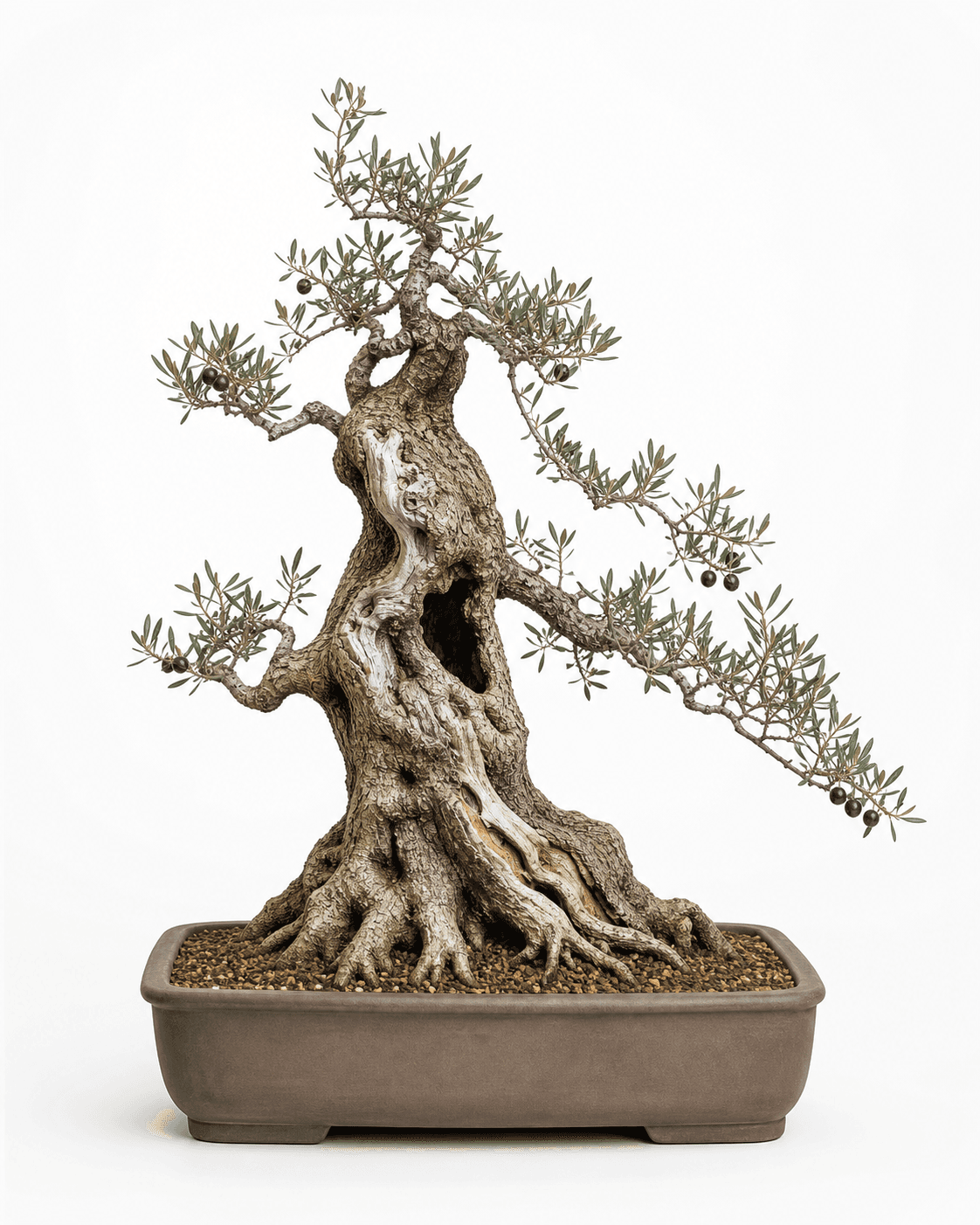
The design implication is equally direct. Olive bonsai should feel like old cultivated survivals: carved trunks, hollowed centers, basal swelling, sparse durable wood, and foliage placed to reveal age rather than hide it under generic green mass. Bonsai Mirai / AsymmetryBonsai Mirai Library
Reading the tree
Read olive by root maturity, leaf mass, and where the tree is allowed to spend energy.
Development olives need extension. Mirai describes olive buttressing as a product of basal leaders and strong growth, so trunk thickening comes from letting selected shoots run, then cutting them away on short cycles to keep scars manageable. Bonsai Mirai Library
Refinement olives need the opposite discipline: protect fine roots, preserve enough leaves to keep metabolism active, and use timed partial leaf reduction to create lateral buds. Mirai warns that full defoliation spends too much energy, while partial leaf work keeps about 30 percent of leaf mass active. Bonsai Mirai Library
Energy direction matters because olive throws basal suckers readily. Keep suckers only when they serve a thickening plan, then remove them before they pull too much vigor away from the upper design or create large new wounds at the base. Bonsai Mirai Library
Pruning
Prune olive when the tree is energy positive, then keep enough leaves to recover.
Large cuts belong in spring or after the first flush hardens, when the tree has enough energy to respond. Mirai is blunt about wound behavior: olive can grow strongly, yet large wounds close slowly, so major cuts should be planned as future deadwood, hidden transitions, or carefully sealed wounds. Bonsai Mirai Library
For ramification, Mirai teaches an early-summer post-flush method: cut elongated tips and reduce the remaining leaves by about 60 to 70 percent. The combined reduction in shoot-tip hormone and leaf sugar production stimulates more lateral branching than tip pruning alone. Bonsai Mirai Library
Reserve that leaf work for strong refined trees in climates with enough heat to recover. In cool maritime summers, or on a tree recently repotted or weak, build strength first and use ordinary extension-and-cutback pruning until vigor is reliable. Bonsai Mirai Library
Repotting
Spring is the safe default, while summer root work belongs to warm olive conditions.
Mirai gives spring, as buds swell and heat is available afterward, as the broadly safe repotting window for broadleaf evergreens. Olive is unusual because it can also recover from summer root work in Mediterranean heat, but that window depends on aftercare, warmth, and a tree with enough stored energy. Bonsai Mirai Library
Newly collected or flat-cut olive material can survive with little root because the species roots readily from living trunk tissue. Treat that as specialist collection biology rather than beginner permission. The safer ordinary bonsai rule is to preserve functioning roots and avoid pairing heavy root reduction with heavy top reduction. Bonsai Mirai Library
After root work, manage exposure as carefully as water. Mirai notes that newly exposed fleshy trunk tissue should be shaded from severe sun until it hardens, and that wide flat root pads may need pot tilting during watering so the center is wetted rather than bypassed. Bonsai Mirai Library
Soil and pot
Use akadama-rich soil when refinement matters, then manage water with observation.
Mirai places olive with Mediterranean broadleaf evergreens that refine best in akadama-rich soil. Solid akadama can produce the fine root system, small leaves, and short internodes required for refined olive bonsai, provided the grower can manage watering and particle breakdown. Bonsai Mirai Library
A practical compromise is 3:1:1 akadama:lava:pumice, with particle sizes scaled to the tree and container. More lava and pumice can help in wet climates or automatic watering systems, but a coarse inert mix can limit leaf reduction and ramification ceiling. Bonsai Mirai Library
Pot pairing should be quiet and clean-walled when the trunk is chaotic. Mirai design method warns that a wild trunk and a wild pot compete with each other; simple ovals, soft rectangles, and understated unglazed containers let the ancient trunk and deadwood stay primary. Bonsai Mirai / AsymmetryBonsai Mirai Library
Climate
Adapt olive care to heat, winter wetness, and container exposure.
In Mediterranean and dry-summer climates, olive can grow strongly with full sun, high heat, and disciplined water. Mirai notes that the species has greatest vigor in warmer, drier climates with strong summer heat, while cool cloudy maritime conditions slow growth even when the tree can be cultivated. Bonsai Mirai Library
In cold-winter regions, the pot changes the hardiness math. NC State lists Zones 8a to 10b for landscape plants, while Mirai warns that containerized olives can suffer below the low 20s F. Protect roots from freezing and keep the winter space bright, cool, and ventilated. NC State ExtensionBonsai Mirai Library
Fruiting requires seasonal rhythm. NC State notes that olive needs about 2 months in the 40 to 50 F range to flower. Warm indoor wintering may preserve leaves but weakens the flower and fruit cycle. NC State Extension
Pests and diseases
Scale, olive knot, fruit fly, and root disease matter most in bonsai culture.
UC IPM lists many olive pests, but bonsai growers should start with scale. Olive scale feeds on twigs, leaves, and fruit, and UC IPM recommends preserving natural enemies and controlling ants because ants disrupt biological control. UC IPM olive scale
Olive knot is the disease to respect around wounds. UC IPM describes rough galls on twigs, branches, trunks, roots, leaves, or fruit stems, with infection associated with rainfall and entry through leaf scars, pruning wounds, and freeze cracks. UC IPM olive knot
Fruiting trees in California and similar risk regions need olive fruit fly awareness. UC IPM says larvae feed inside the fruit, causing rot and fruit-quality loss, and that fruit-bearing ornamental olives can support the pest. UC IPM olive fruit fly
Root and crown problems begin with culture. UC IPM says olive has poor tolerance for saturated soil, and NC State lists root rot, verticillium wilt, and olive knot among problems to watch. Correct drainage, airflow, and timing before adding styling stress. NC State ExtensionUC IPM olive knotUC IPM olive scaleUC IPM olive fruit fly
Plant movement deserves a separate quarantine check. The RHS lists olive as a high-risk host for Xylella fastidiosa and also notes possible olive scab. Buy traceable material, follow current regional import and movement rules, and take suspicious scorch or dieback to a local plant-health authority rather than treating it as an ordinary bonsai aftercare problem. Royal Horticultural Society
Wiring
Wire young olive shoots with aluminum and check scars early.
Mirai recommends aluminum wire on young soft-barked olive branches. Copper can be too abrasive and too forceful for tissue that re-barks slowly, so it raises the risk of long-lived scars. Bonsai Mirai Library
Use wire to set primary lines early, then let growth thicken the structure. Mirai describes olive ramification as an elongate, wire, cut back, and repeat process, with secondary and tertiary structure built by repeated growth cycles. Bonsai Mirai Library
Deadwood-heavy olives need anchors chosen with care. When a live branch emerges from a mostly dead trunk, Mirai teaches anchoring wire in natural fissures or at the branch shoulder rather than wrapping and damaging the deadwood surface or live vein. Bonsai Mirai LibraryBonsai Mirai / Asymmetry
Propagation
Olive can root from seed, cuttings, layers, and even large living trunk fragments.
Kew notes that young olive plants are grown from seed at its Arboretum Nursery in an open, gritty, free-draining mix, with germination that can be uneven. Seedlings are useful for root systems and adaptation, while cultivated fruit traits may vary. Kew POWO
The bonsai-specific advantage is unusual rooting ability. Mirai documents olive propagation from rootless trunk fragments when living tissue remains, and links that success to drought-resistant cuticles and the species ability to survive until callus and roots form. Bonsai Mirai Library
For repeatable nursery-scale propagation, the RHS recommends seed in spring at 13 to 15 C (55 to 59 F) and semi-ripe cuttings in summer. Cuttings preserve the selected plant, while seedlings can vary from the parent. Use a sharply drained medium and keep warm propagation projects away from cold wet conditions. Royal Horticultural SocietyKew POWO
Buying
Buy olive for trunk age, small leaves, clean roots, and a verified label.
Start with identity. Olea europaea, cultivated olive, wild olive, oleaster, and var. sylvestris labels all appear around bonsai material. Dwarf black olive is a different tropical tree, Terminalia molinetii, and should use its own care page. Kew POWOBonsai Mirai Library
Good material has visible living veins, small leaves or short internodes, old bark, recoverable branch origin points, and a root ball that accepts water. Mirai emphasizes branching locations because more origin points create more design options. Bonsai Mirai / AsymmetryBonsai Mirai Library
Red flags include a smooth young trunk sold as ancient, a wet peat core, scale in twig crotches, large fresh cuts in wet weather, unclear black olive labels, a graft union that interrupts the trunk, or a fruiting cultivar with leaves too large for the intended size. UC IPM olive scaleUC IPM olive knotKew POWO
Imported and regionally moved olives need traceable provenance as well as a healthy root ball. The RHS identifies Olea europaea as a high-risk Xylella host, so confirm current plant-health restrictions before buying across borders or regulated areas. Royal Horticultural Society
Troubleshooting
Solve light, oxygen, and timing before adding technique.
Leaves yellow while soil stays wet: improve drainage, reduce watering frequency, warm the root zone, and inspect for sour media or root damage. UC IPM olive overviewBonsai Mirai Library
Leaves drop after indoor moves: increase light, improve airflow, keep the winter space cool and bright, and avoid treating a light problem with fertilizer. NC State ExtensionBonsai Mirai Library
Long internodes and big leaves: give more sun, reduce excess nitrogen, and shift refinement trees toward akadama-rich soil and timed partial leaf work. Bonsai Mirai Library
Galls appear near wounds: suspect olive knot, isolate tools, prune galled twigs during dry weather where appropriate, and avoid making wet-season wounds. UC IPM olive knot
Scale persists on twigs: check ants, open the canopy, preserve beneficial insects, and target crawler timing when treatment is necessary. UC IPM olive scale
Large cuts stay visible: convert the wound into deadwood, hide it with design, or rebuild around it. Olive heartwood lasts well, while callus closure can be slow. Bonsai Mirai LibraryBonsai Mirai / Asymmetry
Design
Style olive as an ancient cultivated survivor, not a generic green broadleaf.
Mirai points out that the familiar ancient olive image is largely a cultivated orchard image shaped by centuries of pruning. That gives bonsai permission to use hollow trunks, flat cuts, deadwood, basal swelling, and sparse foliage as cultural memory rather than wild forest mimicry. Bonsai Mirai LibraryBonsai Mirai / Asymmetry
Set the trunk line first. Mirai design method starts with base-to-apex movement, then chooses the defining branch and apex direction so they support one visual story. On squat trunks, lifting foliage can amplify movement instead of compressing the tree into a heavy lump. Bonsai Mirai / AsymmetryBonsai Mirai Library
Olive accepts a wide design range: literati, low powerful trunk, tall slender tree, hollow trunk, clump, old orchard stump, and wind-shaped Mediterranean form. Broom is usually less persuasive because olive character comes from age, deadwood, and asymmetric cultivated structure. Bonsai Mirai / AsymmetryBonsai Mirai Library
Forms
Choose forms by leaf scale, fruit behavior, and trunk potential.
Kew recognizes six subspecies and notes that subsp. europaea includes cultivated olive and feral var. sylvestris. It also says there are more than 1,000 cultivars, usually with larger fleshier fruit than the wild ancestor. Kew POWO
For bonsai, cultivar fame matters less than observable scale. Small leaves, short internodes, old bark, and compact growth make smaller bonsai easier, while large fruit cultivars usually need larger designs or fruit-thinning discipline. Bonsai Mirai LibraryKew POWO
Fruitless and low-fruit landscape selections can be useful where fruit mess or olive fruit fly pressure matters. NC State and UC IPM both note fruitless forms, while UC IPM flags fruit-bearing ornamental olives as relevant hosts for olive fruit fly. NC State ExtensionUC IPM olive overviewUC IPM olive fruit fly
History
Olive bonsai draws from thousands of years of Mediterranean cultivation.
Kew describes olive as a central Mediterranean crop grown for more than 5,000 years, with food, fuel, medicinal, symbolic, and ornamental uses. It also records a folded olive-leaf wreath from the sarcophagus of Tutankhamun, more than 3,300 years old. Kew POWO
That history matters in bonsai because the ancient olive image is a human-shaped tree image. Old orchard trunks, pollard cuts, hollow centers, and regenerated shoots are legitimate design references when handled with restraint. Bonsai Mirai / AsymmetryBonsai Mirai Library
The National Bonsai Foundation records an Olea europaea in training since 1963, donated by Melba Tucker in 1990, that was created from a 20-foot tree. Its hollow trunk supplies much of the impression of age. The same collection includes Tucker's coastal-grove olive planting, in training since 1972, which uses multiple trees to evoke a Mediterranean landscape. National Bonsai Foundation
Those museum examples show two durable exhibition standards for olive: a single old trunk whose hollows remain visually legible, or a restrained grove whose spacing creates place and scale. In both, foliage supports the old-wood story and the container stays subordinate. National Bonsai FoundationBonsai Mirai / Asymmetry
Species questions
Answer the beginner questions before styling.
Is olive a good beginner bonsai?
Yes for growers with outdoor sun, fast drainage, and bright cool winter protection. It is a difficult first tree for dim indoor rooms, cold wet benches, or growers who cannot manage seasonal water changes.
Can olive bonsai live indoors?
Olive can be sheltered indoors or in a greenhouse for winter protection, but normal development needs outdoor full sun and moving air. A warm low-light room usually produces weak growth and leaf drop.
How much sun does olive bonsai need?
Use full sun as the default. NC State defines full sun as 6 or more hours of direct sunlight per day, and Mirai links strong light with tight internodes and better refined growth.
How often should I water olive bonsai?
Water when the root zone needs it. Let the mix regain air between thorough waterings, but remember that a fine-rooted olive bonsai in summer can drink daily despite the species drought-tolerant reputation in the ground.
When should I repot olive bonsai?
Spring bud-swell is the safe default when warmth follows the repot. Summer repotting can work for olive in hot Mediterranean-style conditions, but it is an advanced, aftercare-heavy choice.
Can olive bonsai tolerate frost?
Landscape olive is listed by NC State for USDA Zones 8a to 10b, but a shallow bonsai pot needs more protection. Mirai warns that containerized olives can be damaged in the low 20s F, especially with cold wet roots.
Should I use wild olive or cultivated olive for bonsai?
Use the material with the best bonsai scale. Wild olive, oleaster, and small-leaved forms are easier for small trees, while cultivated fruit olives can work well as larger rugged designs.
What soil is best for olive bonsai?
Mirai favors 100 percent akadama for refined Mediterranean broadleaf evergreens such as olive. A 3:1:1 akadama:lava:pumice mix is a practical alternative when full akadama is hard to manage.
Can I defoliate olive bonsai?
Use partial leaf reduction only on strong refined trees in warm active growth. Mirai advises against full defoliation and teaches keeping about 30 percent leaf mass active while reducing remaining leaves for ramification.
What pests and diseases matter on olive bonsai?
Scale, ants protecting scale, olive knot after wet wounds, olive fruit fly on fruiting trees in affected regions, root and crown rot, verticillium wilt, and wood decay are the main watch list.
Sources
Species advice needs source discipline.
Next decisions
Plan the operation before copying the calendar.
A good care note for Olive records the tree's stage, the work done, and the aftercare used. That record matters more than a month-name rule.
Related species
Compare nearby trees before transferring advice.
English boxwood
Buxus sempervirens
Japanese boxwood
Buxus microphylla
Korean boxwood
Buxus sinica var. insularis
English holly
Ilex aquifolium
Japanese holly
Ilex crenata