
Species guide
Pyracantha Bonsai Care
Pyracantha angustifolia, Pyracantha coccinea
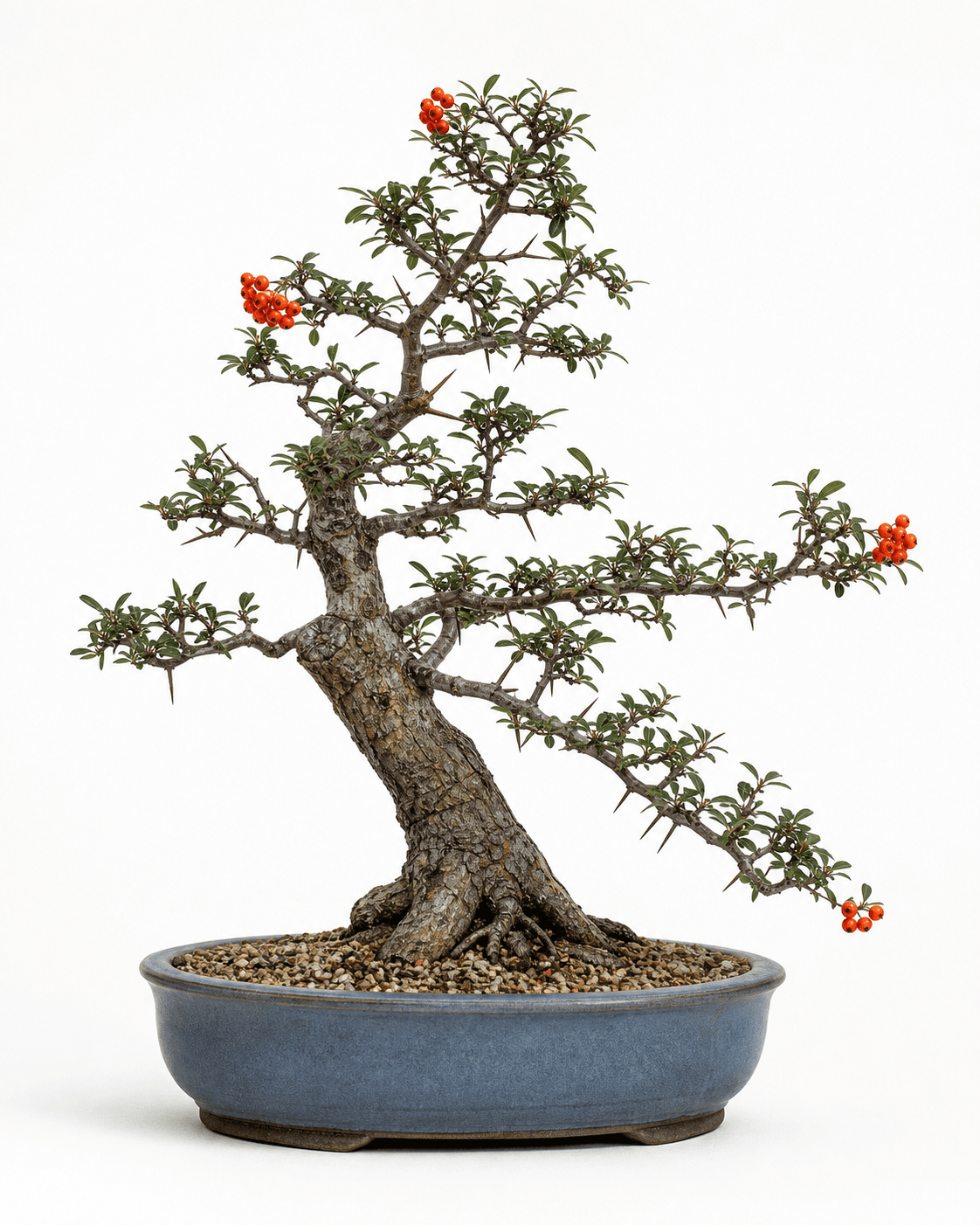
Pyracantha bonsai is an outdoor broadleaf evergreen shrub grown for small leaves, thorny twigging, white spring flowers, and orange, red, or yellow fruit. The tree rewards sun, airflow, steady root moisture, and pruning that preserves enough older wood for the next berry display.
In EntGrove taxonomy, Pyracantha sits in Broadleaf > Evergreen with cotoneaster, olive, boxwood, holly, and myrtle. Its care is shaped by retained foliage and active roots, while its display is shaped by older flowering wood, fruit load, thorns, scab, fire blight, and local invasive-risk rules.
Choose Pyracantha when you can grow outdoors year-round or provide bright, cold container protection in winter. Warm indoor culture weakens flowering, stretches internodes, raises pest pressure, and removes the seasonal rhythm that makes firethorn useful as bonsai.
Source depth is transferred rather than species-specific. Pyracantha appears in local Mirai corpus topic tags, but no reviewed claim text gives a Pyracantha-only technique. The method below applies Mirai broadleaf evergreen, flowering and fruiting, root, watering, soil, pruning, wiring, propagation, energy, and design principles conservatively, with Kew and extension sources grounding species facts.
Updated July 13, 2026. Written by EntGrove Editorial. Last verified July 13, 2026.
Care fingerprint
Read the species through its shared care pattern.
Protect from hard freezes when species demands it, prune with active foliage in mind, and repot when roots can recover without dormancy cues. Use this as the starting point before local conditions and tree strength refine the calendar.
Read the foliage first
Broadleaf stress usually shows in leaf color, leaf size, wilt, scorch, or delayed hardening before it becomes a branch problem.
Match work to dormancy
Deciduous, evergreen, tropical, succulent, and flowering broadleaf trees recover on different calendars.
Protect fine roots
Root work should preserve enough active fine roots for the tree to rehydrate quickly after the operation.
Care cadence
The calendar starts with the tree's seasonal state.
Placement
Timing: Grow outside in full sun to partial shade. In hot regions, shift to afternoon shade when the root ball cannot stay hydrated without cooking.
Watch for: Sparse flowers, weak berries, long internodes, scorched leaves, dry edges, and hot benches with no airflow.
Oregon State: P. coccineaRoyal Horticultural SocietyBonsai Mirai LibraryWatering
Timing: Water thoroughly when the surface and upper particles show drying on a leafy active tree. Let oxygen return between cycles, especially in cool weather.
Watch for: Fruit drop during dry heat, wet sour soil, root rot, water bypassing a dense core, and a pot that swings from dry to saturated.
Bonsai Mirai LibraryRoyal Horticultural SocietyUC IPM pyracanthaFertilizer
Timing: Feed during active growth according to stage: stronger in development, moderate during transition, and light in refinement. Mirai cautions that spring fertilizer affects future reserves more than the first flush already underway.
Watch for: Coarse extension, weak roots after repotting, excess late growth before cold, salt stress, and chasing flowers with single-nutrient inputs.
Bonsai Mirai LibraryPruning and berries
Timing: Use structural pruning in late winter to early spring or after bloom, then preserve selected 1-year-old and 2-year-old wood for flowers and fruit.
Watch for: Removing every spur, late-summer hard pruning, heavy fruit on weak trees, thorn injuries, and dense interiors that hold disease.
Clemson ExtensionRoyal Horticultural SocietyBonsai Mirai LibraryWiring
Timing: Wire young shoots after the flush hardens enough to handle. Use guy wires, pruning, and replacement shoots for older thorny wood.
Watch for: Cracking hardened branches, wire bite hidden by leaves and thorns, wounds from handling, and bends that would read cleaner as clip-and-grow.
Bonsai Mirai LibraryRoyal Horticultural SocietyRepotting
Timing: Repot in spring as buds swell when roots, drainage, or soil breakdown justify work. Keep root work lighter on trees being prepared for flower and fruit display.
Watch for: Slow drainage, compacted nursery cores, winter-damaged roots, fruiting pressure after root work, and cold aftercare.
Bonsai Mirai LibraryClemson ExtensionPests and disease
Timing: Inspect at bloom, after wet spring weather, during dense summer growth, and before winter display. Scab and fire blight change the work plan fastest.
Watch for: Aphids, scale, spider mites, lace bugs, leaf miners, caterpillars, scabby black leaves or berries, blossom blight, and sudden blackened shoot tips.
UC IPM pyracanthaUC IPM fire blightRHS pyracantha scabNC State ExtensionWinter protection
Timing: Protect the pot before sustained hard freezes, especially in Zone 5 and cold Zone 6 conditions. Keep the tree cold and bright; warm indoor storage weakens it.
Watch for: Root balls freezing solid, drying winter wind, premature warm-room growth, spring push followed by collapse, and birds stripping the fruit display.
Clemson ExtensionOregon State: P. coccineaBonsai Mirai LibrarySpecies guide
Apply the species profile before copying another tree's calendar.
At a glance
Pyracantha is a sun-loving, thorny fruiting shrub for outdoor bonsai.
The botanical working range for bonsai is Pyracantha angustifolia and P. coccinea in Rosaceae, with nursery material often sold simply as firethorn or by cultivar. Kew accepts both names, and extension sources describe P. coccinea as a broadleaf evergreen to semi-evergreen spiny shrub with white spring flowers and orange-red fruit. Kew POWO: P. angustifoliaKew POWO: P. coccineaNC State Extension
The practical spec is compact but demanding: outdoor full sun to partial shade, steady summer water, free-draining mineral soil, spring root work, selective pruning that preserves older flowering wood, and disease-aware cleanup. Clemson gives Zones 6 to 9 for P. coccinea, with hardy cultivars possibly reaching Zone 5 in the ground. Clemson ExtensionRoyal Horticultural SocietyBonsai Mirai Library
The best bonsai sizes are shohin through medium trees where small leaves, thorns, tight branchlets, and fruit clusters remain in scale. Informal upright, slanting, clump, cascade, semi-cascade, root-over-rock, and hedge-derived shrub compositions suit the species better than conifer-style pad work. Bonsai Mirai / AsymmetryClemson Extension
Wild habitat
Wild firethorn explains the need for sun, drainage, thorns, and seasonal display.
Kew places P. angustifolia in temperate habitat from the eastern Himalaya through southern China, and P. coccinea from southern Europe through Iran. Clemson summarizes the broader firethorn group as native from southern Europe eastward to China. Kew POWO: P. angustifoliaKew POWO: P. coccineaClemson Extension
In the wild and in hedges, firethorn uses dense thorny branching, glossy leaves, spring flowers, and bird-attracting fruit. Oregon State notes best fruiting in sun, partial-shade tolerance, and orange-red fruit that can persist into winter. NC State ExtensionOregon State: P. coccinea
The design implication is a small defensive shrub with a very different feel from a smooth deciduous tree. Use thorns, angular branch rhythm, fruit placement, and a slightly wild outline as part of the character, while keeping enough negative space for the berries to read. Bonsai Mirai / AsymmetryBonsai Mirai Library
Reading the tree
Read Pyracantha by stage: development builds structure, refinement earns fruit.
Mirai broadleaf evergreen method treats retained foliage as the tree battery. Healthy leaves keep photosynthesizing whenever temperature allows, so weak, yellowing, pest-stressed, or winter-damaged trees should recover before pruning, defoliation, repotting, or display pressure. Bonsai Mirai Library
Development trees should run, thicken, and be cut back after growth hardens. Refinement trees need more restraint: preserve interior buds, choose where flower wood is useful, remove excessive fruit on weak branches, and prevent the canopy from becoming a disease-holding shell. Bonsai Mirai LibraryRoyal Horticultural SocietyClemson Extension
Fruiting is an energy decision. Mirai fruiting-bonsai method prioritizes roots, branching, and credible tree form first; flowers and fruit become the seasonal reward once the tree can afford them. Bonsai Mirai Library
Pruning
Prune for structure first, then preserve the wood that carries flowers and berries.
Clemson says Pyracantha flowers and berries are produced on at least 1-year-old growth, and RHS recommends retaining as much 2-year-old wood as possible when berry display matters. Late-summer or early-fall pruning can remove the next display and push tender growth into cold weather. Royal Horticultural SocietyClemson Extension
Mirai broadleaf evergreen refinement gives the core rhythm: let the spring flush elongate and harden back to an energy-positive state, then prune overlong shoots to interior buds for a finer second flush. On flowering tips, let flowers finish and choose pruning based on display goals. Bonsai Mirai Library
Use stronger cutback when trunk taper, primary branches, and branch replacement matter more than the current bloom. On refined trees, prune to reveal fruit, remove dead or diseased wood, thin congested crotches, and retain selected short spur-bearing wood. Bonsai Mirai LibraryRoyal Horticultural SocietyClemson Extension
Repotting
Repot at spring bud-swell and keep fruiting pressure secondary to root health.
Mirai beginner and broadleaf evergreen repotting method places root work in spring as buds swell, before active growth demands peak water. Repot when water no longer penetrates, the soil has broken down, the root mass is too dense, or a nursery core must be converted. Bonsai Mirai Library
Clemson notes that Pyracantha resents transplanting in the landscape. Mirai classifies broadleaf evergreens as sheen-based trees whose established root core should remain intact during major conversion. For bonsai, stage nursery-soil removal across repots, preserve functioning fine roots beneath the trunk, and avoid pairing heavy root reduction with heavy top reduction. Clemson ExtensionBonsai Mirai Library
A refined broadleaf evergreen rhythm of about 3 to 4 years is a starting point. A vigorous nursery conversion may need earlier staged intervention, while a stable refined tree can wait until drainage, root density, or soil breakdown says the root system needs work. Never bare-root merely to satisfy a calendar. Bonsai Mirai Library
Soil and pot
Use moisture-retentive mineral soil and a pot deep enough for fruiting energy.
RHS and Clemson agree on well-drained soil. Mirai soil method adds the bonsai mechanism: roots need water, nutrients, structural durability, and oxygen in the same shallow container. Royal Horticultural SocietyClemson ExtensionBonsai Mirai Library
For refinement, broadleaf evergreens respond well to akadama-rich mixes that support fine roots and tighter ramification. For development, a 1:1:1 akadama:pumice:lava mix is a useful baseline, adjusted wetter or drier by climate and particle size. Bonsai Mirai Library
Pot choice should support the display. Fruiting Rosaceae and other sheen-based flowering trees benefit from enough soil depth to maintain water movement, and colored or glazed containers can be chosen around the intended berry color and seasonal display. Bonsai Mirai LibraryBonsai Mirai / Asymmetry
Climate
Adapt around sun, winter roots, regional disease, and seed spread.
In mild climates, Pyracantha can stay active through much of winter, so water and disease checks continue even when growth slows. In cold regions, Mirai warns that container roots can be damaged even when the species is hardy in the ground; protect the pot before sustained hard freeze. Bonsai Mirai LibraryClemson Extension
In hot dry regions, sun may produce better fruit, while the shallow pot may need afternoon shade once the tree cannot keep pace with transpiration. Mirai watering method makes this a daily observation across foliar mass, reservoir size, and weather. Oregon State: P. coccineaRoyal Horticultural SocietyBonsai Mirai Library
Regional stewardship matters because birds spread fruit. Kew lists wide introduced ranges for both species, Oregon State notes birds distributing P. coccinea seed, and UC IPM cautions that some Pyracantha species are invasive weeds. Follow local restrictions and contain fruit, seedlings, and prunings. Kew POWO: P. angustifoliaKew POWO: P. coccineaOregon State: P. coccineaUC IPM pyracantha
Pests and diseases
Fire blight, scab, and dense-canopy pests define the risk profile.
UC IPM says firethorns are frequently damaged by fire blight, and the fire blight guide explains blossom and shoot symptoms, pollinator and rain spread, and canker carryover. Blackened hooked shoot tips after bloom deserve immediate extension-guided sanitation. UC IPM pyracanthaUC IPM fire blight
RHS describes pyracantha scab as a disease that can spoil flowers, leaves, and fruit, with black lesions and premature leaf fall. Clemson also flags scab, and recommends resistant cultivars as the most durable prevention. RHS pyracantha scabClemson Extension
Disease resistance varies by selection. Clemson and NC State identify cultivars bred or selected for stronger fire-blight or scab resistance. Buy clean named stock when disease pressure is common, avoid carrying weak fruiting plants into the collection, and keep enough interior space to inspect leaves, shoots, and berries. Clemson ExtensionNC State Extension
Common container pests include aphids, scale, mites, lace bugs, caterpillars, and leaf miners. UC IPM and NC State list several of these problems. In bonsai, dense twigging and thorns make inspection harder, so thin for light and air before pests are hidden inside the shell. UC IPM pyracanthaNC State ExtensionBonsai Mirai Library
Wiring
Wire young shoots, then let pruning carry most of the image.
Mirai structural wiring fundamentals still apply: correct angle, even spacing, continuous contact, and bends distributed across a span. On Pyracantha, thorns and fruiting wood make that work slower and more injury-prone. Bonsai Mirai LibraryRoyal Horticultural Society
Flowering and fruiting Rosaceae tissue tends to be coarse and brittle compared with finer deciduous species. Transfer that Mirai crabapple lesson conservatively: shape young flexible shoots early, use guy wires for heavier movement, and replace branches that would crack under a single dramatic bend. Bonsai Mirai Library
Check wire early in warm growth. Thorns and leaves hide bite, and a fruiting display can distract from swelling branches. If the line can be created with cutback, directional growth, or a branch replacement, that route usually ages better. Bonsai Mirai Library
Propagation
Use seed, cuttings, layers, and grafting only when local rules and source ethics allow it.
NC State lists seed as a recommended propagation strategy for P. coccinea, and RHS covers cuttings in garden practice. Bonsai use should favor compact, disease-resistant, legally sourced material over mass seed production from unknown plants. NC State ExtensionRoyal Horticultural Society
Mirai propagation method favors clean cuts, correct cutting maturity, reduced foliage, oxygen-rich media, controlled moisture, and gradual reintroduction to sun after rooting. On thorny Pyracantha, choose cuttings with short internodes and useful direction before rooting them. Bonsai Mirai Library
Air layers can rescue a useful branch line, but Rosaceae layers may produce coarse or uneven roots. Use the Mirai dry-out and oxygen-aware air-layer method cautiously, and do the work only on vigorous material with enough remaining foliage to recover. Bonsai Mirai Library
Grafting is mainly a cultivar and rootstock tool. Use it when disease resistance, fruit color, or branch placement justifies the scar, then keep graft unions visible in buying decisions because swollen unions can dominate a small bonsai. Clemson ExtensionBonsai Mirai Library
Buying
Buy for compact habit, disease resistance, clean roots, and verified berry color.
Clemson recommends buying when fruit color matters, and that advice is especially useful for bonsai. Red, orange, and yellow fruit read differently against bark, pot color, and fall foliage, while a cultivar tag can also signal disease resistance. Clemson ExtensionRoyal Horticultural Society
Look for a trunk line, low branches, short internodes, small leaves, interior buds, clean bark, and a root base that can be improved without removing every functioning root. Dwarf and compact cultivars deserve attention when the foliage and branch scale are good. Bonsai Mirai / AsymmetryBonsai Mirai LibraryNC State ExtensionClemson Extension
Red flags include scabby fruit, blackened shoot tips, cankers, heavy scale, lace-bug stippling, a wet peat core, severe girdling roots, fruiting on a weak tree, unknown wild-dug material, and species or cultivars restricted in your region. UC IPM pyracanthaUC IPM fire blightRHS pyracantha scabBonsai Mirai Library
Troubleshooting
Most problems trace to low light, bad root oxygen, lost flower wood, winter roots, or disease.
Long shoots with few flowers: increase sun, reduce nitrogen-heavy pushing in refinement, and prune after growth hardens so the next flush has shorter internodes. Oregon State: P. coccineaRoyal Horticultural SocietyBonsai Mirai Library
Buds form but berries fail: check pruning timing, spring frost, rainy bloom weather, summer drought, and whether the tree had enough strength to carry fruit. Clemson ExtensionBonsai Mirai Library
Leaves yellow while soil stays wet: improve drainage, reduce watering frequency, inspect for decomposed soil, and pause styling until roots recover. Bonsai Mirai LibraryUC IPM pyracantha
Spring growth starts then collapses: suspect winter root damage in the pot. Protect earlier next year and let the tree rebuild foliage and roots before asking for flowers. Bonsai Mirai Library
Shoot tips blacken or crook after bloom: treat fire blight as a serious possibility, isolate the tree, avoid working wet foliage, and follow current local extension guidance for sanitation, pruning distance, tool handling, and disposal. UC IPM fire blight
Fruit turns black or leaves drop with spots: compare symptoms with pyracantha scab, clean fallen leaves and fruit, improve airflow, and favor resistant cultivars for future material. RHS pyracantha scabClemson Extension
Seedlings appear around the bench or garden edge: remove them early, contain berries and spent fruit, and check whether your region restricts Pyracantha. Oregon State: P. coccineaUC IPM pyracantha
Design
Style Pyracantha as a thorny flowering shrub with fruit used as deliberate accent.
Mirai design method reads trunk line, defining branch, and apex first. On Pyracantha, the defining branch is often thorny, lateral, and slightly irregular, which suits informal upright, slanting, cascade, semi-cascade, and clump forms. Bonsai Mirai / AsymmetryBonsai Mirai Library
Use flowers and berries to reinforce the image and keep structure honest. If the trunk is humble, a tension design can add interest; if the plant has aged bark, a clean harmonious shrub form lets fruit and branch rhythm carry the composition. Bonsai Mirai / AsymmetryBonsai Mirai Library
Deadwood is secondary. Firethorn can have old thorns, cuts, and bark texture, but the strongest image is usually living branch architecture with visible fruit clusters, clean negative space, and a pot that quiets the sharpness of the foliage. Bonsai Mirai / AsymmetryClemson Extension
Forms
Cultivar choice affects scale, berry color, disease resistance, and handling.
P. coccinea, scarlet firethorn, is the most common extension-reference species here, with Southern European to Iranian origin, glossy leaves, sharp spines, white spring flowers, and orange-red fruit. Clemson also notes Chinese and Formosa firethorn species in the broader horticultural group. Kew POWO: P. coccineaNC State ExtensionClemson Extension
P. angustifolia, narrowleaf firethorn, anchors the Asian firethorn label, with Kew giving a native range from Arunachal Pradesh through southern China. Verify the tag before applying cultivar or hardiness claims from P. coccinea references. Kew POWO: P. angustifolia
Clemson and NC State list useful resistant or compact selections such as Apache, Fiery Cascade, Mohave, Navaho, Red Cushion, Teton, Tiny Tim, and related cultivars. For bonsai, compact habit, smaller leaves, known fruit color, thorn density, and scab or fire-blight resistance matter more than landscape popularity. Clemson ExtensionNC State Extension
Tiny Tim is notable in NC State notes for compact size and no thorns, while Teton and Gnome are flagged for cold hardiness. Treat cultivar claims as source-specific and verify the plant in fruit before paying for color or scale. NC State Extension
History
Pyracantha bonsai belongs to the flowering and fruiting shrub tradition.
Firethorn has been a garden shrub, hedge, espalier, barrier plant, and bird-fruit plant before it becomes bonsai material. Clemson notes its use as an informal screen, barrier, slope cover, container dwarf cultivar, and espalier subject. Clemson Extension
In bonsai, that history points toward compact seasonal display more than ancient trunk gravitas. The tree can be excellent at small scale when the grower builds credible branch structure first and then lets white flowers and fruit sharpen the season. Bonsai Mirai LibraryBonsai Mirai / Asymmetry
The exhibition standard is restraint: healthy foliage, visible thorny twig structure, clean disease-free fruit, a quiet pot, and enough negative space that the berry clusters read as deliberate accents. Bonsai Mirai / AsymmetryRHS pyracantha scabUC IPM fire blight
Species questions
Answer the beginner questions before styling.
Is Pyracantha a good beginner bonsai?
Yes for an outdoor grower who can give sun, airflow, winter root protection, and careful pruning. The tree grows strongly and makes a clear seasonal display, while thorns, disease, and fruit timing require attention.
Can Pyracantha bonsai live indoors?
Use outdoor culture as the standard. A bright cold frame, unheated greenhouse, or sheltered outdoor bench can protect the pot in winter; a warm dim room weakens flowering and growth.
How much sun does Pyracantha bonsai need?
Use full sun for the strongest flowers and berries where the root ball can keep up. Shift to partial shade during severe heat when the shallow container dries too quickly.
How often should I water Pyracantha bonsai?
Use root-zone condition instead of a fixed calendar. A leafy fruiting tree in warm sun may need frequent thorough watering; in cool weather, let oxygen return before watering again.
When should I repot Pyracantha bonsai?
Use spring bud-swell when roots, drainage, or soil breakdown justify work. A refined broadleaf evergreen rhythm is roughly every 3 to 4 years, but the root system decides.
When should I prune Pyracantha for berries?
Preserve selected 1-year-old and 2-year-old wood, because that is where flowers and fruit are carried. Do structural work in late winter to early spring or after bloom, then avoid late-season hard pruning.
Can I wire Pyracantha branches?
Yes, especially young hardened shoots. Check wire early because thorns and leaves hide bite, and use guy wires, pruning, or replacement growth for older stiff branches.
What diseases are most important on Pyracantha bonsai?
Watch fire blight and pyracantha scab first. Fire blight can blacken blossoms and shoots, while scab can spot leaves and fruit, reduce flowers, and spoil the berry display.
Should I let a young Pyracantha carry berries?
Usually only lightly. Fruit is expensive, so developing, weak, newly repotted, or recently collected trees should spend most of their energy on roots and branch structure.
Is Pyracantha invasive?
Some Pyracantha species are invasive or weedy in certain regions. Check local guidance, remove volunteer seedlings, and keep berries and prunings out of wild edges.
Sources
Species advice needs source discipline.
Next decisions
Plan the operation before copying the calendar.
A good care note for Pyracantha records the tree's stage, the work done, and the aftercare used. That record matters more than a month-name rule.
Related species
Compare nearby trees before transferring advice.
English boxwood
Buxus sempervirens
Japanese boxwood
Buxus microphylla
Korean boxwood
Buxus sinica var. insularis
English holly
Ilex aquifolium
Japanese holly
Ilex crenata