
Species guide
Sweet Plum Bonsai Care
Sageretia thea
Sweet plum bonsai, now treated botanically as Sageretia thea and still sold widely as Sageretia theezans, is a warm-protected tropical broadleaf for growers who can provide strong light, steady moisture, humidity, and frost-free winter shelter. Its main failure pattern is fast dehydration followed by twig dieback, with stale wet soil a close second.
There is no dedicated Sageretia file in the local Bonsai Mirai distilled corpus, so this guide applies Mirai tropical, broadleaf evergreen, watering, soil, repotting, wiring, propagation, energy, and design method to the Kew-accepted species. Bonsai Empire and Bonsai4Me are used only as supplemental species-specific checks for flowers, fruit, tender placement, pruning response, pests, and trade labels.
The practical beginner answer is cautious yes. Buy sweet plum only if you can keep it at a bright south or west window, under a serious grow light, or outside in warm weather, then bring it under protection before cold nights slow recovery.
Updated June 16, 2026. Written by EntGrove Editorial. Last verified June 16, 2026.
Care fingerprint
Read the species through its shared care pattern.
Treat indoor culture as a light-management problem first; prune and repot when the tree is actively growing and warm enough to recover. Use this as the starting point before local conditions and tree strength refine the calendar.
Note: Kew accepts Sageretia thea; bonsai trade references still commonly use Sageretia theezans.
Read the foliage first
Broadleaf stress usually shows in leaf color, leaf size, wilt, scorch, or delayed hardening before it becomes a branch problem.
Match work to dormancy
Deciduous, evergreen, tropical, succulent, and flowering broadleaf trees recover on different calendars.
Protect fine roots
Root work should preserve enough active fine roots for the tree to rehydrate quickly after the operation.
Care cadence
The calendar starts with the tree's seasonal state.
Placement
Timing: Grow in the brightest frost-free position available during cold months. Move outside for warm active growth once nights are reliably above 60 F / 16 C if possible, using filtered sun during transition.
Watch for: Cold windowsills, dry heater drafts, leaf scorch behind glass, weak winter light, and outdoor moves before the tree can recover from cool nights.
Bonsai Mirai LibraryBonsai EmpireBonsai4MeWatering
Timing: Water thoroughly when the top particles begin to dry but the root ball still carries moisture. Aim for evenly moist, oxygen-rich roots between thorough waterings.
Watch for: Leaf tips drying, brittle twig ends, water bypassing a compact root core, sour organic soil, brown tips from stagnation, and a small pot crossing from moist to dry in one warm day.
Bonsai EmpireBonsai Mirai LibraryHumidity and airflow
Timing: Raise local humidity with trays, grouped plants, or protected benches, while keeping air moving enough that leaves dry and pests are noticed early.
Watch for: Whitefly, aphids, mildew, sticky leaves, stagnant indoor corners, and misting leaves while the root problem remains unsolved.
Bonsai EmpireBonsai4MeFertilizer
Timing: Feed during active growth after the tree is hydrated and producing new shoots. Use moderate organic feeding for development and lighter feeding for refined trees.
Watch for: Fertilizer on dry soil, salts after repotting, weak winter growth pushed in low light, and feeding a tree whose yellowing foliage points to root imbalance.
Bonsai Mirai LibraryBonsai EmpirePruning
Timing: During active growth, let developing shoots extend and harden before cutting back. On refined trees, trim stronger shoots back to a compact outline while leaving weak interior growth intact.
Watch for: Constant tip nibbling, loss of interior buds, pruning late-summer display shoots before flowers and fruit, and cuts made while the tree is cold or weak.
Bonsai Mirai LibraryBonsai EmpireBonsai4MeLeaf work
Timing: Use partial leaf reduction only on a strong tree with bright light, warm temperatures, and active growth. Preserve foliage on weak or developing branches that need strength.
Watch for: Treating defoliation as a shortcut, removing solar panels before winter, yanking leaves from petioles, and asking a low-light tree to rebuild foliage.
Bonsai Mirai LibraryWiring
Timing: Wire young flexible shoots during active growth, then remove wire early. Use guy wires, clip-and-grow, or branch replacement for older stiff wood.
Watch for: Branch cracking, hidden wire bite, bark marking, wiring right after a dry-down, and forcing mature wood that should be rebuilt with new growth.
Bonsai EmpireBonsai4MeRepotting
Timing: Repot in spring or stable warm active growth when nights are warm and recovery is likely. Keep part of the root mass intact on leafy trees and transition organic nursery cores in stages.
Watch for: Bare-rooting a leafy weak tree, burying the crown, compact decomposed soil, a pot that dries too fast, and fertilizer before robust new growth returns.
Bonsai Mirai LibraryBonsai EmpirePropagation
Timing: Take softwood or semi-hardwood cuttings during warm active growth, ideally after a flush has hardened and nights stay warm enough for root initiation.
Watch for: Too much foliage on cuttings, cold perlite, direct sun before roots form, tugging cuttings from the medium, and fertilizing before active new roots appear.
Bonsai Mirai LibraryBonsai EmpireBonsai4MePests and diseases
Timing: Inspect under leaves whenever the tree comes indoors, after warm humid spells, and before placing it near other tropicals.
Watch for: Aphids, whitefly, sticky residue, pale leaves with green veins, brown tips, mildew, leaf drop, and ants that indicate sap-feeding insects.
Bonsai EmpireBonsai4MeWinter protection
Timing: Keep frost-free, bright, and protected from dry heater air. Reduce watering as growth slows, but avoid letting the root ball fully dry.
Watch for: Cold glass, warm rooms with weak light, stagnant humidity, a root ball staying wet for days, and major styling during low-metabolism winter conditions.
Bonsai Mirai LibraryBonsai EmpireBonsai4MeSpecies guide
Apply the species profile before copying another tree's calendar.
At a glance
Sweet plum is a fine-leaved warm-protected broadleaf with a narrow moisture margin.
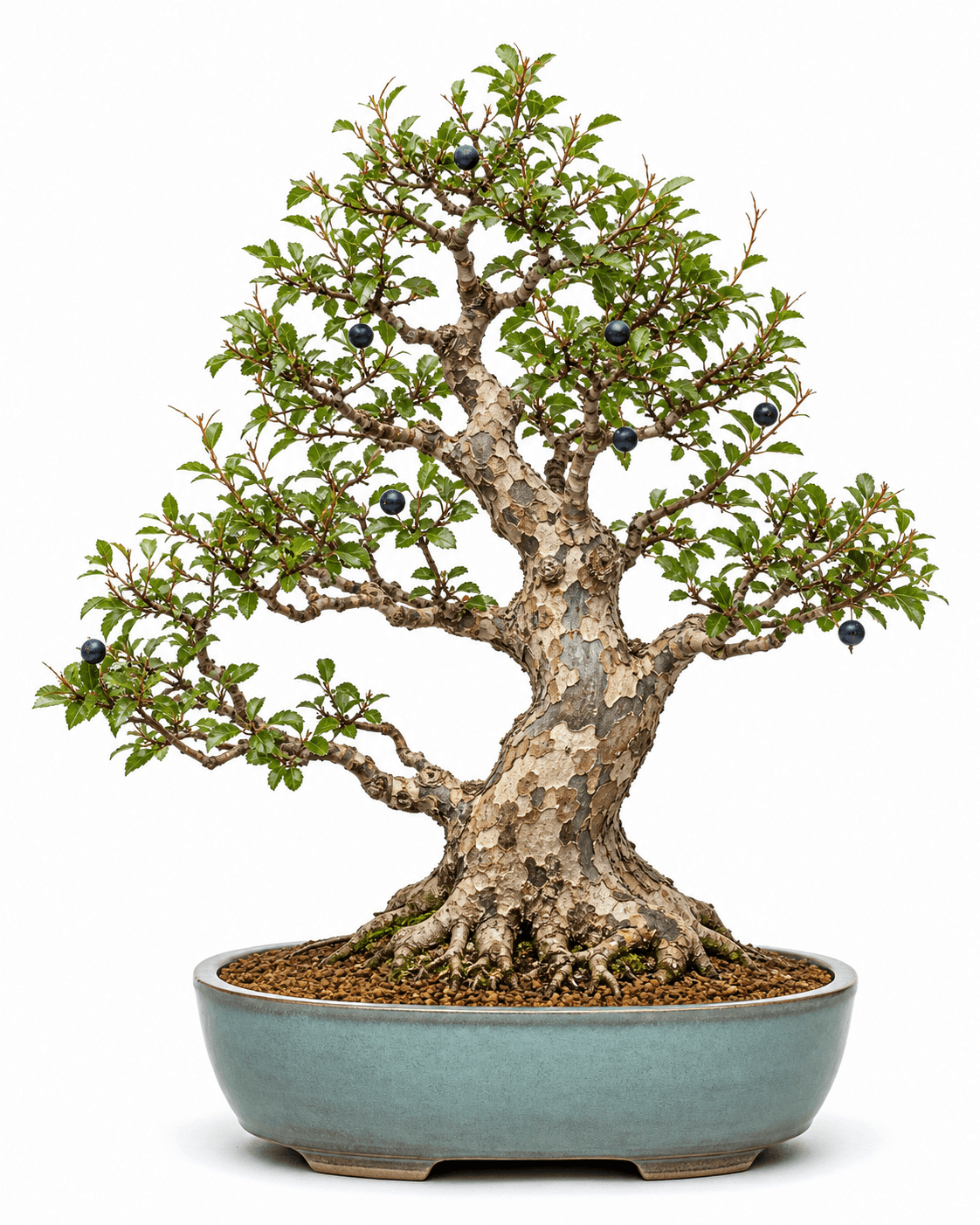
Sageretia thea is the accepted botanical name for the bonsai sold as sweet plum or Sageretia theezans. It belongs to Rhamnaceae and behaves in bonsai as a warm-protected tropical broadleaf with small glossy leaves, fine twigging, patching bark, and occasional small flowers and blue to dark fruit. Kew POWOBonsai EmpireBonsai4Me
The care definition is simple but demanding: bright light, moist oxygenated roots, humidity with airflow, frost-free winter shelter, and warm recovery after root or branch work. Mirai tropical method emphasizes that indoor culture only works when light, humidity, air movement, and water quality are engineered deliberately. Bonsai Mirai LibraryBonsai Empire
Use a medium-retentive aggregate soil, inspect roughly every 2-3 years, and avoid heavy winter work. The best designs are small to medium informal upright, broom-like, clump, twin-trunk, exposed-root, and shohin compositions that express age through fine branch division more than dramatic old-wood bending. Bonsai Mirai LibraryBonsai4Me
Wild habitat
Its wild range explains the warmth, moisture, and light demands in a pot.
Kew places Sageretia thea across a broad subtropical range from northeast Africa and the Arabian Peninsula through Central and South China, temperate East Asia, Japan, Korea, Southeast Asia, and the western Himalaya. It is a scrambling shrub, which matters for bonsai because it naturally wants to extend fine shoots through the canopy. Kew POWO
Useful Temperate Plants, drawing on Flora of China-style references, places the species in mountain forests, thickets, and hills below about 2,100 m in southern China and describes it as deciduous or partly evergreen. The bonsai implication is seasonal flexibility: it may shed leaves under stress or cold, but the grower should aim for warm active growth and steady recovery under a protected tropical calendar. Useful Temperate Plants DatabaseBonsai4Me
Design should read that ecology. A convincing sweet plum can look like a small thicket tree, warm-climate shrub, hedgerow survivor, or old field-grown trunk with a refined canopy. Smooth geometric pads and heavy forced bends usually fight the material. Bonsai Mirai / AsymmetryBonsai4Me
For care, the habitat lesson is moisture with oxygen. A scrambling subtropical shrub can use water quickly when warm and leafy, but a bonsai pot can also hold a sour organic core that excludes oxygen. Good culture solves both sides of that equation. Bonsai Mirai LibraryUseful Temperate Plants Database
Reading
Read light, root oxygen, shoot extension, and leaf texture before each cut.
Sweet plum tells you about light through internodes and leaf size. Mirai tropical method notes that tropical leaves enlarge and shoot extension stalls under insufficient light. On Sageretia, that shows as long pale growth, larger leaves, weak interior buds, and pruning wounds that fail to answer with compact new shoots. Bonsai Mirai Library
It tells you about water through leaf texture and twig tips. A leafy small pot in warm air can dry fast enough to kill fine twigs, while a compact indoor root core can stay wet and oxygen-poor. Check the soil particles, drainage speed, pot weight, and foliage response together. Bonsai EmpireBonsai Mirai Library
Development and refinement should be read branch by branch. A developing branch needs extension and leaves to build vascular strength; a refined branch can be pruned tighter after the shoot hardens. Mirai energy method treats growth itself as the signal that surplus energy exists. Bonsai Mirai Library
Health comes before technique. If foliage is yellow, sticky, limp, dusty with mildew, or dropping after a placement change, pause pruning, wiring, and fertilizing until light, water, airflow, and pests have been checked. Bonsai Mirai LibraryBonsai4Me
Pruning
Build branches by extension, then refine with selective cutback.
Sweet plum can ramify well because it produces fine growth and back buds readily when healthy. Bonsai Empire says shoots can be trimmed back to two leaves and Bonsai4Me notes dense new growth, but Mirai energy method adds the missing condition: the branch must have enough surplus energy to answer the cut. Bonsai EmpireBonsai4MeBonsai Mirai Library
For development, let selected shoots extend to gather energy and thicken the branch, then cut back after the tissue hardens. For refinement, cut stronger shoots earlier and leave weak interior shoots longer so they keep drawing water and storing energy. Bonsai Mirai LibraryBonsai4Me
Flower and fruit display changes pruning. Bonsai Empire advises avoiding late-summer trimming when flowers and fruit are wanted. In practice, let only a healthy refined tree carry display shoots, and remove most fruit from young, weak, or recently repotted trees. Bonsai EmpireBonsai Mirai Library
Avoid routine full defoliation. Mirai tropical guidance treats root maturation and tip management as the engine of smaller leaves and ramification, while full defoliation can slow development by forcing the tree to spend reserves rebuilding foliage. Bonsai Mirai Library
Roots
Repot during warmth and keep part of the leafy root system intact.
The published species guides give a roughly two-year spring rhythm for Sageretia, but the better rule is inspection. Repot when water no longer penetrates evenly, soil particles have broken down, the root mass has filled the container, or the design needs a different pot or angle. Bonsai EmpireBonsai4MeBonsai Mirai Library
Mirai tropical repotting method is especially important here: never bare-root a tree carrying leaves. Keep a functioning portion of the root mass intact so the foliage remains hydrated while new root tips form. Bonsai Mirai Library
Many retail sweet plum trees arrive in dense organic soil. Replace that core in stages if the tree is weak, recently shipped, or living in low indoor light. Fine dark decomposed soil deprives roots of oxygen, but removing it all at once can dehydrate the canopy. Bonsai Mirai LibraryBonsai Empire
After repotting, place the tree in bright protection with morning light or dappled shade, reduce wind, and withhold fertilizer until strong new growth returns. Root recovery is proven by growth and by the pot drying at a healthier rhythm. Bonsai Mirai Library
Soil and pot
Choose a deeper moisture-buffering pot and fine aggregate soil.
Sweet plum wants more water reserve than many conifers, but the reserve must be held in particles that still breathe. Mirai soil method uses akadama for water and nutrient retention, pumice for water availability with structure, and lava for durable oxygen movement. Bonsai Mirai Library
A useful development mix is 1:1:1 akadama, pumice, and lava, adjusted toward more akadama or slightly smaller particles as the tree enters refinement and the grower can water reliably. If the pot dries too quickly, solve pot depth and particle choice before resorting to heavy organic soil. Bonsai Mirai LibraryBonsai Empire
Pot choice should protect against the species weakness: rapid dry-down. Slightly deeper ovals, rectangles, and soft-cornered rounds give more useful root volume than very shallow display pots, especially indoors where humidity and watering consistency vary. Bonsai EmpireBonsai Mirai / Asymmetry
Visually, unglazed or quiet glazed pots both work. Use a restrained container for bark and twigging, or a muted glaze when the tree reliably flowers and fruits. The container should support the small-tree image without advertising itself. Bonsai Mirai / AsymmetryBonsai Empire
Climate
Adapt the calendar to warmth, light, and indoor protection.
In cool temperate climates, sweet plum is a protected tropical. Keep it indoors, under lights, or in a heated conservatory during cold months, then use the warm season outside to rebuild strength. Bonsai EmpireBonsai4MeBonsai Mirai Library
Bonsai Empire gives 53 F / 12 C to 72 F / 22 C as a winter indoor placement range and notes that warmer positions need more light. Bonsai4Me recommends conditions that rarely drop below about 10 C for continuous growth, while warning that permanent heat without night cooling is also stressful. Bonsai EmpireBonsai4Me
In warm humid climates, outdoor culture can be stronger than windowsill culture, but shade and humidity can also invite pests and mildew. Give bright filtered light, airflow, and watering tied to actual drying. Bonsai4MeBonsai Mirai Library
In hot dry interiors, the key is a small microclimate: bright light, a humidity tray or grouped plants, distance from forced-air vents, and a pot size forgiving enough for one late watering. Move the tree slowly between indoor and outdoor positions. Bonsai EmpireBonsai Mirai Library
Pests
Protected culture makes aphids, whitefly, mildew, and root problems more likely.
Bonsai Empire names aphids and whitefly as common Sageretia pests and notes rare mildew. Bonsai4Me also calls out aphids and whitefly under glass and recommends increasing air circulation if mildew appears. Bonsai EmpireBonsai4Me
Pale leaves with darker veins can indicate nutrient uptake trouble, water alkalinity, exhausted roots, or low light. Bonsai Empire mentions ferric fertilizer and less calcareous water, but bonsai triage should first check root oxygen, water quality, light, and recent stress. Bonsai EmpireBonsai Mirai Library
Brown tips can come from overwatering, root stagnation, salts, dry air, or a missed watering followed by partial root death. Avoid treating every brown tip as a fertilizer shortage; roots must breathe before fertilizer can help. Bonsai EmpireBonsai Mirai Library
Quarantine new sweet plum material before it joins ficus, Fukien tea, serissa, Premna, or other indoor tropicals. Sticky residue, ants, whitefly adults, webbing, or mildew on one tree can spread quickly in a warm indoor shelf. Bonsai4MeBonsai Empire
Wiring
Wire young shoots, then let pruning carry the mature structure.
Bonsai Empire says young branches and shoots can be wired in spring, while older branches are stiff and difficult to bend. Bonsai4Me goes further and says selective pruning can often shape the tree enough that wiring can be avoided. Bonsai EmpireBonsai4Me
Use Mirai structural wiring basics when wire is needed: consistent coil angle, continuous contact, no constriction, and bends distributed across a longer span. Small Sageretia shoots can mark quickly, so inspect wire often during warm growth. Bonsai Mirai Library
Skip wiring after a dry-down, after heavy root work, or while the tree is in a low-light winter position. The branch may bend, but the tree may lack the energy to heal damage or reset growth direction. Bonsai Mirai LibraryBonsai Empire
For mature structure, use clip-and-grow, guy wires, and branch replacement. This preserves the fine twig character and avoids the common failure of cracking an older stiff branch to chase a shape that a new shoot could make more cleanly. Bonsai4MeBonsai Mirai / Asymmetry
Propagation
Cuttings are the practical route for bonsai-scale material.
Bonsai Empire and Bonsai4Me both describe softwood and hardwood cuttings as easy during the growing season. For bonsai, cuttings are useful because they let you select compact leaves, short internodes, and low movement from parent material. Bonsai EmpireBonsai4Me
Mirai propagation method favors warm nights, a humid but oxygenated medium such as perlite, reduced foliage, and lower light while roots form. Wait until roots are visible or resistance is clear before transitioning into bonsai soil. Bonsai Mirai Library
Seed is possible botanically, but it is slower and less useful when the goal is known leaf scale and branch character. Use seed only when you want variation or have no access to good cutting material. Useful Temperate Plants DatabaseBonsai Mirai Library
Air layering can be used on vigorous warm-season shoots or branches when the existing line is better than a cutting would provide. Keep the layer warm, moist, and supported, then protect it from hard styling after separation. Bonsai Mirai Library
Buying
Buy for fresh tips, clean roots, and usable young branches.
Most sweet plum bonsai are sold as imported or nursery-grown indoor bonsai. Bonsai4Me notes that thick-trunked specimens are often field-grown in China because the species is slow to thicken in ordinary container culture. Bonsai4MeBonsai Empire
Inspect the tree before the bark seduces you. Look for fresh green tips, live interior buds, evenly moist but clean-smelling soil, no whitefly under leaves, no sticky residue, and branches you can build with pruning, clip-and-grow, and young replacement shoots. Bonsai EmpireBonsai4Me
Avoid trees with wrinkled leaves, brittle shoot tips, a root ball that pulls away from the pot edge, standing-water smell, or a decorative pot with no real drainage. Those are health problems first. Bonsai Mirai LibraryBonsai Empire
If buying online, ask when the tree was last repotted, what soil it is in, whether it has been under glass, and how it will be protected during shipping. A recently dried Sageretia can look acceptable in a listing photo and fail after arrival. Bonsai EmpireBonsai Mirai Library
Troubleshooting
Most sweet plum problems trace to water, light, cold, pests, or stale humidity.
Symptom: crispy leaves or brittle twig tips. Likely cause: the root ball dried too far, or roots were already damaged and failed to supply the canopy. Fix: rehydrate carefully, move to bright protected humidity, avoid fertilizer, and wait for new buds before pruning. Bonsai EmpireBonsai Mirai Library
Symptom: brown leaf tips while the soil stays wet. Likely cause: root oxygen loss, decomposed organic soil, overwatering, salts, or cold wet roots. Fix: improve drainage and warmth, water by particle moisture, and plan staged repotting when growth returns. Bonsai EmpireBonsai Mirai Library
Symptom: long pale growth and bigger leaves. Likely cause: weak light. Fix: increase light gradually with a brighter window, grow light, or warm-season outdoor placement, then prune after the new growth hardens. Bonsai Mirai LibraryBonsai Empire
Symptom: sticky leaves, ants, or tiny white insects. Likely cause: aphids, whitefly, or other sap-feeding pests. Fix: isolate, wash foliage, inspect undersides, improve airflow, and treat according to local label guidance. Bonsai EmpireBonsai4Me
Symptom: mildew on leaves. Likely cause: humid stagnant air, especially under glass. Fix: keep humidity but increase air circulation, remove affected leaf litter, and avoid crowding the tree in a still corner. Bonsai4Me
Symptom: leaf drop after a move indoors. Likely cause: light drop, dry air, cool roots, pest hitchhikers, or watering carried over from outdoor summer. Fix: stabilize placement, inspect pests, reduce watering frequency to actual uptake, and add light before pruning. Bonsai Mirai LibraryBonsai Empire
Design
Use fine twigging and bark as the design strengths.
Start by reading trunk line, defining branch, and apex. Mirai design method uses those three elements to set harmony, tension, or dynamic movement. Sweet plum often works best when the design accepts its small shrub or thicket character. Bonsai Mirai / Asymmetry
The bark is a real asset. Bonsai Empire describes dark bark that peels in irregular patches, and Bonsai4Me notes scaly dark bark. Show that trunk by clearing clutter, choosing a front with movement, and building fine branch division around it. Bonsai EmpireBonsai4Me
Let heavy deadwood stay secondary. Sageretia reads as a living fine-twigged broadleaf, so age is usually expressed through bark, branch density, compact leaves, and a quiet pot more than carved scars. Bonsai Mirai / Asymmetry
For shohin and small trees, simplify. Keep one clear trunk movement, one dominant side branch or canopy direction, and enough open space for the small leaves to read as a tree form, with clipped-hedge density avoided. Bonsai Mirai / AsymmetryBonsai4Me
Forms
Most trade variation is about labels and source quality.
Sweet plum bonsai rarely sells by named cultivar in the way Satsuki azalea, Japanese maple, or Japanese black pine do. The useful buying categories are leaf size, trunk thickness, bark quality, internode length, branch placement, and root health. Bonsai4MeBonsai Empire
Keep Sageretia thea and Sageretia theezans labels together in records. Kew accepts the former and treats the latter as a synonym, while many older bonsai tags, books, and retailers still use the theezans name. Kew POWOBonsai EmpireBonsai4Me
Separate Sageretia from Serissa, Fukien tea, Neea, Premna, tropical privets, and boxwood before applying care advice. Similar small leaves can hide very different root tolerance, cold tolerance, and pruning response. Bonsai Mirai LibraryKew POWO
If you find unusually compact or small-leaf material, propagate it before styling hard. Cuttings preserve the traits that matter most in small Sageretia bonsai. Bonsai Mirai LibraryBonsai Empire
History
Sweet plum is an indoor-bonsai trade staple with better potential than its reputation suggests.
The species entered many Western collections through the indoor bonsai trade, where it was often sold to beginners as a small leafy tree for a windowsill. That history explains both its popularity and its failure rate. Bonsai EmpireBonsai4Me
Bonsai4Me notes field-grown Chinese production behind many thick-trunked imported trees. Those trunks can be useful, but the grower still has to rebuild the root environment, light, and fine branching after import stress. Bonsai4MeBonsai Mirai Library
A high-quality sweet plum should show clean foliage, alive interior buds, controlled moisture, bark character, compact extension, and no hidden pest residue. Exhibition quality depends more on health and proportion than on flowers or fruit. Bonsai Mirai / AsymmetryBonsai Empire
Its value as a teaching tree is sharp: it exposes weak indoor light, careless watering, stagnant humidity, over-eager trimming, and root-zone oxygen problems faster than forgiving tropicals. That makes good recordkeeping especially useful. Bonsai Mirai LibraryBonsai Empire
Species questions
Answer the beginner questions before styling.
Is sweet plum a good beginner bonsai?
Yes for an attentive grower with bright light, frost-free winter protection, steady watering, and pest discipline. It is less forgiving of missed watering than ficus.
Is sweet plum the same as Sageretia theezans?
Yes in normal bonsai trade usage. Kew accepts Sageretia thea and lists Sageretia theezans as a synonym, while many retailers and older bonsai sources still use Sageretia theezans.
Can sweet plum bonsai live indoors?
Yes, with bright light, humidity, airflow, and careful watering. A south or west window or a strong grow light is usually needed, and warm-season outdoor growth is valuable when nights are stable.
How often should I water sweet plum bonsai?
Water when the upper particles begin to dry while the root ball still carries moisture. Keep it evenly moist with oxygen, and avoid both full dry-downs and sour wet soil.
When should I repot sweet plum bonsai?
Inspect every 2-3 years and repot in spring or stable warm active growth when drainage, root density, soil breakdown, or design needs justify it. Keep part of the root mass intact on leafy trees.
When should I prune sweet plum bonsai?
Prune during active growth after shoots harden, unless you are pinching a strong refined tree. Let developing branches extend first, then cut back to build branch strength and ramification.
Can I wire sweet plum bonsai?
Wire young flexible shoots only and check often in warm growth. Older branches become stiff, so pruning, guy wires, and replacement growth are usually safer.
Why is my sweet plum dropping leaves?
Common causes include dry roots, waterlogged roots, weak light, cold drafts, dry heater air, pests such as aphids or whitefly, and mildew from humid stagnant air.
Does sweet plum need winter dormancy?
It needs frost-free winter protection and lower-stress care when light and temperature drop. Protect it from temperate-style chilling, while using cooler bright nights when they are available and safe.
Can sweet plum bonsai flower and fruit indoors?
It can flower and fruit when strong and well lit, but fruit should be treated as a display choice. Remove fruit on young, weak, recently repotted, or low-light trees so the tree keeps energy for recovery.
Sources
Species advice needs source discipline.
Next decisions
Plan the operation before copying the calendar.
A good care note for Sweet plum / Chinese sweet plum records the tree's stage, the work done, and the aftercare used. That record matters more than a month-name rule.
Related species
Compare nearby trees before transferring advice.
Ficus retusa / Indian laurel
Ficus microcarpa
Tigerbark ficus
Ficus microcarpa 'Tigerbark'
Willow-leaf ficus
Ficus salicaria
Benjamin fig
Ficus benjamina
Ginseng ficus
Ficus microcarpa 'Ginseng'