
Species guide
Alder Bonsai Care
Alnus spp.
Alder bonsai need outdoor deciduous culture, reliable moisture, oxygenated soil, and repeated pruning after shoots have enough strength to respond. They suit growers who can water carefully and enjoy fast broadleaf development more than tiny polished shohin work.
This is a genus-level Alnus guide. Kew accepts Alnus in Betulaceae, and common bonsai or nursery labels may refer to common or black alder, red or Oregon alder, Japanese alder, Italian alder, white alder, cutleaf forms, or other local species.
The local Mirai corpus has thin direct Alder coverage, with one direct red alder selection note and one alder dieback note. The care method below is therefore sourced from Mirai deciduous broadleaf method, then narrowed with Kew, NC State, Oregon State, and USDA red-alder evidence for taxonomy, habitat, hardiness, root biology, pests, and propagation.
Updated June 17, 2026. Written by EntGrove Editorial. Last verified June 17, 2026.
Care fingerprint
Read the species through its shared care pattern.
Repot and structural prune around dormant-to-active transitions; protect new leaves; time refinement work after growth hardens. Use this as the starting point before local conditions and tree strength refine the calendar.
Note: Shared Alnus group page covering alder bonsai culture; verify exact species before applying hardiness, leaf scale, invasive-region, or wet-soil tolerance advice.
Read the foliage first
Broadleaf stress usually shows in leaf color, leaf size, wilt, scorch, or delayed hardening before it becomes a branch problem.
Match work to dormancy
Deciduous, evergreen, tropical, succulent, and flowering broadleaf trees recover on different calendars.
Protect fine roots
Root work should preserve enough active fine roots for the tree to rehydrate quickly after the operation.
Care cadence
The calendar starts with the tree's seasonal state.
Placement
Timing: Grow outdoors through a full deciduous season. Use a cold frame, mulch bed, or protected bench for small pots, recent repots, young collected material, and trees near the lower edge of the confirmed species hardiness.
Watch for: Warm indoor storage, wind-dried winter pots, root balls frozen solid while dry, and applying red-alder Zone 5 guidance to an unidentified Alnus.
Kew POWO: AlnusOregon State Landscape PlantsNC State ExtensionBonsai Mirai LibraryLight requirement
Timing: Use full sun in cool or moist conditions. Add afternoon shade when heat, wind, leaf mass, or a shallow container make the pot dry faster than the root system can safely handle.
Watch for: Long internodes in shade, leaf scorch from a dry pot, and weak inner buds under dense summer foliage.
NC State ExtensionOregon State Landscape PlantsBonsai Mirai LibraryWatering
Timing: Water when the surface begins to dry while the interior still holds moisture. A leafy Alder in warm wind may need repeated checks because foliage mass, container volume, and weather drive the decision.
Watch for: Hydrophobic nursery cores, hard dry-down during active growth, standing winter water, sour organic pockets, and yellowing from roots that stay wet without oxygen.
Bonsai Mirai LibraryNC State ExtensionUSDA NRCS plant guideFertilizer
Timing: Feed by stage. Use stronger organic feeding while building trunk, wound closure, and branch structure; moderate feeding once refinement and shorter internodes matter.
Watch for: Coarse shoots on refined trees, weak response after repeated pruning, fertilizer pushed before post-repot root recovery, and treating Frankia nodules as a complete nutrition plan.
Bonsai Mirai LibraryOregon State Landscape PlantsUSDA NRCS plant guidePruning
Timing: Let development shoots extend and harden when branch strength or trunk thickening is needed. In refinement, cut back before unchecked extension shades the interior and sheds weaker shoots.
Watch for: Dieback after cuts without viable nodes, crowded junctions that swell, long straight internodes, and low branches weakened by a top-heavy crown.
Bonsai Mirai LibraryWiring
Timing: Wire only healthy flexible shoots and young branches. Use clean contact, broad bend distribution, and frequent checks once spring leaf mass starts driving thickening.
Watch for: Wire bite on soft bark, bends concentrated at one point, branch splits, wiring immediately after heavy root work, and tips left upside down after in-leaf wiring.
Bonsai Mirai LibraryRepotting
Timing: Repot in spring as buds swell and before active growth, or earlier only when protected winter facilities make that local practice reliable. Keep exposed roots hydrated during the operation.
Watch for: Slow drainage, broken-down particles, compacted field or nursery cores, root work after leaves expand, and moving collected wet-site seedlings straight into shallow display pots.
Bonsai Mirai LibraryNC State ExtensionPropagation and sourcing
Timing: Sow seed or collect legal seedlings when young roots can be handled. Air layer during the broadleaf window after the first flush hardens if the best base sits above a flawed lower trunk.
Watch for: Sparse radial roots, layer separation before roots lignify, seedling tap or sinker roots that need staged correction, and collection from sites where permission or local ecology is unclear.
USDA NRCS plant guideBonsai Mirai LibraryPest and disease checks
Timing: Inspect soft spring shoots, dense summer foliage, humid leaf-spot periods, and trees recovering from drought, bad drainage, collection, or hard pruning.
Watch for: Tent caterpillars, sawflies, leaf beetles, borers, heart rot in older material, leaf spotting, root rot, and pest pressure on soft weak growth.
NC State ExtensionOregon State Landscape PlantsUSDA NRCS plant guideBonsai Mirai LibrarySpecies guide
Apply the species profile before copying another tree's calendar.
At a glance
Alder is a fast deciduous bonsai subject for moist outdoor benches.
Botanical target: Alnus spp., family Betulaceae. Use this page for confirmed Alder labels such as common alder, black alder, red alder, Oregon alder, Pacific coast alder, Japanese alder, Italian alder, white alder, and cutleaf alder forms, then verify the exact species before making winter or invasive-region decisions. Kew POWO: AlnusKew POWO: Alnus glutinosaKew POWO: Alnus rubraOregon State Landscape Plants
Care summary: Broadleaf > Deciduous, outdoor dormancy, full sun to partial shade, generous water, oxygenated soil, spring root work, repeated pruning, gentle wiring, and medium to large scale. Red alder landscape references give Zone 5 or Zones 5a to 6b, while other Alnus species need their own hardiness checks. NC State ExtensionOregon State Landscape PlantsBonsai Mirai Library
Best fit: an outdoor grower who waters reliably and wants fast broadleaf feedback. The weak points are hard dry-down, stale wet soil, pruning without viable nodes, wire scars on young bark, and stock labels that say only Alder. Bonsai Mirai LibraryNC State Extension
Wild habitat
Alder character comes from wet margins, open light, and quick colonization.
Kew gives the Alnus genus a broad temperate native range, so the word Alder describes a group rather than a single care calendar. Kew accepts Alnus glutinosa as a temperate tree from Europe to western Siberia and Iran, and Alnus rubra as a temperate tree from Alaska to California. Kew POWO: AlnusKew POWO: Alnus glutinosaKew POWO: Alnus rubra
Red alder gives the clearest North American bonsai model. Oregon State describes it as a Pacific Coast broadleaf deciduous tree, and USDA NRCS places it most often in moist coastal areas, along streams, lakes, wet forests, and disturbed open sites where seed can establish quickly. Oregon State Landscape PlantsUSDA NRCS plant guideNC State Extension
Care implication: the bonsai pot should stay evenly moist and airy, with strong light when water supply is stable. Design implication: favor upright, clump, grove, raft, and streamside broadleaf images that make sense for a fast pioneer tree rather than forcing aged conifer deadwood language onto soft deciduous tissue. Bonsai Mirai / AsymmetryBonsai Mirai LibraryOregon State Landscape Plants
Reading the tree
Read Alder through vigor, water movement, dieback risk, and scale.
Mirai names red alder as an example of native, locally grown deciduous material that can become excellent bonsai when expressed at the right scale and character. That phrase matters because Alder leaves, growth speed, and wet-site ecology usually ask for medium or larger compositions. Bonsai Mirai LibraryBonsai Mirai / AsymmetryNC State Extension
Alder belongs with high-water-mobility broadleaf subjects. Mirai groups alder with birch, Zelkova, and tamarisk as easy-dieback material, then recommends cycles of cutback and regrowth to establish interior buds and compartmentalized tissue before a branch is allowed to run freely. Bonsai Mirai Library
Use growth as the diagnostic. Strong extension means the tree has surplus energy for development work. Short weak shoots, interior dieback, yellow leaves in wet soil, or sudden scorch after heat point back to roots, water, oxygen, and timing before they point to styling. Bonsai Mirai Library
Pruning
Use Alder speed in development, then prune before the interior is shaded out.
During development, let chosen shoots extend and harden so leaves can thicken trunks, close wounds, and strengthen branch lines. Mirai energy work treats full extension and hardening as the way developmental branches repay the tree before cutback. Bonsai Mirai Library
For refinement, avoid letting every shoot run. Alder can shade the interior quickly, and Mirai specifically groups alder with easy-dieback species that need cutback and regrowth cycles before free extension. Cut back to viable nodes, preserve branch collars, and seal larger wounds on valuable structure. Bonsai Mirai Library
Work by branch purpose. Let sacrifice branches run only where the trunk, base, wound closure, or primary branch needs mass; shorten or remove competing shoots before they create swollen junctions. Keep lower and interior growth lit because weak branches are the first to be shed on fast deciduous material. Bonsai Mirai LibraryBonsai Mirai / Asymmetry
Leaf reduction is an outcome of health, timing, and ramification. Red alder landscape leaves are 3 to 6 inches by NC State, so a convincing Alder bonsai normally depends on proportion, not miniature foliage alone. NC State ExtensionBonsai Mirai Library
Repotting
Repot at spring bud swell and preserve the roots that keep a thirsty tree stable.
Mirai repotting fundamentals place root work in spring as buds swell and before active growth begins. For Alder, that timing keeps the operation ahead of peak leaf-driven water demand. Bonsai Mirai Library
The first transition from field, nursery, or collected wet-site material should be staged. Remove compacted or hydrophobic soil in a way that preserves enough fine roots, corrects circling or downward roots, and avoids taking a vigorous wetland seedling straight into a tiny display pot. Bonsai Mirai LibraryNC State Extension
Frankia nodules are part of the root story. Oregon State, NC State, and USDA describe red alder root nodules tied to nitrogen fixation. Preserve living fine-root function and oxygen access after repotting rather than chasing a sterile, over-cleaned root system. Oregon State Landscape PlantsNC State ExtensionUSDA NRCS plant guide
Aftercare is moisture with air. Secure the tree, settle particles thoroughly, protect from drying wind and harsh sun, then resume fertilizer only after growth shows the roots are functioning. Bonsai Mirai Library
Soil and pot
Build an evenly wetting pot that still breathes after every watering.
Mirai soil fundamentals frame bonsai substrate around water, oxygen, nutrient retention, and structural durability. For Alder, the practical goal is an akadama-forward or balanced akadama, pumice, and lava structure that wets evenly, drains cleanly, and does not collapse into anaerobic mud. Bonsai Mirai Library
Moisture tolerance in the landscape translates into higher watering tolerance in bonsai, not permission for stagnant soil. NC State lists red alder as tolerant of wet soils and poor soils across clay, loam, sand, and shallow rocky textures; a bonsai container needs far more control because roots are confined. NC State ExtensionBonsai Mirai Library
Pot choice should support the design stage. Use larger training boxes or deeper ovals while building roots, trunk, and wound closure; move toward shallower containers only after the root pad, watering routine, and leaf scale justify the visual compression. Bonsai Mirai LibraryNC State Extension
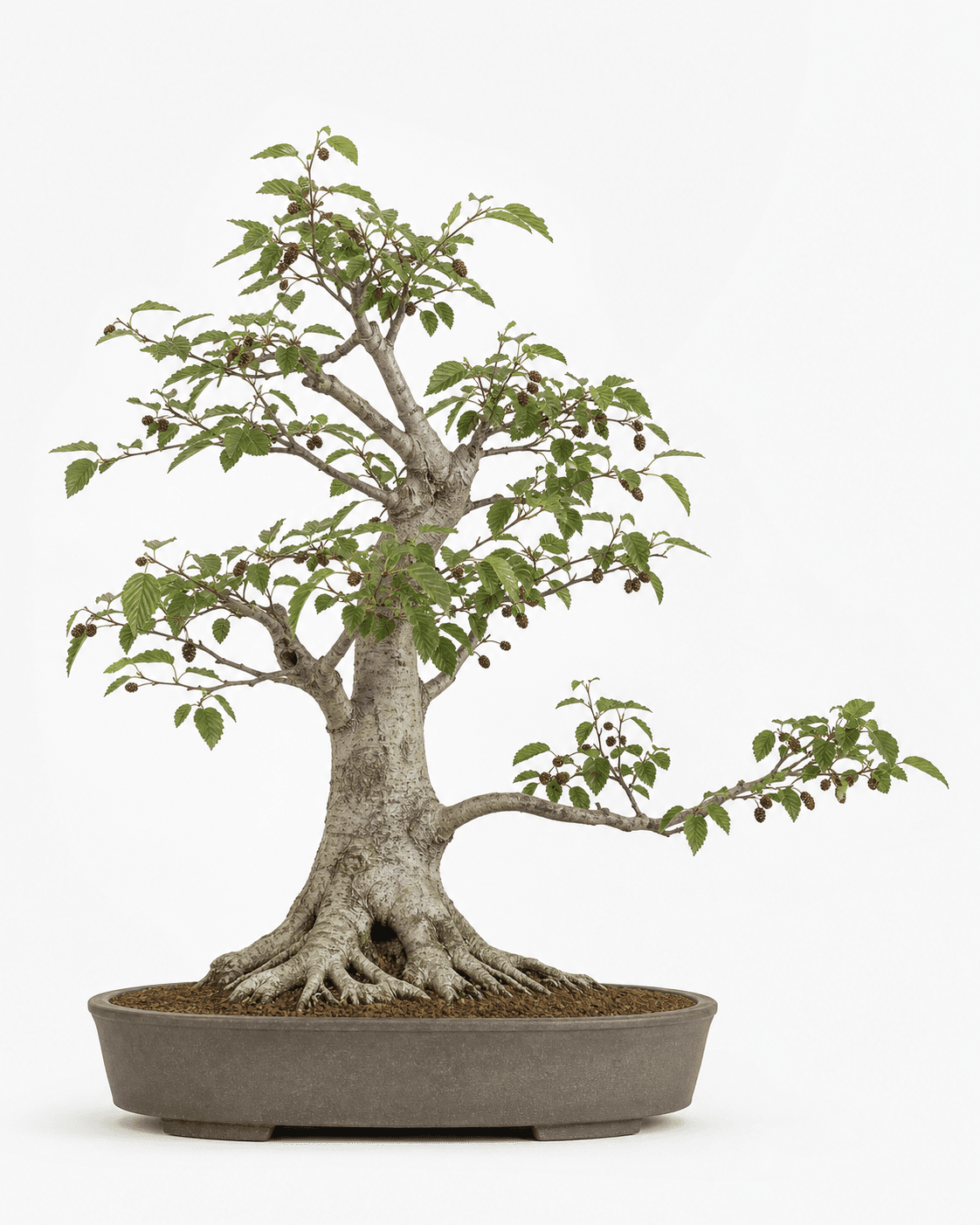
Visually, unglazed brown, gray, muted ochre, or quiet earth-toned pots suit the wetland broadleaf character. A grove or clump often looks better in an oval, slab, or broad shallow container than in a tall formal pot. Bonsai Mirai / AsymmetryOregon State Landscape Plants
Climate
Adapt Alder care by species identity, summer dry-down, and winter root risk.
In cool maritime climates, Alder can be vigorous and forgiving if drainage stays open. That is the climate context behind Mirai naming red alder as promising Pacific Northwest native deciduous material. Bonsai Mirai LibraryOregon State Landscape Plants
In hot or dry-summer regions, protect the pot and roots before the leaves scorch. Use morning sun, afternoon shade, larger training containers, wind breaks, and more frequent watering until the tree proves that its roots can keep pace. Bonsai Mirai LibraryNC State Extension
In cold regions, separate landscape hardiness from bonsai root hardiness. Oregon State lists red alder as Zone 5 and NC State as Zones 5a to 6b, but a shallow pot can freeze and dry harder than a tree rooted in the ground. Oregon State Landscape PlantsNC State ExtensionBonsai Mirai Library
In regions where black alder or other Alnus species are introduced or regulated, check local rules before planting, collecting, or distributing seed-grown material. Kew documents introduced ranges for Alnus glutinosa outside its native Eurasian and North African range. Kew POWO: Alnus glutinosa
Pests and disease
Pests show up fastest when Alder roots, airflow, or timing are already wrong.
USDA NRCS names insect concerns including tent caterpillars, sawflies, leaf beetles, and borers, and it notes heart rot in older red alder material. Oregon State also calls red alder a favored host for tent caterpillars. USDA NRCS plant guideOregon State Landscape Plants
Bonsai prevention starts with roots and canopy density. Keep the root zone evenly moist and oxygenated, avoid stale wet pockets, thin dense extension before humidity sits inside the crown, and clean fallen infected leaves. Bonsai Mirai Library
Leaf spots, chewing, or aphid-style distortion should be read with the tree strength in mind. Treat severe pest pressure, then correct the conditions that invited it: weak light, dry roots, over-dense foliage, late soft growth, or a newly collected root system asked to do refinement work too soon. Bonsai Mirai LibraryNC State Extension
Older collected or nursery trunks deserve careful rot inspection. Soft broadleaf wood and large old cuts can hollow or decay, and Mirai broadleaf design method treats hollows and negative space as deciduous character when they are stable and structurally honest. Bonsai Mirai / AsymmetryBonsai Mirai LibraryUSDA NRCS plant guide
Wiring
Wire Alder for young branch placement, then switch quickly to pruning.
Mirai structural wiring fundamentals emphasize clean contact, even spacing, and a 55 to 60 degree coil angle. On Alder, those fundamentals matter because young bark and fast swelling leave little margin for sloppy contact. Bonsai Mirai Library
Use wire to set primary direction while shoots are flexible. Avoid dramatic bends in older soft deciduous wood, and distribute pressure over a longer span so the bend does not concentrate into a split. Bonsai Mirai Library
Check wire often from first-flush hardening onward. Fast growth can embed wire quickly, and Mirai broadleaf deciduous wiring guidance favors getting structure established early, then relying on pruning and directional regrowth for refinement. Bonsai Mirai Library
If wiring in leaf, rotate branches so leaves face upward after placement. Mirai warns that leaves inverted after wiring can scorch because the underside is not built for direct sun exposure. Bonsai Mirai Library
Propagation
Seed and young collected material are common; layers solve better bases.
USDA NRCS describes red alder as an abundant seed producer with wind-dispersed seed released from spring through winter months, and young trees can resprout from stumps. Seedlings can be useful for groves, clumps, and local native-material projects where collection is legal. USDA NRCS plant guide
Air layering is the better tool when the trunk has character above a weak base. Mirai broadleaf air-layer guidance keeps maximum foliage above the ring, waits for roots to lignify, and may require a second season or rewounding when radial roots remain uneven. Bonsai Mirai Library
Cuttings are possible only when wood stage, hormone, medium, humidity, and aftercare line up. Mirai propagation method separates softwood, semi-hardwood, and hardwood cuttings by lignification and water mobility, so treat Alder cuttings as an experiment until the parent species and local timing are proven. Bonsai Mirai Library
Grafting is uncommon for ordinary Alder bonsai, but approach grafts or root grafts can solve missing roots or branches on valuable material. Use grafting for a specific design problem rather than as a routine propagation default. Bonsai Mirai LibraryBonsai Mirai / Asymmetry
Buying and sourcing
Buy Alder by base, branch options, roots, and confirmed species.
Start with identity. Alnus glutinosa, Alnus rubra, Alnus japonica, Alnus cordata, and Alnus rhombifolia can all appear under Alder or regional common names, but they do not share one hardiness number, leaf scale, invasive-risk profile, or sourcing ethic. Kew POWO: AlnusKew POWO: Alnus glutinosaKew POWO: Alnus rubraOregon State Landscape Plants
Good stock has a base that can become convincing nebari, low flexible shoots, trunk movement that fits a medium or larger deciduous design, healthy buds on inner branches, and roots that can be transitioned from field or nursery soil without losing all fine root function. Bonsai Mirai / AsymmetryBonsai Mirai Library
Reject material with a dry hydrophobic core, sour wet soil, trunk-borer evidence, hollowed roots, every branch emerging from one swollen point, no lower buds, large unhealed chops on thin bark, or a vague tag when your climate sits near the edge of the likely species range. Bonsai Mirai LibraryNC State ExtensionUSDA NRCS plant guide
Collected red alder and wet-site seedlings can be tempting because they are fast and locally available in some regions. Get permission, keep roots moist during collection, avoid taking material from sensitive riparian sites, and give the first season to recovery. USDA NRCS plant guideBonsai Mirai Library
Troubleshooting
Diagnose Alder through root moisture, oxygen, dieback, and identity.
Leaves wilt or scorch in full sun: water in repeated passes, check for a dry nursery core, shade the pot, and pause pruning. Alder foliage can ask for more water than the container safely stores during hot wind. Bonsai Mirai LibraryNC State Extension
Leaves yellow while soil stays wet: suspect oxygen failure, compacted organic soil, or a stale core. Stabilize watering and airflow first, then repot at the next safe bud-swell window if drainage is failing. Bonsai Mirai Library
Branch tips die back after pruning: review whether the cut left viable nodes, whether the branch had enough strength, and whether the wound was sealed. Mirai groups Alder with easy-dieback species that need cutback and regrowth cycles. Bonsai Mirai Library
Wire scars appear: remove wire immediately and avoid the same contact path next time. Shift refinement toward clip-and-grow and small directional corrections once primary branches are placed. Bonsai Mirai Library
The tree grows coarse after every cut: separate development from refinement. Keep one or two sacrifice lines where size is needed, reduce competing shoots early, and moderate fertilizer once branch scale matters. Bonsai Mirai Library
Winter losses repeat: confirm the species and protect the root ball. Red alder landscape references do not define the limits for black alder, Japanese alder, Italian alder, white alder, or a shallow container on a windy bench. Kew POWO: AlnusOregon State Landscape PlantsNC State Extension
Design
Style Alder as a quick, moist-site deciduous tree with believable scale.
Begin with base, trunk line, defining branch, and apex. Mirai design fundamentals use those three visual elements to decide whether a composition feels harmonious, tense, or dynamic, and Alder usually benefits from quiet deciduous credibility more than theatrical movement. Bonsai Mirai / AsymmetryBonsai Mirai Library
Species-iconic design matters. Oregon State describes red alder as broadly conical in the open and straighter in forest conditions, with light gray bark, catkins, and persistent cone-like seed structures. Those traits support groves, clumps, informal uprights, twin trunks, rafts, and naturalistic streamside designs. Oregon State Landscape PlantsNC State ExtensionBonsai Mirai / Asymmetry
Use asymmetry without losing broadleaf logic. Branches should emerge, rise, and then build secondary structure with space and hierarchy. Pads that read like conifer shelves make Alder look styled against its own ecology. Bonsai Mirai / AsymmetryBonsai Mirai Library
Deadwood should be restrained. Soft deciduous wood ages through hollows, decay, and negative space, so use natural wound management and stable hollows rather than long preserved jins or shari. Bonsai Mirai / AsymmetryBonsai Mirai Library
Forms
Keep one Alder page until exact species and form justify separate care.
Oregon State names red alder, Oregon alder, and a cut-leaf red alder form, and also lists related landscape entries for common alder, Japanese alder, Italian alder, white alder, cutleaf black alder, and cutleaf red alder. That is too much label spread for one precise winter calendar. Oregon State Landscape PlantsKew POWO: Alnus
Common or black alder, Alnus glutinosa, deserves particular caution outside its native range because Kew documents introduced regions in North America, New Zealand, Tasmania, Chile, and elsewhere. Check local invasive or regulated status before using seed-grown or planted-out material. Kew POWO: Alnus glutinosa
For bonsai, a form name matters less than the individual tree unless it changes leaf scale, bark, habit, or cold tolerance. Buy the trunk, root base, buds, and confirmed identity before paying for a cultivar label. Bonsai Mirai / AsymmetryOregon State Landscape Plants
History
Alder brings pioneer ecology and local native-material thinking into bonsai.
USDA NRCS describes red alder as a colonizer of clearings and burned-over areas that builds soil with litter and nitrogen compounds formed through symbiotic bacteria in root nodules. That pioneer behavior explains both its vigor and its bonsai management needs. USDA NRCS plant guide
NC State records western North American origin, rapid growth, wet-soil tolerance, poor-soil tolerance, catkins, cone-like winter strobiles, and wildlife use. Those are design signals, not just horticultural facts. NC State Extension
Mirai nursery-stock selection uses red alder as a reminder that locally grown deciduous trees outside the usual bonsai canon can become compelling when the grower reads species character, scale, base, and branch hierarchy honestly. Bonsai Mirai LibraryBonsai Mirai / Asymmetry
A serious Alder bonsai should be judged by water-managed vigor, convincing roots, low branch options, clean pruning history, broadleaf seasonal rhythm, and a design that feels like a small tree from a wet temperate margin. Bonsai Mirai / AsymmetryBonsai Mirai LibraryOregon State Landscape Plants
Species questions
Answer the beginner questions before styling.
Is alder a good beginner bonsai?
Yes, for an outdoor grower who can water reliably and prune by growth stage. Alder grows fast, while hard dry-down, stale wet soil, and vague species labels make it less forgiving than the word beginner suggests.
Can alder bonsai live indoors?
Grow temperate Alder outdoors. Kew treats common alder and red alder as temperate trees, and the bonsai method depends on seasonal dormancy, spring bud swell, and outdoor light.
Which alder species is used for bonsai?
This page covers Alnus spp. as a group. Common labels include common or black alder, red or Oregon alder, Pacific coast alder, Japanese alder, Italian alder, white alder, and cutleaf alder forms.
How much sun does alder bonsai need?
Use full sun when water and root temperature are under control. Shift to partial shade during hot wind, after repotting, or when a shallow pot dries too quickly.
How often should I water alder bonsai?
Water before the root ball dries hard during active growth. Alder can use more moisture than many deciduous bonsai, while the soil still needs oxygen after each watering.
When should I prune alder bonsai?
Let development shoots extend and harden when you need strength, then cut back to viable nodes. In refinement, prune before fast extension shades the interior and causes weak branches to be shed.
When should I repot alder bonsai?
Repot in spring as buds swell and before active growth. Young or transitioning Alder should be inspected about every two years, then stretched only when drainage, root fill, and vigor allow.
Does alder need fertilizer if it fixes nitrogen?
Yes. Red alder forms Frankia nodules that fix nitrogen, but a bonsai still needs stage-based nutrition, oxygenated soil, and recovery time after root work.
Why does alder die back after pruning?
Alder is grouped in the local Mirai corpus with easy-dieback species. Cut back to viable nodes, preserve collars, avoid pruning weak branches too hard, and let regrowth cycles build interior buds before free extension.
What styles suit alder bonsai?
Natural deciduous upright, informal upright, clump, twin-trunk, grove, raft, and streamside broadleaf designs suit Alder best. Medium and larger scales usually fit the leaf size and growth rate.
Sources
Species advice needs source discipline.
Next decisions
Plan the operation before copying the calendar.
A good care note for Alder records the tree's stage, the work done, and the aftercare used. That record matters more than a month-name rule.
Related species
Compare nearby trees before transferring advice.
Japanese maple
Acer palmatum
Trident maple
Acer buergerianum
Amur maple
Acer tataricum subsp. ginnala
Field maple
Acer campestre
Korean hornbeam
Carpinus turczaninovii