
Species guide
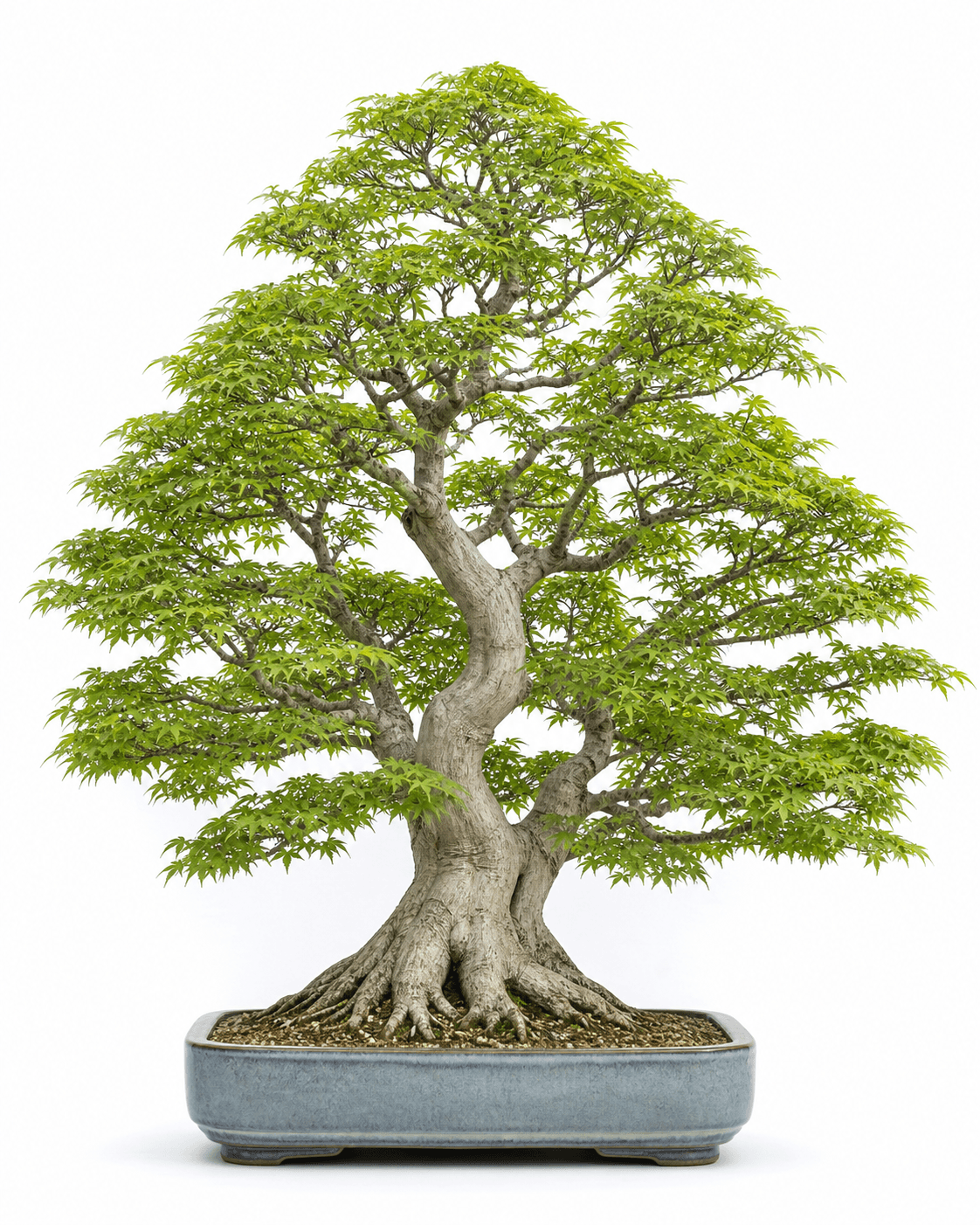
Japanese Maple Bonsai Care
Acer palmatum
Japanese maple bonsai belong outdoors, with winter dormancy, bright protected light, even moisture, and work timed around leaf drop, spring bud push, first-flush hardening, and summer heat. Most failures trace to weak roots, heat and wind exposure, spring structural cuts, overfeeding, or refinement techniques used on trees that need development growth.
Use Acer palmatum as a high-water-mobility deciduous broadleaf. Major structure is safest around fall leaf drop, refinement pinching is reserved for vigorous tertiary trees, partial defoliation follows first-flush hardening on strong trees, and refined roots reward an akadama-led soil system with precise water and oxygen control.
The beginner answer is simple: buy straight species or durable cultivar material with good roots and branch placement, grow it outdoors, protect it from afternoon heat in warm climates, and let the tree prove vigor before asking for advanced maple techniques.
Updated July 5, 2026. Written by EntGrove Editorial. Last verified July 5, 2026.
Care fingerprint
Read the species through its shared care pattern.
Repot and structural prune around dormant-to-active transitions; protect new leaves; time refinement work after growth hardens. Use this as the starting point before local conditions and tree strength refine the calendar.
Read the foliage first
Broadleaf stress usually shows in leaf color, leaf size, wilt, scorch, or delayed hardening before it becomes a branch problem.
Match work to dormancy
Deciduous, evergreen, tropical, succulent, and flowering broadleaf trees recover on different calendars.
Protect fine roots
Root work should preserve enough active fine roots for the tree to rehydrate quickly after the operation.
Care cadence
The calendar starts with the tree's seasonal state.
Placement
Timing: Grow outdoors year-round. Use morning sun or dappled shade in hot climates, airflow without desiccating wind, and winter root protection when shallow pots face hard freezes.
Watch for: Leaf scorch, weak shaded internodes, late-frost injury on young leaves, wind-dried twigs, and the false confidence that landscape hardiness protects container roots.
NC State ExtensionMissouri Botanical GardenBonsai Mirai LibraryWatering
Timing: Check daily while leaves are active. Water when the top layer begins to dry, then wet the whole root mass in multiple passes until drainage confirms full penetration.
Watch for: Crisp leaf margins, a dry core under a damp surface, compacted nursery soil, mineral-heavy water, and soggy akadama that has lost oxygen.
Bonsai Mirai LibraryRepotting
Timing: Repot healthy trees in spring as buds swell and before the canopy opens. Delay weak trees until they have rebuilt enough foliage and root strength.
Watch for: Slow drainage, water sheeting across the surface, a dense root plate, old organic cores, and post-repot bud abortion from excessive root reduction.
Bonsai Mirai LibraryStructural pruning
Timing: Use the fall leaf-drop window for major branch and trunk decisions. After leaves lose pigment and margins begin to crinkle, the tree can reallocate stored resources without spring bleeding.
Watch for: Spring sap bleeding, dieback from cuts past the collar, oversized callus from the wrong paste, and late-fall work after the window has passed.
Bonsai Mirai LibraryPinching and partial defoliation
Timing: Pinch only vigorous refinement trees as the central stem becomes identifiable between the first leaf pair. Partial defoliation belongs after first-flush hardening on strong trees.
Watch for: Sparse bud push, recently weakened trees, cultivar weakness, heat stress, weak interior branches, and the belief that pinching fixes long internodes after they have already formed.
Bonsai Mirai LibraryFertilizer
Timing: Feed by stage. Development trees can be fed to build structure, secondary trees need moderate feeding, and refined maples usually wait until after the first flush spends stored energy. Pause during peak summer heat.
Watch for: Long internodes, coarse first flush, salt stress, cupped new leaves, weak fall reserves, and spring fertilizer on trees you intend to refine.
Bonsai Mirai LibraryWiring
Timing: Fall leaf drop is the best window for meaningful branch movement. Start wire-bite checks as buds swell, then inspect weekly after first-flush hardening.
Watch for: Permanent smooth-bark scars, brittle fine twigs, wire left into swelling, and under-gauged wire that forces repeated rebending.
Bonsai Mirai LibraryPest and disease checks
Timing: Inspect during spring flush, after hot spells, and before winter storage. Root-zone moisture and airflow often decide whether pest and disease pressure becomes serious.
Watch for: Aphids, scale, leafhoppers, leafrollers, maple worms, anthracnose, leaf scorch, powdery mildew, Pseudomonas-like spotting, and late-frost damage.
NC State ExtensionMissouri Botanical GardenBonsai Mirai LibrarySpecies guide
Apply the species profile before copying another tree's calendar.
Spec
Japanese maple is the fine-twigged outdoor maple that rewards timing discipline.
Acer palmatum is a temperate deciduous maple in Sapindaceae. Kew is the botanical authority used for the accepted name, while NC State lists Japanese maple and Japanese maple cultivars as common names, with a 15 to 25 foot landscape height, deciduous foliage, and simple opposite leaves that usually carry 5 to 9 lobes. Kew POWONC State Extension
For bonsai, the species is valued for fine texture, layered broadleaf branching, clean smooth bark, strong fall color, cultivar diversity, and the ability to build very refined ramification. Those same traits make technique timing unforgiving. Smooth bark records mistakes, thin leaves scorch easily, and high water mobility makes spring structural pruning risky. Bonsai Mirai LibraryNC State Extension
The practical care frame is Broadleaf > Deciduous: outdoor dormancy, dappled to morning sun, moist but well-drained roots, spring bud-swell repotting, leaf-drop structural pruning, post-flush pruning when leaves harden, selective wiring, and cultivar-aware restraint. Bonsai Mirai Library
Native habit
Its wild logic is woodland-edge light, thin leaves, and steady root moisture.
NC State describes Japanese maple as native to southeast Korea and central and southern Japan, with the origin field also listing Japan, China, Korea, eastern Mongolia, and southeastern Russia. The landscape recommendation is dappled shade, evenly moist and well-drained soil, and protection from drying wind. NC State Extension
That habitat explains the care. A bonsai pot magnifies light, heat, and wind beyond what an understory or woodland-edge tree experiences in the ground. Morning sun builds compact growth, while afternoon shade and wind protection keep thin leaves and fine roots from spending more water than the root system can replace. NC State ExtensionBonsai Mirai Library
It also explains the design. Japanese maple looks most convincing as an old deciduous broadleaf: trunk line first, primary branch hierarchy second, then fine upward-and-outward twigging. Dense conifer-like pads flatten the species; layered billows and winter silhouette reveal it. Bonsai Mirai LibraryBonsai Mirai / Asymmetry
Energy
Read vigor by stage: development, secondary structure, then refinement.
Mirai separates Japanese maple work by developmental stage. In primary development, the tree needs leaf mass, root expansion, trunk thickening, and wound closure. Pinching at this stage steals the very energy needed to build structure. Let selected shoots extend, then reduce with purpose. Bonsai Mirai Library
In secondary structure, the first flush should harden before pruning. A hardened shoot has darker, firmer leaves and often a reddish tint on the green stem as phloem forms. At that point the shoot has paid energy back into the tree, so pruning can trigger usable lateral and interior buds instead of arresting growth. Bonsai Mirai Library
In refinement, the goal is even energy distribution across the canopy. Pinching redirects stored sugars and starches into interior buds, and partial defoliation admits light while reducing the strongest zones toward the strength of the weakest useful areas. Strong tips are worked first; weak branches are left to grow. Bonsai Mirai Library
Technique
Prune for structure in fall, pinch only refined vigor, and use partial defoliation sparingly.
Major structural pruning belongs around leaf drop. Mirai describes the ideal Japanese maple window as the moment when most leaves have lost chlorophyll, fall color is present, and leaf margins are beginning to crinkle. Spring pruning after buds push risks sugar-rich sap bleeding, moisture loss, and dieback. Bonsai Mirai Library
Cut geometry matters. Preserve the branch collar and make clean cuts that respect compartmentalization. For large wounds, Mirai favors putty-style sealant over high-auxin liquid products that can create swollen callus. Where a primary branch must be removed from refined material, staged stubs and collar maturation reduce dieback risk. Bonsai Mirai Library
Spring pinching is a refinement operation. The shoot is ready when a light touch separates the apparent single emerging tip into two opposing leaves and exposes the central elongating stem. Pinch only that central stem on strong tips first, then return in rounds as medium-strength tips become ready. Bonsai Mirai Library
Pinching does not shorten an internode that has already formed. Internode length is set by prior-year nutrition, stored energy, and spring vigor before the green shoot is visible. Use pinching to redirect strength into interior buds on refined trees, not to rescue coarse development material. Bonsai Mirai Library
Partial defoliation is the safer routine refinement tool. On strong trees after first-flush hardening, remove one of each leaf pair or reduce the strongest leaves to balance energy and admit light. Full defoliation is a deliberate stress reserved for very strong trees and a clear second-flush goal. Bonsai Mirai Library
Roots
Fine top growth depends on a fine, lateral root system below.
Japanese maple root work is tied to spring bud swell. The tree should be established, hydrated, and strong enough to push a new canopy after root reduction. A weak tree with sparse buds needs recovery before root surgery, even if the calendar says spring. Bonsai Mirai Library
Mirai frames deciduous root and canopy development as concurrent. Fine ramification above needs fine, balanced lateral feeder roots below. Remove or reduce thick downward roots in the appropriate window, preserve useful fine roots, and cultivate radial surface roots instead of allowing the tree to feed only from dominant coarse roots. Bonsai Mirai Library
Refined maples are less aggressively repotted than young development stock. A mature root plate usually needs cleaning, surface correction, and oxygen restoration more than dramatic root removal. Newly potted or heavily reduced trees should be protected from freezing, harsh sun, and wind until water balance is restored. Bonsai Mirai Library
A freshly repotted refined maple can still be pinched if the bud push is vigorous and evenly distributed, but fertilizer should wait. High soluble load around new fleshy roots behaves like salt and can reverse water movement out of new root tips. Bonsai Mirai Library
Soil and pot
Use root oxygen and container restraint to create fine maple growth.
NC State asks for evenly moist, well-drained soil. In bonsai, that becomes a particle system that holds water without suffocating roots. A compact nursery core in a shallow pot creates two water behaviors at once and makes Japanese maple scorch, rot, or stall more likely. NC State ExtensionBonsai Mirai Library
For refined Japanese maple and other broadleaf deciduous bonsai, Mirai uses 100 percent akadama. Akadama scales down over time, supports fine root division, and pairs well with small measured pruning. A development tree that still needs trunk and primary branch growth may be kept in a larger wood box or training container before final refinement. Bonsai Mirai Library
The pot should support the broadleaf image. Shallow ovals, soft rectangles, forest trays, and quiet unglazed or subdued glazed containers usually fit better than deep, heavy, or visually loud pots. Leave enough soil volume for summer water demand if the tree has a large canopy. Bonsai Mirai LibraryBonsai Mirai / Asymmetry
Climate
Adjust light, winter protection, and fertilizer to your climate.
In cool maritime climates, Japanese maples can often tolerate more sun and fall wiring with outdoor winter protection. Mirai examples mention refined maples overwintering outside in mild maritime conditions when protected from drying wind and extreme exposure. Bonsai Mirai Library
In hot, low-humidity, or windy climates, crispy leaves usually reflect a stack of stresses: mineral-heavy water, afternoon heat, low humidity, exposed interior foliage, dry wind, and roots that cannot move water fast enough. Move the tree to morning sun, protect from wind, and correct the root-zone problem rather than pushing fertilizer. Bonsai Mirai LibraryNC State Extension
In cold continental climates, a bonsai pot needs protection beyond the landscape hardiness number. Roots should be insulated from deep freeze and wind, recently worked trees need extra shelter, and fall-wired trees may belong in an unheated cold frame or on a greenhouse floor if dieback risk is high. Bonsai Mirai LibraryNC State ExtensionMissouri Botanical Garden
In warm subtropical climates without a true winter reset, Japanese maple can decline in ramification over time. Choose tougher species or cultivars where the climate cannot deliver dormancy, and treat summer heat as a limiting factor for work, water, and fertilizer. Bonsai Mirai Library
Pests
Most pest and disease pressure follows weak roots, still air, or heat stress.
NC State lists aphids, scale, maple worms, leafrollers, and leafhoppers as occasional pests, and links Japanese maple scale specifically. Missouri also flags aphids, borers, scale, mites, and several leaf problems in landscape culture. In bonsai, inspect petiole bases, undersides of leaves, twig crotches, and weak interior growth. NC State ExtensionMissouri Botanical Garden
Disease prevention starts at the root zone. Mirai links spring maple spotting that looks bacterial to water-mold pressure in the root environment, usually from poor winter water and oxygen balance. Anthracnose, leaf scorch, powdery mildew, and frost damage all become more severe when the tree is stressed. Bonsai Mirai LibraryNC State Extension
Treat the cause first. Improve airflow, remove badly infected leaves when appropriate, avoid overhead evening wetness in disease weather, stabilize watering, and quarantine new nursery plants. Chemical controls belong after identification, local label review, and consideration of bonsai leaf sensitivity. NC State ExtensionMissouri Botanical Garden
Wiring
Japanese maple is brittle and scuffable, so wire with timing and protection.
Mirai distinguishes brittle from delicate. Japanese maple can break during bends, and its smooth bark can scuff or scar. Fall leaf drop is the most useful wiring window because branch flexibility is highest and any minor damage has stored energy available for compartmentalization. Bonsai Mirai Library
For heavier structural work, Mirai favors copper because it holds with less rebound than aluminum. Heavy-gauge copper on smooth bark should be paper-wrapped or otherwise buffered. Fine twigs are usually left to clip-and-grow because they break easily and wire scars remain visible for years. Bonsai Mirai Library
Wire checks are non-negotiable. Fall-applied wire may stay until post-first-flush hardening in some mild climates, but inspection begins as buds swell and becomes weekly once wood thickens. On vigorous areas, wire can need removal by mid-May or June. Bonsai Mirai Library
Use wiring to set primary and secondary movement, then let pruning build the fine architecture. On mature refined maples, each wiring pass should require less wire than the last. A heavily wired refined canopy often means earlier structural decisions were missed. Bonsai Mirai Library
Propagation
Grafting dominates cultivars, while seed and air layers build bonsai material.
NC State lists grafting as the recommended propagation strategy, which matches the nursery reality: many Japanese maple cultivars are grafted to preserve leaf, bark, color, and growth traits. For bonsai, graft unions must be inspected before purchase because an ugly high graft can dominate the trunk line forever. NC State ExtensionBonsai Mirai Library
Seedlings are valuable for bonsai even when they lack cultivar identity. Straight species Acer palmatum is often the most predictable choice for beginners because it is durable, trainable, and free of some weak cultivar mutations. Early root pruning over a tile or shallow surface helps create radial nebari. Bonsai Mirai Library
Air layering is useful when the base is poor, the trunk has a flaw below a usable section, or a design needs a new root plane. Mirai places Japanese maple air layering after the spring flush hardens, when stored sugars and starches are high and the recovered root system can drive callus and root formation. Bonsai Mirai Library
Root grafting is a later-stage tool for missing nebari. Use same-species seedlings, work as buds swell, secure cambial contact carefully, and let grafts grow through at least one full season before separation. Foliage cultivar match matters less for root grafts than species compatibility and root placement. Bonsai Mirai Library
Sourcing
Buy roots, trunk quality, and cultivar behavior before color.
The safest beginner purchase is straight species Acer palmatum or a proven durable cultivar with low grafting, good nebari, visible primary structure, short enough internodes, and no fatal trunk scars. A dramatic leaf color cannot compensate for a high graft, inverse taper, one-sided roots, or brittle branch placement. Bonsai Mirai LibraryNC State Extension
Nursery stock can be excellent if the existing structure is preserved. Mirai warns against cutting Japanese maple nursery material to stubs and rebuilding from scratch because the regrown branches often repeat the same diameter and long-internode problem over many years. Preserve usable movement, then edit hard at the right time. Bonsai Mirai Library
Inspect for leaf scorch history, scale, branch dieback, old wire scars, low branch loss, a weak central trunk in clumps, and root congestion. For rough-bark forms such as Arakawa and compact cultivars such as Sharp's Pygmy, Koto Hime, Seigen, and Shishigashira, assume less vigor until the individual tree proves otherwise. Bonsai Mirai LibraryNC State Extension
Troubleshooting
Most Japanese maple problems are timing, water, heat, or strength problems.
Symptom: brown crispy leaf edges in summer. Likely causes: hot afternoon sun, dry wind, mineral-heavy water, dry root core, salt stress, or compacted soil. Fix: move to morning sun, restore even moisture and oxygen, flush salts when appropriate, and pause fertilizer during heat. Bonsai Mirai LibraryNC State Extension
Symptom: long internodes after spring flush. Likely causes: prior-year overfeeding, weak light, development-stage vigor, or relying on late pinching to shorten growth that was already set. Fix: adjust feeding by stage, prune after hardening, and use pinching only on refined vigorous shoots next spring. Bonsai Mirai Library
Symptom: branch dieback after pruning. Likely causes: spring sap movement, cuts past the collar, removing a water path abruptly, or cutting a weak tree. Fix: reserve major structure for leaf drop, leave staged stubs on refined material, preserve alternate branches, and seal large wounds correctly. Bonsai Mirai Library
Symptom: weak or aborted buds after repot. Likely causes: root mass reduced beyond water-supply capacity, fertilizer salts on new roots, freezing after root work, or a compact old core left inside fresh soil. Fix: protect the tree, stabilize water and oxygen, delay feeding, and let foliage rebuild. Bonsai Mirai Library
Symptom: wire marks. Likely causes: fast post-harden swelling, wire left too long, thin bark, or using too little wire and rebending repeatedly. Fix: remove wire early, protect bark on future work, and use fall timing with weekly spring checks. Bonsai Mirai Library
Symptom: cupped new leaves or odd early coloration. Likely causes: nutrient imbalance, calcium deficiency, salt or chloride load, or root-zone stress. Fix: review water source, soil oxygen, fertilizer strength, and spring heat exposure before applying more feed. Bonsai Mirai Library
Design
Let Japanese maple read as an old deciduous tree with layered winter structure.
Start with the base and trunk line, then choose the defining branch and apex. Japanese maple design depends on a visible hierarchy of trunks and branches, with the thickest trunk carrying dominance in clumps and forests. A slender trunk holding the top over heavier neighbors reads poorly. Bonsai Mirai LibraryBonsai Mirai / Asymmetry
Branch structure should move from curved primaries into cleaner, straighter secondary and tertiary segments. Fine tips that curl artificially under wire look less believable than upward-and-outward deciduous twigging. Use pruning for the last steps once wiring has set the larger framework. Bonsai Mirai Library
Japanese maple deadwood is usually a wound-management issue rather than a jin or shari feature. Smooth bark, clean callus, hollow-aware pruning, and flat healing matter more than decorative carving. Preserve a scarless trunk whenever the material gives you one. Bonsai Mirai Library
Forests and clumps reward asymmetric spacing and clear hierarchy. Mirai warns that central trunks can weaken over decades if every strong branch is removed to open light for outer trunks. Preserve the dominant trunk enough to keep the composition believable. Bonsai Mirai Library
Cultivars
Cultivar names change vigor, leaf scale, bark, and risk.
NC State lists many landscape cultivars and forms, including Kiyohime, Mikawa yatsubusa, Osakazuki, Sango-Kaku, Seiryu, Sharp's Pygmy, Shaina, Waterfall, Crimson Queen, Garnet, and Bloodgood. The bonsai list overlaps but should be filtered by trunk, internodes, graft quality, and growth behavior. NC State Extension
Mirai treats straight species Acer palmatum as the most predictable beginner material. Specialty cultivars introduce useful traits, but mutations can reduce vigor. Sharp's Pygmy, Koto Hime, Seigen, Shishigashira, rough-bark Arakawa, dissectum laceleaf forms, and coral-bark Sango-kaku each need individual judgment. Bonsai Mirai Library
Cultivar care is an adjustment layer. Compact forms can ramify beautifully but may be weaker. Rough bark adds age but can hide swelling and disease. Laceleaf dissectum material behaves differently enough that Mirai cautions against treating it like straight Acer palmatum for partial defoliation and refinement. Bonsai Mirai Library
History
Japanese maple is both a garden icon and a refinement benchmark.
Japanese maple has a long garden history because its layered habit, hand-shaped leaves, spring color, fall color, and cultivar range suit small landscapes. NC State emphasizes its role as a specimen and woodland understory tree, which maps naturally to bonsai display. NC State Extension
In bonsai, the species is a benchmark for deciduous refinement: clean roots, smooth bark, scar discipline, branch hierarchy, and winter silhouette. Mirai uses Japanese maple repeatedly to teach why deciduous timing differs from conifer timing and why tree stage matters more than rote calendar work. Bonsai Mirai LibraryBonsai Mirai / Asymmetry
Exhibition-quality Japanese maple usually shows restraint. The tree should look accumulated rather than forced: a stable root base, quiet trunk movement, alternating branch hierarchy, delicate terminal twigging, and enough negative space for each branch to breathe after leaf drop. Bonsai Mirai LibraryBonsai Mirai / Asymmetry
Species questions
Answer the beginner questions before styling.
Can Japanese maple bonsai live indoors?
Japanese maple is an outdoor deciduous tree. It needs seasonal dormancy, outdoor light, airflow, and temperature change. Indoor display should last only a short event or viewing period before the tree returns outside.
Why are my Japanese maple bonsai leaves turning brown on the edges?
Brown edges usually point to stacked stress: hot afternoon sun, dry wind, mineral-heavy water, dry roots, compacted soil, salt load, or poor root oxygen. Move the tree to protected morning sun, correct watering and drainage, and pause fertilizer during heat.
When should I repot a Japanese maple bonsai?
Repot healthy Japanese maple bonsai in spring as buds swell and before leaves open. Root density, water penetration, soil breakdown, and tree strength set the interval better than a fixed calendar habit.
When should I prune Japanese maple bonsai?
Use fall leaf drop for major structural pruning. Use post-flush hardened growth for secondary work. Use spring pinching only on vigorous refined trees as emerging tips become ready.
Should I pinch Japanese maple bonsai in spring?
Pinch only refined, vigorous trees with even bud push. Pinching redirects stored energy into interior buds; it does not shorten internodes that have already formed and it harms trees still building trunk, roots, or secondary branches.
Should I fully defoliate a Japanese maple bonsai?
Routine full defoliation is too much stress for most Japanese maples. Partial defoliation after first-flush hardening is the usual refinement tool, and only on vigorous established trees with a clear second-flush or balancing goal.
What soil is best for Japanese maple bonsai?
Use a well-sifted deciduous bonsai soil that balances moisture and oxygen. Mirai uses 100 percent akadama for refined Japanese maple, while transitional nursery material may need staged correction out of old organic soil.
How much sun does Japanese maple bonsai need?
Use bright protected light. Morning sun with afternoon shade is the safest default in warm climates, especially after pruning, repotting, or canopy opening. Cooler mild climates can usually support more direct sun.
Can Japanese maple bonsai be wired?
Yes, especially for primary and secondary branch placement. Wire around fall leaf drop, protect smooth bark, use enough holding strength to avoid repeated rebending, and check weekly once spring swelling begins.
What Japanese maple cultivar is best for bonsai?
Straight species Acer palmatum is often the most predictable beginner material. Deshojo, Kiyohime, Shishigashira, Sharp's Pygmy, Arakawa, Sango-kaku, and other cultivars can work, but graft quality, root base, internodes, and vigor matter more than the label.
Sources
Species advice needs source discipline.
Next decisions
Plan the operation before copying the calendar.
A good care note for Japanese maple records the tree's stage, the work done, and the aftercare used. That record matters more than a month-name rule.
Related species
Compare nearby trees before transferring advice.
Trident maple
Acer buergerianum
Amur maple
Acer tataricum subsp. ginnala
Field maple
Acer campestre
Korean hornbeam
Carpinus turczaninovii
Japanese hornbeam
Carpinus japonica