
Species guide
Trident Maple Bonsai Care
Acer buergerianum
Trident maple bonsai care starts with outdoor deciduous timing: spring root work at bud swell, first-flush hardening before pruning and partial defoliation, fall leaf-drop structural work, and cold root protection in winter.
Acer buergerianum is the vigorous maple for nebari, root-over-rock, repeated prune-and-partial-defoliate cycles, and compact three-lobed leaves. Its strength is useful only when water, oxygen, heat, fertilizer, wire checks, and branch hierarchy are managed as one system.
Use trident maple as a Broadleaf > Deciduous tree. It belongs outside, it needs dormancy, and its best bonsai work is keyed to visible signals: swelling buds, dark firm hardened leaves, second flush response, leaf drop, and root-zone percolation.
Updated July 7, 2026. Written by EntGrove Editorial. Last verified July 7, 2026.
Care fingerprint
Read the species through its shared care pattern.
Repot and structural prune around dormant-to-active transitions; protect new leaves; time refinement work after growth hardens. Use this as the starting point before local conditions and tree strength refine the calendar.
Read the foliage first
Broadleaf stress usually shows in leaf color, leaf size, wilt, scorch, or delayed hardening before it becomes a branch problem.
Match work to dormancy
Deciduous, evergreen, tropical, succulent, and flowering broadleaf trees recover on different calendars.
Protect fine roots
Root work should preserve enough active fine roots for the tree to rehydrate quickly after the operation.
Care cadence
The calendar starts with the tree's seasonal state.
Placement
Timing: Grow outside year-round. Use full sun in mild conditions, airflow, and afternoon shade after hard work or during severe heat.
Watch for: Leaf burn, hot pots, dry wind, weak shaded extension, and indoor holding that interrupts dormancy.
NC State ExtensionOregon State Landscape PlantsBonsai Mirai LibraryWatering
Timing: Check daily in active growth. Water thoroughly when the root zone is ready, then let oxygen return.
Watch for: Spring soft growth drying quickly, post-hardening leaf burn from wet anaerobic roots, slow drainage, and salt or fertilizer stress during heat.
Bonsai Mirai LibraryFertilizer
Timing: Feed by stage. Development trees can take stronger organic feeding after growth starts; refined trees often wait until the first flush hardens, then feed lighter.
Watch for: Long internodes, coarse upper branches, fertilizer within four to six weeks after repotting, and feeding during consistent 95 F plus heat.
Bonsai Mirai LibraryPruning and partial defoliation
Timing: Let the first flush harden. Then prune and partially defoliate strong refined areas, often two or three times in long warm seasons when the tree responds well.
Watch for: Using trident methods on weak branches, removing more leaf than weak areas can support, late timing after the second flush hardens, and full defoliation as routine.
Bonsai Mirai LibraryStructural work
Timing: Major pruning, wound work, and heavier bending are safest during the two-to-three-week window after natural leaf drop.
Watch for: Green leaves still attached, hard freezes after fresh cuts, losing all hierarchy by cutting every primary branch off, and spring bleeding from large cuts.
Bonsai Mirai LibraryBonsai Mirai / AsymmetryWiring
Timing: Wire during leaf drop or while young green growth is hardening enough to hold direction. Use aluminum and inspect daily to weekly during spring swelling.
Watch for: Brittle branches, bark splitting, wire bite before partial-defoliation timing, conifer-like downward branch pads, and heavy copper on thin bark.
Bonsai Mirai LibraryRepotting
Timing: Repot in spring as buds swell and before active growth is underway. Use evidence from roots, percolation, soil age, and design need.
Watch for: Calendar-only repotting, slip-potting without root work, repeated repots inside two years, old organic cores, and downward roots that block a flat plate.
Bonsai Mirai LibraryRoot grafting and propagation
Timing: Plan root grafts just as buds swell and before leaves push. Take semi-hardwood cuttings after bud push when the tree has enough warmth and juvenile growth.
Watch for: Oversized graft stock, holes that remove too much live wood, graft movement, wet drilling tissue, and cuttings that transpire faster than they root.
Bonsai Mirai LibraryPest and disease checks
Timing: Inspect during spring flush, after leaf work, through humid spells, and whenever leaf scorch or twig dieback appears.
Watch for: Aphids, scale, anthracnose, bacterial leaf scorch, Verticillium wilt, root rot, and leaf burn caused by water or oxygen imbalance.
NC State ExtensionNC State Extension maple insectsNC State Extension maple diseasesBonsai Mirai LibraryWinter protection
Timing: Keep the tree cold and dormant, but protect the pot before container roots freeze hard. Mirai winter guidance uses 28 F / -2 C as the trigger for root-protection action.
Watch for: Dry frozen wind, late fall cuts followed by hard freeze, warmed indoor storage, and spring dieback from roots that froze or dried.
NC State ExtensionOregon State Landscape PlantsBonsai Mirai LibrarySpecies guide
Apply the species profile before copying another tree's calendar.
Spec
Trident maple is the vigorous outdoor maple for roots, ramification, and repeated refinement cycles.
Use this page for Acer buergerianum Miq., the trident maple or three-toothed maple. Kew accepts the name, places it in Sapindaceae, and gives southern and eastern China plus Taiwan as the native range. Kew POWONC State Extension
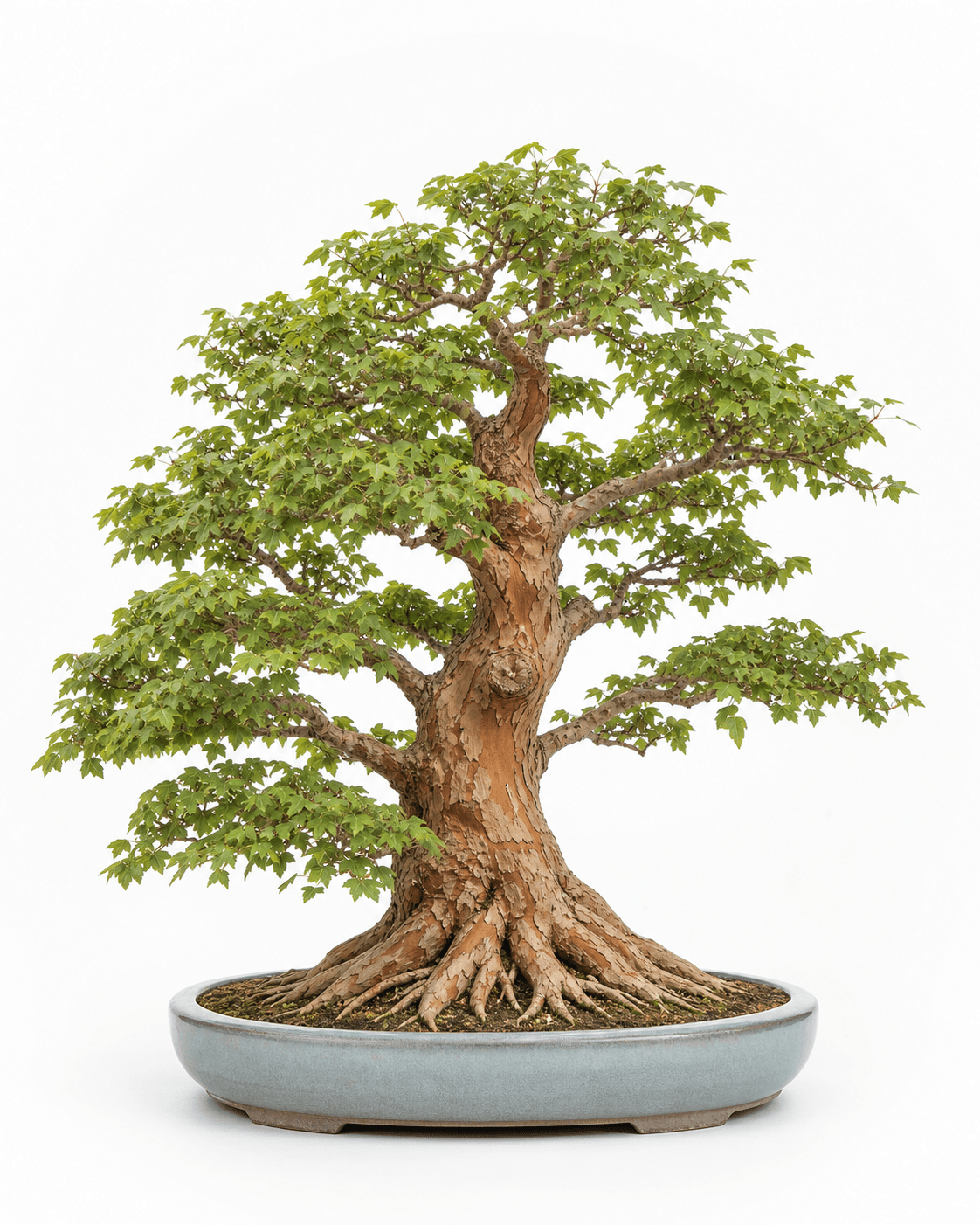
The bonsai identity comes from vigor: fast root thickening, the ability to build a flat plated base, reliable second flushes after partial defoliation, small three-lobed leaves under refinement, and bark that gains orange-brown exfoliating character with age. Bonsai Mirai LibraryNC State ExtensionOregon State Landscape Plants
The care frame is outdoor deciduous. Schedule root work at spring bud swell, prune and partially defoliate after the first flush hardens, reserve major structure for leaf drop, and protect container roots before winter cold turns survival into dieback. Bonsai Mirai Library
Native habit
Its wild signal is a temperate East Asian maple with sun, water movement, and a rounded crown.
Kew places Acer buergerianum in the temperate biome and lists the native range as southern and eastern China plus Taiwan. Oregon State describes a 20-35 foot broadleaf deciduous tree with an oval to rounded outline, lustrous three-lobed leaves, small greenish-yellow flowers, paired samaras, and exfoliating bark. Kew POWOOregon State Landscape Plants
Landscape sources emphasize adaptability: full sun, well-drained acidic soil preference, and tolerance of wind, salt, drought, air pollution, and compaction. In a bonsai pot those tolerances become margin rather than a license to ignore water and oxygen. NC State ExtensionOregon State Landscape PlantsBonsai Mirai Library
Design should read as deciduous broadleaf. Trident maple branches should rise up and out from the shoulder, then divide into billowing foliage masses. Flat conifer pads and downward-only branch lines suppress the tree style that the species naturally supports. Bonsai Mirai / AsymmetryBonsai Mirai Library
Energy
Read trident maple by hardened leaves, root vigor, and branch hierarchy.
The first major signal is cuticle formation. Mirai uses darker, firmer leaves plus a marked drop in daily water demand as the sign that the first flush has hardened and the prune-and-partial-defoliate window is open. Bonsai Mirai Library
The second signal is stage. A development tree needs extension for trunk, root, and branch girth. A refinement tree needs repeated shorter cycles that remove tip dominance, balance leaf surface area, and push interior buds without weakening low branches. Bonsai Mirai Library
The third signal is hierarchy. Mirai cautions against buying or rebuilding a broadleaf deciduous tree with no redeemable dominant structural branch, because cutting every branch off can reset age expression for decades. Preserve useful generational branching where it exists. Bonsai Mirai / AsymmetryBonsai Mirai Library
Weakness often begins below the soil line. Fine tertiary dieback, scattered branch decline, and persistent leaf burn can trace to water and oxygen imbalance around soft maple root tips, especially when compacted soil, old particles, or heat have reduced new root growth. Bonsai Mirai Library
Technique
Let trident maple run, then prune and partially defoliate after hardening.
Trident maple is generally managed by extension, pruning, and partial defoliation rather than routine spring pinching. Let shoots build enough leaf mass to repay the spring push, then cut after hardening to release interior buds and redirect energy. Bonsai Mirai Library
A shoot should usually have four to six nodes before cutback if you expect a reliable second flush. In a long warm season, a strong refined trident may receive two or three prune-and-partial-defoliate cycles, with each cycle judged by the tree response rather than by ambition. Bonsai Mirai Library
The energy-balancing rule is comparative. Remove the largest leaves from strong areas down toward the surface-area density of the weakest useful branch, never below it. Mirai describes roughly 70% leaf-mass reduction as the threshold that can reliably incite a second flush, but weak branches should set the floor. Bonsai Mirai Library
Use whole-leaf removal on trident maple because the petiole releases weakly. Avoid cutting leaves in half as the default, and avoid full defoliation as a routine refinement practice. Partial defoliation combined with pruning gives finer ramification with lower cumulative risk. Bonsai Mirai Library
Opposite leaves create opposite buds, so junction cleanup matters. At each trio of central stem plus two opposing shoots, stagger which side is removed down the branch line to prevent paired swelling and knuckle formation. Bonsai Mirai Library
Roots
Build the nebari as a flat, living plate rather than a tangle of downward roots.
Repot trident maple at spring bud swell while stored energy is moving and before soft leaves begin the main water draw. Mirai deciduous repotting guidance treats this as a physiology window, not a date: the tree is ready when buds are moving, roots can restart, and the root mass actually needs intervention. Bonsai Mirai Library
The species rewards a deliberate root plate. Keep fine roots buried so they stay alive long enough to thicken, fuse, and lignify, then reduce downward roots each repot so water movement supports a shallow radial base. Exposed fine roots desiccate before they can become the plated nebari that makes old trident maple believable. Bonsai Mirai Library
Remove old compact cores when they block percolation or keep the interior wet while the outer soil dries. After root work, secure the tree firmly, keep it out of drying wind, and rebuild sun exposure only after the canopy and water use prove that the new roots are functioning. Bonsai Mirai Library
Container
Use soil and pot choice to moderate a fast, water-hungry maple.
A refined trident maple can use a deciduous akadama-led mix because the tree benefits from fine roots, even moisture, and stable particle structure. Development trees, recovered nursery stock, and trees with old field soil often need more pumice or lava while the grower rebuilds oxygen flow and learns the actual water demand. Bonsai Mirai Library
Particle size should follow tree size and stage. Shohin and tight refined canopies need smaller sifted particles that hold an even moisture film. Large development boxes need a larger oxygen margin so summer watering can be generous without creating stale lower roots. Bonsai Mirai Library
Pot character should support a deciduous broadleaf reading. Unglazed warm browns work for rugged root-over-rock or muscular trunks; quiet glazed ovals and rectangles can suit smoother bark, autumn color, and refined crowns. Avoid containers so shallow that the tree cannot carry peak summer leaf mass without daily crisis. Bonsai Mirai / AsymmetryBonsai Mirai Library
Climate
Adapt the calendar around heat, water, and container root cold.
Landscape references list trident maple as hardy into USDA Zone 5, but bonsai roots experience winter as a shallow container, not as ground insulation. Keep the tree dormant and cold, then protect the pot before the root mass freezes hard. Mirai cold-protection guidance uses 28 F / -2 C as a practical root-protection trigger for containerized trees. NC State ExtensionOregon State Landscape PlantsBonsai Mirai Library
In hot dry regions, the main adjustment is afternoon relief after major work and during heat spikes. Strong spring sun builds compact growth, but a shallow pot with a dense summer canopy can outrun the root system. Move the tree for water balance before leaves scorch, especially after partial defoliation or root reduction. Bonsai Mirai LibraryNC State Extension
In humid regions, watch the opposite problem: wet soil, low oxygen, and soft root tips. A tree can show scorch and twig dieback from a root-zone oxygen failure even when the bench looks wet. Better percolation, canopy adjustment, and disciplined watering solve more trident problems than extra fertilizer. Bonsai Mirai Library
Health
Most trident problems start with stress, then pests and pathogens exploit the opening.
NC State lists common plant problems for Acer buergerianum that include aphids, scale, Verticillium wilt, anthracnose, bacterial leaf scorch, root rot, leaf spot, tar spot, and leaf scorch. Those are landscape labels, but bonsai risk concentrates because the same tree carries more canopy per root volume. NC State ExtensionNC State Extension maple insectsNC State Extension maple diseases
Aphids and scale often appear on soft growth, protected nodes, and crowded interiors. Treat the horticultural cause first: open the canopy enough for light and air, avoid excessive nitrogen that creates soft extension, and inspect under leaves during the spring flush and after each pruning cycle. NC State Extension maple insectsBonsai Mirai Library
Anthracnose, leaf spots, and bacterial leaf scorch need sober diagnosis because their symptoms can resemble drought, hot wind, or bad roots. Remove fallen infected leaves, avoid overhead water late in the day where disease pressure is high, and correct soil oxygen before assuming a spray will rescue a declining maple. NC State Extension maple diseasesBonsai Mirai Library
Wiring
Wire trident maple when tissues can move, then remove it before spring thickening records the wire.
Mirai places the safest major bending window around natural leaf drop, when the canopy is out of the way and the branch still carries enough seasonal flexibility. Spring leaf-out is a poor time for heavy bending because the tissue is hydrated, brittle, and committed to rebuilding energy. Bonsai Mirai Library
Use aluminum wire on thin-barked branches and apply it cleanly at about a 55-60 degree angle. Bend broadleaf branches up and out from the shoulder, then let pruning create subdivision. Downward conifer pads make trident maple look like borrowed technique. Bonsai Mirai LibraryBonsai Mirai / Asymmetry
Wire monitoring is the real technique. A vigorous trident can swell fast enough that wire bite appears between casual checks, especially after a warm rain and a fertilizer push. Inspect daily to weekly in spring, and cut wire off rather than unwinding it through fine maple twigs. Bonsai Mirai Library
Propagation
Seed, cuttings, layers, and root grafts all work, but root grafts matter most for bonsai quality.
Trident maple can be raised from seed for trunk projects and forests, and young material gives the grower control over root spread from the beginning. Seedling vigor is useful, but seedlings still need early root sorting so downward tap behavior does not dominate the base. Bonsai Mirai LibraryKew POWO
Cuttings can be useful for uniform material and small projects. Mirai propagation guidance puts many deciduous cuttings after bud push, when shoots have enough warmth and maturity to root while the grower controls transpiration with humidity, shade, and reduced leaf surface. Bonsai Mirai Library
Root grafting is the species superpower. Use young seedling whips at spring bud swell, drill or cut precisely, align cambium tightly, immobilize the graft, seal the wound, and let the graft grow for a full season before separating it from its original root system. The result can correct empty nebari sectors that pruning alone will never fill. Bonsai Mirai Library
Sourcing
Buy for root base and branch hierarchy before you buy for leaf size.
The best trident maple starting material has a visible radial root plan, trunk taper, and at least one usable branch generation. Large nursery trunks can look impressive, but a swollen graft, buried crossing roots, inverse taper, or a trunk chop with no healing path can cost years. Bonsai Mirai / AsymmetryBonsai Mirai Library
For pre-bonsai, inspect the base from several angles and scrape only enough soil to see whether roots leave the trunk radially or dive straight down. Ask when it was last root worked. Fresh nursery vigor above a compact old core is common, and it becomes your first repotting problem. Bonsai Mirai Library
Collected or field-grown tridents can offer age, movement, and bark, but the transition plan matters. Prioritize a recoverable root mass, clean wound strategy, and a branch system that can express a broadleaf maple. A cheap trunk with no base and no branch future is usually expensive in time. Bonsai Mirai / AsymmetryBonsai Mirai Library
Diagnosis
Diagnose by symptom, then decide whether the cause is canopy, roots, timing, or weather.
Leaf-edge scorch during heat usually points to water balance, hot wind, a shallow overheated pot, or a root system that cannot supply the canopy. Move the tree to morning sun, water thoroughly when ready, cool the pot, and avoid fertilizer until the leaves and root zone stabilize. Bonsai Mirai Library
Interior twig dieback usually means the outside canopy is using the available energy and shading the inside, or that root tips are failing in stale wet soil. Thin large leaves and strong extensions after hardening, improve percolation at the next correct window, and stop cutting weak interior branches before they become energy-positive. Bonsai Mirai Library
Long internodes come from stage mismatch: too much spring fertilizer, too little light, too much uncontrolled extension, or development tactics applied to a refined tree. Let the shoot harden, cut back to useful nodes, and adjust next-cycle feeding rather than chasing internodes with late weak pruning. Bonsai Mirai Library
Wire scars mean monitoring failed. Remove tight wire immediately, protect the branch from more swelling damage, and let callus and bark texture improve the mark over time. On future cycles, wire later in fall, use clip-and-grow for fine areas, and check spring wire far more often. Bonsai Mirai Library
Design
Style trident maple as a deciduous tree that shows roots first, trunk second, branches third.
Mirai design teaching starts with where the tree lives. For trident maple, that means a broadleaf silhouette with uplift, division, negative space, and foliage that reads as a crown rather than stacked conifer shelves. The branch should leave the trunk with purpose, then subdivide into finer hierarchy. Bonsai Mirai / AsymmetryBonsai Mirai Library
The base often carries the tree. Plated nebari, root-over-rock, and low trunk flare suit the species because the roots thicken quickly and can create visible age. Design decisions should protect that value: do not hide the root plane with a deep pot, front the tree from the best root spread, and keep the first branch compatible with the trunk movement. Bonsai Mirai / AsymmetryBonsai Mirai Library
Deadwood is rarely the headline. Trident maple can carry hollow wounds and aged bark, but jins and shari borrowed from juniper language usually distract from deciduous character. Wound closure, callus quality, bark age, and seasonal leaf color create the more credible old-tree story. Bonsai Mirai / AsymmetryBonsai Mirai Library
Cultivars and forms
Cultivars change texture and design, not the basic deciduous care frame.
NC State lists several named cultivars and varieties, including Kifu Nishiki, Michael Steinhart, Mino Yatabusa, Mitsubato Kaede, Miyasama yatsubusa, Streetwise, and Valynor. Some are selected for leaf shape, cork-like trunk texture, fall color, or growth habit rather than a separate care calendar. NC State Extension
Dwarf and corky forms can be compelling in bonsai, but they may alter internode length, bark timing, or wound response. Evaluate the actual tree rather than assuming a cultivar label solves refinement. Leaf reduction still comes from light, root quality, pruning timing, and balanced vigor. NC State ExtensionBonsai Mirai Library
For most growers, the ordinary species is the right starting point. Choose cultivar material for a design reason, then keep the shared rules in place: outdoor dormancy, strong but managed light, careful root timing, repeated shoot control, and close wire checks. NC State ExtensionBonsai Mirai Library
Context
Trident maple became a bonsai staple because it turns horticultural vigor into visible age.
The species entered bonsai practice as a temperate East Asian maple with practical virtues: tough roots, fast trunk building, predictable leaf reduction, and bark that matures into warm exfoliating plates. Those traits make it especially valuable for growers who want deciduous age without waiting as long as slower maples demand. Kew POWONC State ExtensionBonsai Mirai Library
In exhibition-quality tridents, the winter image matters as much as the summer canopy. The viewer should be able to read radial roots, trunk taper, branch order, and fine twig density after the leaves fall. Leaf size is only one part of that standard. Bonsai Mirai / AsymmetryBonsai Mirai Library
Root-over-rock and plated-nebari tridents are common teaching examples because the species can thicken roots into the design quickly. The strongest examples still depend on time, seasonal follow-up, and restraint: the tree must keep enough coarse strength to heal while being pruned often enough to stay deciduous and fine. Bonsai Mirai / AsymmetryBonsai Mirai Library
Species questions
Answer the beginner questions before styling.
Is trident maple a good beginner bonsai?
Yes, for an outdoor grower who can water daily in leaf and protect the pot in winter. Trident maple is vigorous and responds well to pruning, partial defoliation, and root work, but that same vigor means wire checks, apex control, and follow-up pruning cannot be casual.
Can trident maple bonsai live indoors?
No for long-term care. Trident maple is a temperate deciduous tree that needs outdoor light, seasonal growth, autumn shutdown, and winter dormancy. Use indoor display briefly, then return the tree outside.
How often should I water a trident maple bonsai?
Check daily during active growth and water thoroughly when the root zone is ready. Soft spring growth and large leaf mass use water quickly, while hardened leaves and humid weather demand more oxygen return between waterings.
When should I repot trident maple bonsai?
Repot at spring bud swell when the tree needs root work: slow percolation, compact old soil, excessive root density, an old organic core, or a design change to the root plane. The calendar opens the inspection window; root evidence decides the work.
Should I fully defoliate a trident maple bonsai?
Use partial defoliation as the default. Mirai trident maple guidance favors whole-leaf removal from strong areas after first-flush hardening, balanced down toward the weakest useful branch. Routine full defoliation carries more risk than most refinement trees need.
When should I prune trident maple bonsai?
For refinement, let shoots harden after the first flush, then prune and partially defoliate. Shoots usually need four to six nodes before reliable cutback and second flush. Major structural pruning belongs around natural leaf drop on healthy trees.
When should I wire trident maple bonsai?
Wire at leaf drop for structural work, or while young green growth is hardening enough to hold direction. Use aluminum, avoid heavy spring bends after leaf-out, and inspect daily to weekly during swelling growth because scars can form quickly.
How cold can trident maple bonsai tolerate?
Landscape sources list trident maple around USDA Zone 5 hardiness, but bonsai roots need earlier protection. Keep the tree cold and dormant, then protect the container before roots freeze hard; Mirai winter guidance uses about 28 F / -2 C as a root-protection trigger.
Why are the interior twigs on my trident maple dying?
Interior twig dieback usually comes from shaded weak growth, unchecked outer vigor, or root-zone water and oxygen imbalance. Let strong shoots harden, thin and prune by strength, improve percolation at the next correct repotting window, and avoid repeated cuts on weak branches.
Is trident maple better than Japanese maple for bonsai?
Trident maple is usually tougher, faster, and better for plated nebari or root-over-rock work. Japanese maple often offers finer color and softer character. The better choice depends on climate, design goal, and the grower ability to manage water and heat.
Sources
Species advice needs source discipline.
Next decisions
Plan the operation before copying the calendar.
A good care note for Trident maple records the tree's stage, the work done, and the aftercare used. That record matters more than a month-name rule.
Related species
Compare nearby trees before transferring advice.
Japanese maple
Acer palmatum
Amur maple
Acer tataricum subsp. ginnala
Field maple
Acer campestre
Korean hornbeam
Carpinus turczaninovii
Japanese hornbeam
Carpinus japonica