
Species guide
Field Maple Bonsai Care
Acer campestre
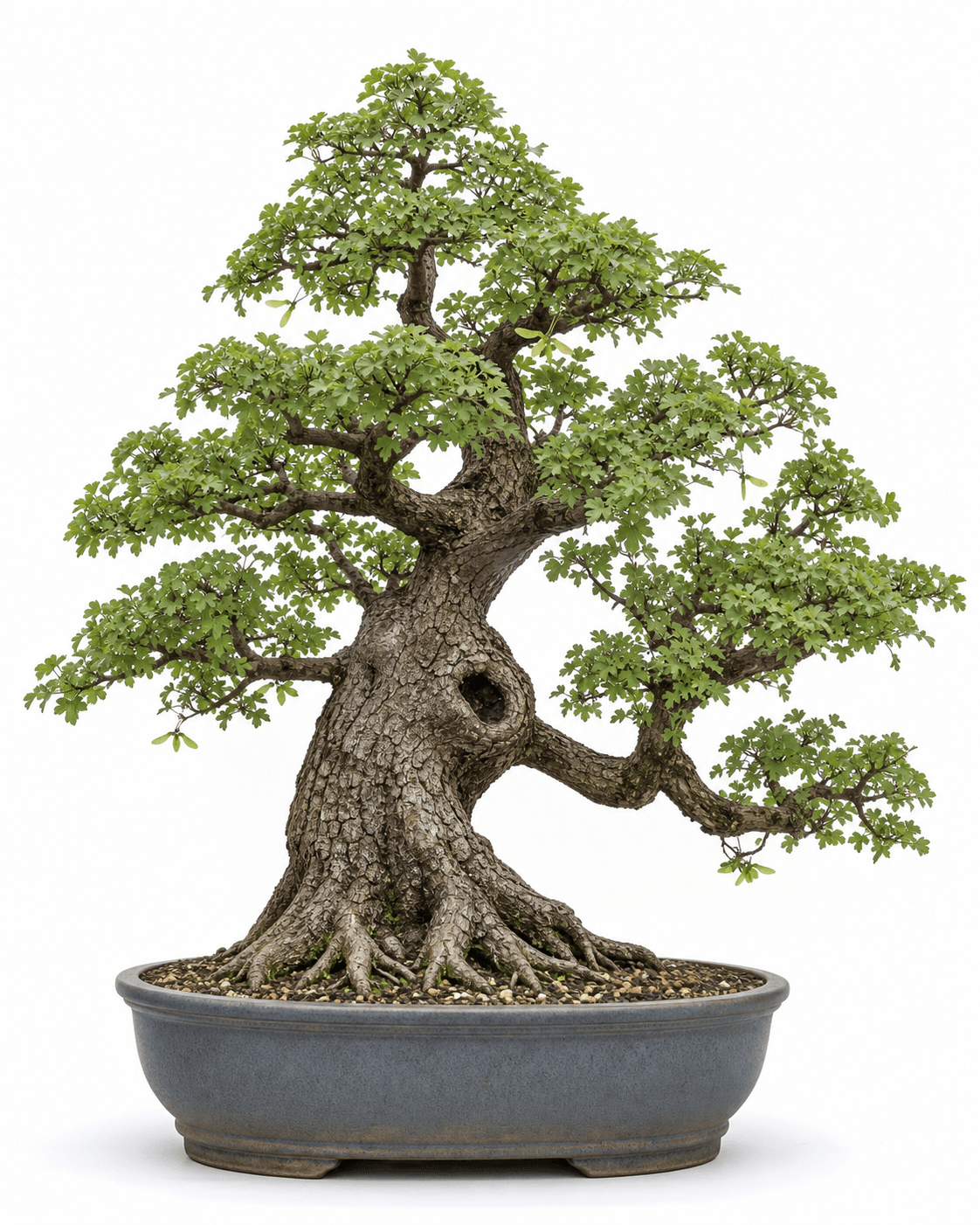
Field maple, also sold as hedge maple, is a durable outdoor deciduous bonsai species with small maple leaves, corky older bark, strong back budding, and enough flexibility to make convincing naturalistic broadleaf designs. It needs real seasons, spring-to-fall light, and careful root-zone water and oxygen management.
Treat Acer campestre as Broadleaf > Deciduous in the EntGrove taxonomy. Kew accepts Acer campestre L. in Sapindaceae, native from Europe to Iran and northern Algeria, while North American horticultural sources usually use hedge maple for the same tree.
The practical care answer is generous but disciplined: let development trees grow, then cut back hard enough to build taper; in refinement, make smaller repeated cuts to lateral buds, preserve interior light, remove seed pods during energy-balancing work, check wire weekly once swelling resumes, and repot when root pressure or water penetration says the root system has reached its limit.
Updated June 18, 2026. Written by EntGrove Editorial. Last verified June 18, 2026.
Care fingerprint
Read the species through its shared care pattern.
Repot and structural prune around dormant-to-active transitions; protect new leaves; time refinement work after growth hardens. Use this as the starting point before local conditions and tree strength refine the calendar.
Note: Durable European and western Asian maple for outdoor deciduous bonsai; hedge maple is the common North American label.
Read the foliage first
Broadleaf stress usually shows in leaf color, leaf size, wilt, scorch, or delayed hardening before it becomes a branch problem.
Match work to dormancy
Deciduous, evergreen, tropical, succulent, and flowering broadleaf trees recover on different calendars.
Protect fine roots
Root work should preserve enough active fine roots for the tree to rehydrate quickly after the operation.
Care cadence
The calendar starts with the tree's seasonal state.
Placement
Timing: Grow outdoors year-round with full sun to light shade, airflow, and winter protection for container roots when freezes are hard or wind is drying.
Watch for: Indoor decline, weak shaded extension, summer scorch after heavy pruning, and assuming landscape hardiness protects a shallow bonsai pot.
Kew POWOOregon State Landscape PlantsRHSWatering
Timing: Check daily during active growth and water when the top layer begins to dry. Increase attention after leaf-out, during wind, and after the canopy is full.
Watch for: Leaf edge burn from heat, dry cores under damp surfaces, slow drainage, and post-hardening overwatering that suppresses new roots.
Bonsai Mirai LibraryFertilizer
Timing: Feed development trees strongly after growth is active. For secondary scaffolding and refinement, resume after the first flush hardens and use lighter, staged feeding so growth stays useful rather than coarse.
Watch for: Long spring internodes, coarse blowouts after large cuts, weak recovery after repotting, and soft late growth before frost.
Bonsai Mirai LibraryPruning
Timing: In refinement, cut back after the first flush hardens and use smaller repeated cuts. Fall leaf-drop is useful for structural clarity, but heavy late-fall cuts need freeze protection while wounds compartmentalize.
Watch for: Opposite-bud swelling, knuckled branch tips, coarse regrowth from oversized cuts, seed pods spending energy, and interior branches shaded by sacrificial outer shoots.
Bonsai Mirai LibraryPartial defoliation
Timing: Use only on vigorous trees after leaves harden. Balance strong areas down toward weak-area leaf density, then protect exposed interior foliage from hot afternoon sun.
Watch for: Recently repotted trees, weak branches with little ramification, second-flush timing that has already passed, and heat above the tree backup plan.
Bonsai Mirai LibraryWiring
Timing: Wire when branches are flexible and the tree can recover, often around leaf-drop or during planned styling. Mirai examples for large refinement trees include 3.5 mm aluminum on intermediate branches and 4.5 to 5 mm on heavier branches. Check weekly once swelling resumes.
Watch for: Wire bite on smooth bark, phototropic rebound, branch memory, and over-wiring when selective guying or pruning would solve the design.
Bonsai Mirai LibraryRepotting
Timing: Inspect in spring as buds swell. Repot when root density, soil breakdown, water penetration, root pressure, or otherwise unexplained dieback justify it.
Watch for: Cracked pots, water sheeting off the surface, old organic nursery cores, and stacking major top reduction with severe root work.
Bonsai Mirai LibraryPest and disease checks
Timing: Inspect during spring flush, summer heat, and late-season shutdown; field maple is generally tough, but maple pests and wilt diseases still matter in containers.
Watch for: Aphids, gall mites, caterpillars, horse chestnut scale, tar spot, Verticillium wilt, honey fungus in landscape-source material, and seedling escape where it spreads aggressively.
RHSMorton ArboretumSpecies guide
Apply the species profile before copying another tree's calendar.
Spec
Field maple is the rugged European maple for outdoor deciduous bonsai.
Acer campestre is a temperate deciduous maple in Sapindaceae. Kew accepts the species and gives a native range from Europe to Iran and northern Algeria. RHS lists it as correct-name Acer campestre, native to Great Britain and Ireland, deciduous, bushy, and hardy to H6 in the United Kingdom. Kew POWORHS
The common-name split is regional. British and European growers usually say field maple, while North American horticultural references often say hedge maple. Oregon State lists hedge maple, field maple, and common maple together, and Morton uses hedge maple with field maple as a common-name equivalent. Oregon State Landscape PlantsMorton Arboretum
For bonsai, the attraction is practical: moderate to vigorous growth, opposite buds that can ramify quickly, smallish lobed leaves, corky fissures on older stems, tolerance of pruning, and enough branch flexibility to permit convincing movement. The tradeoff is that it will create coarse knuckles if every opposite bud is allowed to run. Bonsai Mirai LibraryNC State Extension
Native habit
Its wild character comes from field edges and hedgerows.
Kew places field maple in the temperate biome and gives the native range as Europe to Iran and northern Algeria. Oregon State adds Europe, North Africa, and western Asia, while RHS simplifies the range as Europe and western Asia. Kew POWOOregon State Landscape PlantsRHS
That ecology matters for design. This is a tree of field margins, hedges, broadleaf woods, urban plantings, and managed edges. Let it carry a tougher trunk, broader shoulders, hollow features, and a slightly rugged deciduous silhouette. Bonsai Mirai LibraryOregon State Landscape Plants
The care implication is equally direct. Field maple tolerates sun, light shade, alkaline soil, compaction, air pollution, and some dry soil in the ground, according to Oregon State, USU, and Morton. In a bonsai pot those tolerances become margin while the root system still needs oxygen and steady moisture. Oregon State Landscape PlantsUtah State Extension TreeBrowserMorton Arboretum
Energy
Read field maple by vigor, hardened leaves, and the difference between development and refinement.
Mirai treats first-flush hardening as the main green light for deciduous pruning. Leaves become firmer and darker, water demand changes, and the tree has repaid enough spring energy to tolerate work. On field maple, that moment opens the door to branch selection, energy balancing, and cutback. Bonsai Mirai Library
The development tree and the refinement tree need different answers. In development, let shoots extend long enough to thicken branches and feed roots, then thin junctions before swelling becomes permanent. In secondary scaffolding, moderate feeding and repeated reduction build smoother taper than heavy feeding followed by large cuts. In refinement, smaller cuts preserve scale because large reductions trigger stronger, coarser regrowth. Bonsai Mirai Library
A field maple can be stronger than many maples, but Mirai gives a useful caveat: typical Acer campestre should be handled more conservatively than the most aggressive trident maple unless the individual tree is showing exceptional vigor. Cuticle formation, darker firmer leaves, and a drop in daily water demand are better signals than the calendar alone. Bonsai Mirai Library
Technique
Prune to lateral buds, manage opposite pairs, and keep interior light alive.
Field maple buds alternate planes along the shoot: a lateral pair, then a vertical pair, then lateral again. Mirai recommends targeting the lateral pair when possible so the next bifurcation spreads side to side instead of creating one strong upward bud and one downward weak point. Bonsai Mirai Library
On an already ramified Acer campestre, Mirai allows direct cutback to the selected lateral pair because the first spring response is usually manageable. Where buds are very close near a branch base, leaving both nearby internode bands can be smarter than cutting so tightly that the next usable bud is lost. Bonsai Mirai Library
Opposite buds are the structural trap. Remove extra buds, adventitious shoots, and duplicate branches at junctions before the collar swells. On development branches, keep enough leaf mass and sacrificial extension to build taper; strip or reduce leaves on sacrificial outer shoots when they shade the fine interior you are trying to keep. Bonsai Mirai Library
Partial defoliation belongs only on vigorous trees after hardening. Mirai frames energy balancing as reducing strong areas toward the density of the weakest useful branch, never below it. Remove seed pods while doing leaf work so fruit does not keep drawing energy from the branch system. Bonsai Mirai Library
After heavy interior exposure, use morning sun and afternoon shade for several weeks if summer temperatures can burn interior foliage that developed in shade. For major structural cuts made after autumn pigment reabsorption, protect the tree from hard freezing while wounds compartmentalize. Bonsai Mirai Library
Roots
Repot when root evidence says the pot is full, then rebuild oxygen and fine roots.
General Mirai repotting guidance puts bonsai repotting in spring as buds swell and before active growth is underway. For field maple, the dedicated Mirai material adds diagnostic signals: root pressure cracking a container and otherwise unexplained branch dieback when light is adequate can mean the root system has hit its threshold. Bonsai Mirai Library
Dense roots and broken-down soil both damage the water and oxygen balance. Inspection sets the interval better than calendar habit. A young development tree in active growth may fill a container quickly, while a refined tree can sometimes be held longer to encourage finer roots and smaller growth until weakness appears. Bonsai Mirai Library
Field maple tolerates transplanting well in landscape references, and Morton says hedge maple transplants well. That helps, but a bonsai repot still needs staged judgment: protect fine roots from drying, remove old dense cores deliberately, secure the tree hard in the pot, and avoid combining severe root reduction with heavy canopy reduction unless the tree is very strong. Morton ArboretumBonsai Mirai Library
When transitioning a broadleaf deciduous maple out of dense organic soil, Mirai allows thorough removal of old core material in the right spring window because water and oxygen must move through one coherent root zone. Use that allowance for maples only; deciduous conifers need different root handling. Bonsai Mirai Library
Soil and pot
Use a deciduous soil that favors fine roots, then pick a pot with enough quiet weight.
Mirai gives the high-end deciduous target clearly: akadama-heavy broadleaf soil can build finer roots and finer ramification than a lava-and-pumice-dominant mix. For a beginner or transitional tree, a well-sifted aggregate mix that drains freely is still better than a compact organic nursery core in a shallow container. Bonsai Mirai Library
Outside bonsai, field maple is adaptable. Oregon State says it prefers rich, well-drained soil and handles high pH, acid soils, dry soils, compaction, and air pollution. RHS recommends fertile, moist but well-drained soil and says it is suitable for chalky soils. Translate that into bonsai as drainage first, moisture second, and no stagnant fine particles. Oregon State Landscape PlantsRHS
Pot choice should match the image. Refined broom and informal upright trees can use quiet oval or rectangle pots with muted color. Rugged hedge-derived material, corky bark, and hollow trunks can carry slightly heavier unglazed containers. Avoid tiny pots too early, because field maple refinement depends on sustaining interior growth while the roots are being scaled down. Bonsai Mirai Library
Climate
Field maple is more heat and urban tolerant than Japanese maple, but pot culture narrows the margin.
Mirai describes Acer campestre as durable, vigorous, and climate tolerant, including warmer places where Japanese maple struggles. Oregon State, Morton, and USU all reinforce the landscape tolerance story: sun or light shade, dry soils, compaction, alkaline soil, pollution, and road salt appear across their profiles. Bonsai Mirai LibraryOregon State Landscape PlantsMorton ArboretumUtah State Extension TreeBrowser
In cool maritime regions, field maple can take more sun and a longer work season. In hot continental or Mediterranean regions, use morning sun and afternoon shade after pruning, defoliation, or branch exposure. Mirai warns that newly exposed interior leaves can burn at 80 to 90 F and above because they formed under lower ultraviolet load. Bonsai Mirai Library
Winter needs the bonsai reading of hardiness. USU lists Zones 4 to 8, Morton lists Zones 4 to 7, and NC State lists 5a to 8b. A shallow root pad can freeze, thaw, and dry faster than a landscape root system, so protect the pot while still keeping the tree cold enough for dormancy. Utah State Extension TreeBrowserMorton ArboretumNC State Extension
If heavy work happens very late, use a cold frame, unheated greenhouse, mulch bed, or similar protected storage that stays cold but avoids deep root freezing. The goal is dormant, protected wound recovery with margin while avoiding indoor warmth. Bonsai Mirai Library
Pests
The species is tough, but maple pests and root-driven dieback still need a bench routine.
RHS lists possible pests as gall mites, aphids, caterpillars, and horse chestnut scale, and possible diseases as tar spot, Verticillium wilt, and honey fungus. Morton specifically calls Verticillium wilt a potential maple problem. For bonsai, the first treatment is always confirming that the root zone is draining and breathing. RHSMorton ArboretumBonsai Mirai Library
Aphids and caterpillars usually show up on soft spring growth. Scale can hide on bark and older twigs. Tar spot is often more cosmetic than structural on landscape maples, but repeated leaf stress in a bonsai pot can compound with poor airflow and weak roots. RHS
Scattered branch dieback often deserves a root check before a pest treatment. Mirai notes that random dieback across a deciduous tree often points back to the root system, while localized one-sided dieback points toward a positional cause such as missed watering, chemical exposure, fertilizer concentration, or roots pressed against the pot edge. Bonsai Mirai Library
Wiring
Use the flexibility, then respect the smooth bark and branch memory.
Field maple is unusually forgiving under wire. Mirai compares Acer campestre flexibility favorably with cork-bark elms and Yatsubusa elms, while Japanese and trident maple can be more brittle. That makes field maple a good candidate for staged branch repositioning, compacting, and naturalistic pad division. Bonsai Mirai Library
Wire size still follows control, branch diameter, and aftercare. In the field-maple styling corpus, a large refinement tree used roughly 3.5 mm aluminum for intermediate branches and 4.5 to 5 mm for heavier branches. Smaller bonsai need proportionally smaller wire, and soft secondary shoots usually need aluminum rather than padded copper. Bonsai Mirai Library
The bark still marks. Mirai recommends calendar reminders and weekly checks once wire is in place, because deciduous swelling can turn a useful wire into a permanent scar quickly. Minor scars may soften over time, but each rewiring should follow the same rotation direction where possible so earlier corrections are reinforced. Bonsai Mirai Library
Use wiring selectively on refined trees. The dedicated field-maple styling pass suggests that late-stage refinement may need wire on only a minority of branches when the secondary structure is already corrected. Use guy wires for apical compression and phototropic rebound when a full wire pass would be excessive. Bonsai Mirai Library
Propagation
Seed is the default, cuttings are possible, and grafts solve design gaps.
NC State lists seed as the recommended propagation strategy. RHS gives the practical garden timing: seed in mid to late autumn or spring, and softwood cuttings in early summer. For bonsai, seedling batches are useful because field maple is inexpensive, variable, and responsive to early root and trunk work. NC State ExtensionRHS
Air layering can work on maples when roots are strong enough before separation, and actual root mass should set the timing. Keep field-layer projects in outdoor shade and moisture balance until the new root system can support the canopy. Bonsai Mirai Library
Approach grafting is the design tool for missing field-maple branches. Mirai favors a V-shaped stock cut for better cambial contact and warns against liquid cut paste inside the graft union because it blocks fusion. Expect success signs after roughly three months when the union has callused and the wrap begins to split or loosen. Bonsai Mirai Library
Sourcing
Buy the base, the internodes, and the root transition first.
Field maple is often sold as hedge maple in North America and as hedging or landscape material in Europe. Check the tag for Acer campestre and then inspect the tree as bonsai material: nebari, low movement, trunk taper, graft line if any, branch placement, internode length, and whether low buds exist where you need them. Oregon State Landscape PlantsMorton ArboretumNC State Extension
Hedging whips and seedlings are good practice material, but they need early root sorting. Nursery trees can have useful trunk size, but old organic soil and circling roots must be transitioned deliberately. Collected or field-grown material can produce excellent rugged bases if enough fine roots are kept and the first years are spent on recovery. Bonsai Mirai Library
Morton notes invasive traits and recommends risk review before planting hedge maple. That is landscape guidance, but bonsai growers should still manage seed and local rules, especially when benches sit near woodland edges or natural areas. Morton Arboretum
Troubleshooting
Most field-maple problems trace to roots, timing, shade, or unchecked opposite buds.
Symptom: leaf edges crisp in summer. Likely causes: dry root core, hot wind, exposed interior leaves after pruning, salt or fertilizer stress, or chronic overwatering after cuticle formation that suppressed new roots. Fix: restore water and oxygen balance, move to afternoon shade during heat, and pause fertilizer until strong growth returns. Bonsai Mirai Library
Symptom: long internodes and coarse spring shoots. Likely causes: excess nitrogen, too much shade, a large cutback response, or development-phase feeding on a tree you are trying to refine. Fix: feed by stage, cut after hardening, reduce strong areas toward weak-area density, and preserve interior light. Bonsai Mirai Library
Symptom: swollen knuckles at branch tips or opposite pairs. Likely causes: both buds kept at repeated opposite nodes, four or more shoots allowed from one junction, or delayed thinning during structural development. Fix: prune back to clean bifurcations and make junction selection earlier next season. Bonsai Mirai Library
Symptom: random branch dieback while light is adequate. Likely causes: root density, compacted soil, water penetration failure, or a pot edge root problem. Fix: inspect the root system at the next safe spring window and adjust watering immediately while waiting. Bonsai Mirai Library
Symptom: wire marks. Likely causes: fast vascular swelling, wire left through active growth, or branch memory requiring repeated correction. Fix: remove or unwind before bite becomes deep, then rewire in the same rotation direction only when the tissue can tolerate it. Bonsai Mirai Library
Symptom: weak spring response after late structural pruning. Likely causes: stored energy spent on late wound compartmentalization, frozen roots, or drying winter wind. Fix: protect late-worked trees from deep freezes, delay fertilizer until growth resumes, and rebuild water and oxygen balance before asking for more growth. Bonsai Mirai Library
Design
Build an old broadleaf image with billows, taper, and selective hollows.
Mirai field-maple styling argues for deciduous canopy masses that are billowing, tufted, offset, and visibly separate from flattened conifer pad geometry. A large-tree image gains scale when each primary branch carries multiple independent foliage masses, usually two or three on a major branch. Bonsai Mirai Library
Use the classic design triad: trunk line, defining branch, and apex. Field maple often suits harmony or tension, with extreme dynamic design reserved for exceptional material. A humble hedgerow trunk with limited deadwood may need tension to create interest, while an old corky trunk with hollow character can be calmer because the material already carries the story. Bonsai Mirai Library
Hollow trunks are appropriate when the material supports them. Mirai frames old deciduous trees as organisms that often rot from the inside, so natural hollows can be more believable than polished artificial carving. Let the cavity read as age and avoid decorative damage. Bonsai Mirai Library
Cultivars
Cultivar names are useful, but bonsai structure still decides the purchase.
Oregon State lists Carnival, Nanum or Compactum, Postelense, Pulverulentum, Queen Elizabeth or Evelyn, and Royal Ruby. NC State lists Carnival, Pulverulentum, and Royal Ruby. USU adds a longer nursery list including Elsrijk, Evenly Red, Jade Patina, Metro Gold, Nanum, Queen Elizabeth, Royal Ruby, and William Caldwell. Oregon State Landscape PlantsNC State ExtensionUtah State Extension TreeBrowser
For bonsai, Nanum or Compactum can be interesting because smaller leaves and dense growth may reduce scale faster. Variegated forms such as Carnival and Pulverulentum need more protection from strong sun, and Royal Ruby or red-flush forms are mostly foliage-interest choices. Oregon State Landscape PlantsNC State Extension
A cultivar label should never outrank rootage and branch placement. Choose a plain seedling with a good base over a named form with a straight trunk, high first branch, poor nebari, or a root ball that cannot be transitioned safely. Bonsai Mirai Library
History
The bonsai identity comes from hedges, field margins, and old European broadleaf character.
The Latin campestre points to fields, and Oregon State notes that the tree is often pruned as a hedge in Europe, which explains the hedge maple common name. That history gives bonsai growers a clear design language: hard pruning tolerance, field-edge movement, corky bark, and natural hollow aging. Oregon State Landscape Plants
Field maple is less iconic globally than Japanese maple or trident maple, but that can be an advantage. The species carries a European and western Asian broadleaf identity, with rounded leaves, horizontal samaras, dense branching, and a tougher urban temperament. Kew POWOMorton ArboretumUtah State Extension TreeBrowser
Exhibition-quality field maple depends on refinement discipline: repeated small cutbacks, clean opposite-bud selection, fine roots, and a canopy that reads as old broadleaf architecture. The best trees look grown by weather and time, then edited by a careful hand. Bonsai Mirai LibraryBonsai Mirai / Asymmetry
Species questions
Answer the beginner questions before styling.
Is field maple good for bonsai?
Yes. Field maple is durable outdoor deciduous material with useful vigor, small maple leaves, good back budding, and flexible branches. It is strongest as a medium to large naturalistic broadleaf bonsai.
Is field maple the same as hedge maple?
Yes in normal bonsai and nursery usage. Both names usually refer to Acer campestre. Field maple is common in the UK and Europe, while hedge maple is common in North American horticulture.
Can field maple bonsai live indoors?
Field maple needs outdoor dormancy, outdoor light, and seasonal temperature change. It can be displayed indoors briefly, then it should return outside.
How much sun does field maple bonsai need?
Use full sun to light shade. In hot climates or after heavy pruning, morning sun with afternoon shade is safer until the exposed foliage and bark acclimate.
When should I prune field maple bonsai?
Refinement pruning usually begins after the first flush hardens. Development trees can be allowed to extend longer, then cut back to build taper while thinning crowded opposite-bud junctions.
Can field maple be defoliated?
Partial defoliation can work on vigorous, established trees after leaves harden. Avoid it on weak, recently repotted, recently collected, or heat-stressed trees.
When should I repot field maple bonsai?
Inspect in spring as buds swell. Repot when root density, soil breakdown, poor water penetration, root pressure, or unexplained branch dieback shows the root system needs work.
What soil is best for field maple bonsai?
Use a free-draining deciduous bonsai mix. Advanced refinement can lean akadama-heavy for fine roots, while transitional nursery trees need old compact organic soil removed in stages or during a strong spring repot.
Does field maple wire well?
Yes. It is more flexible than many maples, but smooth bark can still mark quickly. Use reminders and inspect weekly once growth and swelling resume.
What are common field maple bonsai problems?
Common problems include coarse internodes from excess vigor, opposite-bud swelling, wire bite, summer leaf scorch, root-bound dieback, aphids, scale, tar spot, and Verticillium wilt risk.
Sources
Species advice needs source discipline.
Next decisions
Plan the operation before copying the calendar.
A good care note for Field maple records the tree's stage, the work done, and the aftercare used. That record matters more than a month-name rule.
Related species
Compare nearby trees before transferring advice.
Japanese maple
Acer palmatum
Trident maple
Acer buergerianum
Amur maple
Acer tataricum subsp. ginnala
Korean hornbeam
Carpinus turczaninovii
Japanese hornbeam
Carpinus japonica