
Species guide
Korean Hornbeam Bonsai Care
Carpinus turczaninovii
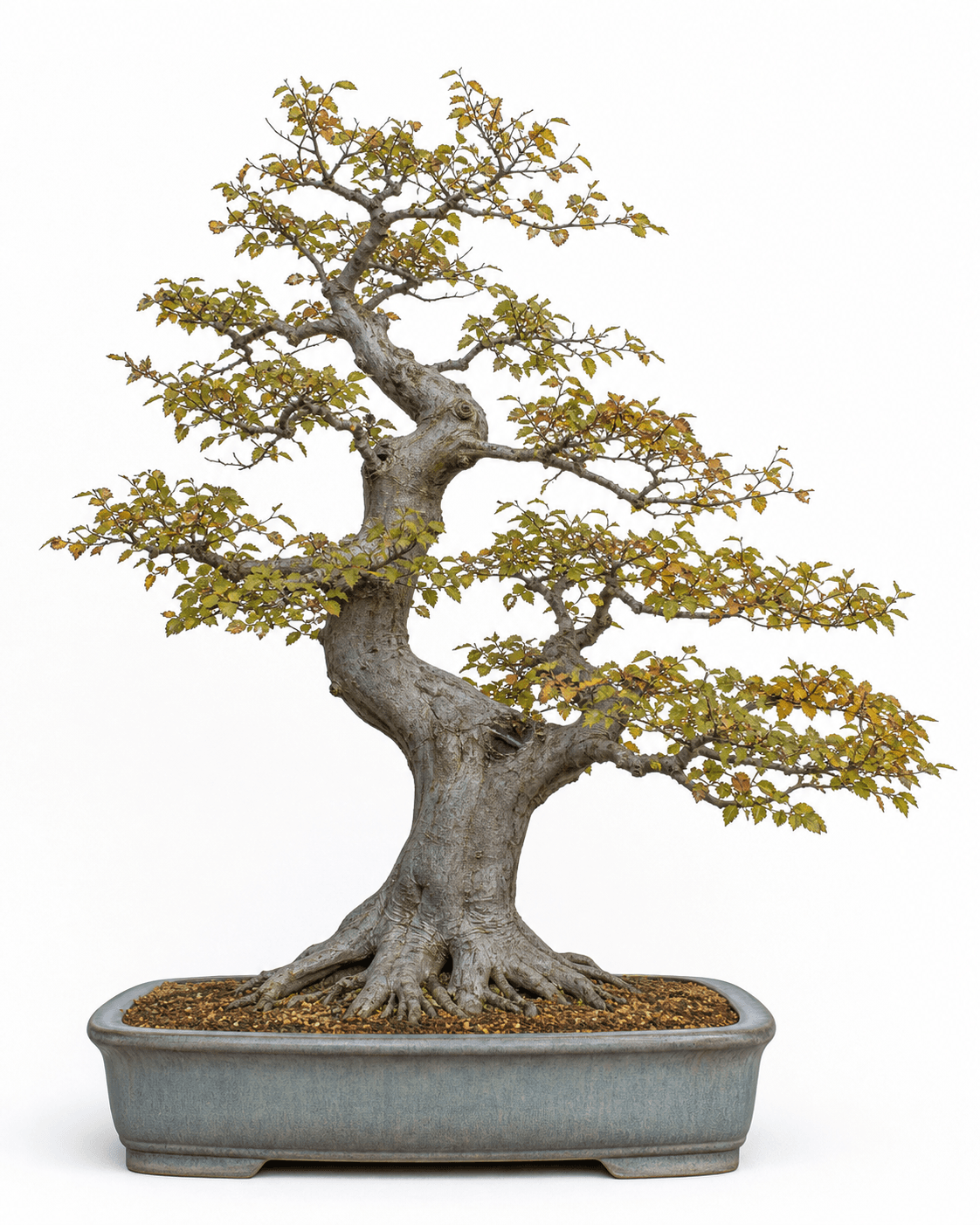
Korean hornbeam is an outdoor deciduous bonsai for growers who can protect container roots, keep moisture and oxygen in balance, and prune by growth stage. Its small leaves, short zigzag stems, fine twigging, and autumn color make it one of the most useful hornbeams for refined medium bonsai.
Use the accepted botanical name Carpinus turczaninovii. Kew accepts that name in Betulaceae, lists Carpinus coreana as a synonym, and gives the native range as China, Korea, south-central Japan, and south Japan.
The Mirai-specific method centers on three points: preserve the root sheen instead of bare-rooting, rebuild lower branches before asking for refinement, and let Korean hornbeam express irregular angular broadleaf character rather than uniform conifer-style pads.
Updated June 17, 2026. Written by EntGrove Editorial. Last verified June 17, 2026.
Care fingerprint
Read the species through its shared care pattern.
Repot and structural prune around dormant-to-active transitions; protect new leaves; time refinement work after growth hardens. Use this as the starting point before local conditions and tree strength refine the calendar.
Read the foliage first
Broadleaf stress usually shows in leaf color, leaf size, wilt, scorch, or delayed hardening before it becomes a branch problem.
Match work to dormancy
Deciduous, evergreen, tropical, succulent, and flowering broadleaf trees recover on different calendars.
Protect fine roots
Root work should preserve enough active fine roots for the tree to rehydrate quickly after the operation.
Care cadence
The calendar starts with the tree's seasonal state.
Placement
Timing: Grow outdoors through the full deciduous cycle. Use a cold frame, mulch bed, unheated shelter, or protected bench when refined pots face freezes, drying wind, or sudden cold before dormancy completes.
Watch for: Warm indoor storage, root balls frozen while dry, hard freezes before leaf-drop transition finishes, and assuming landscape Zone 5a hardiness protects a shallow bonsai container.
NC State ExtensionBonsai Mirai LibraryLight requirement
Timing: Use full sun in cool spring and autumn weather when water supply is steady. Shift to partial shade during hot wind, after root work, or when the pot dries faster than the roots can safely refill the canopy.
Watch for: Long internodes in heavy shade, black crisp leaf edges during heat, and a dense apex shading lower branches that Mirai would otherwise preserve for future structure.
NC State ExtensionBonsai Mirai LibraryWatering
Timing: Water when the surface begins to dry while the interior still holds some moisture. Thorough watering should be followed by oxygen return, especially in older sheen-based root cores.
Watch for: Dry nursery cores, stale wet akadama, root-pathogen scorch, sour root smell, weak spring push from degraded shin, and treating every black leaf edge as a foliar disease.
Bonsai Mirai LibraryNC State ExtensionFertilizer
Timing: Feed by stage. Use stronger organic feeding while building trunk, primary branches, and recovery reserves; pull back once tertiary refinement and shorter internodes matter.
Watch for: Coarse first flush from excessive fall nitrogen, weak lower branches starved by a dominant apex, and pushing fertilizer before a newly repotted tree has rebuilt roots.
Bonsai Mirai LibraryPruning
Timing: Prioritize fall leaf-drop refinement on healthy trees. Use pre-flush spring work for low-water-mobility structural cuts, or post-flush pruning after hardened leaves when the tree is energy positive.
Watch for: Cuts below viable nodes, flush cuts through shoulders, pruning weak lower branches too hard, and reducing viable length before deadwood triage and front assessment are complete.
Bonsai Mirai LibraryWiring
Timing: Wire healthy branches when seasonal flexibility and tree strength align. Late fall is useful for heavy structural moves; guy wires can move older brittle branches with less direct branch pressure.
Watch for: Under-gauged wire that forces repeated bending, downward branch tips losing vigor, wire sitting on buds, and old brittle wood splitting at natural bends.
Bonsai Mirai LibraryRepotting
Timing: Repot at spring bud movement or protected late-winter timing. Preserve the root sheen under the trunk, clean compacted edges and bottom, and avoid pairing major root repair with major restyling.
Watch for: Only a few branches pushing in spring, sour spreading root biology, slow drainage, degraded akadama, and a desire to change planting angle in the same year as a hard repot.
Bonsai Mirai LibraryPropagation and grafting
Timing: Layer, graft, or correct roots while the tree is still vigorous in development. Thread grafts are subtle on Korean hornbeam, while older potted trees callus slowly and give grafts less margin.
Watch for: Air layers attempted on old low-callus material, grafts delayed until refinement, layers separated before radial roots lignify, and root grafts used without a clear design problem.
Bonsai Mirai LibraryPest and disease checks
Timing: Inspect tender spring foliage, shaded interiors, wounds, and trees recovering from root work, drought, cold wet weather, or heavy pruning.
Watch for: Aphids, spider mites, scale, caterpillars, leaf miners, canker, fungal disease, Pseudomonas-style cold wet wound pressure, root pathogens, and pest outbreaks on weak soft growth.
NC State ExtensionBonsai Mirai LibrarySpecies guide
Apply the species profile before copying another tree's calendar.
At a glance
Korean hornbeam is a small-leaf deciduous bonsai with serious root and timing rules.
Botanical target: Carpinus turczaninovii Hance, family Betulaceae. Common labels include Korean hornbeam and Turczaninow hornbeam; bonsai and nursery tags may still use Carpinus turczaninowii with a w or the synonym Carpinus coreana. Kew POWONC State Extension
Care summary: Broadleaf > Deciduous, outdoor dormancy, full sun to partial shade, consistent water with oxygen, spring or protected late-winter root work, fall leaf-drop refinement pruning, cautious wiring, and medium to refined deciduous designs. NC State lists USDA Zones 5a to 7b, while a bonsai pot needs root protection before an in-ground tree would. NC State ExtensionBonsai Mirai Library
Plant features: NC State records a 15 to 20 foot deciduous shrub or small tree with small alternate leaves, mid-spring catkins, hop-like nutlet bracts that mature brown in fall, shallowly fissured gray-brown bark, dense rounded to weeping habit, and short zigzag stems. In bonsai those traits point toward refined twigging, autumn display, and naturalistic broadleaf structure. NC State ExtensionBonsai Mirai / Asymmetry
Wild habitat
Its range explains the moderate-water, root-sheen strategy.
Kew places Carpinus turczaninovii in the temperate biome across China, Korea, south-central Japan, and south Japan. NC State describes it as a deciduous large shrub or small tree in the birch family, native to China, Korea, and Japan. Kew POWONC State Extension
Mirai reads Korean hornbeam as a moderate or lower water-mobility deciduous species associated with drier foothill conditions compared with high-water trees such as Japanese maple, beech, stewartia, and aspen. That ecology is the basis for preserving the root sheen and using a pot deep enough to support the trunk and root core. Bonsai Mirai Library
Care implication: keep the container moist enough to prevent scorch while open enough to keep the shin clean and aerobic. Design implication: lean into small leaves, zigzag branching, irregular branch hierarchy, muscled bark, and the scars that old collected hornbeam can carry after root loss. Bonsai Mirai / AsymmetryBonsai Mirai Library
Reading the tree
Read strength through buds, lower branches, and the root core.
A strong Korean hornbeam shows healthy extension, firm hardened leaves, visible interior buds, and plump caramel-colored terminal buds after leaf drop. Dead or expired twigs taper to brown-black tips without viable buds, which gives a clear fall triage signal before pruning. Bonsai Mirai Library
Weak lower branches are usually a distribution problem before they are a styling problem. Mirai Korean hornbeam work preserves weak lower branches, cuts back strong upper branches more aggressively, and reorients branch tips upward so auxin flow and water movement can rebuild the lower design. Bonsai Mirai Library
Root health decides how much design work is available. A tree with only a few branches pushing strongly in spring, black leaf edges, sour wet soil, or shrinking vigor is asking for root-core recovery before cosmetic refinement. Bonsai Mirai Library
Pruning
Refine with fall leaf-drop pruning, grow-out, and cutback to useful nodes.
The cleanest refinement window is fall leaf drop. Mirai explains that stored resources are being redistributed at that point, so cutting back a dominant apex and strong upper branches can send the following spring response into weaker lower and interior buds. Bonsai Mirai Library
Spring pruning is the fallback for low-water-mobility hornbeam before bud push, and post-flush pruning becomes available only after leaves have hardened, darkened, and stopped elongating. Significant work while leaves are soft and energy negative causes dieback and growth arrest. Bonsai Mirai Library
Korean hornbeam usually produces alternating, angular growth on its own. Cut back to the tight usable nodes on hardened growth, choose the directional bud that points where the next shoot should travel, and avoid cutting to tiny immature basal leaves that lack viable axillary buds. Bonsai Mirai Library
Partial defoliation depends on leaf size and tree strength. Small-leaf refined Korean hornbeam often needs only cutback, while vigorous development trees or larger-leaf hornbeams may have remaining large leaves reduced by roughly two-thirds after the first flush hardens. Bonsai Mirai Library
Repotting
Preserve the root sheen and fix compaction before visible decline.
Korean hornbeam is a root-sheen tree in the Mirai method. Keep the deep root mass directly under the trunk intact when transitioning field-grown or mature material, and avoid the flat bare-rooting approach used on plate-root maples. Bonsai Mirai Library
Refined deciduous trees are commonly repotted on a 3 to 4 year rhythm, while developing material is inspected by drainage, root fill, and vigor. Once shin decline is obvious, remedial surgery often causes branch loss, so clean compaction and degraded soil before the tree shows a crisis. Bonsai Mirai Library
For rock plantings, Mirai treats the tree, roots, and stone as one unit. Work the bottom and sides that contact the container, preserve the mossed root mass over the stone, and remember that Korean hornbeam stays a planted-on-stone composition because its fine sheet-like roots stay delicate over rock compared with maple roots. Bonsai Mirai Library
After major root reduction, aim for a modest proportional flush rather than vigorous regrowth. Big fat buds forming in fall are a better recovery signal than a few long emergency shoots in spring. Bonsai Mirai Library
Soil and pot
Use akadama-heavy soil and enough pot depth for the shin.
Mirai Korean hornbeam work allows 100 percent akadama for refined trees because it provides water retention, nutrient exchange, and oxygen when particle size and watering are managed. During transition, preserve useful native or field core biology while replacing stale edges and bottom zones with structured bonsai soil. Bonsai Mirai Library
Pot depth matters more for Korean hornbeam than for high-water maples. Mirai sheen-based guidance uses a container deep enough to sustain the root core and warns that very shallow pots can trigger a slow 2 to 3 year decline in vigor and ramification. Bonsai Mirai Library
Pot pairing should follow the image: quiet unglazed earth tones for old angular trunks, neutral gray or ash-marked containers for pale-bark deciduous forest and group plantings, and deeper ovals or rectangles for trees still rebuilding the root system. Bonsai Mirai / AsymmetryBonsai Mirai Library
Climate
Adapt by winter reserve, summer dry-down, and wound timing.
NC State lists Korean hornbeam for USDA Zones 5a to 7b in the landscape. Bonsai containers change that risk because refined trees have smaller soil volume, less reserve, and more exposed roots, so protect earlier when the pot can freeze, dry, or swing rapidly. NC State ExtensionBonsai Mirai Library
In hot or dry-summer regions, Korean hornbeam can tolerate more heat than high-water deciduous species when the roots are sound, but the pot still decides the day. Use morning sun, afternoon shade, wind reduction, and larger soil mass when black leaf edges or midday wilt begin to appear. Bonsai Mirai LibraryNC State Extension
Cold wet regions should delay large field-grown trunk chops until after the first spring flush hardens, especially when pathogen pressure is high. Mild-winter regions can use fall leaf-drop chops on vigorous field-grown hornbeam, but potted refined trees still deserve conservative sequencing. Bonsai Mirai Library
Pests and disease
Most pest pressure follows weak roots, dense shade, or bad cuts.
NC State names aphids, spider mites, scale, caterpillars, leaf miners, canker, and fungal diseases on Korean hornbeam. Inspect the undersides of leaves, shaded interior shoots, bark cracks, and spring extension before pests are hidden by a full canopy. NC State Extension
Root health is the first disease prevention step. Black crispy leaf edges with a living leaf center often indicate chronic dry-down or overwatering-driven root pathogens, while a sour root core can show up as scattered branch weakness before the tree looks generally sick. Bonsai Mirai Library
Wound management matters because Korean hornbeam is slow to callus and prone to dieback. Use perpendicular cuts, preserve shoulder tissue, seal important cuts, and avoid cold wet structural wounds when local conditions favor bacterial or fungal entry. Bonsai Mirai Library
Treat severe insects directly, then fix the conditions that made the tree vulnerable: dense shade, overfed soft growth, poor airflow, dry roots, wet anaerobic soil, and a styling schedule that weakened the lower canopy. NC State ExtensionBonsai Mirai Library
Wiring
Set broad structure once, then let pruning carry refinement.
Korean hornbeam branches are brittle. Mirai recommends decisive wire gauges for first structural moves because under-gauged wire forces repeated bending and breakage; thicker pieces may need paper-wrapped copper or a guy wire instead of fine branch-by-branch wiring. Bonsai Mirai Library
Wire with the branch and its existing direction. Bend along natural curves, keep buds on the outside of bends, and stop at the first hairline split. Directional pruning usually creates better hornbeam angularity than trying to bend a long straight run into character. Bonsai Mirai Library
Branch tips should finish up and out, especially on weak lower branches. Mirai Korean hornbeam work shows that branches held downward lose strength, shed interior twigs, and die back, while upward tips restore enough auxin contribution to keep the branch alive. Bonsai Mirai Library
Refinement wiring should control secondary structure without wrapping every fine tip. As the tree responds, expect branches to lift or sag, inspect wire before it bites, and remove or reuse existing wire only when the tree and wire condition justify it. Bonsai Mirai Library
Propagation
Propagate while the tree is vigorous, before refinement suppresses energy.
Seed can produce useful forest, clump, or root-development material when the source is confirmed, but seedlings should be selected early for root base, internode length, and natural twig direction rather than grown blindly for years. Kew POWOBonsai Mirai / Asymmetry
Air layers work best before the tree is energy-suppressed in a small bonsai pot. Mirai Korean hornbeam files caution that old hornbeam calluses poorly, so trunk layers and branch layers need strong foliage, patient timing, and a willingness to re-wound if roots are uneven. Bonsai Mirai Library
Grafting is useful for missing branches or roots on valuable stock. Mirai notes approach and thread grafts are feasible, with thread grafting often more subtle because Korean hornbeam buds are small, but the operation is much easier while the tree is still strong in development. Bonsai Mirai Library
Cuttings are possible as a propagation experiment, but the better bonsai source is usually selected seedling, layer, field-grown trunk, or older material with existing branch hierarchy. Let the design problem choose the propagation method. Bonsai Mirai / AsymmetryBonsai Mirai Library
Buying and sourcing
Buy Korean hornbeam by roots, lower branches, and verified identity.
Start with the label. Kew accepts Carpinus turczaninovii and lists Carpinus coreana as a synonym; NC State uses Korean hornbeam and Turczaninow hornbeam. EntGrove keeps the accepted v spelling while recognizing the common bonsai-trade w spelling. Kew POWONC State Extension
Good stock has a believable base, sound root sheen, usable lower branches, short internodes, buds on interior branch lines, and some irregular angular character. The species rarely powers a weak spindly branch into a future leader, so existing lower options matter. Bonsai Mirai / AsymmetryBonsai Mirai Library
Reject material with a sour compacted root core, large roots cut back without fine recovery, major wire scars on the trunk, every branch emerging from one swollen junction, dead lower structure, or a straight top-heavy apex that already controls the whole tree. Bonsai Mirai Library
Older collected or field-grown hornbeam can carry scars, muscled trunks, and oversized old primary branches. Mirai treats those as possible age signals when they support the design, while fresh unhealed wounds and collapsing root biology are buying risks. Bonsai Mirai / AsymmetryBonsai Mirai Library
Troubleshooting
Diagnose Korean hornbeam through roots, buds, branch direction, and timing.
Black crispy leaf edges: check the root system before treating the leaf. The cause is often chronic dry-down, wet-root pathogens, or a stale core that cannot move water cleanly under heat. Bonsai Mirai Library
Only the apex pushes strongly in spring: suspect root-core decline and energy imbalance. Restore root oxygen, protect lower buds, and reduce the top at the next safe window rather than styling weak branches harder. Bonsai Mirai Library
Lower branches weaken or shed interior twigs: lift branch tips, open light into the lower canopy, preserve active buds, and avoid pruning weak branches to the same length as strong upper branches. Bonsai Mirai Library
Cuts dry back: review whether the cut stayed above viable tissue and preserved shoulder structure. Korean hornbeam is prone to dieback, so leave a small active stub on weak branches and seal valuable cuts. Bonsai Mirai Library
Wire scars or splits appear: remove or relax wire, stop bending, and rebuild the line through directional pruning. Future heavy moves belong in the right seasonal window with enough wire or a guy wire to place the bend once. Bonsai Mirai Library
The tree grows coarse after every cut: separate development from refinement. Feed and run only the branches building structure, then use post-flush or fall cutback to keep refined zones from being overwhelmed. Bonsai Mirai Library
Design
Style the species as angular broadleaf material with irregular billow.
Korean hornbeam character is irregular, angular, and slightly contorted. Mirai emphasizes zigzag alternating branching, unequal branch hierarchy, and informal billowed canopies; forcing each branch into a uniform rounded pad flattens the best feature of the species. Bonsai Mirai / AsymmetryBonsai Mirai Library
Begin with the base, trunk line, defining branch, and apex. Preserve older hierarchical primary branches when they carry age because large cuts in hornbeam can rot from the interior and produce problems that take years to stabilize. Bonsai Mirai / AsymmetryBonsai Mirai Library
Suitable images include refined informal upright, broom, clump, twin-trunk, raft, windswept, planted-on-stone, and deciduous forest. In windswept or directional designs, preserve longer secondaries and tertiaries that carry the wind line instead of reducing everything to dense twigging. Bonsai Mirai / AsymmetryBonsai Mirai Library
Deadwood should read as deciduous age: scars, hollows, natural rot, and negative space. Mirai favors accepting old hornbeam wounds and scar tissue over carving conifer-style deadwood through living bark. Bonsai Mirai / AsymmetryBonsai Mirai Library
Forms
Most labels are synonyms or regional trade language under one care calendar.
Kew lists Carpinus coreana, Carpinus turczaninovii var. coreana, and several related names as synonyms under Carpinus turczaninovii. NC State also lists Carpinus coreana, Carpinus stipulata, and Carpinus turczaninovii var. coreana as previous names. Kew POWONC State Extension
Treat the common bonsai-trade spelling Carpinus turczaninowii as a label bridge to the accepted species rather than a separate care page. Confirm the plant against Korean hornbeam features, source records, and local expert identification when buying valuable material. Kew POWONC State Extension
Separate Korean hornbeam from Japanese hornbeam, American hornbeam, European hornbeam, Oriental hornbeam, and beech. Mirai compares those hornbeams by leaf scale, water movement, and character, with Korean hornbeam favored for smaller leaves and refined scale. Bonsai Mirai LibraryNC State Extension
History
Korean hornbeam earns its bonsai reputation through winter structure and small scale.
NC State calls Korean hornbeam ideal for bonsai because of small leaves and adaptability, and the page includes a documented bonsai specimen image. That public horticultural record aligns with the species role in refined deciduous bonsai: small leaves, compact buds, autumn color, and winter twigging. NC State Extension
The Mirai Korean hornbeam corpus follows field-grown, collected, rock-planted, and refined trees through creation, repotting, fall refinement, and later progression. The recurring lesson is that root health and lower-branch strength decide whether the design can advance. Bonsai Mirai LibraryBonsai Mirai / Asymmetry
Old Korean hornbeam material often carries muscled trunks, longitudinal water-vein texture, scars, and branch attrition from earlier collection and root loss. Those features can create age when the tree is healthy enough to support them. Bonsai Mirai / AsymmetryBonsai Mirai Library
A strong Korean hornbeam bonsai should be judged by root-driven vigor, believable broadleaf branch hierarchy, active lower structure, directional twigging, restrained leaf size, and a seasonal image that still reads well after every leaf drops. Bonsai Mirai / AsymmetryBonsai Mirai LibraryNC State Extension
Species questions
Answer the beginner questions before styling.
Is Korean hornbeam a good beginner bonsai?
Yes, for an outdoor grower who can water consistently, protect the container in winter, and follow seasonal timing. It is more precise than an elm or ficus because root sheen, lower-branch strength, and wiring mistakes matter.
Can Korean hornbeam bonsai live indoors?
Grow Korean hornbeam outdoors. It is a temperate deciduous tree, and the bonsai method depends on dormancy, spring bud movement, first-flush hardening, fall leaf drop, and winter root protection.
What is the correct scientific name for Korean hornbeam?
Use Carpinus turczaninovii. Kew accepts that spelling and lists Carpinus coreana as a synonym; many bonsai labels still use Carpinus turczaninowii with a w.
How much sun does Korean hornbeam bonsai need?
Use full sun to partial shade. Strong spring light builds short internodes when water is steady, while afternoon shade helps in hot wind, small pots, recent repots, and dry-summer climates.
How often should I water Korean hornbeam bonsai?
Water when the surface starts to dry while the core still holds moisture. The goal is even moisture with oxygen return, since both chronic dry-down and stale wet roots can cause black leaf edges and branch weakness.
When should I prune Korean hornbeam bonsai?
Fall leaf drop is the best refinement window on healthy trees. Pre-flush spring pruning is a fallback for low-water-mobility work, and post-flush pruning is safe after leaves harden and the tree is energy positive.
When should I repot Korean hornbeam bonsai?
Repot at spring bud movement or in protected late winter where local facilities make that safe. Refined trees often run on a 3 to 4 year rhythm, but drainage, vigor, and root-core condition are more important than the calendar.
Should Korean hornbeam be bare-rooted?
Avoid full bare-rooting on mature or collected Korean hornbeam. Mirai treats it as a root-sheen species, so preserve the core under the trunk and transition compacted soil in stages.
Why is my Korean hornbeam losing lower branches?
Lower branches weaken when the apex dominates, tips are held downward, the root system is failing, or the lower canopy is shaded. Preserve lower buds, raise branch tips, reduce the strong top, and restore root oxygen before demanding refinement.
What styles suit Korean hornbeam bonsai?
Informal upright, broom, clump, twin-trunk, raft, planted-on-stone, windswept, group, and old collected deciduous styles suit it. The best designs keep angular branching, irregular hierarchy, and broadleaf billow.
Sources
Species advice needs source discipline.
Next decisions
Plan the operation before copying the calendar.
A good care note for Korean hornbeam records the tree's stage, the work done, and the aftercare used. That record matters more than a month-name rule.
Related species
Compare nearby trees before transferring advice.
Japanese maple
Acer palmatum
Trident maple
Acer buergerianum
Amur maple
Acer tataricum subsp. ginnala
Field maple
Acer campestre
Japanese hornbeam
Carpinus japonica