
Species guide
Alpine Larch Bonsai Care
Larix lyallii
Alpine larch, Larix lyallii, is a high-elevation North American deciduous conifer that turns gold, drops its needles, and grows at timberline in cold, bright, rocky, snowy sites. As bonsai, treat it as an outdoor larch with a very narrow spring bud-swell work window, steady summer moisture, cold dormancy, and strong protection from heat and stale roots.
The Mirai corpus has strong Larix method but no dedicated Larix lyallii file. This guide is transparent about that source depth: bonsai technique comes from Mirai larch spring-work, growth-management, pruning, development, design, and deciduous-conifer files, while species identity, range, habitat, hardiness evidence, pests, and ecological design cues are grounded in Kew, USDA Forest Service, and British Columbia forestry sources.
Updated June 5, 2026. Written by EntGrove Editorial. Last verified June 5, 2026.
Care fingerprint
Read the species through its shared care pattern.
Use bud swell, needle hardening, and autumn color as signals; root work is seasonal and refinement depends on soft new extension. Use this as the starting point before local conditions and tree strength refine the calendar.
Do not prune like a pine
Elongating conifers extend from buds and shoots, so candle-cutting assumptions can remove the exact growth the tree needs.
Preserve interior growth
Spruce, fir, hemlock, cedar, redwood, cypress, and larch all become harder to design when interior buds are shaded out.
Keep recovery cool and steady
Many elongating conifers respond best when roots stay evenly moist, oxygenated, and protected from hot dry swings.
Care cadence
The calendar starts with the tree's seasonal state.
Repotting
Timing: Spring as buds swell and just begin showing green
Watch for: A bud window that closes quickly, open needles, frozen roots, old compact nursery soil, weak post-collection roots, and combining first root conversion with severe styling.
Bonsai Mirai LibraryStructural pruning and wiring
Timing: The same spring bud-swell window, while branches are visible and stored reserves are moving
Watch for: Cuts beyond viable buds, handling swelling buds too often, fall branch removal, overworking collected material, and wire that bites during rapid active-season thickening.
Bonsai Mirai LibraryShoot pruning
Timing: Let elongating shoots run first, then prune after extension reveals usable buds
Watch for: Pinching soft shoots, pruning after a heavy repot, cutting every shoot to the same point, losing weak lower branches, and trying full multi-flush refinement in hot climates.
Bonsai Mirai LibraryWatering
Timing: Check daily through active growth, sun, wind, and shallow-pot heat
Watch for: Dry pockets, overheated pot walls, water bypassing old soil, stale saturation, needles dulling in summer, and winter roots drying while dormant.
USDA Forest Service SilvicsBonsai Mirai LibraryFertilizer
Timing: Feed development trees for strength. On refined trees, start after the first pruning and use fall feeding to support next spring reserves.
Watch for: Heavy spring fertilizer on refined trees, weak fall buds, feeding after root damage before uptake returns, and pushing coarse growth when the design needs compression.
Bonsai Mirai LibraryPest and disease inspection
Timing: Early summer through fall cleanup, especially after heat, drought, defoliation, or collected-material stress
Watch for: Larch casebearer risk, seed or shoot fly larvae, aphids, mites, needle blight, needle cast, canker-like swelling, heart rot in old wood, and witches-broom symptoms.
USDA Forest Service FEISUSDA Forest Service SilvicsWinter protection
Timing: After golden needle drop, before severe container-root exposure
Watch for: Warm indoor storage, late pruning wounds, exposed shallow pots, winter sun and dry wind, and root balls that freeze dry after recent work.
British Columbia Tree Species CompendiumBonsai Mirai LibrarySpecies guide
Apply the species profile before copying another tree's calendar.
At a glance
Alpine larch is a timberline Larix with a narrow bonsai margin.
Kew accepts Larix lyallii in Pinaceae and places its native range from southeastern British Columbia to western Montana, including Alberta, British Columbia, Idaho, Montana, and Washington. Kew POWO
USDA FEIS lists subalpine larch, alpine larch, Lyall larch, Lyall's larch, tamarack, timberline larch, and woolly larch as common-name labels. EntGrove keeps alpine larch separate from American larch and western larch because those labels often blur in retail and regional speech. USDA Forest Service FEIS
The bonsai method needs a caveat. The local Mirai corpus has strong Larix guidance but no dedicated Larix lyallii transcript, so this profile transfers larch technique only where the species biology supports it and uses forestry sources for species-specific facts. Bonsai Mirai LibraryUSDA Forest Service Silvics
The care fingerprint is clear: outdoor cold dormancy, high light, cool roots, even moisture, spring bud-swell root and structural work, extension-then-prune shoot management, no pinching, autumn gold, needle drop, and winter root protection. Bonsai Mirai LibraryUSDA Forest Service FEIS
Wild habitat
Its wild habitat is bright, cold, rocky, moist, and exposed.
USDA Silvics describes alpine larch as a tree of high mountains in the inland Pacific Northwest, occupying timberline and cool exposures where many evergreen conifers cannot persist. USDA Forest Service Silvics
The B.C. compendium places subalpine larch between alpine tundra and subalpine boreal climates, often between 1800 m and 2300 m in British Columbia, with subalpine fir, Engelmann spruce, and whitebark pine near timberline. British Columbia Tree Species Compendium
Roots explain a lot of the bonsai challenge. USDA Silvics and B.C. sources describe deep anchoring into fissures, a taproot, large laterals, rocky substrates, and windfirm trees whose crowns or trunks can break while the root system remains anchored. USDA Forest Service SilvicsBritish Columbia Tree Species Compendium
Care should imitate the functional habitat, not the literal talus field. The pot needs bright exposure, cool and evenly moist roots, high oxygen, and protection from heat that a mountain slope would never ask the tree to endure. USDA Forest Service SilvicsBonsai Mirai Library
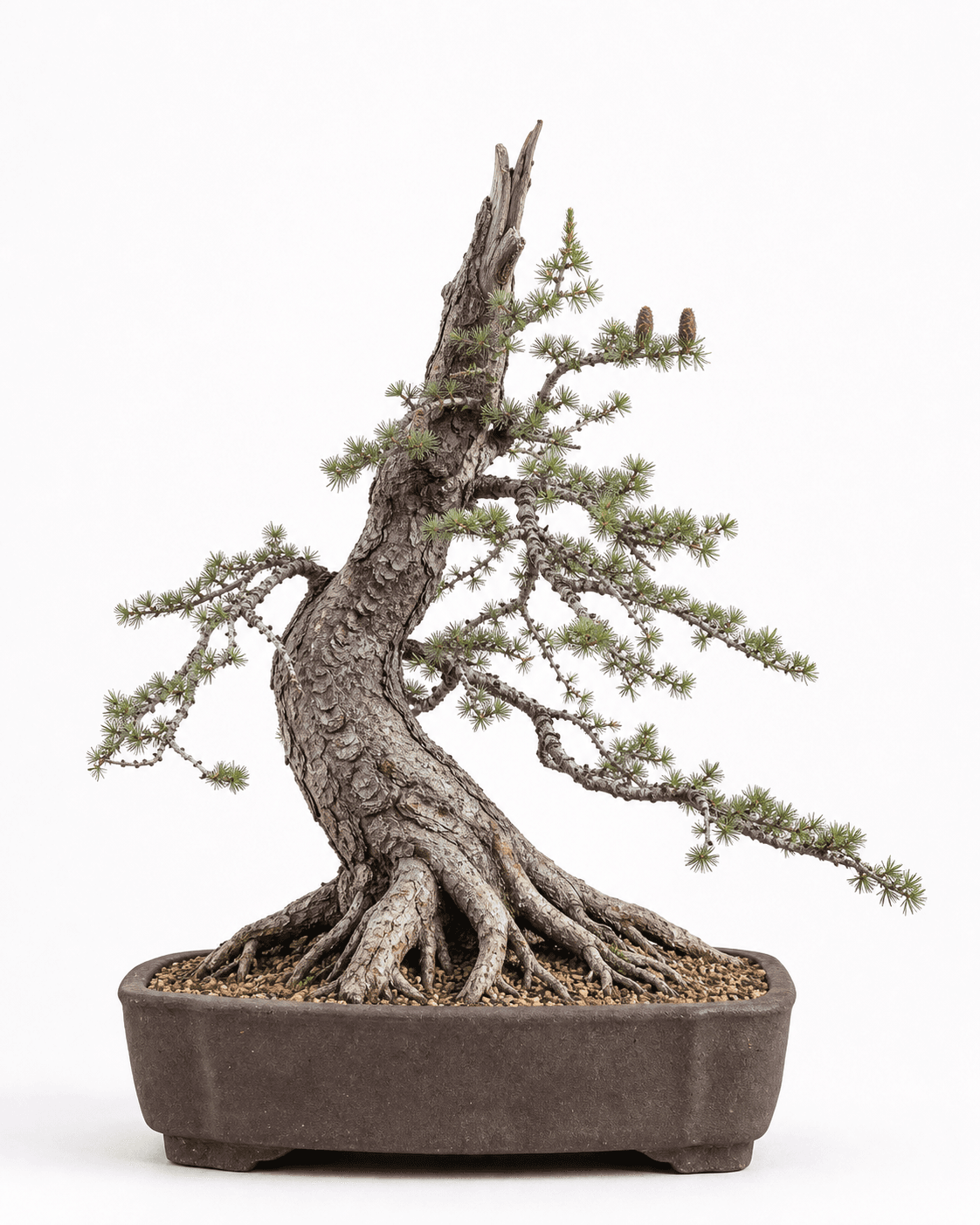
Design follows habitat directly. Old alpine larch should read as timberline material: small pointed apex, snow-loaded drooping branches, visible winter structure, rugged roots, broken tops, and branch lines shaped by wind and heavy snow. Bonsai Mirai LibraryBonsai Mirai / AsymmetryUSDA Forest Service Silvics
Reading the tree
Read bud stage, root history, and whether the tree is building or refining.
Mirai places the most important larch work at spring bud swell. Buds that are swelling and just showing green mark the period when stored sugars and starches are moving and the tree can recover from root work, woody pruning, and wiring. Bonsai Mirai Library
A developing alpine larch needs extension and foliage to build vascular tissue. Let primary and secondary structure run when the trunk, branch diameter, or root system still needs strength. Bonsai Mirai Library
A refined larch earns reduction only after shoots extend and reveal usable buds. Mirai repeatedly warns against pinching because it redirects stored energy into interior shoots that should stay fine. Bonsai Mirai Library
Root history matters more on alpine larch than on a mass-market Japanese larch. A collected or high-elevation seedling may have slow recovery, deep-root habits, sparse feeder roots, and a short local growing season, so reduce the work plan until sustained extension proves strength. USDA Forest Service SilvicsBonsai Mirai Library
Pruning
Let larch shoots spend energy, then prune to viable buds.
Do not pinch alpine larch. Use the larch pattern from Mirai: let the elongating shoot run, then prune after extension to a useful basal whorl, paired buds, or lateral bud that can build ramification. Bonsai Mirai Library
In cool climates on strong refined trees, successive pruning can shorten internodes and produce finer later flushes. The third or fourth push is usually where refined larch ramification becomes useful. Bonsai Mirai Library
On a recently repotted, collected, or heat-stressed tree, skip the full refinement sequence. A tree rebuilding roots needs foliage and extension before it can afford repeated reductions. Bonsai Mirai Library
Never cut behind the last viable bud. Larch can back-bud strongly when healthy, but a branch with no usable bud or active tissue behind the cut can die back. Bonsai Mirai Library
Shape branches as triangular, broken, snow-load pads rather than uniform fans. A single soft vertical break can separate a too-large pad while preserving the alpine character. Bonsai Mirai Library
Repotting
Repot at bud swell and stage the move from wild roots to bonsai roots.
Use spring bud swell as the primary root-work window. This is the same window Mirai uses for larch wiring and structural pruning, but first conversions should not combine every heavy operation at once. Bonsai Mirai Library
A refined, established larch with strong roots can tolerate routine spring pruning, wiring, and repotting in one season. A collected or nursery-transition tree should have root conversion separated from ambitious styling. Bonsai Mirai Library
Forest-repotting guidance in the Mirai corpus warns against bare-rooting deciduous conifers such as Larix. Preserve part of the functioning root mass, eliminate old soil gradually, and tie the tree firmly so new roots do not tear. Bonsai Mirai Library
The wild root habit argues for patience. USDA and B.C. sources describe deep fissure roots, taproots, lateral roots, and rocky-site anchoring. Bonsai conversion should create feeder roots near the trunk over multiple cycles. USDA Forest Service SilvicsBritish Columbia Tree Species CompendiumBonsai Mirai Library
Soil and pot
Use akadama for refined roots, with enough pot volume to keep the mountain tree cool.
Mirai recommends 100 percent high-quality akadama for established refined larch because Larix roots can colonize and scale akadama before the structure fails. That supports finer roots, tighter internodes, and shorter needles. Bonsai Mirai Library
For early development, Mirai allows a more organic grow mix, roughly 70 percent organic and 30 percent aggregate, to build trunk and root strength before refinement. Move toward akadama as the tree enters a bonsai container. Bonsai Mirai Library
Alpine larch occupies relatively moist sites in nature, but the shallow-pot target is moisture with air. Avoid compacted peat, sour organic sludge, and waterlogged pockets that create anaerobic roots. USDA Forest Service SilvicsBonsai Mirai Library
Pot choice should respect the tree story. Rugged unglazed containers, quiet ovals, forest slabs, and deeper development pots all fit better than a delicate glazed pot if the design is about timberline age and rock-rooted endurance. Bonsai Mirai / Asymmetry
Climate
Cold is part of the design; heat is the practical limit.
B.C. forestry records subalpine larch as adapted to severe winters and an upper subalpine climate, with an absolute minimum of -56 degrees C recorded in its habitat. That supports cold dormancy, not warm indoor storage. British Columbia Tree Species Compendium
A bonsai container still changes winter risk. Protect the pot from dry wind, repeated freeze-thaw, and hard exposure after recent root work or late structural work. Bonsai Mirai Library
Warm-summer growers should be conservative. Mirai larch guidance says hot climates need more retained foliage, less frequent pruning, reduced fertilizer, and shade cloth or cooler bench positions when heat outruns transpiration. Bonsai Mirai Library
The species is shade-intolerant, so heat protection should cool the root zone without starving the foliage. Morning sun, open sky, airflow, and afternoon pot cooling usually beat deep shade. USDA Forest Service SilvicsBonsai Mirai Library
Pests and diseases
Wild alpine larch has modest pest pressure, but bonsai stress changes the picture.
USDA FEIS says insects and disease generally cause little damage to subalpine larch in habitat, while still noting fly larvae damage to seed crops, possible larch casebearer spread, brown heart rot, needle blight, needle cast, and canker-like swelling. USDA Forest Service FEIS
USDA Silvics adds crown damage from violent wind, wet snow, and ice; trunk breakage after advanced heart rot; needle blight; needle cast; possible stem cankers; witches-broom; and uncertain dwarf mistletoe records. USDA Forest Service Silvics
On a bonsai bench, the practical checks are simpler: aphids on sugary new growth, mites during heat, larch casebearer or sawfly-like defoliation, fungal needle spots after poor airflow, root rot in stale soil, and bark beetle risk on weak collected material. Bonsai Mirai LibraryUSDA Forest Service FEIS
Treatment should start with diagnosis. Remove obvious larvae by hand at bonsai scale, improve airflow and water rhythm, isolate suspicious fungal symptoms, and use local extension guidance before choosing chemicals. USDA Forest Service FEIS
Wiring
Wire hard structure in spring, then let scissors build the fine winter line.
Mirai favors copper wire on larch because the bark and growth strength can overpower aluminum. Use wire for trunks, primary branches, secondary branches, and apex direction. Bonsai Mirai Library
The best structural window is spring bud swell while the branch architecture is visible. Place wire around swelling buds carefully, support branch shoulders, and avoid repeated handling once buds have taken on water. Bonsai Mirai Library
Vigorous larch can mark quickly. Development trees may need wire removed mid-season even when foliage makes the work awkward; refined pot-bound trees may settle into a spring unwire and rewire rhythm. Bonsai Mirai Library
Fine tertiary ramification is mostly scissor work. The goal is a visible winter silhouette with short internodes, clean bifurcations, and branch lengths that shorten toward the apex. Bonsai Mirai Library
Propagation
Seed is slow and exacting; air layers work by larch method when the tree is strong.
USDA FEIS says subalpine larch can begin producing cones around 100 years old, often does not produce seed in quantity until about 200 years, and large seed crops are infrequent. USDA Forest Service FEIS
Seedlings are slow. USDA Silvics notes vigorous 4 ft saplings are about 30 to 35 years old, and FEIS describes very slow growth during the first 20 to 25 years as roots establish. USDA Forest Service SilvicsUSDA Forest Service FEIS
Mirai larch method supports air layering after the first flush hardens, using a ring-bark cut with wire pressed against the cut tissue and enough foliage above the layer to drive roots. Bonsai Mirai Library
Layering collected or weak alpine larch should wait until the tree has several seasons of container strength. A slow high-elevation species deserves evidence of extension before any propagation wound. USDA Forest Service SilvicsBonsai Mirai Library
Sourcing
Buy label certainty, roots, and provenance before romance.
Confirm the label first. Alpine larch is Larix lyallii; American larch is Larix laricina; western larch is Larix occidentalis. FEIS notes natural hybridization with western larch in overlap areas, so western North American larch labels deserve close inspection. Kew POWOUSDA Forest Service FEISUSDA Forest Service Silvics
Good starter material has live lower buds, flexible branch options, a visible base, healthy spring push, and a root system already moving toward container culture. Very old collected roots may be powerful visually but slow to convert. Bonsai Mirai LibraryUSDA Forest Service Silvics
Avoid weak trees with no interior buds, heat-browned needles, stale nursery peat, hidden trunk rot, heavy canker-like swellings, or a vague tamarack label without region or scientific name. USDA Forest Service FEISUSDA Forest Service Silvics
Collected alpine larch is ethically sensitive because the species grows in remote timberline communities valued for recreation, watershed protection, wildlife habitat, and ecological rarity. Collection should require legal permission, low-impact practice, and strong aftercare capacity. USDA Forest Service SilvicsUSDA Forest Service FEIS
Troubleshooting
Diagnose by season, root function, and the last work window.
Symptom: needles turn lemon yellow to gold in fall and drop. Likely cause: normal deciduous-conifer dormancy. Fix: protect the root ball, keep it from drying hard, and wait for spring bud swell. USDA Forest Service FEIS
Symptom: summer needles dull, wilt, or brown at the tips. Likely cause: dry pockets, hot pot walls, wind, too much foliage removal, or roots that cannot replace water fast enough. Fix: water through the root mass, cool the pot, and reduce heat stress. Bonsai Mirai Library
Symptom: branch dies after fall pruning. Likely cause: lost winter reserves after a bad work window. Fix: move structural pruning back to spring bud swell and use fall for feeding, observation, and protection. Bonsai Mirai Library
Symptom: coarse knuckles at branch tips. Likely cause: pinching or cutting to the same basal point repeatedly. Fix: let selected shoots extend, then prune to useful lateral buds and rebuild cleaner bifurcations. Bonsai Mirai Library
Symptom: needles are mined, chewed, spotted, or cast early. Likely cause: casebearer, sawfly-like feeding, needle blight, needle cast, mites, or drought stress. Fix: inspect with magnification, remove pests where practical, improve airflow, and get local diagnosis for fungi. USDA Forest Service FEISUSDA Forest Service Silvics
Symptom: weak extension after repotting. Likely cause: heavy root reduction, old root core damage, poor tie-down, cold wet soil, or fertilizer before uptake returned. Fix: stabilize, protect from heat and wind, water evenly, and postpone pruning until extension proves recovery. Bonsai Mirai Library
Design
Style alpine larch as timberline age, not generic conifer foliage.
Start with the trunk line, defining branch, apex, and winter silhouette. Larix lyallii is deciduous, so every branch junction and directional choice is exposed after needle drop. Bonsai Mirai / AsymmetryUSDA Forest Service FEIS
Mirai larch design favors triangular pads and conical apex structure for an alpine story. The super-critique corpus specifically notes that old alpine larch carry small near-pointed apices and steeply drooping snow-loaded branches. Bonsai Mirai Library
USDA Silvics describes broad irregular crowns, windfirm roots, crown and trunk breakage from violent winds, and open parklike groves. Those features support broken-top designs, old anchored roots, and spare branch distribution. USDA Forest Service Silvics
Deadwood can be believable when it reads as snow, wind, breakage, and heart-rot age. Keep it restrained, tied to the live vein, and different from dryland juniper drama. USDA Forest Service SilvicsBonsai Mirai / Asymmetry
Forests and groups are strong from seedlings because wild alpine larch often forms small open groves. Use uneven spacing, varied heights, and enough negative space for the gold autumn and bare winter rhythm to matter. USDA Forest Service SilvicsBonsai Mirai / Asymmetry
Cultivars
For launch, keep alpine larch as one species page.
USDA Silvics says races, varieties, or subspecies of alpine larch are not known, and Kew accepts Larix lyallii as the species with Pinus lyallii as a homotypic synonym. USDA Forest Service SilvicsKew POWO
Hybridization with western larch has been documented in western Montana and other overlap conditions, but hybrids should be recorded as uncertain material rather than folded into alpine larch care without evidence. USDA Forest Service FEISUSDA Forest Service Silvics
For bonsai selection, provenance and structure matter more than cultivar names. Prioritize local climate fit, live buds, recoverable roots, trunk character, and the ability to sustain cool summer growth. Bonsai Mirai / AsymmetryUSDA Forest Service Silvics
History
Alpine larch is famous for high-country color, age, and ecological restraint.
USDA Silvics records alpine larch as ecologically interesting and aesthetically attractive, with wood that has little commercial value because it inhabits remote high-mountain terrain. USDA Forest Service Silvics
FEIS notes that hikers and photographers value the tree for bright green summer foliage and lemon-yellow to gold fall color. The U.S. Forest Service also highlights alpine larch as a notable fall-color exception among western conifers. USDA Forest Service FEISU.S. Forest Service Celebrating Wildflowers
The species can be extremely long lived. USDA sources report typical dominant-tree life spans of 400 to 500 years, many trees reaching 700 years, and the oldest individuals estimated near 1,000 years. USDA Forest Service SilvicsUSDA Forest Service FEIS
There is no broad alpine larch bonsai canon like Japanese black pine or Shimpaku. A strong tree should make its species legible through timberline ecology, slow age, gold autumn color, exposed roots, and a restrained winter silhouette. Bonsai Mirai / AsymmetryUSDA Forest Service Silvics
Species questions
Answer the beginner questions before styling.
Can alpine larch be grown as bonsai?
Yes, but it is advanced material. Alpine larch needs outdoor cold dormancy, high light, cool moist roots, spring bud-swell work, and a grower who can protect it from heat and root stress.
Can alpine larch bonsai live indoors?
No. Alpine larch is a cold-climate deciduous conifer. Grow it outdoors, allow autumn needle drop, and use winter root protection instead of warm indoor storage.
When should I repot alpine larch bonsai?
Repot at spring bud swell, just as buds begin showing green. Preserve functioning roots, tie the tree firmly, and separate severe root conversion from severe styling.
Should alpine larch be pinched?
No. Let shoots extend first, then prune to viable buds after extension. Pinching can coarsen interior growth and create knuckled branch tips.
What soil works for alpine larch bonsai?
Use 100 percent high-quality akadama for established refined larch. Use a more growth-oriented mix only while building roots, trunk, and branch structure.
How much sun does alpine larch bonsai need?
Use full sun and high light in cool conditions. In hot gardens, cool the pot and use afternoon protection without placing the tree in deep shade.
Why is my alpine larch turning yellow?
Yellow to gold color in fall is normal before needle drop. Yellowing or browning in active growth should trigger checks for dry roots, heat, pests, needle disease, recent mistimed work, or root trouble.
Is alpine larch the same as tamarack?
Usually no. Alpine larch is Larix lyallii. American larch or tamarack is Larix laricina. Western tamarack often points to Larix occidentalis.
What styles suit alpine larch bonsai?
Alpine literati, informal upright, slanting, forest, group, snow-load branch forms, old broken-top images, and exposed timberline designs suit the species best.
Is collected alpine larch good bonsai material?
It can be, but only with legal permission, careful ethics, and excellent aftercare. The species grows in sensitive high-country communities and slow roots should be converted gradually.
Sources
Species advice needs source discipline.
Next decisions
Plan the operation before copying the calendar.
A good care note for Alpine larch records the tree's stage, the work done, and the aftercare used. That record matters more than a month-name rule.
Related species
Compare nearby trees before transferring advice.
European larch
Larix decidua
Japanese larch
Larix kaempferi
American / tamarack larch
Larix laricina
Western larch
Larix occidentalis
Golden larch
Pseudolarix amabilis