
Species guide
Western Larch Bonsai Care
Larix occidentalis
Western larch, Larix occidentalis, is the large inland Northwest larch also called western tamarack: an outdoor deciduous conifer that turns gold, drops its needles, and grows with strong spring extension before summer thickening. In bonsai, it should be handled as a vigorous larch with bright light, cool moist roots, spring bud-swell root and structural work, and pruning only after shoots extend.
The Mirai corpus includes direct Larix occidentalis coverage inside its larch growth-management file, then backs that up with multiple larch-specific files for development, pruning, wiring, soil, and repotting. Species identity, range, fire ecology, hardiness, pests, and habitat details are grounded in Kew, Oregon State, USDA Silvics, USDA FEIS, and British Columbia forestry sources.
Updated June 6, 2026. Written by EntGrove Editorial. Last verified June 6, 2026.
Care fingerprint
Read the species through its shared care pattern.
Use bud swell, needle hardening, and autumn color as signals; root work is seasonal and refinement depends on soft new extension. Use this as the starting point before local conditions and tree strength refine the calendar.
Do not prune like a pine
Elongating conifers extend from buds and shoots, so candle-cutting assumptions can remove the exact growth the tree needs.
Preserve interior growth
Spruce, fir, hemlock, cedar, redwood, cypress, and larch all become harder to design when interior buds are shaded out.
Keep recovery cool and steady
Many elongating conifers respond best when roots stay evenly moist, oxygenated, and protected from hot dry swings.
Care cadence
The calendar starts with the tree's seasonal state.
Repotting
Timing: Spring as buds swell and just begin showing green
Watch for: Buds opening too far, frozen roots, compact field or nursery soil, old root cores, poor tie-down, and first conversions that should be separated from severe styling.
Bonsai Mirai LibraryStructural pruning and wiring
Timing: The same spring bud-swell window, before needles hide the branch structure
Watch for: Cuts beyond viable buds, branch removal after the energy window, wire crossing swelling buds, and wire bite during fast spring and summer thickening.
Bonsai Mirai LibraryShoot pruning
Timing: After shoots elongate and harden enough to show usable buds
Watch for: Pinching soft shoots, cutting every shoot to the same basal point, reducing weak lower branches, and pruning after heavy root reduction.
Bonsai Mirai LibrarySecond and third pruning
Timing: Cool strong trees can take repeated pruning at roughly 3 to 4 week intervals during active growth
Watch for: Trying refinement in hot weather, pushing a tree without strong extension, and continuing cuts after the final seasonal pruning window.
Bonsai Mirai LibraryWatering
Timing: Check daily through active growth, wind, and bright sun
Watch for: Dry pockets, overheated pot walls, water bypassing old soil, saturated oxygen-poor soil, dull needles, and winter roots drying while dormant.
USDA Forest Service FEISBritish Columbia Tree Species CompendiumBonsai Mirai LibraryFertilizer
Timing: Feed development trees for strength. On refined trees, hold heavy spring fertilizer until after the first pruning, then support fall reserve building.
Watch for: Long coarse internodes, weak fall buds, fertilizer before root uptake returns, and strong apical response that starves lower branches.
Bonsai Mirai LibraryPest and disease inspection
Timing: Late spring through fall cleanup, especially after drought, defoliation, collection, or heat stress
Watch for: Larch casebearer, sawfly-like feeding, aphids, mites, dwarf mistletoe, root rots, canker-like wounds, needle disease, and bark-beetle stress on weak material.
USDA Forest Service FEISUSDA Forest Service SilvicsBritish Columbia Tree Species CompendiumWinter protection
Timing: After gold needle drop and dormancy, before prolonged root-zone freeze or drying wind
Watch for: Warm indoor storage, late pruning wounds, exposed shallow pots, frozen-dry soil, and trees that entered winter weak after heat or pest pressure.
Oregon State Landscape PlantsBonsai Mirai LibrarySpecies guide
Apply the species profile before copying another tree's calendar.
At a glance
Western larch is the vigorous inland Northwest larch.
Kew accepts Larix occidentalis Nutt. in Pinaceae and places the native range in Alberta, British Columbia, Idaho, Montana, Oregon, and Washington. Kew POWO
USDA Silvics calls western larch a deciduous conifer also known as tamarack and western tamarack, with hackmatack, mountain larch, and Montana larch used less often. EntGrove keeps western larch separate from American larch because plain tamarack often points to Larix laricina east of the Rockies. USDA Forest Service Silvics
Oregon State describes a large deciduous conifer with clustered glossy needles, yellow fall color, full-sun preference, moist light soil, rapid growth, USDA Zone 4 hardiness, and western North American native range. Oregon State Landscape Plants
The bonsai fingerprint is clear: outdoor dormancy, bright exposure, cool moisture with oxygen, spring bud-swell root and structural work, extension followed by pruning, no pinching, fast wire checks, gold fall color, and winter root protection. Bonsai Mirai Library
Wild habitat
Its wild story is cool mountain light, mineral soil, and recurring fire.
USDA FEIS places western larch in mountain valleys and lower slopes, often in somewhat swampy areas, with best development in well-lighted open stands. It usually occurs from about 1,500 to 5,500 ft in northern parts of the range and can occur above 7,000 ft farther south. USDA Forest Service FEIS
Climate and soil explain the container plan. USDA FEIS describes cool moist climatic zones and deep porous soils from bedrock, glacial till, loess, or volcanic ash. British Columbia forestry adds that the species tolerates many moisture regimes but is absent from waterlogged sites. USDA Forest Service FEISBritish Columbia Tree Species Compendium
Fire is central to the species. FEIS describes western larch as a long-lived early successional tree favored by open full-sun mineral seedbeds after fire, while mature trees can have thick bark and survive lower-intensity burns better than many associates. USDA Forest Service FEIS
Care should imitate function. Give the bonsai open light, a cool and breathing root zone, a soil surface that does not crust over, and enough water to sustain rapid spring extension without turning the pot into stagnant peat. Bonsai Mirai LibraryUSDA Forest Service FEIS
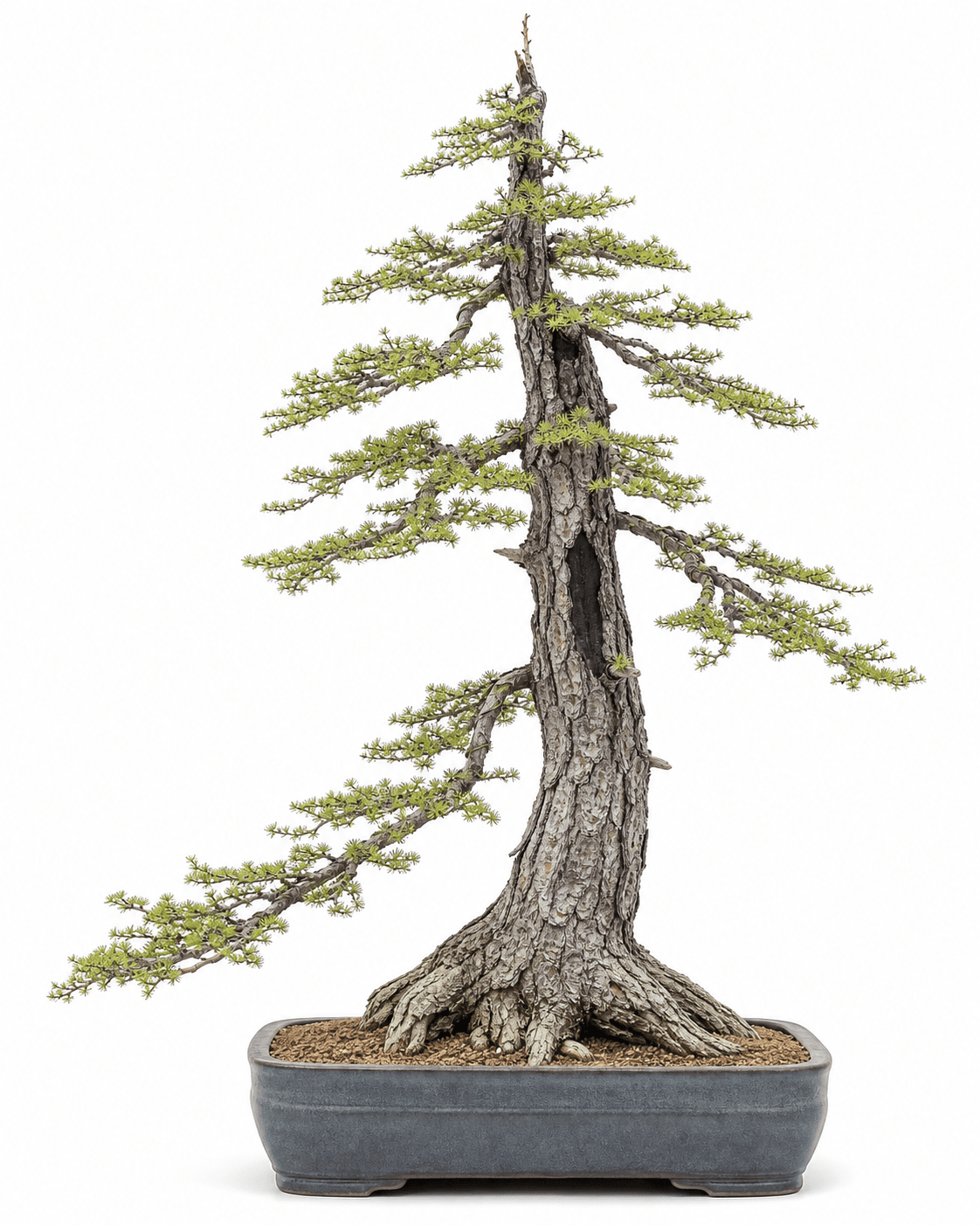
Design can borrow from mixed-conifer forests: tall bare lower trunks, horizontal branch shelves, fire scars, thick plated bark on old material, an open crown, and a fall display that contrasts gold larch against darker evergreen companions. USDA Forest Service FEISBonsai Mirai / Asymmetry
Reading the tree
Read bud swell, extension strength, and whether the tree is building or refining.
Mirai larch method concentrates heavy work at spring bud swell, when stored sugars, starches, and water mobility support root work, woody pruning, and wiring. Western larch follows that rule closely because the corpus names Larix occidentalis inside the larch growth-management coverage. Bonsai Mirai Library
A development-stage western larch needs foliage and extension. Let runners feed the trunk, roots, and weak lower branches until the tree has enough vascular strength to support refinement. Bonsai Mirai Library
A refinement-stage western larch earns pruning after shoots elongate and reveal buds. The first flush is expected to be coarser because it spends stored reserves from the previous year. Bonsai Mirai Library
Heat and root history change the plan. Collected trees, recently repotted trees, and trees in warm gardens should keep more foliage, skip repeated refinement cuts, and prove recovery through continuous extension before further reduction. Bonsai Mirai Library
Pruning
Let western larch shoots run before you prune them.
Do not pinch western larch. Mirai larch method repeatedly uses extension followed by pruning because running shoots spend stored energy, reveal usable buds, and allow the grower to cut with intention. Bonsai Mirai Library
After the first flush hardens, prune strong shoots back to a viable bud, basal whorl, or short side shoot that serves the branch design. Leave active green tissue, since cutting behind the last viable bud can cost the branch. Bonsai Mirai Library
The second and third pruning sequence can compress internodes on a strong refined tree in a cool climate. Useful fine ramification often appears on later pushes, while the first flush stays comparatively coarse. Bonsai Mirai Library
Use restraint after root work. A recently repotted larch should spend the year rebuilding roots unless it extends strongly enough to show that uptake has returned. Bonsai Mirai Library
Manage apical dominance deliberately. Prune the apex and upper branches more often than lower branches, protect weak interior buds, and avoid repeating cuts to the same point until knuckles form. Bonsai Mirai Library
Repotting
Repot at bud swell and convert old roots in stages.
The primary repotting window is spring bud swell, just as buds show green. Mirai places root work, woody pruning, and wiring in this same energy-positive window for larch. Bonsai Mirai Library
A refined tree with a healthy root pad can tolerate routine root work and moderate top work in one spring. First-time nursery or collected material should have the old root core reduced gradually, with styling intensity reduced until the tree responds. Bonsai Mirai Library
Preserve a functioning root mass. Mirai forest-repotting guidance warns against bare-rooting deciduous conifers such as larch because microbial relationships and active feeder roots are part of the recovery system. Bonsai Mirai Library
Western larch wild roots support that caution. USDA FEIS describes deep and spreading roots that stabilize large trees, while B.C. forestry records deep extensive roots and both ectomycorrhizal and endomycorrhizal associations. USDA Forest Service FEISBritish Columbia Tree Species Compendium
Soil and pot
Give refined larch akadama, oxygen, and enough volume to stay cool.
Mirai recommends 100 percent high-quality akadama for established refined larch because Larix roots can colonize it and build fine ramification before the structure breaks down. Bonsai Mirai Library
Use a more growth-oriented development mix when trunk, root, or branch mass is still the goal. Mirai larch development guidance uses roughly 70 percent organic to 30 percent aggregate in early grow containers, then transitions toward refinement soil. Bonsai Mirai Library
The pot should support the story. Tall forest and formal upright compositions can use quiet rectangles or ovals; literati and old fire-influenced trees can use a shallower, more restrained container once roots are fine enough. Bonsai Mirai / Asymmetry
Glazed pots can be appropriate for larch because it is deciduous, shows gold fall color, and exposes winter branch structure. Keep the glaze subdued so it supports seasonal color instead of competing with it. Bonsai Mirai / Asymmetry
Climate adaptation
Western larch rewards cool bright gardens and resents hot stagnant roots.
Oregon State lists USDA Zone 4 hardiness, while USDA FEIS frames the species as cool and moist, with lower range limits tied to low precipitation. In bonsai, that translates to outdoor cold dormancy with container-root protection. Oregon State Landscape PlantsUSDA Forest Service FEIS
In inland Northwest or mountain climates, use full sun, strong airflow, and consistent watering. In warmer lowland gardens, use morning sun, pot shading, and afternoon heat protection when the container overheats. Bonsai Mirai LibraryBritish Columbia Tree Species Compendium
B.C. forestry rates western larch as exposure-requiring, moderately frost tolerant, moderately heat tolerant, moderately water-deficit tolerant, and low in water-surplus tolerance. A bonsai pot should be bright and moist without staying waterlogged. British Columbia Tree Species Compendium
Winter care should protect the root ball from drying wind and repeated freeze-thaw. A dormant cold frame, mulch bed, or sheltered bench is usually better than warm indoor storage. Bonsai Mirai Library
Pests and diseases
Most problems begin with weak roots, defoliation, or stressed old material.
USDA and B.C. forestry sources list damaging agents for western larch in forest settings, including dwarf mistletoe, root rots, needle diseases, cankers, bark-beetle stress, and defoliating insects. In bonsai, these issues usually accelerate after heat, drought, overwork, or stale roots. USDA Forest Service FEISUSDA Forest Service SilvicsBritish Columbia Tree Species Compendium
Inspect soft new growth for aphids, mites, sawfly-like chewing, and casebearer-style needle mining. Treat early, improve airflow, and ask a local extension office for fungal or insect confirmation before applying broad chemical control. USDA Forest Service FEIS
Dwarf mistletoe and stem canker issues are most relevant to collected or forest-source material. Avoid collecting visibly declining trees, trees with heavy swelling or witches-broom symptoms, and trees from sites where permits or ecology make collection inappropriate. USDA Forest Service FEIS
Root rot prevention is bonsai prevention: porous soil, firm tie-down, watering that reintroduces oxygen, and staged root-core conversion. A wet old core inside a fast-draining outer ring is a common hidden failure mode. Bonsai Mirai LibraryBritish Columbia Tree Species Compendium
Wiring
Wire at bud swell, protect buds, and remove wire before fast thickening bites.
Mirai places major larch wiring in the spring bud-swell window, when branches are visible and energy supports recovery. Handle swelling buds carefully because they are both the design future and the recovery engine. Bonsai Mirai Library
Use enough wire to hold, then bend with branch shoulders and live veins in mind. Western larch can build angular old branch character, but fresh twigs and brittle older branches still need support. Bonsai Mirai Library
Check wire frequently once growth starts. Mirai exhibition wiring guidance warns that elongating conifers such as larch can swell quickly and scar if wire stays on through active thickening. Bonsai Mirai Library
Thread wire between needle clusters rather than crushing them. Damaged larch foliage stays visible for the season and can reduce the branch energy you need for recovery. Bonsai Mirai Library
Propagation
Seed, seedlings, and air layers are realistic, while old collected roots need patience.
Western larch regenerates strongly from seed on open mineral seedbeds after disturbance. FEIS notes that burned or open full-sun sites with mineral soil favor western larch establishment. USDA Forest Service FEIS
For bonsai, seedlings are the cleanest legal path to forests and group plantings. Start with strong young roots, full sun, and enough growing space before shifting into refinement containers. Bonsai Mirai LibraryUSDA Forest Service FEIS
Mirai nursery-stock and air-layer guidance treats larch as one of the higher water-mobility conifers capable of air layering when the tree is young, vigorous, and well-foliated above the layer site. Bonsai Mirai Library
Grafting is uncommon for everyday western larch bonsai, but horticultural selections exist. Oregon State notes a limited number of landscape selections, including the dwarf form Bollinger. Oregon State Landscape Plants
Sourcing
Buy the label, the root future, and the climate fit before the trunk story.
Confirm the species. Western larch is Larix occidentalis; American larch or tamarack is Larix laricina; alpine larch is Larix lyallii. In overlap areas, FEIS notes natural hybridization between western and alpine larch. Kew POWOUSDA Forest Service FEIS
Good nursery material has a visible base, live interior buds, flexible branch options, vigorous spring extension, and a root ball that can be converted without removing every functioning root at once. Bonsai Mirai Library
Avoid weak trees with dry brown needle tips during active growth, no interior buds, heavy root rot odor, hidden field soil, severe cankers, dwarf-mistletoe symptoms, or a western tamarack label without region or scientific name. USDA Forest Service FEISBritish Columbia Tree Species Compendium
Collected western larch can have powerful age and fire history, but collection must be legal, low impact, and matched to excellent aftercare. Trees from old mixed-conifer stands often carry root systems that need years of careful container conversion. USDA Forest Service FEISBonsai Mirai Library
Troubleshooting
Diagnose by season, recent work, and whether roots can keep up.
Symptom: needles turn yellow to gold in fall and drop. Likely cause: normal deciduous-conifer dormancy. Fix: protect the root ball, keep dormant roots from drying hard, and wait for spring bud swell. Oregon State Landscape PlantsUSDA Forest Service FEIS
Symptom: summer needles dull, wilt, or brown at tips. Likely cause: hot pot walls, dry pockets, wind, too much foliage removal, or roots that cannot replace water fast enough. Fix: water through the full root mass, cool the pot, and reduce stress. Bonsai Mirai Library
Symptom: weak or false spring push after repotting. Likely cause: stored hydration moving before the roots recover. Fix: stabilize the tree, protect from heat and wind, and postpone pruning until continuous extension proves uptake. Bonsai Mirai Library
Symptom: knuckled branch ends. Likely cause: pinching or cutting repeatedly to the same basal point. Fix: let selected shoots extend, prune to usable lateral buds, and rebuild clean bifurcation. Bonsai Mirai Library
Symptom: mined, chewed, spotted, or cast needles. Likely cause: casebearer, sawfly-like feeding, mites, aphids, needle cast, or drought-stress disease. Fix: inspect closely, improve airflow, remove pests when practical, and use local diagnosis for treatment. USDA Forest Service FEISUSDA Forest Service Silvics
Symptom: branch dies after late pruning. Likely cause: work outside the strong energy window. Fix: move woody cuts to spring bud swell and use fall for feeding, wire checks, and winter preparation. Bonsai Mirai Library
Design
Style western larch as a light-seeking fire-forest conifer with exposed winter structure.
Start with trunk line, defining branch, apex, and winter silhouette. Western larch drops its needles, so branch placement and ramification are visible for months. Bonsai Mirai / AsymmetryOregon State Landscape Plants
USDA FEIS describes tall trees with deep roots, thick plated bark, bare lower trunks in stands, open crowns, and fire-driven regeneration. Those features support old upright designs, forest compositions, and fire-scarred but still vigorous images. USDA Forest Service FEIS
Use the larch branch language from Mirai: triangular pad logic, proportional lower branches, small apex, and refinement through pruning rather than a hedge shell. Bonsai Mirai Library
Deadwood should be restrained and ecological. Fire scars, broken tops, and old dead branches can make sense, while dryland juniper-style deadwood usually overwhelms the deciduous conifer character. USDA Forest Service FEISBonsai Mirai / Asymmetry
Forests are a natural fit. Uneven seedling spacing, varied trunk heights, open sight lines, and a darker companion planting can echo mixed stands where western larch turns gold among Douglas-fir, grand fir, ponderosa pine, western hemlock, and western redcedar. USDA Forest Service FEISBonsai Mirai / Asymmetry
Cultivars
Keep most western larch material under one species page for now.
Kew accepts Larix occidentalis as the species and lists Pinus nuttallii and Larix americana var. brevifolia as synonyms. B.C. forestry notes that races, varieties, or subspecies of western larch are unknown. Kew POWOBritish Columbia Tree Species Compendium
Oregon State notes a limited number of landscape selections, including Bollinger as a dwarf shrub. That type of material can be useful for small bonsai, but cultivar vigor and graft quality should be inspected before purchase. Oregon State Landscape Plants
Natural hybridization with alpine larch is documented where the two meet. Record uncertain collected material honestly instead of forcing it into a clean species calendar without evidence. USDA Forest Service FEIS
History
Western larch is famous for size, autumn color, and fire-shaped forests.
USDA Silvics calls western larch the largest of the larches and the most important timber species in the genus, used for lumber, veneer, poles, ties, mine timbers, and pulpwood. USDA Forest Service Silvics
FEIS records western larch as fast growing and long lived, with trees over 900 years reported. Mature bark can become thick and furrowed into large plates, which helps explain the old fire-resistant visual language. USDA Forest Service FEIS
In bonsai culture, western larch has a smaller public canon than Japanese or European larch. Its strongest trees should make the species legible through gold fall color, open winter architecture, plated bark, light-seeking forest habit, and North American fire ecology. Bonsai Mirai / AsymmetryUSDA Forest Service FEIS
Species questions
Answer the beginner questions before styling.
Can western larch be grown as bonsai?
Yes. Western larch can make strong outdoor bonsai when it gets full light in cool conditions, steady water, spring bud-swell root work, extension-based pruning, and winter dormancy.
Can western larch bonsai live indoors?
No. Western larch is an outdoor deciduous conifer. It needs seasonal light, autumn needle drop, cold dormancy, and winter root protection.
Is western larch the same as tamarack?
Western larch is sometimes called western tamarack or tamarack. In eastern and northern North America, tamarack usually means American larch, Larix laricina, so use the scientific name when buying material.
When should I repot western larch bonsai?
Repot at spring bud swell, just as buds begin showing green. Preserve functioning roots, tie the tree firmly, and stage major root-core conversion over more than one cycle.
Should western larch be pinched?
No. Let shoots extend first, then prune to viable buds after extension. Pinching can push energy into coarse interior growth and create swollen branch ends.
What soil works for western larch bonsai?
Use 100 percent high-quality akadama for established refined larch. Use a more growth-oriented development mix while building trunk, roots, and primary branches.
How much sun does western larch need?
Use full sun in cool climates. In hot lowland gardens, protect the pot and roots from afternoon heat while keeping the tree bright enough to stay vigorous.
Why is my western larch turning yellow?
Yellow to gold needles in fall are normal before needle drop. Yellowing or browning during active growth points to root trouble, heat, drought, pests, disease, or recent mistimed work.
What styles suit western larch bonsai?
Informal upright, formal upright, forest, group, literati, slanting, tall bare-trunk forms, and fire-scarred mixed-conifer images suit western larch well.
Is collected western larch good bonsai material?
It can be excellent material when collection is legal, ethical, and followed by careful aftercare. Old western larch roots and forest soil should be converted gradually.
Sources
Species advice needs source discipline.
Next decisions
Plan the operation before copying the calendar.
A good care note for Western larch records the tree's stage, the work done, and the aftercare used. That record matters more than a month-name rule.
Related species
Compare nearby trees before transferring advice.
European larch
Larix decidua
Japanese larch
Larix kaempferi
American / tamarack larch
Larix laricina
Alpine larch
Larix lyallii
Golden larch
Pseudolarix amabilis