
Species guide
European Larch Bonsai Care Guide
Larix decidua
European larch, Larix decidua, is an outdoor deciduous conifer bonsai for growers with bright light, cold winter dormancy, even moisture, and cool to moderate summers. Its best work happens around spring bud swell, then through carefully timed extension-and-prune cycles after the first flush begins to harden.
The local Mirai corpus gives direct larch coverage that includes European larch in the species comparisons. This guide uses that corpus for bonsai technique, then uses Kew, NC State Extension, the American Conifer Society, and USDA FEIS for accepted name, native range, hardiness, growth habit, pests, and habitat facts.
Updated June 14, 2026. Written by EntGrove Editorial. Last verified June 14, 2026.
Care fingerprint
Read the species through its shared care pattern.
Use bud swell, needle hardening, and autumn color as signals; root work is seasonal and refinement depends on soft new extension. Use this as the starting point before local conditions and tree strength refine the calendar.
Do not prune like a pine
Elongating conifers extend from buds and shoots, so candle-cutting assumptions can remove the exact growth the tree needs.
Preserve interior growth
Spruce, fir, hemlock, cedar, redwood, cypress, and larch all become harder to design when interior buds are shaded out.
Keep recovery cool and steady
Many elongating conifers respond best when roots stay evenly moist, oxygenated, and protected from hot dry swings.
Care cadence
The calendar starts with the tree's seasonal state.
Spring root work and structural work
Timing: Early spring as buds swell and begin showing green, before needles elongate
Watch for: Open needles, frozen root balls, daytime temperatures already in the 70s F, weak interior buds, field-stock conversion, and heavy styling stacked onto major root reduction.
Bonsai Mirai LibrarySpring wiring
Timing: Closed-bud to tight green-bud stage, with the branch structure still visible
Watch for: Crushed buds, branch rebound, thin wire that cannot hold larch growth, wire crossing active buds, and wire left on after vascular expansion begins.
Bonsai Mirai LibraryFirst pruning after extension
Timing: After the first flush elongates and basal needles darken enough to show hardening
Watch for: Pinching soft shoots, cutting beyond the last viable bud, reducing weak branches that need strength, and treating every branch as if it has the same role.
Bonsai Mirai LibrarySecond and third pruning
Timing: Every 3 to 4 weeks only on strong refined trees in cool growing conditions
Watch for: Long internodes, one-bud transitions, three-shoot clusters, weak recently repotted trees, hot-climate trees that need foliage mass, and late cuts before dormancy.
Bonsai Mirai LibraryWatering
Timing: Check daily during active growth, wind, full sun, and warm weather
Watch for: Dull needles, wilting soft extension, hot pot walls, water bypassing an old compacted core, constant saturation, and dormant roots drying in winter wind.
NC State ExtensionUSDA Forest Service FEISBonsai Mirai LibraryFertilizer
Timing: Development trees feed steadily after spring growth starts; refined trees receive light spring support after pruning and stronger fall reserve support.
Watch for: Heavy nitrogen before the first refined pruning, feeding during hot wet anaerobic periods, weak fall buds, and underfeeding young material still building trunk and roots.
Bonsai Mirai LibraryHeat adaptation
Timing: Late spring through summer whenever heat outruns water movement
Watch for: Summer refinement pruning in hot regions, reduced foliage mass, afternoon scorch, hot humid conditions, alkaline water stress, and shallow dark pots.
NC State ExtensionBonsai Mirai LibraryPests and disorders
Timing: Active growth, especially after heat, drought, repotting, or dense shaded foliage
Watch for: Larch casebearer, aphids, larch sawfly, Japanese beetle, needle cast, needle rust, canker, and aphid-like yellowing on sugary new growth.
NC State ExtensionUSDA Forest Service FEISBonsai Mirai LibraryWinter protection
Timing: After yellowing and needle drop, while the tree remains fully outdoors
Watch for: Warm indoor storage, fall pruning wounds, wire left on exposed branches, frozen-dry roots, and spring buds opened under protection then returned to frost.
NC State ExtensionAmerican Conifer SocietyBonsai Mirai LibrarySpecies guide
Apply the species profile before copying another tree's calendar.
At a glance
Treat European larch as the finer, colder-climate larch with a narrow spring work window.
Kew accepts Larix decidua Mill. in Pinaceae and gives its native range as the Alps, Sudeten Mountains, and Carpathians. USDA FEIS also lists Larix decidua as the accepted scientific name and records common larch as another common name. Kew POWOUSDA Forest Service FEIS
The bonsai fingerprint is direct: outdoor deciduous conifer, spring bud-swell root and structural work, no shoot pinching, repeated pruning only after extension, yellow fall color, and a bare winter silhouette. The useful signals are bud swell, elongating shoots, short shoots, autumn color, needle drop, and dormancy. Bonsai Mirai LibraryNC State Extension
Mirai frames European larch as finer and more delicate than Japanese larch. That gives the tree a refined alpine character, while also demanding more restraint around heat, aggressive root work, and repeated pruning in warm regions. Bonsai Mirai Library
Wild habitat
Its wild image is the bright, cold, well-drained mountain forest.
The American Conifer Society describes European larch as a central European mountain species of the Alps and Carpathians, with smaller disjunct lowland populations farther north. It can reach treeline positions around 7,000 ft, with the greatest abundance from about 3,000 to 6,000 ft. American Conifer Society
The care translation is bright light, steady moisture, cool roots, strong drainage, and winter dormancy. NC State says European larch performs best in full sun, moist gravelly loam, cool summers, and cold winters, with poor tolerance for full shade or hot humid conditions. NC State Extension
The soil story is equally important. USDA FEIS describes European larch as favoring uniformly moist, deep, fertile sites, while the American Conifer Society says it avoids waterlogged ground. Bonsai soil should therefore wet thoroughly, drain fast, and return oxygen quickly. USDA Forest Service FEISAmerican Conifer SocietyBonsai Mirai Library
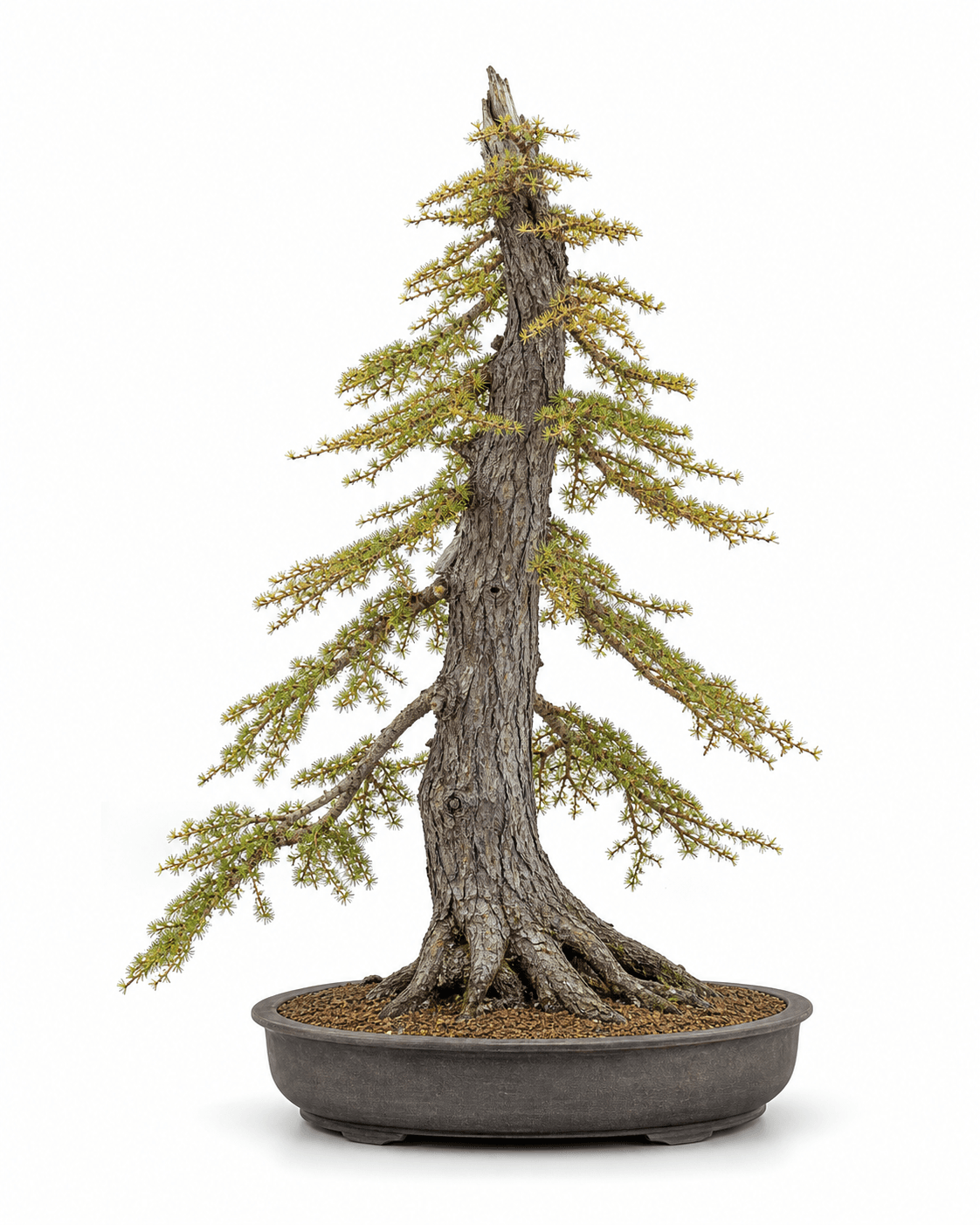
Design follows habitat. European larch reads best as a snow-shaped alpine or montane tree: narrow triangular pads, graceful side-branch drape, a pointed apex, visible winter branch architecture, old cones, and occasional broken-top deadwood. American Conifer SocietyBonsai Mirai / AsymmetryBonsai Mirai Library
Reading the tree
Read buds, extension, and species delicacy before choosing the work.
The first cue is spring bud swell. Mirai places severe pruning, wiring, bending, and root work as buds swell and begin showing green because stored sugars and starches are moving and recovery is available. Bonsai Mirai Library
A strong European larch pushes continuous extension after bud break, sets usable buds near the base of shoots, and keeps active interior growth. A weak branch elongates only at the tip, has little back-budding, and should usually be left to strengthen while more vigorous regions are restrained. Bonsai Mirai Library
Development and refinement need different calendars. Development trees need extension to thicken trunk, roots, and primary branches. Refined trees use extension to drain stored spring strength, then prune to close buds and shorter internodes. Bonsai Mirai Library
Twig color helps with identity before bud push. Mirai uses yellow-gold previous-year twigs as the European larch cue, orange-red as the Japanese larch cue, and gray as the North American larch cue. Bonsai Mirai Library
Pruning
Let shoots spend stored strength, then prune to real buds and triangular branch lines.
The core Mirai rule is to avoid pinching larch. Let spring shoots elongate enough to consume stored strength, then prune with scissors to viable buds, close internodes, and proportional branch outlines. Bonsai Mirai Library
At first pruning, separate body branches from silhouette branches. Interior body growth can be cut harder to build density and bud options, while exterior silhouette growth is shortened to the triangular line that defines the pad. Bonsai Mirai Library
At the second pruning, classify each shoot. Keep fine shoots with close paired buds, prune coarse long-internode shoots back to the basal bud cluster, and use one-bud transitions only where two close buds are unavailable. Bonsai Mirai Library
Growing-season thinning should be restrained. Leaving several shoots at a node distributes energy and keeps the remaining shoots finer; early shoot selection can concentrate strength and recreate coarse growth. Bonsai Mirai Library
Fall pruning is the high-risk error. Mirai warns that deciduous conifers use late-season coarse tips and stored reserves for winter protection, so autumn cuts can cause dieback into the interior branch. Bonsai Mirai Library
Roots
Repot at spring bud swell, and give European larch more restraint than Japanese larch.
Mirai places larch root work as buds swell and just begin showing green. Once needles open and daytime warmth rises, the repotting window closes quickly because water demand and aftercare difficulty increase together. Bonsai Mirai Library
Repot for a purpose: failed percolation, decomposed soil, a root-system correction, a container change, or a design objective. Calendar repotting without a root or design purpose wastes recovery capacity. Bonsai Mirai Library
Larch has high water mobility and can tolerate meaningful root reduction at the correct moment, but European larch is finer and less forgiving than Japanese larch. Preserve functional fine roots, avoid full bare-rooting, secure the tree firmly, and separate first root conversion from ambitious styling. Bonsai Mirai Library
A strong established tree can sometimes receive routine spring root work, pruning, and wiring in one season. Field-grown material, collected material, or a tree moving out of a compact nursery core should receive a staged plan. Bonsai Mirai Library
Soil and pot
Use akadama for refined larch, with a pot choice that protects cool moisture and winter stability.
Mirai recommends 100 percent high-quality akadama for established larch in bonsai containers. Larch roots grow strongly enough to occupy and scale akadama before it breaks down, and that container constraint helps shorten internodes and needles. Bonsai Mirai Library
Early development can use a more growth-oriented substrate. Mirai describes roughly 70 percent organic matter to 30 percent aggregate for trunk-thickening grow containers, then a move toward akadama and tighter control as refinement begins. Bonsai Mirai Library
NC State and USDA FEIS both point toward moisture with drainage. In bonsai terms, water should saturate the full root ball, then leave air behind. A compact peat core that sheds water around its edges is as dangerous as a stale saturated mix. NC State ExtensionUSDA Forest Service FEISBonsai Mirai Library
Unglazed ovals, rectangles, slabs, and forest trays all suit European larch when the design reads as alpine or montane. Hot-region growers should avoid shallow dark containers that overheat roots before the watering routine can respond. Bonsai Mirai / AsymmetryBonsai Mirai Library
Climate adaptation
European larch rewards cold winters and cool summers; warm regions need looser refinement goals.
Landscape hardiness is high. NC State lists USDA Zones 2a to 6b, and the American Conifer Society describes extreme cold tolerance in habitat. A bonsai container changes the risk because exposed roots can freeze dry, warm early, and refreeze after buds open. NC State ExtensionAmerican Conifer SocietyBonsai Mirai Library
Cool-summer regions can run the full refinement program: spring correction, first pruning, second pruning, and a late-season refinement pass on strong trees. In warm or humid regions, Mirai recommends fewer prunings, more foliage mass, less fertilizer in heat, and shade cloth or afternoon protection. Bonsai Mirai LibraryNC State Extension
Water quality can become a quiet limit. Mirai flags larch as sensitive to alkaline or poor-quality water, consistent with the species preference for neutral to acidic, well-drained mountain soils. If foliage loses clarity despite good timing, test water and soil pH before adding fertilizer. Bonsai Mirai LibraryNC State Extension
Winter care should keep the tree cold and protected rather than warm. Store the pot out of desiccating wind, keep roots from drying, and avoid forcing buds open under protection unless you can manage the return to outdoor frost. Bonsai Mirai LibraryNC State Extension
Pests and diseases
Most problems show first in needles, buds, and root performance.
NC State lists larch casebearer, aphids, larch sawfly, and Japanese beetle as insects that can affect European larch. The same profile lists needle cast, rust, and canker as disease concerns. NC State Extension
Mirai adds a bonsai-specific diagnostic: scattered yellow needles on sugary new larch growth can point to aphid feeding rather than fertilizer deficiency. Inspect the shoot closely before plucking needles or adding nitrogen. Bonsai Mirai Library
Disease prevention starts with culture: full sun where heat allows it, open branching, correct spring timing, oxygen-rich soil, no compact nursery core, and watering that avoids both drought and stale saturation. NC State ExtensionUSDA Forest Service FEISBonsai Mirai Library
Treat pest response as local IPM work. Identify the insect or disease, isolate the tree when needed, improve vigor and airflow, remove badly affected dead material, and follow regional extension guidance for chemical controls. NC State Extension
Wiring
Wire before buds open, use enough holding power, and check before swelling scars the branch.
Mirai places the safest larch wiring window while buds are closed or just beginning to swell. As buds take on water and open, each handling touch carries more risk of crushing future shoots. Bonsai Mirai Library
European larch is finer than Japanese larch, but it still rebounds strongly. Use copper where skill allows, transition wire gauges from heavier to lighter along the branch, and support long bends with multiple planes and guy wires. Bonsai Mirai Library
Bud protection is part of the wiring job. Remove shoulder or underside buds only where they will cause swelling or interfere with the line, route wire around active buds, and reroute immediately if green tissue is crushed. Bonsai Mirai Library
Remove or cut off wire as vascular tissue expands in mid to late spring. A refined tree in a constricted pot may allow one spring wire cycle, while a vigorous development tree can mark quickly once foliage hides the wire. Bonsai Mirai Library
Propagation
Seed builds species character; air layers and grafts solve specific bonsai problems.
Seed is the normal species propagation path. NC State lists seed as the recommended propagation strategy, and USDA FEIS notes wind-dispersed seed, periodic large seed crops, and improved stored-seed germination after cold stratification. NC State ExtensionUSDA Forest Service FEIS
Air layering is supported in the Mirai larch corpus. Use ring-bark layering with wire pressed against the cut tissue after the first flush hardens, then let the separated layer recover before major styling resumes. Bonsai Mirai Library
Layering works best on vigorous trees with enough stored energy and active foliage to rebuild roots. A layered larch has to form a new vascular pipe from the outside roots before it can safely support heavy bending, pruning, or repotting. Bonsai Mirai Library
Grafting belongs to cultivar preservation, root correction, or branch placement rather than routine beginner propagation. Use it when the root system, branch map, or named form justifies the extra complexity. Bonsai Mirai LibraryAmerican Conifer Society
Sourcing
Buy cold-climate performance, yellow-gold twigs, visible buds, and convertible roots.
Confirm the label first. European larch, common larch, Alpine larch, and Larix decidua should point to the same species, while Japanese larch, tamarack, western larch, alpine larch, golden larch, and hybrid larch need separate handling. Kew POWOUSDA Forest Service FEISAmerican Conifer Society
Good young material has basal flare, yellow-gold previous-year twigs, live interior buds, flexible branch options, and roots that can be converted in stages. Avoid trees with no interior buds, hidden reverse taper, hard compact root cores, or repeated pest defoliation. Bonsai Mirai LibraryNC State Extension
Field-grown larch can produce powerful trunks, but Mirai warns that field-grown wood can be more brittle during first structural setting. Plan heavy bends with strong wire, guy wires, raffia or parafilm where needed, and recovery time. Bonsai Mirai Library
European larch forests are a strong use for seedlings because the species displays spring color, autumn yellow, old cones, and a readable bare winter line. Buy enough trees to create height, trunk-thickness, and depth variation. Bonsai Mirai / AsymmetryAmerican Conifer Society
Troubleshooting
Diagnose by season: autumn yellowing is normal; active-season decline needs a root and pest check.
Symptom: needles turn yellow to amber in fall and then drop. Likely cause: normal deciduous-conifer dormancy. Fix: protect the pot, keep roots from drying, and wait for spring bud swell. NC State ExtensionBonsai Mirai Library
Symptom: needles dull, wilt, or brown during active growth. Likely cause: dry pockets, hot pot walls, wind, root trouble, or heavy refinement pruning in heat. Fix: water thoroughly, cool the container, preserve foliage mass, and inspect drainage. Bonsai Mirai LibraryNC State Extension
Symptom: branch dies after fall pruning. Likely cause: reserve loss and winter exposure after removing the protective terminal growth. Fix: move structural pruning to spring bud swell and use fall for observation, protection, and reserve building. Bonsai Mirai Library
Symptom: coarse knuckles at branch tips. Likely cause: repeated pinching or repeated cuts to the same basal point. Fix: drop back to finer interior growth in spring and rebuild the branch through extension-and-prune cycles. Bonsai Mirai Library
Symptom: buds crush during wiring or open distorted. Likely cause: wiring too late or routing wire over the bud. Fix: wire earlier, reroute immediately, and reduce handling once buds take on water. Bonsai Mirai Library
Symptom: mined, chewed, rusted, cast, or kinked needles. Likely cause: casebearer, aphids, sawfly, Japanese beetle, needle cast, rust, canker, or root stress. Fix: identify the problem locally, isolate if needed, improve vigor and airflow, and follow extension guidance. NC State ExtensionBonsai Mirai Library
Design
Build the design from alpine ecology: narrow pads, visible winter line, and controlled drape.
Start with the trunk line, defining branch, apex, and number of useful structure origins. Mirai favors preserving existing structure at first styling because every living origin gives the designer more choices. Bonsai Mirai LibraryBonsai Mirai / Asymmetry
European larch pads should be triangular and somewhat narrow, with broken sub-pad rhythm that suggests snow shedding. The apex should remain small and pointed, especially on taller alpine images. Bonsai Mirai Library
The species naturally supports graceful branch drape. The American Conifer Society describes level to upswept main branches with often pendulous side branches, a habit that translates well to mountain forms, forests, and older informal uprights. American Conifer SocietyBonsai Mirai Library
Deadwood is believable when it follows larch ecology: old broken tops, inside-out hollowing, storm damage, and alpine exposure. Dryland juniper-style ribbon shari usually feels less connected to the species. Bonsai Mirai LibraryBonsai Mirai / Asymmetry
Negative space should follow structure. Set primary and secondary lines first, then refine triangular pads and openings as tertiary ramification develops through repeated pruning cycles. Bonsai Mirai Library
Cultivars and forms
Forms and varieties help identity, while roots and climate decide bonsai quality.
NC State lists 'Pendula' as a weeping form. Weeping material can be useful, but the selection still starts with roots, basal flare, interior buds, trunk movement, and whether the tree can thrive in the grower's climate. NC State ExtensionBonsai Mirai Library
Kew accepts three infraspecific varieties: var. carpatica, var. decidua, and var. polonica. The American Conifer Society describes Alpine, Carpathian, and Polish larch differences mostly through cone and shoot traits. American Conifer SocietyKew POWO
Mirai compares the common larches by behavior: Japanese larch is the strongest and most heat-tolerant, European larch is finer and more delicate, and North American tamarack is durable with a different twig and needle character. Bonsai Mirai Library
Hybrid larch also appears in horticulture. USDA FEIS notes that European larch can hybridize with Japanese larch where both are planted, producing Dunkeld larch. Verify labels before applying species-specific heat or twig-color expectations. USDA Forest Service FEIS
History
European larch carries forestry history, alpine longevity, and a clear bonsai seasonal display.
Kew records Larix decidua as first published in 1768. USDA FEIS notes older synonyms such as Larix europaea and Pinus larix in historical usage. Kew POWOUSDA Forest Service FEIS
NC State describes European larch as long lived, with European specimens reaching about 500 years. USDA FEIS records Alpine ages of 600 years or more and an oldest reported tree of 672 years in 1955. NC State ExtensionUSDA Forest Service FEIS
The tree also has practical forestry history. NC State notes timber use in Europe, and USDA FEIS describes wide planting beyond the native range, including naturalized populations in parts of northeastern North America. NC State ExtensionUSDA Forest Service FEIS
A strong European larch bonsai should show the species through the year: yellow-gold winter twigs, soft bright spring needles, controlled summer extension, yellow autumn color, old cones, and a bare winter branch map that can stand without foliage. Bonsai Mirai LibraryNC State ExtensionAmerican Conifer Society
Species questions
Answer the beginner questions before styling.
Is European larch a good beginner bonsai?
Yes, for an outdoor grower with bright light, cold winter dormancy, cool to moderate summers, and consistent watering. It is a poor fit for indoor shelves, hot humid climates, or casual root work.
Can European larch bonsai live indoors?
No. European larch is a temperate deciduous conifer that needs outdoor light, autumn needle drop, and winter dormancy.
How much sun does European larch bonsai need?
Use full sun as the baseline in cool climates. Add afternoon protection, shade cloth, or a cooler bench position when shallow pots overheat or dry faster than the roots can recover.
How often should I water European larch bonsai?
Use observation rather than a fixed day count. Water thoroughly when the soil begins to dry, keep active-growth roots evenly moist, and check often in full sun, wind, and summer heat.
When should I repot European larch bonsai?
Repot in early spring as buds swell and begin showing green, before needles elongate. Repot for a root or design reason, preserve fine roots, avoid full bare-rooting, and separate major root conversion from heavy styling.
Should European larch be pinched?
No. Let shoots elongate and spend stored spring strength, then prune with scissors to viable buds and useful internodes. Repeated pinching creates coarse knuckles and weak branch transitions.
Can European larch bonsai be wired?
Yes. Wire while buds are closed or just swelling, use enough copper or properly sized wire to hold the bend, avoid crushing buds, and remove wire before mid to late spring vascular expansion scars the branch.
Why did my European larch bonsai drop its needles?
Autumn needle drop is normal. Needle loss during spring or summer should trigger checks for dry roots, heat, pests, disease, compact soil, wire damage, or late root work.
What soil is best for European larch bonsai?
Established refined European larch can use 100 percent high-quality akadama. Development trees can use a more growth-oriented mix, then move toward akadama and tighter container control as refinement begins.
How is European larch different from Japanese larch?
European larch has a finer, more delicate character and yellow-gold winter twigs. Japanese larch is usually more vigorous, more heat tolerant, and more forgiving of heavy bonsai work.
Sources
Species advice needs source discipline.
Next decisions
Plan the operation before copying the calendar.
A good care note for European larch records the tree's stage, the work done, and the aftercare used. That record matters more than a month-name rule.
Related species
Compare nearby trees before transferring advice.
Japanese larch
Larix kaempferi
American / tamarack larch
Larix laricina
Alpine larch
Larix lyallii
Western larch
Larix occidentalis
Golden larch
Pseudolarix amabilis