
Species guide
Golden Larch Bonsai Care
Pseudolarix amabilis
Golden larch, Pseudolarix amabilis, is a deciduous conifer from eastern and southeastern China with soft needles, gold autumn color, and a bonsai record that is real but much thinner than true Larix. Grow it outdoors in bright light with cool, moist, acidic, well-drained roots, then use spring bud movement and post-extension pruning as the safest working signals.
The local Mirai corpus has no dedicated Pseudolarix file. This guide therefore grounds species identity, climate, hardiness, morphology, and sourcing in Kew, NC State Extension, Purdue, RHS, RBGE, and Missouri Botanical Garden sources, then applies Mirai deciduous-conifer method only where the physiology is shared: outdoor dormancy, spring root work, extension before pruning, no pinching, and careful wire checks.
Updated June 6, 2026. Written by EntGrove Editorial. Last verified June 6, 2026.
Care fingerprint
Read the species through its shared care pattern.
Use bud swell, needle hardening, and autumn color as signals; root work is seasonal and refinement depends on soft new extension. Use this as the starting point before local conditions and tree strength refine the calendar.
Do not prune like a pine
Elongating conifers extend from buds and shoots, so candle-cutting assumptions can remove the exact growth the tree needs.
Preserve interior growth
Spruce, fir, hemlock, cedar, redwood, cypress, and larch all become harder to design when interior buds are shaded out.
Keep recovery cool and steady
Many elongating conifers respond best when roots stay evenly moist, oxygenated, and protected from hot dry swings.
Care cadence
The calendar starts with the tree's seasonal state.
Placement
Timing: Grow outdoors in bright light, with full sun in cool conditions and light afternoon protection where heat, wind, or reflected paving dries the pot too quickly.
Watch for: Indoor display, full shade, hot humid still air, strong drying wind, alkaline irrigation buildup, and benches where the pot heats faster than roots can replace water.
NC State ExtensionPurdue Arboretum ExplorerWatering
Timing: Check daily during active growth and water thoroughly when the upper mix begins to dry, keeping the root ball evenly moist without stale saturation.
Watch for: Needle dulling, wilting soft extension, dry pockets, water bypassing old nursery soil, persistent soggy peat, and winter roots drying in wind.
NC State ExtensionPurdue Arboretum ExplorerBonsai Mirai LibraryRepotting
Timing: Use spring bud swell, before strong extension, for major root work. Convert compact old cores over more than one cycle when material arrives from nursery or import stock.
Watch for: Open needles, frozen roots, loss of percolation, old alkaline or clay-heavy soil, weak post-import roots, and bare-rooting a conifer root system.
Bonsai Mirai LibraryNC State ExtensionPruning
Timing: Let shoots extend and harden enough to reveal usable buds, then prune back to a bud, side shoot, or branch line that supports the design.
Watch for: Pinching soft growth, cutting every shoot to the same point, reducing weak lower branches, pruning after heavy root work, and late cuts that reduce winter reserves.
Bonsai Mirai LibraryStructural work
Timing: Use the spring bud-swell window for woody cuts and heavier wiring when branch structure is visible and stored energy is moving.
Watch for: Crushed swelling buds, wire left through summer thickening, branch removal beyond live buds, and combining first root conversion with aggressive styling.
Bonsai Mirai LibraryFertilizer
Timing: Feed development trees after growth begins. On refined trees, delay heavy spring feeding until after the first pruning, then support late-season reserve building.
Watch for: Coarse internodes from excess early nitrogen, weak fall buds from underfeeding, fertilizer on a tree with root uptake problems, and strong apex response that starves lower branches.
Bonsai Mirai LibraryPest and disorder checks
Timing: Inspect new needles, buds, bark, and drainage through active growth, especially after heat, drought, wind, repotting, or import stress.
Watch for: No serious insect or disease issues are emphasized by NC State, so first diagnose wind burn, heat and humidity stress, alkaline roots, dry pockets, root rot, mites, aphids, or ordinary conifer pests.
NC State ExtensionPurdue Arboretum ExplorerWinter protection
Timing: Keep dormant outdoors after needle drop, then protect the container from drying wind and extreme root-zone exposure.
Watch for: Warm indoor storage, frozen-dry soil, late pruning wounds, unprotected imported roots, and confusing normal gold autumn drop with decline.
NC State ExtensionRHS AGM OrnamentalsBonsai Mirai LibrarySpecies guide
Apply the species profile before copying another tree's calendar.
At a glance
Golden larch is a false larch with real deciduous-conifer bonsai potential.
Kew accepts Pseudolarix amabilis in Pinaceae and gives China from Hunan to Zhejiang as the native range. The synonym list includes Larix amabilis, which explains why older labels and common names can make it sound closer to true larches than current taxonomy allows. Kew POWO
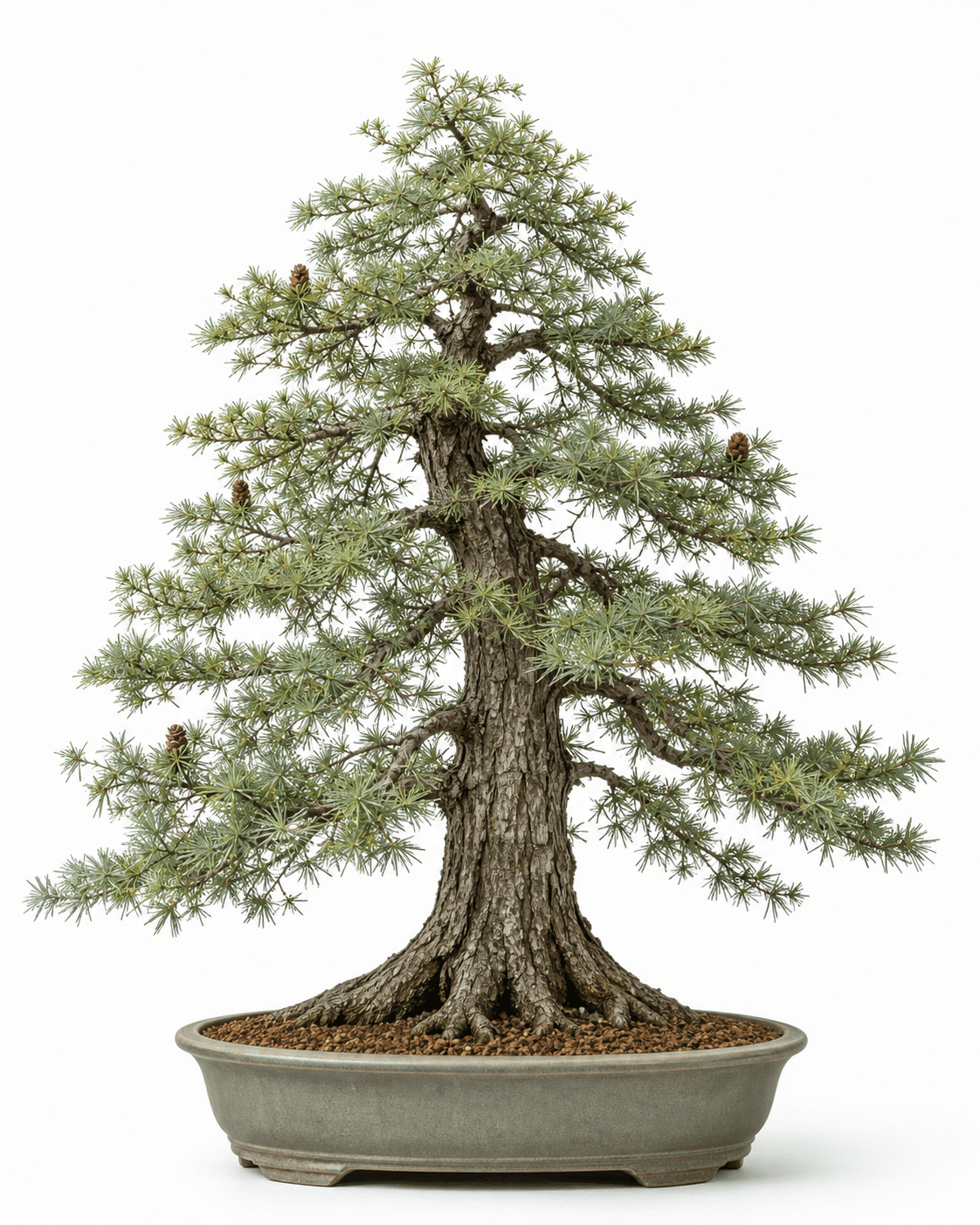
NC State describes golden larch as a broadly conical deciduous conifer with soft light-green needles, bluish undersides, brilliant gold fall color, reddish-brown cones, and an explicit note that it may be used in bonsai. NC State Extension
EntGrove places it in Elongating Species > Deciduous Conifer because the care signals are bud swell, soft extension, seasonal needle drop, root-zone oxygen, and winter dormancy. It should be compared with true larch, dawn redwood, and cypress by timing behavior, while keeping its Pseudolarix identity visible. Bonsai Mirai LibraryKew POWO
Wild habitat
Its wild story is humid Chinese mixed forest on acidic ground.
RBGE describes Pseudolarix amabilis as endemic to China, with records around the lower Yangtze Valley and remaining wild populations complicated by long cultivation, planted trees near villages, and habitat loss. Threatened Conifers of the World
The habitat notes are useful for care: mixed mesophytic forest, humid warm-temperate conditions, occasional winter frost at higher elevations, and soils from acidic rock. RBGE also notes that the species does not occur on limestone. Threatened Conifers of the World
NC State and Purdue translate that ecology into horticulture: moist, acidic, well-drained soil, full sun to partial shade, protection from strong wind, and caution around heat, high humidity, limestone soils, and heavy clay. NC State ExtensionPurdue Arboretum Explorer
For bonsai, the root-zone implication is simple and strict. Keep water available, keep oxygen returning, keep pH on the acidic side, and avoid the common import-tree failure where compact old soil stays wet inside while the outer bonsai mix looks healthy. Bonsai Mirai LibraryNC State Extension
For design, the wild image is humid forest and seasonal color rather than dry alpine deadwood. Build open conical structure, horizontal branch rhythm, gold autumn display, and winter branch clarity before adding dramatic carved features. Bonsai Mirai / AsymmetryThreatened Conifers of the World
Reading the tree
Read bud movement, root recovery, and whether the tree has earned refinement.
Because there is no dedicated Pseudolarix file in the local Mirai corpus, read the tree by broader deciduous-conifer signals. Bud swell marks the root and structural window, active extension shows uptake and stored energy, and autumn color marks the close of the growth cycle. Bonsai Mirai Library
A development tree should extend freely enough to build roots, trunk, and useful interior buds. Cutting too early spends the future of the branch before the branch has generated it. Bonsai Mirai Library
A refined tree can be pruned after shoots elongate and reveal usable buds. Cut to a real bud or side shoot, preserve weak lower branches, and avoid repeated cuts to identical points that create swollen ends. Bonsai Mirai Library
Imported or recently acquired Pseudolarix deserves a recovery year if the root history is unknown. Continuous extension after spring work is the clearest proof that roots are replacing water, not just spending stored hydration. Bonsai Mirai LibraryNC State Extension
Pruning
Let the shoots run, then prune the tree you actually see.
Use pruning rather than pinching. Mirai growth-management guidance puts deciduous conifers in a pruning-only category: let elongated stems build energy and structure, then cut back to desired length or to a bud. Bonsai Mirai Library
On strong spring shoots, wait until the tissue has hardened enough to make a clean decision. Prune strong areas more assertively, leave weak interior shoots longer, and keep the lower branch system from being shaded by unchecked apex growth. Bonsai Mirai Library
Use the true-larch method as a guide, then reduce ambition for Pseudolarix until the tree proves itself. True Larix can sometimes carry repeated pruning cycles in cool strong climates, while Golden larch has thinner bonsai evidence and should be refined more conservatively. Bonsai Mirai LibraryNC State Extension
Avoid broadleaf leaf-drop pruning logic. Mirai leaf-drop pruning guidance excludes deciduous conifers from fall broadleaf pruning windows because they do not heal and mobilize reserves like maples or hornbeams after foliage loss. Bonsai Mirai Library
Repotting
Repot at bud swell and treat old soil as a staged conversion problem.
Mirai elongating-conifer and larch guidance places root work at spring bud swell or just as buds begin opening. That is the safest default for Golden larch bonsai because water movement and stored reserves are rising while the root system still has time to recover. Bonsai Mirai Library
Do not bare-root a deciduous conifer during routine work. Mirai forest-repotting guidance specifically warns against bare-rooting larch and other deciduous conifers, because a functioning root mass and microbial continuity matter to recovery. Bonsai Mirai Library
This matters most with imported or nursery Golden larch. If the old core is clay-heavy, alkaline, or peat-bound, reduce it in stages so new bonsai soil can take over without removing every active fine root at once. NC State ExtensionBonsai Mirai Library
Repot for objective reasons: poor percolation, decomposed substrate, root density, an unstable tie-down, or a planned style change. A healthy tree in a working mix can stay undisturbed until root behavior says the next cycle is due. Bonsai Mirai Library
Soil and pot
Build a cool, acidic, breathing root system before choosing the show pot.
NC State and Purdue agree on the root target: moist, well-drained, acidic soil. NC State also warns that Golden larch dislikes limestone soils and clay soils, which makes alkaline irrigation and compact nursery clay important bonsai risks. NC State ExtensionPurdue Arboretum Explorer
For refined deciduous-conifer work, Mirai larch and bald-cypress guidance often favors high-quality akadama because it holds water and nutrients while supporting fine root ramification. Use that as a direction, then adjust for Pseudolarix heat, local water, and root speed. Bonsai Mirai Library
A practical starting mix is akadama-led with enough pumice or lava to keep oxygen moving in humid or hot regions. In cooler mild regions with fast-drying benches, a higher akadama proportion can make more sense. Bonsai Mirai LibraryNC State Extension
Pot choice should support seasonal color. Quiet unglazed earth tones, subdued glazed ovals, and shallow forest containers can all work because the tree changes from fresh green to gold to bare winter branch structure. Bonsai Mirai / AsymmetryPurdue Arboretum Explorer
Climate adaptation
Cold hardiness is broad, while heat, humidity, wind, and pH decide the real bench fit.
The landscape hardiness record is encouraging. NC State lists USDA Zones 4a to 7b, Purdue lists Zone 4, and the RHS AGM list assigns H7, which its key defines as hardy below -20 C. NC State ExtensionPurdue Arboretum ExplorerRHS AGM Ornamentals
A bonsai pot changes that math. Keep the tree outdoors for dormancy, but protect shallow roots from drying wind, deep freezes without snow cover, and repeated freeze-thaw cycles that landscape hardiness numbers do not measure. Bonsai Mirai Library
Warm regions need the most adjustment. NC State says Golden larch prefers cool nights and is not especially tolerant of heat and high humidity. In those climates, keep more foliage, reduce aggressive pruning, use afternoon protection, and cool the pot. NC State Extension
Hard-water regions need root-zone monitoring. If new growth is pale, the tree stalls despite moisture, or the surface accumulates mineral crust, check pH, water quality, and old soil before increasing fertilizer. NC State ExtensionPurdue Arboretum Explorer
Pests and diseases
Most Golden larch trouble starts as culture stress rather than a named pest outbreak.
NC State says Golden larch has no serious insect or disease issues, and Purdue likewise says there are no serious diseases while recommending wind protection. NC State ExtensionPurdue Arboretum Explorer
For bonsai, that means the first diagnosis should be cultural: wind burn, hot pot walls, dry pockets in old soil, stale wet cores, alkaline irrigation, root loss after import, or spring work done after the safe window. Bonsai Mirai LibraryNC State Extension
Ordinary conifer pests can still appear on stressed container trees. Inspect buds and needles for mites, aphids, scale, chewing damage, or webbing, then use local extension diagnosis before applying treatment. NC State Extension
Root disease risk rises when the bonsai mix stays sour and airless. The preventive treatment is a better root environment: structural particles, full watering, clean drainage, a stable tie-down, and avoiding repeated stress before extension proves recovery. Bonsai Mirai LibraryPurdue Arboretum Explorer
Wiring
Wire while structure is visible, and remove it before the season writes scars.
Mirai larch guidance concentrates wiring in the spring bud-swell window because the bare structure is visible and the tree is entering an energy-positive phase. Golden larch should be handled with the same conservative timing until stronger species-specific evidence exists. Bonsai Mirai Library
Protect swelling buds and soft new foliage. If wire crushes a bud or crosses a branch shoulder awkwardly, reroute it rather than accepting damage that can remove future branch options. Bonsai Mirai Library
Check wire often after growth starts. Deciduous conifers thicken quickly during active growth, and Golden larch has a visible winter silhouette where wire scars will remain obvious. Bonsai Mirai LibraryPurdue Arboretum Explorer
Use guy wires or staged bends for larger moves. A slow tree with wind-sensitive culture does not reward forcing every design decision in one spring. Bonsai Mirai / AsymmetryNC State Extension
Propagation
Seed is the documented path; layers are experimental without direct Pseudolarix evidence.
NC State lists seed as the recommended propagation strategy. It also describes pollen cones in spring and seed cones that mature in one season. NC State Extension
Seedlings are practical bonsai material because they let growers build root spread, trunk movement, and forests early. Start them outdoors, avoid alkaline soil, and protect young roots from drying wind. NC State ExtensionPurdue Arboretum Explorer
Mirai nursery-stock and air-layer guidance treats true larch as one of the higher water-mobility conifers capable of layering under the right conditions. For Pseudolarix, treat that as an experiment rather than settled care advice. Bonsai Mirai Library
Grafted or named forms should be evaluated like any other specialty conifer: check graft quality, cultivar vigor, root system, and whether the form adds bonsai value beyond a label. NC State Extension
Sourcing
Buy healthy roots and a verified label before buying autumn color.
Confirm the scientific name. Golden larch is Pseudolarix amabilis; true larches are Larix. NC State lists false larch and golden pine as common names and Pseudolarix kaempferi as an older name, so tags can be confusing. Kew POWONC State Extension
Good material has a visible base, firm buds, healthy green needles during active growth, no sour root smell, and a root ball that can be staged out of old soil. Bonsai-source photos and NC State use confirm the species can be grown as bonsai, but the material still has to pass horticultural inspection. NC State Extension
Avoid trees with dry brown active-season needles, hidden clay cores, no interior buds, severe wind scorch, mineral crust, or import stress that has not produced a strong new growth cycle. NC State ExtensionPurdue Arboretum Explorer
Wild collection should be treated as inappropriate for ordinary growers. RBGE lists the species as Vulnerable, describes restricted wild populations, and ties decline to habitat loss and small remnant stands. Kew POWO general informationThreatened Conifers of the World
Troubleshooting
Diagnose by season first, then recent root and weather history.
Symptom: needles turn gold or orange-yellow and drop in fall. Likely cause: normal deciduous-conifer dormancy. Fix: protect the dormant pot outdoors and wait for spring bud swell. NC State ExtensionPurdue Arboretum Explorer
Symptom: needles dull, wilt, or scorch during active growth. Likely cause: dry pockets, wind, hot pot walls, or root loss. Fix: water through the whole mass, cool the container, protect from wind, and postpone pruning. NC State ExtensionPurdue Arboretum Explorer
Symptom: pale new growth despite moisture. Likely cause: high pH, limestone or alkaline media, compact clay, or root uptake trouble. Fix: inspect old soil, water quality, and drainage before adding more fertilizer. NC State Extension
Symptom: weak spring push after repotting. Likely cause: root work exceeded uptake capacity or old root-core conversion went too far. Fix: stabilize the tree, protect it from heat and wind, and wait for continuous extension before pruning. Bonsai Mirai Library
Symptom: branch dies after late cuts. Likely cause: woody pruning outside the strong energy window. Fix: move structural cuts to spring bud swell and keep late season focused on health, wire checks, and winter preparation. Bonsai Mirai Library
Symptom: sticky, speckled, webbed, or chewed foliage. Likely cause: ordinary pests taking advantage of stress. Fix: identify the pest locally, improve light and airflow, and avoid treating a stressed root system as a foliage-only problem. NC State Extension
Design
Style it as a seasonal Chinese forest conifer with a clean winter skeleton.
Start with the trunk line, the defining branch, and the winter silhouette. Golden larch drops its needles, so branch placement, scars, inverse taper, and awkward junctions remain visible after the autumn display ends. Bonsai Mirai / AsymmetryPurdue Arboretum Explorer
NC State describes a broadly conical tree with horizontal branches and drooping branchlets. That supports formal upright, informal upright, slanting, group, and forest designs before highly contorted shapes. NC State Extension
Use seasonal contrast as the signature. Fresh spring green, blue-green undersides, gold autumn color, reddish-brown cones, textured bark, and bare winter structure are more distinctive than dense evergreen pads. NC State ExtensionPurdue Arboretum Explorer
Deadwood should be restrained. Pseudolarix can age with fissured bark and branch loss, but humid forest ecology and wind sensitivity make subtle broken tops or old branch stubs more convincing than dryland juniper-style carving. Bonsai Mirai / AsymmetryThreatened Conifers of the World
Forest plantings are a strong fit for seedling material. Vary trunk height, keep sight lines open, and let autumn color carry the display instead of forcing each young tree to look ancient too soon. Bonsai Mirai / AsymmetryNC State Extension
Cultivars
Named forms are secondary to roots, buds, and scale.
NC State lists Annesleyana as a dwarf weeping form and Nana as a dwarf form. Those are useful search labels, but they do not replace a bonsai inspection for roots, taper, buds, and branch placement. NC State Extension
A dwarf or weeping form can help with small compositions, yet weak grafts or overly rigid inherited shapes can make training harder. Check whether the cultivar habit serves the design rather than buying rarity alone. NC State ExtensionBonsai Mirai / Asymmetry
Seed-grown material may be better for forests and long-term development because it gives control over early root spread, trunk movement, and taper. Named forms can come later when the design goal requires them. NC State Extension
History
The species has botanical rarity, public-garden history, and a small bonsai footprint.
Kew accepts the name Pseudolarix amabilis and records the species as Vulnerable in its general information data. RBGE describes a restricted Chinese distribution and habitat-loss pressure in remaining wild populations. Kew POWOKew POWO general informationThreatened Conifers of the World
Missouri Botanical Garden documents a Golden larch near its Museum Building that descends from two trees associated with the Chinese Pavilion at the 1904 World Fair. That is a useful reminder that the species has a long public-garden and plant-collection history outside China. Missouri Botanical Garden
In bonsai culture, Golden larch remains less canonized than Japanese or European larch. A strong tree should make the species clear through Pseudolarix foliage, larger cones, gold autumn color, acidic-root culture, and an honest source note about the thin direct bonsai literature. NC State ExtensionBonsai Mirai Library
Species questions
Answer the beginner questions before styling.
Can Golden larch be grown as bonsai?
Yes. NC State explicitly notes bonsai use, and the species has the seasonal structure bonsai growers want: soft needles, autumn gold, winter branch visibility, and a conifer root system. It needs outdoor culture and careful timing.
Is Golden larch the same as Japanese larch?
No. Golden larch is Pseudolarix amabilis, while Japanese larch is Larix kaempferi. The common name overlaps, so use the scientific name when buying or applying species advice.
Can Golden larch bonsai live indoors?
No. Golden larch is an outdoor deciduous conifer. It needs strong seasonal light, autumn needle drop, winter dormancy, and root-zone protection outdoors.
When should I repot Golden larch bonsai?
Use spring bud swell before strong extension. Preserve functioning roots, avoid bare-rooting, and convert compact old soil over more than one cycle when needed.
Should Golden larch be pinched?
No. Let shoots extend first, then prune to usable buds or side shoots. Pinching soft deciduous-conifer growth is the wrong tool for building reliable ramification.
What soil does Golden larch bonsai need?
Use an acidic, moisture-retentive, well-drained mix with enough structure for oxygen. Avoid alkaline, limestone-heavy, clay-heavy, or stale peat-bound root conditions.
How much sun does Golden larch need?
Use bright outdoor light, with full sun in cool conditions. In hot or windy sites, protect the pot and foliage during the harshest afternoon exposure.
Why is my Golden larch turning yellow?
Gold or orange-yellow foliage in fall is normal before needle drop. Yellowing during active growth points to root stress, dry pockets, heat, wind, high pH, pests, or recent mistimed work.
Is Golden larch cold hardy?
Yes in the landscape. NC State lists USDA Zones 4a to 7b, Purdue lists Zone 4, and RHS gives H7. A bonsai pot still needs protection from exposed root freeze and drying wind.
Is wild-collected Golden larch appropriate for bonsai?
Ordinary growers should avoid wild collection. Kew and RBGE list conservation concern and restricted wild populations, so nursery-grown, seed-grown, or legally propagated material is the right path.
Sources
Species advice needs source discipline.
Next decisions
Plan the operation before copying the calendar.
A good care note for Golden larch records the tree's stage, the work done, and the aftercare used. That record matters more than a month-name rule.
Related species
Compare nearby trees before transferring advice.
European larch
Larix decidua
Japanese larch
Larix kaempferi
American / tamarack larch
Larix laricina
Alpine larch
Larix lyallii
Western larch
Larix occidentalis