
Species guide
Japanese Larch Bonsai Care Guide
Larix kaempferi
Japanese larch, Larix kaempferi, is an outdoor deciduous conifer bonsai that needs bright light, cold dormancy, steady water, and work timed around spring bud swell. It is usually the most forgiving larch for bonsai because it handles heat, root work, pruning, and repeated ramification cycles better than European or American larch when the roots stay healthy.
The Mirai corpus gives strong direct Japanese larch coverage through larch spring work, development, pruning, second and third pruning, growth management, design, and spring wiring sessions. This guide uses that corpus for bonsai technique, then uses Kew, NC State, Oregon State, and the American Conifer Society for accepted name, range, hardiness, habitat, pests, and cultivar context.
Updated June 14, 2026. Written by EntGrove Editorial. Last verified June 14, 2026.
Care fingerprint
Read the species through its shared care pattern.
Use bud swell, needle hardening, and autumn color as signals; root work is seasonal and refinement depends on soft new extension. Use this as the starting point before local conditions and tree strength refine the calendar.
Do not prune like a pine
Elongating conifers extend from buds and shoots, so candle-cutting assumptions can remove the exact growth the tree needs.
Preserve interior growth
Spruce, fir, hemlock, cedar, redwood, cypress, and larch all become harder to design when interior buds are shaded out.
Keep recovery cool and steady
Many elongating conifers respond best when roots stay evenly moist, oxygenated, and protected from hot dry swings.
Care cadence
The calendar starts with the tree's seasonal state.
Spring root work and structural work
Timing: Early spring as buds swell and just begin showing green
Watch for: Open needles, frozen roots, weak interior buds, first-time field-stock transitions, and combined root reduction plus heavy styling on unconverted material.
Bonsai Mirai LibrarySpring wiring
Timing: Closed-bud to tight green-bud stage before needles elongate
Watch for: Crushed buds, branch rebound, old field-grown brittleness, wire applied too lightly, and wire left on after vascular expansion begins.
Bonsai Mirai LibraryFirst pruning after extension
Timing: After the first flush elongates and basal needles harden to green
Watch for: Pinching soft shoots, cutting beyond the last viable bud, reducing weak underdeveloped branches, and making every branch the same length.
Bonsai Mirai LibrarySecond and third pruning
Timing: Through the growing season in cool climates after each flush has produced usable buds
Watch for: Coarse long-internode shoots, three-shoot clusters, knuckles, pruning after heat has peaked, and thinning too aggressively during active growth.
Bonsai Mirai LibraryWatering
Timing: Check daily during active growth, wind, and warm full-sun weather
Watch for: Dull needles, wilted soft extension, hot pot walls, water bypassing compacted soil, constant saturation, and dry dormant roots in winter wind.
Bonsai Mirai LibraryNC State ExtensionFertilizer
Timing: Development trees receive steady strength after the first light spring feed; refined trees wait until after pruning events and get strong fall reserve support.
Watch for: Heavy spring nitrogen on refined trees, feeding during hot wet anaerobic periods, weak fall buds, and underfeeding trees still building trunk and roots.
Bonsai Mirai LibraryHeat adaptation
Timing: Late spring through summer whenever heat outruns water movement
Watch for: Overpruned foliage, afternoon scorch, full-sun pots in hot regions, dry wind, and attempts to force tight refinement in a climate that needs more foliage mass.
Bonsai Mirai LibraryNC State ExtensionPest and disease checks
Timing: Active growth, especially after heat, drought, repotting, or dense shaded foliage
Watch for: Larch case-bearer, larch sawfly, larch looper, tussock moth, Japanese beetle, woolly aphids, needle cast, needle rust, canker, and root rot symptoms.
NC State ExtensionBonsai Mirai LibraryWinter protection
Timing: After autumn yellowing and needle drop
Watch for: Warm indoor storage, exposed shallow pots, frozen-dry roots, fall pruning wounds, and spring buds opened indoors then returned to frost.
Bonsai Mirai LibraryOregon State Landscape PlantsSpecies guide
Apply the species profile before copying another tree's calendar.
At a glance
Treat Japanese larch as the strongest common larch, with spring as the decisive work window.
Larix kaempferi is the accepted name in Kew POWO, and Kew places it in Pinaceae with a native range in central Japan. NC State also records older labels such as Larix leptolepis and Pseudolarix kaempferi, which explains why older nursery tags may carry outdated names. Kew POWONC State Extension
The bonsai fingerprint is direct: outdoor deciduous conifer, spring bud-swell root and structural work, extension before pruning, repeated cutback to viable buds, autumn yellowing, and winter needle drop. It does not use pine candle work or juniper scale-foliage pinching. Bonsai Mirai LibraryOregon State Landscape Plants
Mirai repeatedly frames Japanese larch as the most durable and refinement-friendly of the common larches. That durability gives the grower more room than European or American larch, provided the tree has full outdoor culture, healthy roots, and a climate that allows cold dormancy. Bonsai Mirai Library
Wild habitat
Its wild image is mountain Japan: cold winters, cool rain, volcanic soils, and open conifer light.
Kew gives central Japan as the native range. The American Conifer Society places the wild distribution in central Honshu from Kaga Province to Shimotsuke Province and describes mesic sites at about 3,800 to 8,600 ft. Kew POWOAmerican Conifer Society
The habitat description matters in a bonsai pot. The American Conifer Society describes cold snowy winters, abundant rain in cool summers, and better volcanic soils rather than peat. NC State echoes the cultural translation: full sun, rich acidic well-drained soil, consistent moisture, wind protection, cool summers, and cold winters. American Conifer SocietyNC State Extension
Care follows that ecology. The grower should offer bright light, reliable water, and a breathable root zone, then adjust summer exposure if the container becomes hotter and drier than a mountain root system would be. Bonsai Mirai LibraryNC State Extension
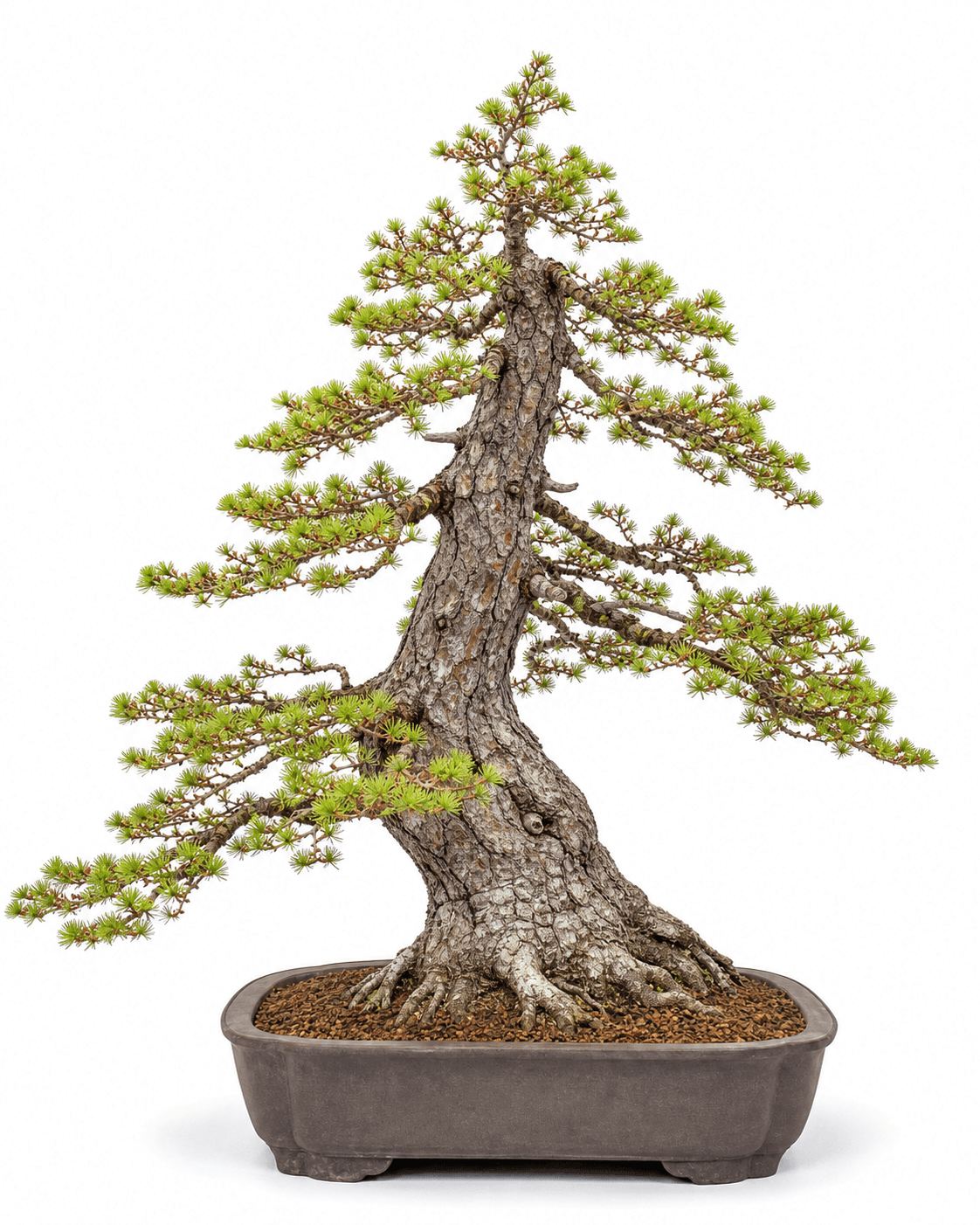
Design also follows ecology. Japanese larch reads well as a high-light mountain conifer with autumn color, a fine winter silhouette, narrow triangular branch masses, and broken alpine rhythm rather than rounded evergreen pads. Bonsai Mirai / AsymmetryBonsai Mirai Library
Reading the tree
Read buds, extension, and energy phase before choosing the work.
The first signal is spring bud swell. Mirai places severe pruning, wiring, and root work as buds swell and just begin showing green because stored sugars and starches are moving and recovery is available. Bonsai Mirai Library
A strong Japanese larch elongates continuously after bud break, builds interior buds, and can be pruned through several cycles in a cool growing season. A weak branch elongates only at the tip, carries little interior foliage, and should usually be left alone while nearby stronger areas are restrained. Bonsai Mirai Library
Development and refinement are different jobs. Development trees need extension, trunk thickening, branch set, and root conversion. Refined trees use extension as a tool, then prune to buds and internodes that keep the silhouette compact. Bonsai Mirai Library
Twig color can help confirm the species when labels are vague. Mirai uses orange-red or red-brown previous-year growth as the Japanese larch cue, while European larch trends yellow-gold and North American larch trends gray. Bonsai Mirai Library
Pruning
Let shoots spend strength, then prune to real buds and proportional branch lines.
The core Mirai rule is to avoid pinching larch. Let shoots elongate, harden enough to show green basal needles and usable buds, then make concise pruning cuts that redirect strength into finer ramification. Bonsai Mirai Library
At the first pruning, separate body branches from silhouette branches. Interior body growth can be cut harder to build density, while exterior silhouette growth is cut to the line that defines the triangular pad. Bonsai Mirai Library
At the second pruning, classify every shoot. Tight internodes and close paired buds can be kept for ramification; coarse long-internode shoots are cut back to the basal bud cluster or to a single useful bud when that gives a cleaner one-to-one transition. Bonsai Mirai Library
Do not thin aggressively during active-season pruning. Leaving several shoots at a node dilutes stored energy and keeps the remaining growth finer; thinning too early can re-coarsen the exact shoot you hoped to refine. Bonsai Mirai Library
Fall branch pruning is a common mistake. Mirai warns that larch stores reserves through fall and uses coarse terminal growth as winter protection; pruning then can cost cold tolerance and cause dieback to interior buds. Bonsai Mirai Library
Roots
Repot at spring bud swell, and treat every repot as root-system improvement.
Mirai is clearer than older public bonsai sources on the main window: larch root work belongs as buds swell and begin showing green. Once needles elongate and daytime warmth rises, aftercare becomes much harder and the safe window closes. Bonsai Mirai Library
Repot for a reason: loss of percolation, decomposed soil, a container change, root-system correction, or a design objective. Calendar repotting without a root or design purpose wastes recovery capacity. Bonsai Mirai Library
Japanese larch tolerates more root reduction than many conifers because of high water mobility, yet it should still be handled as a conifer. Avoid full bare-rooting, keep functional fine roots, secure the tree firmly, and separate severe field-stock conversion from severe styling. Bonsai Mirai Library
A strong established larch can receive routine spring root work, pruning, and wiring in the same season. First transitions from field or nursery stock deserve more restraint because the tree is building a new vascular relationship with the container. Bonsai Mirai Library
Soil and pot
Use akadama for refined larch, and choose pots that keep roots cool and stable.
Mirai recommends 100 percent high-quality akadama for established larch in a bonsai container. The reason is functional: larch roots grow strongly enough to occupy and scale akadama before it breaks down, and the container constraint helps shorten internodes and needles. Bonsai Mirai Library
Early development can use a more growth-oriented substrate. Mirai describes a roughly 70 percent organic to 30 percent aggregate approach for trunk-thickening grow containers, then a move toward akadama and tighter control when refinement begins. Bonsai Mirai Library
NC State and Oregon State both point toward moist, acidic, well-drained conditions. In bonsai terms, that means full saturation at watering, fast drainage, oxygen return, and no compacted peat core that sheds water around the root ball. NC State ExtensionOregon State Landscape PlantsBonsai Mirai Library
Pot choice should support the design and the climate. Mountain-style larch can use unglazed ovals, rectangles, slabs, or forest trays, while hot-region growers should avoid shallow dark pots that overheat roots before the watering routine can catch up. Bonsai Mirai / AsymmetryBonsai Mirai Library
Climate adaptation
Japanese larch can handle more heat than other larches, but heat changes the refinement target.
NC State says Japanese larch performs best where the site mimics cool summers and cold winters and that it typically struggles in hot humid summers. That is the public horticultural baseline. NC State Extension
Mirai adds the bonsai nuance: Japanese larch is the most heat- and stress-tolerant of the common larches, and larch can survive hot climates when enough foliage remains to move water and cool the tree through transpiration. Bonsai Mirai Library
The practical adjustment is to prune less aggressively in hot regions, carry more foliage mass, reduce fertilizer in peak heat, and use shade cloth or a cooler bench position. The resulting branch structure may be slightly bulkier than a cool-climate exhibition larch. Bonsai Mirai Library
Cold protection is still container-specific. Oregon State and the American Conifer Society list Zone 4 hardiness, yet a shallow bonsai pot can freeze, thaw, and dry faster than a landscape root system. Protect roots from wind and freeze-dry cycles after needle drop. Oregon State Landscape PlantsAmerican Conifer SocietyBonsai Mirai Library
Pests and diseases
Watch the needles, buds, and root zone whenever heat or dense growth weakens the tree.
NC State lists larch case-bearer, larch sawfly, larch looper, tussock moth, Japanese beetle, and woolly aphids as potential pests. At bonsai scale, inspect new shoots, bud clusters, needle bundles, and bark fissures before damage becomes broad defoliation. NC State Extension
NC State also lists needle cast, needle rust, and canker. Dense summer foliage, poor air movement, late wet foliage, and a weakened root system all make a small tree less tolerant of those problems. NC State ExtensionBonsai Mirai Library
Root rot is mostly a culture problem. Mirai warns that larch can be overwatered when the soil stays soggy and oxygen is lost, even though the species is thirsty and water mobile in active growth. Bonsai Mirai Library
Use local extension guidance before any pesticide or fungicide. Bonsai scale often allows hand removal, improved spacing, pruning for airflow, correction of watering, and quarantine before chemical treatment is considered. NC State Extension
Wiring
Wire before buds open, use enough holding power, and remove wire before the spring push scars.
Mirai places larch wiring in the pre-flush spring window, while buds are closed or only beginning to show green. Once buds open and needles elongate, handling damage and bud deformation become much more likely. Bonsai Mirai Library
Japanese larch rebounds strongly. Mirai favors copper wire and heavier gauges than the branch might suggest, with gauge transitions from larger to smaller along the branch and guy wires for long straight sections that need multi-plane bends. Bonsai Mirai Library
Bud preservation is part of wiring. Route wire around buds, remove underside and shoulder buds only when they create swelling or interfere with the future branch line, and stop if a bud is crushed enough to expose green tissue. Bonsai Mirai Library
Wire should be removed as vascular tissue expands in mid to late spring. Refined containerized larch may settle into one spring unwire and rewire cycle, while vigorous material can scar quickly under foliage. Bonsai Mirai Library
Propagation
Seed builds variation, air layers solve roots, and grafting is a specialist tool.
Seed is the normal way to produce species Japanese larch and gives variation in trunk movement, vigor, root flare, and foliage scale. NC State notes seed-grown plants are slow for the first 2 or 3 years and then become rapid growers. NC State Extension
Air layering is directly supported in the Mirai larch corpus. Use ring-bark layering with wire pressed against the cut tissue after the first flush hardens, then give the separated layer a recovery season before heavy work. Bonsai Mirai Library
Larch is part of the high-water-mobility conifer group where a young vigorous tree can sometimes support an air layer without a live branch below the layer. That does not make aftercare casual; the new outer roots must rebuild the vascular pipe before styling resumes. Bonsai Mirai Library
Named dwarf, weeping, or contorted selections are usually preserved by grafting in horticulture. For bonsai, grafting should solve a specific root, branch, or cultivar problem after seedling selection and layering have been considered. American Conifer SocietyBonsai Mirai / Asymmetry
Sourcing
Buy roots, buds, and branch options before buying the name.
Confirm the label first. Larix kaempferi, Japanese larch, karamatsu, and older Larix leptolepis labels can point to the same species, while golden larch usually points to Pseudolarix amabilis and should be treated separately. Kew POWONC State Extension
Good young material has visible basal flare, orange-red winter twigs, live interior buds, flexible branch options, and roots that can be converted in stages. Avoid trees with no interior buds, hidden reverse taper, a compacted nursery core that repels water, or repeated pest defoliation. Bonsai Mirai LibraryNC State Extension
Field-grown larch can produce powerful trunks, but Mirai warns that field-grown wood has wider annual rings and can be more brittle during first structural setting. Plan heavy bends with proper wire, guy wires, and recovery, not with one dramatic session. Bonsai Mirai Library
Forests and groups are a strong beginner use because young larch grow fast, display autumn color, and reveal structure after needle drop. Buy enough seedlings to create height variation and depth rather than forcing every tree to act like a finished specimen immediately. Bonsai Mirai / AsymmetryOregon State Landscape Plants
Troubleshooting
Diagnose by season: autumn yellow is normal, active-season browning is evidence.
Symptom: yellow needles in fall followed by needle drop. Likely cause: normal deciduous-conifer dormancy. Fix: protect the pot, keep roots from drying, and wait for spring bud swell. Oregon State Landscape PlantsNC State Extension
Symptom: needles wilt, dull, or brown during active growth. Likely cause: dry pockets, hot pot walls, wind, overpruning that removed cooling foliage, or root trouble. Fix: water thoroughly, cool the container, preserve foliage mass, and inspect drainage. Bonsai Mirai Library
Symptom: branch dies after fall pruning. Likely cause: reserve loss and exposed interior buds before winter. Fix: move structural pruning to spring bud swell and use fall for observation, protection, and reserve building. Bonsai Mirai Library
Symptom: knobby branch tips with no elegant extension. Likely cause: repeated pinching or basal cuts. Fix: let selected shoots elongate, then prune to lateral buds and replace swollen junctions during the spring correction window. Bonsai Mirai Library
Symptom: buds crush during wiring or fail to elongate cleanly. Likely cause: wiring after buds have taken on water or routing wire over the bud. Fix: wire earlier, reroute wire immediately, and limit handling touches once buds swell. Bonsai Mirai Library
Symptom: mined, chewed, rusted, or cast needles. Likely cause: larch case-bearer, sawfly, looper, aphids, needle cast, needle rust, or a weakened root system. Fix: isolate the tree, identify the problem locally, improve vigor and airflow, and follow extension guidance. NC State Extension
Design
Build the design from trunk line, structural branch origins, and a narrow alpine silhouette.
Start with the trunk line, defining branch, apex, and the number of useful structure origins on the trunk. Mirai emphasizes preserving existing branches during first styling because every living origin gives the designer more choices. Bonsai Mirai LibraryBonsai Mirai / Asymmetry
Japanese larch pads should be triangular and narrow, with a small pointed apex that suggests snow shedding. Pad scale should become smaller as the eye moves upward or outward so the tree reads as tall, slender, and old. Bonsai Mirai Library
Multi-apex and secondary-trunk designs can suit stocky field-grown material. Mirai uses lower heavy branches as secondary trunks when that improves scale, rather than forcing all thick branches downward into conventional pads. Bonsai Mirai Library
Deadwood is believable when it follows larch ecology: old broken tops, hollowing from the inside, and weathered alpine damage. Surface shari language borrowed from dryland junipers usually feels less connected to the species. Bonsai Mirai LibraryBonsai Mirai / Asymmetry
Negative space comes after primary and secondary structure. Set the large branch lines first, then refine triangular pads and open spaces as tertiary ramification develops over repeated pruning cycles. Bonsai Mirai Library
Cultivars and forms
Dwarf and contorted selections are useful, but vigor and roots still decide bonsai quality.
NC State lists Blue Dwarf, Jakobsen, and Nana. Oregon State lists Diana and Jacobsen's Pyramid, including smaller landscape dimensions than the species. The American Conifer Society lists many more cultivars, including Bambino, Blue Rabbit, Grey Pearl, Paper Lanterns, Pendula, Stiff Weeper, and Wolterdingen. NC State ExtensionOregon State Landscape PlantsAmerican Conifer Society
Cultivar names help predict habit, but bonsai selection still starts with roots, basal flare, interior buds, branch distribution, and local climate performance. A compact cultivar with weak roots is a worse candidate than a vigorous seedling with useful structure. Bonsai Mirai Library
Japanese larch should be compared with European, American, western, and alpine larch before buying. Mirai treats Japanese larch as the strongest, most heat-tolerant, and most work-tolerant common option, while the other larches may offer finer or more regional character with narrower climate margins. Bonsai Mirai Library
History
Japanese larch is both a Japanese mountain tree and a practical modern bonsai workhorse.
NC State notes that the species name honors Engelbert Kaempfer, the German botanist and plant collector who visited Japan in the late 1600s. Kew records publication under the accepted name in 1856. NC State ExtensionKew POWO
The American Conifer Society describes its central Honshu mountain habitat and notes forestry use. NC State also says it is used as a forestry tree in Japan and Europe and is noted for long life span. American Conifer SocietyNC State Extension
Mirai presents a useful cultural paradox: Japanese larch is among the most desirable larches for bonsai technique, yet it is rarely seen as bonsai in Japan compared with iconic pines and junipers. That gives Western growers room to build species-specific larch design language without copying pine refinement. Bonsai Mirai Library
A strong Japanese larch bonsai should make the species readable in every season: red-brown winter twigs, spring bud swell, vigorous green extension, triangular alpine pads, yellow autumn color, and a bare winter structure that can stand without foliage. Bonsai Mirai LibraryBonsai Mirai / Asymmetry
Species questions
Answer the beginner questions before styling.
Is Japanese larch a good bonsai for beginners?
Yes, for an outdoor grower with bright light, cold winter dormancy, steady water, and willingness to learn spring timing. It is a poor fit for indoor growing or climates where summer heat and humidity cannot be moderated.
Can Japanese larch bonsai live indoors?
No. Japanese larch is a temperate deciduous conifer. It needs outdoor light, autumn needle drop, winter dormancy, and spring bud-swell timing cues.
When should I repot Japanese larch bonsai?
Repot in early spring as buds swell and just begin showing green. Repot for root-system improvement, poor drainage, decomposed soil, or a design objective, then protect the tree from wind and heat while roots recover.
Should Japanese larch be pinched?
No. Let shoots elongate and harden enough to reveal usable buds, then prune with scissors to buds and internodes that fit the design. Repeated pinching creates coarse knuckles and weak branch transitions.
What soil is best for Japanese larch bonsai?
Established refined Japanese larch can use 100 percent high-quality akadama. Development trees can use a more growth-oriented mix, then move toward akadama and tighter container control as refinement begins.
How much sun does Japanese larch bonsai need?
Full sun is the baseline in cool climates. In hotter regions, use afternoon protection, shade cloth, or a cooler bench position when a shallow pot overheats or dries faster than the roots can recover.
Why is my Japanese larch turning yellow?
Yellow needles in fall are normal before needle drop. Yellowing, browning, or dull needles during active growth should trigger checks for dry roots, heat, pests, disease, compact soil, wire damage, or mistimed root work.
Can Japanese larch handle hot climates?
Japanese larch is more heat tolerant than European or American larch, but hot climates need more foliage mass, lighter pruning, careful watering, reduced peak-heat fertilizer, and some afternoon protection.
What styles suit Japanese larch bonsai?
Informal upright, formal upright, slanting, literati, multi-trunk, forest, group, raft, and alpine mountain designs suit Japanese larch. The strongest designs show triangular pads, a narrow apex, autumn color, and bare winter structure.
Sources
Species advice needs source discipline.
Next decisions
Plan the operation before copying the calendar.
A good care note for Japanese larch records the tree's stage, the work done, and the aftercare used. That record matters more than a month-name rule.
Related species
Compare nearby trees before transferring advice.
European larch
Larix decidua
American / tamarack larch
Larix laricina
Alpine larch
Larix lyallii
Western larch
Larix occidentalis
Golden larch
Pseudolarix amabilis