
Species guide
American Larch Bonsai Care
Larix laricina
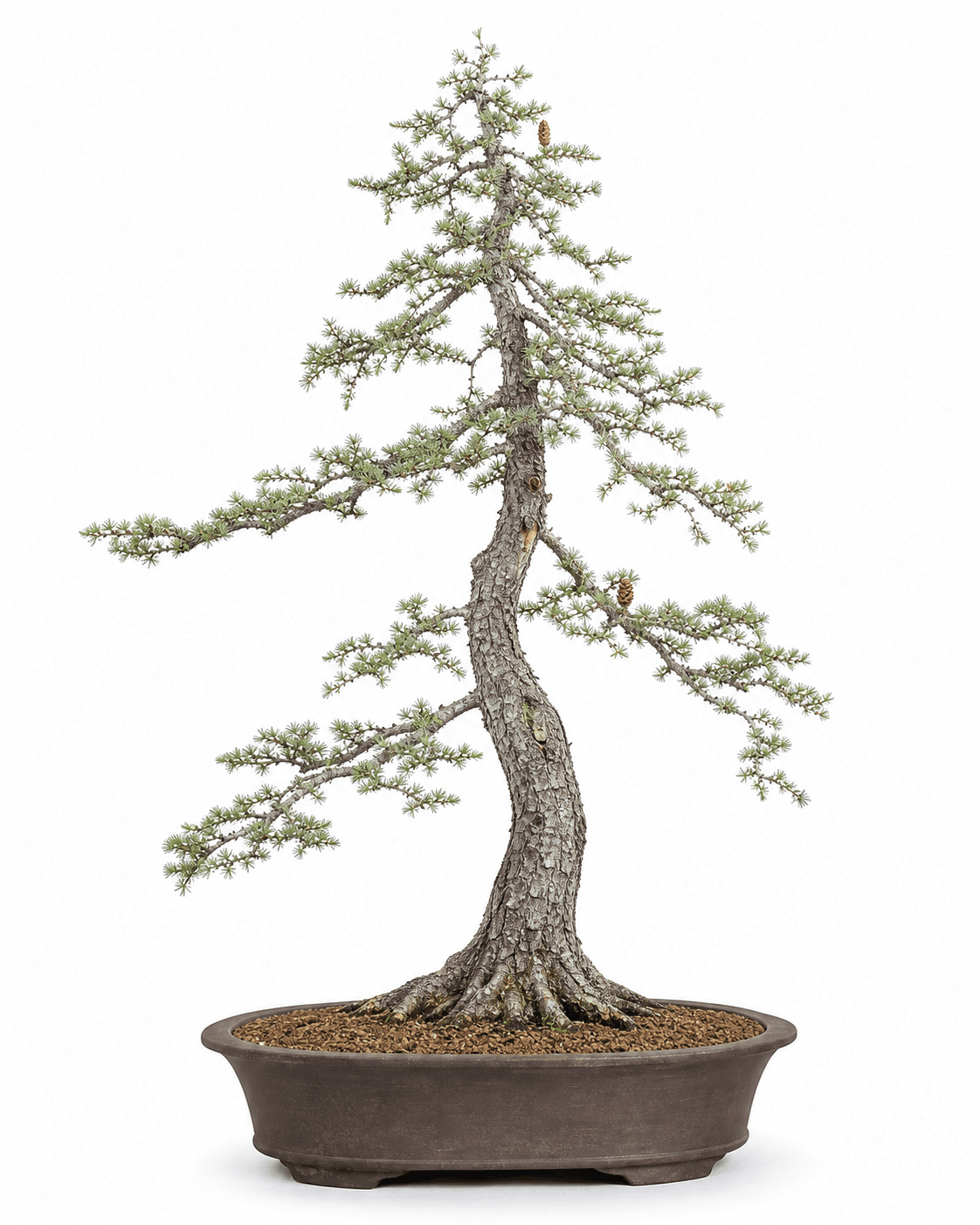
American larch, Larix laricina, is the native North American tamarack: a cold-hardy deciduous conifer that turns gold, drops its needles, and builds bonsai structure through spring bud-swell work and post-extension pruning. It belongs outdoors with cold dormancy, bright light, steady water, and a root zone that stays moist while still breathing.
Mirai has direct American larch and tamarack mentions inside its larch spring-work and development corpus, plus several larch-specific files for pruning, soil, repotting, wiring, and energy management. This guide treats tamarack as a larch first, then uses Kew, Oregon State, USDA, Minnesota Extension, and UMass sources for taxonomy, range, habitat, hardiness, pests, and forestry context.
Updated June 5, 2026. Written by EntGrove Editorial. Last verified June 5, 2026.
Care fingerprint
Read the species through its shared care pattern.
Use bud swell, needle hardening, and autumn color as signals; root work is seasonal and refinement depends on soft new extension. Use this as the starting point before local conditions and tree strength refine the calendar.
Do not prune like a pine
Elongating conifers extend from buds and shoots, so candle-cutting assumptions can remove the exact growth the tree needs.
Preserve interior growth
Spruce, fir, hemlock, cedar, redwood, cypress, and larch all become harder to design when interior buds are shaded out.
Keep recovery cool and steady
Many elongating conifers respond best when roots stay evenly moist, oxygenated, and protected from hot dry swings.
Care cadence
The calendar starts with the tree's seasonal state.
Repotting
Timing: Spring as buds swell and just show green
Watch for: Old compact soil, poor percolation, roots filling the pot, frozen roots, open needles, and first-time nursery transitions that should avoid heavy styling in the same season.
Bonsai Mirai LibraryStructural pruning and wiring
Timing: The same early-spring bud-swell window, before needles obscure the branch structure
Watch for: Cutting beyond the last viable bud, removing weak lower growth, wiring into swelling buds, leaving wire through rapid thickening, and fall pruning that costs winter reserves.
Bonsai Mirai LibraryFirst flush pruning
Timing: After the first flush elongates and hardens enough to reveal usable buds
Watch for: Pinching soft shoots, cutting every shoot to the same length, creating knuckles, reducing weak branches, and losing the lower branch hierarchy to apical strength.
Bonsai Mirai LibrarySecond and third pruning
Timing: Cool climates can run successive spring and summer prunings; hot climates should use fewer reductions
Watch for: Pruning after heavy root reduction, pushing refinement in Zone 7A or warmer heat, starving the tree, and continuing cuts after the final seasonal pruning.
Bonsai Mirai LibraryWatering
Timing: Check daily during active growth, wind, and warm sun
Watch for: Dry pockets, hot pot walls, needles dulling or wilting, water bypassing old peat, constant saturation, and winter roots drying in frozen wind.
Bonsai Mirai LibraryUSDA Forest Service FEISFertilizer
Timing: Withhold heavy spring fertilizer until after the first pruning on refined trees; feed development trees and give strong fall support for reserves.
Watch for: Long coarse internodes, weak fall buds, fertilizer on a tree that has poor uptake, and pushing a recently root-reduced tree before extension confirms recovery.
Bonsai Mirai LibraryPest checks
Timing: Early summer through late summer, with close checks after heat, drought, or defoliation
Watch for: Larch sawfly, larch casebearer, eastern larch beetle, aphids on soft growth, rust, Sirococcus-style shoot blight, root rot, and repeated defoliation.
University of Minnesota ExtensionUniversity of Minnesota ExtensionUMass Amherst ExtensionWinter protection
Timing: After golden needle drop and dormancy, before severe root-zone freeze or drying wind
Watch for: Warm indoor storage, exposed shallow pots, frozen-dry roots, late pruning wounds, and trees that entered winter weak after summer heat or pests.
Oregon State Landscape PlantsBonsai Mirai LibrarySpecies guide
Apply the species profile before copying another tree's calendar.
At a glance
Treat tamarack as a cold-country larch with a narrow spring work window.
Larix laricina is accepted by Kew and belongs to Pinaceae. The common-name field includes tamarack, American larch, eastern larch, Alaska larch, and hackmatack, all of which should point to this species unless a western or European larch label is also present. Kew POWOUSDA Forest Service Silvics
Oregon State describes the species as a deciduous conifer with clustered needles, small cones, full-sun culture, moist acidic soil preference, USDA Zone 1 hardiness, and explicit bonsai popularity. That is a rare landscape-source confirmation that the tree belongs in a bonsai species library. Oregon State Landscape Plants
The bonsai care fingerprint is larch physiology: spring bud-swell repotting and structural work, extension before pruning, short-shoot and bud reading, fast vascular thickening, autumn gold, needle drop, and winter dormancy. Bonsai Mirai Library
Wild habitat
Its wild story is boreal light, peat, cold water, and early-seral openness.
USDA FEIS says tamarack is most often found on cold wet to moist poorly drained sites such as swamps, bogs, muskegs, streams, lakes, and swamp borders, while also appearing on cool moist uplands in parts of its range. USDA Forest Service FEIS
Minnesota Extension places tamarack in bogs and peatlands, often with black spruce, northern white cedar, black ash, red maple, eastern white pine, and paper birch. The tree is light-demanding enough that pure or even-aged stands are common after disturbance. University of Minnesota ExtensionUSDA Forest Service FEIS
Care follows that ecology. A bonsai pot should stay evenly moist and cool, yet roots still need oxygen. The grower should create a bright, well-watered container environment, not a stagnant peat swamp in miniature. Bonsai Mirai LibraryUSDA Forest Service FEIS
Design follows ecology too. Tamarack can read as a boreal bog-edge tree, a lake-margin tree, a young pioneer stand, or a cold exposed larch with a narrow trunk, fine bare winter structure, and gold autumn presence. Bonsai Mirai / AsymmetryUSDA Forest Service Silvics
Reading the tree
Read buds, branch strength, and whether the tree is developing or refining.
Mirai larch method starts with the spring bud. Severe pruning, wiring, and root work are concentrated as buds swell and begin to show green because stored sugars and starches are moving and recovery is available. Bonsai Mirai Library
Development trees need extension, foliage, and vascular growth. A strong branch elongates continuously and back-buds into the interior; a weak branch only extends at the tip and has little interior foliage mass. Weak branches should be preserved until the tree earns reduction. Bonsai Mirai Library
Refined larch is managed by allowing shoots to run, then pruning to viable buds and useful internodes. Cutting repeatedly to the same basal point makes swollen knuckles and stubby branches, so branch phase matters more than calendar habit. Bonsai Mirai Library
Tamarack can be durable among larches, yet its refinement still depends on climate. Hot summer gardens should keep more foliage, reduce pruning frequency, reduce fertilizer, and use shade cloth or cooler bench positions when heat outruns transpiration. Bonsai Mirai Library
Pruning
Let shoots extend, then prune to real buds and proportional pads.
The most important rule is simple: do not pinch larch. Mirai repeatedly frames larch refinement as extension followed by pruning, because the running shoot spends energy, feeds the interior, and reveals buds worth cutting back to. Bonsai Mirai Library
For primary and secondary development, shape the first flush by separating body branches from silhouette branches. Interior body branches can be shortened harder to build density, while silhouette branches are cut to the triangular pad outline the design requires. Bonsai Mirai Library
The lowest branch establishes the proportional reference. Once its length and pad shape are set, every higher branch should be scaled against that decision so the trunk stays elegant and the apex remains smaller than the rest of the tree. Bonsai Mirai Library
Successive pruning can build very fine ramification in cool climates. The second and third pruning sequence compresses internodes and multiplies buds, but it should be skipped after heavy root reduction or in climates where summer heat makes the tree need foliage for cooling. Bonsai Mirai Library
Repotting
Repot at bud swell and respect the old root system during conversion.
Mirai places larch root work at spring bud swell or just as buds begin opening. The same window supports woody pruning and wiring because the tree is mobilizing reserves and water, while later work risks poorer recovery. Bonsai Mirai Library
A refined established larch can tolerate routine pruning, wiring, and repotting in the same spring when the root system is sound. First transitions from field or nursery stock should be staged, with root conversion separated from ambitious styling. Bonsai Mirai Library
Forest-repotting guidance in the Mirai corpus warns against bare-rooting deciduous conifers such as Larix. Preserve part of the root mass, tie the tree firmly, and protect the pot from drying wind while new fine roots colonize the fresh soil. Bonsai Mirai Library
Repot because percolation, root density, soil breakdown, or a planned style change calls for it. A slightly root-filled pot can be useful in refinement because root constriction shortens internodes and needles. Bonsai Mirai Library
Soil and pot
Use moisture retention with oxygen, then match the pot to the seasonal image.
For established larch bonsai, Mirai recommends 100 percent high-quality akadama. Larch has enough root speed and water mobility to occupy the container before the akadama breaks down, which supports finer roots, tighter internodes, and smaller needles. Bonsai Mirai Library
For early trunk building, Mirai allows a grow mix around 70 percent organic and 30 percent aggregate so the tree can build energy quickly. Once the tree moves toward refinement, shift toward akadama and container control. Bonsai Mirai Library
Tamarack ecology supports steady moisture, yet the bonsai mix should drain thoroughly. A pot full of sour peat, compact nursery soil, or decomposed organic sludge creates the opposite of a healthy bog edge because oxygen never returns to the fine roots. USDA Forest Service FEISBonsai Mirai Library
Pot pairing can be more flexible than evergreen conifers. Deciduous conifers show fresh green, autumn gold, and bare winter structure, so unglazed earth containers, quiet glazed ovals, forest slabs, and shallow literati containers can all work when the design explains the choice. Bonsai Mirai / Asymmetry
Climate adaptation
Cold is easy for tamarack; heat and container dryness are the harder tests.
Tamarack is exceptionally cold hardy in the landscape, with Oregon State listing USDA Zone 1. A bonsai container still exposes roots to wind, freeze-thaw swings, and winter drying, so protect the pot even when the species itself is hardy. Oregon State Landscape PlantsBonsai Mirai Library
Southern and warm-summer growers need a different refinement expectation. Mirai larch guidance says hot climates should prune less aggressively, carry more foliar mass, reduce fertilizer, and use shade cloth or cooler placement. Bonsai Mirai Library
USDA FEIS notes tamarack is most common on cold wet sites but grows best on well-drained loamy soils along streams, lakes, seeps, and mineral soils with a shallow organic layer. That range supports a bonsai target of moist, cool, aerated roots. USDA Forest Service FEIS
Imported or nursery-grown larch can wake early in a warm spring. If buds are racing ahead before the bench is safe, move the tree to a cooler shadier spot to slow heat and light cues, then complete root or structural work only while the bud window remains valid. Bonsai Mirai Library
Pests and disease
Most tamarack pest work starts with defoliators, bark beetles, and root health.
Minnesota Extension lists larch sawfly, eastern larch beetle, root and heart rots, and porcupines as common tamarack pests or problems. On a bonsai bench, sawfly, casebearer, aphids, mites, root rot, and bark beetle symptoms deserve the closest attention. University of Minnesota ExtensionUniversity of Minnesota Extension
Larch sawfly larvae feed on tamarack and other larches. Minnesota Extension notes that tamarack can produce replacement foliage after sawfly feeding, but repeated heavy feeding leads to thin foliage and reduced growth. University of Minnesota Extension
Larch casebearer is another larch-specific defoliator. UMass Extension lists eastern larch, Larix laricina, among its hosts, while Minnesota diagnostic material describes cigar-shaped cases and browned or parched needles. UMass Amherst ExtensionUniversity of Minnesota Extension
Fungal and root problems usually follow stress. Keep airflow open, remove fallen needles, avoid overnight wet foliage where disease is active, and solve stale compact soil before applying fertilizer to a tree with poor uptake. University of Minnesota ExtensionBonsai Mirai Library
Wiring
Wire early, use enough strength, and remove it before summer swelling wins.
Mirai recommends copper wire on larch because the bark can handle it and the tree has enough growth strength to overpower aluminum. Fine tertiary ramification should still be built mostly with scissors. Bonsai Mirai Library
The best wiring window is spring before foliage hides the structure. Buds are swelling, so wire must be placed around them and branches should be supported where the bend starts. Bonsai Mirai Library
Vigorous larch can scar quickly. Development trees may need mid-season unwiring when foliage makes the job awkward, while refined pot-bound trees can sometimes settle into a spring unwire and rewire rhythm. Bonsai Mirai Library
Use wire to set trunks, primary branches, secondary branches, and apex direction. Use pruning to build fine branchlets, short shoots, and the visible winter silhouette. Bonsai Mirai Library
Propagation
Seed and air layers are realistic; cuttings and grafts need better reasons.
Tamarack regenerates naturally from seed in open wet sites, and USDA sources describe early-seral establishment on bogs, burned peatlands, and wet openings. Seedlings and young collected nursery trees are the most straightforward bonsai starting points. USDA Forest Service FEISUSDA Forest Service Silvics
Mirai larch spring work gives a practical air-layer method: ring bark after the first flush hardens, press wire against the cut tissue, preserve foliage above the layer, and allow a recovery season after separation before heavy work. Bonsai Mirai Library
Layer timing should follow growth, not a fixed date. In many temperate gardens the first flush may harden around mid to late spring, but tamarack in colder regions can lag Japanese or European larch by local weather. Bonsai Mirai Library
Grafting is possible in Larix horticulture, yet it is rarely the beginner path for tamarack bonsai. Use grafting only to solve a specific branch, root, or cultivar problem that seedling selection or air layering cannot solve cleanly. Bonsai Mirai / Asymmetry
Sourcing
Choose roots, buds, and branch options before chasing the tamarack name.
Start by confirming the label. American larch, eastern larch, Alaska larch, tamarack, and hackmatack can all mean Larix laricina; western tamarack usually means Larix occidentalis in western North America. Kew POWOOregon State Landscape Plants
Good nursery material has a visible basal flare, live lower buds or branches, flexible young wood, gray winter twigs, and roots that can be converted in stages. Avoid trees with no interior buds, a compact peat block that sheds water, severe sawfly defoliation, or hidden trunk rot. Bonsai Mirai LibraryUniversity of Minnesota Extension
Collected tamarack can be compelling because the species inhabits bog edges, lakesides, and cold exposed openings. Collection requires permission, low-impact practice, and aftercare that preserves native root function during recovery. USDA Forest Service FEISBonsai Mirai Library
Cold-zone provenance matters. A tamarack from a northern wetland may be hardy but poorly adapted to hot, long summers, while a landscape nursery tree may have roots trained for containers but less wild character. USDA Forest Service SilvicsBonsai Mirai Library
Troubleshooting
Diagnose by season: gold in autumn is normal, browning in growth is evidence.
Symptom: golden needles in fall followed by needle drop. Likely cause: normal deciduous-conifer dormancy. Fix: protect the pot, keep dormant roots from drying, and wait for spring bud swell. Oregon State Landscape Plants
Symptom: soft shoots wilt or needles dull in summer. Likely cause: dry pockets, hot pot walls, wind, or excessive pruning that removed cooling foliage. Fix: water thoroughly, cool the container, reduce heat exposure, and rebuild foliage mass. Bonsai Mirai Library
Symptom: branch dies after a fall cut. Likely cause: larch reserves were depleted before winter. Fix: move structural pruning back to spring bud swell and use fall mainly for observation, feeding, and protection. Bonsai Mirai Library
Symptom: knobby branch tips with no elegant extension. Likely cause: repeated basal cutting or pinching. Fix: let selected shoots extend, then prune to visible lateral buds that build a tapering branch line. Bonsai Mirai Library
Symptom: needles look chewed, mined, or parched in early summer. Likely cause: larch sawfly or larch casebearer. Fix: inspect larvae or cases, hand-remove at bonsai scale, preserve health, and follow local extension guidance before any treatment. University of Minnesota ExtensionUMass Amherst Extension
Symptom: poor growth after repotting. Likely cause: heavy root reduction, bare-rooting, bad timing, movement in the pot, or fertilizer before uptake returned. Fix: stabilize the tree, protect from heat and wind, water evenly, and wait for sustained extension. Bonsai Mirai Library
Design
Style tamarack for slender cold-country age and visible winter structure.
Begin with trunk line, defining branch, apex, and the winter silhouette. Larch is judged as much without foliage as with it, so every branch junction, taper decision, and apex move remains visible for part of the year. Bonsai Mirai / AsymmetryBonsai Mirai Library
Mirai larch design favors triangular pads and conical apex structure that support a slender alpine or boreal character. Pads can show snow-load drape and soft vertical breaks instead of dense evergreen plates. Bonsai Mirai Library
Apex construction matters because larch stays strongly apical. Bend an apical leader over when the tree needs secondary and tertiary growth to build a conical apex, and avoid killing the hierarchy in multi-trunk designs by jinning the dominant top too early. Bonsai Mirai Library
Deadwood can be believable on larch, especially old broken tops and interior hollows. Keep it consistent with a cold wet or boreal story, where weather, snow load, rot, and branch loss create age without turning the tree into a dryland juniper. Bonsai Mirai LibraryBonsai Mirai / Asymmetry
Forest plantings are especially strong for tamarack. The species naturally forms even-aged pioneer stands, and seedlings can create depth, seasonal gold, and fine winter rhythm faster than a single young trunk can create age. USDA Forest Service FEISBonsai Mirai / Asymmetry
Cultivars
Most bonsai decisions happen at the species and provenance level.
Kew keeps Larix laricina as the accepted taxon and lists Larix laricina var. alaskensis under its synonym data. Oregon State presents tamarack, eastern larch, and American larch together, so EntGrove keeps one American larch page for launch. Kew POWOOregon State Landscape Plants
Named dwarf or landscape forms may appear regionally, but the bonsai screen stays practical: root quality, trunk base, twig density, branch placement, local heat tolerance, and whether the tree has buds where future structure is needed. Bonsai Mirai / Asymmetry
Compare with the other larches before buying. Mirai notes Japanese larch as the strongest and most heat tolerant, European larch as finer and more delicate, and American larch as durable with a less refined needle until the tree is developed. Bonsai Mirai Library
History
Tamarack is a working boreal tree with strong seasonal identity.
USDA Silvics records tamarack as a small to medium deciduous conifer extending from the Atlantic to central Alaska, with wood used for pulpwood, posts, poles, rough lumber, and fuelwood. USDA Forest Service Silvics
Minnesota Extension describes tamarack stands as habitat for red squirrels, snowshoe hares, porcupines, songbirds, and great gray owls. That ecological role supports designs grounded in living northern habitat and local ecology. University of Minnesota Extension
The name hackmatack has deep North American usage, and the tree has a strong cultural presence in wetlands and northern forests. Keep that record in the plant notes if the material has local provenance. USDA Forest Service Silvics
American larch lacks the broad exhibition mythology of Japanese black pine or Shimpaku, which gives the designer room to make the species itself legible: gold fall color, fine winter twigs, cold wet ecology, and a quiet northern silhouette. Bonsai Mirai / Asymmetry
Species questions
Answer the beginner questions before styling.
Can American larch be grown as bonsai?
Yes. American larch, also called tamarack, is recognized as a bonsai plant by Oregon State and has direct larch-method support in the Mirai corpus. It needs outdoor culture, cold dormancy, bright light, steady water, and spring-timed work.
Can tamarack bonsai live indoors?
No. Tamarack is a cold-hardy deciduous conifer. Grow it outdoors, allow autumn needle drop, and protect the container roots through winter instead of keeping it in a warm room.
When should I repot American larch bonsai?
Repot at spring bud swell, just as buds begin showing green. Preserve part of the old root mass, tie the tree firmly, and separate severe nursery-root conversion from severe styling.
Should American larch be pinched?
No. Let shoots extend and spend energy, then prune to viable buds after extension and hardening. Pinching and repeated basal cuts create knuckles and weak branch structure.
What soil works for tamarack bonsai?
Use 100 percent high-quality akadama for established refined larch. Development trees can use a more organic grow mix, then move toward akadama and container control as refinement begins.
How much sun does American larch bonsai need?
Full sun is the baseline in cool climates. In hot or windy summers, give afternoon protection, cool the pot, and keep enough foliage to help the tree move water and manage heat.
Why is my tamarack bonsai turning yellow?
Golden yellow in fall is normal before needle drop. Yellowing, browning, or parched needles during active growth should be checked for dry roots, heat, sawfly, larch casebearer, aphids, mites, root trouble, or recent mistimed work.
Is tamarack the same as American larch?
Usually yes. Tamarack, American larch, eastern larch, Alaska larch, and hackmatack commonly refer to Larix laricina. Western tamarack usually points to Larix occidentalis, which deserves separate care notes.
What styles suit American larch bonsai?
Informal upright, formal upright, literati, slanting, group, forest, raft, bog-edge, and cold exposed boreal designs suit American larch. The best designs show fine winter structure and autumn color.
Sources
Species advice needs source discipline.
Next decisions
Plan the operation before copying the calendar.
A good care note for American / tamarack larch records the tree's stage, the work done, and the aftercare used. That record matters more than a month-name rule.
Related species
Compare nearby trees before transferring advice.
European larch
Larix decidua
Japanese larch
Larix kaempferi
Alpine larch
Larix lyallii
Western larch
Larix occidentalis
Golden larch
Pseudolarix amabilis