
Species guide
American Beech Bonsai Care
Fagus grandifolia
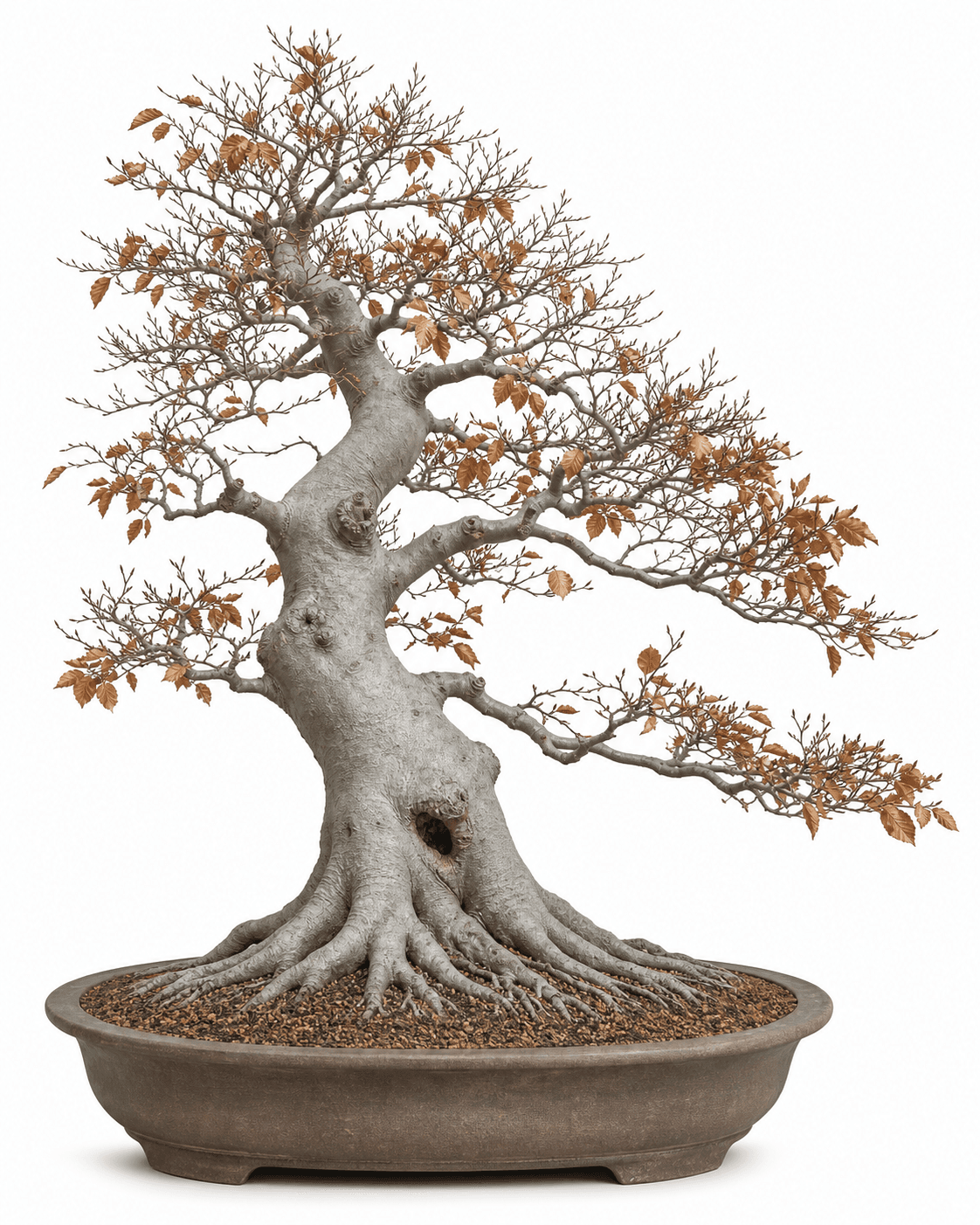
American beech bonsai care starts with treating Fagus grandifolia as an outdoor, eastern North American deciduous tree. Give it winter dormancy, bright spring light, summer heat moderation, evenly moist acidic roots with oxygen, and enough scale for large leaves and smooth gray bark to look intentional.
The local Mirai corpus supports this page through direct American beech timing, beech forest work, Fagus post-flush pruning, fall leaf-drop pruning, rootbound nursery-stock repotting, deciduous root work, structural wiring, propagation, watering, soil, fertilizer, energy, and design fundamentals. Kew, NC State, USDA, UConn, Cornell, Missouri, and Cornell IPM ground taxonomy, range, hardiness, morphology, ecology, and regional disease context.
The main failure points are warm indoor culture, hot dry roots, stale wet soil, rough handling of smooth bark, routine full defoliation, spring bleeding on vigorous trees, wire bite, oversized leaves on tiny designs, difficult transplant recovery, and confusing American beech disease alerts with ordinary bonsai pest pressure.
Updated June 18, 2026. Written by EntGrove Editorial. Last verified June 18, 2026.
Care fingerprint
Read the species through its shared care pattern.
Repot and structural prune around dormant-to-active transitions; protect new leaves; time refinement work after growth hardens. Use this as the starting point before local conditions and tree strength refine the calendar.
Note: White beech can appear as an American beech common name, but it is ambiguous with European hornbeam trade labels; older Fagus ferruginea labels are also ambiguous in beech references, so confirm Fagus grandifolia before applying this care profile.
Read the foliage first
Broadleaf stress usually shows in leaf color, leaf size, wilt, scorch, or delayed hardening before it becomes a branch problem.
Match work to dormancy
Deciduous, evergreen, tropical, succulent, and flowering broadleaf trees recover on different calendars.
Protect fine roots
Root work should preserve enough active fine roots for the tree to rehydrate quickly after the operation.
Care cadence
The calendar starts with the tree's seasonal state.
Placement
Timing: Grow outside with seasonal light, rain, air movement, and real winter dormancy. Protect the container during severe freezes without waking the tree in household heat.
Watch for: Weak indoor shoots, winter wind drying the pot, repeated freeze-thaw around fine roots, and using landscape hardiness as the whole container-protection plan.
Kew POWOUConn Plant DatabaseBonsai Mirai LibraryLight and heat
Timing: Use bright spring light while temperatures are mild, then add afternoon shade or wind shelter during hot dry weather. Rotate the tree during active growth so one side does not weaken in shade.
Watch for: Scorched leaf edges, limp foliage in hot wind, long weak extension in deep shade, a dense apex shading lower branches, and sudden trunk sun exposure after canopy opening.
NC State ExtensionUConn Plant DatabaseBonsai Mirai LibraryWatering
Timing: Water when the surface begins to dry while the core still holds moisture. Thorough watering should be followed by oxygen return, especially in old nursery cores and akadama-heavy refinement soil.
Watch for: Hydrophobic summer edges, stale wet cores, compacted nursery soil, chlorosis in alkaline conditions, and winter saturation when roots are inactive.
NC State ExtensionUConn Plant DatabaseBonsai Mirai LibraryFertilizer
Timing: Feed by development stage after active uptake resumes. Development trees need stronger feeding to build roots, wounds, and branches; refined trees need lighter feeding so one strong flush does not make the crown coarse.
Watch for: Coarse internodes from overfeeding a finished crown, weak buds from underfeeding a developing tree, fertilizer before post-repot roots harden, and feeding used to compensate for bad water or oxygen.
Bonsai Mirai LibraryPruning and leaf work
Timing: Use fall leaf-drop work once held leaves have dried brown and detach at the petiole. In spring and early summer, wait for the first flush to harden before post-flush pruning or selective leaf reduction.
Watch for: Spring bleeding, late-season cuts, routine full defoliation, pruning weak branches that need leaves, and removing marcescent leaves by tearing buds or bark.
Bonsai Mirai LibraryRepotting
Timing: Repot at spring bud swell when freezing can be excluded afterward. Hydrate before root work, expose the true base from the top down, cut roots cleanly, anchor firmly, and protect from wind after the operation.
Watch for: Surface roots hiding the real base, torn roots, deep compacted nursery soil, movement in the pot, heavy top work after root reduction, and constant wetness before new roots callus.
Bonsai Mirai LibraryCornell Woody Plants DatabaseNC State ExtensionWiring
Timing: Wire young flexible growth in leafless or post-harden windows, using aluminum for ordinary deciduous work and padding where contact could stain or bruise bark. Remove or loosen wire before spring thickening bites.
Watch for: Wire scars on smooth bark, copper staining, brittle older branches, tight coils during spring swell, and bends that impose sharp conifer movement on a broadleaf woodland tree.
Bonsai Mirai LibraryPest and disease checks
Timing: Inspect bark, lower leaf surfaces, buds, shaded interiors, weak root systems, and any local trees under regional disease pressure.
Watch for: Whitefly, aphids, scale, chlorosis, powdery mildew, root rot, beech bark disease scale or cankers, and beech leaf disease banding with canopy thinning.
Bonsai Mirai LibraryUConn Extension beech bark diseaseCornell IPM beech leaf diseaseUConn Plant DatabaseSpecies guide
Apply the species profile before copying another tree's calendar.
At a glance
American beech is a native outdoor deciduous bonsai for medium and larger designs.
Use this page for Fagus grandifolia Ehrh., the American beech or North American beech. Kew accepts the name in Fagaceae and gives its range as eastern Canada to the central and eastern United States. NC State adds common labels such as beechnut tree, red beech, ridge beech, and white beech, with the white-beech label needing confirmation because other plants can carry it. Kew POWONC State Extension
The practical bonsai profile is outdoor dormancy, bright spring light, partial summer protection in heat, acidic aggregate soil that stays evenly moist, spring bud-swell repotting, fall or post-flush pruning, bark-safe wiring, and a design size that respects leaves commonly listed at 3 to 6 inches long. Expect slow growth, a smooth gray trunk, marcescent winter leaves on young growth, beechnuts on mature material, and a patient path to refinement. Missouri Department of ConservationUConn Plant DatabaseCornell Woody Plants DatabaseBonsai Mirai Library
Difficulty is intermediate. American beech suits growers who can manage water carefully, protect shallow roots in winter, and accept slow branch building. Warm indoor culture, tiny bonsai expectations, and one-session styling that leaves permanent marks on smooth bark are poor matches for this species. UConn Plant DatabaseCornell Woody Plants DatabaseBonsai Mirai Library
Wild origin
Its wild ecology explains the care: woodland light, moist acid soil, and shallow roots.
USDA describes American beech as an eastern North American forest tree with high shade tolerance, shallow spreading roots, blue-gray bark, slow growth, long life potential, and heavy ecological value as mast for wildlife. NC State and UConn both emphasize moist, well-drained acidic soil and intolerance of wet or compacted conditions. USDA Forest Service FEISUSDA Forest Service SilvicsNC State ExtensionUConn Plant Database
In care, that translates to a root ball that should stay damp without losing air. A shallow bonsai pot dries faster than forest soil and holds less buffer against heat and freeze. Old field soil, compacted nursery cores, and deep organic pockets are the usual hidden problems because they can stay wet inside while the newer outer mix dries. NC State ExtensionUConn Plant DatabaseBonsai Mirai Library
In design, the wild tree suggests a broad deciduous crown, horizontal or gently ascending branches, smooth pale bark, visible seasonal rhythm, and restraint. The most persuasive American beech bonsai read as eastern woodland trees rather than compact conifers with layered pads. Missouri Department of ConservationUConn Plant DatabaseBonsai Mirai / Asymmetry
Reading the tree
Separate development, secondary structure, and refinement before cutting.
Mirai deciduous method separates primary structure, secondary scaffolding, and tertiary ramification. A developing American beech needs extension to build roots, branch diameter, wound closure, and interior buds. A refined branch can be pruned, pinched, or leaf-reduced only after vigor and density prove that the branch can afford the work. Bonsai Mirai Library
American beech is usually single-flush in practical bonsai work. Mirai describes beech as producing one, sometimes two, useful flushes in a season. A post-flush cut can be the last major growth-management action of the year, so the grower should preserve weak lower branches and spend strength only where the tree is clearly energy positive. Bonsai Mirai Library
Marcescent leaves change the fall read. The direct Mirai American beech note says the tree can be worked in the standard post-leaf-drop window once retained leaves have dried brown. Remove held leaves at the petiole before pruning, and use the condition of the tree rather than the calendar alone. Bonsai Mirai Library
Pruning
Prune after leaf drop or after the first flush hardens, then reduce leaves selectively.
For fall work, wait until leaves have naturally dried, crinkled, and release cleanly at the petiole. Mirai leaf-drop guidance gives a short post-abscission window for fully deciduous broadleaf species and notes that beech leaves can cling, so the grower must avoid tearing buds or bark while preparing the tree. Bonsai Mirai Library
For growing-season work, wait until the first flush is hardened: leaves darken, firm up, and extension slows. Then cut long shoots back to useful interior leaves or buds. On strong exterior shoots, Mirai beech method reduces leaf area by folding the leaf and cutting at an angle so the remaining leaf still keeps a natural pointed shape. Bonsai Mirai Library
Full defoliation should stay out of the routine. Large leaves can be reduced on vigorous refined sections, but weak branches need intact foliage to feed roots and create future buds. After canopy opening, protect the tree from sudden hot sun because shade-adapted interior leaves and smooth trunks can scorch. Bonsai Mirai Library
Pinching is a refinement-only tool. Mirai spring pinching guidance treats beech as the exception among alternate-bud deciduous species where carefully timed pinching can help transition strength and encourage interior ramification. Use it only on strong, already-placed branches with balanced buds. Bonsai Mirai Library
Repotting
Repot at spring bud swell and correct roots from the surface down.
The safest root window is spring bud swell, before expanding foliage turns water demand high. Mirai rootbound nursery-stock guidance says buds swelling or just beginning to open mark the window for aggressive deciduous repotting, provided freezes can be excluded after the work. Bonsai Mirai Library
Start from the top of the root mass. Beech and other deciduous trees often accumulate soil and adventitious roots above the true base in containers. Expose the widest usable flare gently, especially on smooth bark, then decide how much bottom and side depth can be removed without losing recovery strength. Bonsai Mirai LibraryNC State ExtensionUConn Plant Database
American beech adds a transplant warning. Cornell describes it as difficult to transplant except as small balled-and-burlapped or container-grown material, and UConn calls the root system shallow and wide. Large field trees, compacted clay balls, and heavy root chops need staged conversion rather than aesthetic haste. Cornell Woody Plants DatabaseUConn Plant DatabaseUSDA Forest Service FEIS
After root work, anchor the tree firmly, water thoroughly, and let oxygen return before repeating irrigation. Mirai emphasizes that movement in the pot breaks new roots, and constant saturation after root reduction invites rot instead of callus. Bonsai Mirai Library
Soil and pot
Use moisture-retentive aggregate soil with clear oxygen return.
American beech wants the same physical root-zone balance in a pot that its habitat asks for in the ground: moisture with air. NC State specifies moist, well-drained acidic soil and intolerance of wet or compacted soil. UConn repeats moist, well-drained, acidic soil and warns against excessive wetness. NC State ExtensionUConn Plant Database
In development, an akadama, pumice, and lava blend can keep correcting roots open while still holding water. In refinement, Mirai deciduous soil guidance often moves toward solid akadama or akadama-heavy soil when the grower can water and repot on time. The mix should re-wet evenly, drain clearly, and avoid a stale organic center. Bonsai Mirai Library
Pot choice should support a quiet woodland image. Shallow ovals, rectangles, forest trays, slab plantings, soft earth tones, muted glazes, gray clay, and unglazed warm surfaces can all work. Very small or very shallow containers demand excellent summer water control and usually make the large leaf scale harder to justify. Bonsai Mirai / AsymmetryMissouri Department of ConservationUConn Plant Database
Climate
Adjust for heat, winter wind, disease region, and leaf size.
In cool humid regions, American beech can take more direct light if roots stay evenly moist. In hot interior gardens, use morning sun, afternoon shade, wind moderation, and a soil structure that does not dry hard by late afternoon. NC State ExtensionUConn Plant DatabaseBonsai Mirai Library
Winter care is root care. UConn and Cornell list cold landscape hardiness, but refined bonsai have shallow roots and fine ramification that can die back under freeze-thaw and drying wind. Set pots on the ground, mulch around them, or use an unheated cold frame when containers are exposed. UConn Plant DatabaseCornell Woody Plants DatabaseBonsai Mirai Library
In regions with active beech leaf disease or beech bark disease, inspect local forest and extension alerts before collecting or buying material. A diseased regional population changes sourcing risk, sanitation, and whether a native beech project is worth starting. UConn Extension beech bark diseaseCornell IPM beech leaf disease
Pests and disease
Watch whitefly, scale, leaf disease, bark disease, and root stress separately.
Mirai beech post-flush work calls out whitefly monitoring on the undersides of leaves. Also watch for aphids, scale, mildew, chlorosis, and root decline, especially after drought, stale wet soil, or a dense canopy that holds humid still air. Bonsai Mirai LibraryUConn Plant Database
Beech bark disease is a disease complex, not a wire-scar diagnosis. UConn Extension describes felted beech scale feeding that opens bark to Neonectria infection on native American and non-native European beech. Scale, cankers, bark cracking, and crown decline need local extension guidance. UConn Extension beech bark disease
Beech leaf disease is separate. Cornell IPM links it with Litylenchus crenatae f. sp. mccannii and describes leaf banding, bud and twig death, canopy thinning, and host risk across Fagus species. Dark bands, repeated bud death, and canopy thinning deserve diagnosis before ordinary bonsai pruning continues. Cornell IPM beech leaf disease
Prevention starts with culture: enough light to harden buds, no stale wet core, no chronic drought, no unnecessary wounds, clean tools, good airflow, and restraint after disease stress. Treat confirmed pests according to local labels and avoid broad chemical routines when roots or water balance are the real problem. Bonsai Mirai LibraryNC State ExtensionCornell IPM beech leaf disease
Wiring
Wire for subtle placement, not dramatic bends.
Mirai structural wiring guidance uses aluminum on deciduous species because it is less abrasive on thin bark, and calls beech a tree for soft, subtle, low-angularity movement. American beech is especially unforgiving because the smooth gray bark is a primary design feature. Bonsai Mirai LibraryMissouri Department of Conservation
Wire in leafless or post-harden windows when the branch can move without active soft tissue. Use clean 55 to 60 degree turns, no gaps, and an anchor that contacts the branch shoulder. Check frequently during spring growth, and cut wire off before it bites. Bonsai Mirai Library
For older limbs, prefer cutback, branch replacement, guy wires with padding, or directional buds. Large forced bends, copper contact on pale bark, and repeated re-wiring in the same groove create scars that are more visible than the styling benefit. Bonsai Mirai LibraryBonsai Mirai / Asymmetry
Propagation
Seed and small nursery material are more realistic than heroic layers.
American beech can be grown from seed, and Missouri describes beechnuts in prickly husks. Seed is useful for forests and native-source projects, but it is slow. Expect years before roots, bark, trunk scale, and branch options become bonsai-relevant. Missouri Department of ConservationUSDA Forest Service Silvics
Air-layering Fagus is possible with caveats. Mirai notes that beech air-layers poorly because vascular flow can form narrow callus paths instead of even radial roots, and that slow-to-callus deciduous layers may need a heavy wire ring, re-wounding, rooting hormone, and patient oxygen control. Bonsai Mirai Library
Grafting and thread grafting can solve root or branch placement, but smooth bark makes every union visible. Use grafts for a clear design reason, align entry and exit cleanly, and place the future scar where the design can absorb it. Bonsai Mirai LibraryBonsai Mirai / Asymmetry
Sourcing
Buy for identity, roots, bark, and health before trunk size.
Confirm Fagus grandifolia first. American beech, North American beech, beechnut tree, red beech, ridge beech, and some white-beech labels can point here; European beech, Japanese beech, hornbeam, and ironwood need their own identity checks. Kew POWONC State ExtensionMissouri Department of Conservation
Good candidates have a workable shallow base, clean smooth bark, low branch options, short internodes for the species, healthy buds, no obvious regional disease symptoms, and a future image that can work at medium or large scale. Small container-grown or young field material is usually safer than large dug trees. Cornell Woody Plants DatabaseUConn Plant DatabaseBonsai Mirai Library
Walk away from heavy wire scars, bark cankers, leaf banding, severe scale, hydrophobic nursery cores, compacted clay balls with few fine roots, a single high graft, or a design that depends on shrinking leaves to shohin proportions. UConn Extension beech bark diseaseCornell IPM beech leaf diseaseCornell Woody Plants DatabaseBonsai Mirai Library
Troubleshooting
Diagnose American beech by symptom, timing, and root state.
Scorched leaf edges usually mean water demand exceeded root supply: hot wind, afternoon sun, dry pockets, weak new roots, or canopy opening that exposed shade leaves. Move to gentler light, water thoroughly, and correct the soil at the next safe root window. NC State ExtensionBonsai Mirai Library
Yellow leaves can point to stale wet roots, alkaline or compacted soil, low uptake after repotting, chlorosis, or sap-feeding insects. Check drainage, root smell, water movement, leaf undersides, and recent fertilizer before adding more food. NC State ExtensionUConn Plant DatabaseBonsai Mirai Library
Weak lower branches usually mean the top is shading or outcompeting them. Keep more foliage on weak branches, rotate the tree, reduce strong upper regions only after hardening or at the correct fall window, and avoid pruning a weak branch in hopes that it will bud from nothing. Bonsai Mirai Library
Bleeding after spring cuts means the tree had already resumed strong water movement. Cool the tree, seal the wound if needed, and shift future structural pruning to the correct fall leaf-drop window or to post-flush hardening when the tree is energy positive. Bonsai Mirai Library
Wire marks are preventable damage. Remove tight wire, stop reusing scar tracks, and shift future movement to aluminum, padding, guy wires, clip-and-grow, or branch replacement. Smooth beech bark records mistakes for a long time. Bonsai Mirai Library
Design
Build a broad eastern woodland image with clean bark and winter structure.
Start with the base, trunk line, defining branch, and apex. Mirai design method uses those anchors to decide whether the tree should read as calm, old, youthful, solitary, clumped, or forest-grown. American beech usually rewards calm design decisions. Bonsai Mirai / AsymmetryBonsai Mirai Library
Use the species assets: smooth gray bark, shallow roots, broad crown, horizontal or ascending branches, retained winter leaves, bronze fall color, and a native eastern woodland story. Missouri and UConn both describe the wide crown and smooth bark that make the tree recognizable. Missouri Department of ConservationUConn Plant Database
Forests and clumps are especially convincing when trunks vary in spacing and girth while the upper canopy stays softly unified. Mirai beech forest work emphasizes asymmetry, primary trunk placement, front-to-back depth, and a restrained canopy silhouette rather than dramatic height jumps. Bonsai Mirai LibraryBonsai Mirai / Asymmetry
Deadwood should stay subtle. American beech can show old hollows or scars, but age reads more credibly through bark, roots, taper, branch hierarchy, leaf mass, winter silhouette, and seasonal change than through large jin or shari. Bonsai Mirai / AsymmetryUSDA Forest Service FEIS
Forms
American beech has fewer bonsai-relevant cultivar labels than European beech.
Cornell notes that American beech has few cultivars and that they are rare, including Cameron as a weeping variety and Diamond Bark as a bark-pattern form. Treat those as sourcing notes rather than separate care calendars. Cornell Woody Plants Database
Most material will be straight species. Judge leaf size, internode length, bark quality, root base, branch placement, disease status, and recovery strength. A rare label cannot fix a poor base, scarred bark, or a root ball that cannot transition. Bonsai Mirai LibraryCornell Woody Plants Database
Keep the beech pages separate. European beech is Fagus sylvatica, Japanese beech is Fagus crenata, and American beech is Fagus grandifolia. Each one shares Fagus method while differing in range, morphology, source depth, trade labels, and disease context. Kew POWOKew POWOKew POWO
History
American beech brings eastern North American forest character into bonsai.
USDA Silvics describes American beech as the North American Fagus species, slow-growing, long-lived, and important for mast. Missouri describes its smooth steel-gray bark, broad crown, beechnuts, and native woodland presence. Those traits give the species a distinct voice from imported or cultivar-heavy beech material. USDA Forest Service SilvicsMissouri Department of Conservation
In bonsai, American beech remains less common than European or Japanese beech. That makes it valuable for native-tree work, forest plantings, and regional displays when the grower can source clean, disease-aware material and accept a slower path to refinement. Bonsai Mirai / AsymmetryCornell Woody Plants DatabaseCornell IPM beech leaf disease
A strong American beech display should read across the year: credible roots, clean smooth bark, controlled scars, seasonally appropriate leaves, a winter branch structure that still feels broadleaf, and a pot that supports the woodland image without competing with it. Bonsai Mirai LibraryBonsai Mirai / Asymmetry
Species questions
Answer the beginner questions before styling.
Is American beech a good beginner bonsai?
Yes, for a patient outdoor grower who wants a native deciduous project at medium or larger scale. It asks for better timing, water control, and scar prevention than the easiest beginner trees.
Can American beech bonsai live indoors?
Keep American beech outdoors. It needs winter dormancy, seasonal light, air movement, and protected container roots during severe freezes.
What is the correct scientific name for American beech?
EntGrove uses Fagus grandifolia Ehrh., accepted by Kew. Older labels can include Fagus americana, Fagus ferruginea, and Fagus sylvatica var. americana.
How is American beech different from European beech?
American beech is Fagus grandifolia from eastern North America and generally carries larger-leaf scale and different regional disease concerns. European beech is Fagus sylvatica and has a deeper cultivar trade.
How is American beech different from Japanese beech?
American beech is Fagus grandifolia from eastern North America. Japanese beech is Fagus crenata from Japan and usually fits Japanese woodland and forest-bonsai design language with a different source base.
How much sun does American beech bonsai need?
Use bright spring light, then add afternoon shade or wind shelter in hot dry weather. Deep shade keeps the tree alive but usually weakens interior buds and lengthens growth.
How often should I water American beech bonsai?
Water when the soil surface begins to dry while the core still holds moisture. Keep the mix evenly moist and oxygenated, and avoid both hard dry pockets and stale wet cores.
When should I prune American beech bonsai?
Use the fall leaf-drop window once retained leaves have dried brown and can be removed at the petiole, or prune after the first spring flush hardens. Avoid spring cuts during active bleeding.
When should I repot American beech bonsai?
Repot at spring bud swell when roots, drainage, or soil age justify the work and freezes can be excluded afterward. Young nursery conversions need staged root correction more than a fixed interval.
Should I defoliate American beech bonsai?
Avoid routine full defoliation. On strong refined sections, use selective leaf reduction after the first flush hardens, leaving weak branches with enough foliage to recover and build buds.
What soil is best for American beech bonsai?
Use aggregate soil that holds moisture and drains clearly. Development trees can use akadama, pumice, and lava; refined trees may use akadama-heavy or solid akadama when watering and repot timing are reliable.
Why are my American beech leaves browning at the edges?
Leaf-edge browning usually means water demand exceeded root supply because of heat, wind, dry pockets, weak roots, or sudden sun exposure after canopy work. Move to gentler light and inspect soil structure.
Can American beech be air-layered?
It can be attempted, but Fagus layers can be slow and uneven. Use layering only on vigorous material, manage oxygen carefully, and separate only after the layer has radial roots strong enough for recovery.
Sources
Species advice needs source discipline.
Next decisions
Plan the operation before copying the calendar.
A good care note for American beech records the tree's stage, the work done, and the aftercare used. That record matters more than a month-name rule.
Related species
Compare nearby trees before transferring advice.
Japanese maple
Acer palmatum
Trident maple
Acer buergerianum
Amur maple
Acer tataricum subsp. ginnala
Field maple
Acer campestre
Korean hornbeam
Carpinus turczaninovii