
Species guide
American Hornbeam Bonsai Care
Carpinus caroliniana
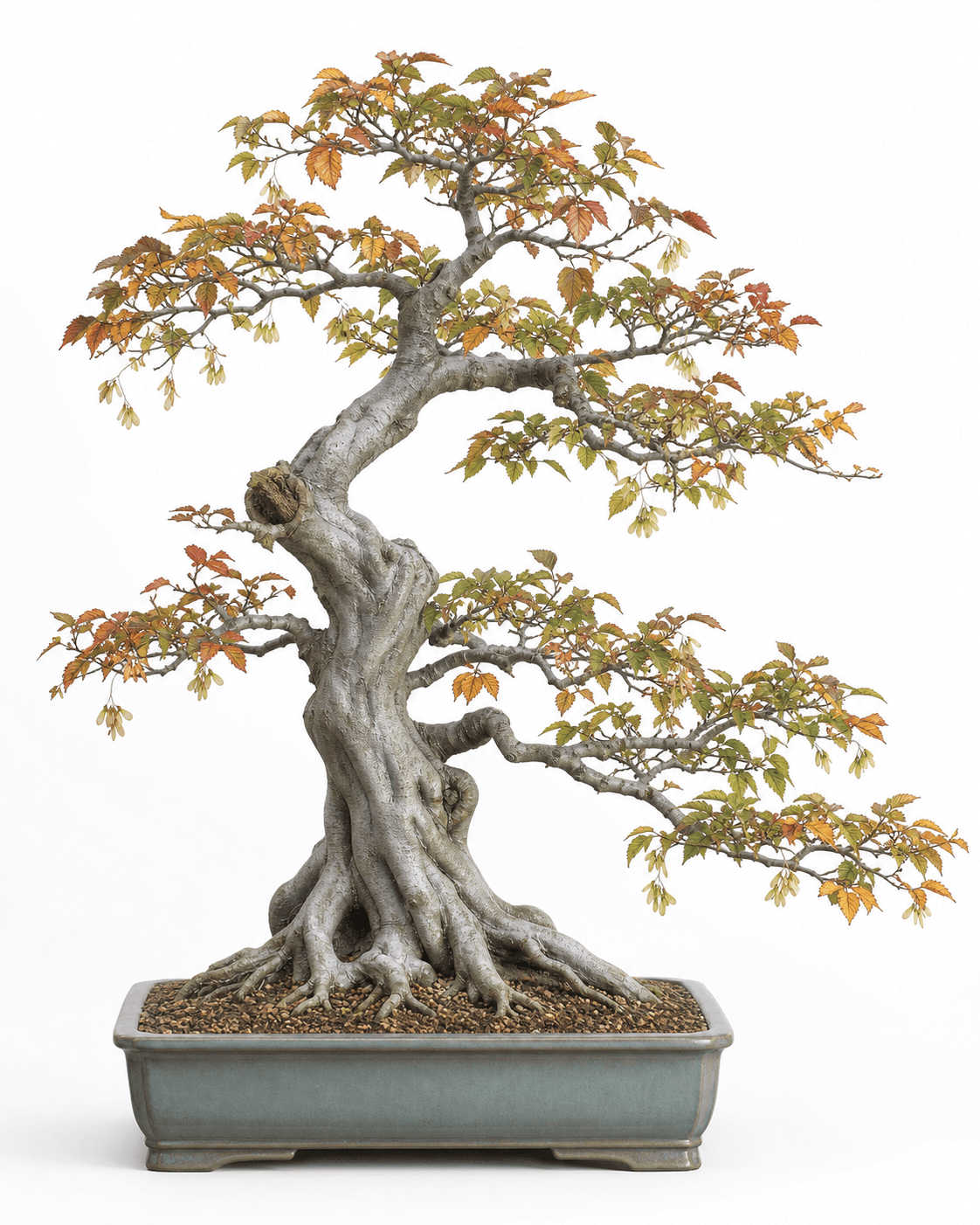
American hornbeam is an outdoor deciduous bonsai for growers who want a native North American tree with muscled gray bark, orange-to-red fall color, and a quiet understory character. Keep the root ball evenly moist, protect the container in winter, and size the design for leaves that commonly run 2.5 to 5 inches long.
Treat it as Broadleaf > Deciduous in the EntGrove taxonomy. Kew accepts Carpinus caroliniana Walter in Betulaceae, while North American references also use blue beech, musclewood, muscle wood, water beech, and ironwood; ironwood needs identity checks because it is also used for Ostrya virginiana.
The Mirai corpus has direct American hornbeam mentions plus stronger Carpinus, hornbeam, deciduous pruning, watering, repotting, wiring, air-layering, and design files. The resulting care pattern is conservative: outdoor dormancy, moisture with oxygen, spring bud-swell root work, grow-out then cutback, restrained partial defoliation, and branch placement that respects brittle wood and larger foliage.
Updated June 17, 2026. Written by EntGrove Editorial. Last verified June 17, 2026.
Care fingerprint
Read the species through its shared care pattern.
Repot and structural prune around dormant-to-active transitions; protect new leaves; time refinement work after growth hardens. Use this as the starting point before local conditions and tree strength refine the calendar.
Read the foliage first
Broadleaf stress usually shows in leaf color, leaf size, wilt, scorch, or delayed hardening before it becomes a branch problem.
Match work to dormancy
Deciduous, evergreen, tropical, succulent, and flowering broadleaf trees recover on different calendars.
Protect fine roots
Root work should preserve enough active fine roots for the tree to rehydrate quickly after the operation.
Care cadence
The calendar starts with the tree's seasonal state.
Placement
Timing: Grow outdoors with air movement, rain, seasonal light, and real dormancy. Protect the pot from hard freezes, freeze-thaw cycles, and winter wind rather than waking the tree in a heated room.
Watch for: Weak indoor growth, frozen exposed roots, winter wind drying the pot, and treating in-ground Zone 3 hardiness as if it fully protects a shallow bonsai container.
NC State ExtensionMorton ArboretumBonsai Mirai LibraryLight requirement
Timing: Use bright spring light where heat is mild, then shift toward afternoon shade or filtered light when hot weather and shallow pots make leaves scorch or roots dry too quickly.
Watch for: Long internodes in deep shade, scorched margins in hot dry sun, top growth shading lower branches, and confusing shade tolerance with indoor-low-light tolerance.
NC State ExtensionOregon State Landscape PlantsMorton ArboretumBonsai Mirai LibraryWatering
Timing: Water thoroughly as the surface begins to dry while the core still holds moisture. Spring flush, hot wind, shallow pots, and dense foliage raise demand quickly.
Watch for: Drought stress, heat stress, compacted nursery soil, wet stagnant cores, occasional-flooding assumptions carried into a bonsai pot, and root rot from overwatering.
NC State ExtensionUSDA Forest Service FEISBonsai Mirai LibraryFertilizer
Timing: Feed by stage. Use stronger organic feeding while building primary structure, moderate feeding for secondary development, and lighter feeding after the first flush hardens on refined trees.
Watch for: Coarse internodes from overfeeding, pale foliage from poor roots or water chemistry, and feeding hard before a weak collected tree has rebuilt roots.
Bonsai Mirai LibraryNC State ExtensionPruning
Timing: Use spring bud swell for safe structural correction on healthy trees, post-flush cutback for ramification, and fall leaf-drop pruning for refined trees when the tree has had a full season to store energy.
Watch for: Constant pinching before leaves harden, lower branches weakening under a dominant apex, rough chops on a slow tree, and late-season pruning that triggers dieback.
Bonsai Mirai LibraryBonsai Mirai / AsymmetryUConn Plant DatabaseWiring
Timing: Wire only vigorous branches that are ready for structural movement. Early fall and leafless windows are useful, but American hornbeam wood is brittle enough that one planned bend is safer than repeated correction.
Watch for: Wire bite, bark scars, brittle old wood, wiring right after repotting, and conifer-style bends that fight the species natural understory character.
Bonsai Mirai LibraryBonsai Mirai / AsymmetryMissouri Department of ConservationRepotting
Timing: Repot at spring bud swell when drainage, root fill, or old soil justify intervention. Developing trees often need earlier core correction; older refined trees can wait when water entry, drainage, and vigor remain reliable.
Watch for: Deep spreading lateral roots, slow drainage, dry pockets, sour organic cores, weak extension, and combining heavy root reduction with heavy top work.
Bonsai Mirai LibraryMorton ArboretumUConn Plant DatabaseLeaf work
Timing: After the first flush hardens, reduce oversized leaves only on vigorous sections that need refinement. On larger-leaved hornbeams, Mirai uses leaf-blade reduction rather than whole-leaf plucking.
Watch for: Weak branches losing needed leaf mass, partial defoliation before cuticle hardens, petiole damage, and expecting shohin leaf scale from young American hornbeam stock.
Bonsai Mirai LibraryNC State ExtensionPest and disease checks
Timing: Inspect new foliage, shaded interiors, and trees stressed by dry roots, compaction, stale soil, or poor airflow.
Watch for: Leaf spots, cankers, twig blight, aphids, scale, mites, chlorosis from water or root problems, and root rot from stale saturated soil.
NC State ExtensionUConn Plant DatabaseBonsai Mirai LibrarySpecies guide
Apply the species profile before copying another tree's calendar.
At a glance
American hornbeam is a slow native deciduous tree for outdoor bonsai.
The botanical name is Carpinus caroliniana Walter, in Betulaceae. Common labels include American hornbeam, blue beech, musclewood, muscle wood, water beech, and ironwood. The accepted native range runs from eastern Canada to the southeastern United States. Kew POWONC State Extension
Use it as an outdoor temperate bonsai. Landscape hardiness sources span USDA Zones 3a to 9b, but container roots need protection during hard freezes. The most reliable bench is bright in spring, protected from hot dry afternoon sun in summer, and cold enough in winter to keep dormancy real. NC State ExtensionOregon State Landscape PlantsMorton ArboretumBonsai Mirai Library
Expect slow to moderate bonsai progress. The leaves are usually large enough for medium and larger designs, the roots want moisture without stale saturation, and the strongest styles are informal upright, clump, forest, raft, and naturalistic stream-edge images that show the fluted bark and fall color. NC State ExtensionMorton ArboretumBonsai Mirai / Asymmetry
Wild habitat
Read American hornbeam as a moist-woods understory tree.
American hornbeam grows naturally in eastern North America, often in moist woods, streambanks, riverbanks, bottomland mixed-hardwood forests, and shaded understory positions. Oregon State notes stream and river habitat with periodic flooding, while the Forest Service describes best sites as moist but sufficiently drained for aeration. Kew POWONC State ExtensionOregon State Landscape PlantsUSDA Forest Service FEIS
For care, that habitat means more than simple shade tolerance. A pot-grown tree needs consistent water, oxygen returning after each watering, and relief from heat stress before the foliage spends water only to cool itself. A dry, windy afternoon can overwhelm a shallow container even when the same species survives deep shade in the ground. NC State ExtensionUSDA Forest Service FEISBonsai Mirai Library
For design, the wild reading is quiet and muscular: a low understory tree, sometimes multi-stemmed, with smooth fluted bark, broadleaf branching, seasonal color, and hanging nutlet bracts. Mirai design method starts from where the tree lives, so American hornbeam usually looks strongest when the image suggests woodland age rather than dramatic alpine struggle. Missouri Department of ConservationMorton ArboretumBonsai Mirai / Asymmetry
Reading the tree
Judge strength by roots, lower branches, and first-flush behavior.
American hornbeam rewards slower diagnosis. Read vigor from even bud push, firm leaves, active lower branches, clean extension after cutback, and water moving through the whole tree after hot days. A weakening apex, a few isolated strong shoots, or blackening leaf edges often points back to roots and water balance. Bonsai Mirai LibraryNC State Extension
Mirai treats American hornbeam and Japanese hornbeam as larger-leaved Carpinus compared with Korean hornbeam. That changes the refinement target: use ramification, pot confinement, and selective leaf reduction over years instead of trying to force tiny leaves in one season. Bonsai Mirai LibraryNC State Extension
Lower branches deserve deliberate protection. Mirai hornbeam work repeatedly favors correcting dominant upper growth while leaving weak lower branches with enough foliage and upward tip position to rebuild. On a slow native tree, lower-branch loss can take years to replace. Bonsai Mirai LibraryBonsai Mirai / Asymmetry
Pruning
Let shoots harden, then cut back for ramification.
Healthy American hornbeam can take spring pre-flush structural decisions because Mirai groups hornbeam with lower-water-mobility deciduous species that can be pruned and wired at bud swell. If a fresh cut darkens and wets, stop and wait for the first flush to harden. Bonsai Mirai Library
For refinement, allow spring growth to extend, then prune back once leaves have darkened, firmed, and stopped elongating. Mirai partial-defoliation strategy says hornbeams usually activate interior buds without constant pinching, so the better rhythm is grow, harden, cut back, and repeat only when the tree has recovered. Bonsai Mirai Library
Use leaf reduction as a response to current leaf size and tree vigor. On larger-leaved hornbeams, Mirai reduces the remaining leaves by about two-thirds after the first flush hardens, preserving petioles and some photosynthetic surface. Whole-leaf plucking on weak branches costs more than it gives. Bonsai Mirai LibraryNC State Extension
For heavy reductions, protect the tree stage. Mirai deciduous fall-work guidance allows fall leaf-color pruning before full dormancy on healthy broadleaf deciduous trees, but weak, newly collected, recently repotted, or drought-stressed American hornbeam should rebuild roots and storage before large cuts. Bonsai Mirai LibraryBonsai Mirai / Asymmetry
Repotting
Repot at bud swell and preserve enough functioning root biology.
Use spring bud swell as the primary repotting window. Mirai beginner repotting and deciduous method place root work as buds start moving, when new root growth and top growth can restart together. Winter-solstice repotting belongs only to growers with reliable winter protection. Bonsai Mirai Library
American hornbeam needs more caution than a vigorous elm because public horticultural sources repeatedly flag transplant difficulty. Morton says deep spreading lateral roots make it difficult to transplant, UConn says it does not transplant well, and NC State says spring is the best moving window. Morton ArboretumUConn Plant DatabaseNC State Extension
Mirai hornbeam files treat Carpinus as a tree where the root sheen and old functioning soil biology matter. Avoid turning the first bonsai repot into a full bare-root event. Remove failing field or nursery soil in stages, preserve fine roots, and keep enough root mass under the trunk for the tree to recover. Bonsai Mirai LibraryBonsai Mirai / Asymmetry
After root work, tie the tree firmly, protect it from dry wind, water for even moisture, and delay major structural wiring until extension proves the roots are functioning. Heavy root reduction and heavy top reduction belong together only on very strong deciduous trees with stored energy. Bonsai Mirai LibraryUSDA Forest Service FEIS
Soil and pot
Use a retentive aggregate soil with enough oxygen and depth.
The target is moisture with oxygen. NC State recommends regular moisture and high organic matter in landscape loams, while the Forest Service describes best habitat soils as moist but aerated. In bonsai, translate that into akadama-forward aggregate soil that rewets evenly and drains cleanly. NC State ExtensionUSDA Forest Service FEISBonsai Mirai Library
For development, use an akadama, pumice, and lava style mix that holds water but admits air after each watering. For refinement, Mirai deciduous wiring and apex files support higher akadama, including 100 percent akadama, when the grower can manage watering and wants finer roots and ramification. Bonsai Mirai Library
Pot depth should support root function before display ambition. Mirai deciduous design notes that sheen-based deciduous trees and many hornbeams decline in overly shallow pots. Medium-depth oval, rectangle, or forest containers suit the species better than very shallow show pots during development. Bonsai Mirai LibraryBonsai Mirai / Asymmetry
Pot pairing should be quiet: muted glazed containers for fall color, gray or earth-toned pots for winter bark, and shallow-wide training containers for air layers or raft development. Let the muscled bark and branch structure carry the visual weight. Bonsai Mirai / AsymmetryMorton Arboretum
Climate
Adapt the bench to heat, shade, and container exposure.
In cool and humid regions, American hornbeam can take more direct sun if the pot never dries hard. In hot inland regions, use spring sun for bud strength, then shift to afternoon shade, shade cloth, or a cooler bench before leaf edges scorch. NC State ExtensionMorton ArboretumBonsai Mirai Library
In cold regions, protect the root ball before prolonged hard freezes and drying wind. The species hardiness rating describes in-ground trees; a shallow pot has less insulation, less soil volume, and more exposure to thaw-freeze cycling. NC State ExtensionOregon State Landscape PlantsMorton ArboretumBonsai Mirai Library
In mild-winter regions, keep the tree outside long enough to experience shortening days and winter chill. Warm indoor storage through winter creates soft growth, weak reserves, and pest pressure. Use shelter as freeze management, not as a dormancy replacement. Kew POWOBonsai Mirai Library
Pests and diseases
Most problems start with stressed roots or crowded foliage.
NC State lists leaf spots, cankers, and twig blight as occasional disease problems. UConn lists leaf diseases and cankers. In bonsai, those problems intensify when the canopy is dense, the soil core is stale, or pruning wounds are made on weak tissue. NC State ExtensionUConn Plant DatabaseBonsai Mirai Library
Watch for aphids, scale, mites, and soft-growth pests in shaded interiors and after overfeeding. Treat visible pests with proportionate controls, then correct the cultural cause: weak light, poor airflow, excessive nitrogen, old soil, or heat-stressed roots. NC State ExtensionBonsai Mirai Library
Name confusion matters in diagnostics. American hornbeam is called blue beech or water beech, but it is Carpinus, not Fagus. Beech bark disease and beech leaf disease alerts apply to actual beech species unless local extension guidance says otherwise; verify the plant before applying Fagus disease assumptions. NC State ExtensionMissouri Department of Conservation
Wiring
Set structure once, then refine mostly with pruning.
Mirai Carpinus files describe hornbeam branches as brittle but workable when the bend is planned, supported, and done once. Wire should solve primary and secondary structure, then clip-and-grow should make most tertiary refinement. Bonsai Mirai LibraryBonsai Mirai / Asymmetry
Use wire only where shape change is still needed. Mirai deciduous wiring guidance stops structural wire before naturally shaped sections, favors a gauge that holds without repeated bending, and uses guy wires for older branches that need gradual repositioning. Bonsai Mirai Library
Inspect early during active thickening. American hornbeam bark is smooth and visually important, so wire getting tight is the removal signal. Visible bite leaves marks that do not belong on a quiet deciduous trunk line. Missouri Department of ConservationBonsai Mirai Library
Hydration improves bend safety. Mirai wiring guidance rejects drying a tree to make it bend; a well-watered, vigorously growing deciduous branch is more malleable than a dry, weakened one. Bonsai Mirai Library
Propagation
Seed, cuttings, layers, and grafts are possible, but root quality is the point.
UConn lists seed propagation, difficult cuttings, and grafting as an option for difficult forms. For bonsai, propagation should aim at usable roots, low branch placement, or matching material for a forest rather than simply multiplying plants. UConn Plant DatabaseBonsai Mirai Library
The Mirai corpus includes direct American hornbeam air-layer work. Separate layers in spring as buds swell, wait until roots are strong enough to carry the foliage, anchor the new tree firmly, and retain enough leaf mass after separation to fuel root production. Bonsai Mirai Library
Approach grafting and thread grafting are best planned while the tree is vigorous in development. Mirai hornbeam guidance warns that older hornbeam calluses and grafts slowly, so grafts need precise fit, firm immobilization, and at least a full growing season before reliance. Bonsai Mirai LibraryBonsai Mirai / Asymmetry
Sourcing
Buy for confirmed identity, bark, roots, and lower structure.
Start with the label and the plant in front of you. NC State lists American hornbeam among species often confused with river birch, European hornbeam, Oriental hornbeam, American beech, hophornbeam, elms, and zelkovas. Confirm Carpinus caroliniana before applying this page. NC State ExtensionMissouri Department of Conservation
Good material has a muscled trunk, a root base that can be corrected in stages, low branches or buds, compact internodes, and a trunk line that already suggests woodland character. A plain seed-grown native with bark and low options can be better than a named cultivar with a high graft or straight column. Morton ArboretumOregon State Landscape PlantsBonsai Mirai / Asymmetry
Named forms are mostly sourcing clues. NC State lists J.N. Upright or Firespire and Walter; Morton lists Firespire, J.N. Strain, Native Flame, and Palisade. Upright forms can help formal or forest designs, while fall-color selections are useful only when the roots and branch placement are also bonsai-worthy. NC State ExtensionMorton Arboretum
Walk away from vague ironwood tags, sour compacted nursery cores, severe wire scars, no lower branch structure, large uncorrectable lateral roots, or material that needs a dramatic bend in old brittle wood to become interesting. UConn Plant DatabaseBonsai Mirai Library
Troubleshooting
Diagnose by symptom, cause, and timing.
Scorched or blackening leaf edges usually mean water demand exceeded root supply: heat, wind, a shallow pot, dry pockets, compacted soil, or a root pathogen from chronic saturation. Move to gentler light, water deeply, and fix root-zone structure at the next safe window. NC State ExtensionBonsai Mirai Library
Weak lower branches usually mean the apex is taking too much energy, lower leaves are shaded, or root strength is too low to support the whole design. Reduce top dominance at the correct seasonal window and leave weak lower branches with enough foliage to recover. Bonsai Mirai LibraryBonsai Mirai / Asymmetry
Persistent yellowing can come from water pH, stale roots, chronic saturation, nutrient imbalance, or pest pressure. Mirai watering guidance points to pH near neutral as the broadest nutrient-availability range; check drainage, root smell, water quality, and leaf undersides before increasing fertilizer. Bonsai Mirai LibraryNC State Extension
Twig dieback after pruning usually means work was too late, too severe for the current root system, or made past viable buds. Rebuild vigor first, then use bud-swell, post-flush, or fall leaf-color windows according to tree strength. Bonsai Mirai Library
Wire scars mean the check interval was too long. Remove tight wire before bark pressure appears, rewire with a better gauge or use guy wires, and let pruning and new growth soften small marks over time. Bonsai Mirai Library
Design
Let muscled bark and angular Carpinus branching lead the design.
Start with base, trunk line, defining branch, and apex. Mirai design fundamentals use those anchors to decide harmony, tension, or dynamic movement. American hornbeam usually benefits from a quiet naturalistic image with visible branch hierarchy and winter-readable structure. Bonsai Mirai / AsymmetryBonsai Mirai Library
Carpinus character is angular and irregular. Build movement by cutting to side branches, preserving useful old primaries, and allowing some branches to zigzag rather than forcing uniform conifer pads. Bonsai Mirai Library
The best styles are medium to large informal upright, twin trunk, clump, forest, raft, stream-edge groupings, and understated broom-like silhouettes. The leaf size and slower pace make tiny refinement a long project, while muscled bark reads strongly at larger scale. NC State ExtensionMorton ArboretumBonsai Mirai / Asymmetry
Use deadwood sparingly. Mirai broadleaf guidance treats deciduous deadwood as temporary compared with conifer deadwood. American hornbeam can show age through bark fluting, old callus, restrained hollows, branch hierarchy, and fall color without relying on jin or shari. Bonsai Mirai LibraryMissouri Department of Conservation
Forms
Cultivars affect silhouette more than the care calendar.
NC State lists J.N. Upright or Firespire and Walter. Morton lists Firespire, J.N. Strain, Native Flame, and Palisade. These names mainly describe upright habit or fall-color selection, not a separate bonsai calendar. NC State ExtensionMorton Arboretum
Upright selections can suit formal upright, group, and forest designs, but a cultivar label cannot compensate for poor roots, high grafts, no lower branch options, or oversized internodes. Judge the individual tree first. Morton ArboretumBonsai Mirai / Asymmetry
Common-name forms need extra care. Blue beech and water beech are common Carpinus labels, while ironwood may point to Ostrya virginiana. Use bark, leaf, bud, and fruit-bract checks before applying American hornbeam timing. NC State ExtensionMissouri Department of Conservation
History
American hornbeam brings native woodland character into bonsai.
Kew records the accepted species name as Carpinus caroliniana Walter, and North American field guides have long treated the tree as a distinctive small woodland species. Missouri emphasizes the muscle-like bark that gives the common name musclewood. Kew POWOMissouri Department of Conservation
Its cultural story is practical as well as ornamental. NC State notes the hard wood was used for bowls, tool handles, levers, and other small objects, and the common hornbeam name reflects hard wood that can take a horn-like polish. NC State Extension
In bonsai, American hornbeam is still less standardized than Japanese maple, trident maple, or Korean hornbeam. That is part of its value: local material, native ecology, muscled bark, and patient deciduous technique can make a tree that reads like eastern North American woods rather than an imported template. Bonsai Mirai LibraryBonsai Mirai / AsymmetryMorton Arboretum
Species questions
Answer the beginner questions before styling.
Is American hornbeam a good beginner bonsai?
Yes, for an outdoor grower who wants a slow native deciduous tree and can water consistently. It is better as a patient medium or larger tree than as an instant-refinement shohin project.
Can American hornbeam bonsai live indoors?
Keep American hornbeam outdoors. It needs seasonal light, winter dormancy, air movement, and container-root protection during hard freezes.
What is the correct scientific name for American hornbeam?
EntGrove uses Carpinus caroliniana Walter, the accepted name in Kew. Blue beech, musclewood, muscle wood, water beech, and ironwood are common labels, but ironwood can also mean other trees.
How is American hornbeam different from European or Korean hornbeam?
American hornbeam is a North American understory tree with strong muscled bark and relatively slow growth. European hornbeam is more common in Western landscape trade, while Korean hornbeam is often favored for smaller leaves and refined ramification.
How much sun does American hornbeam bonsai need?
Use bright spring light where temperatures are mild, then shift to afternoon shade or filtered light during hot dry weather. The species tolerates shade, but bonsai ramification still needs enough light to harden shoots.
How often should I water American hornbeam bonsai?
Water when the soil begins to dry, before the root ball dries hard. Keep the pot evenly moist during active growth, but avoid stale saturated soil.
When should I prune American hornbeam bonsai?
Use spring bud swell for structural correction on healthy trees, post-flush cutback after leaves harden, and fall leaf-color pruning for refined trees with strong stored energy.
When should I repot American hornbeam bonsai?
Repot at spring bud swell when drainage, root fill, or old soil justify it. Reduce old field or nursery cores in stages because American hornbeam is transplant sensitive.
Should I defoliate American hornbeam?
Use selective partial defoliation only on vigorous trees after the first flush hardens. Reduce oversized leaves by about two-thirds and preserve petioles; weak branches need full leaves to recover.
What soil mix is best for American hornbeam bonsai?
Use a moisture-retentive aggregate mix with good oxygen. An akadama-forward mix with pumice and lava works for development, while higher akadama can support refinement when watering is dependable.
Why are my American hornbeam leaves turning yellow?
Check drainage, old soil, water pH, root smell, heat stress, and leaf pests before adding fertilizer. Yellowing often reflects root or water problems rather than simple hunger.
Sources
Species advice needs source discipline.
Next decisions
Plan the operation before copying the calendar.
A good care note for American hornbeam records the tree's stage, the work done, and the aftercare used. That record matters more than a month-name rule.
Related species
Compare nearby trees before transferring advice.
Japanese maple
Acer palmatum
Trident maple
Acer buergerianum
Amur maple
Acer tataricum subsp. ginnala
Field maple
Acer campestre
Korean hornbeam
Carpinus turczaninovii