
Species guide
American Winterberry Bonsai Care
Ilex verticillata
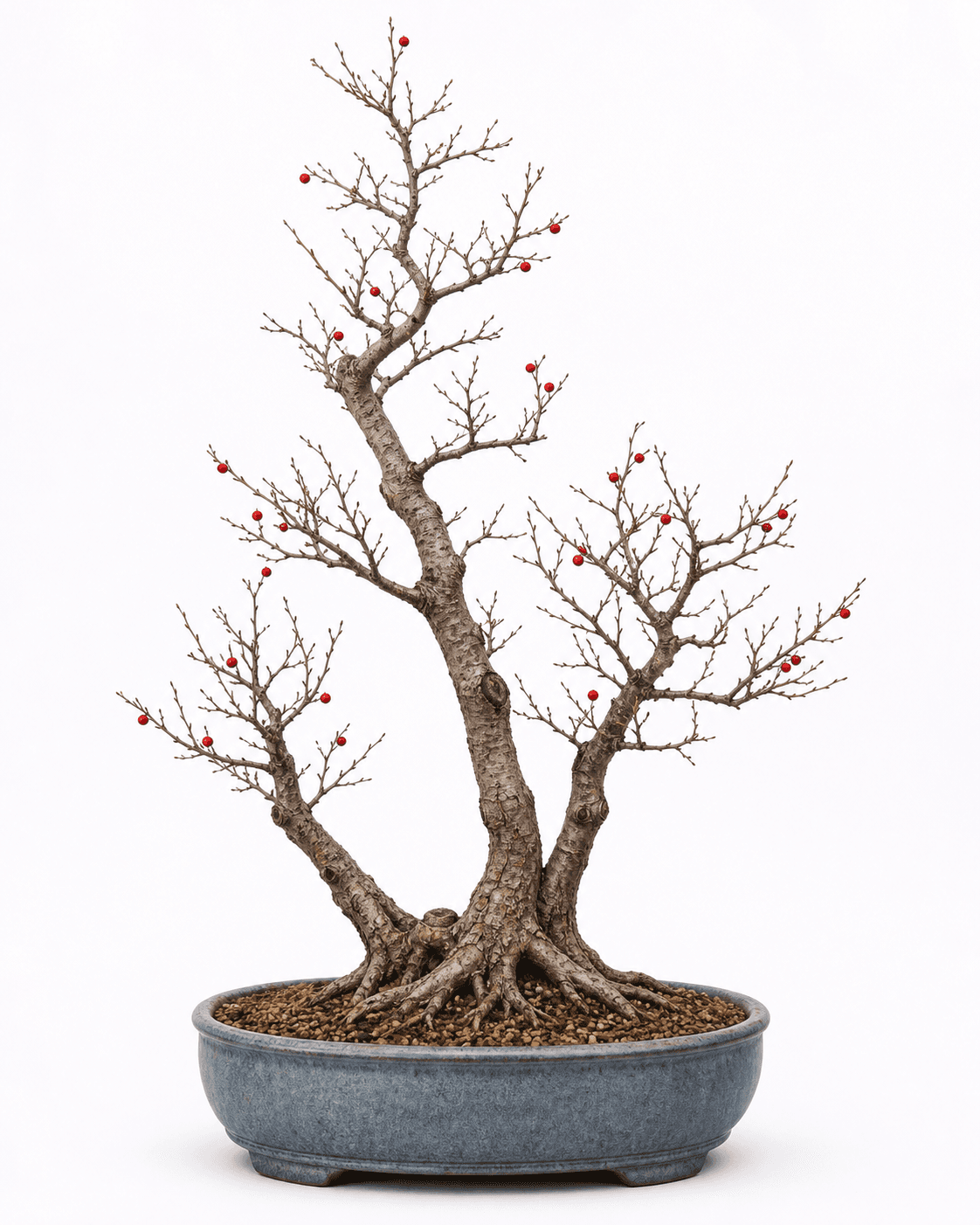
American winterberry is an outdoor deciduous holly grown for bare-twig winter fruit, native-shrub character, and quiet seasonal display. It needs cold dormancy, steady moisture, acidic root conditions, and compatible male pollen for reliable berries.
Treat American winterberry as Broadleaf > Deciduous in the EntGrove taxonomy. Kew accepts Ilex verticillata in Aquifoliaceae and gives the native range as eastern Canada to the central and eastern United States.
In bonsai, build structure before demanding a fruit show. Mirai gives direct Ilex verticillata guidance for post-flush pruning and frames fruiting trees as display material that earns flowers and fruit after roots, branch hierarchy, and ramification are already stable.
Updated June 16, 2026. Written by EntGrove Editorial. Last verified June 16, 2026.
Care fingerprint
Read the species through its shared care pattern.
Repot and structural prune around dormant-to-active transitions; protect new leaves; time refinement work after growth hardens. Use this as the starting point before local conditions and tree strength refine the calendar.
Note: Native eastern North American deciduous holly; fruiting requires a compatible male Ilex verticillata blooming at the same time as the female cultivar.
Read the foliage first
Broadleaf stress usually shows in leaf color, leaf size, wilt, scorch, or delayed hardening before it becomes a branch problem.
Match work to dormancy
Deciduous, evergreen, tropical, succulent, and flowering broadleaf trees recover on different calendars.
Protect fine roots
Root work should preserve enough active fine roots for the tree to rehydrate quickly after the operation.
Care cadence
The calendar starts with the tree's seasonal state.
Placement
Timing: Keep outdoors year-round. Give full dormancy in winter and strong outdoor light during the growing season, then protect the pot rather than warming the tree indoors.
Watch for: Warm indoor storage, exposed frozen root balls, drying winter wind, late freezes after buds move, and assuming landscape Zone 3 hardiness transfers directly to a shallow pot.
NC State ExtensionClemson ExtensionBonsai Mirai LibraryLight requirement
Timing: Use full sun to bright part shade. More sun usually improves flowering and fruiting, while summer afternoon relief can protect shallow pots in hot regions.
Watch for: Weak berry set in shade, leaf scorch in hot exposed pots, coarse shoots after heavy feeding, and lichen on young material that signals weak growth or low light.
Clemson ExtensionOregon State Landscape PlantsNC State ExtensionWatering
Timing: Water when surface particles and top dressing read dry, then saturate the full root mass. Keep the tree consistently moist during bloom, fruit set, summer heat, and post-repot recovery.
Watch for: Wilt, berry drop, dry peat cores, sour stagnant mix, alkaline-water chlorosis, and wet foliage or wet trunks lingering in humid weather.
Bonsai Mirai LibraryClemson ExtensionUniversity of Maryland ExtensionFertilizer
Timing: Feed after growth is active. Use stronger feeding for root, trunk, and branch development, then moderate once the tree is being held for flowers, fruit, and short internodes.
Watch for: Long coarse shoots, weak fruiting after starvation, fertilizer on freshly reduced roots, alkaline lockout, and late soft growth entering winter.
Bonsai Mirai LibraryPruning
Timing: Use the direct Mirai Ilex verticillata cue: prune once after the first flush hardens, then let later flushes grow while the branch system resolves.
Watch for: Pruning off flower-bearing shoots, pushing fruit before ramification is ready, removing too much leaf area, and letting root suckers steal strength from the intended trunk.
Bonsai Mirai LibraryNC State ExtensionWiring
Timing: Wire structural deciduous work around fall leaf drop or on young flexible shoots. Use clip-and-grow for much of the mature silhouette.
Watch for: Brittle holly wood, old wire pressure points, spiraling scars, broken fruiting twigs, and over-formal branch pads that fight the shrub character.
Bonsai Mirai LibraryRepotting
Timing: Repot in spring as buds swell and before active growth demands the full root system. Preserve the central root mass while transitioning nursery soil in stages.
Watch for: Heavy root pruning on weak fruiting trees, a dense peat core inside fresh mix, drying wind after work, broken tie-downs, and soil breakdown that reduces oxygen.
Bonsai Mirai LibraryClemson ExtensionPollination and fruit
Timing: Keep a compatible male Ilex verticillata close to the female and match bloom windows. Use fruit on strong, refined trees and remove part or all of it from weak or developing material.
Watch for: No male plant, mismatched early and late cultivars, dry roots during fruit set, birds stripping display fruit, and berries left on a tree that needs to rebuild.
University of Maryland ExtensionClemson ExtensionBonsai Mirai LibrarySpecies guide
Apply the species profile before copying another tree's calendar.
At a glance
American winterberry is a cold-hardy, moisture-loving, fruiting deciduous holly.
The species target is Ilex verticillata (L.) A.Gray, accepted by Kew in Aquifoliaceae. Common labels include American winterberry, winterberry holly, common winterberry, winterberry, Michigan holly, Christmas berry, and black alder. Kew POWONC State ExtensionOregon State Landscape Plants
The horticultural profile is clear: outdoor deciduous shrub or small tree, USDA Zones 3 to 9 in landscape sources, full sun to part shade, acidic moist soil, slow to moderate growth, late-spring flowers, and bright fruit on pollinated female plants from late summer into winter. NC State ExtensionClemson ExtensionUniversity of Maryland Extension
As bonsai, it is a medium-difficulty outdoor tree for growers who want a winter-display native shrub. The most believable sizes are shohin through medium and larger, with clump, informal upright, multi-trunk, raft-adjacent, wetland-edge, and natural deciduous silhouettes carrying the best design logic. Oregon State Landscape PlantsBonsai Mirai / Asymmetry
Wild habitat
Wetland margins explain the moisture, acidity, suckers, and winter-display habit.
Kew gives the native range as eastern Canada to the central and eastern United States. Clemson describes colonies along streams, ponds, swamps, thickets, and low woods, and Maryland places it in swamps and forested wetlands across several physiographic regions. Kew POWOClemson ExtensionUniversity of Maryland Extension
The care implication is steady water with oxygen. Winterberry tolerates wet sites in the ground, but a bonsai pot becomes stagnant when fine roots sit in compacted nursery peat or broken-down soil. Mirai watering method frames the root zone as a water and oxygen balance repeated across the season. NC State ExtensionClemson ExtensionBonsai Mirai Library
The design implication is a twiggy wetland shrub, often with clumping and suckering behavior, clean winter lines, and fruit clusters on bare branches. Oregon State describes spreading branches that sucker and form multistemmed clumps, which is useful source material when the image calls for a native thicket or old pond-edge shrub. Oregon State Landscape PlantsBonsai Mirai / Asymmetry
Reading the tree
Separate root recovery, branch building, and fruit display before you prune.
Mirai fruiting-bonsai method treats flowers and fruit as rewards of a finished or nearly finished branch system. During primary and secondary development, the tree should sacrifice display so roots, trunk, primary branches, wound response, and back budding can improve. Bonsai Mirai Library
American winterberry has one direct local Mirai claim: Ilex verticillata can be ramified by pruning once after the first flush has hardened, then letting later flushes grow. That method builds twigs while accepting sparse flower and fruit production until ramification is ready. Bonsai Mirai Library
Read the tree by its current bottleneck. Weak shoots and pale leaves point toward roots, light, pH, or water. Strong extension with no fruit can mean the tree is still building. Heavy berry set on a small tree can be attractive for one winter and expensive for the next growing season. Bonsai Mirai LibraryNC State Extension
Pruning and fruiting
Prune after the flush hardens, and make fruit a deliberate choice.
For structure, use the post-flush hardened window. Let the first flush extend and harden, prune once to the branch length and direction you want, then let later flushes feed the tree. Mirai warns that pruning everything repeatedly can leave refined branches unsupported while the rest of the tree is still in development. Bonsai Mirai Library
Flowers appear in the leaf axils in late spring according to NC State, and Maryland gives June to July flowers. Preserve enough short flowering wood when fruit matters, then remove fruit from young, recently repotted, weak, or still-developing trees so stored energy returns to roots and ramification. NC State ExtensionUniversity of Maryland ExtensionBonsai Mirai Library
Pollination is part of pruning strategy. Maryland says fruiting requires pollen from a male plant of the same species and that greater overlap between male and female bloom improves berry production. Cutting the tree hard before or during bloom can remove the crop before pollination happens. University of Maryland ExtensionClemson Extension
Repotting
Repot at spring movement, and preserve enough fine root to keep moisture steady.
Use the broad Mirai spring repotting signal: buds swelling, before active growth has fully committed the tree to its existing roots. The operation should solve a real problem such as poor percolation, a dense root mass, decomposed substrate, planting-angle change, or staged nursery-soil removal. Bonsai Mirai Library
Winterberry roots should stay damp during work. Mirai repotting method emphasizes preserving root tissue, hydrating exposed roots if they begin to dry, anchoring the tree, and using particle structure that restores water and oxygen. That matters for a moisture-loving holly because drought after root work can abort recovery and fruit. Bonsai Mirai LibraryClemson Extension
Inspection cadence is safer than a fixed interval. A vigorous young winterberry in a small training pot may need annual inspection, while an older fruiting tree in stable soil can wait longer. The check is drainage, root density, soil breakdown, and the tree response after the previous operation. Bonsai Mirai Library
Soil and pot
Use acidic moisture with structure, then give the fruiting shrub enough depth.
The landscape sources point in the same direction. Maryland lists pH 4.5-6.5 and moist high-organic soil, Clemson says winterberry prefers moist acidic loam and dislikes alkaline soil, and NC State lists acidic soil with moist to occasionally wet drainage. University of Maryland ExtensionClemson ExtensionNC State Extension
For bonsai, start with a 2:1:1 akadama:pumice:lava style deciduous mix where watering skill is reliable. Increase pumice or particle size if summer humidity, shade, or an old nursery core keeps the pot too wet, and keep acid chemistry in mind when choosing water and amendments. Bonsai Mirai LibraryClemson Extension
Pot pairing should serve both root volume and winter display. Mirai pot discussion supports restrained glazed or unglazed choices for deciduous trees, with seasonal color and fruit as the display cue. Soft ovals, quiet rectangles, and deeper shohin containers fit winterberry better than ultra-shallow exhibition pots during development. Bonsai Mirai LibraryBonsai Mirai / Asymmetry
Climate
Cold hardy in the ground, but still pot sensitive on the bench.
USDA Zone 3 landscape hardiness does not remove bonsai winter care. A shallow container loses ground insulation, so use a cold frame, mulch bed, protected ground contact, or wind-sheltered storage when hard freezes and dry wind can dehydrate the root mass. NC State ExtensionOregon State Landscape PlantsBonsai Mirai Library
Hot inland regions need water and root-volume adaptations. Use morning sun with afternoon shade when the pot dries faster than roots can rehydrate, keep the container slightly deeper during development, and protect from dry wind during bloom, fruit set, and after root work. Bonsai Mirai LibraryClemson Extension
Regions with alkaline tap water need a chemistry plan. Clemson says foliage chlorosis appears in alkaline soil, NC State warns neutral to alkaline soils can cause yellowing and even death, and Mirai fruiting-tree guidance links alkaline water with iron lockout and weaker flowering or fruiting productivity. Clemson ExtensionNC State ExtensionBonsai Mirai Library
Pests and diseases
Most problems show up first as leaf pests, chlorosis, mildew, or weak fruiting.
NC State lists native holly leafminer, Japanese wax scale, and southern red mites as the most frequently reported holly pests in the southeastern United States. On bonsai, inspect leaf undersides, twig crotches, and dense interior growth before the winter display hides problems. NC State Extension
NC State also notes occasional leaf spots and powdery mildew. Prevention is horticultural: light, airflow, clean pruning, no stagnant root zone, no wet trunks from careless watering, and no dense thicket of suckers under a refined canopy. NC State ExtensionBonsai Mirai Library
Chlorosis is the most important culture diagnostic. Clemson says winterberry does not tolerate alkaline soil, and NC State says neutral to alkaline soils may cause chlorosis and even death. Correct water and substrate chemistry slowly and measure pH rather than guessing. Clemson ExtensionNC State ExtensionBonsai Mirai Library
Fruit and leaves have low-severity toxicity notes. NC State says ingestion may cause vomiting, diarrhea, or other illness in humans. Treat bench fruit as display material for the tree and wildlife, with normal caution around children and pets. NC State Extension
Wiring
Wire lightly, distribute bends, and let pruning carry mature refinement.
Mirai fruiting-bonsai method places broadleaf deciduous wiring around fall leaf drop when tissue is flexible and sugar movement is high. Spring wiring can tear hydrated tissue, while old fruiting branchlets are easy to snap during handling. Bonsai Mirai Library
The holly corpus adds a genus-level caution from yaupon: mature primary branches can be brittle, while clip-and-grow and secondary or tertiary wiring are more reliable. Transfer that conservatively to American winterberry, especially on old suckering clumps or field material. Bonsai Mirai Library
Use smooth aluminum for most secondary and tertiary work, paper-wrapped copper only when a stronger initial structural hold is justified, and inspect often as the first flush hardens. Wire scars are especially visible on a leafless winter-display tree. Bonsai Mirai Library
Propagation
Seed, cuttings, suckers, layers, and grafts all solve different winterberry problems.
Seed gives genetic diversity and native provenance, but it delays trunk and branch quality and does not guarantee female fruiting material. For bonsai, label seedlings carefully once sex and bloom timing are known. NC State ExtensionUniversity of Maryland Extension
Cuttings and layers preserve a known female or male cultivar. Mirai propagation method emphasizes clean cuts, correct wood stage, stable moisture, and avoiding overwatering while new roots form. The best cutting is compact, vigorous, and already useful as future bonsai material. Bonsai Mirai Library
Suckers are practical for clump design, replacement trunks, and cultivar preservation. Clemson notes winterberry forms thickets or colonies by root suckers in consistently moist soil, and Oregon State describes suckering multistemmed clumps. Clemson ExtensionOregon State Landscape Plants
Grafting is a specialty tool rather than the default. Use approach or thread grafting to add missing branches, repair root placement, or build a pollinator branch only when the graft can be hidden and the cultivar identity remains clear. Bonsai Mirai Library
Buying and sourcing
Buy structure, sex, and bloom timing before you buy a berry show.
Start with a confirmed label. Female plants provide the berry display, while male plants provide pollen. Maryland gives practical pairings such as Red Sprite with Jim Dandy and Winter Red or Sparkleberry with Southern Gentleman. University of Maryland Extension
Inspect the plant without being distracted by fruit. Look for a usable base, low branch options, a trunk line that can survive leaf drop, short internodes, healthy acidic-soil foliage, and a root system that can transition from nursery media without drying or rot. NC State ExtensionBonsai Mirai / Asymmetry
Nursery shrubs are common and legal. Collected wetland or roadside material needs permission, local ecological judgment, and staged recovery in a training container. Root suckers can be useful, but only when they improve the future clump or raft. Clemson ExtensionOregon State Landscape PlantsBonsai Mirai Library
Troubleshooting
Diagnose winterberry by roots, light, pollen, pruning, and pH.
No berries usually means one or more missing inputs: no male Ilex verticillata nearby, mismatched bloom windows, weak light, drought during bloom or fruit set, pruning away flower-bearing shoots, or a young tree still being built structurally. University of Maryland ExtensionClemson ExtensionBonsai Mirai Library
Yellow leaves point first to alkaline conditions, root trouble, or old soil. NC State and Clemson both warn about chlorosis in alkaline conditions. Correct with measured water and substrate changes, then wait for new growth to show the result. NC State ExtensionClemson ExtensionBonsai Mirai Library
Wilting with wet soil points toward low oxygen, decomposed soil, or a dense nursery core. Mirai watering and soil method treats overwatering as oxygen failure, so the fix is structure, drainage, and timing rather than simply watering less. Bonsai Mirai Library
Coarse extension and weak lower branches mean the tree is in development or the top is taking too much strength. Let selected shoots extend for trunk and branch building, then prune after hardening and preserve the lower structure that will carry the winter silhouette. Bonsai Mirai Library
Design
Make the winter silhouette strong enough that fruit becomes an accent.
The defining feature is seasonal contrast: leafy green shrub in summer, yellow to purplish fall color in some forms, then bare branchlets with red, orange, or yellow fruit. Design the trunk and primary branches for winter first because fruit cannot cover weak structure for long. NC State ExtensionClemson ExtensionBonsai Mirai / Asymmetry
Mirai design fundamentals ask the grower to read base, trunk line, defining branch, and apex. American winterberry usually reads best as harmony or quiet tension: one clear trunk or clump direction, a restrained defining branch, and an apex that feels like a deciduous shrub rather than a conifer pad. Bonsai Mirai / Asymmetry
Deadwood is usually secondary. Old hollies can scar and hollow, and the local holly corpus warns that older holly wounds heal slowly and wet deadwood can rot. Preserve a hollow or scar only when it strengthens the thicket or old-shrub story. Bonsai Mirai Library
Cultivars
Cultivar selection is mostly a fruit color, size, and pollination decision.
Maryland gives the practical pollination pairs: early-blooming Red Sprite with Jim Dandy, and late-blooming Winter Red or Sparkleberry with Southern Gentleman. Clemson also organizes cultivar choice around male and female bloom timing. University of Maryland ExtensionClemson Extension
NC State lists female cultivars such as Afterglow, Berry Heavy, Berry Nice, Bright Horizon, Jolly Red, Red Sprite, Sunset, Winter Gold, and Winter Red, plus male pollinizers such as Jim Dandy and Southern Gentleman. Red Sprite is especially useful to inspect because Oregon State notes a compact 3 to 5 ft habit. NC State ExtensionOregon State Landscape Plants
Fruit color should be chosen after plant architecture. Red is the classic winter signal, while orange and yellow fruit can be quieter in bonsai display. A compact plant with a poor trunk remains poor bonsai material even when the berry color is rare. NC State ExtensionBonsai Mirai / Asymmetry
History
The American winterberry story is native-plant horticulture first, bonsai exhibition second.
American winterberry is best documented as an eastern North American wetland and garden shrub. NC State describes its wildlife value, with fruit eaten by more than 48 bird species and flowers supporting pollinators and specialized bees. NC State Extension
Its bonsai use is less codified than Japanese winterberry, but Mirai naming Ilex verticillata inside a fruiting-bonsai design session is important. It places the species inside the same flowering and fruiting deciduous framework as crabapple, hawthorn, quince, persimmon, and wisteria. Bonsai Mirai Library
For now, the strongest public guidance is practical rather than legendary: use native shrub ecology, known cultivar pairings, bonsai root discipline, and a winter silhouette that reads clearly before the fruit is added. University of Maryland ExtensionClemson ExtensionBonsai Mirai / Asymmetry
Species questions
Answer the beginner questions before styling.
Is American winterberry a good beginner bonsai?
Yes, for an outdoor beginner who can water steadily, keep acidic root conditions, and manage pollination. It is a poor fit for indoor culture or dry neglected containers.
Can American winterberry bonsai live indoors?
No. American winterberry is a temperate deciduous holly that needs outdoor light, seasonal dormancy, airflow, and winter cues.
Do I need male and female American winterberry plants?
Yes, when berries are the goal. Female plants produce fruit only when flowers receive compatible pollen from a male Ilex verticillata blooming at the same time.
How much sun does American winterberry bonsai need?
Use full sun to bright part shade. More light generally supports stronger fruiting, but shallow bonsai pots may need afternoon protection during hot dry weather.
How often should I water American winterberry bonsai?
Water as surface particles begin to dry, then saturate the pot. The species prefers consistently moist acidic conditions, and the bonsai mix still needs drainage and oxygen.
When should I prune American winterberry bonsai?
Use the post-flush-hardened window as the main structural pruning cue. Preserve flower-bearing wood when fruit is wanted, and let later flushes grow while branches are still developing.
When should I repot American winterberry bonsai?
Repot in spring as buds swell and before full active growth. Root density, drainage, soil breakdown, and nursery-core transition should decide the operation rather than a fixed calendar interval.
Why did my American winterberry bonsai not make berries?
Common causes are no male pollinator, mismatched bloom timing, weak light, drought during flowering or fruit set, pruning off flower-bearing shoots, or a tree still being built structurally.
Why are my American winterberry leaves yellow?
Check pH, roots, and soil oxygen first. Extension sources warn that neutral to alkaline conditions can cause chlorosis, and compacted or stagnant bonsai soil can create similar weakness.
Should I leave all the berries on American winterberry bonsai?
Leave fruit on strong, refined trees when display is the goal. Remove some or all fruit from weak, recently repotted, young, or developing trees so energy returns to roots and branch building.
Sources
Species advice needs source discipline.
Next decisions
Plan the operation before copying the calendar.
A good care note for American winterberry records the tree's stage, the work done, and the aftercare used. That record matters more than a month-name rule.
Related species
Compare nearby trees before transferring advice.
Japanese maple
Acer palmatum
Trident maple
Acer buergerianum
Amur maple
Acer tataricum subsp. ginnala
Field maple
Acer campestre
Korean hornbeam
Carpinus turczaninovii