
Species guide
Blackthorn Bonsai Care: Prunus spinosa
Prunus spinosa
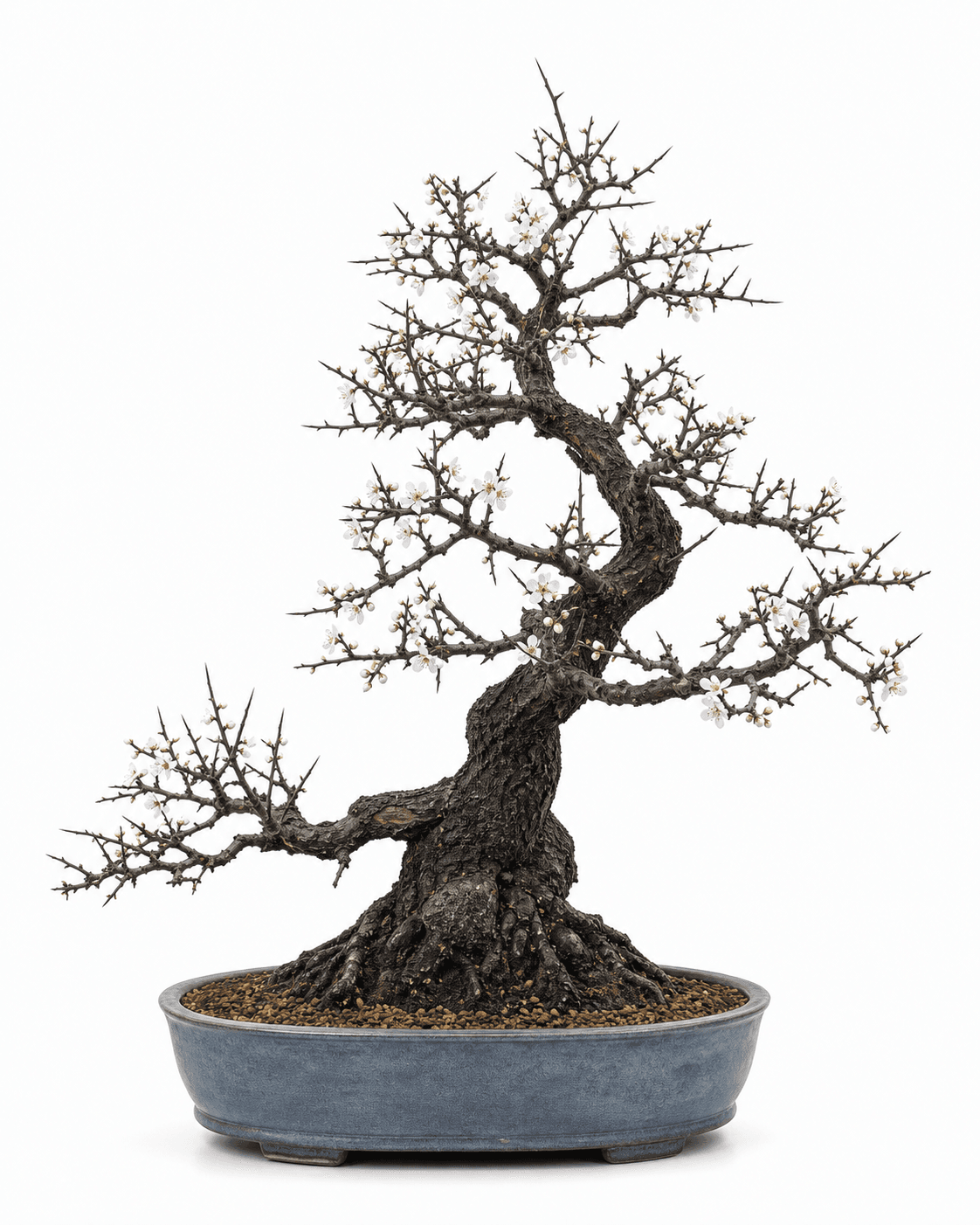
Blackthorn bonsai, Prunus spinosa, is a hardy outdoor deciduous shrub for growers who want white spring flowers, dark sloe fruit, black bark, thorny branch character, and a wild hedgerow image. It needs sun, winter dormancy, steady water in a shallow pot, and pruning that respects spring flower timing.
Kew accepts Prunus spinosa in Rosaceae and gives the native range as Europe to Central Asia and Iran plus northwest Africa. RHS, Kew, and Woodland Trust all use blackthorn and sloe labels, while bonsai culture should treat the plant as Broadleaf > Deciduous with Prunus-specific timing.
The local Mirai corpus has no dedicated Prunus spinosa lesson, so this guide transfers high-confidence Prunus, flowering, fruiting, deciduous, watering, soil, repotting, wiring, propagation, and design method, then grounds taxonomy, hardiness, habitat, pests, thorns, suckering, fruit, and regional spread risk in Kew, RHS, European Atlas, Woodland Trust, and extension-style sources.
Updated June 16, 2026. Written by EntGrove Editorial. Last verified June 16, 2026.
Care fingerprint
Read the species through its shared care pattern.
Repot and structural prune around dormant-to-active transitions; protect new leaves; time refinement work after growth hardens. Use this as the starting point before local conditions and tree strength refine the calendar.
Note: Thorny, suckering European and western Asian Prunus; check local invasive status outside the native range and manage roots, suckers, and fruiting waste carefully.
Read the foliage first
Broadleaf stress usually shows in leaf color, leaf size, wilt, scorch, or delayed hardening before it becomes a branch problem.
Match work to dormancy
Deciduous, evergreen, tropical, succulent, and flowering broadleaf trees recover on different calendars.
Protect fine roots
Root work should preserve enough active fine roots for the tree to rehydrate quickly after the operation.
Care cadence
The calendar starts with the tree's seasonal state.
Placement
Timing: Grow outdoors year-round in sun and moving air. Keep the tree dormant in winter and protect the container during severe root-zone cold, dry wind, or repeated freeze-thaw.
Watch for: Warm indoor winter storage, early bud movement in protected spaces, roots frozen while dry, late frost after flower buds swell, and weak bloom in shade.
RHSKew POWOBonsai Mirai LibraryLight requirement
Timing: Use full sun for flower density, short internodes, and fruit color. Add temporary afternoon shade only during severe heat, after root work, or when a shallow pot cannot keep up with transpiration.
Watch for: Sparse flower buds, long hedge-like extension, leaf scorch on recently repotted trees, and using shade to compensate for missed watering.
RHSWoodland TrustBonsai Mirai LibraryWatering
Timing: Water thoroughly when the upper soil begins to dry. Flowering, fruit set, summer wind, dense foliage, and shallow containers raise demand.
Watch for: Complete dry-down after bloom, sour old field soil, waterlogged fine substrate, wilting fruiting shoots, and root balls that shed water around a dry core.
RHSBonsai Mirai LibraryFertilizer
Timing: Feed through active growth to rebuild reserves after bloom, pruning, and fruit thinning. Prioritize balanced nutrition and trace elements over zero-nitrogen flower formulas.
Watch for: Coarse extension on refined branches, weak recovery after repeated cuts, fruit exhausting a developing tree, alkaline water limiting micronutrient uptake, and late soft growth before winter.
Bonsai Mirai LibraryPruning and flowering
Timing: Make blackthorn pruning decisions around spring bloom, post-flower leaf push, and early-summer hardening. For Prunus, fall pruning can remove the buds that would flower before next year leaves emerge.
Watch for: Cutting off next spring flowers, leaving sucker growth to steal energy, shearing every thorny shoot into a hedge, and making large wet-spring wounds.
Bonsai Mirai LibraryKew POWORHSWiring
Timing: Wire only when the branch role is clear. Late winter before bloom, the tail end of flowering before vegetative push, or early-summer post-hardened work are safer than wiring fully leafed, brittle shoots.
Watch for: Thorn injuries, cracked Prunus wood, wire hidden behind dense shoots, fast bite on expanding branches, downward branch tips losing vigor, and weak trees being styled too early.
Bonsai Mirai LibraryKew POWORepotting
Timing: Repot around spring bud swell or, on a strong tree that flowers before leafing out, immediately after bloom and before leaf expansion. Set the interval by roots and soil.
Watch for: Heavy root reduction on collected shrubs, exposed fine roots drying in wind, old hedgerow soil left as a dry core, abrupt soil-system changes, and fruit set after major root work.
Bonsai Mirai LibraryKew POWOPests and diseases
Timing: Inspect from bud swell through leaf drop, especially in wet springs and after large cuts. Keep the canopy open and sanitize tools between Prunus work.
Watch for: Aphids, caterpillars, bullfinches on buds, silver leaf, blossom wilt, Xylella host restrictions, Rosaceae rust, cankers, root rot, and regional Prunus sanitation advice.
RHSBonsai Mirai LibraryRegional responsibility
Timing: Outside the native range, check local status before planting, collecting fruiting material, or discarding roots, suckers, and sloes.
Watch for: Root fragments resprouting, bird-spread fruit, blackthorn listed as regionally invasive, and confusion with unrelated buckthorn weeds.
Kew POWOAsk ExtensionSpecies guide
Apply the species profile before copying another tree's calendar.
At a glance
Blackthorn is a thorny outdoor flowering Prunus with real bonsai potential.
The species target is Prunus spinosa L., a Rosaceae shrub or small tree accepted by Kew and listed by RHS as blackthorn with deciduous foliage. Common labels include blackthorn, sloe, and sloe plum, and the EntGrove care group is Broadleaf > Deciduous. Kew POWORHS
Its native range runs from Europe to Central Asia and Iran plus northwest Africa. Kew describes a temperate shrub or tree, RHS lists H7 hardiness, full sun, moist but well-drained soil, and 2.5 to 4 m mature size, and Woodland Trust records white March to April flowers before leaves plus blue-black fruit around 1 cm across. Kew POWORHSWoodland Trust
The bonsai difficulty is intermediate. Blackthorn tolerates outdoor weather and pruning, but thorns, suckers, Prunus disease pressure, fruit load, and flower-bud timing make it more demanding than elm or ficus. It suits medium and larger informal upright, slanting, clump, raft, literati, and old hedgerow-style designs. Kew POWORHSBonsai Mirai / Asymmetry
Wild habitat
Hedgerow ecology explains the thorns, suckers, sun, and rugged design language.
Kew describes blackthorn in hedgerows, thickets, scrubland, screes, and woodland edges. European Atlas expands that picture to forest margins, open woodlands, sunny rocky slopes, river valleys, meadows, pastures, and scrub communities. Kew POWOEuropean Atlas of Forest Tree Species
The care implication is a bright outdoor tree with a cold rest period, spring flowers, fast root and sucker response, and a preference for moisture with drainage. A hedge can tolerate rough soil volumes, while a bonsai pot has a narrow water and oxygen margin. RHSWoodland TrustBonsai Mirai Library
The design implication is stronger still. Blackthorn should read as an old hedgerow or scrub-edge shrub: dark bark, sharp thorns, tight twigging, basal strength, spring bloom, small dark fruit, and a trunk line that can hold interest after the flower moment passes. Kew POWOWoodland TrustBonsai Mirai / Asymmetry
Reading the tree
Decide whether the tree is building structure, carrying bloom, or recovering roots.
Mirai flowering and fruiting method separates development from display. A young or collected blackthorn should build roots, trunk, primary branches, and younger water-conductive shoots before it is asked to carry a full flower and fruit cycle. Bonsai Mirai Library
Prunus method matters because blackthorn flowers before leaves. Local Mirai claims say Prunus flower first, then leaf from the base of spent flower buds; pruning and wiring near the end of bloom can reset structure before vegetative growth takes over. Bonsai Mirai LibraryKew POWOWoodland Trust
Suckers are the other reading signal. Kew says blackthorn reproduces by suckering and by seed, and European Atlas describes numerous suckers. On a bonsai, unwanted root and trunk suckers are a tax on the design unless they are deliberately building a clump, raft, or replacement trunk. Kew POWOEuropean Atlas of Forest Tree Species
Pruning and flowers
Prune around bloom, then grow the shoots that set the next display.
Blackthorn opens its flowers before the leaves, so the calendar differs from maple and beech. Mirai Prunus method says fall pruning removes flower buds that would open before next year leaves emerge, while post-flush hardened pruning in late May or June stimulates the growth that can carry next spring flowers. Bonsai Mirai LibraryWoodland Trust
Use two pruning modes. In development, let selected shoots extend to thicken trunks, branches, or replacement growth, then cut back after hardening. In refinement, shorten last year growth around the post-flower and pre-leaf window, then use early-summer pruning to renew compact flowering wood. Bonsai Mirai Library
Fruit is optional on a bonsai. Woodland Trust gives the fruit as blue-black and about 1 cm across, but Mirai fruiting-tree guidance treats fruit set as expensive. Let a mature, strong tree carry a few sloes for display; remove fruit from weak, recently collected, recently repotted, or still-developing material. Woodland TrustBonsai Mirai Library
Repotting
Work roots at spring movement, then reduce the flower and fruit burden.
The safest broad repotting window is spring as buds swell, before active growth demands the full root system. Mirai repotting method uses that signal, and Prunus-specific guidance allows a strong flower-first tree to be worked after flowering and before leaf expansion when climate and vigor support the choice. Bonsai Mirai Library
Intervals should come from the root mass. Fast young blackthorn in coarse training soil can need work around 2 years; older refined trees can often wait 3 to 4 years. The check is drainage, root density, soil breakdown, health, and the tree response after the previous root work. Bonsai Mirai LibraryBonsai Empire
Collected hedgerow material needs patience. Kew notes that bare-root plants are available only during dormancy and that exposed roots must be covered because wind and sun can dry them. In bonsai work, keep fine roots moist, anchor the tree firmly, and transition field soil in stages instead of making a dramatic root reduction for appearance. Kew POWOBonsai Mirai Library
After substantial root work, reduce display pressure. Remove part or all of the flower and fruit load, shade only if needed for aftercare, and avoid major styling until new root function is visible in leaf quality and shoot extension. Bonsai Mirai Library
Soil and pot
Use moisture with oxygen, then give flowering roots enough depth.
RHS gives the landscape baseline as moist but well-drained soil in full sun, across chalk, clay, loam, and sand. Bonsai soil should narrow that broad tolerance into a granular root environment that holds enough water for spring bloom and summer fruit while preserving oxygen. RHSBonsai Mirai Library
Mirai soil and repotting method supports akadama-heavy deciduous mixes for refinement because they hold water and nutrients while keeping structure. A 2:1:1 akadama:pumice:lava mix is a practical development baseline; more solid akadama can refine roots and internodes once watering skill is reliable. Bonsai Mirai Library
Pot choice should reflect both horticulture and image. Mirai identifies flowering and fruiting broadleaf deciduous trees as sheen-based material that benefits from deeper pots; very shallow containers can create a slow decline in vigor, ramification, flower, and fruit quality. Muted ovals, soft rectangles, and old-hedgerow earth tones suit blackthorn better than decorative shine. Bonsai Mirai LibraryBonsai Mirai / Asymmetry
Climate
Hardy tops still need container-aware winter and summer care.
RHS H7 hardiness means the species is highly cold tolerant in UK landscape conditions, with the category covering temperatures below -20 C. Container roots are more exposed, so mulch pots, set them on the ground, use an unheated cold frame, and prevent dry frozen soil in harsh climates. RHSBonsai Mirai Library
Hot regions need root-zone management more than indoor shelter. Use full sun until heat and water demand exceed root capacity, then apply temporary afternoon shade, larger training containers, wind protection, or more frequent watering. Permanent shade usually weakens flowers and lengthens internodes. RHSWoodland TrustBonsai Mirai Library
Wet maritime regions need wound discipline. Mirai Prunus guidance warns against large structural cuts during cool wet spring weather because vascular pathogens can enter open wounds; RHS also flags silver leaf and blossom wilt on blackthorn. Choose drier pruning windows, keep tools clean, and seal larger cuts where appropriate. Bonsai Mirai LibraryRHS
Pests and diseases
Treat blackthorn as a Prunus, Rosaceae, and hedgerow plant.
RHS lists aphids, caterpillars, bullfinches, silver leaf, blossom wilt, and Xylella fastidiosa high-risk-host status for Prunus spinosa. On bonsai, add wire scars, root stress, stale soil, and poor airflow to that risk list. RHSBonsai Mirai Library
Rust should be watched when junipers, cedars, cypress, apples, pears, crabapples, hawthorns, and related Rosaceae hosts are nearby. Mirai rust guidance describes spring infection of emerging Rosaceae leaves and recommends removing infected leaves as orange spots appear to interrupt sporulation. Bonsai Mirai Library
The prevention pattern is basic and strict: full sun, airflow, clean tools, no repeated wet foliage during cool spells, no waterlogged soil, no weak trees carrying heavy fruit, and no large Prunus wounds during cold wet weather. RHSBonsai Mirai Library
Wiring
Wire young wood with intent, then let pruning carry the fine work.
Mirai Prunus guidance says to wire before flowering or at the tail end of flowering before vegetative push, because leaf production begins quickly and wiring during full leaf push risks damaging new buds. The post-hardened early-summer window can also be useful on strong trees. Bonsai Mirai Library
Prunus wood is brittle. Mirai attributes that brittleness to low water mobility in the core and identifies the base of last year growth as a fragile junction. Rotate while bending, use enough gauge to hold the bend once, and avoid repeated small corrections. Bonsai Mirai Library
Orient lower Prunus branch tips upward enough to preserve vigor. Mirai notes that downward or flat lower branches can lose water-conductive strength over time; on blackthorn, that matters because thorny dense growth can hide a weakening branch until it dies back. Bonsai Mirai Library
Thorns change the practical workflow. Wear gloves, clear the branch path before applying wire, leave room to inspect for bite, and prefer clip-and-grow or guy wires once older wood stiffens. RHS specifically warns to wear protective equipment when handling blackthorn. RHSBonsai Mirai Library
Propagation
Seed, cuttings, suckers, layers, and grafts each come with tradeoffs.
Kew says blackthorn reproduces by suckering and by bird- or animal-sown seed, and says stones can be sown shallowly in well-drained medium after roughly two months of cold exposure. Seed is useful for local adaptation and root work, with a long development horizon. Kew POWO
RHS lists softwood cuttings in early summer with bottom heat or seed propagation. Kew also lists semi-ripe cuttings in late summer. Cuttings preserve a known plant, but they still need years of trunk building before they look like old hedgerow material. RHSKew POWO
Air layers and suckers can solve specific bonsai problems: a better base, a low branch with movement, or a clump composition. Mirai notes Malus and Prunus air layers often produce only one or two coarse roots, so root distribution must be built deliberately after separation. Bonsai Mirai LibraryKew POWO
Grafting is less common than with ornamental cherry or Ume, but it remains a tool for adding interior branches or improving roots on valuable trunks. Keep grafts low, clean, and subordinate to the future trunk line. Bonsai Mirai Library
Buying and sourcing
Buy trunk, roots, and health before buying a flower photo.
Good blackthorn stock has a usable base, trunk movement, live low buds or branches, a manageable root ball, and no obvious cankers or dead strips. A spring flower display can still hide poor roots, coarse branch placement, or a trunk that will never scale down. Bonsai Mirai / AsymmetryKew POWO
Hedging plants are common because Kew notes large quantities are sold as dormant bare-root stock from November to March. Those plants are useful for forests, clumps, rafts, and long trunk projects, but the roots must be protected from wind and sun while exposed. Kew POWO
Collected material should be approached carefully and legally. Prioritize permission, local ecological status, enough fine roots, and a realistic recovery plan. A massive thorny shrub with no fine root and no low branch options is poor bonsai material even if the bark is old. Kew POWOBonsai Mirai Library
Outside the native range, regional responsibility matters. Kew lists introduced regions, and Ask Extension records blackthorn as invasive in Oregon while discussing a Minnesota case. Keep berried cuttings out of compost, dispose of suckering roots deliberately, and check local rules before planting blackthorn into habitat. Kew POWOAsk Extension
Troubleshooting
Most failures come from indoor culture, mistimed cuts, root stress, or unmanaged vigor.
No flowers usually points to shade, weak roots, a tree still in development, fall pruning that removed flower buds, summer pruning after the useful Prunus window, or winter storage that interrupted dormancy. Restore outdoor sun and correct timing before changing fertilizer. Bonsai Mirai LibraryRHS
Leaves wilting or browning in summer often means the shallow pot has dried too far, especially after flowering or fruit set. Water thoroughly, cool the root zone, and check whether compact old field soil is blocking even rehydration. Bonsai Mirai LibraryRHS
Yellowing, weak extension, sour smell, or dieback after wet weather points toward poor oxygen in the root mass. Tilt the pot, reduce watering frequency until the substrate breathes, and plan a spring soil correction if the core is compact. Bonsai Mirai Library
Suckers taking over are a design and energy problem. Remove unwanted root and trunk suckers early, keep deliberate clump trunks only where they serve the composition, and avoid leaving thorny runners to thicken unseen behind the canopy. Kew POWOEuropean Atlas of Forest Tree Species
Orange leaf spots, silvering leaves, blossom collapse, cankers, or sudden branch death need a disease response. Remove infected tissue, clean tools, improve airflow, check local extension guidance, and separate severe Prunus disease from normal post-fruit fatigue. RHSBonsai Mirai Library
Design
Style blackthorn through old thorn scrub character.
The best blackthorn designs start with a trunk line and defining branch that explain the species: dark bark, thorns, spring flowers, small sloes, basal strength, and dense hedgerow survival. Mirai design method begins with where the tree lives, then lets branch structure express that ecology. Bonsai Mirai / AsymmetryKew POWO
Use asymmetry and age cues. A slanting trunk, raft from suckers, clump of uneven stems, battered informal upright, or sparse literati can all fit blackthorn. Broom symmetry and smooth dome silhouettes usually underuse the species. Bonsai Mirai / AsymmetryEuropean Atlas of Forest Tree Species
Deadwood should be restrained. Prunus wood can be hard and slow to decay, and Mirai notes that deliberate hollowing or carving belongs only on a well-rooted tree. On blackthorn, old bark, dark branch color, and thorn structure often tell the story with less carving. Bonsai Mirai LibraryKew POWO
Seasonal display is the reward for structure. A blackthorn shown with buds swelling, white flowers, or a few dark sloes should still have clean branch placement and a pot that leaves the spring or autumn moment enough quiet space. Bonsai Mirai / AsymmetryWoodland Trust
Forms
Most bonsai material is species blackthorn or local hedge stock.
The primary bonsai subject is straight Prunus spinosa. Keep the label simple unless the plant is a documented hybrid, selected ornamental, or related Prunus sold under a confusing sloe, plum, or thorn label. Kew POWORHS
Identification matters in winter. Woodland Trust distinguishes blackthorn by black spiny twigs with leaf buds along the spines, flowers before leaves, and differences from hawthorn and cherry plum. A guessed Prunus label can put pruning, disease, and flower timing on the wrong calendar. Woodland Trust
Local-origin material has value. Kew recommends seed collected as locally as possible for gene-pool preservation because foreign plants can flower and fruit out of phase with local wildlife. Bonsai growers should apply the same thinking when planting escape-prone or fruiting material outside containers. Kew POWO
History
Blackthorn carries hedgerow history, wildlife value, and a hard-used wood tradition.
Kew describes blackthorn as important for early insects, nesting birds, moths, and hedgerow structure, while Woodland Trust notes its early pollen and nectar value plus caterpillar and bird use. That wildlife role helps explain the plant as more than a flower-and-fruit ornament. Kew POWOWoodland Trust
The fruit has its own cultural life. Kew and Woodland Trust both describe sloes as astringent fruits used for sloe gin and preserves. On bonsai, that history supports a few fruits as seasonal punctuation rather than a heavy crop. Kew POWOWoodland Trust
Blackthorn wood has been used for walking sticks, clubs, and tool parts, including the Irish shillelagh tradition recorded by Kew and Woodland Trust. A bonsai image can borrow that toughness through trunk movement, dark bark, thorn lines, and a restrained pot. Kew POWOWoodland TrustBonsai Mirai / Asymmetry
The exhibition standard is timing plus restraint: an old-looking tree before peak bloom, after flowers with fresh leaves, or with a few autumn sloes. The flower moment should sit on top of a readable bonsai structure as seasonal punctuation. Bonsai Mirai / AsymmetryBonsai Mirai Library
Species questions
Answer the beginner questions before styling.
Is blackthorn a good beginner bonsai?
Blackthorn can work for a beginner with outdoor space, gloves, and patience for thorny suckering growth. Elm, ficus, and dwarf jade are easier first trees; blackthorn is better as a first flowering outdoor shrub project.
Is blackthorn the same as sloe?
Yes. Blackthorn and sloe are common names for Prunus spinosa. Sloe often refers to the dark blue-black fruit, while blackthorn usually refers to the plant.
Can blackthorn bonsai live indoors?
Blackthorn should live outdoors as a deciduous Prunus that needs sun, air movement, leaf drop, and winter dormancy. Protect the pot in winter instead of moving the tree into a warm room.
How much sun does blackthorn bonsai need?
Full sun is the default for compact growth and flowering. Temporary afternoon shade can help after repotting, during severe heat, or when a shallow pot cannot keep up with water demand.
When should I prune blackthorn bonsai?
Prune around the flower cycle. Use post-flower and pre-leaf work for refinement, then early-summer pruning after hardening to build the growth that can carry next spring flowers. Remove unwanted suckers early.
Can I wire blackthorn bonsai?
Yes, but wire with restraint. Young and partly hardened shoots move best; old Prunus wood can crack, thorns complicate handling, and wire bite can hide in dense branchlets.
When should I repot blackthorn bonsai?
Repot around spring bud swell, or just after flowering and before leaf expansion on a strong tree. Set the interval by drainage, root density, soil breakdown, vigor, and recovery history.
Should I let blackthorn bonsai carry sloes?
Only on a strong, mature tree. A few sloes can complete the seasonal image, but full fruit set drains energy that a developing, weak, collected, or recently repotted tree needs for roots and branches.
Is blackthorn invasive?
It is native across much of Europe and western Asia, but Kew lists introduced regions and extension-style guidance records invasive concern in Oregon. Check local rules before planting, collecting, or discarding fruiting and suckering material.
Why did my blackthorn bonsai stop flowering?
Common causes are shade, weak roots, warm winter storage, a tree still in development, fall pruning that removed flower buds, late summer pruning after buds formed, or heavy fruiting the prior year.
Sources
Species advice needs source discipline.
Next decisions
Plan the operation before copying the calendar.
A good care note for Blackthorn / sloe records the tree's stage, the work done, and the aftercare used. That record matters more than a month-name rule.
Related species
Compare nearby trees before transferring advice.
Japanese maple
Acer palmatum
Trident maple
Acer buergerianum
Amur maple
Acer tataricum subsp. ginnala
Field maple
Acer campestre
Korean hornbeam
Carpinus turczaninovii