
Species guide
Blue Rug Juniper Bonsai Care
Juniperus horizontalis 'Wiltonii'
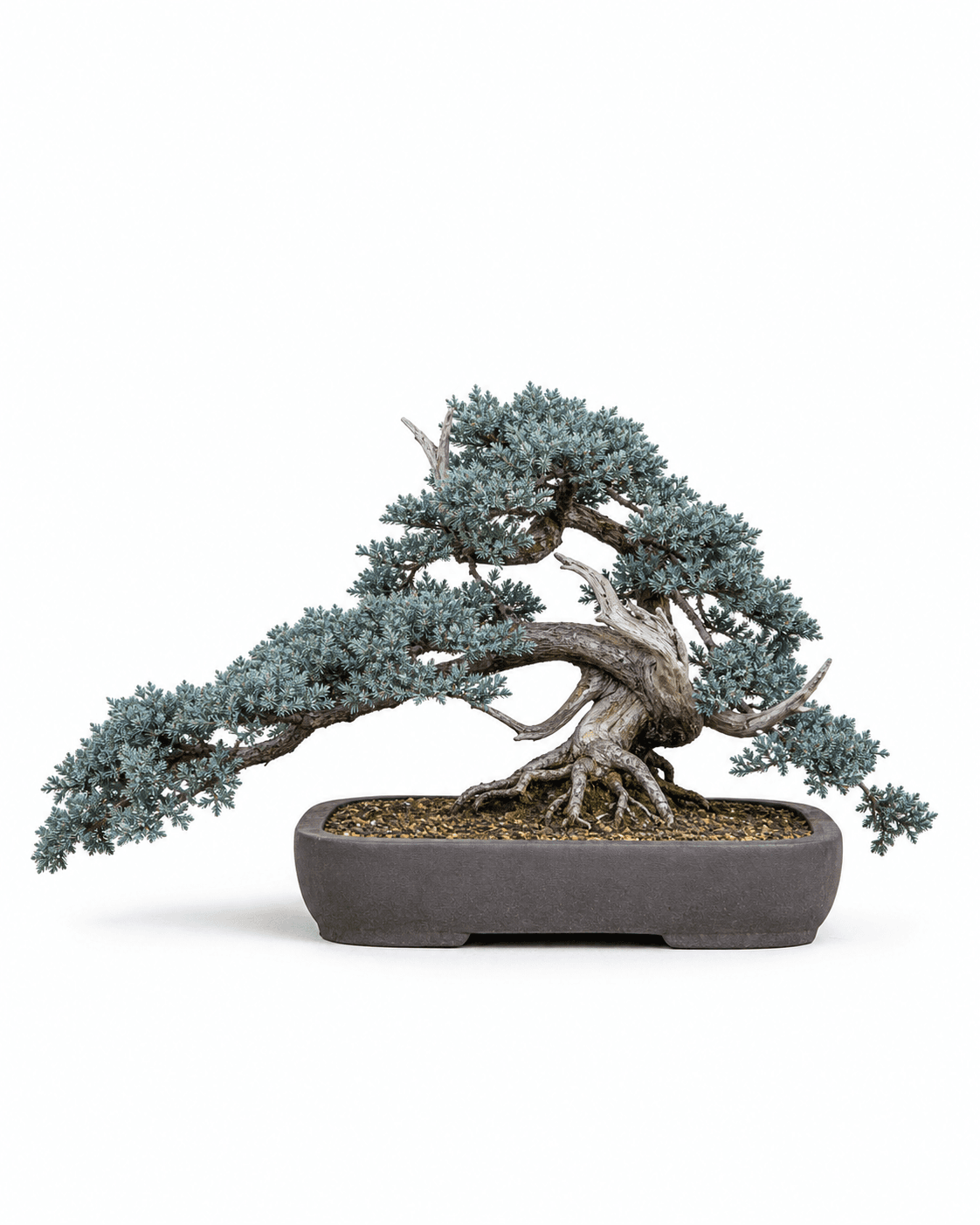
Blue rug juniper is Juniperus horizontalis Wiltonii, a low silver-blue creeping juniper cultivar that can become convincing outdoor bonsai when the grower designs from its mat-forming habit. Give it full outdoor light, open mineral soil, complete watering with oxygen return, and scissor pruning after growth has earned the work.
The local Mirai corpus has direct Blue rug coverage in air-layer transition, nursery-stock shohin, and nursery-stock series material. This profile uses those files plus juniper refinement and mounding-juniper method, then uses NC State and Oregon State for cultivar identity, parent-species range, hardiness, dimensions, foliage, winter color, and pest context.
Separate Blue rug from generic creeping juniper, Andorra, Blue Pacific, shore juniper, Blue Star, procumbens nana, Pfitzer, Parsons, Savin, Tam, Hollywood, San Jose, and eastern red cedar before copying timing. Low blue mats can hide different species, growth habits, and root behavior.
Updated June 10, 2026. Written by EntGrove Editorial. Last verified June 10, 2026.
Care fingerprint
Read the species through its shared care pattern.
Use the running habit instead of fighting it; branch selection, live foliage preservation, and gradual styling are the main constraints. Use this as the starting point before local conditions and tree strength refine the calendar.
Keep foliage strong
Junipers recover through active foliage, so styling choices should leave enough healthy tips to power the tree.
Protect live veins
Old junipers often depend on narrow live veins between roots and foliage; root work and carving should respect that path.
Do not stack major work
Heavy bending, major foliage reduction, carving, and repotting belong in a staged plan rather than the same weekend.
Care cadence
The calendar starts with the tree's seasonal state.
Placement
Timing: Grow outdoors year round in full sun and moving air. Use afternoon protection after repotting, hard styling, or severe reflected heat.
Watch for: Indoor display, deep shade, hot pavement, dry wind after root work, and winter shelves that stay wet without airflow.
NC State Extension Blue Rug juniperOregon State Landscape Plants: Juniperus horizontalisBonsai Mirai LibraryWatering
Timing: Water in repeated passes until the entire rootball drains, then wait for the upper soil to begin drying before watering again.
Watch for: Hydrophobic nursery cores, water channeling around the mat, wet compact soil after foliage reduction, and drought assumptions copied from landscape use.
Bonsai Mirai LibraryNC State Extension Blue Rug juniperFeeding
Timing: Feed healthy development trees during active growth. Use lighter feeding after refinement pruning or when compact blue foliage is the goal.
Watch for: Coarse runners, dense pest-prone mats, fertilizer on weak roots, and starving a young tree that still needs branch and root development.
Bonsai Mirai LibraryPruning
Timing: Let growth strengthen, then clean undersides, preserve useful interior growth, and shorten tips with sharp scissors to living side growth.
Watch for: Pinching, hedge-shearing, cutting to bare stems, removing every crotch shoot, and pruning before recovery foliage appears.
Bonsai Mirai LibraryRepotting
Timing: Repot during spring movement on a vigorous plant. Keep enough foliage to power root regeneration and convert old nursery cores over staged cycles.
Watch for: Bare-rooting, combining major root and canopy reduction on mature stock, loose tie-downs, wet old peat, and oversized training pots.
Bonsai Mirai LibraryWiring
Timing: Wire lignified branches when the tree is hydrated and growth has hardened. Inspect often because Blue rug scars slowly.
Watch for: Wire bite hidden under dense blue foliage, torn crotches, crushed tips, branch bases pulled from the mat, and repeated exploratory bending.
Bonsai Mirai LibraryPropagation
Timing: Use cuttings or air layers to preserve Wiltonii. Air-layer only vigorous material and allow the separated plant to rebuild before the next reduction.
Watch for: Seedlings sold as Blue Rug, layers worked too soon after separation, overstripped cuttings, and clone labels drifting into generic horizontalis.
Bonsai Mirai LibraryNC State Extension Blue Rug juniperPests and disease
Timing: Inspect dense mats during wet springs, hot dry mite weather, winter shelter, and the year after nursery-stock reduction.
Watch for: Aphids, bagworms, caterpillars, false spider mites, juniper scale, tip mites, webworms, spruce spider mites, blights, rust, fungal disease, root rot, and interior shade browning.
NC State Extension Blue Rug juniperClemson Extension juniper pestsUC IPM JuniperWinter protection
Timing: Keep dormant outdoors and protect shallow pots from repeated hard freeze, drying wind, and thaw-refreeze cycles.
Watch for: Warm indoor overwintering, frozen dry roots, late heavy pruning, wet unventilated shelters, and fresh root work exposed to sudden cold.
NC State Extension Blue Rug juniperOregon State Landscape Plants: Juniperus horizontalisBonsai Mirai LibrarySpecies guide
Apply the species profile before copying another tree's calendar.
At a glance
Blue rug is the Wiltonii creeping juniper, a low blue mat with bonsai potential.
Record the plant as Juniperus horizontalis 'Wiltonii' when the label, source, or propagation history supports it. NC State gives Blue Rug Juniper as the common name, and Oregon State lists Wiltonii with Blue Rug as synonym language. NC State Extension Blue Rug juniperOregon State Landscape Plants: Juniperus horizontalis
For bonsai, the practical headline is low, blue, trailing, and slow to outgrow mistakes. The best material has a visible base, one useful moving line, and enough interior shoots to compress the mat over time. Bonsai Mirai LibraryNC State Extension Blue Rug juniper
The source depth is stronger than many retail groundcover cultivars. Mirai has direct Blue rug work in an air-layer transition, a nursery-stock shohin creation, and a broader nursery-stock series, plus general juniper refinement files that explain the timing. Bonsai Mirai Library
Wild context
Use northern creeping-juniper ecology, then adjust for a nursery cultivar.
Wiltonii is a cultivar, so the care context begins with Juniperus horizontalis. NC State describes the parent as native across Canada and the northern United States, while Oregon State lists a northern range from Nova Scotia to British Columbia and south into parts of the northern United States. NC State Extension creeping juniperOregon State Landscape Plants: Juniperus horizontalis
Creeping juniper naturally occupies rocky or sandy, well-drained sites. In a bonsai pot, that translates to sun, airflow, mineral drainage, and complete watering rather than constant dryness. NC State Extension creeping juniperOregon State Landscape Plants: Juniperus horizontalisBonsai Mirai Library
For design, the wild and landscape habit points to horizontal line, exposed roots, low deadwood, rock edges, and open negative space. A tall tree image can work only when one nursery trunk has enough movement and taper to support it. Bonsai Mirai / AsymmetryBonsai Mirai Library
For climate, the northern parentage gives cold capacity, while bonsai culture adds root exposure. Protect the container earlier than the landscape hardiness number suggests. NC State Extension Blue Rug juniperOregon State Landscape Plants: Juniperus horizontalisBonsai Mirai Library
Reading the tree
Read label, root flare, interior growth, and recovery state before cutting.
Start with identity. Blue rug should be separated from generic creeping juniper, Andorra, Blue Pacific, Blue Star, procumbens, Pfitzer, Parsons, Savin, Tam, Hollywood, and juvenile Chinese juniper before timing is copied. NC State Extension Blue Rug juniperNC State Extension creeping juniperBonsai Mirai juniper identification
Expose the true root flare before judging the front. Mirai nursery-stock method emphasizes that nursery trees are often planted above the real base, and the useful bonsai starts where trunk and roots actually divide. Bonsai Mirai Library
Read recovery by interior growth, not color alone. The Blue rug air-layer transition file treats tight mature interior clusters along usable branch runs as the signal that a recovered juniper can be compressed again. Bonsai Mirai Library
Read the mat from below. Useful branches, dead twigs, inverse taper, wire bite, mites, and old nursery media often hide under the blue surface. Bonsai Mirai LibraryNC State Extension Blue Rug juniper
Foliage work
Use scissors, interior growth, and restraint instead of pinching.
Avoid pinching. Mirai juniper method ties pinching to torn tissue, weak roots, and juvenile stress growth; sharp scissors create cleaner wounds and clearer energy redistribution. Bonsai Mirai Library
Preserve useful crotch growth when the design needs compression. The air-layer transition file warns that reflexively removing all crotch growth can erase exactly the tight interior growth needed to shorten long branches. Bonsai Mirai Library
Work branch by branch. Establish the defining branch first, then prune and wire each branch against the composition rather than applying one uniform cut across the mat. Bonsai Mirai LibraryBonsai Mirai / Asymmetry
For refinement, shorten to strong living side growth after the foliage has firmed. Hide cuts inside the canopy because juniper cut tips brown and stay visible on a small blue mat. Bonsai Mirai Library
Roots
Repot for a secure rootball, oxygen, and staged nursery-core conversion.
Most Blue rug candidates are landscape groundcover stock. Expect a shallow mat, a hidden root flare, old nursery media, and water behavior that may differ between the center and the pot edge. NC State Extension Blue Rug juniperBonsai Mirai Library
Repot during spring movement on strong foliage. Mirai repeatedly frames juniper foliage as the strength source that regenerates roots after disturbance. Bonsai Mirai Library
Do root work in stages when the plant is mature, root-bound, or carrying old compact media. Preserve a meaningful portion of functional conifer roots and tie the mat down firmly. Bonsai Mirai Library
Young recently up-potted nursery stock can sometimes tolerate combined styling and repotting when roots tease easily and enough foliage remains. Older container-grown junipers deserve more separation between major operations. Bonsai Mirai Library
Soil and pot
Use open mineral soil and a container that makes the low line believable.
A 1:1:1 akadama:pumice:lava mix is a sound developed-bonsai starting point. Increase drainage or water retention by climate, pot depth, root age, and how completely the old core has been replaced. Bonsai Mirai Library
NC State lists Wiltonii as tolerant of clay, loam, sand, shallow rocky soil, and acidic to alkaline pH, but bonsai culture should still prioritize drainage, oxygen, and even wetting. NC State Extension Blue Rug juniperBonsai Mirai Library
Low containers, slabs, crescents, and shallow ovals can suit groundcover material. Training pots should be chosen first for water and oxygen balance, then for visual character after roots are reliable. Bonsai Mirai LibraryBonsai Mirai / Asymmetry
Avoid wide wet containers around a thin mat. A small trunk with reduced foliage can sit in cold damp soil long enough to lose roots before the grower sees foliage decline. Bonsai Mirai LibraryNC State Extension Blue Rug juniper
Climate
Adjust for cold roots, hot pots, and dense mats.
In cold regions, keep the tree dormant outdoors and protect the pot from deep freeze, drying wind, and thaw-refreeze cycles. Landscape Zone 3 or Zone 4 hardiness does not make a shallow bonsai pot invulnerable. Oregon State Landscape Plants: Juniperus horizontalisNC State Extension Blue Rug juniperBonsai Mirai Library
In hot dry regions, give sun but manage pot heat and mite pressure. Blue rug tolerates dry sunny slopes in landscape culture, yet bonsai roots still need complete hydration and a cool enough container. NC State Extension Blue Rug juniperUC IPM Juniper
In humid regions, airflow and interior cleaning matter. Dense mats can hold wet foliage and shade, raising blight and mite diagnostic difficulty. Clemson Extension juniper pestsUC IPM Juniper Twig Blights
After air-layer separation, hard styling, or root work, shift from calendar confidence to recovery signals: firm extension, interior buds, even water use, and stable color through weather changes. Bonsai Mirai Library
Pests and disease
Dense blue mats make pest inspection a normal care task.
NC State lists aphids, bagworms, caterpillars, false spider mites, juniper scale, tip mite, webworm, spruce spider mites, blights, fungal disease, and wet-location root rot for Wiltonii. NC State Extension Blue Rug juniper
Clemson describes twig and tip blights as browned shoot tips or whole shoots, often favored by warm wet conditions. Sanitation, airflow, dry foliage, and resistant stock are the first prevention layer. Clemson Extension juniper pests
Spider mites are common on dry, dusty, dense junipers. Mirai recommends a white-paper tap test, and UC IPM lists mites, scale, aphids, borers, root rots, rusts, scorch, and water-stress disorders across junipers. Bonsai Mirai LibraryUC IPM Juniper
Root rot prevention is cultural. Correct old media, avoid stagnant wet benches, keep the pot draining, and do major work only when the foliage mass can support recovery. Bonsai Mirai LibraryNC State Extension Blue Rug juniper
Wiring
Wire with inspection discipline because Blue rug does not erase scars quickly.
Wire lignified branch lines rather than green tufts. Dense blue foliage is the recovery engine, and crushing it while setting wire weakens the branch you are trying to keep. Bonsai Mirai Library
The direct Blue rug air-layer file gives a specific caution: slow-growing creeping juniper should not be allowed to wire-bite because the trunk will not quickly outgrow the scar. Bonsai Mirai Library
Finish each important branch before moving to the next. Prune, wire, check the line, and keep the defining branch long enough to set the scale for the rest of the composition. Bonsai Mirai LibraryBonsai Mirai / Asymmetry
Use deadwood only where it helps the small tree. A modest jin or small shari can make nursery material more interesting, while oversized carving can overwhelm a low cultivar. Bonsai Mirai LibraryBonsai Mirai / Asymmetry
Propagation
Use vegetative propagation for Wiltonii and let layers recover before reduction.
Use cuttings or air layers to preserve the Wiltonii clone. Seed from Juniperus horizontalis can produce creeping juniper seedlings, but it will not preserve Blue rug cultivar identity. NC State Extension Blue Rug juniperBonsai Mirai Library
Mirai nursery-stock series material places juniper air layering in midsummer because heat and photosynthesis support callus and root formation. Keep foliage active above the layer. Bonsai Mirai Library
After separation, wait for recovery. The direct Blue rug air-layer transition profile treats free growth and interior adventitious buds as the pathway back to safe compression. Bonsai Mirai Library
Grafting is possible in broader juniper practice, but Blue rug is usually valued as own-root groundcover material. Record any graft union before styling, sale, or propagation claims. Bonsai Mirai Library
Buying
Buy the base, line, root behavior, and label before the blue color.
Good Blue rug material has credible Wiltonii labeling, firm silver-blue foliage, a visible or findable root flare, one non-repetitive moving line, and a rootball that wets evenly enough for staged conversion. NC State Extension Blue Rug juniperBonsai Mirai Library
Mirai nursery-stock selection prioritizes an expanding base, non-repetitive trunk movement, and at least one distinguishing feature. On Blue rug, that feature may be a deadwood stub, raft line, or small trunk with tension. Bonsai Mirai LibraryBonsai Mirai / Asymmetry
Red flags include no visible trunk, severe inverse taper, dead interior branches, mite stippling, wet sour media, hydrophobic peat, wire bite, fresh shearing, and a generic blue groundcover tag. Bonsai Mirai LibraryNC State Extension Blue Rug juniperClemson Extension juniper pests
Expect groundcover economics. Blue rug can be excellent practice and shohin material, while premium pricing should require clone clarity, age, root work, trunk line, and recovery history. NC State Extension Blue Rug juniperBonsai Mirai / Asymmetry
Troubleshooting
Diagnose by roots, recent work, density, pests, and cultivar identity.
Symptom: blue exterior with brown interior. Likely cause: shaded old foliage, mites, scale, tip blight, or normal old-foliage shedding. Fix: inspect with light and magnification, then clean gradually. NC State Extension Blue Rug juniperClemson Extension juniper pestsBonsai Mirai Library
Symptom: water runs down the pot wall while foliage dulls. Likely cause: hydrophobic nursery core or compact old roots. Fix: soak carefully now and plan staged spring root work. Bonsai Mirai Library
Symptom: decline after an air layer or hard styling. Likely cause: the tree was compressed before vascular and root recovery rebuilt. Fix: stop pruning and allow free growth until interior buds and firm extension return. Bonsai Mirai Library
Symptom: permanent wire marks. Likely cause: wire hidden under dense slow-growing foliage. Fix: remove or adjust wire earlier and design around existing scars only if they can read as age. Bonsai Mirai Library
Symptom: the plant never develops a convincing tree image. Likely cause: forcing a low groundcover into a trunk style without enough base or movement. Fix: shift toward raft, cascade, slab, low clump, or root-over-rock design. Bonsai Mirai / AsymmetryNC State Extension Blue Rug juniper
Design
Design Blue rug from the horizontal line, then create hierarchy.
Start at the base and follow the longest convincing live line. A Blue rug bonsai usually succeeds when the groundcover habit becomes deliberate movement rather than a clipped pillow. Bonsai Mirai / AsymmetryBonsai Mirai Library
Choose one defining branch or trunk line that sets the direction. In clump or connected-root compositions, let the thickest trunk be dominant and keep subordinate trunks simpler and slimmer. Bonsai Mirai LibraryBonsai Mirai / Asymmetry
Use negative space inside the mat. The blue texture is valuable, but a continuous surface hides branch hierarchy, deadwood, and the small changes of direction that make the tree read as bonsai. Bonsai Mirai / AsymmetryBonsai Mirai Library
Pot pairing should keep scale honest. Low unglazed ovals, slabs, shallow rectangles, and stone pockets can all work when roots are ready and the container explains the low line. Bonsai Mirai / Asymmetry
Cultivars
Wiltonii is one creeping-juniper cultivar among many blue groundcovers.
Wiltonii is the cultivar this page covers. Oregon State lists it as Wiltonii, Wiltoni, and Blue Rug; NC State gives Blue Rug Juniper as the common name. Oregon State Landscape Plants: Juniperus horizontalisNC State Extension Blue Rug juniper
NC State lists other Juniperus horizontalis cultivars including Andorra, Bar Harbor, Blue Chip, Blue Forest, Lime Glow, Mother Lode, Plumosa, Plumosa Compacta, Wiltonii, and Youngstown. NC State Extension creeping juniper
Blue Pacific is a shore-juniper cultivar, Blue Star is Juniperus squamata, and procumbens nana is Juniperus procumbens Nana. Keep those labels separate even when the retail bench looks similar. NC State Extension Blue PacificMissouri Botanical GardenBonsai Mirai Library
Andorra and Plumosa stay in the queue as separate horizontalis forms because growth habit, winter color, and size affect design expectations. NC State Extension creeping juniperOregon State Landscape Plants: Juniperus horizontalis
History
Blue rug is humble nursery stock with a useful Mirai training record.
NC State ties Wiltonii to a natural mutation discovered in Maine by Jacob van Heiningen of South Wilton, Connecticut. Its public history is landscape groundcover history more than classical exhibition history. NC State Extension Blue Rug juniper
Mirai makes the bonsai relevance concrete through Blue rug demonstrations: shohin creation from nursery stock, air-layer separation and recovery, and later compression after interior growth returns. Bonsai Mirai Library
That makes Blue rug useful teaching material. It can show root-flare discovery, groundcover-to-tree selection, air-layer timing, foliage-powered recovery, wire-bite discipline, and small-tree proportion. Bonsai Mirai LibraryBonsai Mirai / Asymmetry
The exhibition standard is scale-appropriate: clean roots, visible line, purposeful deadwood, compact blue foliage, open voids, and a container that respects the low cultivar. Bonsai Mirai / AsymmetryBonsai Mirai Library
Species questions
Answer the beginner questions before styling.
Can Blue rug juniper be used for bonsai?
Yes. Blue rug juniper can be used for outdoor bonsai, especially shohin, low clump, raft, cascade, semi-cascade, root-over-rock, slab, and small deadwood designs.
Can Blue rug juniper live indoors?
No. Blue rug juniper needs outdoor sun, airflow, seasonal change, and winter dormancy. Indoor display should be brief.
Is Blue rug juniper the same as creeping juniper?
Blue rug is the Wiltonii cultivar of creeping juniper, Juniperus horizontalis. Species-level creeping juniper and Wiltonii should be tracked separately.
When should Blue rug juniper be repotted?
Repot during spring movement on a strong tree. Keep active foliage, preserve part of the conifer root system, tie the mat firmly, and convert old nursery soil in stages.
What soil is best for Blue rug juniper bonsai?
Start with open mineral soil such as 1:1:1 akadama:pumice:lava, then adjust particle size and water retention for climate, pot depth, and root age.
Should Blue rug juniper be pinched?
Avoid pinching. Let foliage strengthen and harden, then prune with sharp scissors to living side growth while preserving enough foliage to power roots.
Why is my Blue rug juniper brown inside?
Common causes include dense shade inside the mat, old-foliage shedding, spider mites, scale, twig blight, root stress, or wet old nursery media. Inspect before spraying.
Can Blue rug juniper be air-layered?
Yes. Mirai has direct Blue rug air-layer material. Layer vigorous plants, keep foliage active, and let the separated tree grow freely until interior buds and extension show recovery.
How fast does Blue rug juniper grow?
NC State tags Wiltonii as rapid in landscape use, while Oregon State describes it as very low, about 4 in. tall, with dense short shoots on long trailing branches. Bonsai pots slow the usable pace.
How is Blue rug different from Blue Pacific?
Blue rug is Juniperus horizontalis Wiltonii, a creeping-juniper cultivar. Blue Pacific is a Juniperus conferta cultivar tied to shore juniper. Keep them separate before applying care or pricing assumptions.
Sources
Species advice needs source discipline.
Next decisions
Plan the operation before copying the calendar.
A good care note for Blue rug juniper records the tree's stage, the work done, and the aftercare used. That record matters more than a month-name rule.
Related species
Compare nearby trees before transferring advice.
Hollywood juniper
Juniperus chinensis 'Torulosa'
Andorra juniper
Juniperus horizontalis 'Plumosa'
Parsons juniper
Juniperus davurica 'Parsonii'
Savin juniper
Juniperus sabina
Tam juniper
Juniperus sabina 'Tamariscifolia'