
Species guide
Chinese Elm Bonsai Care
Ulmus parvifolia
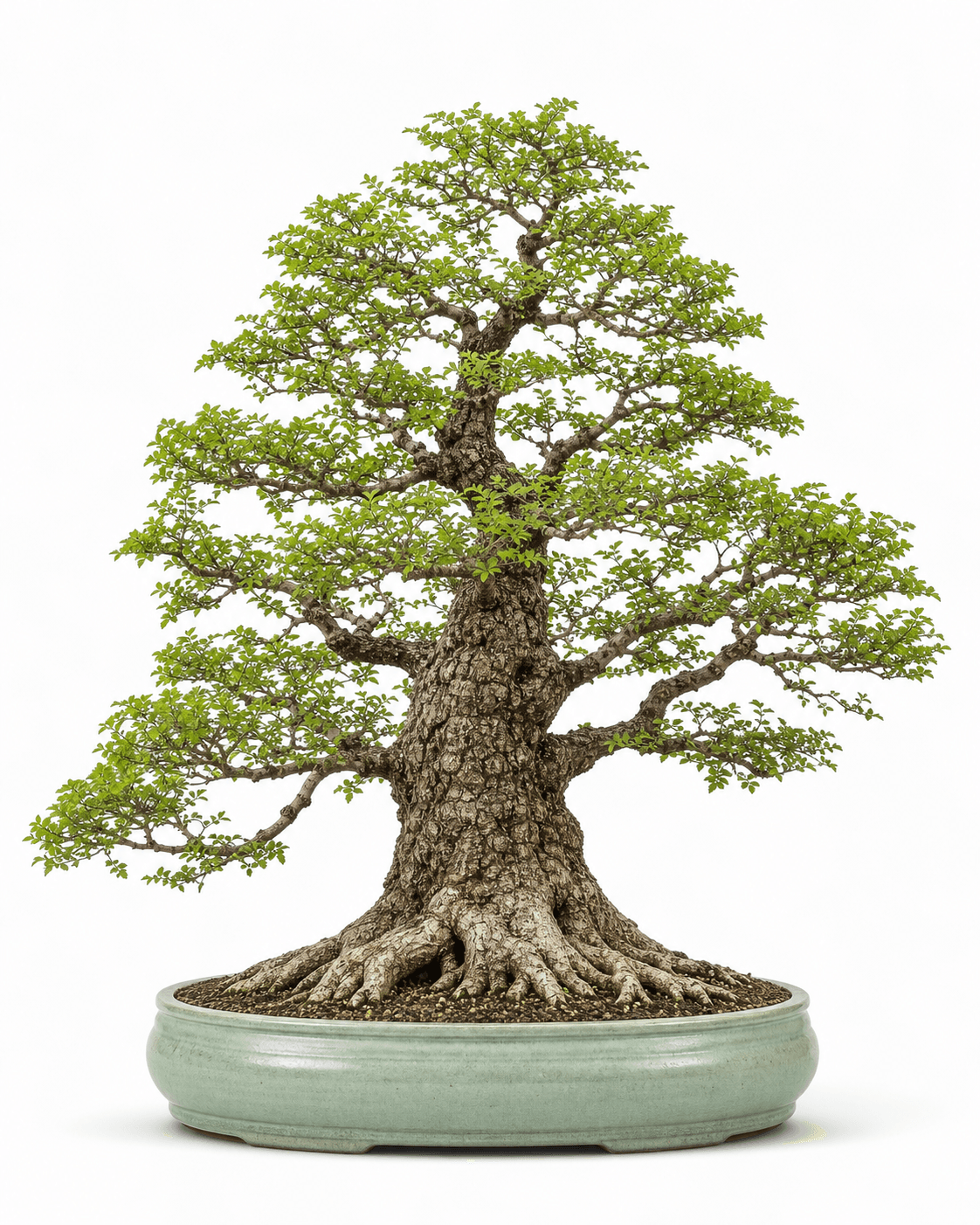
Chinese elm bonsai, Ulmus parvifolia, are forgiving because they are vigorous, small-leaved, heat tolerant, and quick to bud after correct pruning. They still decline when kept in dim warm rooms, stale root cores, or unchecked extension growth.
Grow Chinese elm as an outdoor deciduous or semi-deciduous broadleaf whenever possible. Use bright protected indoor winter culture only as a compromise, then time the main bonsai work around spring bud swell, first-flush hardening, midsummer refinement, and autumn vascular storage.
The local Mirai corpus has unusually direct Chinese elm coverage, including yatsubusa summer refinement, field-grown cork-bark structure, deciduous wiring, root-sheen care, and wound management. This guide prioritizes that methodology and uses Kew, NC State, and Oregon State for public taxonomy, hardiness, morphology, and cultivar grounding.
Updated July 5, 2026. Written by EntGrove Editorial. Last verified July 5, 2026.
Care fingerprint
Read the species through its shared care pattern.
Repot and structural prune around dormant-to-active transitions; protect new leaves; time refinement work after growth hardens. Use this as the starting point before local conditions and tree strength refine the calendar.
Read the foliage first
Broadleaf stress usually shows in leaf color, leaf size, wilt, scorch, or delayed hardening before it becomes a branch problem.
Match work to dormancy
Deciduous, evergreen, tropical, succulent, and flowering broadleaf trees recover on different calendars.
Protect fine roots
Root work should preserve enough active fine roots for the tree to rehydrate quickly after the operation.
Care cadence
The calendar starts with the tree's seasonal state.
Placement
Timing: Keep outside in full sun to partial shade through the growing season. Use bright, cool protection only when winter roots or retail acclimation require it.
Watch for: Long pale internodes, weak interior buds, sudden leaf drop after moves, and dry indoor air.
NC State ExtensionBonsai Mirai LibraryWatering
Timing: Water after the surface begins to dry, then wet the whole root mass. Adjust for leaf mass, pot depth, wind, heat, and substrate age.
Watch for: Water running around a hydrophobic core, sour organic soil, crisp leaves, marginal yellowing, or repeated wilt despite wet media.
Bonsai Mirai LibraryRepotting
Timing: Repot at spring bud swell or just as buds open, often later than maples because elms respond strongly to heat.
Watch for: Dense roots, compacted organic cores, lost percolation, weakened spring push, or damaged root sheen.
Bonsai Mirai LibraryPruning
Timing: Let shoots extend to 3 or 4 leaves and partly harden, then cut back to viable buds. Refined trees often take midsummer work after energy reaccumulates.
Watch for: Four-way junctions, inverse swelling, blind basal leaves, interior shade, and coarse unchecked runners.
Bonsai Mirai LibraryWiring
Timing: Wire healthy flexible branches selectively. Structural wire belongs on committed scaffolding, then gets checked within months during active thickening.
Watch for: Wire bite, gray bark splitting to green phloem during bends, trunk bark abrasion, and over-wired fine twigs.
Bonsai Mirai LibraryFertilizer
Timing: Feed to match the stage: stronger in development, moderate in secondary growth, and restrained in refinement after first flush hardens.
Watch for: Oversized first flush after heavy fall feeding, weak yellow margins, and pushing late growth too close to cold.
Bonsai Mirai LibraryPests
Timing: Inspect during indoor protection, humid still weather, and after stress. Public extension sources list elm insects and disease issues even though Chinese elm is disease resistant relative to many elms.
Watch for: Mites, scale, lace bugs, leaf beetles, powdery mildew, cankers, rots, leaf spots, and broad canopy yellowing.
NC State ExtensionBonsai Mirai LibrarySpecies guide
Apply the species profile before copying another tree's calendar.
At a glance
Chinese elm is the forgiving elm, but roots and timing still set the limit.
Chinese elm is Ulmus parvifolia in Ulmaceae, a small-leaved broadleaf tree known in bonsai as Chinese elm, lacebark elm, cork-bark Chinese elm, yatsubusa elm, Seiju, and Hokkaido. NC State describes the species as deciduous to semi-evergreen, fast growing, full sun to partial shade, and used in bonsai; Oregon State adds Zone 5 hardiness, late-summer flowers, fall samaras, and the common Siberian elm label confusion. NC State ExtensionOregon State Landscape Plants
For bonsai, the useful definition is practical: a vigorous outdoor deciduous broadleaf that can sometimes hold foliage or tolerate protected wintering when climate and pre-sale culture push it toward semi-evergreen behavior. It is forgiving because it buds readily, grows fast, and accepts repeated pruning, while its fine root sheen and dieback-prone elm wood still punish stale soil, heavy cuts, and poor timing. Bonsai Mirai Library
Beginners should grow it for light, roots, and cadence first. Full sun or bright outdoor light, thorough watering with oxygen return, spring root work only when the tree earns it, active-growth cutback, and frequent wire checks will solve more Chinese elm problems than any indoor care schedule. Bonsai Mirai LibraryNC State Extension
Wild habitat
Read the species from its East Asian, heat-tolerant, urban-adapted behavior.
NC State places Chinese elm in China, Korea, and Japan, while Oregon State gives northern and central China, Japan, and Korea. In landscape culture, both sources describe a broadleaf deciduous tree that tolerates sun, varied soils, urban conditions, and Dutch elm disease pressure better than many familiar elms. NC State ExtensionOregon State Landscape Plants
That ecological picture explains the bonsai margin. Chinese elm accepts heat, pruning, and urban stress better than zelkova or many native elms, but a bonsai pot removes deep soil buffering. A shallow container can turn a tolerant landscape tree into a daily water and oxygen problem. Bonsai Mirai LibraryOregon State Landscape Plants
Design should follow the species character: mottled or corky bark, small alternate leaves, quick extension, and rounded deciduous foliage masses. The tree can become formal broom, informal upright, forest, clump, or cork-bark trunk study, but it should still read as a broadleaf tree with upward and outward branch rhythm rather than conifer pad geometry. Bonsai Mirai / AsymmetryBonsai Mirai Library
Reading the tree
Separate development, secondary building, and refinement before you cut.
Mirai separates Chinese elm pruning by stage. Developmental elms carry longer growth because foliage builds girth, wounds, and vascular tissue. Secondary trees are cut earlier to redirect fewer branch tips. Refined trees can be worked later in midsummer after the spring flush hardens and stored energy has returned. Bonsai Mirai Library
A developing cork-bark elm can run longer because rough bark, strong budding, and active compartmentalization hide some scars and wire marks. A smooth-bark Chinese elm or tiny yatsubusa cultivar needs cleaner timing because marks, swelling, and awkward internodes remain visible. Bonsai Mirai Library
The most important visual reading is the junction. Four or more shoots from one point create inverse swelling. Reduce developing junctions to a main line and one useful secondary, or one dominant leader where the structure demands it, before the swelling becomes permanent. Bonsai Mirai Library
Pruning
Let Chinese elm extend, then cut back to real buds rather than pinching blindly.
Small-leaved deciduous species such as Chinese elm should usually extend 3 or 4 leaves and partially harden before cutback. Pinching tender tips too early can create multiple buds at one junction and build the whorls that later become knuckles. Bonsai Mirai Library
On refined Chinese elm, cut strong elongated shoots back to the first two fully formed leaves that have viable axillary buds. The first one or two leaves of a flush can be blind, so count from the first crotch that actually shows a bud rather than from the shoot base. Bonsai Mirai Library
Partial defoliation is leaf-size dependent. Small-leaf yatsubusa or Hokkaido type elms are often pruned only, with no leaf cutting. Larger-leaf or overly strong areas may need leaf-mass reduction after hardening so light, air, and energy move inward. Bonsai Mirai Library
After heavy thinning that exposes shaded bark and interior shoots, shift the tree to morning sun and afternoon shade for 6 to 8 weeks. Freshly exposed deciduous tissue can sunburn even when the species normally handles full sun. Bonsai Mirai Library
Roots
Protect the elm root sheen and repot when buds and drainage agree.
Mirai treats elm as a sheen-sensitive broadleaf deciduous species. The fine roots under the root flare govern water movement and branch stability. When that sheen degrades or is corrected too aggressively on a weak tree, branch shedding can follow even when the top work looked correct. Bonsai Mirai Library
Repot Chinese elm at spring bud swell or just as buds open. Elms respond to heat and often move later than maples, so the correct window is the tree waking, not the first warm weekend on the calendar. Bonsai Mirai Library
A healthy refined tree in a small pot may need review about every 2 years, but drainage, root density, substrate breakdown, and spring vigor decide. A root mass that resists a chopstick or sheds water around the edge needs a planned root session, not more surface watering. Bonsai Mirai Library
Treat coarse roots as branches at repot. Cut heavy roots back to finer secondary roots where possible, introduce taper early, and avoid tearing the fine root plate that powers the next flush. Bonsai Mirai Library
Soil and pot
Use depth and particle behavior to move water through the sheen.
Chinese elm needs aggregate soil that holds water without losing oxygen. Refined deciduous work can move toward akadama-led mixes because akadama supports fine ramification and nutrient exchange; recovery or field-dug material may begin in pumice-heavy media with fine particles retained around limited roots. Bonsai Mirai Library
Because elm health depends on the root sheen beneath the flare, pot depth can matter more than extra width. A slightly deeper deciduous container can drive water through the root plate and keep oxygen moving where a shallow wide pot may leave stale zones. Bonsai Mirai Library
Match the pot to the image. Glazed ovals and rectangles fit refined deciduous foliage and autumn color, while rough-bark cork forms can take quieter earthy glazes or unglazed warmth when the bark is the feature. Bonsai Mirai / AsymmetryBonsai Mirai Library
Climate
Chinese elm flexes by region, but bonsai roots still need protection.
In cold-winter regions, hardy outdoor Chinese elms need wind protection and root protection in bonsai pots. Retail trees imported or grown warm may behave semi-evergreen and should be hardened gradually rather than thrown into severe freeze exposure. NC State ExtensionBonsai Mirai Library
In mild and Mediterranean climates, the tree may keep leaves longer and push in irregular waves. Defer structural pruning if the tree is semi-active late in the year and a cold event is close, because late vascular disruption reduces winter margin. Bonsai Mirai Library
In hot climates, Chinese elm has a wider margin than many deciduous species, and yatsubusa forms show strong heat tolerance in the Mirai corpus. Heat tolerance still assumes root oxygen, adequate water, and restraint when a tree is shedding leaves to protect itself. Bonsai Mirai Library
Indoor culture should be framed as protection, not as the ideal growing environment. Bright cool wintering can preserve a tree that cannot safely freeze, while warm dim rooms produce long internodes, weak buds, stale wet soil, and pest pressure. Bonsai Mirai Library
Pests and diseases
Most pests follow stress, stale roots, or still indoor air.
NC State lists common elm insect and disease issues for Ulmus parvifolia and notes occasional wilts, rots, cankers, and leaf spots. It also describes resistance to Japanese beetles, elm leaf beetles, and Dutch elm disease, which should be read as useful resistance rather than immunity. NC State Extension
Powdery mildew on elm leaves usually signals poor airflow plus humidity. It can reduce photosynthesis without immediately killing the tree, but the correction is light, airflow, density control, and healthier timing rather than panic pruning. Bonsai Mirai Library
Spider mites, scale, lace bugs, and aphids become more likely under indoor protection, dry air, or stagnant benches. Check leaf undersides, dense forks, and sticky residue before blaming fertilizer or dormancy. NC State ExtensionBonsai Mirai Library
Broad yellowing across the canopy is more serious than a few yellow margins. Mirai links generalized yellowing to root-system trouble or locked-up nutrients, so inspect water penetration, soil smell, root oxygen, and irrigation quality before feeding heavily. Bonsai Mirai Library
Wiring
Wire structure, not every twig, and expect fast bite.
Deciduous wiring should preserve natural movement. Mirai uses structural wire to set the backbone, then pruning and selective guy-wire work to build finer ramification. Wiring every twig makes Chinese elm look mechanical and slows the growth you need. Bonsai Mirai LibraryBonsai Mirai / Asymmetry
On elm, bark beginning to split gray and show green phloem is the warning that a bend is near failure. Roll brittle deciduous branches through the bend instead of forcing a single crease, and stop before the tissue tears. Bonsai Mirai Library
Wire can bite into elm bark within 3 to 4 months in active growth. Rough cork-bark material may hide some scars, but smooth-bark Chinese elm and refined branches need earlier removal. Bonsai Mirai Library
Mature rough-bark trunks should not have wire run across them. Anchor discrete structural wires carefully and use the minimum contact needed to hold position. Bonsai Mirai Library
Propagation
Cuttings are easy; air layers are for design problems worth saving.
NC State lists seed as a propagation strategy for the landscape species. In bonsai practice, elm cuttings are the practical route for clones because small and even thumb-sized cuttings can root readily with mist, bottom heat, and a well-aerated medium. NC State ExtensionBonsai Mirai Library
Take cuttings during active growth when foliage is present, reduce water stress, and keep the medium humid but oxygenated. Larger cuttings require tighter heat and humidity control and should be treated as experiments. Bonsai Mirai Library
Air layers are useful when a swollen junction, inverse taper, or planned reduction can become a separate clump or small tree. High-quality layers may take more than one season because root distribution matters more than speed. Bonsai Mirai Library
Grafting is less common for ordinary Chinese elm care, but approach or thread grafting can solve missing branches on valuable trunks when cutback alone cannot place a bud where the design needs one. Bonsai Mirai Library
Buying
Buy the roots, label, and trunk base before the foliage.
Good starter material has confirmed Ulmus parvifolia identity, active buds, small leaves, visible root flare, manageable soil, lower branch options, and no irreversible inverse taper. Cork-bark and dwarf cultivars are valuable only when the base and roots are still usable. Oregon State Landscape PlantsBonsai Mirai Library
Reject vague elm labels until the plant is identified. Oregon State warns that Siberian elm, Ulmus pumila, is sometimes sold as Chinese elm. Zelkova is another common confusion. The care calendar changes when the species changes. Oregon State Landscape Plants
Nursery and landscape material can make excellent trunks, especially cork-bark forms, but inspect buried grafts, circling roots, old cuts, weak branch attachments, and urban-tree wood defects. NC State flags weak wood and self-seeding as landscape problems. NC State ExtensionBonsai Mirai Library
Retail indoor bonsai often arrive in compacted organic soil with a decorative top layer. Stabilize light and water first, then plan root correction at bud swell rather than tearing the tree apart during stress leaf drop. Bonsai Mirai Library
Troubleshooting
Diagnose the recent change before adding more work.
Chinese elm rebounds well when the cause is found early. Work backward through placement, water movement, root oxygen, pest pressure, recent pruning, and seasonal state before fertilizing or repotting. Bonsai Mirai Library
Design
Use the base, bark, and natural branch rhythm to choose the image.
Mirai design method starts with the base, trunk line, defining branch, and apex. On Chinese elm, the base and bark often decide whether the tree wants to be a refined broom, a rough informal upright, a clump, a forest, or a compact cork-bark study. Bonsai Mirai / AsymmetryBonsai Mirai Library
Deciduous branch architecture moves up and out when young, then drops and rounds at the tips with age. Lower branches can remain compact while upper zones carry more mass, which differs from pine-style lower-branch dominance. Bonsai Mirai Library
Rounded terminal foliage masses read older than pointed tips. In refinement, divide foliage at secondary branches into separate rounded zones so the tree feels larger and more mature. Bonsai Mirai Library
Deadwood should stay secondary. Chinese elm can carry old scars and hollows, especially rough-bark material, but the species value is bark, roots, twigging, seasonal leaf behavior, and branch rhythm. Bonsai Mirai / AsymmetryBonsai Mirai Library
Cultivars
Cultivar labels change scale, bark, and wiring margin.
Oregon State lists Hokkaido and Seiju as very small-leaved dwarf forms and notes Seiju corking with age. NC State lists Hakkaido and Seiju and broader landscape cultivars such as Allee, Athena, Bosque, Drake, Frosty, and Golden Ray. NC State ExtensionOregon State Landscape Plants
Yatsubusa and Hokkaido type elms can be flexible and small-leaved, which supports shohin-scale refinement and reduces the need for leaf cutting. Mirai also warns that yatsubusa roots can be tuberous, brittle, and lower-water-use than standard Chinese elm roots. Bonsai Mirai Library
Cork-bark forms forgive some visible scars but introduce bark-protection problems. Avoid running wire across mature bark, keep moss and black mold from decomposing the outer bark, and let bark character lead the design. Bonsai Mirai Library
History
Chinese elm became a beginner staple because it survives the learning curve.
The species is widely used in landscapes and bonsai because it adapts to sun, urban conditions, pruning, and disease pressure. NC State explicitly lists bonsai use, while Oregon State calls it a popular bonsai tree and explains the lacebark name as a way to separate Ulmus parvifolia from Siberian elm. NC State ExtensionOregon State Landscape Plants
Its beginner reputation should be understood as a margin, not as a license for poor culture. A Chinese elm can forgive a missed timing lesson, then teach the next one through leaf drop, water behavior, wire bite, root congestion, or swelling at a junction. Bonsai Mirai Library
Exhibition-quality Chinese elm is not casual. The refined standard asks for clean root flare, believable deciduous structure, fine twigging, controlled scars, visible seasonal character, and an image that still feels like an old broadleaf tree after the leaves drop. Bonsai Mirai / AsymmetryBonsai Mirai Library
Wounds
Elm cuts need stubs, paste, and patience around the collar.
Elms are dieback-prone after large cuts. Mirai recommends leaving a stub on major removals, letting the tree recede and compartmentalize, then refining the cut later rather than chasing immediately into the shoulder. Bonsai Mirai Library
On hard deciduous wood, a saw is often safer than concave cutters because crushed bark and shoulder tissue can force dieback past the intended collar. Seal fresh cuts promptly to protect moisture and support callus formation. Bonsai Mirai Library
If an old callus stalls over dried porous wood, winter wound rehabilitation may include cleaning the surface to solid wood, filling a slightly concave scaffold, and reopening the cambium edge with paste. This belongs on valuable wounds, not routine pruning cuts. Bonsai Mirai Library
Species questions
Answer the beginner questions before styling.
Can Chinese elm bonsai live indoors?
Chinese elm can tolerate bright protected indoor wintering better than many temperate bonsai, especially when the tree was sold as semi-evergreen retail stock. It grows stronger outdoors with more light, airflow, and seasonal cues.
Why is my Chinese elm bonsai losing leaves?
Leaf drop can follow autumn dormancy, a move, temperature swings, low indoor light, drought, stale roots, or pests. Stabilize placement and watering, inspect for mites or scale, and wait for new growth before major work.
When should I repot a Chinese elm bonsai?
Repot healthy Chinese elm bonsai at spring bud swell or just as buds open, often later than maples because elms respond to heat. Young vigorous trees may need review about every 2 years, but drainage and root condition decide.
How often should I prune Chinese elm bonsai?
During strong growth, let shoots extend to 3 or 4 leaves and partly harden, then cut back to viable buds. Refined trees may take midsummer cutback, while weak indoor trees need vigor before pruning.
Should I pinch Chinese elm bonsai?
Use pinching sparingly. Mirai favors letting small-leaf deciduous shoots extend and harden before cutback because early pinching can create too many buds at one junction and build swelling.
What soil is best for Chinese elm bonsai?
Use an oxygen-rich aggregate. Refined trees can move toward akadama-led deciduous soil, while collected or recovery trees may need pumice-heavy media until fine roots rebuild.
Is Chinese elm the same as Siberian elm or zelkova?
No. Chinese elm in bonsai usually means Ulmus parvifolia. Siberian elm is Ulmus pumila, and zelkova is Zelkova serrata. Retail labels can blur them, so verify the plant before applying a care calendar.
When should I wire Chinese elm bonsai?
Wire healthy flexible branches when structure needs setting, then check often. Elm can thicken enough for wire bite within 3 to 4 months during active growth.
Can I defoliate Chinese elm bonsai?
Use leaf work only on healthy trees after the first flush hardens. Small-leaf yatsubusa or Hokkaido type elms often need cutback only, while larger leaves may justify partial defoliation in strong areas.
Is Chinese elm good for beginners?
Yes, especially for outdoor growers. It is one of the better first deciduous bonsai because it is vigorous and responsive, but it still needs bright light, correct watering, root oxygen, and timely pruning.
Sources
Species advice needs source discipline.
Next decisions
Plan the operation before copying the calendar.
A good care note for Chinese elm records the tree's stage, the work done, and the aftercare used. That record matters more than a month-name rule.
Related species
Compare nearby trees before transferring advice.
Japanese maple
Acer palmatum
Trident maple
Acer buergerianum
Amur maple
Acer tataricum subsp. ginnala
Field maple
Acer campestre
Korean hornbeam
Carpinus turczaninovii