
Species guide
Chinese Privet Bonsai Care
Ligustrum sinense
Chinese privet bonsai should be treated as fast outdoor broadleaf evergreen hedge stock with spring root work, post-harden pruning, generous water in heat, and strict flower or fruit control. The plant is forgiving in a pot, yet Ligustrum sinense is invasive in many eastern and southern U.S. landscapes, so containment is part of the care plan.
Use Ligustrum sinense as the accepted name and normalize the common trade spelling Ligustrum sinensis to that record. The tree can behave evergreen, semi-evergreen, or partly deciduous depending on winter exposure, so judge the actual tree before pruning, repotting, or diagnosing winter leaf drop.
The local Mirai corpus has one direct Ligustrum substrate claim and no dedicated Chinese-privet class. This guide transfers Mirai broadleaf-evergreen method transparently, then grounds identity, USDA hardiness, fruit spread, pests, toxicity, and regional risk in Kew, NC State Extension, and Mississippi State Extension.
Updated June 15, 2026. Written by EntGrove Editorial. Last verified June 15, 2026.
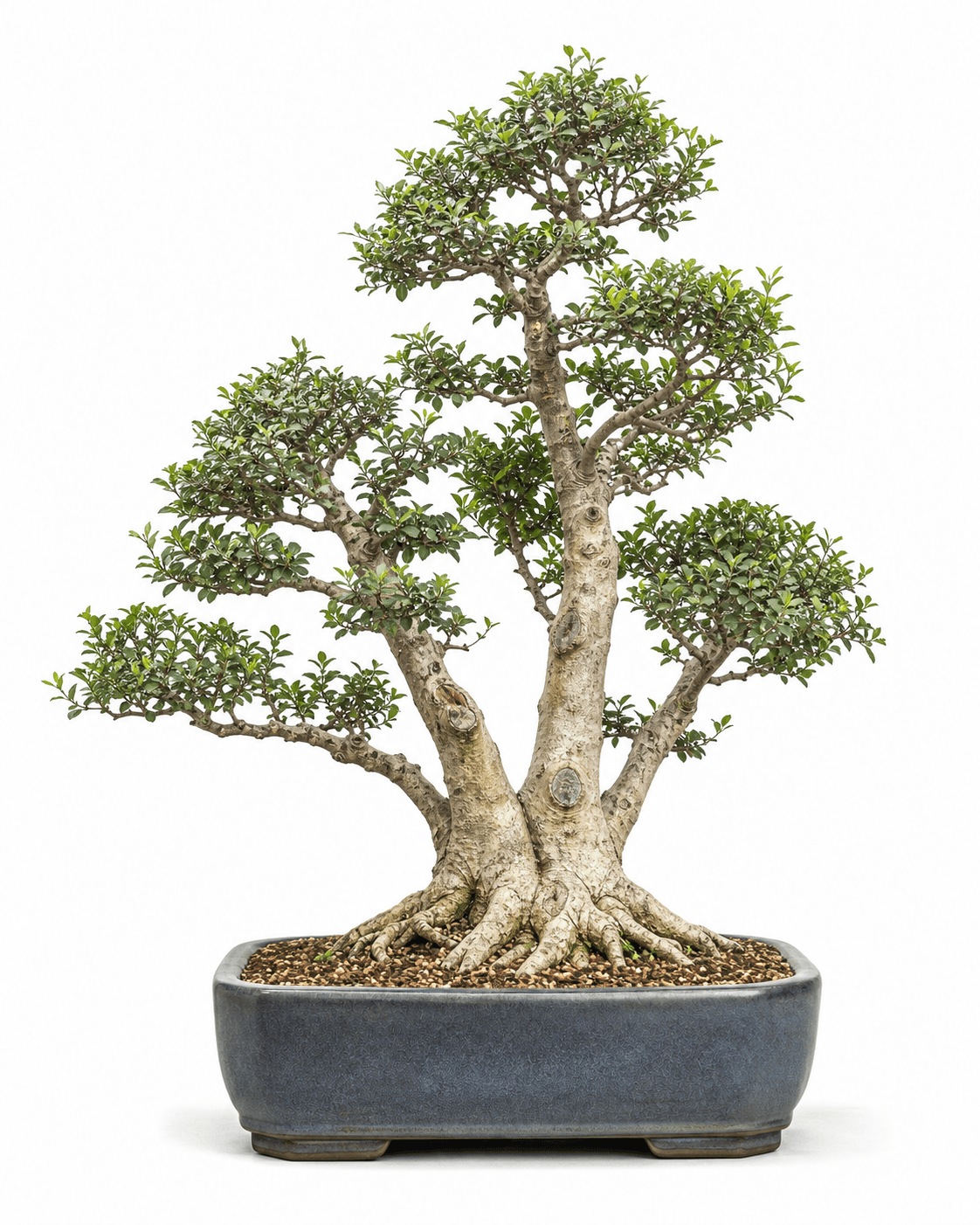
Care fingerprint
Read the species through its shared care pattern.
Protect from hard freezes when species demands it, prune with active foliage in mind, and repot when roots can recover without dormancy cues. Use this as the starting point before local conditions and tree strength refine the calendar.
Note: Invasive in much of the eastern and southern United States; keep bonsai material contained and prevent fruit or root spread where it can escape.
Read the foliage first
Broadleaf stress usually shows in leaf color, leaf size, wilt, scorch, or delayed hardening before it becomes a branch problem.
Match work to dormancy
Deciduous, evergreen, tropical, succulent, and flowering broadleaf trees recover on different calendars.
Protect fine roots
Root work should preserve enough active fine roots for the tree to rehydrate quickly after the operation.
Care cadence
The calendar starts with the tree's seasonal state.
Placement
Timing: Grow outside in full sun to partial shade. Buffer container roots during severe freezes, especially in Zones 6 and 7 or after recent root work.
Watch for: Long internodes in shade, leaf scorch after abrupt exposure changes, root damage that appears after spring growth starts, and fruiting trees near natural areas.
NC State ExtensionBonsai Mirai LibraryMississippi State ExtensionWatering
Timing: Water the whole root mass when the surface and visible particles begin to dry. Large leaf mass, hot wind, and shallow pots can raise demand quickly.
Watch for: Water bypassing a compacted field core, yellow leaves with wet soil, wilt after hot wind, and repeated light sprinkling that never saturates the pot.
Bonsai Mirai LibraryFeeding
Timing: Feed strongly in trunk and branch development after growth confirms root function. In refinement, feed lightly after the first flush hardens and again in fall.
Watch for: Long internodes, oversized leaves, soft late growth before frost, fertilizer applied too soon after repotting, and starving a tree under repeated pruning.
Bonsai Mirai LibraryPruning
Timing: Let shoots extend and harden, then prune back to interior buds. Use harder structural cuts near spring push on healthy trees, then refine after growth hardens.
Watch for: A clipped outer shell, shaded interior buds, swollen junctions from too many shoots, and flower panicles left where seed spread matters.
Bonsai Mirai LibraryNC State ExtensionFlower and fruit control
Timing: Remove flower panicles before fruit sets in invasive regions. If bloom is intentionally kept for display, strip developing fruit before birds can move it.
Watch for: Black fruit, fallen berries in bench gravel, dumped clippings, root suckers, and local regulations that restrict possession, sale, or transport.
NC State ExtensionMississippi State ExtensionWiring
Timing: Wire young or semi-hardened shoots after the flush firms. Use pruning, replacement shoots, and guy wires for older branches.
Watch for: Wire bite hidden by leaves, bark scuffing, old branch shoulders that crack, and over-wired fine twigging that would respond better to cutback.
Bonsai Mirai LibraryBonsai Mirai / AsymmetryRepotting
Timing: Repot in spring as buds swell. Convert old hedge soil in stages, anchor firmly, and shelter from wind until water uptake is stable.
Watch for: Aggressive bare-rooting on weak evergreen material, combining severe root work with severe top reduction, and ignoring an anaerobic core because the rim drains.
Bonsai Mirai LibraryPests and disease
Timing: Inspect during warm growth, after hedge collection, and before placing new material near a collection. Dense foliage hides pests and disease.
Watch for: Aphids, scale, whiteflies, weevils, leaf miners, thrips, leaf spot, anthracnose, twig blight, cankers, mildew, wilt, root rot, and rust mites.
NC State ExtensionSourcing
Timing: Use legal removals and contained nursery material. Choose by base, roots, leaf scale, low buds, clean foliage, and a clear disposal plan.
Watch for: Viable berries, buried hedge bases, suckering roots, unlabeled privet stock, regulated regions, field soil that sheds water, and pest-heavy thickets.
NC State ExtensionMississippi State ExtensionBonsai Mirai / AsymmetrySpecies guide
Apply the species profile before copying another tree's calendar.
At a glance
Chinese privet is easy to train and serious to contain.
Chinese privet is Ligustrum sinense, a fast Oleaceae shrub or small tree with opposite leaves, white spring flowers, and dark fruit. NC State lists it as evergreen to semi-evergreen and places it in USDA Zones 6a to 9b. Kew POWONC State Extension
The bonsai appeal is practical: small leaves, fast thickening, strong back-budding from hedge stock, and quick feedback from pruning. The tradeoff is environmental: flowers and fruit can make a container tree a seed source in regions already fighting privet thickets. NC State ExtensionMississippi State Extension
The source-depth caveat should stay visible. Mirai has direct Ligustrum substrate evidence and strong broadleaf-evergreen method, while Kew, NC State, and Mississippi State supply the species-specific identity, hardiness, flower, fruit, pest, toxicity, and invasive-risk details. Bonsai Mirai LibraryKew POWONC State ExtensionMississippi State Extension
Habitat
Read it as a shade-tolerant edge shrub with bird-moved fruit.
Kew gives the native range as China to Vietnam and Taiwan. In the southeastern United States, Mississippi State describes Chinese privet as a non-native plant that invades disturbed areas, stream corridors, forests, pastures, fields, and rights of way. Kew POWOMississippi State Extension
That ecology explains the care. A plant that tolerates sun, partial shade, repeated cutting, and disturbed ground does not need pampering in a pot. It needs oxygenated roots, strong light, repeated pruning, and enough recovery time between major operations. NC State ExtensionMississippi State ExtensionBonsai Mirai Library
For design, the wild habit points toward edited hedge, clump, broom, old stump, and small broadleaf tree images. Dense uniform shearing hides the trunk and repeats the invasive thicket habit; open branch exits and visible negative space make the same material look intentional. Bonsai Mirai / AsymmetryNC State Extension
For stewardship, fruit is the central fact. NC State says the purple drupe is eaten by birds and mammals, and Mississippi State identifies wildlife seed movement as a major dispersal path. A bonsai grower should prevent fruit where escape risk exists. NC State ExtensionMississippi State Extension
Reading the tree
Confirm the species, then choose work from vigor and season.
Start with the name. Kew accepts Ligustrum sinense Lour.; EntGrove treats Ligustrum sinensis as a spelling to normalize, then separates Chinese privet from glossy privet, California privet, Japanese privet, common privet, waxleaf privet, and north privet hybrids. Kew POWONC State Extension: Ligustrum lucidumKew POWO: Ligustrum ovalifolium
Then read winter behavior. NC State describes Chinese privet as evergreen or semi-evergreen, while Mirai broadleaf-evergreen method recognizes that some species shift leaf retention by winter temperature. A partially bare winter tree can be normal if buds and cambium are alive. NC State ExtensionBonsai Mirai Library
Finally read stage. Development material needs extension, root conversion, trunk selection, and branch placement. Refined material needs lighter feeding, first-flush patience, post-harden cutback, interior light, and fruit control. Bonsai Mirai Library
Pruning
Use hedge vigor without making a clipped shell.
Mirai broadleaf-evergreen refinement accepts that retained foliage drives a coarse first flush. Let that flush extend and harden back to an energy-positive state, then prune to useful interior buds for the next, finer flush. Bonsai Mirai Library
Chinese privet is fast enough that pruning has to be selective. Cut to branch structure, preserve weak interior shoots that are still feeding the branch, and reduce crowded nodes to two useful shoots before swelling becomes a design flaw. Bonsai Mirai LibraryNC State Extension
Flower pruning is part of containment. If bloom has no specific display purpose, remove flower panicles before fruit forms. If flowers are shown, return immediately after display and strip developing fruit before birds, benches, or compost move seed. NC State ExtensionMississippi State Extension
Routine full defoliation should be conditional. Mirai reserves broadleaf-evergreen defoliation for vigorous trees with active tips, and repeated annual defoliation weakens trees. Small-leaved Chinese privet usually refines well through light, feeding restraint, and post-harden cutback. Bonsai Mirai Library
Roots
Repot in spring and fix old hedge soil before refinement.
Use spring bud-swell as the default root-work window. Mirai broadleaf-evergreen method places repotting in spring, when the tree can move stored energy toward new roots and retained foliage can support recovery. Bonsai Mirai Library
Old hedge removals can carry a compacted clay or organic core that water skirts around. The first repot should restore water entry and oxygen by correcting the surface, sides, bottom, and problem pockets without stripping a weak evergreen root mass all at once. Bonsai Mirai LibraryNC State Extension
Do not stack major stress. A first severe root reduction, a hard trunk chop, and heavy foliage removal in the same season can exhaust even vigorous privet. Sequence the work so the tree proves root function before the next big cut. Bonsai Mirai Library
After repotting, anchor the tree firmly, chopstick mineral soil into all voids, water thoroughly, shelter from wind, and withhold fertilizer until strong foliar growth confirms new root production. Bonsai Mirai Library
Soil and pot
Use mineral soil that can handle speed and oxygen demand.
Mirai has a direct Ligustrum note supporting 100 percent akadama. That is the high-refinement choice when the tree is established, akadama quality is reliable, and the grower can water accurately. Bonsai Mirai Library
For development, old hedge conversion, humid summers, or uncertain field soil, a 1:1:1 akadama:pumice:lava mix gives more structural air and drainage margin. Increase pumice when root rot, stale organic soil, or wet winters are the main risk. Bonsai Mirai LibraryNC State Extension
Pot choice should support a broadleaf hedge-origin image. Muted glazed ovals, quiet rectangles, and deeper training pots suit vigorous roots and small evergreen leaves while the root pad is being built. Bonsai Mirai / Asymmetry
A shallow show pot should come after root domestication. If water enters unevenly or the tree dries unpredictably, use a deeper training container until fine roots occupy the full soil column. Bonsai Mirai Library
Climate
Protect the pot, then obey local invasive rules.
NC State lists Zones 6a to 9b, but container roots lose buffering faster than landscape shrubs. In colder parts of the range, use a cold frame, sheltered bench, or unheated structure before severe freeze and wind exposure damage the root system. NC State ExtensionBonsai Mirai Library
Warm regions create a different problem. The tree can grow, flower, and fruit readily, and Mississippi State notes that Chinese privet is on every southeastern state invasive list. Remove reproductive material before it becomes a landscape problem. NC State ExtensionMississippi State Extension
Semi-evergreen behavior changes by winter. Mild climates may keep leaves, while exposed cold containers can shed foliage. Wait for bud condition and cambium color before assuming a leafless winter branch is dead. NC State ExtensionBonsai Mirai Library
Regulations vary. Before buying, selling, transporting, or gifting Chinese privet, check local invasive-plant restrictions. Removal material can be valuable bonsai stock, but the disposal path matters as much as the trunk. Mississippi State ExtensionNC State Extension
Pests and diseases
Fast growth hides pests until the canopy is opened.
NC State lists whiteflies, Japanese and Ligustrum weevils, white peach scale, and privet rust mites as common insect problems. Dense evergreen growth can hide them under leaves and in twig forks. NC State Extension
The same source lists anthracnose, twig blight, cankers, powdery mildew, leaf spots, wilt, and root rot. Diagnosis should begin with recent pruning, airflow, drainage, old soil, and whether the tree was collected recently. NC State ExtensionBonsai Mirai Library
Pest treatment should precede styling. Wash foliage, identify the pest, restore airflow, and delay wiring or heavy pruning until clean extension returns. A vigorous plant can still decline when roots and foliage are stressed together. NC State ExtensionBonsai Mirai Library
NC State also flags toxicity concerns for humans and pets. Keep fruit and clippings away from children, dogs, and compost streams where viable seed can spread. NC State ExtensionMississippi State Extension
Wiring
Wire young shoots, then let pruning build the old branch.
Mirai structural wiring method still applies: wire should contact the branch evenly at roughly 55 to 60 degrees, hold the bend, and avoid constricting growth. On fast privet, inspection matters because thickening can bury wire quickly. Bonsai Mirai Library
Young or semi-hardened shoots are the best candidates. Older hedge branches are often cleaner with clip-and-grow, replacement shoots, or guy wires because a forced bend can crack the shoulder or leave scars. Bonsai Mirai LibraryBonsai Mirai / Asymmetry
Thin enough foliage to see the branch line before wiring, while preserving weak interior leaves that still feed future cutback points. The goal is a visible broadleaf skeleton, not a surface-level green mass. Bonsai Mirai Library
Wire work belongs after root function is stable. A collected privet that is still rebuilding roots should spend the first season growing, not carrying detailed wire across every twig. Bonsai Mirai Library
Propagation
Cuttings and layers preserve selected material; seed increases the risk problem.
Chinese privet produces abundant fruit, and that fruit is the species-management problem. In invasive regions, seed propagation is unnecessary and irresponsible when removal material, cuttings, or layers can supply bonsai stock. NC State ExtensionMississippi State Extension
Cuttings are the practical route for preserving a useful leaf scale, short internodes, or a legal removal selection. Mirai propagation method favors clean sharp cuts, controlled foliage mass, airy medium, and no fertilizer until roots are established. Bonsai Mirai Library
Air-layering can turn an old hedge branch into usable bonsai material when the base is poor. Choose the layer point by future nebari, trunk line, and first branch, then keep the moss oxygenated instead of constantly saturated. Bonsai Mirai LibraryBonsai Mirai / Asymmetry
Grafting rarely earns its complexity on ordinary Chinese privet because the species responds strongly to pruning and vegetative propagation. Use grafting only to solve a specific root or branch-placement problem. Bonsai Mirai / AsymmetryBonsai Mirai Library
Buying
Use removal material first, and check legality before trading it.
The strongest ethical source is legal removal from a landscape or thicket where Chinese privet is already a problem. Old stumps can offer base flare, taper, low buds, and trunk character that young nursery liners lack. Mississippi State ExtensionBonsai Mirai / Asymmetry
Inspect the base, root spread, bark, low branch origins, interior buds, and leaf scale. Avoid material with viable fruit, unknown Latin identity, severe pests, rotten old cores, or a root mass that water cannot enter. NC State ExtensionBonsai Mirai Library
Confirm local rules before buying, selling, gifting, or transporting it. A trunk is valuable only if moving it does not spread seed, roots, berries, or contaminated soil into a new site. Mississippi State ExtensionNC State Extension
If you can choose among privets, Chinese privet has a smaller-leaf bonsai case than glossy privet, while California privet has a different cold and naturalizing profile. Keep the tag and source history with the tree. NC State ExtensionNC State Extension: Ligustrum lucidumMissouri Botanical Garden: Ligustrum ovalifolium
Troubleshooting
Diagnose Chinese privet by roots, light, pruning shell, pests, and fruit.
Symptom: long shoots and coarse leaves. Likely cause: shade, too much nitrogen during refinement, or constant surface clipping. Fix: increase light gradually, feed lightly, and prune after hardening to interior buds. NC State ExtensionBonsai Mirai Library
Symptom: yellow leaves with wet soil. Likely cause: stale old soil, root rot, poor oxygen, or water bypassing a compacted core. Fix: inspect drainage, open the surface, and plan spring root correction. NC State ExtensionBonsai Mirai Library
Symptom: sticky leaves, white insects, stippling, or distorted tips. Likely cause: whiteflies, scale, rust mites, aphids, or weevils. Fix: isolate, wash, identify the pest, and pause styling. NC State Extension
Symptom: powdery coating, twig dieback, or spotted leaves. Likely cause: powdery mildew, anthracnose, twig blight, cankers, dense foliage, or weak roots. Fix: thin for airflow, remove infected tissue, and restore root vigor. NC State ExtensionBonsai Mirai Library
Symptom: black fruit forming. Likely cause: flower panicles were left after bloom. Fix: remove fruit before wildlife moves it, clean the bench, and prune reproductive shoots earlier next cycle. NC State ExtensionMississippi State Extension
Symptom: spring growth starts and then collapses. Likely cause: winter container root injury that appears when new leaves demand water. Fix: protect roots earlier next winter and delay pruning until recovery growth is clear. Bonsai Mirai Library
Design
Make the common hedge origin feel deliberate.
Start with base, trunk line, defining branch, and apex. Chinese privet is common material, so the design has to edit strongly: keep the best trunk, remove duplicate shoots, and make each branch exit readable. Bonsai Mirai / Asymmetry
Its small leaves make smaller bonsai possible, but the tree still needs open branch spacing. A tight hedge wall makes the trunk disappear, while a broom, clump, informal upright, or multi-trunk image can carry the species naturally. NC State ExtensionBonsai Mirai / Asymmetry
Old removal material often brings scars, cut stubs, suckers, and basal shoots. Use those features as age cues only when they support the trunk line; otherwise remove them before they create inverse taper or thicket clutter. Mississippi State ExtensionBonsai Mirai Library
Deadwood should stay restrained. Smooth young bark, fast callus, cut-back hedge history, and fine twigging usually tell the broadleaf story better than carved bright wood. Bonsai Mirai / Asymmetry
Cultivars and forms
Cultivar color is secondary to identity, vigor, and fruit control.
NC State lists Sunshine, Swift Creek, and Variegatum as Chinese privet cultivars or varieties. Yellow or variegated foliage can help identification, but it often competes with the quiet age image bonsai needs. NC State Extension
Plain green material is usually the development default because branch structure, root quality, leaf size, and containment matter more than color. A weak variegated plant with poor roots is a slow project even when the foliage is distinctive. Bonsai Mirai / AsymmetryNC State Extension
Record the full label through repotting. Chinese privet, generic privet, Ligustrum sinensis, Sunshine, Swift Creek, Variegatum, and small-leaved privet labels should all be checked against the actual plant and local restrictions. Kew POWONC State Extension
Also separate Chinese privet from glossy privet, California privet, Japanese privet, common privet, waxleaf privet, and north privet hybrids. Genus-level care overlaps, while hardiness, leaf scale, invasive status, and fruit risk remain species-specific. NC State ExtensionNC State Extension: Ligustrum lucidumMissouri Botanical Garden: Ligustrum ovalifolium
History
Its bonsai value comes from transforming a problem shrub into controlled material.
Chinese privet was introduced as an ornamental shrub, then escaped into warm-temperate landscapes where it forms dense thickets. Mississippi State frames it as one of the most serious invasive shrubs in the Southeast. Mississippi State Extension
That history makes bonsai use different from collecting a rare native tree. Good material often comes from removal work, and the act of training it is most defensible when the plant is already being removed from a place where it harms habitat. Mississippi State ExtensionBonsai Mirai / Asymmetry
The public bonsai pedigree is modest compared with maple, pine, juniper, azalea, or boxwood. Chinese privet earns its place as teaching material: cheap, fast, small-leaved, responsive, and honest about the discipline required to keep common material from looking common. Bonsai Mirai LibraryBonsai Mirai / Asymmetry
A strong exhibited Chinese privet should show clean roots, no viable fruit, pest-free foliage, open branch exits, controlled leaf size, and a design that reads as a miniature broadleaf tree rather than a clipped hedge. Bonsai Mirai / AsymmetryNC State Extension
Species questions
Answer the beginner questions before styling.
Is Chinese privet a good beginner bonsai?
Yes for contained outdoor pot culture with strong light, regular pruning, and fruit control. The horticulture is forgiving; the stewardship requirement is serious because it is invasive in many regions.
Can Chinese privet bonsai live indoors?
Use outdoor culture as the baseline. Brief indoor display is fine, and protected winter shelter can be useful, but long-term warm dim indoor culture weakens light, airflow, seasonal rhythm, and root health.
Is Chinese privet invasive?
Yes in much of the eastern and southern United States. Keep it contained, remove flowers or berries before seed can spread, dispose of clippings carefully, and follow local invasive-plant rules.
How much sun does Chinese privet bonsai need?
Give full sun to partial shade. Strong outdoor light keeps internodes shorter, while recently repotted or shallow-potted trees may need afternoon protection during heat.
How often should I water Chinese privet bonsai?
Water by root-zone condition, not by a weekly rule. Water thoroughly when the surface begins to dry, then let oxygen return before the next watering.
When should I repot Chinese privet bonsai?
Repot in spring as buds swell. Inspect vigorous hedge-stock annually, then repot when roots are dense, water entry slows, old soil breaks down, or the tree needs a container transition.
When should I prune Chinese privet bonsai?
Let shoots extend and harden, then prune back to interior buds. Use harder structure cuts near spring push on healthy trees, and remove flower panicles early where seed spread matters.
Can I wire Chinese privet branches?
Yes, especially young or semi-hardened shoots. Check often because fast growth can bite wire quickly, and use clip-and-grow or guy wires for older hedge branches.
What soil is best for Chinese privet bonsai?
Mirai has direct Ligustrum evidence for 100 percent akadama. During development or old hedge conversion, a 1:1:1 akadama:pumice:lava mix gives more oxygen and drainage margin.
Should Chinese privet bonsai be allowed to flower?
Only with a containment plan. In invasive regions, remove flowers before fruit forms, or remove fruit immediately after display so birds, benches, compost, or yard waste cannot move seed.
Sources
Species advice needs source discipline.
Next decisions
Plan the operation before copying the calendar.
A good care note for Chinese privet records the tree's stage, the work done, and the aftercare used. That record matters more than a month-name rule.
Related species
Compare nearby trees before transferring advice.
English boxwood
Buxus sempervirens
Japanese boxwood
Buxus microphylla
Korean boxwood
Buxus sinica var. insularis
English holly
Ilex aquifolium
Japanese holly
Ilex crenata